April 7

What was advertised in a colonial American newspaper 250 years ago today?

Supplement to the South-Carolina Gazette and Country Journal (April 7, 1772).

“A variety of other articles too tedious to enumerate.”

In the spring of 1772, an advertiser who identified himself simply as “STUKES” (almost certainly William Stukes) advised readers of the South-Carolina Gazette and Country Journal that he imported and sold a “COMPLEAT assortment of millinary, haberdashery, [and] stationary” and “As compleat and large an assortment of RIBBONS as ever was imported into this province at one time.”  As further evidence of the bounty available at his shop, he listed dozens of textiles, garments, and accessories.  Stukes stocked everything from “new fashioned flowered Leghorn hats” to “Ladies Morocco pocket books … with silver French locks” to “fine white linen gloves” to “fashionable fans.”  Like many other eighteenth-century advertisers, he expected such a vast array of choices to entice consumers.

Yet he did not want to overwhelm prospective customers by committing too much to print (or he did not want to pay for additional space that a longer list would occupy in the newspaper).  He concluded his litany of goods with a note that he carried “a variety of other articles too tedious to enumerate.”  Where did Stukes draw the line?  Giving only his last name amounted to an economy of prose, but the lengthy list of goods certainly did not.  Only two other shopkeepers placed advertisements listing a similar number of items in the April 7, 1772, edition of the South-Carolina Gazette and Country Journal.  Stukes apparently did not consider the “blue satin hats” and the “wax ear-rings” and the “Barcelona cravats” and the “womens black calamanco pumps” in his notice to be “too tedious to enumerate” as he competed to attract customers by demonstrating the choices available at his shop.  Proclaiming that listing anything more would become “tedious” was a sly way of encouraging prospective customers to imagine for themselves what else they might discover in Stukes’s shop.  He gained the advantage of cataloging his wares in the public prints while simultaneously suggesting that he exercised restraint in how much he shared about his merchandise.

Slavery Advertisements Published April 7, 1772

GUEST CURATOR: Drew Nunnemacher

The Slavery Adverts 250 Project chronicles the role of newspaper advertising in perpetuating slavery in the era of the American Revolution. The project seeks to reveal the ubiquity of slavery in eighteenth-century life from New England to Georgia by republishing advertisements about enslaved people – for sale as individuals or in groups, wanted to purchase or for hire for short periods, runaways who liberated themselves, and those who were subsequently captured and confined in jails and workhouses – in daily digests on this site as well as in real time via the @SlaveAdverts250 Twitter feed, utilizing twenty-first-century media to stand in for the print media of the eighteenth century.

The project aims to provide modern audiences with a sense of just how often colonizers encountered these advertisements in their daily lives. Enslaved men, women, and children appeared in print somewhere in the colonies almost every single day. Those advertisements served as a constant backdrop for social, cultural, economic, and political life in colonial and revolutionary America. Colonizers who did not purport to own enslaved people were still confronted with slavery as well as invited to maintain the system by purchasing enslaved men, women, and children or assisting in the capture of so-called “runaways” who sought to free themselves from bondage. The frequency of these newspaper advertisements suggests just how embedded slavery was in colonial and revolutionary American culture in everyday interactions beyond the printed page.

These advertisements also testify to the experiences of enslaved men, women, and children, though readers must consider that those experiences have been remediated through descriptions offered by enslavers rather than enslaved people themselves. Often unnamed in the advertisements, enslaved men, women, and children were not invisible or unimportant in early America.

These advertisements appeared in colonial American newspapers 250 years ago today.

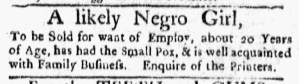
South-Carolina Gazette and Country Journal (April 7, 1772).

**********

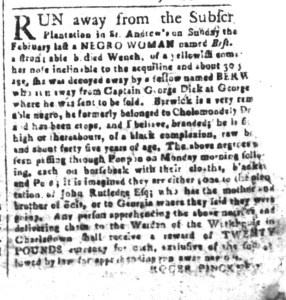
South-Carolina Gazette and Country Journal (April 7, 1772).

**********

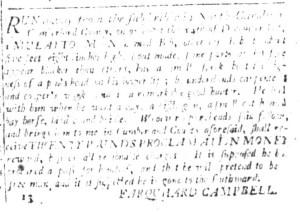
South-Carolina Gazette and Country Journal (April 7, 1772).

**********

South-Carolina Gazette and Country Journal (April 7, 1772).

**********

South-Carolina Gazette and Country Journal (April 7, 1772).

**********

South-Carolina Gazette and Country Journal (April 7, 1772).

**********

South-Carolina Gazette and Country Journal (April 7, 1772).

**********

South-Carolina Gazette and Country Journal (April 7, 1772).

**********

South-Carolina Gazette and Country Journal (April 7, 1772).

**********

South-Carolina Gazette and Country Journal (April 7, 1772).

**********

South-Carolina Gazette and Country Journal (April 7, 1772).

**********

South-Carolina Gazette and Country Journal (April 7, 1772).

**********

South-Carolina Gazette and Country Journal (April 7, 1772).

**********

Supplement to the South-Carolina Gazette and Country Journal (April 7, 1772).

**********

Supplement to the South-Carolina Gazette and Country Journal (April 7, 1772).

**********

Supplement to the South-Carolina Gazette and Country Journal (April 7, 1772).

**********

Supplement to the South-Carolina Gazette and Country Journal (April 7, 1772).

**********

Supplement to the South-Carolina Gazette and Country Journal (April 7, 1772).

**********

Supplement to the South-Carolina Gazette and Country Journal (April 7, 1772).

April 6

What was advertised in a colonial American newspaper 250 years ago today?

Boston Evening-Post (April 6, 1772).

“At the GOLDEN MORTAR … A compleat and fresh Assortment of Drugs & Medicines.”

Very few images appeared in the April 6, 1772, edition of the Boston Evening-Post.  The masthead ran on the first page, as usual, featuring a cartouche with an ornate border enclosing an image of a crown suspended over a heart.  Immediately below, the colophon stated that the newspaper was “Printed by THOMAS and JOHN FLEET, at the HEART and CROWN in Cornhill.”  Readers encountered only two other images in that issue, both of them adorning advertisements on the second page.  A woodcut depicting a ship at sea embellished a notice that announced the London would soon sail for London.  It helped draw attention to instructions for anyone interested in “Freight or Passage [to] apply to the Captain on board, or to Nath. Wheatley’s Store in King-Street.”

That woodcut belonged to the printers, Thomas Fleet and John Fleet.  The woodcut that accompanied Oliver Smith’s advertisement, however, did not.  It depicted a mortar and pestle, replicating Smith’s shop sign, “the GOLDEN MORTAR,” in the same way the image in the masthead represented the sign that marked the Fleets’ printing office.  The Fleets and other printers supplied a small number of woodcuts – ships at sea, houses, horses, enslaved people – for eighteenth-century advertisers to include in their newspaper notices.  If advertisers wished for specialized images associated exclusively with their businesses, they commissioned the woodcuts and provided them to the printers.  That also meant they could retrieve their woodcuts from one printing office and submit them to another.

Smith did so in the early 1770s.  His woodcut depicting a mortar and pestle enhanced an advertisement in the Massachusetts Gazette and Boston Weekly News-Letter in the fall of 1771.  More than half a year later, the same woodcut appeared in an advertisement in the Boston Evening-Post.  Not only did Smith attempt to widen his share of the market for “Drugs & Medicines” in Boston by advertising in multiple newspapers, he also sought to increase the visibility of the device associated with his shop.  The “GOLDEN MORTAR” served as a rudimentary trademark or brand that made his advertisements and his shop easy for consumers to identify.

Slavery Advertisements Published April 6, 1772

GUEST CURATOR: Drew Nunnemacher

The Slavery Adverts 250 Project chronicles the role of newspaper advertising in perpetuating slavery in the era of the American Revolution. The project seeks to reveal the ubiquity of slavery in eighteenth-century life from New England to Georgia by republishing advertisements about enslaved people – for sale as individuals or in groups, wanted to purchase or for hire for short periods, runaways who liberated themselves, and those who were subsequently captured and confined in jails and workhouses – in daily digests on this site as well as in real time via the @SlaveAdverts250 Twitter feed, utilizing twenty-first-century media to stand in for the print media of the eighteenth century.

The project aims to provide modern audiences with a sense of just how often colonizers encountered these advertisements in their daily lives. Enslaved men, women, and children appeared in print somewhere in the colonies almost every single day. Those advertisements served as a constant backdrop for social, cultural, economic, and political life in colonial and revolutionary America. Colonizers who did not purport to own enslaved people were still confronted with slavery as well as invited to maintain the system by purchasing enslaved men, women, and children or assisting in the capture of so-called “runaways” who sought to free themselves from bondage. The frequency of these newspaper advertisements suggests just how embedded slavery was in colonial and revolutionary American culture in everyday interactions beyond the printed page.

These advertisements also testify to the experiences of enslaved men, women, and children, though readers must consider that those experiences have been remediated through descriptions offered by enslavers rather than enslaved people themselves. Often unnamed in the advertisements, enslaved men, women, and children were not invisible or unimportant in early America.

These advertisements appeared in colonial American newspapers 250 years ago today.

Boston Evening-Post (April 6, 1772).

**********

New-York Gazette and Weekly Mercury (April 6, 1772).

**********

New-York Gazette and Weekly Mercury (April 6, 1772).

**********

New-York Gazette and Weekly Mercury (April 6, 1772).

**********

Supplement to the New-York Gazette and Weekly Mercury (April 6, 1772).

**********

Supplement to the New-York Gazette and Weekly Mercury (April 6, 1772).

**********

South-Carolina and American General Gazette (April 6, 1772).

**********

South-Carolina and American General Gazette (April 6, 1772).

**********

South-Carolina and American General Gazette (April 6, 1772).

**********

South-Carolina and American General Gazette (April 6, 1772).

**********

South-Carolina and American General Gazette (April 6, 1772).

**********

South-Carolina and American General Gazette (April 6, 1772).

**********

South-Carolina and American General Gazette (April 6, 1772).

**********

South-Carolina and American General Gazette (April 6, 1772).

**********

South-Carolina and American General Gazette (April 6, 1772).

**********

South-Carolina and American General Gazette (April 6, 1772).

**********

South-Carolina and American General Gazette (April 6, 1772).

**********

South-Carolina and American General Gazette (April 6, 1772).

**********

South-Carolina and American General Gazette (April 6, 1772).

**********

South-Carolina and American General Gazette (April 6, 1772).

**********

South-Carolina and American General Gazette (April 6, 1772).

April 5

What was advertised in a colonial American newspaper 250 years ago this week?

South-Carolina Gazette (April 2, 1772).

“Be very punctual in their Publications … and be particularly careful in circulating the Papers.”

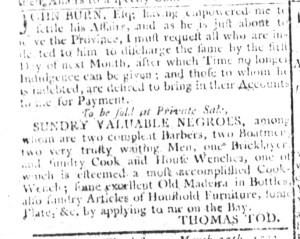
The first page of the April 2, 1772, edition of the South-Carolina Gazette consisted almost entirely of the masthead and advertisements placed by colonizers.  At the top of the first column, however, Peter Timothy, the printer, inserted his own notice before the “New Advertisements” placed by his customers.  In it, he announced that “my present State of Health will not admit of my continuing the PRINTING BUSINESS any longer.”  Effective on May 1, “Thomas Powell, Edward Hughes, & Co.” would “conduct and continue the Publication of this GAZETTE.”  Wishing for the success of his successors, Timothy assured readers that they could expect the same quality from the publication under new management that he had delivered “during the Course of Thirty-three Years.”  Picking up where he left off, the partners “will have the Advantage of an extensive and well established Correspondence” with printers and others who provided news.  In addition, Timothy declared that they would “be very punctual in their Publications—regular and exact in inserting the Prices Current—continue my Marine List—and be particularly careful in circulating the Papers.”

Timothy addressed subscribers and other readers when he mentioned the “Charles-Town Price Current” and “Timothy’s Marine List,” as the printer called his version of the shipping news obtained from the customs house.  In making promises about the punctually publishing newspapers and attending to their circulation, however, he addressed both readers and advertisers.  Colonizers who paid to insert notices wanted their information disseminated as quickly and as widely as possible, whether they encouraged consumers to purchase goods and services, invited bidders to attend auctions and estate sales, or offered rewards for the capture and return of enslaved people who liberated themselves.  Certainly subscribers wanted their newspapers to arrive quickly and efficiently, but Timothy understood the importance of advertising when it came to generating revenues.  After all, he devoted only five of the twelve columns in the April 2 edition to news (including the “Charles-Town Price Current” and “Timothy’s Marine List”) and the other seven to advertising.  In addition, he distributed a half sheet supplement, another six columns, that consisted entirely of advertising.  Paid notices accounted for just over two-thirds of the content Timothy disseminated on April 2, even taking his “extensive and well established Correspondence” into consideration.
As he prepared to pass the torch to Powell and Hughes, Timothy did not address advertisers directly, but he certainly addressed concerns that would have been important to them.  The South-Carolina Gazette competed with two other newspapers published in Charleston at the time.  Timothy sought to keep both subscribers and advertisers loyal to the publication he would soon hand over to new partners.

April 4

What was advertised in a colonial American newspaper 250 years ago today?

Providence Gazette (April 4, 1772).

“They have just opened a large and fine assortment of Spring and Summer Goods.”

Joseph Russell and William Russell were among the most prolific advertisers in the Providence Gazette in the late 1760s and early 1770s.  Two of the city’s most prominent merchants, the Russells generated significant advertising revenue for the printers of the Providence Gazette.  They sometimes ran multiple advertisements at once, especially when they received new shipments of imported goods via vessels arriving in port.  Even when the Russells were relatively quiet, they inserted a new advertisement approximately once a month or every six weeks.  In doing so, they maintained their visibility in the public prints much more consistently than their competitors.  That likely contributed to their prominence, both in the Providence and in other towns where the Providence Gazette circulated.

As part of their ongoing advertising campaign, the Russells inserted a new advertisement in the April 4, 1772, edition of the Providence Gazette.  It did not include much by way of prologue, sporting a headline that read, “To be Sold by JOSEPH & Wm. RUSSELL,” before listing a variety of goods in two columns.  The Russells apparently marketed items they previously had on hand or else they would have resorted to a convention adopted by many merchants and shopkeepers in their advertisements.  That standard format proclaimed that the advertisers had “just imported” certain goods and named the vessels and captains that transported them across the Atlantic.  Prospective customers could compare that information to the shipping news to determine how recently the merchandise made it to shops and stores.

Lacking such an introduction, the Russells’ advertisement suggested to readers that they had not just received the “Cream coloured plates and mugs,” “Brass kettles,” and “Looking glasses of all sizes.”  The advertisement concluded with a note that the merchants “have just opened a large and fine assortment of Spring and Summer Goods” for those who wished to peruse them, but savvy consumers realized that they would choose from among items imported during a previous season.  If the Russells had new goods recently delivered from England, they would have incorporated that information into their new advertisement.

April 3

What was advertised in a colonial American newspaper 250 years ago today?

Massachusetts Gazette and Boston Weekly News-Letter (April 3, 1772).

“Country Traders … may be supplied with all Kinds of Writing-Paper … at any Store in Town.”

John Fleeming published the Boston Chronicle in partnership with John Mein from 1767 to 1770.  That newspaper folded, in large part due to the blatant Tory sympathies espoused by Fleeming’s partner.  Mein fled Boston, leaving Fleeming to oversee the business for the few months that the newspaper continued publication in his absence.  With the Boston Chronicle behind him, Fleeming turned to job printing and selling stationery and writing supplies.  In the April 3, 1772, edition of the Massachusetts Gazette and Boston Weekly News-Letter, for instance, he advertised a “large Assortment of STATIONARY” that included “Writing Paper of all Kinds, Quills, Wax, Wafers, Ink-Chests & Stands of various Kinds, Ivory Folders, Leather Ink Bottles, Ink-Powder, and Patent Cake Ink.”

Fleeming hoped to encourage retail sales among residents of Boston who visited his shop, but he also made an appeal to “Country Traders and Shopkeepers” looking to make wholesale purchases.  He promised them that they “may be supplied with all Kinds of Writing-Paper by the Ream, as Cheap as at any Store in Town.”  Fleeming competed with a number of stationers who imported paper from England, especially after Parliament repealed the duties on paper and other items and merchants called an end to the nonimportation agreement adopted to achieve that goal.  Eager to maximize revenues, Fleeming aimed to attract wholesale as well as retail customers.

In so doing, he resorted to a familiar marketing strategy, one adopted by merchants who sold a variety of imported goods ranging from textiles to housewares to hardware to patent medicines.  Some advertised that they filled retail orders sent from colonizers in the countryside.  Others did not work directly with consumers outside of Boston, but that did not mean that they neglected to capture wider markets as wholesalers.  Merchants frequently assured “Country Traders” that they offered the best bargains, allowing them to generate sales by passing along the savings to their customers.  By modern standards, Fleeming’s advertisement may not appear flashy, but that does not mean that it lacked a sound marketing strategy in the eighteenth century.

Slavery Advertisements Published April 3, 1772

GUEST CURATOR: Drew Nunnemacher

The Slavery Adverts 250 Project chronicles the role of newspaper advertising in perpetuating slavery in the era of the American Revolution. The project seeks to reveal the ubiquity of slavery in eighteenth-century life from New England to Georgia by republishing advertisements about enslaved people – for sale as individuals or in groups, wanted to purchase or for hire for short periods, runaways who liberated themselves, and those who were subsequently captured and confined in jails and workhouses – in daily digests on this site as well as in real time via the @SlaveAdverts250 Twitter feed, utilizing twenty-first-century media to stand in for the print media of the eighteenth century.

The project aims to provide modern audiences with a sense of just how often colonizers encountered these advertisements in their daily lives. Enslaved men, women, and children appeared in print somewhere in the colonies almost every single day. Those advertisements served as a constant backdrop for social, cultural, economic, and political life in colonial and revolutionary America. Colonizers who did not purport to own enslaved people were still confronted with slavery as well as invited to maintain the system by purchasing enslaved men, women, and children or assisting in the capture of so-called “runaways” who sought to free themselves from bondage. The frequency of these newspaper advertisements suggests just how embedded slavery was in colonial and revolutionary American culture in everyday interactions beyond the printed page.

These advertisements also testify to the experiences of enslaved men, women, and children, though readers must consider that those experiences have been remediated through descriptions offered by enslavers rather than enslaved people themselves. Often unnamed in the advertisements, enslaved men, women, and children were not invisible or unimportant in early America.

These advertisements appeared in colonial American newspapers 250 years ago today.

New-Hampshire Gazette (April 3, 1772).

**********

New-London Gazette (April 3, 1772).

April 2

GUEST CURATOR:  Brian Looney

Who was the subject of an advertisement in a colonial American newspaper 250 years ago today?

Maryland Gazette (April 2, 1772).

“RAN away … a Mulatto Man Slave called Stephen Butler.”

Advertisements offering rewards for enslaved people who freed themselves by running away were common in American newspapers before and after the American Revolution. This advertisement describes Stephen Butler, “a Mulatto Man Slave” who knew that the system was morally wrong and never stopped trying to break it.  Leonard Boarman, the advertiser, stated that Butler worked as a carpenter and “has been pretty well known as a Runaway for these 30 Years.”  He also said that Butler would try to “make his Escape” if anyone caught him.  Boarman knew that Butler was committed to living as a free man.  Many other enslaved people also ran away from their enslavers before and after the colonies fought a war for independence.  That caused Congress to pass legislation to enforce the return of enslaved people. George Washington signed into law the Fugitive Slave Act of 1793, further strengthening the Fugitive Slave Clause in the Constitution.  Freedom meant different things to different people during the era of the American Revolution.

**********

ADDITIONAL COMMENTARY:  Carl Robert Keyes

Brian has chosen an advertisement that delivers a very rich narrative about “a Mulatto Man Slave called Stephen Butler.”  Boarman claims that Butler “RAN away” from his plantation, but he also suggests that Butler lived independently for three decades.  Butler possessed several skills that may have allowed him to earn a living away from Boarman’s plantation.  He “works at tight coopering, sawing and Wheel-work” and “is by Trade a Carpenter.”  Those skills likely helped him to forge relationships with colonizers who cared more about the contributions he could make to their community than whether an enslaver claimed Butler as his property.

Boarman indicated that very well may have been the case.  He claimed that Butler “has so great a Correspondence” or interaction “amongst many white People, that he never was once taken only by myself.”  Apparently other colonizers accepted Butler as a free man and even aided him in evading Boarman.  The enslaver declared that Butler “has confessed to me and many others where he has been harboured and whose Houses he resorted.”  In addition, Butler “has worked for several by Stealth,” putting his skills as a carpenter to good use.  Boarman declined to name those who had previously assisted Butler, but also threatened that if he could “make Proof either against white or black” accomplices then he would “proceed against them as the Law directs.”

Indeed, the law assessed penalties on anyone who assisted fugitives seeking their freedom.  Butler and others often relied on extended communities to aid them in liberating themselves and maintaining their freedom, but that did not prevent the state from imposing measures intended to return them to enslavement.  As Brian points out, the U.S. Constitution included a Fugitive Slave Clause that Congress later strengthened with the Fugitive Slave Act of 1793.  Such legislation endangered people like Butler who managed to integrate into communities as free men and women, putting the power of the state behind the demands that enslavers like Boarman made in newspaper advertisements and legal documents.  This advertisement tells an incredible story of resistance in the face of many challenges presented by both aggrieved enslavers and a legal system that privileged enslavement over freedom.

Welcome, Guest Curator Brian Looney

Brian Looney is a junior at Assumption University in Worcester, Massachusetts. He is a History major with a Political Science minor. Brian is also a U.S. Army veteran and a member of the Army ROTC program at Worcester Polytechnic Institute.  He works for the Assumption men’s basketball team as the team manager, works in Admissions as an admissions ambassador, and is an altar server on campus.  Brian made his contributions to the Adverts 250 Project and the Slavery Adverts 250 Project when he was enrolled in HIS 359 Revolutionary America, 1763-1815, in Fall 2021.

Welcome, guest curator Brian Looney!