May 15

What was advertised in a colonial American newspaper 250 years ago today?

New-London Gazette (May 15, 1772).

“A STAGE-WAGGON … from Sagharbour on Long-Island, to New-York.”

Newspaper advertisements documented some of the transportation infrastructure established in the colonies in the early 1770s.  The May 15, 1772, edition of the New-London Gazette, for instance, carried an advertisement for a “STAGE-WAGGON” that operated between New York City and Sag Harbor, a village on Long Island, and an advertisement for “Passage-Boats” that connected New London and Norwich.

Samuel Stockwell and John Springer informed readers who needed to travel or transport goods along the Thames River between New London on the coast and Norwich in the interior of the colony that their boats “Continue to ply every Day, Wind and Weather permitting.”  They pledged to keep to their schedule as faithfully as possible.  Stockwell and Springer included images of two vessels in their advertisement, simultaneously suggesting their industriousness and the destinations they served.

A more extensive advertisement for the wagon between New York and Sag Harbor explained that the route “will greatly facilitate the travelling between the New England and Southern Provinces.  That was made possible by combining travel on the wagon with sailing on “a Passage-Boat kept by James Wiggins” that crossed Long Island Sound between Sag Harbor and New London twice a week.  The wagon service departed from both New York and Sag Harbor on Monday mornings.  When they met, they exchanged passengers.  Travelers arrived at their destination by Wednesday evening.  Conveniently, the boat for New London departed “every Thursday Morning, and returns again … on Saturdays.”  Passengers sailing that direction arrived in time to catch a wagon headed to New York on Monday morning.

These two advertisements provided sufficient information for readers to plan trips between Norwich and New York, their journey involving two boats and two wagons in a little less than a week.  In an advertisement for his own stagecoach service in the Connecticut Journal, Nicholas Brown asserted that “Gentlemen from the Southern Provinces, travelling to Boston … generally go by Water from New-York to Providence.”  The advertisements in the New-London Gazetteillustrate other routes available to travelers in New England and New York.

Slavery Advertisements Published May 15, 1772

GUEST CURATOR: Alex Ruston

The Slavery Adverts 250 Project chronicles the role of newspaper advertising in perpetuating slavery in the era of the American Revolution. The project seeks to reveal the ubiquity of slavery in eighteenth-century life from New England to Georgia by republishing advertisements about enslaved people – for sale as individuals or in groups, wanted to purchase or for hire for short periods, runaways who liberated themselves, and those who were subsequently captured and confined in jails and workhouses – in daily digests on this site as well as in real time via the @SlaveAdverts250 Twitter feed, utilizing twenty-first-century media to stand in for the print media of the eighteenth century.

The project aims to provide modern audiences with a sense of just how often colonizers encountered these advertisements in their daily lives. Enslaved men, women, and children appeared in print somewhere in the colonies almost every single day. Those advertisements served as a constant backdrop for social, cultural, economic, and political life in colonial and revolutionary America. Colonizers who did not purport to own enslaved people were still confronted with slavery as well as invited to maintain the system by purchasing enslaved men, women, and children or assisting in the capture of so-called “runaways” who sought to free themselves from bondage. The frequency of these newspaper advertisements suggests just how embedded slavery was in colonial and revolutionary American culture in everyday interactions beyond the printed page.

These advertisements also testify to the experiences of enslaved men, women, and children, though readers must consider that those experiences have been remediated through descriptions offered by enslavers rather than enslaved people themselves. Often unnamed in the advertisements, enslaved men, women, and children were not invisible or unimportant in early America.

These advertisements appeared in colonial American newspapers 250 years ago today.

Connecticut Journal (May 15, 1772).

**********

New-Hampshire Gazette (May 15, 1772).

May 14

What was advertised in a colonial American newspaper 250 years ago today?

Massachusetts Gazette and Boston Weekly News-Letter (May 14, 1772).

Much cheaper than they are usually sold.”

In the spring of 1772, Samuel Gray sold “China WARE … At the Three Sugar Loaves in Cornhill, near the Heart and Crown,” the printing office where Thomas Fleet and John Fleet published the Boston Evening-Post.  Gray declared that he stocked a “neat Assortment of India China Ware.”  He provided a short list of merchandise, including a “Variety of pudding, sallad, and soop Dishes, round, eight-square, scalloped, and oval” as well as “octagon, and mackrel Dishes, of different sizes” and “others of various Forms and sizes.”  He also carried a “Variety of Table Plates and Butter Plates, Pattypans, Sauce Boats, Bowls, Tea Cups and Saucers, Coffee [Saucers], and other Articles.”  Repeatedly invoking a “variety” of styles and “others” encouraged prospective customers to imagine an even greater array of choices they would encounter at the Three Sugar Loaves.

In addition to consumer choice, Gray highlighted low prices in his efforts to entice readers into his shop.  The secondary headline for his advertisement proclaimed that he parted with his wares “CHEAP for CASH.”  Near the end of the notice, he underscored the bargains available to customers who paid in cash rather than credit.  He informed them that they could acquire most of his goods “exceeding low for Cash, much cheaper than they are usually sold.”  He likely intended for the italics to draw attention to this deal.  Gray further explained that “many of the Articles will be retailed at the first Sterling Cost,” suggesting that he did not mark up the wholesale prices that he paid.  Gray did not specify which items were among the “many” sold at such low prices.  He may have treated those items as loss leaders, figuring customers who purchased some of those “many” items would also buy other items.  He also acknowledged that he did not sell cups and saucers “much cheaper than they are usually sold.”  After all, he had to make a living.  In his marketing efforts, he carefully balanced bargain prices for most items with standard rates on just a couple, seeking to convince consumers that he offered better deals than they would find among his competitors.

Slavery Advertisements Published May 14, 1772

GUEST CURATOR: Thomas Ross

The Slavery Adverts 250 Project chronicles the role of newspaper advertising in perpetuating slavery in the era of the American Revolution. The project seeks to reveal the ubiquity of slavery in eighteenth-century life from New England to Georgia by republishing advertisements about enslaved people – for sale as individuals or in groups, wanted to purchase or for hire for short periods, runaways who liberated themselves, and those who were subsequently captured and confined in jails and workhouses – in daily digests on this site as well as in real time via the @SlaveAdverts250 Twitter feed, utilizing twenty-first-century media to stand in for the print media of the eighteenth century.

The project aims to provide modern audiences with a sense of just how often colonizers encountered these advertisements in their daily lives. Enslaved men, women, and children appeared in print somewhere in the colonies almost every single day. Those advertisements served as a constant backdrop for social, cultural, economic, and political life in colonial and revolutionary America. Colonizers who did not purport to own enslaved people were still confronted with slavery as well as invited to maintain the system by purchasing enslaved men, women, and children or assisting in the capture of so-called “runaways” who sought to free themselves from bondage. The frequency of these newspaper advertisements suggests just how embedded slavery was in colonial and revolutionary American culture in everyday interactions beyond the printed page.

These advertisements also testify to the experiences of enslaved men, women, and children, though readers must consider that those experiences have been remediated through descriptions offered by enslavers rather than enslaved people themselves. Often unnamed in the advertisements, enslaved men, women, and children were not invisible or unimportant in early America.

These advertisements appeared in colonial American newspapers 250 years ago today.

Maryland Gazette (May 14, 1772).

**********

Massachusetts Gazette and Boston News-Letter (May 14, 1772).

**********

Massachusetts Gazette and Boston News-Letter (May 14, 1772).

**********

Pennsylvania Journal (May 14, 1772).

**********

Pennsylvania Journal (May 14, 1772).

**********

Pennsylvania Journal (May 14, 1772).

**********

South-Carolina Gazette (May 14, 1772).

**********

South-Carolina Gazette (May 14, 1772).

**********

South-Carolina Gazette (May 14, 1772).

**********

South-Carolina Gazette (May 14, 1772).

**********

South-Carolina Gazette (May 14, 1772).

**********

Supplement to the South-Carolina Gazette (May 14, 1772).

**********

Supplement to the South-Carolina Gazette (May 14, 1772).

**********

Supplement to the South-Carolina Gazette (May 14, 1772).

**********

Supplement to the South-Carolina Gazette (May 14, 1772).

**********

Supplement to the South-Carolina Gazette (May 14, 1772).

**********

Supplement to the South-Carolina Gazette (May 14, 1772).

**********

Supplement to the South-Carolina Gazette (May 14, 1772).

**********

Supplement to the South-Carolina Gazette (May 14, 1772).

**********

Virginia Gazette [Purdie and Dixon] (May 14, 1772).

**********

Virginia Gazette [Purdie and Dixon] (May 14, 1772).

**********

Virginia Gazette [Purdie and Dixon] (May 14, 1772).

**********

Virginia Gazette [Purdie and Dixon] (May 14, 1772).

**********

Virginia Gazette [Purdie and Dixon] (May 14, 1772).

**********

Virginia Gazette [Purdie and Dixon] (May 14, 1772).

**********

Virginia Gazette [Purdie and Dixon] (May 14, 1772).

**********

Virginia Gazette [Purdie and Dixon] (May 14, 1772).

**********

Virginia Gazette [Purdie and Dixon] (May 14, 1772).

**********

Virginia Gazette [Purdie and Dixon] (May 14, 1772).

**********

Virginia Gazette [Purdie and Dixon] (May 14, 1772).

**********

Virginia Gazette [Purdie and Dixon] (May 14, 1772).

**********

Virginia Gazette [Purdie and Dixon] (May 14, 1772).

**********

Virginia Gazette [Purdie and Dixon] (May 14, 1772).

May 13

What was advertised in a colonial American newspaper 250 years ago this week?

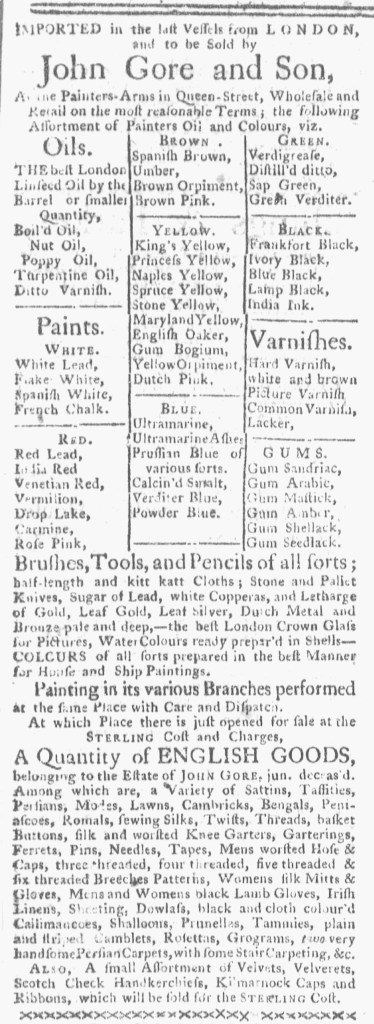
Supplement to the Boston-Gazette (May 11, 1772).

“Oils…  Paints…  Varnishes… GUMS.”

When it appeared in the Supplement to the Boston-Gazette on May 11, 1772, John Gore and Son’s advertisement for paint and supplies may have looked familiar to readers who regularly perused that newspaper.  After all, it ran two weeks earlier in the April 27 edition.  By the time the notice appeared in the Boston-Gazette a second time, it had also appeared in the Massachusetts Gazette and Boston Weekly News-Letter twice, first on April 23 and then on May 7.  The format made it memorable, an extensive list of oils, paints, varnishes, and gums arranged as a table.  That table had sections for various shades of whites, reds, browns, yellows, blues, greens, and blacks, suggesting the many choices available to customers.  No other advertisement in any of the newspapers published in Boston at the time incorporated that distinctive design.

It was not uncommon for advertisers to place notices in multiple newspapers in order to reach more consumers and increase their share of the market.  When they did so, they usually submitted copy to the printing offices and then compositors made decisions about the design of each advertisement when they set the type.  That meant that advertisements with identical copy had variations in line breaks, font sizes, italics, and capitalization from newspaper to newspaper, depending on the decisions made by compositors.  In some instances, advertisers made requests or included instructions.  For example, some merchants and shopkeepers preferred for their merchandise to appear in two columns with only one item on each line rather than in a dense block of text.  In such cases, compositors still introduced variations in graphic design, even when working with identical copy.

That did not happen with Gore and Son’s advertisement.  Instead, the same advertisement ran in both the Massachusetts Gazette and Boston Weekly News-Letter and the Boston-Gazette.  Workers in the two offices transferred type already set back and forth multiple times.  When the time the advertisement appeared in the Supplement to the Boston-Gazette, three transfers had taken place, first from Richard Draper’s printing office to the Benjamin Edes and John Gill’s printing office, then a return to Draper’s office, and once again to Edes and Gill’s office.  Early American printers frequently reprinted content from one newspaper to another.  That was standard practice for disseminating news, but it did not involve the coordination and cooperation required for sharing type.  Gore and Son’s advertisement suggests even greater collaboration among printers in Boston, a relationship that merits further investigation to understand how they ran their businesses.

May 12

GUEST CURATOR:  Thomas Ross

What was advertised in a colonial American newspaper 250 years ago today?

Essex Gazette (May 12, 1772).

“The handsomest Horse in America.”

This advertisement describes “The famous Bellsize Arabian,” a horse considered “the handsomest Horse in America.” During the eighteenth century, horse racing was a popular sport throughout the colonies. According to Mehmet Samuk, “horse racing was separated by strong lines of class and race.”  In 1674, a court in Virginia fined a tailor who planned a race because horse racing was supposed to be “exclusive to only rich gentlemen.”  Even though that was the official position of the court, horse racing became popular among the general public in almost every colony by the time of the American Revolution.

Rich gentlemen were not the only people who participated in the races. It was not uncommon for the owners of the horses to employ enslaved people, free black people, and poor white people as jockeys. Samuk states that “African Americans eventually emerged as some of the most talented and experienced trainers of racing horses,” another contribution to American commerce and culture beyond working on plantations.

**********

ADDITIONAL COMMENTARY:  Carl Robert Keyes

In addition to the prestige associated with racing horses, some colonizers also sought to earn money by breeding horses with notable pedigrees.  They placed newspaper advertisements offering stallions to “cover” mares.  Such was the case with Amos Mansfield of Danvers, Massachusetts, and an Arabian horse named Bellsize Arabian (or Belsize Arabian, according to the list of “Historic Sires” compiled by Thoroughbred Heritage).  Mansfield placed an advertisement in the May 12, 1772, edition of the Essex Gazette to inform readers that the horse “will cover this Season.”

To incite interest, Mansfield detailed Belsize Arabian’s pedigree.  “He is a Son of the famous Horse called Moresah,” Mansfield declared, “and his Mother is of the best Race that the great Sultan or Emperor Muley Abalah ever had.”  He further explained that Belsize Arabian was “both by Sire and Mother of the best Blood and true Araback Race in all Barbary.”  By 1772, the horse already had a reputation for “covering” mares, first in England and then in New England.  Even if prospective clients were not familiar with all the details in the horse’s pedigree, Mansfield likely expected that the connection to the Sultan of Morocco would resonate with them.  For just “a Guinea a Colt,” colonizers could have Belsize Arabian “cover” their mares.

Mansfield attempted to increase the chances that readers would take note of his advertisement by including an image of a horse.  The woodcut did not depict Belsize Arabian in particular.  Instead, the printer provided a generic image that could have adorned any advertisement about horses.  Nonetheless, it was the only image that accompanied an advertisement in that issue of the Essex Gazette, almost certainly drawing eyes to the pedigree that Mansfield considered so important.  Some customers who engaged the services of Belsize Arabian might have been interested in racing horses, but other may have been content with displaying the offspring of “the handsomest Horse in America.”

Welcome, Guest Curator Thomas Ross

Thomas Ross is a junior at Assumption University in Worcester, Massachusetts. He is pursuing a double major in History and Political Science with a minor in the Core Texts and Enduring Questions Program. On campus, Thomas is a member of the Honors Program, president of the Class of 2023, chair of the Eco-Action Committee, and a tutor of writing, history and political science. Thomas’s interests in history lie in the twentieth-century American left and their struggles and progress regarding labor. In the spring of 2022, he was inducted into Phi Alpha Theta National History Honor Society. He made his contributions to the Adverts 250 Project and the Slavery Adverts 250 Project while enrolled in HIS 359 Revolutionary America, 1763-1815, in Fall 2021.

Welcome, guest curator Thomas Ross!

Slavery Advertisements Published May 12, 1772

GUEST CURATOR: Thomas Ross

The Slavery Adverts 250 Project chronicles the role of newspaper advertising in perpetuating slavery in the era of the American Revolution. The project seeks to reveal the ubiquity of slavery in eighteenth-century life from New England to Georgia by republishing advertisements about enslaved people – for sale as individuals or in groups, wanted to purchase or for hire for short periods, runaways who liberated themselves, and those who were subsequently captured and confined in jails and workhouses – in daily digests on this site as well as in real time via the @SlaveAdverts250 Twitter feed, utilizing twenty-first-century media to stand in for the print media of the eighteenth century.

The project aims to provide modern audiences with a sense of just how often colonizers encountered these advertisements in their daily lives. Enslaved men, women, and children appeared in print somewhere in the colonies almost every single day. Those advertisements served as a constant backdrop for social, cultural, economic, and political life in colonial and revolutionary America. Colonizers who did not purport to own enslaved people were still confronted with slavery as well as invited to maintain the system by purchasing enslaved men, women, and children or assisting in the capture of so-called “runaways” who sought to free themselves from bondage. The frequency of these newspaper advertisements suggests just how embedded slavery was in colonial and revolutionary American culture in everyday interactions beyond the printed page.

These advertisements also testify to the experiences of enslaved men, women, and children, though readers must consider that those experiences have been remediated through descriptions offered by enslavers rather than enslaved people themselves. Often unnamed in the advertisements, enslaved men, women, and children were not invisible or unimportant in early America.

These advertisements appeared in colonial American newspapers 250 years ago today.

Essex Gazette (May 12, 1772).

**********

South-Carolina Gazette and Country Journal (May 12, 1772).

**********

South-Carolina Gazette and Country Journal (May 12, 1772).

**********

South-Carolina Gazette and Country Journal (May 12, 1772).

**********

South-Carolina Gazette and Country Journal (May 12, 1772).

**********

South-Carolina Gazette and Country Journal (May 12, 1772).

**********

South-Carolina Gazette and Country Journal (May 12, 1772).

**********

South-Carolina Gazette and Country Journal (May 12, 1772).

**********

South-Carolina Gazette and Country Journal (May 12, 1772).

**********

South-Carolina Gazette and Country Journal (May 12, 1772).

**********

South-Carolina Gazette and Country Journal (May 12, 1772).

**********

Supplement to the South-Carolina Gazette and Country Journal (May 12, 1772).

**********

Supplement to the South-Carolina Gazette and Country Journal (May 12, 1772).

**********

Supplement to the South-Carolina Gazette and Country Journal (May 12, 1772).

**********

Supplement to the South-Carolina Gazette and Country Journal (May 12, 1772).

**********

Supplement to the South-Carolina Gazette and Country Journal (May 12, 1772).

**********

Supplement to the South-Carolina Gazette and Country Journal (May 12, 1772).

**********

Supplement to the South-Carolina Gazette and Country Journal (May 12, 1772).

May 11

What was advertised in a colonial American newspaper 250 years ago today?

Boston-Gazette (May 11, 1772).

“Acquaints the LADIES, That he has just received … A great Variety of Articles of the latest Fashions.”

When William Gale received a new shipment of goods from London in the spring of 1772, he placed advertisements in the Boston Evening-Post and the Boston-Gazette to alert prospective customers.  He declared that he stocked a “great Variety of Articles of the latest Fashions” that he would sell “very cheap, at his Shop opposite the Post Office.”  Unlike most of his competitors who carried similar goods and placed newspapers notices, Gale targeted women as consumers, suggesting that they had greater interest in fashion than their husbands, fathers, brothers, and sons.  He opened his advertisement with an assertion that he “Respectfully acquaints the LADIES” that he had new inventory.  To demonstrate the choices available to them, he then provided a list that began with a “Large assortment of Ladies newest fashion London-made dress gauze and lace bonnets.”  He underscored fashion elsewhere in his catalog of goods, including “newest-fashion bonnets” and “white, sky-blue, and rose sattins, the newest fashions.”

Gale was not the only advertiser to single out women as consumers.  In the May 11, 1772, edition of the Boston-Gazette, Isaac Greenwood advertised “UMBRILLOES” that he made at his shop in the North End.  He advised that “Ladies may be supplied with all Sizes, so small as to suit Misses of 4 or 5 Years of Age.”  Although he eventually mentioned that he supplied “Oyl Cloth … for Men,” the woodcut of a woman holding an umbrella that adorned his advertisement made clear that he considered women and girls his primary customers for such an exotic and fashionable product.

Other advertisers did not place the same emphasis on women as consumers.  Elsewhere in the same issue, William Beatty addressed “his Friends and the Publick.”  Jonathan Williams, Jr., extended his “grateful Acknowledgments to those Persons who have favoured him with their Custom during the past Season” and invited “his Friends and the Public” to examine his new merchandise.  Samuel Abbot and Company made overtures to “their Town and Country Customers.”

In stark contrast to Gale’s advertisement, John Maud, a tailor, offered his services to “the Gentlemen who are his Customers, and others.”  In promoting his business, he stated that he had “some of the newest Patterns” and boasted that “no one can finish, or cut Cloaths with greater Elegance and Taste.”  Yet he also suggested that neither he nor his customers were interested in fashion solely for its own sake.  Maud reported that he was “well used to” making “Regimental Clothing, and Navy Uniforms” since he had been “employed these many Years by the Gentlemen of the Army and Navy.”  Such garments had a purpose beyond mere fashion, even if the men who wore them took pride in their appearance.

Gale and Greenwood focused on female customers, while Maud cultivated a male clientele.  Most advertisers, however, did not gender their goods and services nor fashion and consumption more generally, even though essays and editorials in the public prints usually asserted that shopping was a feminine vice.  Most encouraged widespread participation in the marketplace, even as a few thought that they might generate more sales by targeting women or, less frequently, men.

Slavery Advertisements Published May 11, 1772

GUEST CURATOR: Thomas Ross

The Slavery Adverts 250 Project chronicles the role of newspaper advertising in perpetuating slavery in the era of the American Revolution. The project seeks to reveal the ubiquity of slavery in eighteenth-century life from New England to Georgia by republishing advertisements about enslaved people – for sale as individuals or in groups, wanted to purchase or for hire for short periods, runaways who liberated themselves, and those who were subsequently captured and confined in jails and workhouses – in daily digests on this site as well as in real time via the @SlaveAdverts250 Twitter feed, utilizing twenty-first-century media to stand in for the print media of the eighteenth century.

The project aims to provide modern audiences with a sense of just how often colonizers encountered these advertisements in their daily lives. Enslaved men, women, and children appeared in print somewhere in the colonies almost every single day. Those advertisements served as a constant backdrop for social, cultural, economic, and political life in colonial and revolutionary America. Colonizers who did not purport to own enslaved people were still confronted with slavery as well as invited to maintain the system by purchasing enslaved men, women, and children or assisting in the capture of so-called “runaways” who sought to free themselves from bondage. The frequency of these newspaper advertisements suggests just how embedded slavery was in colonial and revolutionary American culture in everyday interactions beyond the printed page.

These advertisements also testify to the experiences of enslaved men, women, and children, though readers must consider that those experiences have been remediated through descriptions offered by enslavers rather than enslaved people themselves. Often unnamed in the advertisements, enslaved men, women, and children were not invisible or unimportant in early America.

These advertisements appeared in colonial American newspapers 250 years ago today.

Boston-Gazette (May 11, 1772).

**********

Newport Mercury (May 11, 1772).

**********

Newport Mercury (May 11, 1772).

**********

New-York Gazette and Weekly Mercury (May 11, 1772).

**********

New-York Gazette and Weekly Mercury (May 11, 1772).

**********

Supplement to the New-York Gazette and Weekly Mercury (May 11, 1772).

**********

Supplement to the New-York Gazette and Weekly Mercury (May 11, 1772).

**********

Supplement to the New-York Gazette and Weekly Mercury (May 11, 1772).

**********

Supplement to the New-York Gazette and Weekly Mercury (May 11, 1772).

**********

Supplement to the New-York Gazette and Weekly Mercury (May 11, 1772).

**********

Supplement to the New-York Gazette and Weekly Mercury (May 11, 1772).

**********

Supplement to the New-York Gazette and Weekly Mercury (May 11, 1772).

**********

Pennsylvania Packet (May 11, 1772).