May 10

What was advertised in a colonial American newspaper 250 years ago this week?

Pennsylvania Journal (May 7, 1772).

“JUST IMPORTED in the ship Britannia, Capt. Falconer from London.”

Readers of the Pennsylvania Journal and other colonial newspapers did not have to rely solely on the list of vessels “Entered In” that appeared in the shipping news from the customs house to learn which ships recently arrived in port.  Advertisements often carried that information as well.  Consider, for instance, the first advertisement in the May 7, 1772, edition of the Pennsylvania Journal.  It included a standard introduction that named the ship that transported the goods offered for sale before naming the purveyor of those goods or listing the merchandise.  Richard Bache began his advertisement for an assortment of textiles with “JUST IMPORTED in the ship Britannia, Capt, Falconer from London.” His notice appeared on the first page, two pages before the shipping news.

Even if readers skipped over that advertisement, it would have been difficult for them to miss every reference to the arrival of the Britannia from London.  Several other advertisements included introductions nearly identical to the one in Bache’s notice.  George Fullerton began his advertisement (on the third page, one column to the right of the shipping news) with “IMPORTED in the ship Britannia, Capt. Falconer, from London.”  The fourth and final page featured four more advertisements that mentioned the Britannia.  Mark Freeman and Townsend Speakman both opened their advertisements with that introduction, while John White and the partnership of Duffield and Delany listed their names first and then credited “the Britannia, Captain Falconer, from London” for delivering their “FRESH” merchandise.  On the first page, Daniel Roberdeau hawked “A COMPLEAT EDITION of the GENUINE LETTERS of the Late Rev. Mr. GEORGE WHITEFIELD … Received from his Executors, per Capt. Falconer.”  He did not need to provide more information since other advertisements provided context about Falconer.

Prospective customers likely found such notes helpful as they perused newspaper advertisements, especially when merchants and shopkeepers ran advertisements for weeks or even months.  Noting which vessel transported the merchandise in an advertisement helped readers determine if it was still “FRESH” or if other shops carried textiles, garments, housewares, and other goods that arrived more recently and, as a result, might include more recent fashions and styles.  This standard introduction to so many advertisements thus yielded its greatest advantage for advertisers when their notices first appeared in the public prints, but contained to provide useful context for consumers throughout the entire run of those advertisements.

May 9

What was advertised in a colonial American newspaper 250 years ago today?

Providence Gazette (May 9, 1772).

“Ladies and Gentlemen … will be used in the most genteel Manner.”

When Richard Mathewson of East Greenwich, Rhode Island, “opened a House … for entertaining Gentlemen,” he placed an advertisement in the April 4, 1772, edition of the Providence Gazette.  He also stabled horses and “carries on the Baker’s Business,” offering those “and other Conveniences” for entertaining “in the best Manner.”  One of his competitors, William Arnold, saw in that advertisement an opportunity.  Three weeks later, he began running his own notices that made explicit reference to Mathewson’s advertisement.  “WHEREAS in the Providence Gazette, of April 4,” Arnold declared, “we find an Advertisement setting forth, that Richard Mathewson … will entertain Horses and Men; I therefore, in Compassion to the tender and delicate Constitutions of the fair Sex, have opened the Doors of my House to both Ladies and Gentlemen.”  He pledged that all customers “may depend they will be used in the most genteel Manner” as they enjoyed the amenities at “one of the most convenient Houses, well fitted with Lodgings, and stored with Provisions of the best Kind.”

Only on rare occasions did eighteenth-century advertisers make direct mention of their competitors.  They frequently made generalizations about offering the lowest prices, stocking the most extensive inventory, or providing the best customer service relative to what consumers would find elsewhere in town, but very rarely did they name their competitors or make direct comparisons between their goods and services.  Arnold decided that such a comparison would serve him well in his marketing efforts, distinguishing his public house and inn from the one operated by Mathewson.  In making his business accessible to “the fair Sex,” he implied that he cultivated a more genteel atmosphere than Mathewson managed for “Gentlemen, and their Horses” at his establishment.  Arnold suggested that the presence of “both Ladies and Gentlemen” meant that his customers could expect a more refined environment than they would experience at Mathewson’s “House … for entertaining Gentlemen.”  Taverns and coffeehouses often tended to be masculine homosocial spaces in early America, but Arnold surmised that running an appropriately “genteel” house of entertainment could attract patrons less interested in visiting one that marketed itself as catering primarily to “Gentlemen, and their Horses.”

Slavery Advertisements Published May 9, 1772

GUEST CURATOR: Thomas Ross

The Slavery Adverts 250 Project chronicles the role of newspaper advertising in perpetuating slavery in the era of the American Revolution. The project seeks to reveal the ubiquity of slavery in eighteenth-century life from New England to Georgia by republishing advertisements about enslaved people – for sale as individuals or in groups, wanted to purchase or for hire for short periods, runaways who liberated themselves, and those who were subsequently captured and confined in jails and workhouses – in daily digests on this site as well as in real time via the @SlaveAdverts250 Twitter feed, utilizing twenty-first-century media to stand in for the print media of the eighteenth century.

The project aims to provide modern audiences with a sense of just how often colonizers encountered these advertisements in their daily lives. Enslaved men, women, and children appeared in print somewhere in the colonies almost every single day. Those advertisements served as a constant backdrop for social, cultural, economic, and political life in colonial and revolutionary America. Colonizers who did not purport to own enslaved people were still confronted with slavery as well as invited to maintain the system by purchasing enslaved men, women, and children or assisting in the capture of so-called “runaways” who sought to free themselves from bondage. The frequency of these newspaper advertisements suggests just how embedded slavery was in colonial and revolutionary American culture in everyday interactions beyond the printed page.

These advertisements also testify to the experiences of enslaved men, women, and children, though readers must consider that those experiences have been remediated through descriptions offered by enslavers rather than enslaved people themselves. Often unnamed in the advertisements, enslaved men, women, and children were not invisible or unimportant in early America.

These advertisements appeared in colonial American newspapers 250 years ago today.

Providence Gazette (May 9, 1772).

**********

Providence Gazette (May 9, 1772).

May 8

What was advertised in a colonial American newspaper 250 years ago today?

New-Hampshire Gazette (May 8, 1772).

“A good Assortment of GOODS, / suitable for the Season, lately imported, / from Great-Britain and Ireland.”

When John McMasters and Company “removed from Col. Wallingford’s, to Mr. David Moore’s Store, North-End” in Portsmouth in the spring of 1772, they placed an advertisement in the New-Hampshire Gazette to inform current and prospective customers of their new location.  They incorporated a variety of marketing appeals into their notice.  They promoted their “good Assortment of GOODS,” suggesting plenty of choices for consumers, and then listed several of the items they imported from Great Britain and Ireland, including “Broad Cloths of different Prizes; A great Variety ofRIBBONS, Irish Linnens of all Prizes, Shalloons, Tammies, and Callamancoes.”  McMasters and Company set low prices and offered “short Credit.”  They also emphasized customer service, pledging that “their Customers in Town and Country … may depend on being as well used as they could be at any Warehouse in BOSTON.”  In making that assertion, McMasters and Company acknowledged that they operated in a regional marketplace rather than competing solely with local merchants and shopkeepers.  They realized that consumers looked to the bustling port of Boston for extensive selections of merchandise at bargain prices, but assured them that they did not need to travel or send away for the goods they wanted.

McMasters and Company made familiar appeals in their advertisement.  Purveyors of goods and services consistently mentioned consumer choice and low prices in their newspaper notices.  Many also highlighted customer service.  As a result, the format of McMaster and Company’s advertisement was its most distinctive feature.  Decorative type embellished John McMasters’s name, drawing attention to the advertisement.  Very few visual images appeared in the New-Hampshire Gazette, especially compared to newspapers published in larger port cities.  A crude woodcut depicting an enslaved man who “Deserted from his Master” adorned another advertisement in the May 8, 1772, edition, but otherwise no other notices included images or decorative type.  Each advertisement had a standard paragraph format, with the exception of McMasters and Company’s notice.  They opted to divide their copy into shorter lines and center each line to create a unique shape compared to the blocks of text in the news and other advertisements.  The innovative use of white space in combination with the decorative type likely attracted attention, increasing the chances that consumers saw McMasters and Company’s appeals to price, choice, and customer service.  Graphic design enhanced their marketing efforts.

Slavery Advertisements Published May 8, 1772

GUEST CURATOR: Thomas Ross

The Slavery Adverts 250 Project chronicles the role of newspaper advertising in perpetuating slavery in the era of the American Revolution. The project seeks to reveal the ubiquity of slavery in eighteenth-century life from New England to Georgia by republishing advertisements about enslaved people – for sale as individuals or in groups, wanted to purchase or for hire for short periods, runaways who liberated themselves, and those who were subsequently captured and confined in jails and workhouses – in daily digests on this site as well as in real time via the @SlaveAdverts250 Twitter feed, utilizing twenty-first-century media to stand in for the print media of the eighteenth century.

The project aims to provide modern audiences with a sense of just how often colonizers encountered these advertisements in their daily lives. Enslaved men, women, and children appeared in print somewhere in the colonies almost every single day. Those advertisements served as a constant backdrop for social, cultural, economic, and political life in colonial and revolutionary America. Colonizers who did not purport to own enslaved people were still confronted with slavery as well as invited to maintain the system by purchasing enslaved men, women, and children or assisting in the capture of so-called “runaways” who sought to free themselves from bondage. The frequency of these newspaper advertisements suggests just how embedded slavery was in colonial and revolutionary American culture in everyday interactions beyond the printed page.
These advertisements also testify to the experiences of enslaved men, women, and children, though readers must consider that those experiences have been remediated through descriptions offered by enslavers rather than enslaved people themselves. Often unnamed in the advertisements, enslaved men, women, and children were not invisible or unimportant in early America.

These advertisements appeared in colonial American newspapers 250 years ago today.

Connecticut Journal (May 8, 1772).

**********

New-Hampshire Gazette (May 8, 1772).

May 7

What was advertised in a colonial American newspaper 250 years ago today?

Massachusetts Gazette and Boston Weekly News-Letter (May 7, 1772.)

“Oils…  Paints… Varnishes… GUMS.”

John Gore and Son’s advertisement for an “Assortment of Painters Oil and Colours” available “At the Painters-Arms in Queen-Street” ran once again in the May 7, 1772, edition of the Massachusetts Gazette and Boston Weekly News-Letter.  It featured a table of “Oils… Paints… Varnishes… [and] GUMS” of various colors, making it distinct from other advertisements and easy to recognize.  Among the various paints, the table offered choices that ranged from “Princess Yellow, Naples Yellow, [and] Spruce Yellow” to “India Red, Venetian Red, [and] Vermilion.”  The format both delineated the many choices available to consumers and challenged them to imagine the possibilities.

Readers of the Massachusetts Gazette and Boston Weekly Mercury had seen this advertisement before.  It ran two weeks earlier in the April 23 edition.  Unlike other advertisements that ran for consecutive weeks, however, Gore and Son’s advertisement did not appear in the subsequent issue on April 30.  Instead, it ran in the Boston-Gazette on April 27.  That was not merely a case of an advertiser submitting the same copy to two newspapers.  Careful examination reveals that the notices in the Massachusetts Gazette and Boston Weekly News-Letter and the Boston-Gazette featured identical format, indicating that someone transferred the type from one printing office to another.  That made publishing Gore and Son’s advertisement a collaborative effort among competitors.  It was not the only paid notice that originated in the Massachusetts Gazette and Boston Weekly Mercury and then ran in identical format in another newspaper in the spring of 1772.  The type for Gore and Son’s advertisement eventually found its way back to Richard Draper’s printing office, where the compositor added a final line about “A few Casks of NEW RICE” but otherwise did not make any adjustments to the format.

This raised all kinds of questions about the business of printing in early America.  What kinds of bookkeeping practices did this entail?  How did Draper and other printers keep track of which type belonged to them or to competitors?  How did they go about charging advertisers for notices that ran in multiple newspapers?  Did advertisers receive a discount from those printing offices that did not have to set the type?  Or did the work involved in transferring type from one office to another balance the labor required to set type?  Printers in Boston sometimes collaborated in publishing almanacs and pamphlets.  To what extent did they collaborate in publishing the advertisements that generated significant revenue for their newspapers?

Slavery Advertisements Published May 7, 1772

GUEST CURATOR: Tyler Reid

The Slavery Adverts 250 Project chronicles the role of newspaper advertising in perpetuating slavery in the era of the American Revolution. The project seeks to reveal the ubiquity of slavery in eighteenth-century life from New England to Georgia by republishing advertisements about enslaved people – for sale as individuals or in groups, wanted to purchase or for hire for short periods, runaways who liberated themselves, and those who were subsequently captured and confined in jails and workhouses – in daily digests on this site as well as in real time via the @SlaveAdverts250 Twitter feed, utilizing twenty-first-century media to stand in for the print media of the eighteenth century.

The project aims to provide modern audiences with a sense of just how often colonizers encountered these advertisements in their daily lives. Enslaved men, women, and children appeared in print somewhere in the colonies almost every single day. Those advertisements served as a constant backdrop for social, cultural, economic, and political life in colonial and revolutionary America. Colonizers who did not purport to own enslaved people were still confronted with slavery as well as invited to maintain the system by purchasing enslaved men, women, and children or assisting in the capture of so-called “runaways” who sought to free themselves from bondage. The frequency of these newspaper advertisements suggests just how embedded slavery was in colonial and revolutionary American culture in everyday interactions beyond the printed page.

These advertisements also testify to the experiences of enslaved men, women, and children, though readers must consider that those experiences have been remediated through descriptions offered by enslavers rather than enslaved people themselves. Often unnamed in the advertisements, enslaved men, women, and children were not invisible or unimportant in early America.

These advertisements appeared in colonial American newspapers 250 years ago today.

Maryland Gazette (May 7, 1772).

**********

Massachusetts Gazette and Boston Weekly News-Letter (May 7, 1772).

**********

Pennsylvania Journal (May 7, 1772).

**********

South-Carolina Gazette (May 7, 1772).

**********

South-Carolina Gazette (May 7, 1772).

**********

South-Carolina Gazette (May 7, 1772).

**********

South-Carolina Gazette (May 7, 1772).

**********

South-Carolina Gazette (May 7, 1772).

**********

South-Carolina Gazette (May 7, 1772).

**********

Supplement to the South-Carolina Gazette (May 7, 1772).

**********

Supplement to the South-Carolina Gazette (May 7, 1772).

**********

Supplement to the South-Carolina Gazette (May 7, 1772).

**********

Supplement to the South-Carolina Gazette (May 7, 1772).

**********

Supplement to the South-Carolina Gazette (May 7, 1772).

**********

Supplement to the South-Carolina Gazette (May 7, 1772).

**********

Supplement to the South-Carolina Gazette (May 7, 1772).

**********

Supplement to the South-Carolina Gazette (May 7, 1772).

**********

Supplement to the South-Carolina Gazette (May 7, 1772).

**********

Addition to the South-Carolina Gazette (May 7, 1772).

**********

Addition to the South-Carolina Gazette (May 7, 1772).

**********

Virginia Gazette [Purdie and Dixon] (May 7, 1772).

**********

Virginia Gazette [Purdie and Dixon] (May 7, 1772).

**********

Virginia Gazette [Purdie and Dixon] (May 7, 1772).

**********

Virginia Gazette [Purdie and Dixon] (May 7, 1772).

**********

Virginia Gazette [Purdie and Dixon] (May 7, 1772).

**********

Virginia Gazette [Purdie and Dixon] (May 7, 1772).

**********

Virginia Gazette [Purdie and Dixon] (May 7, 1772).

**********

Virginia Gazette [Purdie and Dixon] (May 7, 1772).

**********

Virginia Gazette [Purdie and Dixon] (May 7, 1772).

**********

Virginia Gazette [Purdie and Dixon] (May 7, 1772).

**********

Virginia Gazette [Purdie and Dixon] (May 7, 1772).

May 6

What was advertised in a colonial American newspaper 250 years ago this week?

Massachusetts Gazette and Boston Post-Boy (May 4, 1772).

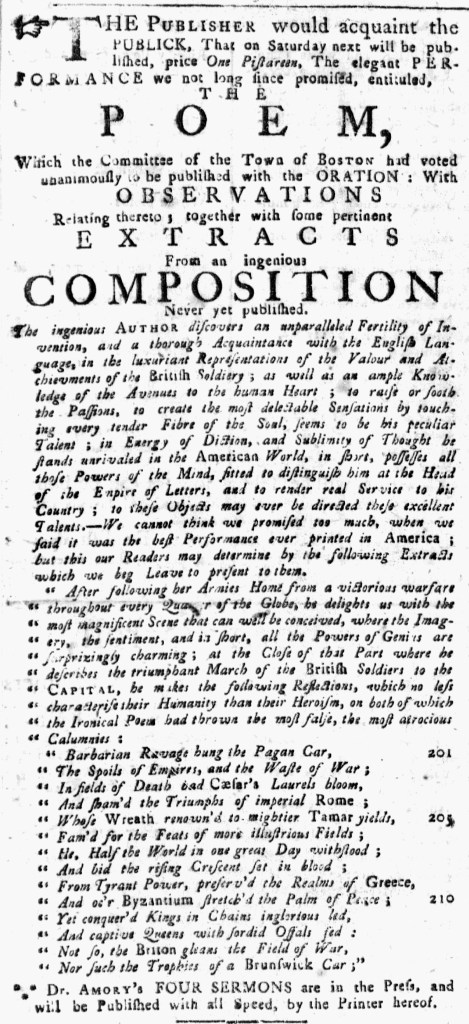
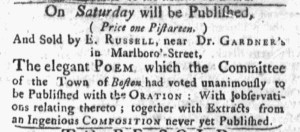
“The elegant POEM, which the Committee of the Town of Boston had voted unanimously to be Published with the ORATION.”

The May 4, 1772, edition of the Massachusetts Gazette and Boston Post-Boy carried a brief advertisement for “The elegant POEM, which the Committee of the Town of Boston had voted unanimously to be Published with the ORATION.”  The “ORATION” referred to the address that Dr. Joseph Warren delivered on the second anniversary of the Boston Massacre, an address already published and advertised in several newspapers in Boston and beyond.  Why, if “the Committee of the Town of Boston had voted unanimously” to publish it with Warren’s oration, had that not occurred?

The advertisement did not name the author of the poem, but many readers knew that James Allen wrote it.  Both the American Antiquarian Society and the Massachusetts Historical Society state that the poem “was suppressed due to doubts about Allen’s patriotism and later was republished by Allen’s friends, with extracts from another of his poems, as ‘The Retrospect.’”  That narrative draws on commentary that accompanied the poems as well as Samuel Kettell’sSpecimens of American Poetry (1829) and Evert A. Duyckinck and George L. Duyckinck’s Cyclopaedia of American Literature (1856).  More recently, Lewis Leary argues that Allen’s “friends” had motives other than commemorating the Bloody Massacre in King Street or demonstrating Allen’s patriotism in the wake of the committee composed of Samuel Adams, John Hancock, and other prominent patriots reversing course about publishing the poem in the wake of chatter that called into question Allen’s politics.

According to Leary, Allen’s poem about the Boston Massacre and “The Retrospect” must be considered together, especially because “the extracts from ‘The Retrospect’ are unabashedly loyalist, praising Britain’s military force, her selfless defense of her colonies, and benevolent rule over them.”  Furthermore, the commentary by Allen’s supposed friends “does indeed clear ‘the authors character as to his politics’ and exhibits his ‘political soundness,’ but that character and that soundness are loyalist, not patriot.”[1]

Postscript to the Censor (May 2, 1772).

Significantly, Ezekiel Russell published the pamphlet that contained Allen’s poem, “The Retrospect,” and commentary from Allen’s “friends.”  He also published the Censor, a weekly political magazine that supported the British government and expressed Tory sympathies.  The Postscript that accompanied the final issue of the Censor included a much more extensive advertisement for Allen’s poem, one that included extracts from both the commentary and “The Retrospect.”  The portion of the commentary inserted in the advertisement describes how Allen “describes the triumphant March of the British Soldiers to the CAPITAL” and then “makes the following Reflections, which no less characterise their Humanity than their Heroism” in “The Retrospect.”  The advertisement praises the “ingeniousAUTHOR” for his “luxuriant Representations of the Valour and Achievement of the British Soldiery.”

Leary argues that Allen’s “friends” sought to discredit Adams, Hancock, and other patriots for being so easily fooled by his poem about the Boston Massacre that seemed to say what they wanted to hear.  In that regard, the “publication of his Poem and its antithetical counterpart seems to have been one among many minor skirmishes in the verbal battles between Tories and Patriots on the eve of the Revolution, in which skirmish Allen seems to have been more pawn than participant.”  To that end, the “purpose of his ‘friends’ seems clearly to have been to discomfit the committee for its vacillation on the publication of the poem and to expose patriot leaders in Boston as men who could be duped by a skillful manipulator of words.”  Allen’s “friends,” according to Leary, did seek to clarify his politics, but with the intention of “certify[ing] him, certainly to his embarrassment, a Loyalist clever enough to mislead his patriot townspeople.”[2]

Still, that may not tell the entire story.  Leary argues that “what evidence is available suggests that James Allen as a younger man, like many colonials, had been enthusiastically a loyal British subject, grateful for Britain’s protection of her colonies, but that after the horror of the massacre in Boston on March 5, 1770, had become at thirty-six a patriot who could bitterly challenge the British.”[3]  In 1785, Allen’s poem about the Boston Massacre appeared in a collection of orations that commemorated the event, including Warren’s address.  By then, the editors who compiled the anthology recognized that Allen wrote the poem “when his feelings, like those of every other free-born American were alive at the inhuman murders of their countrymen.”[4]  The controversy had passed, Allen’s poem no longer questioned as an insincere lamentation belied by his earlier work.

**********

[1] Lewis Leary, “The ‘Friends’ of James Allen, or, How Partial Truth Is No Truth at All,” Early American Literature 15, no. 2 (Fall 1980): 166-167.

[2] Leary, “‘Friends’ of James Allen,” 168-169.

[3] Leary, “‘Friends’ of James Allen,” 168.

[4] Quoted in Leary, “‘Friends’ of James Allen,” 170.

May 5

What was advertised in a colonial American newspaper 250 years ago today?

Essex Gazette (May 5, 1772).

“MULBERRY TREES.”

Loammi Baldwin did much more than advertise mulberry trees for sale in Woburn, Massachusetts, in a notice that ran in the May 5, 1772, edition of the Essex Gazette.  He advocated for colonizers in New England to more firmly establish a silk industry and, to that end, offered advice for cultivating mulberry trees.

What was the connection between mulberry trees and silk?  As Bob Wyss explains, the silkworm, a type of caterpillar, “prefers a diet of mulberry leaves.  It produces a cocoon which, when unraveled, can be spun into silk thread.”  Colonizers experimented with silk production in Virginia as early as 1613, “but efforts to build businesses around [silkworms] in American colonies such as Georgia, South Carolina, and Pennsylvania were only marginally successful.”  Efforts expanded into New England when the Connecticut Colonial Assembly “passed legislation offering financial incentives for silk growers” in 1734.  Bolstered by those incentives and newspaper advertisements promoting mulberry trees and silk production, some colonizers in Connecticut met with success in their silk ventures in the second half of the eighteenth century.  In the early nineteenth century, “Connecticut was a national leader in silk production and by 1840 was producing three times as much silk as any other state.”

Baldwin believed that silk production had a lot of potential in neighboring Massachusetts.  “I would spare no reasonable pains,” he declared, to encourage and bring to perfection, the production of so valuable an article as silk.”  He explained that he had already raised silkworms for a few years and “made a machine to winde the silk.”  He found the entire process “less difficult than I imagined.”  Yet readers did not need to take his word for it.  “Some of the raw silk,” Baldwin confided, “I sent to the society for encouraging arts, sciences and commerce in Great-Britain, where it was examined, and found equal to the Italian silk.”  As a result, he had a vision that depended on colonizers purchasing the mulberry trees he advertised.  “I am fully of the opinion,” Baldwin asserted, “that the culture of silk may be effected and brought to at least the state of raw silk, which we may export to great advantage.”  Yet he did not confine that vision merely to producing raw materials.  Instead, he believed that colonizers could “then procure Weavers, and other tradesmen, and carry on the whole manufacture amongst ourselves.”

Both politics and commerce likely influenced Baldwin’s vision.  Within the past several years, colonizers objected to new imperial regulations, including the Stamp Act and duties on imported goods imposed in the Townshend Acts.  In response, they adopted nonimportation agreements and encouraged the production and consumption of “domestic manufactures,” goods made in the colonies, as alternatives to imports from Britain.  In an age of homespun cloth signaling resistance to abuses perpetrated by Parliament, cultivating mulberry trees for the purpose of producing silk had the potential to further safeguard both the political and commercial interests of the colonies.

Slavery Advertisements Published May 5, 1772

GUEST CURATOR: Tyler Reid

The Slavery Adverts 250 Project chronicles the role of newspaper advertising in perpetuating slavery in the era of the American Revolution. The project seeks to reveal the ubiquity of slavery in eighteenth-century life from New England to Georgia by republishing advertisements about enslaved people – for sale as individuals or in groups, wanted to purchase or for hire for short periods, runaways who liberated themselves, and those who were subsequently captured and confined in jails and workhouses – in daily digests on this site as well as in real time via the @SlaveAdverts250 Twitter feed, utilizing twenty-first-century media to stand in for the print media of the eighteenth century.

The project aims to provide modern audiences with a sense of just how often colonizers encountered these advertisements in their daily lives. Enslaved men, women, and children appeared in print somewhere in the colonies almost every single day. Those advertisements served as a constant backdrop for social, cultural, economic, and political life in colonial and revolutionary America. Colonizers who did not purport to own enslaved people were still confronted with slavery as well as invited to maintain the system by purchasing enslaved men, women, and children or assisting in the capture of so-called “runaways” who sought to free themselves from bondage. The frequency of these newspaper advertisements suggests just how embedded slavery was in colonial and revolutionary American culture in everyday interactions beyond the printed page.

These advertisements also testify to the experiences of enslaved men, women, and children, though readers must consider that those experiences have been remediated through descriptions offered by enslavers rather than enslaved people themselves. Often unnamed in the advertisements, enslaved men, women, and children were not invisible or unimportant in early America.

These advertisements appeared in colonial American newspapers 250 years ago today.

Essex Gazette (May 5, 1772).

**********

South-Carolina Gazette and Country Journal (May 5, 1772).

**********

South-Carolina Gazette and Country Journal (May 5, 1772).

**********

South-Carolina Gazette and Country Journal (May 5, 1772).

**********

South-Carolina Gazette and Country Journal (May 5, 1772).

**********

South-Carolina Gazette and Country Journal (May 5, 1772).

**********

South-Carolina Gazette and Country Journal (May 5, 1772).

**********

South-Carolina Gazette and Country Journal (May 5, 1772).

**********

Addition to the South-Carolina Gazette and Country Journal (May 5, 1772).

**********

Addition to the South-Carolina Gazette and Country Journal (May 5, 1772).

**********

Addition to the South-Carolina Gazette and Country Journal (May 5, 1772).

**********

Supplement to the South-Carolina Gazette and Country Journal (May 5, 1772).

**********

Supplement to the South-Carolina Gazette and Country Journal (May 5, 1772).

**********

Supplement to the South-Carolina Gazette and Country Journal (May 5, 1772).

**********

Supplement to the South-Carolina Gazette and Country Journal (May 5, 1772).

**********

Supplement to the South-Carolina Gazette and Country Journal (May 5, 1772).

**********

Supplement to the South-Carolina Gazette and Country Journal (May 5, 1772).

**********

Supplement to the South-Carolina Gazette and Country Journal (May 5, 1772).

**********

Supplement to the South-Carolina Gazette and Country Journal (May 5, 1772).

**********

Supplement to the South-Carolina Gazette and Country Journal (May 5, 1772).

**********

Supplement to the South-Carolina Gazette and Country Journal (May 5, 1772).

**********

Supplement to the South-Carolina Gazette and Country Journal (May 5, 1772).