September 14

What as advertised in a colonial American newspaper 250 years ago today?

Pennsylvania Packet (September 14, 1772).

“The curious in books … are requested to call for the Catalogue.”

An advertisement in the September 14, 1772, edition of the Pennsylvania Packet invited readers to visit “the Book-Store of WILLIAM WOODHOUSE” to receive a free copy of “A CATALOGUE OF A COLLECTION OF NEW AND OLD BOOKS, In all the Arts and Sciences, and in various Languages.”  The advertisement indicates that the lengthy title of the catalog included “Also, as large quantity of entertaining Novels, with the lowest price printed to each book.”  At a glance, it appears that Woodhouse was responsible for compiling and promoting this catalog, but closer inspection reveals that Woodhouse almost certainly collaborated with another bookseller, Robert Bell.

Ten months later, Bell distributed a catalog that replicated the title of the catalog advertised in September 1772, with the exception of adding his name: “ROBERT BELL’s SALE CATALOGUE Of a COLLECTION of NEW AND OLD BOOK, In all the Arts and Sciences, and in various Languages, Also, a large Quantity of entertaining NOVELS; with the lowest Price printed to each BOOK; NOW SELLING, At the BOOK-STORE of WILLIAM WOODHOUSE, Bookseller, Stationer, and Bookbinder, in Front-street, near Chestnut-street, Philadelphia.”  Woodhouse apparently provided retail space for Bell in both 1772 and 1773.

Yet more than merely identical titles testify to Bell’s role in producing and marketing the catalog.  The newspaper advertisement concluded with a nota bene that declared, “In this Collection are many uncommon BOOKS, seldom to be found;—therefore, the curious in books—the Directors of Libraries—and all others, that delight in the food of the mind, are requested to call for the Catalogue at said WOODHOUSE’S, as above.”  Those flourishes, especially “the curious in books” and “food of the mind,” echoed the language that the flamboyant Bell deployed in other advertisements.  For instance, he previously marketed “ROBERTSON’S celebrated History of CHARLES the Fifth” to “ALL Gentlemen that possess a sentimental TASTE.”

Bell was one of the most innovative and influential American booksellers and publishers of the eighteenth century.  Inserting the “lowest price” in the entry for each book in the catalog distinguished it from other catalogs that merely listed authors, titles, and, sometimes, sizes ranging from folio to quarto to octavo to duodecimo.  In addition, Bell supplemented newspaper advertisements and catalogs with broadsides and subscription notices, creating savvy marketing campaigns that incorporated multiple media to entice colonizers to become consumers of the books that he hawked.

Slavery Advertisements Published September 14, 1772

GUEST CURATOR: Julia Tardugno

The Slavery Adverts 250 Project chronicles the role of newspaper advertising in perpetuating slavery in the era of the American Revolution. The project seeks to reveal the ubiquity of slavery in eighteenth-century life from New England to Georgia by republishing advertisements about enslaved people – for sale as individuals or in groups, wanted to purchase or for hire for short periods, runaways who liberated themselves, and those who were subsequently captured and confined in jails and workhouses – in daily digests on this site as well as in real time via the @SlaveAdverts250 Twitter feed, utilizing twenty-first-century media to stand in for the print media of the eighteenth century.

The project aims to provide modern audiences with a sense of just how often colonizers encountered these advertisements in their daily lives. Enslaved men, women, and children appeared in print somewhere in the colonies almost every single day. Those advertisements served as a constant backdrop for social, cultural, economic, and political life in colonial and revolutionary America. Colonizers who did not purport to own enslaved people were still confronted with slavery as well as invited to maintain the system by purchasing enslaved men, women, and children or assisting in the capture of so-called “runaways” who sought to free themselves from bondage. The frequency of these newspaper advertisements suggests just how embedded slavery was in colonial and revolutionary American culture in everyday interactions beyond the printed page.

These advertisements also testify to the experiences of enslaved men, women, and children, though readers must consider that those experiences have been remediated through descriptions offered by enslavers rather than enslaved people themselves. Often unnamed in the advertisements, enslaved men, women, and children were not invisible or unimportant in early America.

From compiling an archive of digitized eighteenth-century newspapers to identifying advertisements about enslaved men, women, and children in those newspapers to preparing images of each advertisement to posting this daily digest, Julia Tardugno served as guest curator for this entry. She completed this work as part of the Summer Scholars Program, funded by a fellowship from the D’Amour College of Liberal Arts and Sciences at Assumption University in Worcester, Massachusetts, in Summer 2022. 

These advertisements appeared in colonial American newspapers 250 years ago today.

Boston Evening-Post (September 14, 1772).

**********

Boston-Gazette (September 14, 1772).

**********

New-York Gazette and Weekly Mercury (September 14, 1772).

**********

New-York Gazette and Weekly Mercury (September 14, 1772).

**********

Pennsylvania Packet (September 14, 1772).

**********

Pennsylvania Packet (September 14, 1772).

**********

Pennsylvania Packet (September 14, 1772).

**********

Supplement of the Pennsylvania Packet (September 14, 1772).

**********

Supplement of the Pennsylvania Packet (September 14, 1772).

September 13

What was advertised in a colonial American newspaper 250 years ago this week?

Massachusetts Gazette and Boston Weekly News-Letters (September 10, 1772).

“Will be sold (by Wholesale only) at such Rates as may encourage all Retailers in Town and Country.”

The partnership of Smith and Atkinson advertised a “large and very general Assortment of Piece Goods” in the September 10, 1772, edition of the Massachusetts Gazette and Boston Weekly News-Letter, but they did not seek to sell their wares directly to consumers.  Instead, they addressed retailers, advising them of their intention to deal “by Wholesale only.”  Smith and Atkinson imported such a variety of merchandise that they considered it “equally tedious & unnecessary to enumerate here.”  They may have wished to avoid paying for the amount of space required to catalog their inventory in a newspaper advertisement, but this strategy also had the benefit of prompting “Retailers in Town and Country” to fret about what kinds of goods Smith and Atkinson had on hand that might “compleat their Assortments” that they offered to their own customers.

Shopkeepers considered promoting consumer choice one of the most effective appeals in eighteenth-century advertisements.  Many did publish lengthy lists in the public prints, demonstrating to prospective customers that they could fulfill their needs and desires.  Even those who opted for shorter advertisements often mentioned the “assortment” or “variety” of wares they stocked.  Realizing that retailers so often advanced such appeals to rouse demand among consumers, Smith and Atkinson adapted the strategy to their own purposes in targeting shopkeepers in Boston and surrounding towns.  They proclaimed that they could augment any inventory throughout the year, “there being at all Seasons … a great Variety” of goods at their store.  They also declared that they set low prices for retailers who wished to enhance their inventory, explaining that they could pass along the savings because “these Goods have been purchased on the best Terms.”  In addition, those who paid cash received even better deals.  Smith and Atkinson mentioned that “Due Encouragement will be given to those who pay ready Money” twice.  Many of the advertisements for consumer goods in colonial newspapers targeted consumers themselves, but merchants also resorted to advertising to facilitate wholesale transactions.  When they did so, their appeals about large assortments of goods and low prices simultaneously adapted and reinforced the marketing strategies commonly deployed by retailers who sought to incite demand among consumers.

September 12

What was advertised in a colonial American newspaper 250 years ago today?

Providence Gazette (September 12, 1772).

“This lottery being evidently designed to serve the Public … the Managers are persuaded it will meet with general Encouragement.”

Advertisements for lotteries that funded public works project accounted for a substantial amount of the content in the September 12, 1772, edition of the Providence Gazette.  A notice for the “GLOUCESTER South Road Lottery” asserted that it was “evidently designed to serve the Public, as travelling from Providence to Connecticut will be thereby rendered very commodious.”  Another lottery held for the purpose of raising funds “to build a Town Wharff in Warwick” was similarly described as “being designed to serve the Public,” prompting the manager appointed by the General Assembly to expect “good Encouragement” from colonizers purchasing tickets.    A third lottery advertised in that issue would pay for “repairing the Meeting House in the Town of Barrington; and also for purchasing and opening some Highways in said Town.”  Each of those advertisements indicated that “a List of the Prizes, when drawn, will be published in the Providence Gazette.”

Many colonial newspapers regularly carried lottery results.  Those results usually appeared in elaborate tables that listed dozens or even hundreds of winning tickets and the prize associated with each ticket.  The advertisement for the Gloucester South Road Lottery, for instance, indicated that it consisted of 1400 tickets with prizes for 467 of those tickets.  Similarly, the lottery for the wharf in Warwick had 353 prizes for “CLASS I,” its first drawing, and another 248 prizes for “CLASS II.”  On September 12, the Providence Gazette published the “LIST of the fortunate Numbers in the MARKET-HOUSE LOTTERY, CLASS III.”  A table that contained ten columns each for the winning tickets and prizes listed approximately eight hundred of those “fortunate Numbers.”  It spread across two of the three columns on the second page, extending three-quarters of the page, seeming to displace news from Quebec and London inserted in what space remained below the table.

Considered collectively, the advertisements for lotteries in Rhode Island and the list of winners in the Market House Lottery filled an entire page in a weekly newspaper that consisted of only four pages.  Just as those lotteries raised funds for various projects, they also generated revenues for John Carter, the printer of the Providence Gazette.  He may or may not have considered the list of “fortunate Numbers” news that he printed gratis as a public service, especially since it appeared on a page that otherwise did not feature advertising, but the notices encouraging readers to purchase tickets did run alongside other paid advertisements … and they ran for multiple weeks.  Colonizers who bought lottery tickets took a chance on winning a payout, but printing advertisements for lottery tickets was a sure thing for Carter and other colonial printers.

Slavery Advertisements Published September 12, 1772

GUEST CURATOR: Julia Tardugno

The Slavery Adverts 250 Project chronicles the role of newspaper advertising in perpetuating slavery in the era of the American Revolution. The project seeks to reveal the ubiquity of slavery in eighteenth-century life from New England to Georgia by republishing advertisements about enslaved people – for sale as individuals or in groups, wanted to purchase or for hire for short periods, runaways who liberated themselves, and those who were subsequently captured and confined in jails and workhouses – in daily digests on this site as well as in real time via the @SlaveAdverts250 Twitter feed, utilizing twenty-first-century media to stand in for the print media of the eighteenth century.

The project aims to provide modern audiences with a sense of just how often colonizers encountered these advertisements in their daily lives. Enslaved men, women, and children appeared in print somewhere in the colonies almost every single day. Those advertisements served as a constant backdrop for social, cultural, economic, and political life in colonial and revolutionary America. Colonizers who did not purport to own enslaved people were still confronted with slavery as well as invited to maintain the system by purchasing enslaved men, women, and children or assisting in the capture of so-called “runaways” who sought to free themselves from bondage. The frequency of these newspaper advertisements suggests just how embedded slavery was in colonial and revolutionary American culture in everyday interactions beyond the printed page.

These advertisements also testify to the experiences of enslaved men, women, and children, though readers must consider that those experiences have been remediated through descriptions offered by enslavers rather than enslaved people themselves. Often unnamed in the advertisements, enslaved men, women, and children were not invisible or unimportant in early America.

From compiling an archive of digitized eighteenth-century newspapers to identifying advertisements about enslaved men, women, and children in those newspapers to preparing images of each advertisement to posting this daily digest, Julia Tardugno served as guest curator for this entry. She completed this work as part of the Summer Scholars Program, funded by a fellowship from the D’Amour College of Liberal Arts and Sciences at Assumption University in Worcester, Massachusetts, in Summer 2022. 

These advertisements appeared in colonial American newspapers 250 years ago today.

Pennsylvania Chronicle (September 12, 1772).

**********

Pennsylvania Chronicle (September 12, 1772).

September 11

What was advertised in a colonial American newspaper 250 years ago today?

New-London Gazette (September 11, 1772).

“SCHEME Of the Second and last CLASS of a LOTTERY.”

An advertisement in the September 11, 1772, edition of the New-London Gazette promoted a “LOTTERY For raising Six Hundred Pounds, to repair and add to the Great Bridge over the Cove at Chelsea” in Norwich, Connecticut.  That was one of several public works projects in New England funded by lotteries in the era of the American Revolution.  The General Assembly passed “an especial Act” and appointed managers to oversee the lottery.  Local agents in half a dozen towns sold tickets.

Rather than hold a single set of drawings, the managers opted to sponsor more than one “class” of tickets and prizes.  Doing so gave colonizers more opportunities to participate, likely making it easier for the managers to meet their fundraising goals.  Winners in one class could reinvest in another, those less fortunate could try again, and others could purchase tickets for the first time.  The notice published in September concerned “the Second and last CLASS” limited to “2000 TICKETS at Fifteen Shillings each; of which 592 are Prizes.”  Tickets sales amounted to £1500, with £1200 paid out in prizes and the remaining £300 for the bridge.

The managers encouraged colonizers to purchase their tickets quickly because “the Tickets in the former Class were sold in less than two Months,” leaving “many people disappointed.”  They aimed to sell all the tickets in time to hold the drawing by the middle of October.  The managers pledged that “Proper Notice will be given of the Time and Place of drawing,” just as a “a List of Prizes will be published in the New London Gazette.”  By the time they encountered the advertisement for the lottery on the final page of the September 11 issue, readers likely saw the “LIST of the NUMBERS which came up PRIZES in Chelsea Bridge LOTTERY, Class the First; drawn August 31, 1772” that dominated the first page.  The printer managed to squeeze one advertisement into the right margin, but otherwise the list of winning numbers and the prizes associated with them was the only content that appeared below the masthead.  Publishing that list served many purposes, including giving a boost to the advertisement for the second class of the lottery that appeared elsewhere in the newspaper.

Slavery Advertisements Published September 11, 1772

GUEST CURATOR: Julia Tardugno

The Slavery Adverts 250 Project chronicles the role of newspaper advertising in perpetuating slavery in the era of the American Revolution. The project seeks to reveal the ubiquity of slavery in eighteenth-century life from New England to Georgia by republishing advertisements about enslaved people – for sale as individuals or in groups, wanted to purchase or for hire for short periods, runaways who liberated themselves, and those who were subsequently captured and confined in jails and workhouses – in daily digests on this site as well as in real time via the @SlaveAdverts250 Twitter feed, utilizing twenty-first-century media to stand in for the print media of the eighteenth century.

The project aims to provide modern audiences with a sense of just how often colonizers encountered these advertisements in their daily lives. Enslaved men, women, and children appeared in print somewhere in the colonies almost every single day. Those advertisements served as a constant backdrop for social, cultural, economic, and political life in colonial and revolutionary America. Colonizers who did not purport to own enslaved people were still confronted with slavery as well as invited to maintain the system by purchasing enslaved men, women, and children or assisting in the capture of so-called “runaways” who sought to free themselves from bondage. The frequency of these newspaper advertisements suggests just how embedded slavery was in colonial and revolutionary American culture in everyday interactions beyond the printed page.

These advertisements also testify to the experiences of enslaved men, women, and children, though readers must consider that those experiences have been remediated through descriptions offered by enslavers rather than enslaved people themselves. Often unnamed in the advertisements, enslaved men, women, and children were not invisible or unimportant in early America.

From compiling an archive of digitized eighteenth-century newspapers to identifying advertisements about enslaved men, women, and children in those newspapers to preparing images of each advertisement to posting this daily digest, Julia Tardugno served as guest curator for this entry. She completed this work as part of the Summer Scholars Program, funded by a fellowship from the D’Amour College of Liberal Arts and Sciences at Assumption University in Worcester, Massachusetts, in Summer 2022. 

These advertisements appeared in colonial American newspapers 250 years ago today.

New-Hampshire Gazette (September 11, 1772).

**********

New-Hampshire Gazette (September 11, 1772).

Welcome Back, Guest Curator Julia Tardugno

Julia Tardugno, Summer Scholar, D’Amour College of Liberal Arts and Sciences, Assumption University.

Julia Tardugno is a junior double majoring in History and Secondary Education at Assumption University in Worcester, Massachusetts. She is from Methuen, Massachusetts, where she discovered a passion for teaching and history. Her interests in history include World War II and the impact of social justice issues around the world.

On campus, Julia is an active member of the Assumption community. She serves as a resident assistant, executive member of the Student Government Association as the Vice President for Student Affairs, and the Orientation Family Leader Executive. She is also a Light the Way Scholar.  Julia successfully applied to the Assumption University Education Program in the spring of her junior year, officially accepted in July 2022. In the future, Julia hopes to pursue a career as a teacher or college professor with a goal of passing on her love for learning to her students.

Julia previously contributed to the Adverts 250 Project and the Slavery Adverts 250 Project when enrolled in HIS 359 – Revolutionary America, 1763-1815, in Fall 2021.  In Spring 2022, she was selected for the inaugural cohort for the D’Amour College of Liberal Arts and Sciences Summer Scholars Program.  That program provided funding for Julia to work on the Slavery Adverts 250 Project under the mentorship of Prof. Carl Robert Keyes during the summer of 2022.  Her various contributions include researching and preparing the daily digests of advertisements about enslaved people for September 11 through October 22, 1772.  Publication of those daily digests begins today and will continue for the next six weeks.

Welcome back, guest curator Julia Tardugno!

September 10

What was advertised in a colonial American newspaper 250 years ago today?

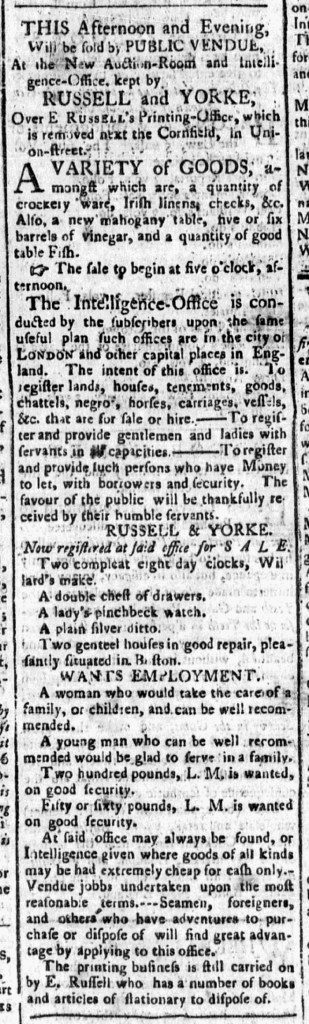
Massachusetts Spy (September 10, 1772).

“The New Auction-Room and Intelligence-Office.”

The partnership of Russell and Yorke operated the “New-Auction-Room and Intelligence-Office” in Boston in 1772.  In the September 10 edition of the Massachusetts Spy, they explained to prospective clients that the intelligence office “is conducted … upon the same useful plan such offices are in the city of LONDON and other capital placed in England.”  Russell and Yorke served as agents who registered real estate, commodities, livestock, and other items “for sale or hire.”  They also introduced colonizers with money to invest to borrowers who could provide “security.”  In addition, they offered employment services, keeping a roster of colonizers seeking employment in order to “provide gentlemen and ladies with servants in all capacities.”  In the auction room, they conducted sales “upon the most reasonable terms” for clients who entrusted them to sell “goods of all kinds.”  Their advertisement included sections for items “Now registered at said office for SALE” (including “A lady’s pinchbeck watch” and “Two genteel houses in good repair, pleasantly situated in Boston”) and people who “WANT EMPLOYMENT” (including “A woman who would take the care of a family, or children, and can be well recommended”).

Russell and Yorke listed “negros” among the commodities they registered and sold at the intelligence office, acknowledging that slavery and the slave trade were enmeshed in commerce and daily life in Boston during the era of the American Revolution.  One of the partners, Ezekiel Russell, also ran a printing office.  For less than six months, from late November 1771 through early May 1772, he published a combination political magazine and newspaper called The Censor.  That publication occasionally included a supplement for advertising, but did not attract many advertisers during its short run.  No advertisements offering enslaved people for sale or offering rewards of the capture and return of enslaved people who liberated themselves by running away from their enslavers appeared in extant issues, differentiating The Censor from other colonial newspapers.  That does not seem, however, to have been the result of a principled stand by Russell but rather an outcome grounded in failing to recruit advertisers for a publication with low circulation numbers during its brief existence.  Just a few months after The Censor folded, the printer advertised his services as an agent who registered “negros” at the intelligence office “Over E. RUSSELL’s Printing-Office” in Boston.  While other printers in the city acted as slave brokers when they disseminated “enquire of the printer” advertisements in their newspapers, Russell promoted the services he provided as a slave broker at his new intelligence office.  In printing offices and intelligence offices alike, facilitating the buying and selling of enslaved men, women, and children was one of many services available to colonizers.

Slavery Advertisements Published September 10, 1772

The Slavery Adverts 250 Project chronicles the role of newspaper advertising in perpetuating slavery in the era of the American Revolution. The project seeks to reveal the ubiquity of slavery in eighteenth-century life from New England to Georgia by republishing advertisements about enslaved people – for sale as individuals or in groups, wanted to purchase or for hire for short periods, runaways who liberated themselves, and those who were subsequently captured and confined in jails and workhouses – in daily digests on this site as well as in real time via the @SlaveAdverts250 Twitter feed, utilizing twenty-first-century media to stand in for the print media of the eighteenth century.

The project aims to provide modern audiences with a sense of just how often colonizers encountered these advertisements in their daily lives. Enslaved men, women, and children appeared in print somewhere in the colonies almost every single day. Those advertisements served as a constant backdrop for social, cultural, economic, and political life in colonial and revolutionary America. Colonizers who did not purport to own enslaved people were still confronted with slavery as well as invited to maintain the system by purchasing enslaved men, women, and children or assisting in the capture of so-called “runaways” who sought to free themselves from bondage. The frequency of these newspaper advertisements suggests just how embedded slavery was in colonial and revolutionary American culture in everyday interactions beyond the printed page.

These advertisements also testify to the experiences of enslaved men, women, and children, though readers must consider that those experiences have been remediated through descriptions offered by enslavers rather than enslaved people themselves. Often unnamed in the advertisements, enslaved men, women, and children were not invisible or unimportant in early America.

These advertisements appeared in colonial American newspapers 250 years ago today.

Maryland Gazette (September 10, 1772).

**********

Maryland Gazette (September 10, 1772).

**********

Maryland Gazette (September 10, 1772).

**********

Maryland Gazette (September 10, 1772).

**********

Maryland Gazette (September 10, 1772).

**********

Maryland Gazette (September 10, 1772).

**********

Massachusetts Gazette and Boston Weekly News-Letter (September 10, 1772).

**********

Massachusetts Spy (September 10, 1772).

**********

Massachusetts Spy (September 10, 1772).

**********

New-York Journal (September 10, 1772).

**********

South-Carolina Gazette (September 10, 1772).

**********

South-Carolina Gazette (September 10, 1772).

**********

South-Carolina Gazette (September 10, 1772).

**********

South-Carolina Gazette (September 10, 1772).

**********

South-Carolina Gazette (September 10, 1772).

**********

South-Carolina Gazette (September 10, 1772).

**********

South-Carolina Gazette (September 10, 1772).

**********

South-Carolina Gazette (September 10, 1772).

**********

South-Carolina Gazette (September 10, 1772).

**********

South-Carolina Gazette (September 10, 1772).

**********

South-Carolina Gazette (September 10, 1772).

**********

Supplement to the South-Carolina Gazette (September 10, 1772).

**********

Supplement to the South-Carolina Gazette (September 10, 1772).

**********

Supplement to the South-Carolina Gazette (September 10, 1772).

**********

Supplement to the South-Carolina Gazette (September 10, 1772).

**********

Supplement to the South-Carolina Gazette (September 10, 1772).

**********

Supplement to the South-Carolina Gazette (September 10, 1772).

**********

Supplement to the South-Carolina Gazette (September 10, 1772).

**********

Postscript to the South-Carolina Gazette (September 10, 1772).

**********

Virginia Gazette [Purdie and Dixon] (September 10, 1772).

**********

Virginia Gazette [Purdie and Dixon] (September 10, 1772).

**********

Virginia Gazette [Purdie and Dixon] (September 10, 1772).

**********

Virginia Gazette [Purdie and Dixon] (September 10, 1772).

**********

Virginia Gazette [Purdie and Dixon] (September 10, 1772).

**********

Virginia Gazette [Purdie and Dixon] (September 10, 1772).

**********

Virginia Gazette [Purdie and Dixon] (September 10, 1772).

**********

Virginia Gazette [Purdie and Dixon] (September 10, 1772).

**********

Virginia Gazette [Purdie and Dixon] (September 10, 1772).

**********

Virginia Gazette [Purdie and Dixon] (September 10, 1772).

**********

Virginia Gazette [Purdie and Dixon] (September 10, 1772).

**********

Virginia Gazette [Purdie and Dixon] (September 10, 1772).