Slavery Advertisements Published December 10, 1772

The Slavery Adverts 250 Project chronicles the role of newspaper advertising in perpetuating slavery in the era of the American Revolution. The project seeks to reveal the ubiquity of slavery in eighteenth-century life from New England to Georgia by republishing advertisements about enslaved people – for sale as individuals or in groups, wanted to purchase or for hire for short periods, runaways who liberated themselves, and those who were subsequently captured and confined in jails and workhouses – in daily digests on this site as well as in real time via the @SlaveAdverts250 Twitter feed, utilizing twenty-first-century media to stand in for the print media of the eighteenth century.

The project aims to provide modern audiences with a sense of just how often colonizers encountered these advertisements in their daily lives. Enslaved men, women, and children appeared in print somewhere in the colonies almost every single day. Those advertisements served as a constant backdrop for social, cultural, economic, and political life in colonial and revolutionary America. Colonizers who did not purport to own enslaved people were still confronted with slavery as well as invited to maintain the system by purchasing enslaved men, women, and children or assisting in the capture of so-called “runaways” who sought to free themselves from bondage. The frequency of these newspaper advertisements suggests just how embedded slavery was in colonial and revolutionary American culture in everyday interactions beyond the printed page.

These advertisements also testify to the experiences of enslaved men, women, and children, though readers must consider that those experiences have been remediated through descriptions offered by enslavers rather than enslaved people themselves. Often unnamed in the advertisements, enslaved men, women, and children were not invisible or unimportant in early America.

These advertisements appeared in colonial American newspapers 250 years ago today.

Maryland Gazette (December 10, 1772).

**********

Maryland Gazette (December 10, 1772).

**********

Maryland Gazette (December 10, 1772).

**********

Massachusetts Gazette and Boston Weekly News-Letter (December 10, 1772).

**********

Massachusetts Gazette and Boston Weekly News-Letter (December 10, 1772).

**********

Massachusetts Gazette and Boston Weekly News-Letter (December 10, 1772).

**********

Massachusetts Gazette and Boston Weekly News-Letter (December 10, 1772).

**********

Massachusetts Gazette and Boston Weekly News-Letter (December 10, 1772).

**********

Massachusetts Spy (December 10, 1772).

**********

New-York Journal (December 10, 1772).

**********

South-Carolina Gazette (December 10, 1772).

**********

South-Carolina Gazette (December 10, 1772).

**********

South-Carolina Gazette (December 10, 1772).

**********

South-Carolina Gazette (December 10, 1772).

**********

South-Carolina Gazette (December 10, 1772).

**********

South-Carolina Gazette (December 10, 1772).

**********

South-Carolina Gazette (December 10, 1772).

**********

South-Carolina Gazette (December 10, 1772).

**********

Supplement to the South-Carolina Gazette (December 10, 1772).

**********

Supplement to the South-Carolina Gazette (December 10, 1772).

**********

Supplement to the South-Carolina Gazette (December 10, 1772).

**********

Supplement to the South-Carolina Gazette (December 10, 1772).

**********

Supplement to the South-Carolina Gazette (December 10, 1772).

**********

Supplement to the South-Carolina Gazette (December 10, 1772).

**********

Supplement to the South-Carolina Gazette (December 10, 1772).

**********

Virginia Gazette [Purdie and Dixon] (December 10, 1772).

**********

Virginia Gazette [Purdie and Dixon] (December 10, 1772).

**********

Virginia Gazette [Purdie and Dixon] (December 10, 1772).

**********

Virginia Gazette [Purdie and Dixon] (December 10, 1772).

**********

Virginia Gazette [Purdie and Dixon] (December 10, 1772).

**********

Virginia Gazette [Purdie and Dixon] (December 10, 1772).

**********

Virginia Gazette [Purdie and Dixon] (December 10, 1772).

**********

Virginia Gazette [Purdie and Dixon] (December 10, 1772).

**********

Virginia Gazette [Purdie and Dixon] (December 10, 1772).

**********

Virginia Gazette [Purdie and Dixon] (December 10, 1772).

**********

Virginia Gazette [Purdie and Dixon] (December 10, 1772).

**********

Virginia Gazette [Purdie and Dixon] (December 10, 1772).

**********

Virginia Gazette [Purdie and Dixon] (December 10, 1772).

**********

Virginia Gazette [Purdie and Dixon] (December 10, 1772).

**********

Virginia Gazette [Purdie and Dixon] (December 10, 1772).

**********

Virginia Gazette [Purdie and Dixon] (December 10, 1772).

**********

Virginia Gazette [Purdie and Dixon] (December 10, 1772).

**********

Virginia Gazette [Purdie and Dixon] (December 10, 1772).

**********

Virginia Gazette [Purdie and Dixon] (December 10, 1772).

**********

Virginia Gazette [Rind] (December 10, 1772).

**********

Virginia Gazette [Rind] (December 10, 1772).

**********

Virginia Gazette [Rind] (December 10, 1772).

**********

Virginia Gazette [Rind] (December 10, 1772).

December 9

What was advertised in a colonial American newspaper 250 years ago today?

Pennsylvania Journal (December 9, 1772).

“MUFFTS, TIPPITS, ERMINE.”

When furriers John Fromberger and John Siemon formed their partnership, they placed advertisements in newspapers published in Philadelphia.  A woodcut depicting a miff and tippet adorned the notice they placed in the Pennsylvania Journal in September 1771.  Several weeks later, they transferred the woodcut to the printing office of the Pennsylvania Chronicle so it could appear in advertisements they ran in that newspaper.  In December, the furriers once again made arrangements for the image to accompany their advertisements in the Pennsylvania Journal.  Within in a few weeks, it appeared in yet another newspaper, the New-York Journal.  Siemon visited the city, advised prospective customers that “he intends to stay a month only,” and took the woodcut with him to help draw attention to his advertisements.  Given his short stay, Siemon did not manage to transfer the woodcut from one printing office to another.  His advertisements in the New-York Gazette and Weekly Mercury did not feature any image.

Siemon returned to New York in November 1772.  In a new advertisement in the New-York Journal, he informed readers that “he intends settling here” and requested “a further continuance of those Ladies and Gentlemen who were pleased to favour him with their custom last winter.”  That advertisement did not mention any connection to Fromberger; apparently the furriers dissolved their partnership.  The advertisement did include a familiar image, at least a portion of one.  Siemon included the muff, but not the tippet formerly arranged above it.  Perhaps he modified the woodcut to acknowledge his new enterprise.  Perhaps the portion depicting the tippet had been damaged so he had that part removed and salvaged the rest.  Perhaps he had the tippet removed because it occupied so much space.  A smaller woodcut cost less to include in his advertisements.  Whatever the explanation, Siemon had a familiar, but updated, image for customers to associate with his business.

Fromberger apparently thought that was a good idea.  A month after John Siemon and Company advertised in the New-York Journal, John Fromberger and Company placed a notice with an image in the Pennsylvania Journal.  Since Siemon retained the original woodcut, Fromberger commissioned a new woodcut.  He exercised some consistency in selecting what appeared in the image, a muff and a tippet.  This time, however, the muff and the tippet appeared side by side rather than one above the other.  Both items had the same patterns as the muff and the tippet in the original woodcut. Fromberger likely believed that consumers in Philadelphia associated a similar image with the business he operated.  A similar image repeatedly accompanied his previous notices, making a new one that depicted both a muff and a tippet familiar and appropriate for marketing his new enterprise.

Slavery Advertisements Published December 9, 1772

The Slavery Adverts 250 Project chronicles the role of newspaper advertising in perpetuating slavery in the era of the American Revolution. The project seeks to reveal the ubiquity of slavery in eighteenth-century life from New England to Georgia by republishing advertisements about enslaved people – for sale as individuals or in groups, wanted to purchase or for hire for short periods, runaways who liberated themselves, and those who were subsequently captured and confined in jails and workhouses – in daily digests on this site as well as in real time via the @SlaveAdverts250 Twitter feed, utilizing twenty-first-century media to stand in for the print media of the eighteenth century.

The project aims to provide modern audiences with a sense of just how often colonizers encountered these advertisements in their daily lives. Enslaved men, women, and children appeared in print somewhere in the colonies almost every single day. Those advertisements served as a constant backdrop for social, cultural, economic, and political life in colonial and revolutionary America. Colonizers who did not purport to own enslaved people were still confronted with slavery as well as invited to maintain the system by purchasing enslaved men, women, and children or assisting in the capture of so-called “runaways” who sought to free themselves from bondage. The frequency of these newspaper advertisements suggests just how embedded slavery was in colonial and revolutionary American culture in everyday interactions beyond the printed page.

These advertisements also testify to the experiences of enslaved men, women, and children, though readers must consider that those experiences have been remediated through descriptions offered by enslavers rather than enslaved people themselves. Often unnamed in the advertisements, enslaved men, women, and children were not invisible or unimportant in early America.

These advertisements appeared in colonial American newspapers 250 years ago today.

Pennsylvania Journal (December 9, 1772).

**********

Pennsylvania Journal (December 9, 1772).

December 8

What was advertised in a colonial American newspaper 250 years ago today?

South-Carolina Gazette and Country Journal (December 8, 1772).

“He has now opened a New CAROLINA, GEORGIA, FLORIDA, and PENNSYLVANIA COFFEE-HOUSE.”

When he became proprietor of Cole’s and Greenland Coffee House in London, Robert Benson launched an advertising campaign in newspapers published in Charleston, South Carolina.  He hoped to entice merchants and others who visited London to socialize and do business at his establishment rather than choose any of the many others in Cornhill near the Royal Exchange.  He first placed advertisements in the South-Carolina Gazette and the South-Carolina Gazette and Country Journal in July and August 1772.  In December, he continued marketing the “New” and renamed “CAROLINA, GEORGIA, FLORIDA, and PENNSYLVANIA COFFEE-HOUSE.”

As he had previously done, Benson opened his advertisement by introducing himself as “BOB, late Waiter at the CAROLINA COFFEE-HOUSE.”  That established his experience and credentials.  Benson likely hoped that merchants and others who had visited that coffee house might remember “BOB” and the familiarity would convince them to seek out his services at his new location.  Even for those who had not previously interacted with “BOB,” the nickname may have suggested that they would encounter genuine friendliness when they were far from home and chose to visit his coffee house.

Benson provided amenities from home for the comfort and convenience of his patrons.  In particular, he “settled a regular Correspondence” for newspapers from the Carolinas, Georgia, Pennsylvania, and other colonies.  Merchants and others could stay informed of events on the other side of the Atlantic and follow the shipping news as they conducted business in London.  Benson asserted that he kept his subscriptions current and received the latest editions “on the Arrival of every Ship” from the Carolinas, Georgia, Florida, and Pennsylvania.  Other services included “Particular Attention … to all Bills, Letters, &c. left at the said Coffee-House.”

Benson did not rely solely on foot traffic near the Royal Exchange and word of mouth to generate business when he became the proprietor of a coffee house in Ball Court.  Instead, he placed advertisements in newspapers on the other side of the Atlantic, hoping that doing so would draw attention to his establishment and distinguish from others in the neighborhood.  Such efforts demonstrated to colonial merchants and other prospective patrons that Benson took seriously his commitment to serving them when they ventured to London.  In contrast, proprietors of other coffee houses did not advertise in American newspapers.  Benson likely hoped that difference would distinguish the Carolina, Georgia, Florida, and Pennsylvania Coffee House from others.

Slavery Advertisements Published December 8, 1772

The Slavery Adverts 250 Project chronicles the role of newspaper advertising in perpetuating slavery in the era of the American Revolution. The project seeks to reveal the ubiquity of slavery in eighteenth-century life from New England to Georgia by republishing advertisements about enslaved people – for sale as individuals or in groups, wanted to purchase or for hire for short periods, runaways who liberated themselves, and those who were subsequently captured and confined in jails and workhouses – in daily digests on this site as well as in real time via the @SlaveAdverts250 Twitter feed, utilizing twenty-first-century media to stand in for the print media of the eighteenth century.

The project aims to provide modern audiences with a sense of just how often colonizers encountered these advertisements in their daily lives. Enslaved men, women, and children appeared in print somewhere in the colonies almost every single day. Those advertisements served as a constant backdrop for social, cultural, economic, and political life in colonial and revolutionary America. Colonizers who did not purport to own enslaved people were still confronted with slavery as well as invited to maintain the system by purchasing enslaved men, women, and children or assisting in the capture of so-called “runaways” who sought to free themselves from bondage. The frequency of these newspaper advertisements suggests just how embedded slavery was in colonial and revolutionary American culture in everyday interactions beyond the printed page.

These advertisements also testify to the experiences of enslaved men, women, and children, though readers must consider that those experiences have been remediated through descriptions offered by enslavers rather than enslaved people themselves. Often unnamed in the advertisements, enslaved men, women, and children were not invisible or unimportant in early America.

These advertisements appeared in colonial American newspapers 250 years ago today.

South-Carolinas Gazette and Country Journal (December 8, 1772).

**********

South-Carolinas Gazette and Country Journal (December 8, 1772).

**********

South-Carolinas Gazette and Country Journal (December 8, 1772).

**********

South-Carolinas Gazette and Country Journal (December 8, 1772).

**********

South-Carolinas Gazette and Country Journal (December 8, 1772).

**********

South-Carolinas Gazette and Country Journal (December 8, 1772).

**********

South-Carolinas Gazette and Country Journal (December 8, 1772).

**********

South-Carolinas Gazette and Country Journal (December 8, 1772).

**********

South-Carolinas Gazette and Country Journal (December 8, 1772).

**********

South-Carolinas Gazette and Country Journal (December 8, 1772).

December 7

What was advertised in a colonial American newspaper 250 years ago today?

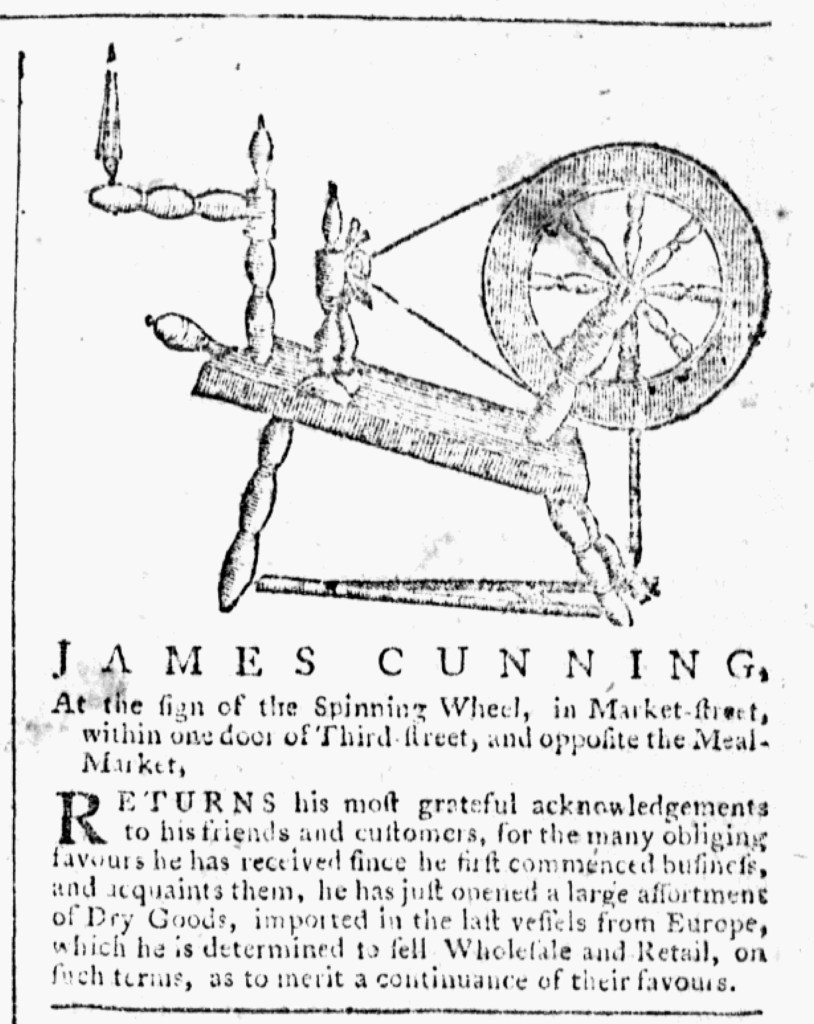
Pennsylvania Packet (December 7, 1772).

“At the sign of the Spinning Wheel.”

In December 1772, James Cunning took the pages of the Pennsylvania Packet to advertise the “large assortment of Dry Goods” available at his shop on Market Street in Philadelphia.  He took the opportunity to express his “grateful acknowledgments to his friends and customers,” thanking them for “the many obliging favours he has received since he first commenced business.”  In order to “merit a continuance of their favours,” Cunning declared that he would set favorable “terms” for both wholesale and retail sales.  Those “terms” certainly included price and likely credit as well.  They may have also included packaging, delivery, and other services.

Cunning advised readers that they would find his shop “At the sign of the Spinning Wheel.”  To strengthen the association between that symbol of industriousness and his business, Cunning adorned his advertisement with a woodcut that depicted a spinning wheel.  Larger than the stock images of vessels at sea and horses in the upper left corners of half a dozen advertisements in the December 7 issue and its supplement, the spinning wheel accounted for more than half the space occupied by Cunning’s advertisement.  That represented significant expense for Cunning, first for commissioning a woodcut tied to his business and for his exclusive use, then for the space required to publish it.  Printers charged by the amount of space, not the number of words.

Cunning apparently considered including the image in his notices worth the expense, especially since he continued to use it when placing new advertisements.  The image first appeared in advertisements Cunning inserted in the Pennsylvania Journal in October 1771.  By the end of the month, he transferred the woodcut to the printing offices of the newly-launched Pennsylvania Packet.  It appeared in an advertisement in the inaugural issue.  More than a year later, Cunning included the image in a new advertisement in the Pennsylvania Packet, convinced that it would result in a satisfactory return on his investment in commissioning it.  He could have retired the image after it appeared in that initial run of advertising if he did not believe that it resulted in greater attention for his business.  That he used it again suggests that he determined that image and text together helped to draw “friends and customers” to his shop.

Slavery Advertisements Published December 7, 1772

The Slavery Adverts 250 Project chronicles the role of newspaper advertising in perpetuating slavery in the era of the American Revolution. The project seeks to reveal the ubiquity of slavery in eighteenth-century life from New England to Georgia by republishing advertisements about enslaved people – for sale as individuals or in groups, wanted to purchase or for hire for short periods, runaways who liberated themselves, and those who were subsequently captured and confined in jails and workhouses – in daily digests on this site as well as in real time via the @SlaveAdverts250 Twitter feed, utilizing twenty-first-century media to stand in for the print media of the eighteenth century.

The project aims to provide modern audiences with a sense of just how often colonizers encountered these advertisements in their daily lives. Enslaved men, women, and children appeared in print somewhere in the colonies almost every single day. Those advertisements served as a constant backdrop for social, cultural, economic, and political life in colonial and revolutionary America. Colonizers who did not purport to own enslaved people were still confronted with slavery as well as invited to maintain the system by purchasing enslaved men, women, and children or assisting in the capture of so-called “runaways” who sought to free themselves from bondage. The frequency of these newspaper advertisements suggests just how embedded slavery was in colonial and revolutionary American culture in everyday interactions beyond the printed page.

These advertisements also testify to the experiences of enslaved men, women, and children, though readers must consider that those experiences have been remediated through descriptions offered by enslavers rather than enslaved people themselves. Often unnamed in the advertisements, enslaved men, women, and children were not invisible or unimportant in early America.

These advertisements appeared in colonial American newspapers 250 years ago today.

Boston-Gazette (December 7, 1772).

**********

Boston-Gazette (December 7, 1772).

**********

New-York Gazette and Weekly Mercury (December 7, 1772).

**********

New-York Gazette and Weekly Mercury (December 7, 1772).

**********

Supplement to the New-York Gazette and Weekly Mercury (December 7, 1772).

**********

Supplement to the New-York Gazette and Weekly Mercury (December 7, 1772).

**********

Supplement to the New-York Gazette and Weekly Mercury (December 7, 1772).

**********

Supplement to the New-York Gazette and Weekly Mercury (December 7, 1772).

**********

Supplement to the New-York Gazette and Weekly Mercury (December 7, 1772).

**********

Supplement to the New-York Gazette and Weekly Mercury (December 7, 1772).

**********

Supplement to the New-York Gazette and Weekly Mercury (December 7, 1772).

**********

Supplement to the Pennsylvania Packet (December 7, 1772).

**********

Supplement to the Pennsylvania Packet (December 7, 1772).

December 6

Who was the subject of an advertisement in a colonial American newspaper 250 years ago this week?

Virginia Gazette [Purdie and Dixon] (December 3, 1772).

To be HIRED for a Year, and delivered on New Year’s Day, FOUR Negro MEN, five young WOMEN, and a BOY.”

As the new year approached in December 1772, “FOUR Negro MEN, five young WOMEN, and a BOY” faced the prospects of their living and working conditions changing significantly, though they may not have been aware that was the case.  Anne Blair took to the pages of Alexander Purdie and John Dixon’s Virginia Gazette to advertise that she offered those enslaved people “To be HIRED for a Year, and delivered on New Year’s Day.”  In other words, she did not seek to sell them to other enslavers but instead “rent” them, just as she offered a plantation in Prince George County “to be rented, for a Year, or Years.”  Blair did not provide any additional details about the enslaved men, women, and boy.  She did not list their skills or occupations, nor did she mention whether any of them were relations who risked separation upon being “HIRED for a Year.”

Blair was not alone in acting as an absentee enslaver who sought to collect the wages earned by enslaved people hired out to other colonizers.  On the same day that her advertisement appeared in the Virginia Gazette, a notice about a “smart, sensible” enslaved woman, “Who is a good Sempstress, a plain Cook, and extreamly well qualified to do every Business about a House,” ran on the first page of the South-Carolina Gazette.  The advertisement advised that the woman was “To be Sold, or hired by the Month.”  The shorter term meant more flexibility for any colonizer who “hired” the enslaved woman.  It did not take into account anything that she might think about the arrangement.  All that mattered was the convenience of “her present Proprietor,” an anonymous advertiser who depended on the printers to act as intermediaries and brokers.  That “Proprietor” stated that he wished to sell or hire out the enslaved woman only because “he has no Employment for her” in his own household.

Before, during, and after the era of the American Revolution, enslaved people faced upheavals in their lives beyond the buying and selling undertaken by enslavers.  Many also experienced the hiring out system, an alternate form of extracting their labor while treating them as commodities rather than people.  The early American press played a role in perpetuating those practices.  Newspaper advertisements and the printers who published them facilitated various forms of buying, selling, trading, and hiring out enslaved people.

December 5

What was advertised in a colonial American newspaper 250 years ago today?

Providence Gazette (December 5, 1772).

“The PRINTING and POST-OFFICES are removed to Meeting-Street.”

John Carter’s printing office had a new location.  In early December 1772, the printer of the Providence Gazette moved from his location “in King-Street, opposite the Court-House” to a new location “in Meeting-Street, near the Court-House.”  The colophon in the November 28 edition listed the former address.  Carter updated the colophon in the December 5 edition.

That was not his only means for letting readers know that the printing office moved.  He also inserted a notice that stated, “The PRINTING and POST-OFFICES are removed to Meeting-Street, nearly opposite the Friends Meeting-House.”  To draw attention to it, Carter enclosed the notice within a border made of decorative type and gave it a prominent spot on the front page.  It was the first item in the first column, making it difficult for readers to miss it, even if they only skimmed other content in that issue.  That strategy was not new to Carter.  The printing office previously “removed to a new Building on the main Street” in October 1771.  At that time, Carter published an announcement enclosed within on a border as the first item on the first page of the October 12 edition.  He also revised the colophon to reflect the new location.

Other elements remained the same.  Carter continued to use a sign depicting “Shakespear’s Head” to identify the printing office.  Colonizers still encountered it as they traversed the streets of Providence, a familiar sight in the commercial landscape of the city.  The printer also continued to promote other services in the colophon, advising that “all Manner of Printing-Work is performed with Care and Expedition” at his office.  In particular, “Hand-Bills … done in a neat and correct Manner, at a very short Notice, and on reasonable Terms.”

Carter placed a subscription proposal for an edition of “ENGLISH LIBERTIES, OR The free-born Subject’s INHERITANCE” below the notice about the new location.  In the previous issue, that subscription proposal and an advertisement for the “NEW-ENGLAND ALMANACK” that Carter published and sold appeared on the front page.  As usual, all other advertisements ran on the final pages.  Carter exercised his prerogative as printer to give his own notices prime spots in the newspaper.

Slavery Advertisements Published December 5, 1772

The Slavery Adverts 250 Project chronicles the role of newspaper advertising in perpetuating slavery in the era of the American Revolution. The project seeks to reveal the ubiquity of slavery in eighteenth-century life from New England to Georgia by republishing advertisements about enslaved people – for sale as individuals or in groups, wanted to purchase or for hire for short periods, runaways who liberated themselves, and those who were subsequently captured and confined in jails and workhouses – in daily digests on this site as well as in real time via the @SlaveAdverts250 Twitter feed, utilizing twenty-first-century media to stand in for the print media of the eighteenth century.

The project aims to provide modern audiences with a sense of just how often colonizers encountered these advertisements in their daily lives. Enslaved men, women, and children appeared in print somewhere in the colonies almost every single day. Those advertisements served as a constant backdrop for social, cultural, economic, and political life in colonial and revolutionary America. Colonizers who did not purport to own enslaved people were still confronted with slavery as well as invited to maintain the system by purchasing enslaved men, women, and children or assisting in the capture of so-called “runaways” who sought to free themselves from bondage. The frequency of these newspaper advertisements suggests just how embedded slavery was in colonial and revolutionary American culture in everyday interactions beyond the printed page.

These advertisements also testify to the experiences of enslaved men, women, and children, though readers must consider that those experiences have been remediated through descriptions offered by enslavers rather than enslaved people themselves. Often unnamed in the advertisements, enslaved men, women, and children were not invisible or unimportant in early America.

These advertisements appeared in colonial American newspapers 250 years ago today.

Pennsylvania Chronicle (December 5, 1772).