December 15

What was advertised in a colonial American newspaper 250 years ago today?

Connecticut Courant (December 15, 1772).

“The Printer is sensible that the Courant is very badly printed.”

Throughout the colonies, printers had difficulties getting subscribers to pay for their newspapers.  They regularly inserted notices calling on subscribers to settle accounts, especially when one year ended and another began.  Such was the case when Ebenezer Watson ran a notice in the December 15, 1772, edition of the Connecticut Courant.  He asserted that for most of his customers “the Year … terminates with this Day’s Publication (No. 416).”  That made it a good time for him to “return his sincere Thanks to all those Gentlemen who have not only been his Customers a Number of Years, but who have been very punctual” in paying for their subscriptions.  The printer requested that those who had been punctual continue to pay their bills in a timely fashion because “it is by their kind Assistance that he has been enabled to continue his Business to this Time.”  Watson depended on them for the “Continuance” of the Connecticut Courant.

He also addressed those who still owed for their subscriptions, declaring that he “takes the Liberty, ONCE MORE! To ask all those indebted to him, whose Accounts are of a Number of Years standing, whether they don’t think it REASONABLE that he should NOW, call upon them for PAYMENT.”  With a bit of exasperation, Watson underscored that his subscribers had a responsibility to settle accounts since he had made the request so often.  With a bit of sarcasm, he advised that “If they think the Request UNREASONABLE, after having been waited upon such a Length of Time, they are hereby inform’d that they are at Liberty to take their own Time.”  Unlike other printers, Watson did not threaten legal action.  Instead, he sought to shame delinquent subscribers into paying, suggesting that none of them could really consider his request unreasonable given the amount of time that Watson supplied them with newspapers.

The printer then made a curious admission in a nota bene.  He stated that he was “sensible that the Courant is very badly printed.”  Furthermore, he acknowledged that “the Complaints of his Customers on that Account are very just.”  Such critiques applied to the material quality of the newspapers produced in Watson’s printing office, but not to the quality of the news that he collated and disseminated to readers.  Those complaints also did not justify withholding payment.  Indeed, if subscribers wished to see an improvement in the quality of the printing then they needed to send their payments.  Watson explained that “his Types are worn out” and he could not “procure new ones” without “a large Sum of Money.”  That being the case, “an immediate Settlement is the only effectual Plan to be adopted to replenish the Office with a new Set of Printing Materials.”  That was a different strategy than most printers deployed when they called on subscribers and others to settle accounts.  Watson sought to negotiate with his customers by promising that the quality of the newspaper would improve but only if they fulfilled their half of the bargain by making payments that he would then use to purchase new type.  The printer gambled that a carrot, the promise of new types, would be more effective than a stick, threatening legal action, in convincing recalcitrant customers to pay their overdue accounts.

Slavery Advertisements Published December 15, 1772

The Slavery Adverts 250 Project chronicles the role of newspaper advertising in perpetuating slavery in the era of the American Revolution. The project seeks to reveal the ubiquity of slavery in eighteenth-century life from New England to Georgia by republishing advertisements about enslaved people – for sale as individuals or in groups, wanted to purchase or for hire for short periods, runaways who liberated themselves, and those who were subsequently captured and confined in jails and workhouses – in daily digests on this site as well as in real time via the @SlaveAdverts250 Twitter feed, utilizing twenty-first-century media to stand in for the print media of the eighteenth century.

The project aims to provide modern audiences with a sense of just how often colonizers encountered these advertisements in their daily lives. Enslaved men, women, and children appeared in print somewhere in the colonies almost every single day. Those advertisements served as a constant backdrop for social, cultural, economic, and political life in colonial and revolutionary America. Colonizers who did not purport to own enslaved people were still confronted with slavery as well as invited to maintain the system by purchasing enslaved men, women, and children or assisting in the capture of so-called “runaways” who sought to free themselves from bondage. The frequency of these newspaper advertisements suggests just how embedded slavery was in colonial and revolutionary American culture in everyday interactions beyond the printed page.

These advertisements also testify to the experiences of enslaved men, women, and children, though readers must consider that those experiences have been remediated through descriptions offered by enslavers rather than enslaved people themselves. Often unnamed in the advertisements, enslaved men, women, and children were not invisible or unimportant in early America.

These advertisements appeared in colonial American newspapers 250 years ago today.

South-Carolina Gazette and Country Journal (December 15, 1772).

**********

South-Carolina Gazette and Country Journal (December 15, 1772).

**********

South-Carolina Gazette and Country Journal (December 15, 1772).

**********

South-Carolina Gazette and Country Journal (December 15, 1772).

**********

South-Carolina Gazette and Country Journal (December 15, 1772).

**********

South-Carolina Gazette and Country Journal (December 15, 1772).

**********

South-Carolina Gazette and Country Journal (December 15, 1772).

**********

South-Carolina Gazette and Country Journal (December 15, 1772).

**********

South-Carolina Gazette and Country Journal (December 15, 1772).

**********

Supplement to the South-Carolina Gazette and Country Journal (December 15, 1772).

**********

Supplement to the South-Carolina Gazette and Country Journal (December 15, 1772).

**********

Supplement to the South-Carolina Gazette and Country Journal (December 15, 1772).

**********

Supplement to the South-Carolina Gazette and Country Journal (December 15, 1772).

**********

Supplement to the South-Carolina Gazette and Country Journal (December 15, 1772).

**********

Supplement to the South-Carolina Gazette and Country Journal (December 15, 1772).

December 14

What was advertised in a colonial American newspaper 250 years ago today?

New-York Gazette and Weekly Mercury (December 14, 1772).

“The underwritten certificate, from one well known in New-York, and now in perfect health.”

James Rivington is best remembered today as a Loyalist printer who published a newspaper during the era of the American Revolution.  Before he launches his newspapers, he often placed advertisements for “KEYSER’s PILLS” in other newspapers published in New York in the early 1770s.  Whether or not they published newspapers, printers frequently stocked patent medicines, along with books, stationery, and writing supplies, to generate additional revenues.  That being the case, colonizers would not have considered it unusual to encounter advertisements in which Rivington hawked a medicine to those afflicted with venereal disease.

In an advertisement that ran in the New-York Gazette and Weekly Mercury for several weeks in late November and early December 1772, the printer advised that “Any Person desirous of being made more particularly acquainted” with the efficacy of Keyser’s Pills “than can be decently communicated in an Advertisement” could discuss the remedy with him and then “try a Method the easiest and safest, and so secret that the Patient may be cured” without anyone “harbouring the least Suspicion” of their “lamentable Circumstances.”  Yet Keyser’s Pills had an ameliorative effect on more than just venereal diseases.  Rivington devoted a section of his advertisement to how the pills had “Great Effects” on “THE RHEUMATISM” and concluded by noting that they would “cure a Negro in the worst Stage of the Yeaws.”

On December 14, Rivington placed a new version of his advertisement.  He asserted that Keyser’s Pills were so effective in alleviating “every appearance of the venereal distemper” that “persons tormented with other diseases” made “tryals” of the pills.  Those patients included William Shipman, “well known in New-York,” who “was a long time the verist of cripples” but now, as a result of taking Keyser’s Pills, was “in perfect health.”  Rivington referred readers to a “Copy of W. Shipman’s certificate” or testimonial that provided an overview of his suffering as a result of being “so violently afflicted with the rheumatism,” his disappointment with other medicines, his decision to “make trial of Dr. Keyser’s pills,” and the “suprizing relief” that he began experiencing after only two weeks.  Shipman continued taking the pills “without any other consequence but that happy one of being restored to perfect health and ease.”

Shipman’s testimonial comprised half of Rivington’s advertisement, indicating that the printer believed it would effectively market Keyser’s pills to prospective patients.  Rivington acknowledged that Shipman “took a great many of the pills, which made his cure expensive.”  Yet the effectiveness justified the expense.  The “health, strength and agility” that Shipman “now enjoys,” Rivington argued, “is an ample compensation for the purchase money.”  Consumers could acquire “boxes of Ten, Twenty, and Forty Shillings each” as they made their own “tryals” of the pills and determined how much they wished to invest.  Rivington likely intended that Shipman’s testimonial about taking the pills over a period of several months would convince customers to purchase in larger quantities in hopes of achieving the same results.

Slavery Advertisements Published December 14, 1772

The Slavery Adverts 250 Project chronicles the role of newspaper advertising in perpetuating slavery in the era of the American Revolution. The project seeks to reveal the ubiquity of slavery in eighteenth-century life from New England to Georgia by republishing advertisements about enslaved people – for sale as individuals or in groups, wanted to purchase or for hire for short periods, runaways who liberated themselves, and those who were subsequently captured and confined in jails and workhouses – in daily digests on this site as well as in real time via the @SlaveAdverts250 Twitter feed, utilizing twenty-first-century media to stand in for the print media of the eighteenth century.

The project aims to provide modern audiences with a sense of just how often colonizers encountered these advertisements in their daily lives. Enslaved men, women, and children appeared in print somewhere in the colonies almost every single day. Those advertisements served as a constant backdrop for social, cultural, economic, and political life in colonial and revolutionary America. Colonizers who did not purport to own enslaved people were still confronted with slavery as well as invited to maintain the system by purchasing enslaved men, women, and children or assisting in the capture of so-called “runaways” who sought to free themselves from bondage. The frequency of these newspaper advertisements suggests just how embedded slavery was in colonial and revolutionary American culture in everyday interactions beyond the printed page.

These advertisements also testify to the experiences of enslaved men, women, and children, though readers must consider that those experiences have been remediated through descriptions offered by enslavers rather than enslaved people themselves. Often unnamed in the advertisements, enslaved men, women, and children were not invisible or unimportant in early America.

These advertisements appeared in colonial American newspapers 250 years ago today.

Boston Evening-Post (December 14, 1772).

**********

Boston-Gazette (December 14, 1772).

**********

Newport Mercury (December 14, 1772).

**********

Newport Mercury (December 14, 1772).

**********

New-York Gazette and Weekly Mercury (December 14, 1772).

**********

New-York Gazette and Weekly Mercury (December 14, 1772).

**********

New-York Gazette and Weekly Mercury (December 14, 1772).

**********

New-York Gazette and Weekly Mercury (December 14, 1772).

**********

New-York Gazette and Weekly Mercury (December 14, 1772).

**********

New-York Gazette and Weekly Mercury (December 14, 1772).

December 13

What was advertised in a colonial American newspaper 250 years ago this week?

Virginia Gazette [Purdie and Dixon] (November 26, 1772).

“In your Gazette of the 26th Ultimo, I observe and Advertisement signed by Alexander Wodrow.”

Colonizers placed newspaper advertisements to serve a variety of purposes.  They hawked consumer goods and services.  They described enslaved people who liberated themselves by running away and offered rewards for their capture and return.  They called on debtors and creditors to settle accounts with the executors of estates.  They offered real estate for sale.  They notified readers about stray livestock to claim.

Some colonizers used advertisements to pursue feuds with others or to defend their reputations to the public.  Such was the case with notices placed by Alexander Wodrow and William Love, both of Falmouth, in Alexander Purdie and John Dixon’s Virginia Gazette in November and December 1772.  It began with a “letter” addressed to the printers but placed among the paid notices in the November 26 edition.  Wodrow asked the printers “to acquaint the Publick that William Love, by the Connivance of David Kerr,” Wodrow’s former attorney, “has this Day in his Possession an accepted Note for near two Hundred Pounds, drawn by Kerr on Mr. Gavin Lawson, and accepted by Mr. Lawson, payable to William Love, and Company.”  Furthermore, “the said Note was fraudulently obtained” and accepted by Lawson “inadvertently.”  Wodrow did not specify his relationship to Lawson or his interest in the matter.

Virginia Gazette [Purdie and Dixon] (December 10, 1772).

That did not matter to Love.  What did matter was that his reputation had been impugned in the public prints.  In response, he dispatched his own “letter” to the printers.  It appeared among other paid notices in column with a header that read, “Advertisements,” in the December 10 edition.  Love cited the Wodrow’s advertisement, directing the printers (and readers) to “your Gazette of the 26th Ultimo.”  For those who had not seen the previous advertisement and did not have access to the newspaper from two weeks ago, Love provided a summary of Wodrow’s allegations.  He then declared that “the said Note is still in my Hands.”  To defend his reputation, he invited “any Persons who will give themselves the Trouble to inquire into the Matter of Mr. Gavin Lawson, or the Gentlemen of Falmouth” to consult with Love directly.  Upon doing so, Love was convinced that they would “be satisfied that there was no Fraud done or intended in this Transaction.”  Even if no readers went to “the Trouble” of contacting Love for more information, he did not allow Wodrow the sole power of framing their dispute in the public prints.

It was a convoluted story.  A significant sum and, just as valuable, the reputations of several colonizers were on the line.  Dressing up their notices as letters to the printers and purchasing space in a newspaper gave both Wodrow and Love an opportunity to air their grievances, warn others of a potentially fraudulent note, and defend their reputations to the broader public beyond their local community in Falmouth.  Purdie and Dixon published updates from London, Boston, Philadelphia, Charleston, and Williamsburg in the section of the newspaper devoted to news, but readers sometimes encountered accounts of local affairs, like the quarrel in Falmouth, among the advertisements.

December 12

What was advertised in a colonial American newspaper 250 years ago today?

Pennsylvania Chronicle (December 12, 1772).

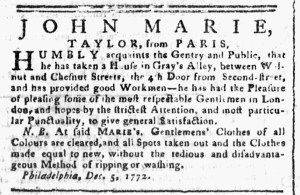
“He has had the Pleasure of pleasing some of the most respectable Gentlemen in London.”

John Marie, a tailor, wanted the better sort to know that he was well qualified to serve them at the shop he ran out of his house in Gray’s Alley in Philadelphia.  In an advertisement in the December 12, 1772, edition of the Pennsylvania Chronicle, he introduced himself as a “TAYLOR, from PARIS.”  He intended that his connection to one of the most cosmopolitan cities in Europe, a city where the fashionable often set tastes adopted in London, the most cosmopolitan city in the British Empire, would recommend him to genteel consumers in the largest and one of the most cosmopolitan cities in the colonies.  He made clear that he sought a particular kind of client by addressing “the Gentry and Public.”  Consumers and tailor would mutually benefit from their association as Marie enhanced the appearances of his clients and those clients gained the cachet of being dressed by a French tailor.

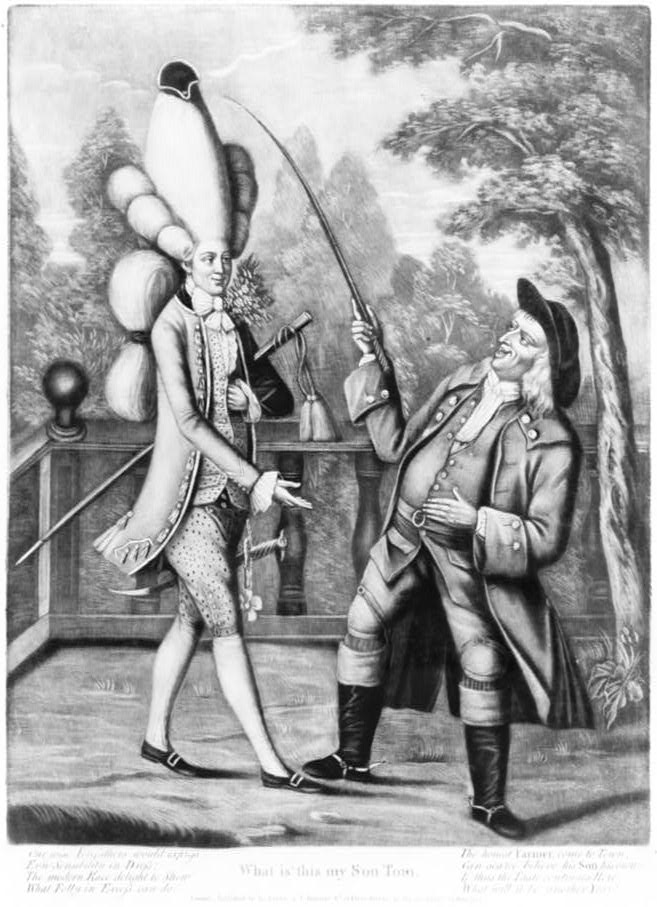
To demonstrate that he was prepared to work with the local gentry, Marie heralded his previous experience.  The tailor proclaimed that he “has had the Pleasure of pleasing some of the most respectable Gentlemen in London,” though he was too discreet to mention names.  That he served “respectable Gentlemen” suggested that he kept them outfitted according to the latest styles but did not resort to anything too frivolous or outrageous.  Prospective clients could depend on him dressing them well without transforming them into the macaronis who were the target of so much derision in both London and Philadelphia in the 1770s.  In “Fashion and the Culture Wars of Revolutionary Philadelphia,” Kate Haulman explains that the term macaroni “applied to elaborately powdered, ruffled, and corseted men of fashion” whose “suits were opulent and closely cut, with incredibly slim silhouettes.”[1]  A series of prints published in London depicted all sorts of men, “from farmers to barristers,” as macaronis.  Thus, Haulman argues, “macaroni could apply to any man who followed fashion to ape high status.”[2]  Marie suggested that he did not seek to serve such pretenders.  The gentry in Philadelphia could depend on him to dress them as “respectable Gentlemen,” just as he had done for his clients in London.

Print depicting a macaroni and his perplexed father. “What is this my Son Tom” (London: R. Sayer and J. Bennett, 1774). Courtesy Library of Congress.

[1] Kate Haulman, “Fashion and the Culture Wars of Revolutionary Philadelphia,” William and Mary Quarterly, 3rd ser., 62, no. 4 (October 2005): 635

[2] Haulman, “Fashion and the Culture Wars,” 636.

Slavery Advertisements Published December 12, 1772

The Slavery Adverts 250 Project chronicles the role of newspaper advertising in perpetuating slavery in the era of the American Revolution. The project seeks to reveal the ubiquity of slavery in eighteenth-century life from New England to Georgia by republishing advertisements about enslaved people – for sale as individuals or in groups, wanted to purchase or for hire for short periods, runaways who liberated themselves, and those who were subsequently captured and confined in jails and workhouses – in daily digests on this site as well as in real time via the @SlaveAdverts250 Twitter feed, utilizing twenty-first-century media to stand in for the print media of the eighteenth century.

The project aims to provide modern audiences with a sense of just how often colonizers encountered these advertisements in their daily lives. Enslaved men, women, and children appeared in print somewhere in the colonies almost every single day. Those advertisements served as a constant backdrop for social, cultural, economic, and political life in colonial and revolutionary America. Colonizers who did not purport to own enslaved people were still confronted with slavery as well as invited to maintain the system by purchasing enslaved men, women, and children or assisting in the capture of so-called “runaways” who sought to free themselves from bondage. The frequency of these newspaper advertisements suggests just how embedded slavery was in colonial and revolutionary American culture in everyday interactions beyond the printed page.

These advertisements also testify to the experiences of enslaved men, women, and children, though readers must consider that those experiences have been remediated through descriptions offered by enslavers rather than enslaved people themselves. Often unnamed in the advertisements, enslaved men, women, and children were not invisible or unimportant in early America.

These advertisements appeared in colonial American newspapers 250 years ago today.

Pennsylvania Chronicle (December 12, 1772).

**********

Providence Gazette (December 12, 1772).

December 11

What was advertised in a colonial American newspaper 250 years ago today?

New-London Gazette (December 11, 1772).

“All the above articles will be sold lower than can be bought either in [New] York or Boston.”

In the fall of 1772, Ebenezer Backus, Jr., ran multiple advertisements for goods available at his store in Norwich, Connecticut, in the New-London GazetteOne of those advertisements may very well have circulated separately as a broadside or handbill.  It occupied almost an entire page in the November 20 edition.  An advertisement of that size would have been expensive.  In subsequent issues, Backus published another advertisement, one more in line with the length of advertisements published by other purveyors of goods and services.

Like the longer advertisement, the shorter version included a list of goods.  To help prospective customers navigate that list, Backus divided his notice into two columns with only one or two items per line rather than including everything in a paragraph of dense text.  He stocked a variety of textiles, including checks, ginghams, damasks, “Pelong Sattins,” and “Plain Sattins” as well as accessories like buttons, “Barcelona Handkerchiefs of different colours,” and a “Compleat assortment of Ribbons.”  Beyond merchandise intended for making garments, Backus also sold “Cream coloured Ware of all Kinds.”

Although Backus included fewer goods in this advertisement than his previous one, he did add a new marketing appeal with the intention of capturing the attention of prospective customers.  In a nota bene that concluded the notice, Backus asserted that “All the above articles will be sold lower than can be bought either in [New] York or Boston.”  Consumers in and around Norwich may have expected to pay more to acquire goods in the small town of Norwich than in the region’s major urban ports, but Backus assured them that was not the case.  He hoped to entice them with bargains as good or even better than they would encounter elsewhere.  In so doing, he demonstrated that the consumer revolution reached even small towns where colonizers had access to the same goods at the same prices as their counterparts in the largest cities in the colonies.

Slavery Advertisements Published December 11, 1772

The Slavery Adverts 250 Project chronicles the role of newspaper advertising in perpetuating slavery in the era of the American Revolution. The project seeks to reveal the ubiquity of slavery in eighteenth-century life from New England to Georgia by republishing advertisements about enslaved people – for sale as individuals or in groups, wanted to purchase or for hire for short periods, runaways who liberated themselves, and those who were subsequently captured and confined in jails and workhouses – in daily digests on this site as well as in real time via the @SlaveAdverts250 Twitter feed, utilizing twenty-first-century media to stand in for the print media of the eighteenth century.

The project aims to provide modern audiences with a sense of just how often colonizers encountered these advertisements in their daily lives. Enslaved men, women, and children appeared in print somewhere in the colonies almost every single day. Those advertisements served as a constant backdrop for social, cultural, economic, and political life in colonial and revolutionary America. Colonizers who did not purport to own enslaved people were still confronted with slavery as well as invited to maintain the system by purchasing enslaved men, women, and children or assisting in the capture of so-called “runaways” who sought to free themselves from bondage. The frequency of these newspaper advertisements suggests just how embedded slavery was in colonial and revolutionary American culture in everyday interactions beyond the printed page.

These advertisements also testify to the experiences of enslaved men, women, and children, though readers must consider that those experiences have been remediated through descriptions offered by enslavers rather than enslaved people themselves. Often unnamed in the advertisements, enslaved men, women, and children were not invisible or unimportant in early America.

These advertisements appeared in colonial American newspapers 250 years ago today.

New-Hampshire Gazette (December 11, 1772).

**********

New-London Gazette (December 11, 1772).

December 10

What was advertised in a colonial American newspaper 250 years ago today?

New-York Journal (December 10, 1772).

“Christmas pieces.”

In December 1772, John Holt, printer of the New-York Journal, ran an advertisement that listed a variety of stationery wares imported via the Lady Gage and other vessels recently arrived from London and now available for sale at his printing office.  Holt’s inventory included “ACCOUNT, and blank books of all sorts and sizes,” “Writing paper of all kinds from the lowest to the highest prices … with black, or gilt edges, or plain,” “Receipt books of all sorts and sizes, with and without clasps, some interleaved with blotting paper,” and “Very best red and black wax of all Sorts, and wafers in boxes.”

Given the time of the year, Holt stocked “Almanacks of several sorts for the Year 1773.”  In a nod to the holiday that would take place just a week before the new year, the printer also listed “Christmas pieces” among the pamphlets he carried.  He did not, however, suggest that any of his other merchandise, such as “Newberry’s children’s books of all sorts” and “Best Merry Andrew and Harry’s playing cards,” might make for good Christmas gifts.

That Holt even mentioned “Christmas pieces” in December did distinguish him from other merchants and shopkeepers.  In stark contrast to today’s association of Christmas with marketing and consumerism, colonizers did not make the same connections.  Only rarely did retailers attempt to make sale by encouraging consumers to purchase gifts.  The appropriately named Garrat Noel, a bookseller and stationer in New York, did so in December 1765 when he “offer[ed] to the Public, the following List of Books, as proper for Christmas Presents and New-Year’s Gifts.”  He confided that he set “extraordinary low Prices” as “an Encouragement to those who are willing to be generous on the Occasion.”  He described that holiday sale as “his annual Custom.”  Most other retailers did not adopt or expand that custom.  John Mein, a bookseller in Boston, marketed a “Large Assortment of entertaining and instructive Books for Children, very proper for Christmas and New Year’s Gifts,” the following year, but throughout the colonies such examples were rare.

Marketing and Christmas were not yet synonymous in eighteenth-century America, despite the efforts of a few booksellers to connect purchasing gifts, especially for children, and the holiday.  Holt’s “Christmas pieces” may very well have been devotional literature not intended as gifts.  The pages of colonial newspapers carried very different messages about Christmas and consumerism than newspapers, radios, televisions, and the internet would disseminate in December in later centurires.