December 4

What was advertised in a colonial American newspaper 250 years ago today?

Connecticut Journal (December 4, 1772).

“Whoever shall take up the said Mare and return her … shall have One Dollar Reward.”

William Hickcok’s advertisement about a bay mare “STRAYED or Stolen” from a local stable must have arrived in the printing office of the Connecticut Journal just before the December 4, 1772, edition went to press.  That would explain its unusual placement on the third page of that issue.  The notice ran across the bottom of the page, divided into three columns of four lines each.  A line ran above Hickcok’s advertisement, making clear where other content ended and his notice began.

Thomas Green and Samuel Green, the printers of the Connecticut Journal, or a compositor who worked in their printing office made room for the advertisement rather than forcing Hickcok to wait an entire week for the next issue.  Like other colonial American newspapers, a standard issue of the Connecticut Journal consisted of four pages created by printing two pages on each side of a broadside and then folding it in half.  Printers typically produced the front and final pages first, reserving the second and third pages for the most current news and advertising.  That seems to have been the case for the December 4 edition.  Advertisements that previously ran in the newspaper, including one dated November 13 and another dated November 16, appeared on the front page, along with news from London that continued on the second page.  The third page featured recent news from Boston and New York and shipping news from the customs house as well as some advertisements from previous issues and two new advertisements dated December 4 (in addition to Hickcok’s advertisement with that date).  Hickcok’s advertisement ran in what otherwise would have been the margin at the bottom of the page.

A week later, Hickcok’s notice ran once again, this time in a single column on the first page.  Whoever set the type anticipated a means of saving time and labor.  By setting the type in columns, even though the advertisement initially ran across the bottom of the entire page, the compositor eliminated the necessity of breaking down the type and setting it again for the next issue.  In this way, the printing office managed to accommodate Hickcok’s desire to run his advertisement as soon as possible while minimizing the amount of additional time and labor required to do so.

Slavery Advertisements Published December 4, 1772

The Slavery Adverts 250 Project chronicles the role of newspaper advertising in perpetuating slavery in the era of the American Revolution. The project seeks to reveal the ubiquity of slavery in eighteenth-century life from New England to Georgia by republishing advertisements about enslaved people – for sale as individuals or in groups, wanted to purchase or for hire for short periods, runaways who liberated themselves, and those who were subsequently captured and confined in jails and workhouses – in daily digests on this site as well as in real time via the @SlaveAdverts250 Twitter feed, utilizing twenty-first-century media to stand in for the print media of the eighteenth century.

The project aims to provide modern audiences with a sense of just how often colonizers encountered these advertisements in their daily lives. Enslaved men, women, and children appeared in print somewhere in the colonies almost every single day. Those advertisements served as a constant backdrop for social, cultural, economic, and political life in colonial and revolutionary America. Colonizers who did not purport to own enslaved people were still confronted with slavery as well as invited to maintain the system by purchasing enslaved men, women, and children or assisting in the capture of so-called “runaways” who sought to free themselves from bondage. The frequency of these newspaper advertisements suggests just how embedded slavery was in colonial and revolutionary American culture in everyday interactions beyond the printed page.

These advertisements also testify to the experiences of enslaved men, women, and children, though readers must consider that those experiences have been remediated through descriptions offered by enslavers rather than enslaved people themselves. Often unnamed in the advertisements, enslaved men, women, and children were not invisible or unimportant in early America.

These advertisements appeared in colonial American newspapers 250 years ago today.

Massachusetts Gazette and Boston Weekly News-Letter (December 4, 1772).

**********

Massachusetts Gazette and Boston Weekly News-Letter (December 4, 1772).

**********

Massachusetts Gazette and Boston Weekly News-Letter (December 4, 1772).

**********

Massachusetts Gazette and Boston Weekly News-Letter (December 4, 1772).

**********

Massachusetts Gazette and Boston Weekly News-Letter (December 4, 1772).

**********

Massachusetts Spy (December 4, 1772).

December 3

What was advertised in a colonial American newspaper 250 years ago today?

New-York Journal (December 3, 1772).

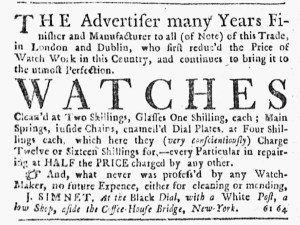
“Every Particular in repairing at HALF the PRICE charged by any other.”

In early December 1772, watchmaker John Simnet inserted a new advertisement in the New-York Journal.  Simnet had a long history of advertising, first in New Hampshire and then in New York.  He sometimes promoted the services he provided, but other times denigrated the skill and character of one competitor or another.  This time he opted to compare his prices and ancillary services to those offered by other watchmakers, but he did not launch any attacks against particular rivals.

Simnet incorporated superlatives into his advertisement.  He mentioned his origins, declaring that he had been “many Years [a] Finisher and Manufacturer to all (of Note) of this Trade, in London and Dublin.”  In other words, he previously worked in only the best workshops in those cities before migrating to the colonies.  Upon his arrival he became the “first [who] reduc’d the Price of Watch Work in this Country,” suggesting that others charged far too much for the mending and cleaning services they provided.  Simnet also proclaimed that he “continues to bring it to the utmost Perfection,” leaving it to readers to determine if “it” meant prices alone or the entire watchmaking trade.

To entice prospective clients to avail themselves of his services, Siment listed his prices.  He charged two shillings to clean watches and one to clean watch glasses.  He replaced “Main Springs, inside Chains, [and] enamell’d Dial Plates, at Four Shillings each,” compared to others in the colonies who “(very conscientiously) Charge Twelve or Sixteen Shillings.”  He accused the industry of purposely charging three or four times what the prices should have been for replacing certain parts.  As for other fixing other parts of watches, Simnet asserted that he asked “HALF the Price charged by any other.”

If those prices were not enough to get clients into his shop, the watchmaker offered ancillary services for free.  He promised “no future Expence, wither for cleaning or mending” for any watches purchased from him.  Deploying one more superlative, Simnet proclaimed that such a deal “never was profess’d by any Watch-Maker” in the colonies.  Simnet had a high opinion of himself and the work undertaken in his shop.  He hoped that his confidence would convince prospective clients to choose him over his competitors, though he also compared prices and provided supplementary services as part of his sales pitch.

Slavery Advertisements Published December 3, 1772

The Slavery Adverts 250 Project chronicles the role of newspaper advertising in perpetuating slavery in the era of the American Revolution. The project seeks to reveal the ubiquity of slavery in eighteenth-century life from New England to Georgia by republishing advertisements about enslaved people – for sale as individuals or in groups, wanted to purchase or for hire for short periods, runaways who liberated themselves, and those who were subsequently captured and confined in jails and workhouses – in daily digests on this site as well as in real time via the @SlaveAdverts250 Twitter feed, utilizing twenty-first-century media to stand in for the print media of the eighteenth century.

The project aims to provide modern audiences with a sense of just how often colonizers encountered these advertisements in their daily lives. Enslaved men, women, and children appeared in print somewhere in the colonies almost every single day. Those advertisements served as a constant backdrop for social, cultural, economic, and political life in colonial and revolutionary America. Colonizers who did not purport to own enslaved people were still confronted with slavery as well as invited to maintain the system by purchasing enslaved men, women, and children or assisting in the capture of so-called “runaways” who sought to free themselves from bondage. The frequency of these newspaper advertisements suggests just how embedded slavery was in colonial and revolutionary American culture in everyday interactions beyond the printed page.

These advertisements also testify to the experiences of enslaved men, women, and children, though readers must consider that those experiences have been remediated through descriptions offered by enslavers rather than enslaved people themselves. Often unnamed in the advertisements, enslaved men, women, and children were not invisible or unimportant in early America.

These advertisements appeared in colonial American newspapers 250 years ago today.

Maryland Gazette (December 3, 1772).

**********

Maryland Gazette (December 3, 1772).

**********

Maryland Gazette (December 3, 1772).

**********

New-York Journal (December 3, 1772).

**********

South-Carolina Gazette (December 3, 1772).

**********

South-Carolina Gazette (December 3, 1772).

**********

South-Carolina Gazette (December 3, 1772).

**********

South-Carolina Gazette (December 3, 1772).

**********

South-Carolina Gazette (December 3, 1772).

**********

South-Carolina Gazette (December 3, 1772).

**********

South-Carolina Gazette (December 3, 1772).

**********

South-Carolina Gazette (December 3, 1772).

**********

Supplement to the South-Carolina Gazette (December 3, 1772).

**********

Supplement to the South-Carolina Gazette (December 3, 1772).

**********

Supplement to the South-Carolina Gazette (December 3, 1772).

**********

Supplement to the South-Carolina Gazette (December 3, 1772).

**********

Supplement to the South-Carolina Gazette (December 3, 1772).

**********

Supplement to the South-Carolina Gazette (December 3, 1772).

**********

Supplement to the South-Carolina Gazette (December 3, 1772).

**********

Virginia Gazette [Purdie and Dixon] (December 3, 1772).

**********

Virginia Gazette [Purdie and Dixon] (December 3, 1772).

**********

Virginia Gazette [Purdie and Dixon] (December 3, 1772).

**********

Virginia Gazette [Purdie and Dixon] (December 3, 1772).

**********

Virginia Gazette [Purdie and Dixon] (December 3, 1772).

**********

Virginia Gazette [Purdie and Dixon] (December 3, 1772).

**********

Virginia Gazette [Purdie and Dixon] (December 3, 1772).

**********

Virginia Gazette [Purdie and Dixon] (December 3, 1772).

**********

Virginia Gazette [Purdie and Dixon] (December 3, 1772).

**********

Virginia Gazette [Purdie and Dixon] (December 3, 1772).

**********

Virginia Gazette [Purdie and Dixon] (December 3, 1772).

**********

Virginia Gazette [Purdie and Dixon] (December 3, 1772).

**********

Virginia Gazette [Purdie and Dixon] (December 3, 1772).

**********

Virginia Gazette [Purdie and Dixon] (December 3, 1772).

**********

Virginia Gazette [Purdie and Dixon] (December 3, 1772).

**********

Virginia Gazette [Purdie and Dixon] (December 3, 1772).

**********

Virginia Gazette [Rind] (December 3, 1772).

**********

Virginia Gazette [Rind] (December 3, 1772).

**********

Virginia Gazette [Rind] (December 3, 1772).

**********

Virginia Gazette [Rind] (December 3, 1772).

**********

Virginia Gazette [Rind] (December 3, 1772).

December 2

What was advertised in a colonial American newspaper 250 years ago today?

Pennsylvania Journal (December 2, 1772).

“For LONDONDERRY, The Ship FAME, HUGH LISLE, Master.”

The Pennsylvania Journal relayed shipping news from other ports as well as lists of vessels that “Entered in,” “Outwards,” and “Cleared” from the customs house in Philadelphia.  In addition, the newspaper carried advertisements about vessels seeking freight and passengers heading to various ports throughout the British Atlantic world.  Stock images of ships at sea often adorned those advertisements.

Sometimes the pages of the newspaper may have seemed as crowded as the docks in Philadelphia, a bustling port and the largest city in the colonies on the eve of the American Revolution.  Fourteen such advertisements, each with an image of a ship, ran in the December 2, 1772, edition in advance of vessels departing for Antigua, Belfast, Charleston, Drogheda, Londonderry, and Newry.  Ten of them appeared on the final page.  Filling an entire column, they impressed on readers the connections between Philadelphia and other parts of the empire.

Other newspapers published in Philadelphia also ran such advertisements, but the Pennsylvania Journal seemed to be the most popular place for merchants and captains to promote upcoming voyages.  On December 2, the Pennsylvania Gazetteran ten of those advertisements, eight of them clustered together in a single column.  Earlier in the week, the Pennsylvania Packet carried only three such advertisements on November 30.  Later in the week, the Pennsylvania Chronicle carried just one on December 5.  Many, but not all, of the advertisements that ran in other newspapers also ran in the Pennsylvania Journal.  The notice concerning the Fame, headed to Londonderry, for instance, appeared in the Pennsylvania Chronicle and the Pennsylvania Packet as well as the Pennsylvania Journal.  The notice about the Minerva’s upcoming voyage to Newry ran in both the Pennsylvania Gazette and the Pennsylvania Journal.  On the other hand, the advertisement announcing that the Industry would sail to Newry and Drogheda appeared solely in the Pennsylvania Packet.

Whether they had been published for decades or just a few years, each of the newspapers printed in Philadelphia featured extensive advertising.  Those who placed notices expressed confidence in the circulation of each newspaper to reach readers who would benefit from the information they paid to insert.  At the same time, merchants and masters of vessels seemed to have the greatest confidence that advertising in the Pennsylvania Journal would yield the results they desired, at least during one week late in the fall of 1772.  This raises a question worth exploring in more detail: did advertisers … and readers … have different expectations about the kinds of notices they would encounter in the various newspapers published in Philadelphia in the 1770s?

Slavery Advertisements Published December 2, 1772

The Slavery Adverts 250 Project chronicles the role of newspaper advertising in perpetuating slavery in the era of the American Revolution. The project seeks to reveal the ubiquity of slavery in eighteenth-century life from New England to Georgia by republishing advertisements about enslaved people – for sale as individuals or in groups, wanted to purchase or for hire for short periods, runaways who liberated themselves, and those who were subsequently captured and confined in jails and workhouses – in daily digests on this site as well as in real time via the @SlaveAdverts250 Twitter feed, utilizing twenty-first-century media to stand in for the print media of the eighteenth century.

The project aims to provide modern audiences with a sense of just how often colonizers encountered these advertisements in their daily lives. Enslaved men, women, and children appeared in print somewhere in the colonies almost every single day. Those advertisements served as a constant backdrop for social, cultural, economic, and political life in colonial and revolutionary America. Colonizers who did not purport to own enslaved people were still confronted with slavery as well as invited to maintain the system by purchasing enslaved men, women, and children or assisting in the capture of so-called “runaways” who sought to free themselves from bondage. The frequency of these newspaper advertisements suggests just how embedded slavery was in colonial and revolutionary American culture in everyday interactions beyond the printed page.

These advertisements also testify to the experiences of enslaved men, women, and children, though readers must consider that those experiences have been remediated through descriptions offered by enslavers rather than enslaved people themselves. Often unnamed in the advertisements, enslaved men, women, and children were not invisible or unimportant in early America.

These advertisements appeared in colonial American newspapers 250 years ago today.

Pennsylvania Gazette (December 2, 1772).

**********

Pennsylvania Journal (December 2, 1772).

December 1

What was advertised in a colonial American newspaper 250 years ago today?

South-Carolina Gazette and Country Journal (December 1, 1772).

“PIKE’s ANNUAL BALL.”

The December 1, 1772, edition of the South-Carolina Gazette and Country Journal carried an advertisement that proclaimed “BALL” in a larger font than anything else in the entire issue.  That headline drew attention to an announcement that “PIKE’s ANNUAL BALL, for the young LADIES and GENTLEMEN, under his Tuition, will be on Tuesday the Eighth of December.”  The event would begin “exactly at SIX o’CLOCK.”  Presumably members of the community other than the dancing master’s students were welcome to attend the ball to observe the skills that Pike taught in what he had promoted as a “NEW SUIT of ROOMS” in another advertisement that he published in September.

Pike concluded that advertisement with a message to the “Parents and Guardians of his Scholars, that his BALL will be on Tuesday the 8th of December next.”  He underscored that they needed to sign up for classes “as soon as possible, that they may be enabled to complete his Figures in a proper Manner” when they were on display at the ball.  The dancing master aimed to excite some anxiety about public scrutiny, knowing that colonizers carefully observed each other to assess whether their appearance and comportment revealed authentic grace and gentility …or whether they merely put on an act and went through the motions.  Effortless dancing, many believed, revealed virtue, while stumbling around the dance floor and awkwardly interacting with partners and other dancers suggested character flaws.

As a result, colonizers who wished to demonstrate that they truly belonged among the ranks of the genteel relied on the services of various instructors, including tutors who taught them how to speak French, tutors who taught them how to play musical instruments, and dancing and fencing masters, like Pike, who taught them how to move gracefully and how to engage in polite exchanges at social gatherings.  In cautioning the parents and guardians of his prospective pupils that “his SCHOLARS” would be on display at his annual ball in December, Pike reminded them that they needed his services just as much as he needed their patronage if they wished to safeguard their social standing.

Slavery Advertisements Published December 1, 1772

The Slavery Adverts 250 Project chronicles the role of newspaper advertising in perpetuating slavery in the era of the American Revolution. The project seeks to reveal the ubiquity of slavery in eighteenth-century life from New England to Georgia by republishing advertisements about enslaved people – for sale as individuals or in groups, wanted to purchase or for hire for short periods, runaways who liberated themselves, and those who were subsequently captured and confined in jails and workhouses – in daily digests on this site as well as in real time via the @SlaveAdverts250 Twitter feed, utilizing twenty-first-century media to stand in for the print media of the eighteenth century.

The project aims to provide modern audiences with a sense of just how often colonizers encountered these advertisements in their daily lives. Enslaved men, women, and children appeared in print somewhere in the colonies almost every single day. Those advertisements served as a constant backdrop for social, cultural, economic, and political life in colonial and revolutionary America. Colonizers who did not purport to own enslaved people were still confronted with slavery as well as invited to maintain the system by purchasing enslaved men, women, and children or assisting in the capture of so-called “runaways” who sought to free themselves from bondage. The frequency of these newspaper advertisements suggests just how embedded slavery was in colonial and revolutionary American culture in everyday interactions beyond the printed page.

These advertisements also testify to the experiences of enslaved men, women, and children, though readers must consider that those experiences have been remediated through descriptions offered by enslavers rather than enslaved people themselves. Often unnamed in the advertisements, enslaved men, women, and children were not invisible or unimportant in early America.

These advertisements appeared in colonial American newspapers 250 years ago today.

South-Carolina Gazette and Country Journal (December 1, 1772).

**********

South-Carolina Gazette and Country Journal (December 1, 1772).

**********

South-Carolina Gazette and Country Journal (December 1, 1772).

**********

South-Carolina Gazette and Country Journal (December 1, 1772).

**********

South-Carolina Gazette and Country Journal (December 1, 1772).

November 30

What was advertised in a colonial American newspaper 250 years ago today?

Boston-Gazette (November 30, 1772).

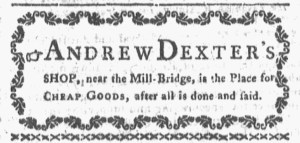
“ANDREW DEXTER’S SHOP.”

Andrew Dexter’s advertisement in the November 30, 1772, edition of the Boston-Gazette consisted of only three lines, but its design likely gave it greater impact than other notices of similar length.  A border comprised of ornamental type enclosed the entire advertisement, making the manicule that called attention to the first line an unnecessary addition.  In its entirety, the advertisement stated, “ANDREW DEXTER’S SHOP, near the Mill-Bridge, is the Place for CHEAP GOODS, after all is done and said.”

Dexter had some experience using borders to set his advertisements apart from others in newspapers published in Boston.  A lengthier advertisement that ran in the Boston Evening-Post, the Boston-Gazette, and the Massachusetts Gazette and Boston Weekly News-Letter in May featured a border.  The border was not nearly as elaborate as the one in the advertisement published in November, but so few newspaper advertisements had borders that it still served its purpose.

Boston Evening-Post (November 30, 1772).

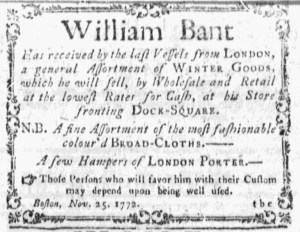
The number of advertisers who opted for borders increased in the wake of examples that Jolley Allen, who had a long history with borders, and Dexter published in multiple newspapers in May.  On the same day that Dexter’s brief notice with the prominent border ran in the Boston-Gazette, William Bant inserted advertisements with borders in both the Boston Evening-Post and the Boston-Gazette.  Jonathan Williams, Jr., once again ran his advertisement enclosed within a border in the Massachusetts Gazette and Boston Post-Boy.  Herman Brimmer and Andrew Brimmer had a border around just their names in an advertisement in the Supplement to the Boston Evening-Post.  Later in the week, Bant and Williams ran advertisements enclosed within borders in the December 4 edition of the Massachusetts Gazette and Boston Weekly News-Letter.  The Brimmers’ advertisement with a border around their names appeared in the supplement that accompanied that issue.

About half a dozen advertisers in Boston incorporated borders into their newspaper notices, publishing them so widely that they became a familiar to readers of several publications.  The majority of advertisers did not adopt this strategy for distinguishing their notices from others, but enough did so to suggest that advertisers carefully observed the tactics deployed by their competitors, including decisions about graphic design, and planned accordingly for their own advertisements.

Slavery Advertisements Published November 30, 1772

The Slavery Adverts 250 Project chronicles the role of newspaper advertising in perpetuating slavery in the era of the American Revolution. The project seeks to reveal the ubiquity of slavery in eighteenth-century life from New England to Georgia by republishing advertisements about enslaved people – for sale as individuals or in groups, wanted to purchase or for hire for short periods, runaways who liberated themselves, and those who were subsequently captured and confined in jails and workhouses – in daily digests on this site as well as in real time via the @SlaveAdverts250 Twitter feed, utilizing twenty-first-century media to stand in for the print media of the eighteenth century.

The project aims to provide modern audiences with a sense of just how often colonizers encountered these advertisements in their daily lives. Enslaved men, women, and children appeared in print somewhere in the colonies almost every single day. Those advertisements served as a constant backdrop for social, cultural, economic, and political life in colonial and revolutionary America. Colonizers who did not purport to own enslaved people were still confronted with slavery as well as invited to maintain the system by purchasing enslaved men, women, and children or assisting in the capture of so-called “runaways” who sought to free themselves from bondage. The frequency of these newspaper advertisements suggests just how embedded slavery was in colonial and revolutionary American culture in everyday interactions beyond the printed page.

These advertisements also testify to the experiences of enslaved men, women, and children, though readers must consider that those experiences have been remediated through descriptions offered by enslavers rather than enslaved people themselves. Often unnamed in the advertisements, enslaved men, women, and children were not invisible or unimportant in early America.

These advertisements appeared in colonial American newspapers 250 years ago today.

Supplement to the Boston Evening-Post (November 30, 1772).

**********

Newport Mercury (November 30, 1772).

**********

New-York Gazette and Weekly Mercury (November 30, 1772).

**********

New-York Gazette and Weekly Mercury (November 30, 1772).

**********

New-York Gazette and Weekly Mercury (November 30, 1772).

**********

New-York Gazette and Weekly Mercury (November 30, 1772).

**********

New-York Gazette and Weekly Mercury (November 30, 1772).

**********

New-York Gazette and Weekly Mercury (November 30, 1772).

**********

New-York Gazette and Weekly Mercury (November 30, 1772).

**********

Supplement to the New-York Gazette and Weekly Mercury (November 30, 1772).

**********

Supplement to the New-York Gazette and Weekly Mercury (November 30, 1772).

**********

Supplement to the New-York Gazette and Weekly Mercury (November 30, 1772).

**********

Supplement to the New-York Gazette and Weekly Mercury (November 30, 1772).

**********

Supplement to the New-York Gazette and Weekly Mercury (November 30, 1772).

**********

Supplement to the New-York Gazette and Weekly Mercury (November 30, 1772).

**********

Pennsylvania Packet (November 30, 1772).

**********

Supplement to the Pennsylvania Packet (November 30, 1772).