November 13

What was advertised in a colonial American newspaper 250 years ago today?

Maryland Journal (November 13, 1773).

“Mr. RATHELL thankfully acknowledges the receipt of a Letter signed ‘a Friend to Literary Institutions.’”

Joseph Rathell’s “PROPOSALS FOR ESTABLISHING A CIRCULATING LIBRARY IN BALTIMORE-TOWN appeared once again in the November 13, 1773, edition of the Maryland Journal.  So did William Aikman’s address “To the LADIES and GENTLEMEN of the Town of BALTIMORE concerning his efforts to establish a circulating library in Annapolis and deliver books to subscribers in Baltimore.  Aikman reported that he heard from prospective subscribers that they had concerns about “the trouble and risk they run of procuring and returning the books.”  To assuage such anxieties, he devised a plan for subscribers in Baltimore to submit orders and return books to a local merchant who would then forward them to Annapolis via a weekly packet ship.  Aikman planned to charge a dollar for delivery service in addition to the subscription fees.  Rathell mocked the additional fee in an advertisement that ran in the same issue of the Maryland Journal as Aikman’s notice.  He seemingly knew about Aikman’s advertisement before it appeared in print, perhaps tipped off by a friend in the printing office.

Whether or not that was the case, Rathell did receive other assistance from the Maryland Journal in marketing his circulating library.  The local news items included a blurb about his efforts and the response from residents of the city so far.  The blurb ran immediately below “SHIP NEWS” and before “PRICES CURRENT at BALTIMORE,” a prime spot for merchants and other readers to notice it.  It related that Rathell “thankfully acknowledges the receipt of a Letter signed ‘a Friend to Literary Institutions,’ enclosing the Names of sundry Ladies and Gentlemen, as Subscribers to his intended CIRCULATING LIBRARY.”  Readers may have doubted the veracity of this report, dismissing it as mere puffery.  Those who continued reading encountered commentary from Rathell that might have more appropriately appeared among the advertisements.  For instance, he pledged that “he will be particularly exact in selecting the Books, in which he will be principally governed by Gentlemen of known literary Skill, in Philadelphia, and New-York.”  In so doing, he directed attention away from Aikman’s library in Annapolis in favor of larger and more cosmopolitan port cities.  He also directly solicited requests from prospective subscribers to his library, proclaiming that “any Commands addressed to Mr. Rathell, directing his Attention to particular, scarce, or curious Publications, &c. shall meet due Regard.”  This advertisement masqueraded as a news item, supplementing the proposals that Rathell published elsewhere in the newspaper.  He could have incorporated all of the information into a single notice, but a news item doubled as an endorsement of his enterprise.  In the end, it did not matter.  Rathell did not manage to launch a circulating library in Baltimore.  Aikman had more success with his endeavor in Annapolis, at least prior to the Revolutionary War.

Slavery Advertisements Published November 13, 1773

The Slavery Adverts 250 Project chronicles the role of newspaper advertising in perpetuating slavery in the era of the American Revolution. The project seeks to reveal the ubiquity of slavery in eighteenth-century life from New England to Georgia by republishing advertisements about enslaved people – for sale as individuals or in groups, wanted to purchase or for hire for short periods, runaways who liberated themselves, and those who were subsequently captured and confined in jails and workhouses – in daily digests on this site as well as in real time via the @SlaveAdverts250 Twitter feed, utilizing twenty-first-century media to stand in for the print media of the eighteenth century.

The project aims to provide modern audiences with a sense of just how often colonizers encountered these advertisements in their daily lives. Enslaved men, women, and children appeared in print somewhere in the colonies almost every single day. Those advertisements served as a constant backdrop for social, cultural, economic, and political life in colonial and revolutionary America. Colonizers who did not purport to own enslaved people were still confronted with slavery as well as invited to maintain the system by purchasing enslaved men, women, and children or assisting in the capture of so-called “runaways” who sought to free themselves from bondage. The frequency of these newspaper advertisements suggests just how embedded slavery was in colonial and revolutionary American culture in everyday interactions beyond the printed page.

These advertisements also testify to the experiences of enslaved men, women, and children, though readers must consider that those experiences have been remediated through descriptions offered by enslavers rather than enslaved people themselves. Often unnamed in the advertisements, enslaved men, women, and children were not invisible or unimportant in early America.

These advertisements appeared in colonial American newspapers 250 years ago today.

Maryland Journal (November 13, 1773).

**********

Maryland Journal (November 13, 1773).

**********

Maryland Journal (November 13, 1773).

November 12

What was advertised in a colonial American newspaper 250 years ago today?

New-London Gazette (November 12, 1773).

“A COMPLEAT and ENTIRELY NEW Assortment Of the best PRINTING MATERIALS.”

Timothy Green, the printer of the New-London Gazette, made an important announcement about his business in the November 12, 1773, edition of his newspaper.  He proclaimed that he “Has just IMPORTED from LONDON, A COMPLEAT and ENTIRELY NEW Assortment Of the best PRINTING MATERIALS.”  New type and other equipment would enhance not only the newspaper, making it more attractive for both subscribers and advertisers, but also books, pamphlets, almanacs, and blanks produced in his printing office.  In addition, he sought orders for broadsides, handbills, and other job printing.  With the arrival of these “best PRINTING MATERIALS,” Green “hopes that the kind of Encouragement of the PUBLIC will not be wanting.”  He was ready to serve clients, giving “his constant Attention to please them.”

The savvy printer just happened to place the most ornate of all the advertisements in that issue of the New-London Gazetteimmediately below his own notice.  A border made of decorative type enclosed an advertisement in which David Gardiner, Jr., offered cash for “Small Furrs, Bees-Wax, old Brass, Copper, and Pewter” and hawked a “good ASSORTMENT of Ship-Chandlery Ware, Groceries of all Kinds, an Assortment of Glass and Stone Ware,” and other merchandise.  The distinctive advertisement demonstrated to prospective clients that they could place their own notices that featured visual elements designed to attract attention.  It also presented possibilities for broadsides, handbills, catalogs, billheads, blanks, and other job printing orders.

New-London Gazette (November 19, 1773).

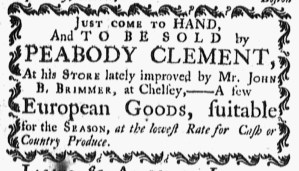
Gardiner’s advertisement ran in the next issue of the New-London Gazette, but it was no longer the only one with a decorative border.  In a new advertisement, Peabody Clement promoted imported goods “JUST COME TO HAND.” Green or one of the compositors in his shop selected different printing ornaments for Clement’s advertisement than those in Gardiner’s notice.  That distinguished the notices from each other, while also displaying some of the range of new types in Green’s printing office.  Perhaps Clement saw the printer’s announcement and Gardiner’s advertisement in the November 12 edition and that helped convince him to place his own notice and influenced his decision about the format.

Slavery Advertisements Published November 12, 1773

The Slavery Adverts 250 Project chronicles the role of newspaper advertising in perpetuating slavery in the era of the American Revolution. The project seeks to reveal the ubiquity of slavery in eighteenth-century life from New England to Georgia by republishing advertisements about enslaved people – for sale as individuals or in groups, wanted to purchase or for hire for short periods, runaways who liberated themselves, and those who were subsequently captured and confined in jails and workhouses – in daily digests on this site as well as in real time via the @SlaveAdverts250 Twitter feed, utilizing twenty-first-century media to stand in for the print media of the eighteenth century.

The project aims to provide modern audiences with a sense of just how often colonizers encountered these advertisements in their daily lives. Enslaved men, women, and children appeared in print somewhere in the colonies almost every single day. Those advertisements served as a constant backdrop for social, cultural, economic, and political life in colonial and revolutionary America. Colonizers who did not purport to own enslaved people were still confronted with slavery as well as invited to maintain the system by purchasing enslaved men, women, and children or assisting in the capture of so-called “runaways” who sought to free themselves from bondage. The frequency of these newspaper advertisements suggests just how embedded slavery was in colonial and revolutionary American culture in everyday interactions beyond the printed page.

These advertisements also testify to the experiences of enslaved men, women, and children, though readers must consider that those experiences have been remediated through descriptions offered by enslavers rather than enslaved people themselves. Often unnamed in the advertisements, enslaved men, women, and children were not invisible or unimportant in early America.

These advertisements appeared in colonial American newspapers 250 years ago today.

New-London Gazette (November 12, 1773).

November 11

What was advertised in a colonial American newspaper 250 years ago today?

Rivington’s New-York Gazetteer (November 11, 1773).

“Dr. OGDEN’S very successful Method of Cure, which the Printer inserted in the Almanack at the particular request of some of the Inhabitants.”

As the new year approached and printers throughout the colonies advertised almanacs for 1774, James Rivington of New York took to the pages of his own newspaper to advise prospective customers that the “very great Demand for Rivington’s Almanack … HAS occasioned him to print a new Edition.”  Like many other printers who marketed the almanacs they published, Rivington provided an extensive list of the contents as a means of generating interest.  He enumerated twenty items.  They included helpful reference information, such as “Courts in this and the neighbouring Provinces,” “Fairs,” “FRIENDS Meetings,” and “Roads.”  They also included six “Cures for Disorders in Horses” and five “Receipts [or cures] from some of the most eminent Physicians” for a variety of symptoms.  For entertainment, the almanac contained “Pleasant Jests.”  For the edification of readers, it included “A very important Lesson.”  Rivington emphasized that the contents of his almanac “vary in many particulars from others” sold by competitors.  The items he selected for inclusion “have been so well received by the Public, as to occasion a very large Quantity to be sold in a few Days.”  Existing demand served as a recommendation for the new edition.

Before commenting on the reception that the almanac already enjoyed or listing the contents, Rivington opened his advertisement with a note intended to resonate with prospective customers in nearby Connecticut.  “The following Almanack is particularly recommended to the Inhabitants of the Colony of Connecticut,” the printer asserted, “where the ulcerous and malignant Sore Throat, at this Time rages in a very high Degree.”  Rivington reported that he inserted “Dr, OGDEN’S very successful Method of Cure … at the particular Request of some of the Inhabitants.”  Among the contents enumerated in the advertisement, “Dr. JACOB OGDEN’S Method of treating the Malignant Sore Throat Distemper” appeared first.  That item alone, Rivington suggested, justified purchasing this particular almanac.  He implied that he provided an important service, though his altruism had limits.  After all, he could have published the “Method of Cure” in Rivington’s New-York Gazetteer; or the Connecticut, New-Jersey, Hudson’s-River, and Quebec Weekly Advertiser for the benefit of readers throughout the region he distributed his newspaper.  Still, Rivington framed his choice of contents for his almanac as an act of benevolence that took current events in account.  His awareness of the particular needs of prospective customers in Connecticut led him to respond in a manner that he intended would simultaneously contribute to public health and further his own commercial interests.

Slavery Advertisements Published November 11, 1773

The Slavery Adverts 250 Project chronicles the role of newspaper advertising in perpetuating slavery in the era of the American Revolution. The project seeks to reveal the ubiquity of slavery in eighteenth-century life from New England to Georgia by republishing advertisements about enslaved people – for sale as individuals or in groups, wanted to purchase or for hire for short periods, runaways who liberated themselves, and those who were subsequently captured and confined in jails and workhouses – in daily digests on this site as well as in real time via the @SlaveAdverts250 Twitter feed, utilizing twenty-first-century media to stand in for the print media of the eighteenth century.

The project aims to provide modern audiences with a sense of just how often colonizers encountered these advertisements in their daily lives. Enslaved men, women, and children appeared in print somewhere in the colonies almost every single day. Those advertisements served as a constant backdrop for social, cultural, economic, and political life in colonial and revolutionary America. Colonizers who did not purport to own enslaved people were still confronted with slavery as well as invited to maintain the system by purchasing enslaved men, women, and children or assisting in the capture of so-called “runaways” who sought to free themselves from bondage. The frequency of these newspaper advertisements suggests just how embedded slavery was in colonial and revolutionary American culture in everyday interactions beyond the printed page.

These advertisements also testify to the experiences of enslaved men, women, and children, though readers must consider that those experiences have been remediated through descriptions offered by enslavers rather than enslaved people themselves. Often unnamed in the advertisements, enslaved men, women, and children were not invisible or unimportant in early America.

These advertisements appeared in colonial American newspapers 250 years ago today.

Maryland Gazette (November 11, 1773).

**********

Maryland Gazette (November 11, 1773).

**********

Maryland Gazette (November 11, 1773).

**********

Maryland Gazette (November 11, 1773).

**********

Maryland Gazette (November 11, 1773).

**********

Maryland Gazette (November 11, 1773).

**********

Maryland Gazette (November 11, 1773).

**********

Maryland Gazette (November 11, 1773).

**********

Massachusetts Spy (November 11, 1773).

**********

Virginia Gazette [Purdie and Dixon] (November 11, 1773).

**********

Virginia Gazette [Purdie and Dixon] (November 11, 1773).

**********

Virginia Gazette [Purdie and Dixon] (November 11, 1773).

**********

Virginia Gazette [Purdie and Dixon] (November 11, 1773).

**********

Virginia Gazette [Purdie and Dixon] (November 11, 1773).

**********

Virginia Gazette [Purdie and Dixon] (November 11, 1773).

**********

Virginia Gazette [Purdie and Dixon] (November 11, 1773).

**********

Virginia Gazette [Purdie and Dixon] (November 11, 1773).

**********

Virginia Gazette [Rind] (November 11, 1773).

**********

Virginia Gazette [Rind] (November 11, 1773).

**********

Virginia Gazette [Rind] (November 11, 1773).

November 10

What was advertised in a colonial American newspaper 250 years ago today?

Pennsylvania Journal (November 10, 1773).

“For terms of freight or passage apply … at the London Coffee-House.”

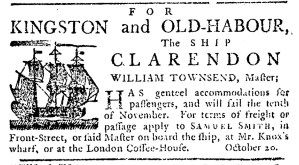
The Clarendon prepared to sail from Philadelphia to Kingston and Old Harbour in Jamaica on November 10, 1773.  In advance of the ship’s departure, newspaper advertisements promoted “genteel accommodations for passengers” and solicited cargo for the voyage.  Those notices continued until the day the Clarendon was scheduled to leave port, appearing in the November 10 edition of the Pennsylvania Journal.  By then, neither Samuel Smith, the merchant who sponsored the voyage, nor William Townsend, the captain, probably did not accept freight that would cause delays by taking too long to load, but perhaps welcomed passengers who waited until the last minute.  Townsend likely gathered letters to deliver to correspondents in Jamaica for as long as the ship remained in port.  The advertisement advised that anyone with business for the Clarendon should apply to Smith “in Front-Street,” the captain “at Mr. Knox’s wharf, or at the London Coffee-House.”

It was not that only advertisement in that issue of the Pennsylvania Journal that listed the London Coffee House as one of the locations designated for meeting with masters of vessels to conduct business.  A notice for the Lovely Lass, departing for Jamaica under the command of Andrew Waid before the end of November, directed readers “to CRAIG and MORRELL, or the said Master, at the London Coffee-House.”  Similarly, the Lydia, under the command of Thomas Dean, “WILL sail with all convenient speed” to Liverpool, “having part of her cargo ready to go on board.”  To arrange freight or passage, readers needed to contact “Jeremiah Warder and Sons, said master on board, or at the London Coffee-House.”  Another ship, the Charming Nancy, would depart for Jamaica under the command of Charles Biddle on December 1.  A familiar refrain instructed readers to “apply to MATTHIAS ASPDEN, or said Master on board, or at the London Coffee-House.”

Not every advertisement adorned with a woodcut depicting a ship at sea made reference to the London Coffee House, but four out of ten in that edition of the Pennsylvania Journal listed that landmark as one of the places to meet with merchants and captains to arrange for freight or passage.  Readers did not have to reside in Philadelphia to realize that the London Coffee House was an important gathering place for conducting business during the era of the American Revolution.  Advertisements testified to how often merchants and captains frequented the establishment to meet with associates and customers.

Slavery Advertisements Published November 10, 1773

The Slavery Adverts 250 Project chronicles the role of newspaper advertising in perpetuating slavery in the era of the American Revolution. The project seeks to reveal the ubiquity of slavery in eighteenth-century life from New England to Georgia by republishing advertisements about enslaved people – for sale as individuals or in groups, wanted to purchase or for hire for short periods, runaways who liberated themselves, and those who were subsequently captured and confined in jails and workhouses – in daily digests on this site as well as in real time via the @SlaveAdverts250 Twitter feed, utilizing twenty-first-century media to stand in for the print media of the eighteenth century.

The project aims to provide modern audiences with a sense of just how often colonizers encountered these advertisements in their daily lives. Enslaved men, women, and children appeared in print somewhere in the colonies almost every single day. Those advertisements served as a constant backdrop for social, cultural, economic, and political life in colonial and revolutionary America. Colonizers who did not purport to own enslaved people were still confronted with slavery as well as invited to maintain the system by purchasing enslaved men, women, and children or assisting in the capture of so-called “runaways” who sought to free themselves from bondage. The frequency of these newspaper advertisements suggests just how embedded slavery was in colonial and revolutionary American culture in everyday interactions beyond the printed page.

These advertisements also testify to the experiences of enslaved men, women, and children, though readers must consider that those experiences have been remediated through descriptions offered by enslavers rather than enslaved people themselves. Often unnamed in the advertisements, enslaved men, women, and children were not invisible or unimportant in early America.

These advertisements appeared in colonial American newspapers 250 years ago today.

Pennsylvania Gazette (November 10, 1773).

November 9

What was advertised in a colonial American newspaper 250 years ago today?

Connecticut Courant (November 9, 1773).

“Shall have their Money return’d if the Work he does shall not be found upon Tryal to answer their End.”

In the fall of 1773, Enos Doolittle, a silversmith, took to the pages of the Connecticut Courant to advise prospective clients that he also offered services as a “CLOCK and WATCH-MAKER.”  To that end, he “lately furnished himself with a universal Assortment of WATCH FURNITURE” or parts, including springs, glasses, dial plates, keys, and seals.  Doolittle assured “Any Gentlemen that please to Favour him with their Custom” that he possessed the skills necessary both to repair damaged clocks and watches or make new ones.

To entice prospective customers, Doolittle presented a return policy.  He pledged that customers “shall have their Money return’d if the Work he does shall not be found upon Tryal to answer their End.”  That put him in company with other watchmakers who issued similar guarantees.  For instance, Thomas Hilldrup, a “WATCH MAKER from LONDON” who advertised extensively in newspapers published in Connecticut during the previous year, asserted that he “restored [watches] to their pristine vigour, and warranted [them] to perform well, free of any expence for one year.”  Similarly, Issac Heron in New York noted, “As usual, he warrants their performance – not for ever, but one year,” while Thomas Morgan in Baltimore “proposes to engage his performance for one year, provided the owners do not abuse the same, nor apply to unskilful hands, where many good watches are greatly abused for want of experience.”  Watchmakers set some conditions along with their guarantees.

Doolittle paired his warranty with a promise of low prices that matched those set by his competitors.  He may have been making a jab at the “WATCH MAKER from LONDON” who so often advertised his own shop in Hartford when he declared that “his Motives are barely to obtain such a Support as one of his Profession has a right to expect.”  Accordingly, Doolittle “is determined to Work as Cheap as any one in the Colony.”  Eschewing the pretensions that played such a significant role in advertisements placed by some of his competitors, Doolittle promised quality work for reasonable prices.  In contrast to watchmakers who sought acclaim for themselves and their work, Doolittle suggested that he labored industriously on behalf of his clients and focused on customer satisfaction.

Slavery Advertisements Published November 9, 1773

The Slavery Adverts 250 Project chronicles the role of newspaper advertising in perpetuating slavery in the era of the American Revolution. The project seeks to reveal the ubiquity of slavery in eighteenth-century life from New England to Georgia by republishing advertisements about enslaved people – for sale as individuals or in groups, wanted to purchase or for hire for short periods, runaways who liberated themselves, and those who were subsequently captured and confined in jails and workhouses – in daily digests on this site as well as in real time via the @SlaveAdverts250 Twitter feed, utilizing twenty-first-century media to stand in for the print media of the eighteenth century.

The project aims to provide modern audiences with a sense of just how often colonizers encountered these advertisements in their daily lives. Enslaved men, women, and children appeared in print somewhere in the colonies almost every single day. Those advertisements served as a constant backdrop for social, cultural, economic, and political life in colonial and revolutionary America. Colonizers who did not purport to own enslaved people were still confronted with slavery as well as invited to maintain the system by purchasing enslaved men, women, and children or assisting in the capture of so-called “runaways” who sought to free themselves from bondage. The frequency of these newspaper advertisements suggests just how embedded slavery was in colonial and revolutionary American culture in everyday interactions beyond the printed page.

These advertisements also testify to the experiences of enslaved men, women, and children, though readers must consider that those experiences have been remediated through descriptions offered by enslavers rather than enslaved people themselves. Often unnamed in the advertisements, enslaved men, women, and children were not invisible or unimportant in early America.

These advertisements appeared in colonial American newspapers 250 years ago today.

South-Carolina Gazette and Country Journal (November 9, 1773).

**********

South-Carolina Gazette and Country Journal (November 9, 1773).

**********

South-Carolina Gazette and Country Journal (November 9, 1773).

**********

South-Carolina Gazette and Country Journal (November 9, 1773).

**********

South-Carolina Gazette and Country Journal (November 9, 1773).