December 31

What was advertised in a colonial American newspaper 250 years ago today?

Connecticut Gazette (December 31, 1773).

“Clocks and Watches repaired … as well and cheap as in New-York or Boston.”

John Champlin, a goldsmith and jeweler, ran a shop in New London in the early 1770s.  He occasionally placed advertisements in the Connecticut Gazette to promote the goods and services that he provided.  For instance, as 1773 came to a close, he advised the public that he stocked a “good Assortment of cypher’d and brilliant Ear-ring & Button Stones, Locket Stones, Ring Stones of all Kinds,” “Wires of all Kinds, a neat Assortment of Files,” “Materials for repairing Clocks and Watches,” “best plated Shoe and Knee Buckles,” and “many other Articles.”  Like others advertisers, he intended that a list demonstrating the many choices he offered would entice consumers to visit his shop.

Champlin deployed other marketing strategies as well.  He made an appeal to price, asserting that he sold “All Sorts of Gold-smith, Silver-smith, and Jeweller’s Work as cheap” as anywhere else in the colony.  In so doing, he acknowledged that he operated within a regional rather than a local marketplace.  Prospective customers in New London and nearby towns had the option to send away to smiths and jewelers in New Haven, Hartford, and other towns if they thought they might get better deals, but Champlin assured them that was not necessary.  The market also extended beyond the colony.  Champlin declared that his customers “may have Clocks and Watches repaired at his Shop … as well and cheap as in New-York or Boston.”  In recent months, Thomas Hilldrup, a watchmaker in Hartford, advertised widely in newspapers in Hartford, New Haven, and New London, encouraging colonizers to send their watches to him via post riders.  Champlin may have deliberately avoided alluding to Hartford, not wishing to amplify Hillrup’s marketing efforts, and instead focused on low prices often associated with major ports.  All the same, the message was clear that customers should bring or send their clocks and watches to him rather than sending them for repairs in any other city or town.

The goldsmith and jeweler advanced and adapted some of the most common marketing appeals that appeared in eighteenth-century newspaper advertisements.  He emphasized consumer choice, low prices, and quality.  In so doing, he sought to make himself competitive not only in the town where he kept his shop but anywhere in the colony and throughout New England where readers perused the Connecticut Gazette.
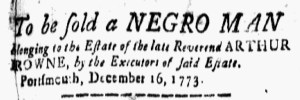
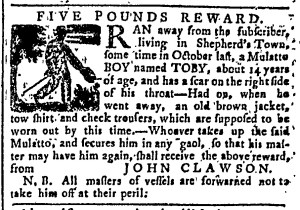
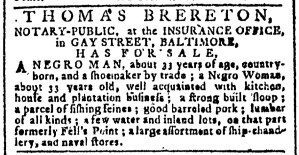
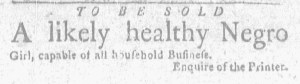
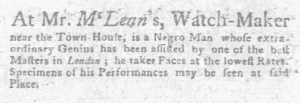
Slavery Advertisements Published December 31, 1773

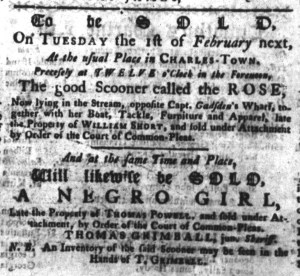
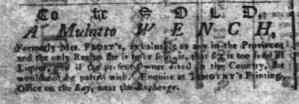
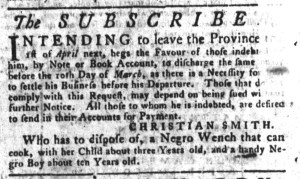
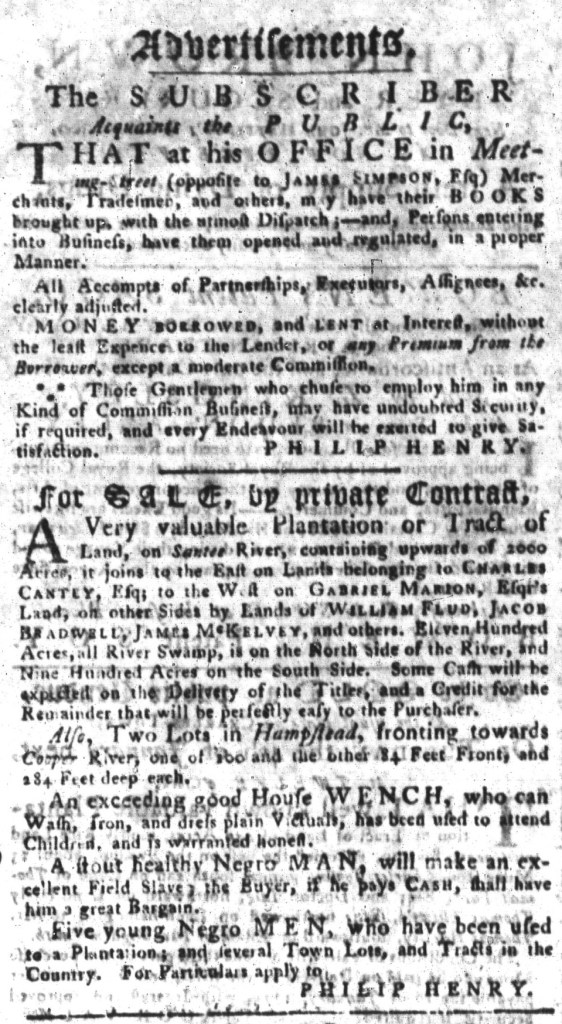
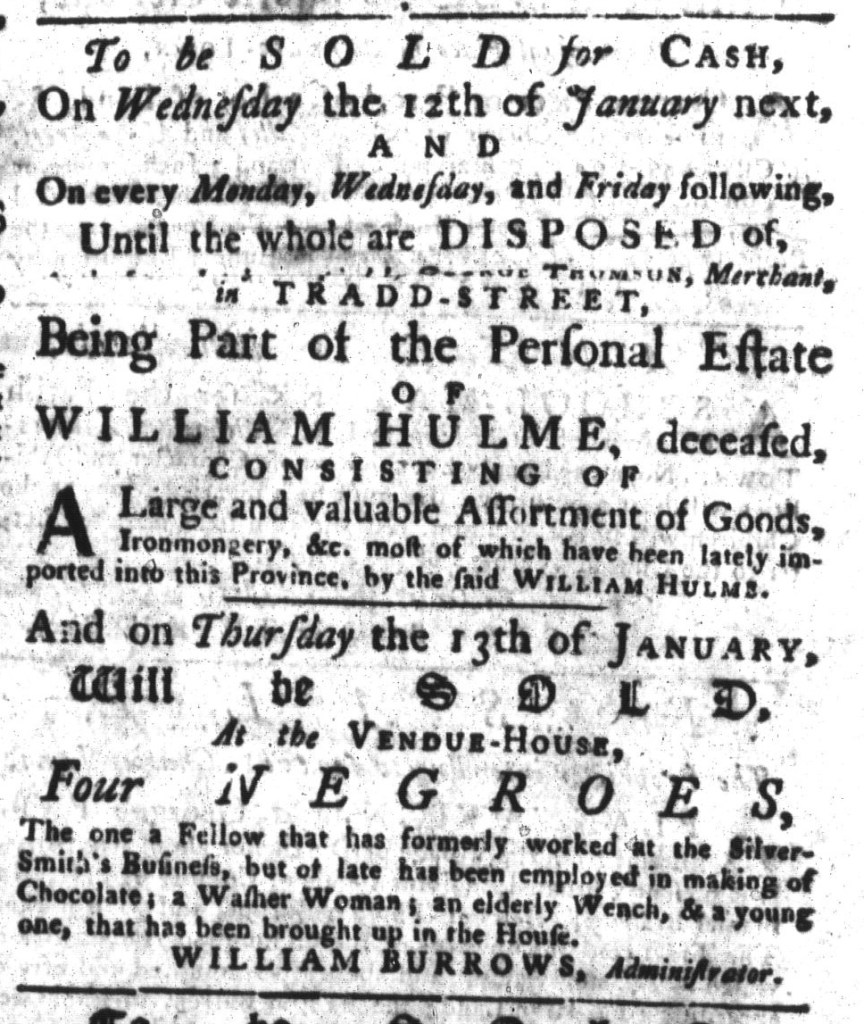
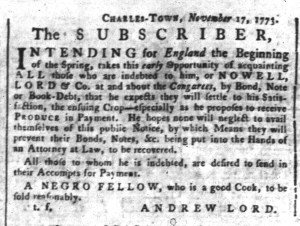
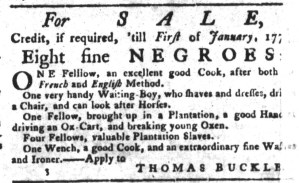
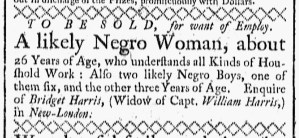
The Slavery Adverts 250 Project chronicles the role of newspaper advertising in perpetuating slavery in the era of the American Revolution. The project seeks to reveal the ubiquity of slavery in eighteenth-century life from New England to Georgia by republishing advertisements about enslaved people – for sale as individuals or in groups, wanted to purchase or for hire for short periods, runaways who liberated themselves, and those who were subsequently captured and confined in jails and workhouses – in daily digests on this site as well as in real time via the @SlaveAdverts250 Twitter feed, utilizing twenty-first-century media to stand in for the print media of the eighteenth century.

The project aims to provide modern audiences with a sense of just how often colonizers encountered these advertisements in their daily lives. Enslaved men, women, and children appeared in print somewhere in the colonies almost every single day. Those advertisements served as a constant backdrop for social, cultural, economic, and political life in colonial and revolutionary America. Colonizers who did not purport to own enslaved people were still confronted with slavery as well as invited to maintain the system by purchasing enslaved men, women, and children or assisting in the capture of so-called “runaways” who sought to free themselves from bondage. The frequency of these newspaper advertisements suggests just how embedded slavery was in colonial and revolutionary American culture in everyday interactions beyond the printed page.
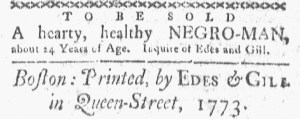
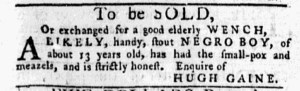
These advertisements also testify to the experiences of enslaved men, women, and children, though readers must consider that those experiences have been remediated through descriptions offered by enslavers rather than enslaved people themselves. Often unnamed in the advertisements, enslaved men, women, and children were not invisible or unimportant in early America.

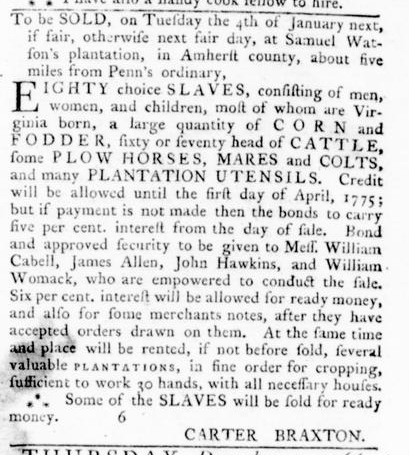
These advertisements appeared in colonial American newspapers 250 years ago today.

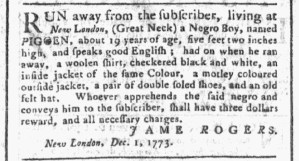
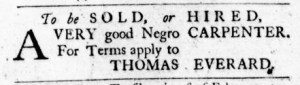
Connecticut Gazette (December 31, 1773).

**********

New-Hampshire Gazette (December 31, 1773).

December 30

What was advertised in a colonial American newspaper 250 years ago today?

Massachusetts Spy (December 30, 1773).

“THE Editor of the ROYAL AMERICAN MAGAZINE, presents his most respectful Compliments.”

After advertising the Royal American Magazine more widely than in any previous month in November 1773, Isaiah Thomas placed fewer advertisements in December.  In total, he ran twenty advertisements in seven newspapers in six towns in five colonies, compared to the forty-three advertisements he published in November.  The success of his marketing efforts in June, July, August, September, October, and November likely explains the decline in the number of advertisements for December.  Thomas distributed subscription proposals to determine whether or not he could entice enough subscribers to make the magazine a viable venture and, if so, how many copies he needed to print.  Once he determined that sufficient interest existed to merit moving forward with the project, he did not need to disseminate the subscription proposals or notices about submitting them to his printing office as widely.  He could instead devote more attention to launching a newspaper, the Essex Journal, in Newburyport in partnership with Henry-Walter Tinges.

Thomas also shifted his attention to the production of the magazine, including gathering contents.  His advertisement addressed to the “generous Patrons and Promoters of useful KNOWLEDGE throughout AMERICA” solicited “the Favour of their LUCUBRATIONS” or essays to publish in the magazine.  In November, that notice appeared only in Boston, but in December it ran in newspapers published in Boston and Newburyport, Massachusetts; Portsmouth, New Hampshire; and Newport, Rhode Island.  Still, Thomas’s own publications carried the notice six of the twelve times it ran in December, five times in the Massachusetts Spy, where it originated, and once in the free inaugural issue of the Essex Journal.  That advertisement included a request for “PRINTERS of all the Public Papers in America” to insert it “as soon as may be,” but fewer took note of it than a notice asserting that “subscription papers will be returned to the intended publisher in a few days.”  That advertisement appeared five times in October, thirty-two times in November, and eight more times in December.  Only two newspapers, the Maryland Gazette and the Norwich Packet, carried it in December.  Having commenced publication the previous month, the Norwich Packet may have been eager for both the content and, especially, advertising revenue.

Thomas continued to advertise the Royal American Magazine in 1774.  He regularly announced the publication of new issues each month.  He did not, however, place such advertisements as widely as the subscription proposals and other notices calling on subscribers to submit their names as soon as possible or risk missing out on the magazine.  His marketing campaign concentrated on establishing the magazine rather than promoting it once it began publication.

**********

“Subscription Papers will be returned” Update

  • December 2 – Maryland Gazette (fifth appearance)
  • December 2 – Norwich Packet (third appearance)
  • December 9 – Maryland Gazette (sixth appearance)
  • December 9 – Norwich Packet (fourth appearance)
  • December 16 – Maryland Gazette (seventh appearance)
  • December 16 – Norwich Packet (fifth appearance)
  • December 23 – Maryland Gazette (eighth appearance)
  • December 30 – Maryland Gazette (ninth appearance)

“generous Patrons” Update

  • December 2 – Massachusetts Spy (second appearance)
  • December 3 – New-Hampshire Gazette (first appearance)
  • December 4 – Essex Journal (first appearance)
  • December 6 – Newport Mercury (first appearance)
  • December 9 – Massachusetts Spy (third appearance)
  • December 13 – Boston-Gazette (third appearance)
  • December 13 – Newport Mercury (second appearance)
  • December 16 – Massachusetts Spy (fourth appearance)
  • December 20 – Newport Mercury (third appearance)
  • December 23 – Massachusetts Spy (fifth appearance)
  • December 24 – New-Hampshire Gazette (second appearance)
  • December 30 – Massachusetts Spy (sixth appearance)

Slavery Advertisements Published December 30, 1773

The Slavery Adverts 250 Project chronicles the role of newspaper advertising in perpetuating slavery in the era of the American Revolution. The project seeks to reveal the ubiquity of slavery in eighteenth-century life from New England to Georgia by republishing advertisements about enslaved people – for sale as individuals or in groups, wanted to purchase or for hire for short periods, runaways who liberated themselves, and those who were subsequently captured and confined in jails and workhouses – in daily digests on this site as well as in real time via the @SlaveAdverts250 Twitter feed, utilizing twenty-first-century media to stand in for the print media of the eighteenth century.

The project aims to provide modern audiences with a sense of just how often colonizers encountered these advertisements in their daily lives. Enslaved men, women, and children appeared in print somewhere in the colonies almost every single day. Those advertisements served as a constant backdrop for social, cultural, economic, and political life in colonial and revolutionary America. Colonizers who did not purport to own enslaved people were still confronted with slavery as well as invited to maintain the system by purchasing enslaved men, women, and children or assisting in the capture of so-called “runaways” who sought to free themselves from bondage. The frequency of these newspaper advertisements suggests just how embedded slavery was in colonial and revolutionary American culture in everyday interactions beyond the printed page.

These advertisements also testify to the experiences of enslaved men, women, and children, though readers must consider that those experiences have been remediated through descriptions offered by enslavers rather than enslaved people themselves. Often unnamed in the advertisements, enslaved men, women, and children were not invisible or unimportant in early America.

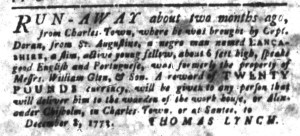
These advertisements appeared in colonial American newspapers 250 years ago today.

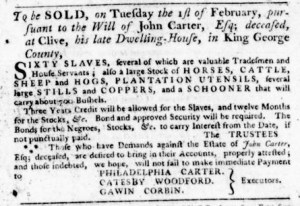
Maryland Gazette (December 30, 1773).

**********

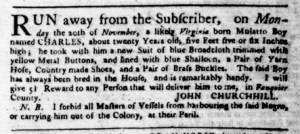
Maryland Gazette (December 30, 1773).

**********

Maryland Journal (December 30, 1773).

**********

Maryland Journal (December 30, 1773).

**********

Massachusetts Gazette and Boston Weekly News-Letter (December 30, 1773).

**********

Massachusetts Gazette and Boston Weekly News-Letter (December 30, 1773).

**********

Norwich Packet (December 30, 1773).

**********

Virginia Gazette [Purdie and Dixon] (December 30, 1773).

**********

Virginia Gazette [Purdie and Dixon] (December 30, 1773).

**********

Virginia Gazette [Purdie and Dixon] (December 30, 1773).

**********

Virginia Gazette [Purdie and Dixon] (December 30, 1773).

**********

Virginia Gazette [Purdie and Dixon] (December 30, 1773).

**********

Virginia Gazette [Purdie and Dixon] (December 30, 1773).

**********

Virginia Gazette [Purdie and Dixon] (December 30, 1773).

**********

Virginia Gazette [Rind] (December 30, 1773).

**********

Virginia Gazette [Rind] (December 30, 1773).

**********

Virginia Gazette [Rind] (December 30, 1773).

December 29

What was advertised in a colonial American newspaper 250 years ago today?

Essex Journal (December 29, 1773).

“The Number of at present, is insufficient to defrey the expence attending the Printing of a News-Paper.”

After published an inaugural issue of the Essex Journal and distributing it gratis to incite interest in the first newspaper published in Newburyport, Massachusetts, Isaiah Thomas and Henry-Walter Tinges paused publication to gather the names of subscribers.  More than three weeks after that first issue appeared on December 4, 1773, Thomas and Tinges commenced weekly publication of the Essex Journal.  In a notice on the first page, they confessed to “such Gentlemen and Ladies who wish well to this undertaking and have not yet subscribed that THEIR helping hands are wanted to bear up this Fabrick, … which if not well supported will fall, and lay the Foundation in Ruins.”  In other words, “the Number of Subscribers at present, is insufficient to defrey the expence attending the Printing of a News-Paper.”

Still, Thomas and Hinges took a chance, hoping that publishing a second and subsequent issues would convince prospective customers who intended to subscribe but had not yet done so to submit their names to the printing office.  According to the printers, some had indicated that was their plan: “we were assured that many intended to subscribe on the appearance of a second paper, and others would, at times, drop in.”  The fate of the newspaper depended on the “kindness and generosity” of subscribers.

In addition to printing a second issue to demonstrate the usefulness of the venture to readers in Newburyport and other towns in Massachusetts and New Hampshire, Thomas and Hinges adjusted the publication date to suit the needs of the community.  They distributed the inaugural issue on a Saturday, but learned that “meets not the public approbation,” so they “altered the day of publication to WEDNESDAY, which is greatly approved of.”  In turn, that required a new investment on the part of the printers: “we intend establishing a rider from Boston to this place, that we may have the most early and authentic intelligence.”  Thomas also published the Massachusetts Spy in Boston on Thursdays.  He may have originally thought that the Essex Journal could reprint content from that newspaper on Saturdays, but delivering “the most early and authentic intelligence” on Wednesdays likely meant drawing more content from the Boston Evening-Post, the Boston-Gazette, and Massachusetts Gazette and Boston Post-Boy, all of them published on Mondays.  Thomas and Hinges noted the “not very inconsiderable” expense, but also declared their commitment “to spare no pains or cost in our power to tender, in future, THIS paper as useful and entertaining as any News-Paper in America.”

Thomas and Hinges apparently gained more subscribers as well as advertisers.  They published the Essex Journal on every Wednesday in 1774 and Hinges and a new partner continued into 1775.  Then publication became sporadic in May, following the fighting at Lexington and Concord, and moved to Fridays for the remainder of the year, throughout most of 1776, before moving to Thursdays and ceasing in February 1777.

Slavery Advertisements Published December 29, 1773

The Slavery Adverts 250 Project chronicles the role of newspaper advertising in perpetuating slavery in the era of the American Revolution. The project seeks to reveal the ubiquity of slavery in eighteenth-century life from New England to Georgia by republishing advertisements about enslaved people – for sale as individuals or in groups, wanted to purchase or for hire for short periods, runaways who liberated themselves, and those who were subsequently captured and confined in jails and workhouses – in daily digests on this site as well as in real time via the @SlaveAdverts250 Twitter feed, utilizing twenty-first-century media to stand in for the print media of the eighteenth century.

The project aims to provide modern audiences with a sense of just how often colonizers encountered these advertisements in their daily lives. Enslaved men, women, and children appeared in print somewhere in the colonies almost every single day. Those advertisements served as a constant backdrop for social, cultural, economic, and political life in colonial and revolutionary America. Colonizers who did not purport to own enslaved people were still confronted with slavery as well as invited to maintain the system by purchasing enslaved men, women, and children or assisting in the capture of so-called “runaways” who sought to free themselves from bondage. The frequency of these newspaper advertisements suggests just how embedded slavery was in colonial and revolutionary American culture in everyday interactions beyond the printed page.

These advertisements also testify to the experiences of enslaved men, women, and children, though readers must consider that those experiences have been remediated through descriptions offered by enslavers rather than enslaved people themselves. Often unnamed in the advertisements, enslaved men, women, and children were not invisible or unimportant in early America.

These advertisements appeared in colonial American newspapers 250 years ago today.

Pennsylvania Gazette (December 29, 1773).

December 28

What was advertised in a colonial American newspaper 250 years ago today?

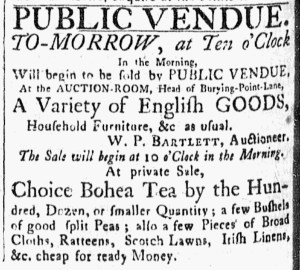
Essex Gazette (December 28, 1773).

“At private Sale, Choice Bohea Tea.”

Tea, tea, tea.  Everyone was talking about tea after Parliament passed the Tea Act in 1773.  That legislation allowed the East India Company to sell tea directly in colonies without paying export taxes in London.  This reduced the cost of tea for American consumers, but many colonizers resisted because this arrangement included paying duties when the tea was unloaded from the vessels once they arrived in American ports.  If they paid those duties, colonizers would implicitly recognize Parliament’s right to tax them.  They had rejected such assertions when they protested the Townshend Acts and, as a matter of principle, rejected them once again, even when presented with the prospect of buying tea at lower prices.  Many also worried about greater enforcement to prevent smuggling, realizing that they illicit trade also yielded bargain prices.

The talk about tea continued as colonizers anticipated the arrival of ships carrying tea belonging to the East India Company.  The talk about tea continued when three of ships arrived in Boston and residents prevented them from unloading their cargo.  The talk about tea continued after the destruction of that tea during a protest now known as the Boston Tea Party.  The December 28, 1773, edition of the Essex Gazette, for instance, featured plenty of talk about tea.  Two of the three columns on the first page covered the “Proceedings of the PEOPLE, previous to the Destruction of the Tea at Boston.”  The final column followed up with “the following Particulars respecting that HAPPY EVENT, the Destruction of the East-India Company’s ministerial Tea,” reprinted from the December 23 edition of the Massachusetts Gazette and Boston Weekly News-Letter.  At the bottom of that column, a short item with a dateline from “NEWPORT, December 13,” reported that “[b]y a letter from Boston, it seems as though our brethren there had some fears that we should receive the India Company’s detestable Tea; but we think it may be safely affirmed, that it will not be suffered to be sold here.”  Furthermore, there would be consequences “if landed, which is scare possible.”  The article proclaimed that such tea “will be reshipped on board the LIBERTY, and sent to GASPEE, the first favourable wind or weather,” invoking memories of another significant protest, the burning of the Gaspee in June 1772.  Elsewhere in that issue, news articles of varying lengths summarized talk about tea in New York, Philadelphia, and Portsmouth.

Among all that talk about tea, W.P. Bartlett, an auctioneer, advertised “Choice Bohea Tea” available “At private Sale.”  In Salem as in Boston, advertising, selling, buying, and drinking tea did not cease immediately as a rection to the Boston Tea Party.  Tea remained on the market as colonizers continue to debate what to do about tea and how to continue protesting against the Tea Act.

Slavery Advertisements Published December 28, 1773

The Slavery Adverts 250 Project chronicles the role of newspaper advertising in perpetuating slavery in the era of the American Revolution. The project seeks to reveal the ubiquity of slavery in eighteenth-century life from New England to Georgia by republishing advertisements about enslaved people – for sale as individuals or in groups, wanted to purchase or for hire for short periods, runaways who liberated themselves, and those who were subsequently captured and confined in jails and workhouses – in daily digests on this site as well as in real time via the @SlaveAdverts250 Twitter feed, utilizing twenty-first-century media to stand in for the print media of the eighteenth century.

The project aims to provide modern audiences with a sense of just how often colonizers encountered these advertisements in their daily lives. Enslaved men, women, and children appeared in print somewhere in the colonies almost every single day. Those advertisements served as a constant backdrop for social, cultural, economic, and political life in colonial and revolutionary America. Colonizers who did not purport to own enslaved people were still confronted with slavery as well as invited to maintain the system by purchasing enslaved men, women, and children or assisting in the capture of so-called “runaways” who sought to free themselves from bondage. The frequency of these newspaper advertisements suggests just how embedded slavery was in colonial and revolutionary American culture in everyday interactions beyond the printed page.

These advertisements also testify to the experiences of enslaved men, women, and children, though readers must consider that those experiences have been remediated through descriptions offered by enslavers rather than enslaved people themselves. Often unnamed in the advertisements, enslaved men, women, and children were not invisible or unimportant in early America.

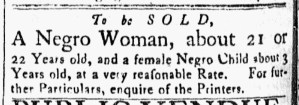
These advertisements appeared in colonial American newspapers 250 years ago today.

Essex Gazette (December 28, 1773).

**********

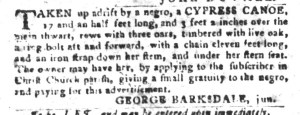
South-Carolina Gazette and Country Journal (December 28, 1773).

**********

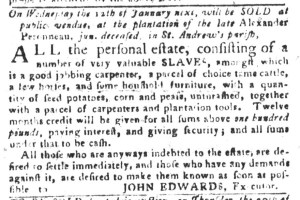
South-Carolina Gazette and Country Journal (December 28, 1773).

**********

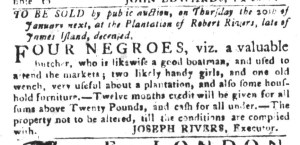
South-Carolina Gazette and Country Journal (December 28, 1773).

**********

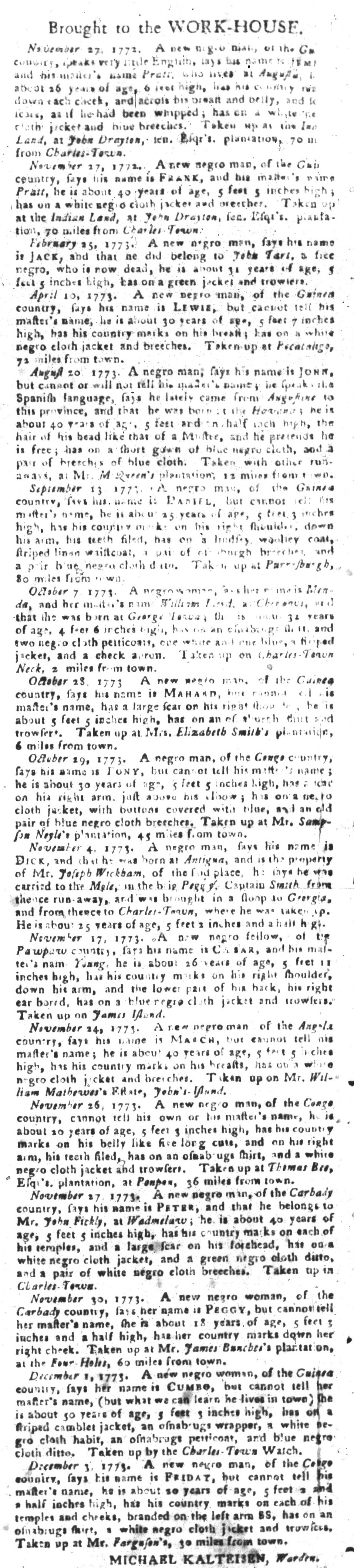
South-Carolina Gazette and Country Journal (December 28, 1773).

**********

South-Carolina Gazette and Country Journal (December 28, 1773).

**********

South-Carolina Gazette and Country Journal (December 28, 1773).

**********

South-Carolina Gazette and Country Journal (December 28, 1773).

**********

South-Carolina Gazette and Country Journal (December 28, 1773).

**********

South-Carolina Gazette and Country Journal (December 28, 1773).

**********

South-Carolina Gazette and Country Journal (December 28, 1773).

December 27

What was advertised in a colonial American newspaper 250years ago today?

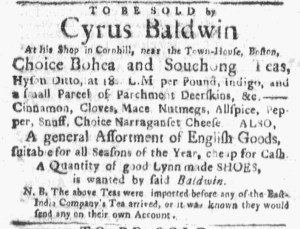
Boston Evening-Post (December 27, 1773).

“The above Teas were imported before any of the East-India Company’s Tea arrive, or it was known they would send any on their own Account.”

Cyrus Baldwin advertised “Choice Bohea and Souchong Tea” in the December 20, 1773, edition of the Boston Evening-Post, the first issue published following the protest now known as the Boston Tea Party.  In an effort to convince both prospective customers and the general public that he traded in good faith, he appended a nota bene to assert that his teas “were imported before any of the East-India Company’s Tea arrive, or it was known they would send any on their own Account.”  Three days later, he ran a similar advertisement in the Massachusetts Spy.  That notice included new merchandise, but it still listed “CHOICE Bohea and Souchong Teas” and concluded with the same nota bene.  As the politics of tea became a main topic of discussion, in town meetings, in the press, in everyday conversation, did not decide to discontinue his advertisements presenting tea for sale at his shop in Boston.

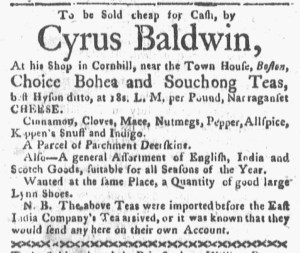
Boston-Gazette (December 27, 1773).

On December 27, Baldwin once again advertised in the Boston Evening-Post, replacing his advertisement from the previous issue with the one from the Massachusetts Spy.  In addition, that advertisement, complete with the nota bene, also ran in the Boston-Gazette on December 27.  Over the course of several days, Baldwin inserted it in three of the five newspapers published in Boston at the time.  Notably, neither Isaiah Thomas, the printer of the Massachusetts Spy, nor Benjamin Edes and John Gill, the printers of the Boston-Gazette, rejected the advertisement, though they had earned reputations as the printers who most vociferously advocated for the patriot cause and critiqued Parliament and colonial officials.  Did their willingness to publish the advertisement serve as tacit endorsement of the rationale Baldwin offered to justify selling his tea?  Maybe not.  The printers may have been too busy participating in events as they unfolded after the Boston Tea Party and gathering news from near and far that they did not scrutinize the contents of all the advertisements submitted to their printing offices.  After all, other merchants and shopkeepers continued to advertise tea in the Boston-Gazette and the Massachusetts Spy.  The printers may not have examined each advertisement closely to spot tea among the lists of merchandise.  They might have also been satisfied, at least for the moment, because they knew any tea sold by Baldwin and others had not been acquired via the problematic shipments that ended up in the harbor rather than in shops and stores.

As colonizers, including “Venders of Tea,” debated what to do next following the Boston Tea Party, they did not immediately cease advertising, buying, selling, and drinking tea.  Following strategies that they adopted in response to the Stamp Act and the Townshend Acts, they eventually devised nonimportation and consumption agreements.  Loyalists like Peter Oliver accused patriots, especially women, of cheating on those agreements.  Such indiscretions would have been a continuation of the flexibility toward tea exhibited in newspaper advertisements published in the days immediately after the Boston Tea Party.

Slavery Advertisements Published December 27, 1773

The Slavery Adverts 250 Project chronicles the role of newspaper advertising in perpetuating slavery in the era of the American Revolution. The project seeks to reveal the ubiquity of slavery in eighteenth-century life from New England to Georgia by republishing advertisements about enslaved people – for sale as individuals or in groups, wanted to purchase or for hire for short periods, runaways who liberated themselves, and those who were subsequently captured and confined in jails and workhouses – in daily digests on this site as well as in real time via the @SlaveAdverts250 Twitter feed, utilizing twenty-first-century media to stand in for the print media of the eighteenth century.

The project aims to provide modern audiences with a sense of just how often colonizers encountered these advertisements in their daily lives. Enslaved men, women, and children appeared in print somewhere in the colonies almost every single day. Those advertisements served as a constant backdrop for social, cultural, economic, and political life in colonial and revolutionary America. Colonizers who did not purport to own enslaved people were still confronted with slavery as well as invited to maintain the system by purchasing enslaved men, women, and children or assisting in the capture of so-called “runaways” who sought to free themselves from bondage. The frequency of these newspaper advertisements suggests just how embedded slavery was in colonial and revolutionary American culture in everyday interactions beyond the printed page.

These advertisements also testify to the experiences of enslaved men, women, and children, though readers must consider that those experiences have been remediated through descriptions offered by enslavers rather than enslaved people themselves. Often unnamed in the advertisements, enslaved men, women, and children were not invisible or unimportant in early America.

These advertisements appeared in colonial American newspapers 250 years ago today.

Boston-Gazette (December 27, 1773).

**********

Boston-Gazette (December 27, 1773).

**********

Supplement to the New-York Gazette and Weekly Mercury (December 27, 1773).

**********

Supplement to the New-York Gazette and Weekly Mercury (December 27, 1773).

**********

Supplement to the New-York Gazette and Weekly Mercury (December 27, 1773).

**********

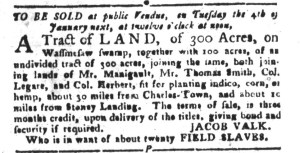
South-Carolina Gazette (December 27, 1773).

**********

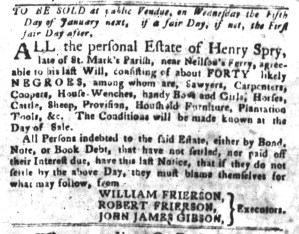
South-Carolina Gazette (December 27, 1773).

**********

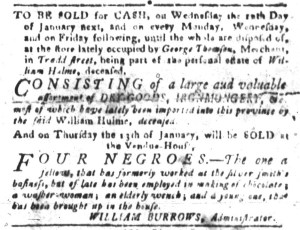
South-Carolina Gazette (December 27, 1773).

**********

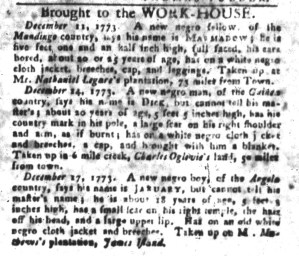
South-Carolina Gazette (December 27, 1773).

**********

South-Carolina Gazette (December 27, 1773).

**********

South-Carolina Gazette (December 27, 1773).

**********

South-Carolina Gazette (December 27, 1773).

**********

Supplement to the South-Carolina Gazette (December 27, 1773).

**********

Supplement to the South-Carolina Gazette (December 27, 1773).

**********

Supplement to the South-Carolina Gazette (December 27, 1773).

**********

Supplement to the South-Carolina Gazette (December 27, 1773).