March 31

What was advertised in a colonial American newspaper 250 years ago today?

Norwich Packet (March 31, 1774).

“Set off from the Printing-Office in Norwich every Thursday, immediately after the Publication of the NORWICH PACKET.”

When Moses Cleveland set about establishing a “Post to ride weekly between Norwich and Boston,” he simultaneously advertised in newspapers in both towns.  His advertisements, dated March 23, 1774, first appeared in the March 24 edition of the Norwich Packet and ran a week later in the Massachusetts Spy.  Cleveland covered a route that incorporated stops in both Connecticut and Massachusetts, including Windham, Pomfret, and Mendon.  He advised prospective customers that he would “set out from the Printing-Office in Norwich every Thursday, immediately after the Publication of the NORWICH PACKET.”  Customers in Connecticut received that newspaper hot off the presses, while those in Boston only waited a couple of days.  He arrived there on Saturdays, delivering news from the west that the Boston Evening-Post, Boston-Gazette, and Massachusetts Gazette and Boston Post-Boy might publish the following Monday.  Cleveland remained there until Monday morning before returning to Norwich via the same route.
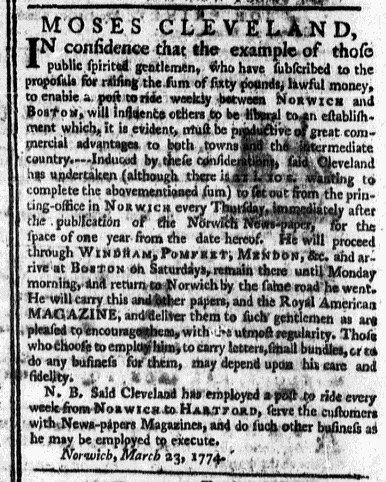
Massachusetts Spy (March 31, 1774).

His advertisement in the Massachusetts Spy featured almost identical copy, though either the postrider or the printer, Isaiah Thomas, made some updates.  In the Norwich Packet, Cleveland declared that he “will carry this Paper,” while in the Massachusetts Spy he stated that he “will carry this and other papers, and the Royal American MAGAZINE,” the publication that Thomas launched earlier in the year and had been promoting in the public prints from New Hampshire to Maryland for months.  Perhaps Cleveland instructed Thomas to mention the magazine in his advertisement, but a revision to the nota bene that concluded the notice suggests that Thomas did so on his own.  In the Norwich Packet, that postscript indicated that Cleveland “has employed a Post to ride every Week from Norwich to Hartford, [and] serve the Customers with this Paper.”  In the Massachusetts Spy, on the other hand, the nota bene advised that Cleveland “has employed a post to ride every week from NORWICH to HARTFORD, [and] serve the customers with News-Papers [and] Magazines.”  Had delivering the Royal American Magazine, the only magazine published in the colonies at the time, or any other magazines been among the services that Cleveland thought most likely to garner attention from prospective customers, he probably would have mentioned magazines in his advertisement that originated in the Norwich Packet.  More likely, the savvy Thomas seized an opportunity to promote his magazine and assure subscribers beyond Boston that they would receive it in a timely manner.
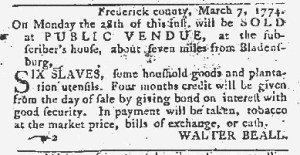
Slavery Advertisements Published March 31, 1774

GUEST CURATOR:  Delia Lee

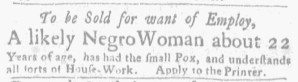
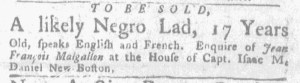
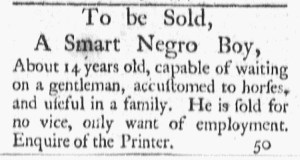
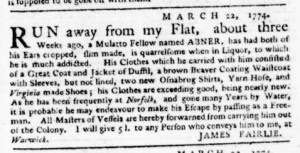
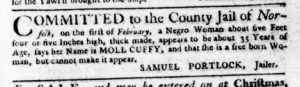
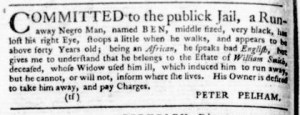
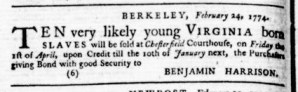
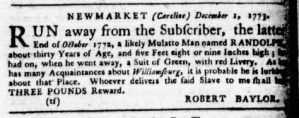
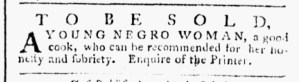
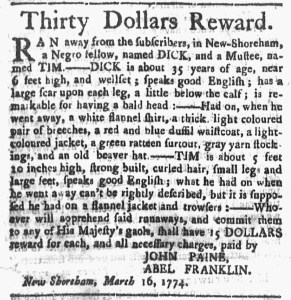
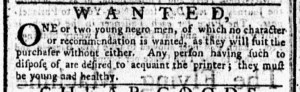
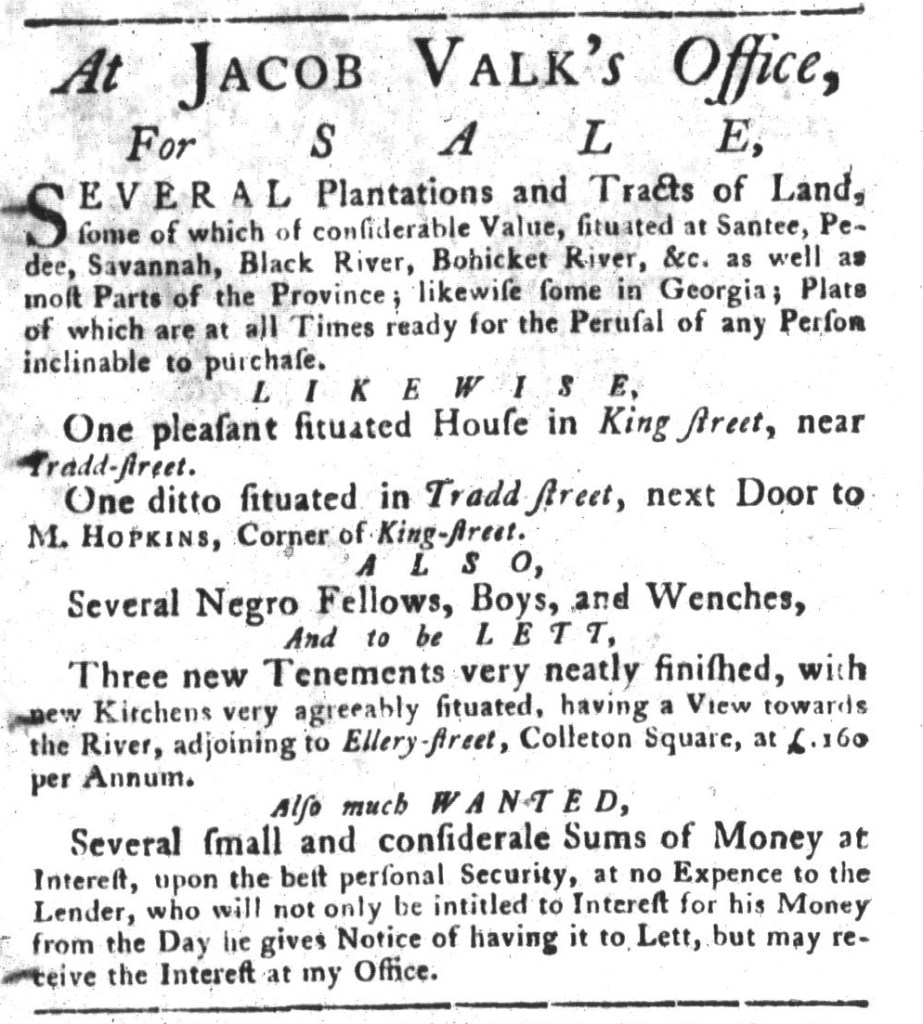
The Slavery Adverts 250 Project chronicles the role of newspaper advertising in perpetuating slavery in the era of the American Revolution. The project seeks to reveal the ubiquity of slavery in eighteenth-century life from New England to Georgia by republishing advertisements about enslaved people – for sale as individuals or in groups, wanted to purchase or for hire for short periods, runaways who liberated themselves, and those who were subsequently captured and confined in jails and workhouses – in daily digests on this site as well as in real time via the @SlaveAdverts250 Twitter feed, utilizing twenty-first-century media to stand in for the print media of the eighteenth century.

The project aims to provide modern audiences with a sense of just how often colonizers encountered these advertisements in their daily lives. Enslaved men, women, and children appeared in print somewhere in the colonies almost every single day. Those advertisements served as a constant backdrop for social, cultural, economic, and political life in colonial and revolutionary America. Colonizers who did not purport to own enslaved people were still confronted with slavery as well as invited to maintain the system by purchasing enslaved men, women, and children or assisting in the capture of so-called “runaways” who sought to free themselves from bondage. The frequency of these newspaper advertisements suggests just how embedded slavery was in colonial and revolutionary American culture in everyday interactions beyond the printed page.

These advertisements also testify to the experiences of enslaved men, women, and children, though readers must consider that those experiences have been remediated through descriptions offered by enslavers rather than enslaved people themselves. Often unnamed in the advertisements, enslaved men, women, and children were not invisible or unimportant in early America.

These advertisements appeared in colonial American newspapers 250 years ago today.

Maryland Gazette (March 31, 1774).

**********

Maryland Gazette (March 31, 1774).

**********

Maryland Journal (March 31, 1774).

**********

Maryland Journal (March 31, 1774).

**********

Massachusetts Gazette and Boston Weekly News-Letter (March 31, 1774).

**********

Massachusetts Gazette and Boston Weekly News-Letter (March 31, 1774).

**********

Massachusetts Gazette and Boston Weekly News-Letter (March 31, 1774).

**********

Rivington’s New-York Gazetteer (March 31, 1774).

**********

Virginia Gazette [Purdie and Dixon] (March 31, 1774).

**********

Virginia Gazette [Purdie and Dixon] (March 31, 1774).

**********

Virginia Gazette [Purdie and Dixon] (March 31, 1774).

**********

Virginia Gazette [Purdie and Dixon] (March 31, 1774).

**********

Virginia Gazette [Purdie and Dixon] (March 31, 1774).

**********

Virginia Gazette [Purdie and Dixon] (March 31, 1774).

**********

Virginia Gazette [Purdie and Dixon] (March 31, 1774).

**********

Virginia Gazette [Purdie and Dixon] (March 31, 1774).

**********

Virginia Gazette [Purdie and Dixon] (March 31, 1774).

**********

Virginia Gazette [Purdie and Dixon] (March 31, 1774).

**********

Virginia Gazette [Purdie and Dixon] (March 31, 1774).

**********

Virginia Gazette [Rind] (March 31, 1774).

**********

Virginia Gazette [Rind] (March 31, 1774).

**********

Virginia Gazette [Rind] (March 31, 1774).

**********

Virginia Gazette [Rind] (March 31, 1774).

**********

Virginia Gazette [Rind] (March 31, 1774).

**********

Virginia Gazette [Rind] (March 31, 1774).

**********

Virginia Gazette [Rind] (March 31, 1774).

**********

Virginia Gazette [Rind] (March 31, 1774).

March 30

What was advertised in a colonial American newspaper 250 years ago today?

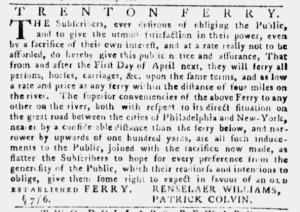
Pennsylvania Gazette (March 30, 1774).

“The superior conveniencies of the above Ferry.”

Rensselaer Williams and Patrick Colvin provided a public service.  At least that was how they wanted prospective clients to think about the “TRENTON FERRY” that they operated.  They opened their advertisement in the March 30, 1774, edition of the Pennsylvania Gazette with a declaration that they were “ever desirous of obliging the Public, and to give the utmost satisfaction in their power.”  To that end, they even set prices (or so they claimed) “by a sacrifice of their own interest, and at a rate really not be afforded.”  Williams and Colvin hoped such proclamations would attract attention in advance of opening for business on “the First Day of April next.”

At that time, they pledged to “ferry all persons, horses, [and] carriages” at “as low a rate and price as any ferry within four miles on the river.”  They certainly had in mind unnamed competitors that they expected were already familiar to prospective clients.  To make their service even more attractive, Williams and Colvin asserted that the “superior conveniencies” of their ferry compared to “any other on the river” included “its direct situation on the great road between the cities of Philadelphia and New-York,” a well-travelled corridor between the two largest cities in British mainland North America.  They emphasized that their location was “nearer by a considerable distance than the ferry below,” once again alluding to the competition.  Prospective clients might even consider passage on Williams and Colvin’s ferry faster and safer since the Delaware River was “narrower by upwards of one hundred yards” at their location.

This advertisement, along with others for ferries and stages, helps in mapping the transportation infrastructure in place in the colonies on the eve of the American Revolution.  Advertisements for almanacs frequently included descriptions of roads among the contents of those annual volumes.  Rather than relying on maps as they traveled from place to place, colonizers instead took into account general knowledge acquired through word of mouth as well as printed sources that included newspaper advertisements and almanacs.  Williams and Colvin certainly anticipated that merchants, travelers, and others would share with others what they read about the “TRENTON FERRY,” what they heard about it, and their own experiences hiring the service.

March 29

What was advertised in a colonial American newspaper 250 years ago today?

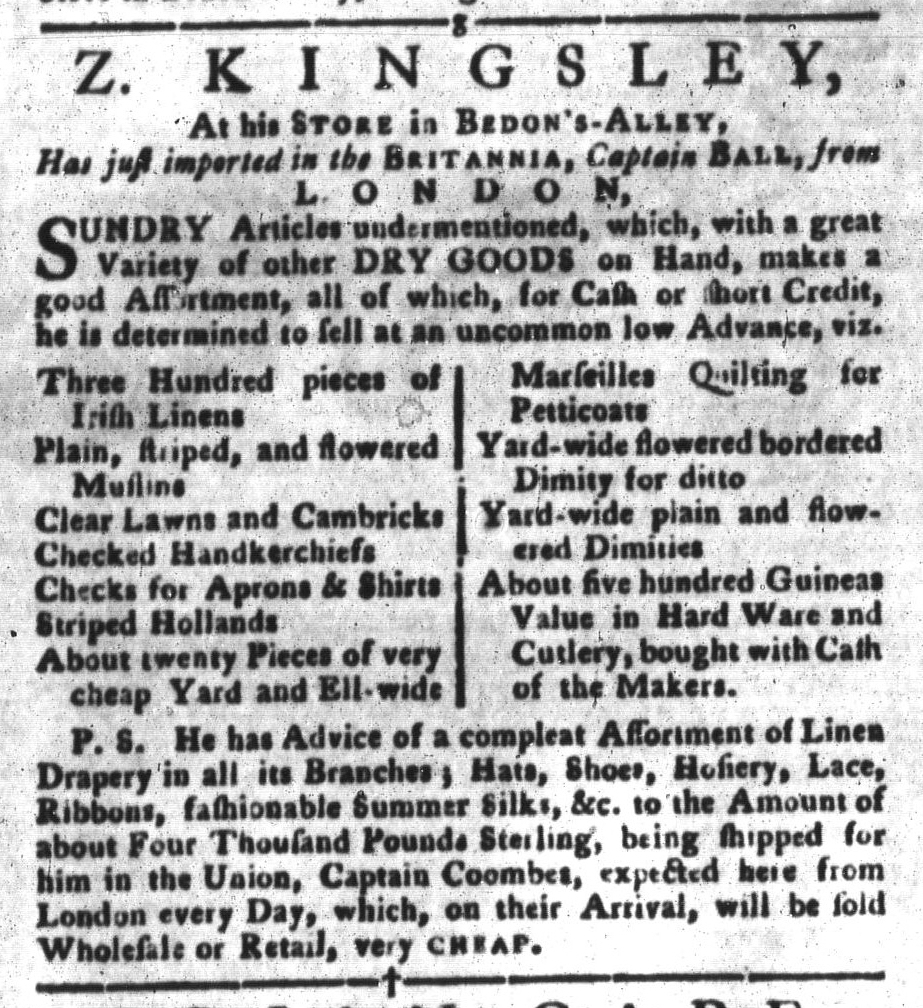
South-Carolina Gazette and Country Journal (March 29, 1774).

“He has Advice of a compleat Assortment … expected here from London every Day.”

Zephaniah Kingsley trumpeted the magnitude of the inventory “At his STORE in BEDON’S-ALLEY” in an advertisement in the March 29, 1774, edition of the South-Carolina Gazette and Country Journal.  He promoted the “SUNDRY Articles undermentioned” in a list of items “just imported … from LONDON” as well as a “great Variety of other DRY GOODS on Hand” from previous shipments.  All together, they constituted a “good Assortment” that offered a vast array of choices to consumers in Charleston.  He even took the unusual step of the total worth of some of his merchandise, declaring that he stocked “About five hundred Guineas Value in Hard Ware and Cutlery.”  That certainly signaled that he had indeed acquired a “good Assortment” of those items to satisfy the desires of just about any prospective customer.

The merchant opted for a postscript (rather than the more common nota bene) to alert readers that he “has Advice of a compleat Assortment of Linen Drapery in all its Branches; Hats, Shoes, Hosiery, Lace, Ribbons, fashionable Summer Silks,” and other goods “being shipped for him in the Union, … expected here from London every Day.”  As if his current inventory was not enough, Kingsley encouraged a sense of anticipation for new items that matched the most current fashions in London, the most cosmopolitan city in the empire.  In so doing, he once again deployed a marketing strategy that he used a couple of months earlier.  In early February, he proclaimed that he “intends having ready to open as soon as possible in the spring, an elegant assortment of Linen Drapery … with a quantity of the most fashionable summer Silks.”  The new advertisement served as an update for customers whose attention Kingsley caught with that preview.  In his effort to sell all his merchandise, including goods already “on Hand,” the merchant emphasized new items and even those that had not yet arrived but that he would make available to consumer imminently.  Curiosity about those goods, he likely reasoned, could help in moving older inventory out of his store once he got customers through the doors.

Slavery Advertisements Published March 29, 1774

GUEST CURATOR:  Madison Kenney

The Slavery Adverts 250 Project chronicles the role of newspaper advertising in perpetuating slavery in the era of the American Revolution. The project seeks to reveal the ubiquity of slavery in eighteenth-century life from New England to Georgia by republishing advertisements about enslaved people – for sale as individuals or in groups, wanted to purchase or for hire for short periods, runaways who liberated themselves, and those who were subsequently captured and confined in jails and workhouses – in daily digests on this site as well as in real time via the @SlaveAdverts250 Twitter feed, utilizing twenty-first-century media to stand in for the print media of the eighteenth century.

The project aims to provide modern audiences with a sense of just how often colonizers encountered these advertisements in their daily lives. Enslaved men, women, and children appeared in print somewhere in the colonies almost every single day. Those advertisements served as a constant backdrop for social, cultural, economic, and political life in colonial and revolutionary America. Colonizers who did not purport to own enslaved people were still confronted with slavery as well as invited to maintain the system by purchasing enslaved men, women, and children or assisting in the capture of so-called “runaways” who sought to free themselves from bondage. The frequency of these newspaper advertisements suggests just how embedded slavery was in colonial and revolutionary American culture in everyday interactions beyond the printed page.

These advertisements also testify to the experiences of enslaved men, women, and children, though readers must consider that those experiences have been remediated through descriptions offered by enslavers rather than enslaved people themselves. Often unnamed in the advertisements, enslaved men, women, and children were not invisible or unimportant in early America.

These advertisements appeared in colonial American newspapers 250 years ago today.

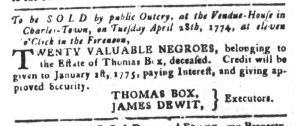
South-Carolina Gazette and Country Journal (March 29, 1774).

**********

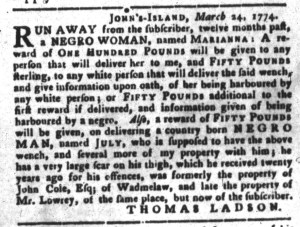
South-Carolina Gazette and Country Journal (March 29, 1774).

**********

South-Carolina Gazette and Country Journal (March 29, 1774).

**********

South-Carolina Gazette and Country Journal (March 29, 1774).

**********

South-Carolina Gazette and Country Journal (March 29, 1774).

**********

South-Carolina Gazette and Country Journal (March 29, 1774).

**********

South-Carolina Gazette and Country Journal (March 29, 1774).

March 28

What was advertised in a colonial American newspaper 250 years ago today?

Supplement to the New-York Gazette and Weekly Mercury (March 28, 1774).

“The Sign of the SUN and BREECHES.”

Cornelius Ryan, “LEATHER DRESSER and BREECHES MAKER,” pursued his trade at “the Sign of the SUN and BREECHES, IN THE BROADWAY” in New York.  Residents and visitors to the busy port likely glimpsed his sign as they traversed the streets of the city.  Readers of the New-York Gazette and Weekly Mercury almost certainly noticed the woodcut that adorned the advertisements he ran in that newspaper.  It included the same elements as the sign that marked his location, a sun above a pair of breeches.  The sun had a face that stared directly at readers as well as eight rays enclosed within a corona.  In addition, the initials “CR,” for Cornelius Ryan, appeared between the legs of the breeches.  The woodcut may or may not have replicated Ryan’s sign; at the very least, it strengthened the association that the leather dresser and breeches maker wanted consumers to have with his business and visual representations of it.

To achieve that, Ryan invested in commissioning a woodcut stylized for his exclusive use.  Most entrepreneurs did not go to such lengths when they advertised in colonial newspapers, though Smith Richards, who kept shop “At the Tea canister and two sugar loaves,” once again included a woodcut depicting those items in his notice in the same supplement that carried Ryan’s advertisement.  Nesbitt Deane advertised hats he “Manufactured,” but did not adorn his notice with the image of a tricorne hat and his name within a banner that he had included in other notices on several occasions over the years.  Since advertisers paid by the amount of space their notices occupied rather than the number of words, woodcuts amounted to significant additional expense beyond the costs of producing them.  For Ryan, the woodcut accounted for nearly half of his advertisement, doubling the cost of running it in the New-York Gazette and Weekly Mercury.  He may very well have considered it worth the investment if the striking image prompted prospective customers to read the copy more closely.  The visual image served as a gateway for the appeals to skill, quality, price, consumer choice, and customer satisfaction that followed.

Slavery Advertisements Published March 28, 1774

GUEST CURATOR:  Madison Kenney

The Slavery Adverts 250 Project chronicles the role of newspaper advertising in perpetuating slavery in the era of the American Revolution. The project seeks to reveal the ubiquity of slavery in eighteenth-century life from New England to Georgia by republishing advertisements about enslaved people – for sale as individuals or in groups, wanted to purchase or for hire for short periods, runaways who liberated themselves, and those who were subsequently captured and confined in jails and workhouses – in daily digests on this site as well as in real time via the @SlaveAdverts250 Twitter feed, utilizing twenty-first-century media to stand in for the print media of the eighteenth century.

The project aims to provide modern audiences with a sense of just how often colonizers encountered these advertisements in their daily lives. Enslaved men, women, and children appeared in print somewhere in the colonies almost every single day. Those advertisements served as a constant backdrop for social, cultural, economic, and political life in colonial and revolutionary America. Colonizers who did not purport to own enslaved people were still confronted with slavery as well as invited to maintain the system by purchasing enslaved men, women, and children or assisting in the capture of so-called “runaways” who sought to free themselves from bondage. The frequency of these newspaper advertisements suggests just how embedded slavery was in colonial and revolutionary American culture in everyday interactions beyond the printed page.

These advertisements also testify to the experiences of enslaved men, women, and children, though readers must consider that those experiences have been remediated through descriptions offered by enslavers rather than enslaved people themselves. Often unnamed in the advertisements, enslaved men, women, and children were not invisible or unimportant in early America.

These advertisements appeared in colonial American newspapers 250 years ago today.

Boston Evening-Post (March 28, 1774).

**********

Boston-Gazette (March 28, 1774).

**********

Supplement to the Boston-Gazette (March 28, 1774).

**********

Dunlap’s Pennsylvania Gazette (March 28, 1774).

**********

Dunlap’s Pennsylvania Gazette (March 28, 1774).

**********

Newport Mercury (March 28, 1774).

**********

Newport Mercury (March 28, 1774).

**********

New-York Gazette and Weekly Mercury (March 28, 1774).

**********

New-York Gazette and Weekly Mercury (March 28, 1774).

**********

New-York Gazette and Weekly Mercury (March 28, 1774).

**********

South-Carolina Gazette (March 28, 1774).

**********

South-Carolina Gazette (March 28, 1774).

**********

South-Carolina Gazette (March 28, 1774).

**********

South-Carolina Gazette (March 28, 1774).

**********

South-Carolina Gazette (March 28, 1774).

**********

South-Carolina Gazette (March 28, 1774).

**********

South-Carolina Gazette (March 28, 1774).

**********

South-Carolina Gazette (March 28, 1774).

**********

South-Carolina Gazette (March 28, 1774).

**********

South-Carolina Gazette (March 28, 1774).

March 27

What was advertised in a colonial American newspaper 250 years ago this week?

New-York Journal (March 24, 1774).

“WATCHES … no Expence for cleaning them.”

John Simnet, a watchmaker, was a prolific advertiser in New York’s newspapers in the early 1770s.  In late March 1774, he placed a new advertisement in the New-York Journal, with a headline that proclaimed, “The Sixth Year of this Advertisement in this Country.”  Simnet referred to the fact that he migrated to the colonies from London, though he first set up shop in New Hampshire.  He advertised there for about a year and a half, frequently engaging in feuds with a competitor, before relocating to New York.  Perhaps prospective customers in and near Portsmouth had not appreciated his abrasive style, though the curmudgeon did not seem to learn his lesson if that was the case.  After settling in New York, he frequently picked fights with local watchmakers, their arguments witnessed by newspaper readers as they perused the advertisements.  Over the years, the colorful Simnet has become a favorite for the Adverts 250 Project, one of the colonial advertisers most often featured thanks to his lively notices.  In March 1774, Simnet had indeed commenced his “Sixth Year” of running advertisements in the colonies.

When he did so, he advanced a marketing strategy he frequently deployed.  Simnet offered an ancillary service for free to his clients who paid for other services: “those Gentlemen, &c. who have employed the Advertiser to Repair their WATCHES, ARE now at no Expence for cleaning them.”  In other words, he did not charge customers for routine cleaning of watches that he previously repaired.  That kept the watches in good running order, which further testified to Simnet’s skills and justified hiring him for other work.  The watchmaker declared that “it will be his endeavour to prove, Watches which are tolerably good, will perform 20 Years without Expence.”  Prospective clients could take their watches to his competitors who did not invest the same care in their work, causing them to have to pay for additional repairs over time, or they could entrust their watches to Simnet with confidence that he would assist them in averting further expense.  His clients could avoid paying for “mending Work” on their watches (and simultaneously safeguard Simnet’s reputation) if they presented their watches for cleaning “at least once a Year.”  Putting a little effort into such routine maintenance, offered for free, made the clients and the watchmakers partners in the enterprise, encouraging customer loyalty.

March 26

What was advertised in a colonial American newspaper 250 years ago today?

Providence Gazette (March 26, 1774).

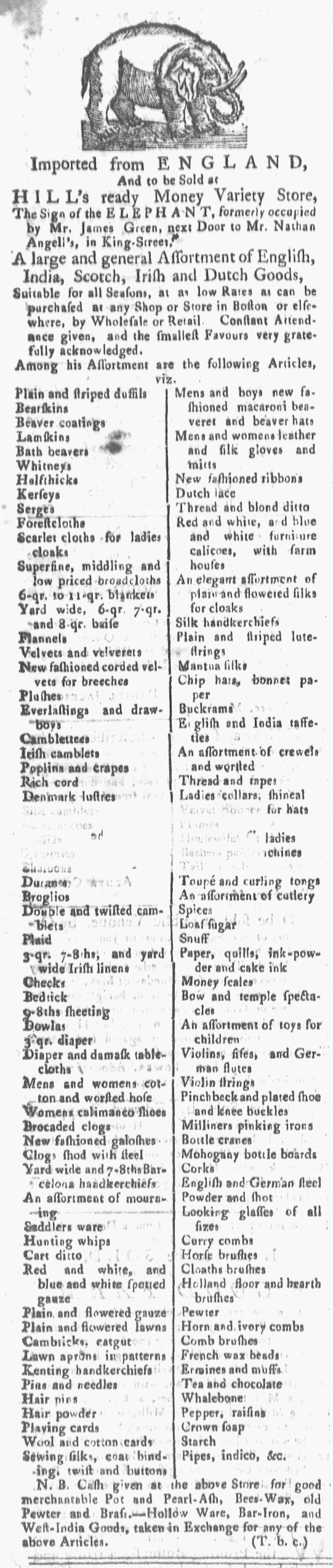
“The Sign of the ELEPHANT.”

The advertising campaign for “HILL’s ready Money Variety Store” at the “Sign of the Elephant” in Providence went through stages in the winter and spring of 1774.  An initial advertisement in the January 22 edition of the Providence Gazette promoted a “compleat Assortment of English, Scotch and India GOODS,” listing about a dozen items available at the store.  It also promised “every other Article usually imported, too many to be enumerated in this Week’s Paper.”  That suggested that a portion of the advertisement had been omitted but would appear in a subsequent issue.

The initial advertisement ran for three weeks before a much longer version replaced it on February 12.  That notice almost filled an entire column since it extensively “enumerated” Hill’s inventory, everything from “Scarlet cloths for ladies cloaks” and “New fashioned corded velvets for breeches” to “Mens and boys new fashioned macaroni beaveret and beaver hats” and “Velvet ribbons for hats” to “Looking glasses of all sizes” and “An assortment of toys for children.”  The compositor divided the advertisement into two columns, listing one item per line to make it easier for readers to peruse and identify items of interest.  That advertisement ran for six consecutive weeks.

On March 26, Hill placed a new version.  The inventory remained the same, but it featured a new introduction and, most significantly, a woodcut depicting an elephant.  Hill intensified his effort to associate a logo with his business, presenting readers of the Providence Gazette with an image of an elephant to make his “Variety Store” even more memorable.  Except for the device that appeared in the masthead each week, it was the only image that appeared in that edition of the Providence Gazette.  With the addition of the woodcut, Hill’s advertisement filled an entire column in the newspaper.  Yet the image may have been the more powerful marketing strategy than the list that demonstrated choices for consumers.  By selecting an elephant, Hill emphasized goods, especially textiles, imported from India.  Most likely, none of the colonizers in Providence had ever glimpsed that exotic creature in real life.  Primitive as the woodcut might seem to modern eyes, it may have been one of the few visual depictions of an elephant that readers of the Providence Gazette ever encountered.  The novelty served an importance purpose in Hill’s marketing efforts.

March 25

What was advertised in a colonial American newspaper 250 years ago today?

Connecticut Gazette (March 25, 1774).

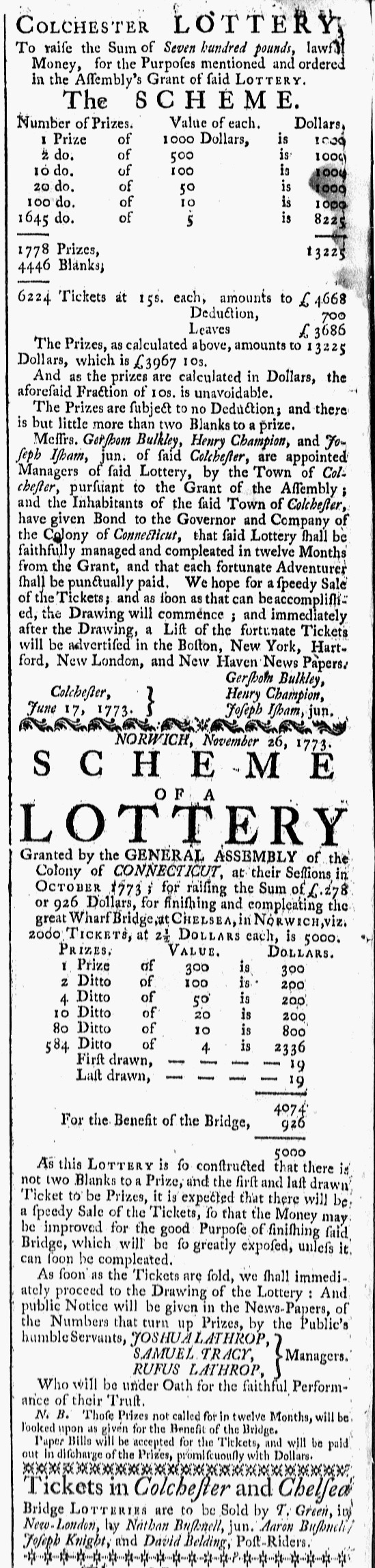
“LOTTERY … for finishing and compleating the great Wharf Bridge.”

Lotteries funded a variety of public works projects in early America.  In October 1773, for instance, the “GENERAL ASSEMBLY of the Colony of CONNECTICUT” … approved a lottery “for raising the Sum … for finishing and compleating the great Wharf Bridge, at CHELSEA, in NORWICH.”  The lottery managers, Joshua Lathrop, Samuel Tracy, and Rufus Lathrop, set about advertising the “SCHEME OF A LOTTERY” in November, continuing their efforts for several months into 1774.  They ran two notices in the March 25 edition of the Connecticut Gazette, the original advertisement and an update that gave a deadline for purchasing tickets.  In addition to that newspaper published in New London, they also placed the original notice in the Norwich Packet on March 24.  Between the two newspapers, the managers reached readers in the region likely to support the project.

They competed, however, with another lottery.  The managers of the “COLCHESTER LOTTERY” published their own “SCHEME” for their drawing.  The advertisements for the two lotteries appeared one after the other, filling almost an entire column in the Connecticut Gazette.  Immediately below them, Timothy Green, the printer and a local agent working on behalf of both lotteries, placed a notice advising that “Tickets in Colchester and Chelsea Bridge LOTTERIES are to be Sold by T. Green, in New-London, by Nathan Bushnell, jun. Aaron Bushnell, Joseph Knight, and David Belding, Post-Riders.”  In hopes of convincing colonizers to purchase their tickets, the managers of the Norwich Bridge Lottery emphasized that their endeavor served “the good Purpose of finishing said Bridge, which will be so greatly exposed, unless it can soon be completed.”

Preparations for a lottery could last as long as a year, but the managers aimed to complete the Norwich Bridge Lottery in six months.  In their update, they advised that they “hope to be ready to proceed to the drawing by the 20th of April next, or sooner.”  To meet that goal, they needed to sell all the tickets as quickly as possible.  They called on local agents like Green and the post riders to “dispose” of their tickets by April 1 or “return them in to the Managers.”  Similarly, they requested that “those who intend to be Adventurers in said Lottery will soon apply for their Tickets, that there may be no delay in the Drawing.”  That served the dual purpose of dispersing prizes to the winners and raising the funds necessary to complete the work on the bridge.  As with other lotteries for public works projects, the managers encouraged colonizers to contemplate both their own interests and the interests of their communities, anticipating that the combination would convince them to purchase tickets.

Connecticut Gazette (March 25, 1774).