The Slavery Adverts 250 Project chronicles the role of newspaper advertising in perpetuating slavery in the era of the American Revolution. The project seeks to reveal the ubiquity of slavery in eighteenth-century life from New England to Georgia by republishing advertisements about enslaved people – for sale as individuals or in groups, wanted to purchase or for hire for short periods, runaways who liberated themselves, and those who were subsequently captured and confined in jails and workhouses – in daily digests on this site as well as in real time via the @SlaveAdverts250 Twitter feed, utilizing twenty-first-century media to stand in for the print media of the eighteenth century.
The project aims to provide modern audiences with a sense of just how often colonizers encountered these advertisements in their daily lives. Enslaved men, women, and children appeared in print somewhere in the colonies almost every single day. Those advertisements served as a constant backdrop for social, cultural, economic, and political life in colonial and revolutionary America. Colonizers who did not purport to own enslaved people were still confronted with slavery as well as invited to maintain the system by purchasing enslaved men, women, and children or assisting in the capture of so-called “runaways” who sought to free themselves from bondage. The frequency of these newspaper advertisements suggests just how embedded slavery was in colonial and revolutionary American culture in everyday interactions beyond the printed page.
These advertisements also testify to the experiences of enslaved men, women, and children, though readers must consider that those experiences have been remediated through descriptions offered by enslavers rather than enslaved people themselves. Often unnamed in the advertisements, enslaved men, women, and children were not invisible or unimportant in early America.
These advertisements appeared in colonial American newspapers 250 years ago today.
What was advertised in a colonial American newspaper 250 years ago today?
New-York Journal (March 24, 1774).
“The best Price given for ALL SORTS OF LINEN RAGS.”
John Keating, the owner of a “PAPER MANUFACTORY” in New York, uses politics as an advertising strategy. In 1774, “The demand for paper in America, is of late so greatly increased, that very large sums are continually sent abroad, for the purchase of it.” Keating attempted to take advantage of the political tension with Britain by connecting the donation of spare rags to make into paper with patriotism. He argued, “All those who really wish to promote the interest of America … will contribute their aid to the success of the paper manufactory in this place.”
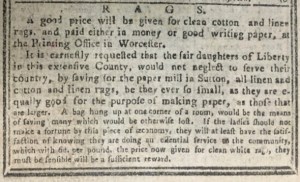
Advertisements asking families to save linen rags to support American printing were not uncommon during the era of the American Revolution. An advertisement printed on the back of Thomas’s Massachusetts, New-Hampshire, and Connecticut Almanack for the Year of our Lord Christ 1779 claims “ fair daughters of Liberty…would not neglect to serve their country, by saving for the paper mill in Sutton, all linen and cotton and linen rags.” Again, entrepreneurs who made paper or printed on it used patriotism to pressure households to support American industry by donating rags. Kayla Haveles argues that printing was “as vital to revolution as guns and gunpowder” because the colonists used it to spread ideology and attack the British.
Thomas’s Massachusetts, Connecticut, and New-Hampshire Almanack for the Year of Our Lord Christ 1779 (Worcester: Isaiah Thomas, 1778).
Additionally, the frequency of these advertisements highlights the contributions of women in the Revolution. Both advertisements focus on saving rags in the home. Keating’s advertisement asked every family to save spare rags in their household. Women were responsible for the housework so Keating’s call to action targeted women. The advertisement on the back of the almanac asked “daughters of Liberty” to save rags. Both advertisements are examples of how women contributed to the Revolution by supporting the American economy.
**********
ADDITIONAL COMMENTARY: Carl Robert Keyes
John Keating had been placing similar advertisements for the “NEW-YORK Paper MANUFACTORY” for years by the time this advertisement appeared in the March 24, 1774, edition of the New-York Journal. The Adverts 250 Project first featured one of his advertisements that offered “Ready Money for clean Rags” that ran in that newspaper on February 18, 1768. During the six years in between, Keating maintained an almost constant presence in the public prints, encouraging colonizers, especially women, to collect rags for paper production and explaining the patriotic benefits of their efforts. He advertised at times when relationships with Parliament deteriorated, including when nonimportation agreements went into effect to protest various legislation, as well as when the situation cooled and most merchants, shopkeepers, and consumers returned to business as usual. Keating remained a steady voice in favor of “domestic manufactures” or goods produced in the colonies.
In this instance, Keating ran his advertisement at a time of crisis. Throughout the colonies, the destruction of the tea in Boston the previous December remained a topic of conversation, including in New York. The Sons of Liberty anticipated the arrival of the Nancy with a cargo of tea that they did not want landed in their city. Keating’s advertisement, which had been running since before the Boston Tea Party, appeared on the last page of the March 24 issue, interspersed among other advertisements. A notice that the Sons of Liberty would meet every Thursday evening “till the Arrival and Departure of the TEA SHIP,” on the other hand, made its second appearance, this time in the first column on the first page. Only tables showing prices current and sunrise, sunset, and high tide preceded the announcement. Its placement made it more likely that readers would see it, while also framing how they read other advertisements in the issue. Most readers likely did not need that notice from the Sons of Liberty to influence their reaction to Keating’s advertisement calling on “all those who really wish to promote the interest of America” to do their part, considering how widely colonizers discussed the politics of tea at the time. Still, the combination of print culture and public discourse occurring everywhere from the town common to taverns made Keating’s appeals to patriotism even more urgent.
Madison Kenney is a senior at Assumption University in Worcester, Massachusetts. She is a double major in History and Secondary Education. She plans to become a high school sistory teacher and is especially interested in the history of marginalized communities. In Spring 2024, she is student-teaching at Westborough High School. Madison made her contributions to the Adverts 250 Project and the Slavery Adverts 250 Project while enrolled in HIS 401 Revolutionary America, 1763-1815, in Fall 2023.
The Slavery Adverts 250 Project chronicles the role of newspaper advertising in perpetuating slavery in the era of the American Revolution. The project seeks to reveal the ubiquity of slavery in eighteenth-century life from New England to Georgia by republishing advertisements about enslaved people – for sale as individuals or in groups, wanted to purchase or for hire for short periods, runaways who liberated themselves, and those who were subsequently captured and confined in jails and workhouses – in daily digests on this site as well as in real time via the @SlaveAdverts250 Twitter feed, utilizing twenty-first-century media to stand in for the print media of the eighteenth century.
The project aims to provide modern audiences with a sense of just how often colonizers encountered these advertisements in their daily lives. Enslaved men, women, and children appeared in print somewhere in the colonies almost every single day. Those advertisements served as a constant backdrop for social, cultural, economic, and political life in colonial and revolutionary America. Colonizers who did not purport to own enslaved people were still confronted with slavery as well as invited to maintain the system by purchasing enslaved men, women, and children or assisting in the capture of so-called “runaways” who sought to free themselves from bondage. The frequency of these newspaper advertisements suggests just how embedded slavery was in colonial and revolutionary American culture in everyday interactions beyond the printed page.
These advertisements also testify to the experiences of enslaved men, women, and children, though readers must consider that those experiences have been remediated through descriptions offered by enslavers rather than enslaved people themselves. Often unnamed in the advertisements, enslaved men, women, and children were not invisible or unimportant in early America.
These advertisements appeared in colonial American newspapers 250 years ago today.
Massachusetts Gazette and Boston Weekly News-Letter (March 24, 1774).
**********
Massachusetts Gazette and Boston Weekly News-Letter (March 24, 1774).
What was advertised in a colonial American newspaper 250 years ago today?
Supplement to the Pennsylvania Gazette (March 23, 1774).
“Remarkable old Spirits, West-India Rum, and Brandy.”
Thomas Batt advertised his “WINE and SPIRIT STORE” in the Pennsylvania Gazette for three months in 1774. He stocked a “large and valuable Collection” that included “Old genuine Madeira, Lisbon, Mountain and Teneriffe Wines; remarkable old Spirits, [and] excellent Claret.” He pledged to “sell any Quantity, from a Pipe [a large barrel] to a Gallon” to suit the needs of his customers.
When it ran on March 23, 1774, Batt’s advertisement appeared in the Supplement to the Pennsylvania Gazette rather than in the standard issue for that week. Colonial newspapers typically consisted of four pages created by printing two pages on each side of a broadsheet and then folding it in half. On occasion, printers had more news, letters, advertisements, and other content than would fit within four pages. Sometimes they inserted notices that material which they did not publish that week would appear in the next issue. Other times, however, they had enough content to justify publishing a supplement, either two or four pages.
In this instance, the printers opted for a four-page supplement, doubling the content they distributed to subscribers and other readers that week. The revenue generated from advertisements likely made the supplement a viable endeavor since paid notices filled ten of the twelve columns. Those advertisement had not merely been displaced to the supplement by news that appeared in the standard issue. News items accounted for slightly less than six of those twelve columns. Overall, that meant that the standard issue and the supplement carried eight columns of news and sixteen columns of advertising. More than one hundred paid notices, including Batt’s advertisement for his “WINE and SPIRIT STORE,” occupied two-thirds of the space in that issue of the Pennsylvania Gazette and its supplement. Quite often, eighteenth-century newspapers served as vehicles for delivering advertising even more so than for disseminating news.
The Slavery Adverts 250 Project chronicles the role of newspaper advertising in perpetuating slavery in the era of the American Revolution. The project seeks to reveal the ubiquity of slavery in eighteenth-century life from New England to Georgia by republishing advertisements about enslaved people – for sale as individuals or in groups, wanted to purchase or for hire for short periods, runaways who liberated themselves, and those who were subsequently captured and confined in jails and workhouses – in daily digests on this site as well as in real time via the @SlaveAdverts250 Twitter feed, utilizing twenty-first-century media to stand in for the print media of the eighteenth century.
The project aims to provide modern audiences with a sense of just how often colonizers encountered these advertisements in their daily lives. Enslaved men, women, and children appeared in print somewhere in the colonies almost every single day. Those advertisements served as a constant backdrop for social, cultural, economic, and political life in colonial and revolutionary America. Colonizers who did not purport to own enslaved people were still confronted with slavery as well as invited to maintain the system by purchasing enslaved men, women, and children or assisting in the capture of so-called “runaways” who sought to free themselves from bondage. The frequency of these newspaper advertisements suggests just how embedded slavery was in colonial and revolutionary American culture in everyday interactions beyond the printed page.
These advertisements also testify to the experiences of enslaved men, women, and children, though readers must consider that those experiences have been remediated through descriptions offered by enslavers rather than enslaved people themselves. Often unnamed in the advertisements, enslaved men, women, and children were not invisible or unimportant in early America.
These advertisements appeared in colonial American newspapers 250 years ago today.
Pennsylvania Gazette (March 23, 1774).
**********
Supplement to the Pennsylvania Gazette (March 23, 1774).
**********
Supplement to the Pennsylvania Gazette (March 23, 1774).
What was advertised in a colonial American newspaper 250 years ago today?
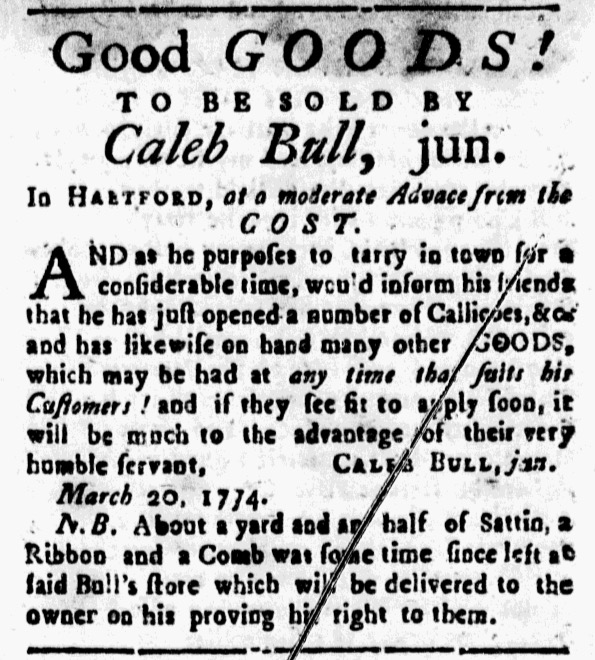
Connecticut Courant (March 22, 1774).
“Good GOODS!”
Caleb Bull, Jr., had experience deploying crafty headlines to draw attention to his advertisements in the Connecticut Courant. In the spring of 1772, he ran an advertisement that consisted almost entirely of the headline: “New, New, New GOODS! AT CALEB BULL jun’s. Store in HARTFORD.” He inserted an advertisement with a similar headline in the March 22, 1774, edition of the Connecticut Courant. “Good GOODS!” it proclaimed.
Some of the headlines for notices that recently appeared in that newspaper may have inspired Bull to devise something playful and out of the ordinary for his own advertisement. At the beginning of the month, William Beadle alluded to the Boston Tea Party when he offered “Best Bohea TEA, Such as Fishes never drink!!” Matthew Talcott’s notice declared, “Make Way! A Probationer for New Gate!” in the previous issue. That issue also carried William Prentice’s advertisement for “Cheap GOODS.” That headline did not merely announce that Prentice sold goods; it also made an appeal to price. For eighteenth-century readers, “cheap” meant inexpensive rather than inferior quality.
The following week, Bull placed his own advertisement for “Good GOODS!” It served as a counterpoint to Prentice’s “Cheap GOODS” advertisement that ran once again. In this instance, the headline did indeed market the quality of the items offered for sale. The shopkeeper also made an appeal to price, assuring prospective customers that they would pay “a moderate Adva[n]ce from the COST.” In other words, Bull marked up his merchandise only slightly. He sacrificed larger profits in favor of presenting consumers with bargains, a means of competing with the “Cheap GOODS” available at another store in Hartford.
With experience publishing innovative headlines for his advertisements, Bull may have perused recent issues of the Connecticut Courant, noticed similarly provocative headlines, and determined that the time was right to make his own intervention in the public prints. If that was the case, he monitored advertisements in the local newspaper for style as well as substance, then composed copy accordingly.
The Slavery Adverts 250 Project chronicles the role of newspaper advertising in perpetuating slavery in the era of the American Revolution. The project seeks to reveal the ubiquity of slavery in eighteenth-century life from New England to Georgia by republishing advertisements about enslaved people – for sale as individuals or in groups, wanted to purchase or for hire for short periods, runaways who liberated themselves, and those who were subsequently captured and confined in jails and workhouses – in daily digests on this site as well as in real time via the @SlaveAdverts250 Twitter feed, utilizing twenty-first-century media to stand in for the print media of the eighteenth century.
The project aims to provide modern audiences with a sense of just how often colonizers encountered these advertisements in their daily lives. Enslaved men, women, and children appeared in print somewhere in the colonies almost every single day. Those advertisements served as a constant backdrop for social, cultural, economic, and political life in colonial and revolutionary America. Colonizers who did not purport to own enslaved people were still confronted with slavery as well as invited to maintain the system by purchasing enslaved men, women, and children or assisting in the capture of so-called “runaways” who sought to free themselves from bondage. The frequency of these newspaper advertisements suggests just how embedded slavery was in colonial and revolutionary American culture in everyday interactions beyond the printed page.
These advertisements also testify to the experiences of enslaved men, women, and children, though readers must consider that those experiences have been remediated through descriptions offered by enslavers rather than enslaved people themselves. Often unnamed in the advertisements, enslaved men, women, and children were not invisible or unimportant in early America.
These advertisements appeared in colonial American newspapers 250 years ago today.
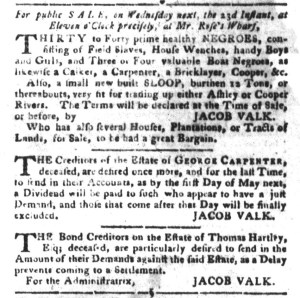
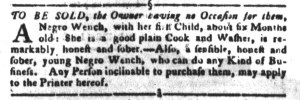
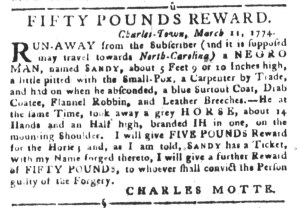
South-Carolina Gazette and Country Journal (March 22, 1774).
**********
South-Carolina Gazette and Country Journal (March 22, 1774).
**********
South-Carolina Gazette and Country Journal (March 22, 1774).
**********
South-Carolina Gazette and Country Journal (March 22, 1774).
**********
South-Carolina Gazette and Country Journal (March 22, 1774).
**********
South-Carolina Gazette and Country Journal (March 22, 1774).
**********
South-Carolina Gazette and Country Journal (March 22, 1774).
**********
South-Carolina Gazette and Country Journal (March 22, 1774).
**********
South-Carolina Gazette and Country Journal (March 22, 1774).
**********
South-Carolina Gazette and Country Journal (March 22, 1774).
What was advertised in a colonial American newspaper 250 years ago today?
Boston-Gazette (March 21, 1774).
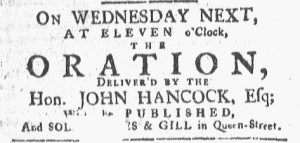
“THE ORATION DELIVER’D BY THE Hon. JOHN HANCOCK, Esq; Will be PUBLISHED.”
Many colonizers commemorated events that were part of the American Revolution before the Revolutionary War began. For instance, residents of Boston acknowledged the anniversary of the “horrid Massacre on the 5th of March 1770” each year. That description of the Boston Massacre came from coverage of the fourth anniversary commemorations in the March 7, 1774, edition of the Boston-Gazette. Benjamin Edes and John Gill, the printers, reported that “the Freeholders and other Inhabitants of this Town met at Faneuil-Hall.” They selected Samuel Adams as moderator for the meeting. Adams, in turn, recognized John Hancock to deliver “an ORATION, on the dangerous Tendency of Standing Armies being placed in free and populous Cities” and sought to “perpetuate the Memory of the horrid Massacre … by a Party of Soldiers belonging to the 29th Regiment, commanded by Capt. Thomas Preston.”
According to the printers, a “prodigious Crowd of People attended to hear the Oration, which was received with universal applause.” In turn, two committees were appointed, one to select a speaker to deliver the oration the following year and the other “to return the Orator the Thanks of the Town for his elegant and spirited Oration, and also to request a Copy of it for the Press.” Already, the annual commemoration including publishing the oration for further dissemination throughout the city and beyond. Edes and Gill further reported that the anniversary occurred on Saturday, “the Evening of which is considered by many Persons as the Commencement of the Sabbath,” so the display of the “Exhibition Portraits of the Murderers, and the slaughtered Citizens” was delayed until Monday evening, the same day the printers distributed that issue of the Boston-Gazette.
Two weeks later, on March 21, Edes and Gill ran a notice in their own newspaper to alert readers that “ON WEDNESDAY NEXT … THE ORATION DELIVER’D BY THE Hon. JOHN HANCOCK, Esq; Will be PUBLISHED” at their printing office. They even specified the time, “ELEVEN o’Clock,” so prospective customers would know exactly when they could obtain their copies. The printers staged an eighteenth-century precursor to a release party. In hopes of inciting greater demand and gaining even more attention for Hancock’s arguments about the rights of colonizers, Edes and Gill also ran advertisements in the Boston Evening-Post and the Massachusetts Gazette and Boston Post-Boy on March 21. The next issue of the Massachusetts Gazette and Boston Weekly News-Letter carried a notice that the oration had been published and was available from “EDES & GILL in Queen-Street.” Each year, printers published the oration marking the anniversary of the Boston Massacre and advertised it widely. Commodification of the event went hand in hand with commemoration.
The Slavery Adverts 250 Project chronicles the role of newspaper advertising in perpetuating slavery in the era of the American Revolution. The project seeks to reveal the ubiquity of slavery in eighteenth-century life from New England to Georgia by republishing advertisements about enslaved people – for sale as individuals or in groups, wanted to purchase or for hire for short periods, runaways who liberated themselves, and those who were subsequently captured and confined in jails and workhouses – in daily digests on this site as well as in real time via the @SlaveAdverts250 Twitter feed, utilizing twenty-first-century media to stand in for the print media of the eighteenth century.
The project aims to provide modern audiences with a sense of just how often colonizers encountered these advertisements in their daily lives. Enslaved men, women, and children appeared in print somewhere in the colonies almost every single day. Those advertisements served as a constant backdrop for social, cultural, economic, and political life in colonial and revolutionary America. Colonizers who did not purport to own enslaved people were still confronted with slavery as well as invited to maintain the system by purchasing enslaved men, women, and children or assisting in the capture of so-called “runaways” who sought to free themselves from bondage. The frequency of these newspaper advertisements suggests just how embedded slavery was in colonial and revolutionary American culture in everyday interactions beyond the printed page.
These advertisements also testify to the experiences of enslaved men, women, and children, though readers must consider that those experiences have been remediated through descriptions offered by enslavers rather than enslaved people themselves. Often unnamed in the advertisements, enslaved men, women, and children were not invisible or unimportant in early America.
These advertisements appeared in colonial American newspapers 250 years ago today.
Boston Evening-Post (March 21, 1774).
**********
Boston-Gazette (March 21, 1774).
**********
Dunlap’s Pennsylvania Packet (March 21, 1774).
**********
Dunlap’s Pennsylvania Packet (March 21, 1774).
**********
Dunlap’s Pennsylvania Packet (March 21, 1774).
**********
Dunlap’s Pennsylvania Packet (March 21, 1774).
**********
Massachusetts Gazette and Boston Post-Boy (March 21, 1774).
**********
Newport Mercury (March 21, 1774).
**********
Newport Mercury (March 21, 1774).
**********
New-York Gazette and Weekly Mercury (March 21, 1774).
**********
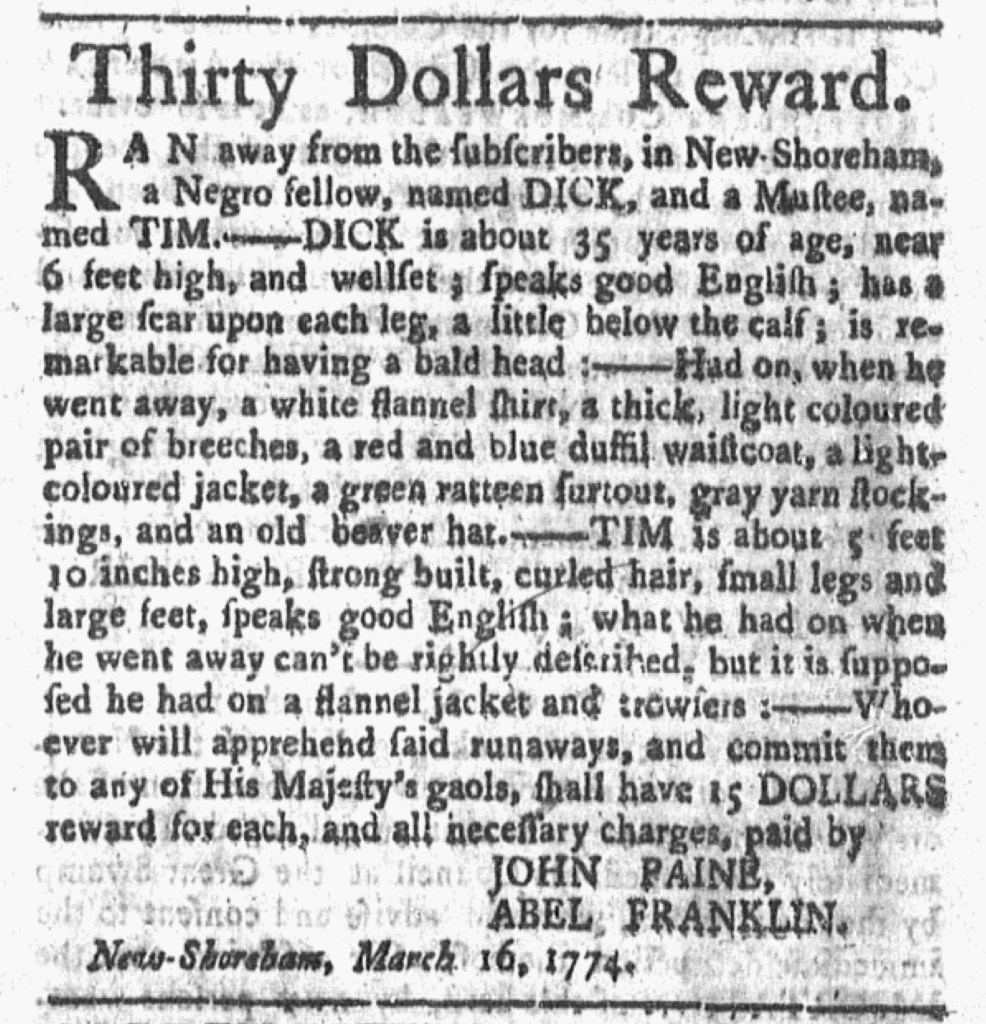
New-York Gazette and Weekly Mercury (March 21, 1774).