March 20

What was advertised in a colonial American newspaper 250 years ago this week?
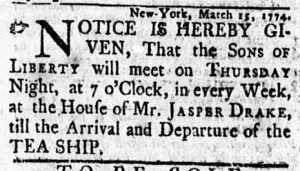
New-York Journal (March 17, 1774).

“The SONS OF LIBERTY will meet on THURSDAY Night … till the Arrival and Departure of the TEA SHIP.”

It was a call to action.  An advertisement in the March 17, 1774, edition of the New-York Journal proclaimed, “NOTICE IS HEREBY GIVEN, That the SONS OF LIBERTY will meet on THURSDAY Night, at 7 o’Clock, in every Week, at the House of Mr. JASPER DRAKE, till the Arrival and Departure of the TEA SHIP.”  That advertisement ran in the column next to an anonymous address “TO THE PUBLICK” that anticipated “the TEA-SHIP, which has been long expected, is near at hand.”  The address asserted, “Our sister colonies have gloriously defended the common cause of this country,” referring to the destruction of several shipments of tea in Boston the previous December and colonizers in Philadelphia had managed to prevent the Polly from landing its tea there.  In turn, the address called on colonizers in New York “to stand our ground, and as the day of tryal is now come, that we shall convince the whole American world that we are not slack and indolent, nor in the least degree unworthy, of being registered as a genuine sister province.”  It was a call to match the resolve and resistance already demonstrated in Boston and Philadelphia.

The “TEA SHIP” in these advertisements referred to the Nancy.  As James R. Fichter explains in Tea: Consumption, Politics, and Revolution, 1773-1776, the consignees of the tea aboard the Nancy “hoped to land and store this tea (but not sell it), which was initially acceptable to local Patriots.”[1]  But that was in November.  On December 1, 1773, even before the Boston Tea Party, the consignees “gave up their role in the tea and asked Governor Tryon to take over.”  The governor initially intended to land and store the tea, emboldened by support from British troops, but reconsidered that plan when Patriots in New York decided they could no longer endorse that plan and, especially, after the colony received word about the destruction of the tea in Boston.  That news encouraged Patriots in their position while convincing Tryon that “‘the Peace of Society’ and ‘good Order,’ trumped landing the tea, and the best he could hope for was an outcome like at Philadelphia (where the ship was turned around).”  The governor engineered a plan for the Nancy to land at Sandy Hook, outside New York City’s customs area, where it could be resupplied to return to Boston while evading any legal obligation to unload its cargo.  Yes, as Fichter notes, the governor “could not formally condone smuggling around His Majesty’s customs, even if it would maintain order.  So Tryon made no official announcement.”  Instead, he made sure that Patriots overheard conversations about this plan when they gathered at one of the coffeehouses in the city.

In the meantime, the Nancy continued making its way across the Atlantic, sheltering in Antiqua in February 1774 following a storm.  The ship made then its way to British mainland North America, arriving at Sandy Hook on April 18, a month after the Sons of Liberty advertised their weekly meetings at Drake’s house.  Conveniently, the governor was away from the city at the time.  Local Patriots observed the Nancy receiving supplies for its return to London, intervening only to prevent sailors who did not wish to continue on a ship further damaged in another storm from coming ashore.  The Nancy needed a crew to return to London without lingering in the waters near New York or inciting any sort of disorder that the carefully orchestrated plan had avoided so far.  As the Son of Liberty’s advertisement in the New-York Journal demonstrates, tea remained a flashpoint for resistance after the Boston Tea Party.  They achieved their goal of the “Arrival and Departure of the TEA SHIP.”

**********

[1] For quotations and a more extensive overview of the Nancy, see James R. Fichter, Tea: Consumption, Politics, and Revolution, 1773-1776 (Ithaca: Cornell University Press, 2023), 88-93.

March 19

What was advertised in a colonial American newspaper 250 years ago today?

Providence Gazette (March 19, 1774).

“… and many other Articles, as cheap as usual.”

Were advertisements in early American newspapers effective?  Did they work?  Did readers become consumers because advertisements incited demand?  Did consumers select where they would shop because of the advertisements they encountered in the public prints.  There are no easy answers to those questions.

What can be asserted with more certainty is that many merchants, shopkeepers, artisans, and others who provided goods and services considered advertising worth the investment, so much so that they placed advertisements for years.  Consider Nicholas Tillinghast and William Holroyd of Providence.  As spring approached in 1774, they once again took to the pages of the Providence Gazette, this time promoting an assortment of “GARDEN SEEDS” as well as a “Variety of English and West India GOODS.”  Perhaps seeing James Green’s advertisement for similar merchandise in the March 5 edition prompted them to insert their own notice in the next edition for fear of losing former and prospective customers to a competitor.

By that time, Tillinghast and Holroyd had been advertising in the Providence Gazette for years.  The Adverts 250 Projecthas not featured every advertisement that they published, but it has examined several of them.  On November 24, 1770, the partners announced that they “newly opened the Shop … at the Sign of the Elephant … where they have to sell a Variety of Articles.”  A year later, they once again hawked “a Variety of well assorted GOODS,” noting that they stocked too many items “to be particularly mentioned in an Advertisement.”  On May 16, 1772, they asserted that they sold a “Variety [of] ARTICLES … at as cheap a Rate as any Goods, of the same Quality, can be purchased in this Town.”  They did not merely announce that they had merchandise for sale.  Instead, Tillinghast and Holroyd repeatedly underscored that they offered choices to consumers and sometimes used prices to encourage prospective customers to choose their store over others.  They did so once again in August 1773 when they directed “their old Customers and the Public” to a new shop “which they have built.”  Their inventory consisted of “English Piece Goods, and Hard Ware of various Sorts, West-India Goods, Groceries and Wines of several Sorts.”  The partners resorted to a familiar refrain: “the Particulars of which would be tedious to enumerate in an Advertisement.”  Instead, they “can be better recounted to any who shall be pleased to make personal Application.”  Tillinghast and Holroyd promised attentive customer service.

Did advertising work?  Tillinghast and Holroyd thought that it worked well enough to justify placing yet another notice in the Providence Gazette in March 1774.  If they suspected that advertising did not yield a return on their investment, would they have continued doing so?

March 18

What was advertised in a colonial American newspaper 250 years ago today?

Connecticut Gazette (March 18, 1774).

Make Way! A Probationer for NEW GATE!

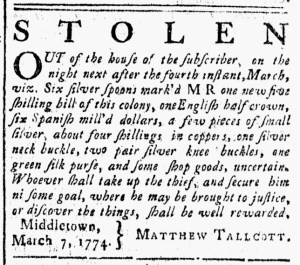
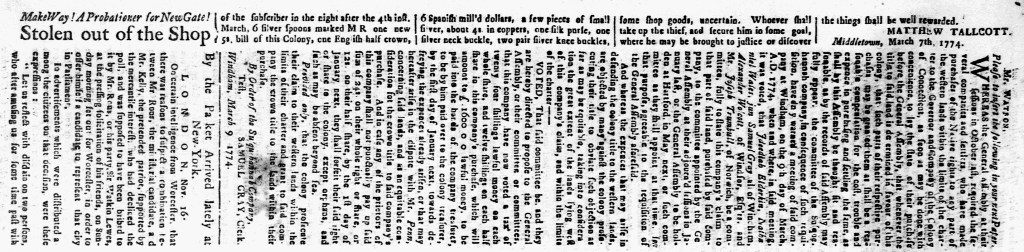
For Matthew Talcott, all was fine on the evening of March 4, 1774, but he woke up to discover a calamity the next morning.  Sometime during the night six silver spoons “marked M R,” “one silver neck buckle, two pair silver knee buckels,” quite a bit of cash, and “some shop goods, uncertain,” had been stolen from his shop in Middletown, Connecticut.  In response, Talcott turned to the public prints, running advertisements in hopes that someone “shall take up the thief, and secure him in some [jail], where he may be brought to justice.”  He also sought to recover the stolen items and money.  In addition to giving a reward, he invested in advertisements in three newspapers published in the colony.

Connecticut Journal (March 18, 1774).

Talcott’s advertisement first appeared in the Connecticut Gazette, published in New London, and the Connecticut Journal and New-Haven Post-Boy on March 11.  In each instance, a headline alerted readers to the contents of the rest of the advertisement.  The Connecticut Journal used “STOLEN” as the headline, while the Connecticut Gazette featured a more playful one that may have attracted even more attention: “Make Way! A Probationer for NEW GATE!”  The colony had recently opened a prison in a copper mine converted for that purpose in East Granby.  Someone in the printing office, rather than Talcott, may have devised the headline.

What suggests that was the case?  The two advertisements featured some variations.  The one in the Connecticut Gazette indicated that the theft took place “out of the Shop” while the Connecticut Journal stated it occurred “OUT of the house” of the unfortunate Talcott.  He likely worked where he resided.  Some of the stolen goods also appeared in slightly different order.  Talcott likely wrote the copy once for one newspaper and then copied it for the other, but was not exact in the process.  The compositor for the Connecticut Journal then used the first word as the headline, a common practice.  The editor or the compositor for the Connecticut Gazette, on the other hand, may have spotted an opportunity for creativity.

Connecticut Courant (March 15, 1774).

Consider that Talcott’s advertisement next ran in the Connecticut Courant, published in Hartford, on March 15.  It featured the same copy, including the snappy headline, that appeared in the Connecticut Gazette.  It also appeared in the margin on the final page, suggesting that the printing office received the advertisement at the last moment.  Type had already been set for the rest of the issue, but the compositor found a way to include Talcott’s notice.  Rather than Talcott submitting his advertisement directly to the Connecticut Courant, he may have made arrangements with the printer of the Connecticut Gazette to instruct his counterpart in Hartford to publish it, marking it in the copy sent as part of an exchange network of printers throughout the colony and the region.

While not conclusive, the circumstances collectively suggest that Talcott wrote the original copy, the Connecticut Gazetteembellished it with a provocative headline, and the Connecticut Courant reprinted it.  Several people played a role in creating the advertisement ultimately distributed to readers throughout the colony.

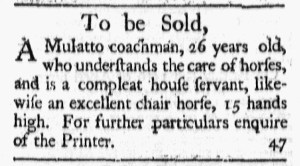
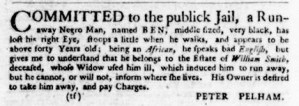
Slavery Advertisements Published March 18, 1774

GUEST CURATOR:  Adam Ide

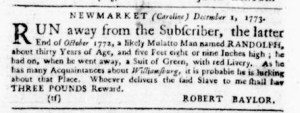
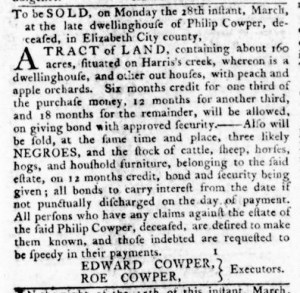
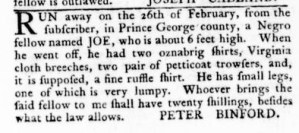
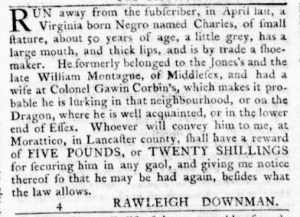
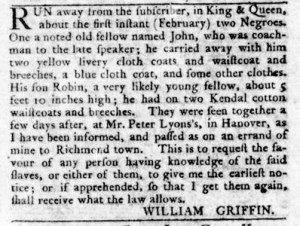
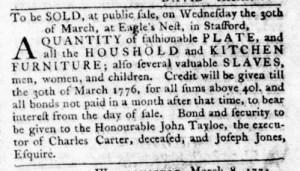
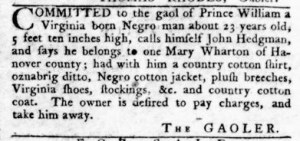
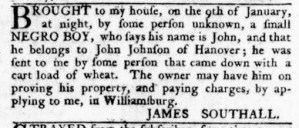
The Slavery Adverts 250 Project chronicles the role of newspaper advertising in perpetuating slavery in the era of the American Revolution. The project seeks to reveal the ubiquity of slavery in eighteenth-century life from New England to Georgia by republishing advertisements about enslaved people – for sale as individuals or in groups, wanted to purchase or for hire for short periods, runaways who liberated themselves, and those who were subsequently captured and confined in jails and workhouses – in daily digests on this site as well as in real time via the @SlaveAdverts250 Twitter feed, utilizing twenty-first-century media to stand in for the print media of the eighteenth century.

The project aims to provide modern audiences with a sense of just how often colonizers encountered these advertisements in their daily lives. Enslaved men, women, and children appeared in print somewhere in the colonies almost every single day. Those advertisements served as a constant backdrop for social, cultural, economic, and political life in colonial and revolutionary America. Colonizers who did not purport to own enslaved people were still confronted with slavery as well as invited to maintain the system by purchasing enslaved men, women, and children or assisting in the capture of so-called “runaways” who sought to free themselves from bondage. The frequency of these newspaper advertisements suggests just how embedded slavery was in colonial and revolutionary American culture in everyday interactions beyond the printed page.

These advertisements also testify to the experiences of enslaved men, women, and children, though readers must consider that those experiences have been remediated through descriptions offered by enslavers rather than enslaved people themselves. Often unnamed in the advertisements, enslaved men, women, and children were not invisible or unimportant in early America.

These advertisements appeared in colonial American newspapers 250 years ago today.

New-Hampshire Gazette (March 18, 1774).

March 17

GUEST CURATOR:  Adam Ide

What was advertised in a colonial American newspaper 250 years ago today?

Massachusetts Gazette and Boston Weekly News-Letter (March 17, 1774).

“Will be Sold by PUBLIC VENDUE, at the Auction-Room in Queen-Street.”

In this advertisement, the auctioneer Joseph Russell was advertising an auction that he was running in which the property of “a Gentleman lately deceased” would be sold off. The practice of auctioning made its way into the colonies through its popularity in England in the seventeenth and eighteenth centuries.

This advertisement originally caught my eye because they were selling off the property of a dead man. I wondered it that could be seen as disrespectful to the family and the memory of whoever’s items were being auctioned off. However, upon further research, I learned that “for most residents [of the British colonies], it was at local auctions—estate auctions, sheriffs’ sales, and discount vendues—that bidders, sellers, and observers created a body of knowledge that established a link between price and value.”[1]

Ellen Hartigan-O’Connor writes about the ways in which colonists interacted with each other and took part in consumer culture by participating in public auctions. Hartigan-O’Connor claims that “[w]ith each exchange, people reflected on what goods were worth” since there was no easy-to-come-by comparative price information.[2] Many were left “to wonder how much they should pay for tools, teapots, or thread if the prices fluctuated with market availability.”[3]

Thankfully for colonists, auctions or “vendues” or “public sales” offered a solution. Unlike regular retail, which relied on the fluctuation of the markets and the importation of new goods, auctions allowed the price that someone was willing to pay to determine the value. Through this method, “it was only at the end, when the hammer strike closed the bidding at a final price, that the assembled community learned what they really considered to be the value of an object.”[4] So despite my initial hesitance toward an estate sale, having one’s items sold at “PUBLIC VENDUE” after one died not only gave people an opportunity to purchase goods outside of the fluctuating markets of the time, but it also allowed the community to determine for themselves the value of the items being sold.

**********

ADDITIONAL COMMENTARY:  Carl Robert Keyes

Adam chose one of many auction notices that appeared in Boston’s newspapers during the week in March 1774 that he examined for his duties as guest curator of the Adverts 250 Project and the Slavery Adverts 250 Project.  As he notes in his examination of Joseph Russell’s advertisement for an upcoming “PUBLIC VENDUE,” auctions were a popular means of buying and selling goods in eighteenth-century America.  Russell’s notice in the Massachusetts Gazette and Boston Weekly News-Letter appeared immediately below another one about a sale the following day “At GOULD’S Auction-Office.”

The compositor for that newspaper often placed auction notices, with sales that took place at a particular time on a particular date, first among advertisements, following the shipping news from the custom house.  Sales in shops, stores, and warehouses did not operate on such regimented schedules, so the printing office, readers, and, especially, auctioneers likely considered it less important to have a dedicated place to find other advertisements.  In contrast, Gould’s auction would happen “TO-MORROW” and at no other time and Russell’s auction was scheduled for “Wednesday next.”

Not every compositor in every printing office took that approach, demonstrating that early American printers did not devise universal methods of classifying and organizing the contents of their newspapers.  When Russell’s advertisement ran in the Boston-Gazette later in the week, it appeared among notices placed for a variety of purposes.  It did not have a privileged place on the page, nor did Benjamin Church’s advertisement, one column over, for a “PUBLICK AUCTION … On THURSDAY NEXT.”  M. Deshon, “AUCTIONEER,” placed his own notice that appeared further down the column.

The Boston Evening-Post and the Massachusetts Gazette and Boston Post-Boy each carried advertisements about auctions that week.  Among the newspapers published in Boston, only the Massachusetts Spy did not disseminate notices about public vendues, though several appeared in its pages the following week.  Merchants and shopkeepers certainly competed with auctioneers when it came to finding buyers in Boston on the eve of the American Revolution.

**********

[1] Ellen Hartigan-O’Connor, “Public Sales and Public Values in Eighteenth-Century North America,” Early American Studies 13, no. 4 (Fall 2015): 749.

[2] Hartigan-O’Connor, “Public Sales and Public Values,” 751.

[3] Hartigan-O’Connor, “Public Sales and Public Values,” 751.

[4] Hartigan-O’Connor, “Public Sales and Public Values,” 752.

Welcome, Guest Curator Adam Ide

Adam Ide is a senior at Assumption University in Worcester, Massachusetts. He is a double major in History and Secondary Education.  He is especially interested in different types of historiographical study. He recently defended his Honors thesis on the use of counterfactuals in historiographical studies. Beyond academics, Adam is the Sports Editor for Assumption University’s newspaper, Le Provocateur, as well as the Residential Assistant advisor to the Residence Hall Association. He is a recipient of the Light the Way Scholarship due to his work with children with autism spectrum disorder. He has made his contributions to the Adverts 250 Project and the Slavery Adverts 250 Project while enrolled in HIS 401 Revolutionary America, 1763-1815, in Fall 2023.

Welcome, guest curator Adam Ide!

Slavery Advertisements Published March 17, 1774

GUEST CURATOR:  Adam Ide

The Slavery Adverts 250 Project chronicles the role of newspaper advertising in perpetuating slavery in the era of the American Revolution. The project seeks to reveal the ubiquity of slavery in eighteenth-century life from New England to Georgia by republishing advertisements about enslaved people – for sale as individuals or in groups, wanted to purchase or for hire for short periods, runaways who liberated themselves, and those who were subsequently captured and confined in jails and workhouses – in daily digests on this site as well as in real time via the @SlaveAdverts250 Twitter feed, utilizing twenty-first-century media to stand in for the print media of the eighteenth century.

The project aims to provide modern audiences with a sense of just how often colonizers encountered these advertisements in their daily lives. Enslaved men, women, and children appeared in print somewhere in the colonies almost every single day. Those advertisements served as a constant backdrop for social, cultural, economic, and political life in colonial and revolutionary America. Colonizers who did not purport to own enslaved people were still confronted with slavery as well as invited to maintain the system by purchasing enslaved men, women, and children or assisting in the capture of so-called “runaways” who sought to free themselves from bondage. The frequency of these newspaper advertisements suggests just how embedded slavery was in colonial and revolutionary American culture in everyday interactions beyond the printed page.

These advertisements also testify to the experiences of enslaved men, women, and children, though readers must consider that those experiences have been remediated through descriptions offered by enslavers rather than enslaved people themselves. Often unnamed in the advertisements, enslaved men, women, and children were not invisible or unimportant in early America.

These advertisements appeared in colonial American newspapers 250 years ago today.

Rivington’s New-York Gazetteer (March 17, 1774).

**********

Virginia Gazette [Purdie and Dixon] (March 17, 1774).

**********

Virginia Gazette [Purdie and Dixon] (March 17, 1774).

**********

Virginia Gazette [Purdie and Dixon] (March 17, 1774).

**********

Virginia Gazette [Purdie and Dixon] (March 17, 1774).

**********

Virginia Gazette [Purdie and Dixon] (March 17, 1774).

**********

Virginia Gazette [Purdie and Dixon] (March 17, 1774).

**********

Virginia Gazette [Purdie and Dixon] (March 17, 1774).

**********

Virginia Gazette [Purdie and Dixon] (March 17, 1774).

**********

Virginia Gazette [Purdie and Dixon] (March 17, 1774).

**********

Virginia Gazette [Rind] (March 17, 1774).

**********

Virginia Gazette [Rind] (March 17, 1774).

**********

Virginia Gazette [Rind] (March 17, 1774).

**********

Virginia Gazette [Rind] (March 17, 1774).

**********

Virginia Gazette [Rind] (March 17, 1774).

**********

Virginia Gazette [Rind] (March 17, 1774).

**********

Virginia Gazette [Rind] (March 17, 1774).

**********

Virginia Gazette [Rind] (March 17, 1774).

**********

Virginia Gazette [Rind] (March 17, 1774).

**********

Virginia Gazette [Rind] (March 17, 1774).

**********

Virginia Gazette [Rind] (March 17, 1774).

March 16

What was advertised in a colonial American newspaper 250 years ago today?

Pennsylvania Gazette (March 16, 1774).

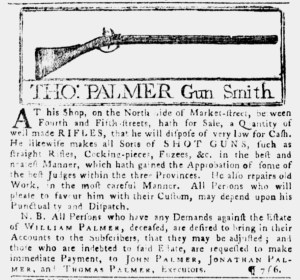
“THO. PALMER Gun Smith.”

Jack Healy, a student in my Revolutionary America class, selected Thomas Palmer’s advertisement for “a Quantity of well made RIFLES” and “all Sorts of SHOT GUNS” to feature on the Adverts 250 Project, hoping to learn more about firearms in the colonies during the era of the American Revolution and the Early Republic.  The woodcut depicting a gun, which the gunsmith previously used in other advertisements, helped attract Jack’s attention, prompting him to seek more information.

Among other secondary sources, I recommended that Jack peruse Saul Cornell’s A Well-Regulated Militia: The Founding Fathers and the Origins of Gun Control in America.  In the opening chapter, “English Tyranny versus American Liberty,” Cornell describes militia laws “that required each householder to provide himself with a musket to meet his obligation to participate in the militia” for the purposes of keeping order and defending their communities.  “It would be impossible,” Cornell asserts, “to overstate the militia’s centrality to the lives of American colonists.”  In addition to providing defense, the militia “served an important social role” as “one of the central means for organizing citizens” prior to the emergence of modern political parties.  Communities gathered at musters, drilling, celebrating, and forging bonds.[1]

Palmer did not mention any of that in his advertisement.  He did not need to do so since prospective customers were so familiar with the part that militias played in colonial culture.  Instead, he emphasized the quality of the firearms he produced, declaring that he constructed them “in the best and neatest Manner.”  Furthermore, his work “hath gained the Approbation of some of the best Judges within the three Provinces” of Pennsylvania, New Jersey, and Delaware, though he did not identify who gave such endorsements.  For those not in the market to purchase a new firearm, Palmer offered to repair “old Work, in the most careful Manner.”  To fulfill their civic obligations and to participate in communal gatherings, many colonizers may have turned to Palmer to obtain and maintain the firearms they carried as members of their local militia.

**********

[1] Saul Cornell, A Well-Regulated Militia: The Founding Fathers and the Origins of Gun Control in America (New York: Oxford University Press, 2006), 12-13.

Welcome, Guest Curator Jack Healy

Jack Healy is a senior at Assumption University in Worcester, Massachusetts.  He is a History major with a minor in Theology.  He describes himself as a history fanatic and a devout Catholic.  His hobbies include collecting flags and prayer cards.  He often uses the prayer cards as bookmarks.  Jack made his contributions to the Adverts 250 Project and the Slavery Adverts 250 Project while enrolled in HIS 401 Revolutionary America, 1763-1815, in Fall 2023.

Welcome, guest curator Jack Healy!

Slavery Advertisements Published March 16, 1774

GUEST CURATOR:  Jack Healy

The Slavery Adverts 250 Project chronicles the role of newspaper advertising in perpetuating slavery in the era of the American Revolution. The project seeks to reveal the ubiquity of slavery in eighteenth-century life from New England to Georgia by republishing advertisements about enslaved people – for sale as individuals or in groups, wanted to purchase or for hire for short periods, runaways who liberated themselves, and those who were subsequently captured and confined in jails and workhouses – in daily digests on this site as well as in real time via the @SlaveAdverts250 Twitter feed, utilizing twenty-first-century media to stand in for the print media of the eighteenth century.

The project aims to provide modern audiences with a sense of just how often colonizers encountered these advertisements in their daily lives. Enslaved men, women, and children appeared in print somewhere in the colonies almost every single day. Those advertisements served as a constant backdrop for social, cultural, economic, and political life in colonial and revolutionary America. Colonizers who did not purport to own enslaved people were still confronted with slavery as well as invited to maintain the system by purchasing enslaved men, women, and children or assisting in the capture of so-called “runaways” who sought to free themselves from bondage. The frequency of these newspaper advertisements suggests just how embedded slavery was in colonial and revolutionary American culture in everyday interactions beyond the printed page.

These advertisements also testify to the experiences of enslaved men, women, and children, though readers must consider that those experiences have been remediated through descriptions offered by enslavers rather than enslaved people themselves. Often unnamed in the advertisements, enslaved men, women, and children were not invisible or unimportant in early America.

These advertisements appeared in colonial American newspapers 250 years ago today.

Pennsylvania Journal (March 16, 1774).

**********

Postscript to the Pennsylvania Journal (March 16, 1774).