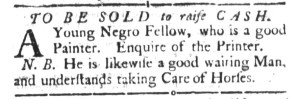
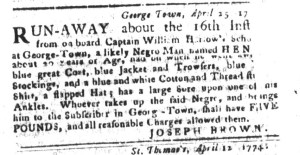
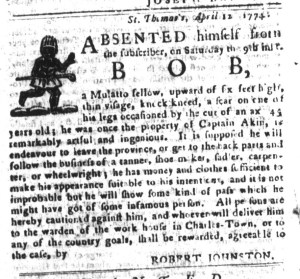
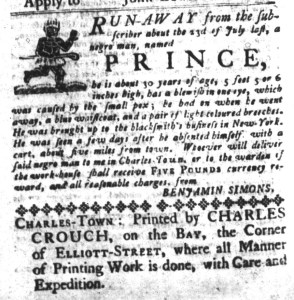
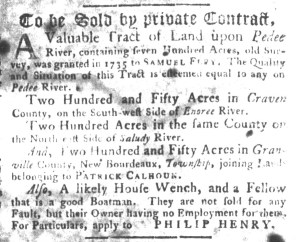
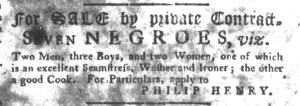
Slavery Advertisements Published May 20, 1774

GUEST CURATOR:  Brendan Shaughnessy

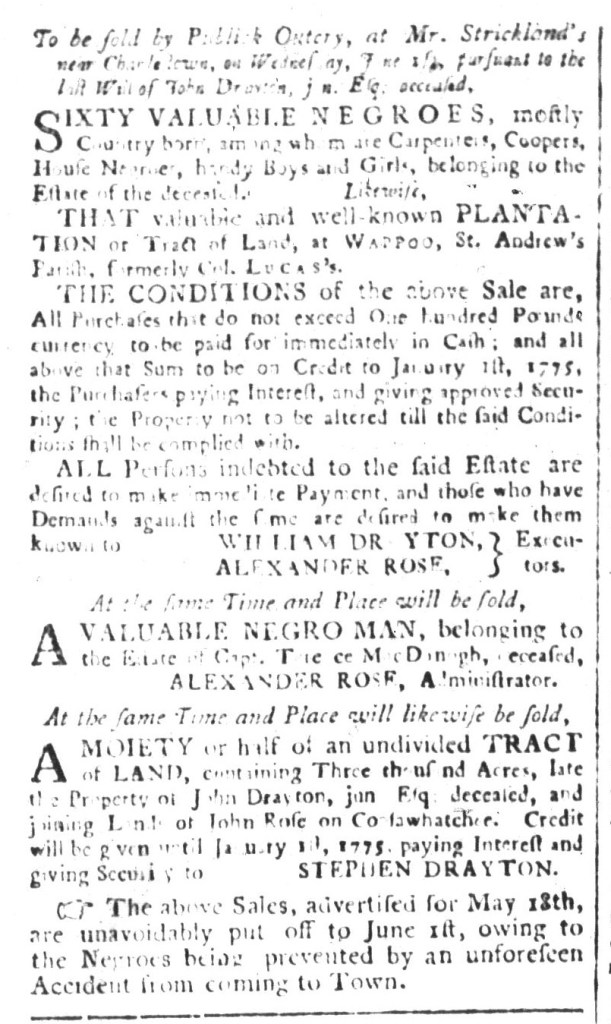
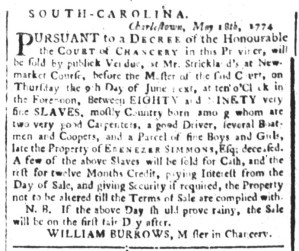
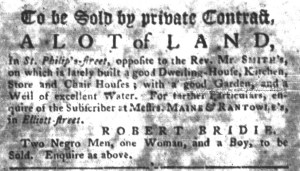
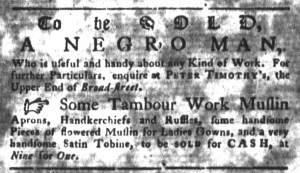
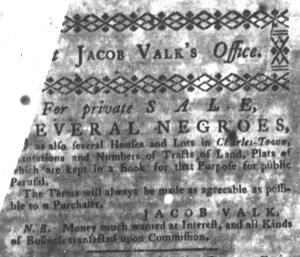
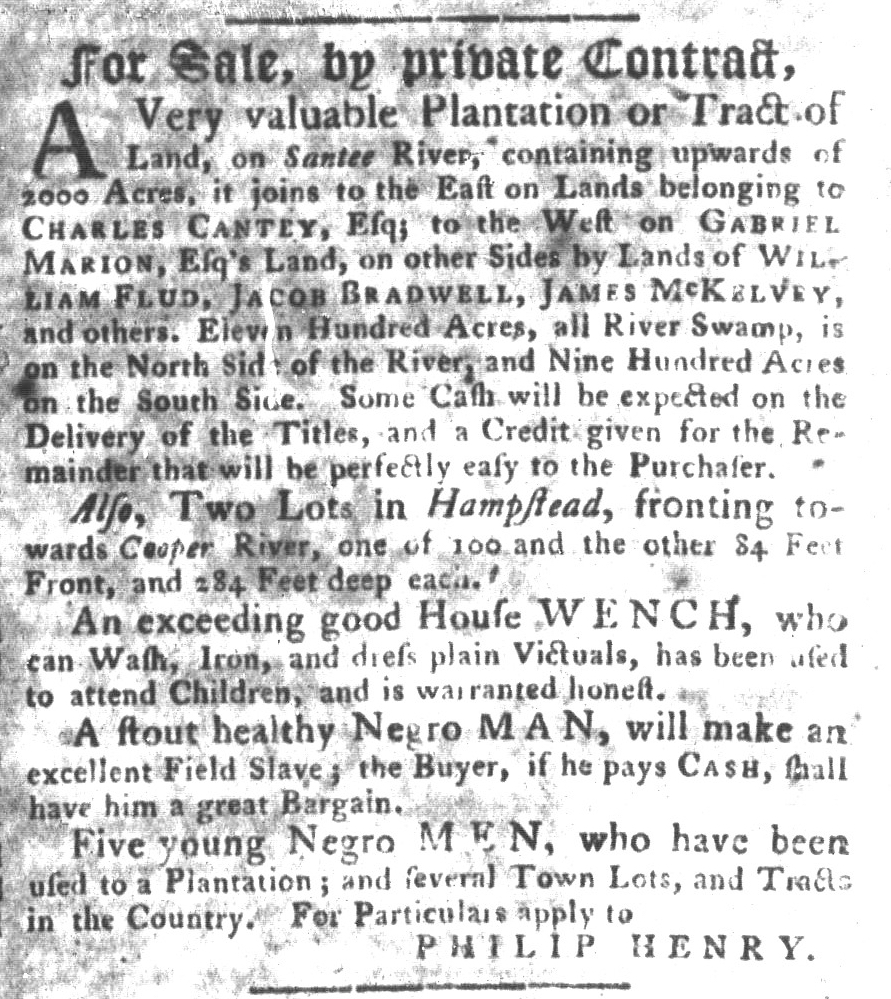
The Slavery Adverts 250 Project chronicles the role of newspaper advertising in perpetuating slavery in the era of the American Revolution. The project seeks to reveal the ubiquity of slavery in eighteenth-century life from New England to Georgia by republishing advertisements about enslaved people – for sale as individuals or in groups, wanted to purchase or for hire for short periods, runaways who liberated themselves, and those who were subsequently captured and confined in jails and workhouses – in daily digests on this site as well as in real time via the @SlaveAdverts250 Twitter feed, utilizing twenty-first-century media to stand in for the print media of the eighteenth century.

The project aims to provide modern audiences with a sense of just how often colonizers encountered these advertisements in their daily lives. Enslaved men, women, and children appeared in print somewhere in the colonies almost every single day. Those advertisements served as a constant backdrop for social, cultural, economic, and political life in colonial and revolutionary America. Colonizers who did not purport to own enslaved people were still confronted with slavery as well as invited to maintain the system by purchasing enslaved men, women, and children or assisting in the capture of so-called “runaways” who sought to free themselves from bondage. The frequency of these newspaper advertisements suggests just how embedded slavery was in colonial and revolutionary American culture in everyday interactions beyond the printed page.

These advertisements also testify to the experiences of enslaved men, women, and children, though readers must consider that those experiences have been remediated through descriptions offered by enslavers rather than enslaved people themselves. Often unnamed in the advertisements, enslaved men, women, and children were not invisible or unimportant in early America.

These advertisements appeared in colonial American newspapers 250 years ago today.
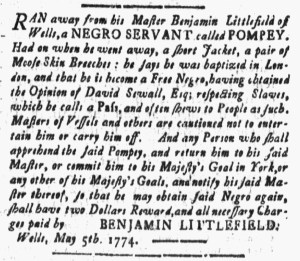
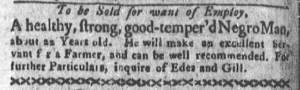
New-Hampshire Gazette (May 20, 1774).

**********
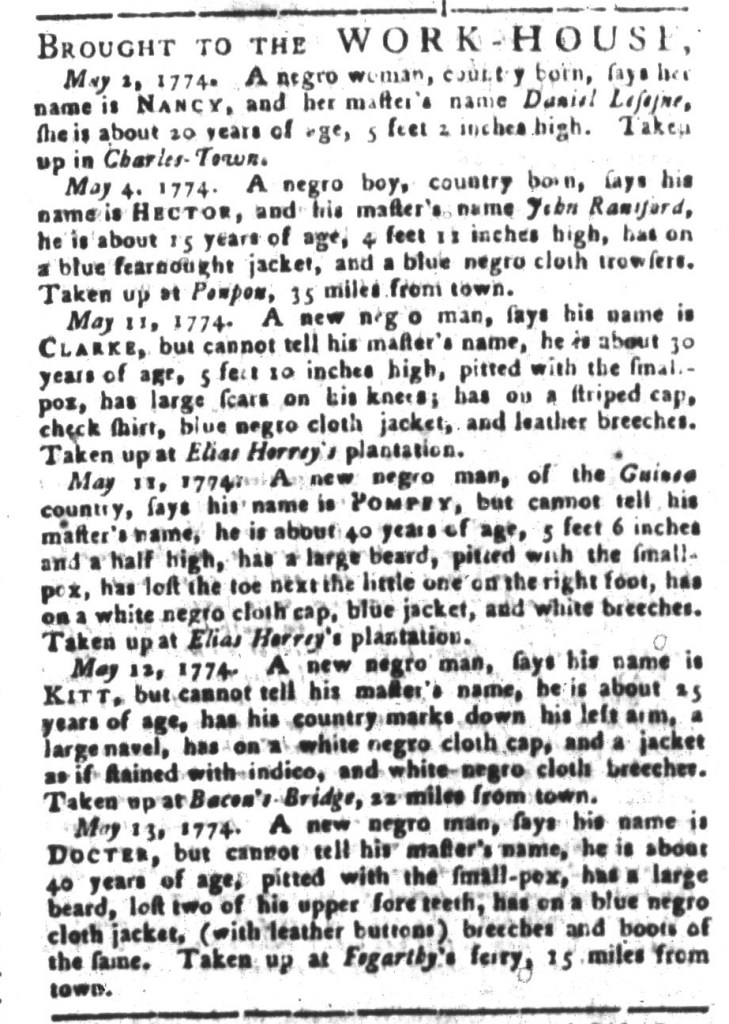
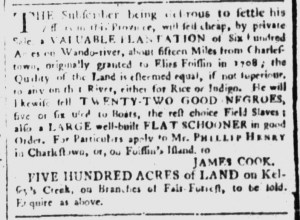
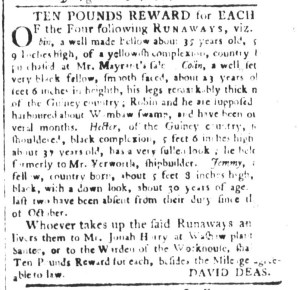
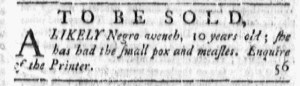
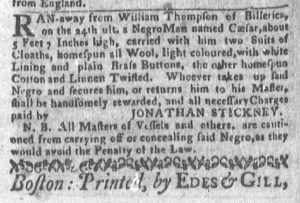
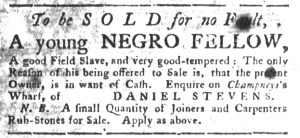
South-Carolina and American General Gazette (May 20, 1774).

**********

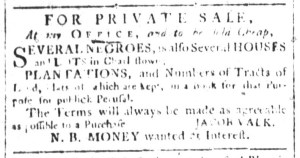
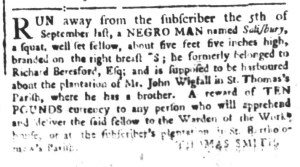
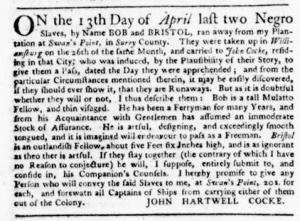
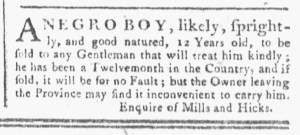
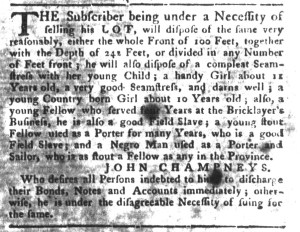
South-Carolina and American General Gazette (May 20, 1774).

**********
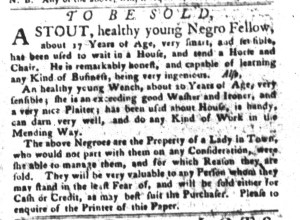
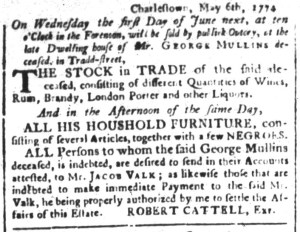
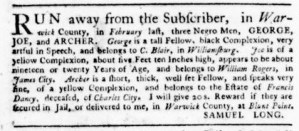
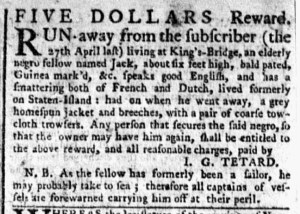
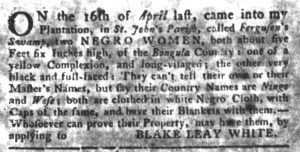
South-Carolina and American General Gazette (May 20, 1774).

**********
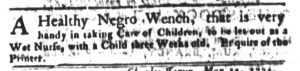
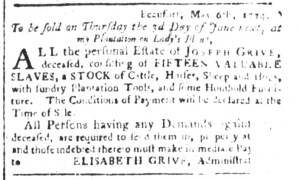
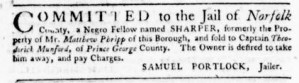
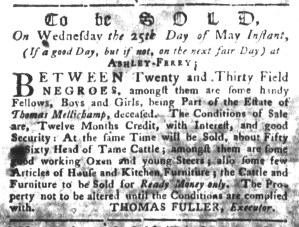
South-Carolina and American General Gazette (May 20, 1774).

**********
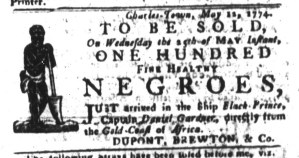
South-Carolina and American General Gazette (May 20, 1774).

**********

South-Carolina and American General Gazette (May 20, 1774).

**********
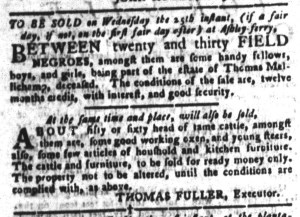
South-Carolina and American General Gazette (May 20, 1774).

**********
South-Carolina and American General Gazette (May 20, 1774).

**********
South-Carolina and American General Gazette (May 20, 1774).

**********

South-Carolina and American General Gazette (May 20, 1774).

**********
South-Carolina and American General Gazette (May 20, 1774).

**********
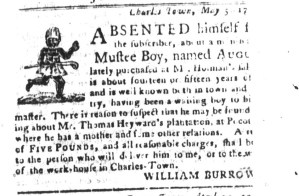
South-Carolina and American General Gazette (May 20, 1774).

**********

South-Carolina and American General Gazette (May 20, 1774).

**********

South-Carolina and American General Gazette (May 20, 1774).

**********

South-Carolina and American General Gazette (May 20, 1774).

**********

South-Carolina and American General Gazette (May 20, 1774).

**********

South-Carolina and American General Gazette (May 20, 1774).

**********

South-Carolina and American General Gazette (May 20, 1774).

**********

South-Carolina and American General Gazette (May 20, 1774).

**********

South-Carolina and American General Gazette (May 20, 1774).

**********

South-Carolina and American General Gazette (May 20, 1774).

May 19

What was advertised in a colonial American newspaper 250 years ago today?

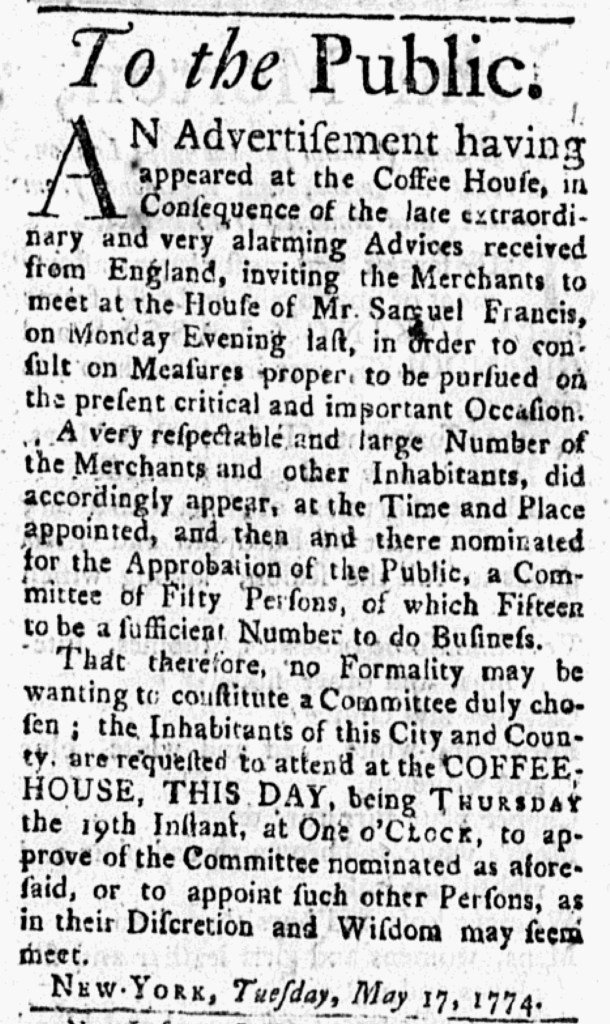
New-York Journal (May 19, 1774).

“Meet … to consult on Measures proper to be pursued on the present critical and important Occasion.”

Important news sometimes appeared among the advertisements in colonial newspapers during the imperial crisis that culminated in thirteen colonies declaring independence from Britain.  While the rest of the newspaper carried reports, updates, editorials, and extracts of letters meant to keep readers informed of “the freshest ADVICES, both FOREIGN andDOMESTIC” (as the masthead for the New-York Journal and other newspapers proclaimed), readers also needed to peruse the advertisements.  Such was the case in the spring of 1774 when New York received word of the Boston Port Act that closed the harbor until such time that resident made restitution for the tea destroyed by colonizers masquerading as Indians the previous December.

A notice in the May 19 edition of the New-York Journal referred to an “Advertisement” or announcement that “appeared at the Coffee House, in Consequence of the late extraordinary and very alarming Advices received from England.”  That announcement invited merchants to meet “at the House of Mr. Samuel Francis,” meaning the tavern operated by Samuel Fraunces, “in order to consult on Measures proper to be pursued on the present critical and important Occasion.”  In turn, the advertisement in the newspaper reported on what occurred at that meeting.  “A very respectable and large Number of the Merchants and other Inhabitants” gathered and nominated a committee “of Fifty Persons, of which Fifteen to be a sufficient Number to do Business.”  The advertisement, addressed “To the Public,” called on the “inhabitants of this City and County” to attend another meeting to “approve of the Committee nominated … or to appoint such other Persons, as in their Discretion and Wisdom may seem meet.”  The organizers intended to garner as much support as possible to “constitute a Committee duly chosen” to act on behalf of all residents concerned about the most recent abuse perpetrated by Parliament.

Disseminating notice about the meeting as a newspaper advertisement made more colonizers aware of the meeting, though word also spread in conversation.  It also kept readers at a distance informed that merchants and others in New York prepared to take action, encouraging them to continue checking the public prints for more news about politics and current events.  Those who also read Rivington’s New-York Gazetteer that day encountered the complete text of the Boston Port Act on the front page, an opportunity to assess it for themselves beyond whatever rumors they previously heard.  Working back and forth between news and advertisements, colonizers gained a more complete picture of the events unfolding in the wake of the Boston Tea Party.

Slavery Advertisements Published May 19, 1774

GUEST CURATOR:  Brendan Shaughnessy

The Slavery Adverts 250 Project chronicles the role of newspaper advertising in perpetuating slavery in the era of the American Revolution. The project seeks to reveal the ubiquity of slavery in eighteenth-century life from New England to Georgia by republishing advertisements about enslaved people – for sale as individuals or in groups, wanted to purchase or for hire for short periods, runaways who liberated themselves, and those who were subsequently captured and confined in jails and workhouses – in daily digests on this site as well as in real time via the @SlaveAdverts250 Twitter feed, utilizing twenty-first-century media to stand in for the print media of the eighteenth century.

The project aims to provide modern audiences with a sense of just how often colonizers encountered these advertisements in their daily lives. Enslaved men, women, and children appeared in print somewhere in the colonies almost every single day. Those advertisements served as a constant backdrop for social, cultural, economic, and political life in colonial and revolutionary America. Colonizers who did not purport to own enslaved people were still confronted with slavery as well as invited to maintain the system by purchasing enslaved men, women, and children or assisting in the capture of so-called “runaways” who sought to free themselves from bondage. The frequency of these newspaper advertisements suggests just how embedded slavery was in colonial and revolutionary American culture in everyday interactions beyond the printed page.

These advertisements also testify to the experiences of enslaved men, women, and children, though readers must consider that those experiences have been remediated through descriptions offered by enslavers rather than enslaved people themselves. Often unnamed in the advertisements, enslaved men, women, and children were not invisible or unimportant in early America.

These advertisements appeared in colonial American newspapers 250 years ago today.

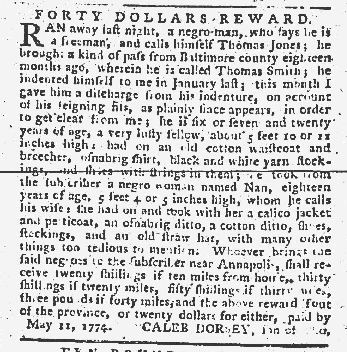
Maryland Gazette (May 19, 1774).

**********

Maryland Gazette (May 19, 1774).

**********

Massachusetts Gazette and Boston Weekly News-Letter (May 19, 1774).

**********

Supplement to the Massachusetts Gazette and Boston Weekly News-Letter (May 19, 1774).

**********

Supplement to the Massachusetts Gazette and Boston Weekly News-Letter (May 19, 1774).

**********

Rivington’s New-York Gazetteer (May 19, 1774).

**********

Postscript to the Virginia Gazette [Purdie and Dixon] (May 19, 1774).

**********

Postscript to the Virginia Gazette [Purdie and Dixon] (May 19, 1774).

**********

Postscript to the Virginia Gazette [Purdie and Dixon] (May 19, 1774).

**********

Postscript to the Virginia Gazette [Purdie and Dixon] (May 19, 1774).

**********

Postscript to the Virginia Gazette [Purdie and Dixon] (May 19, 1774).

**********

Postscript to the Virginia Gazette [Purdie and Dixon] (May 19, 1774).

**********

Postscript to the Virginia Gazette [Purdie and Dixon] (May 19, 1774).

**********

Postscript to the Virginia Gazette [Purdie and Dixon] (May 19, 1774).

**********

Virginia Gazette [Rind] (May 19, 1774).

**********

Virginia Gazette [Rind] (May 19, 1774).

May 18

What was advertised in a colonial American newspaper 250 years ago today?

Pennsylvania Gazette (May 18, 1774).

“At the Sign of the SCYTHE and SICKLE.”

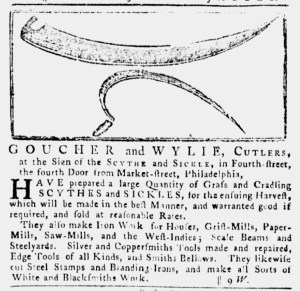
For marking the location of their workshop and for adorning their newspaper advertisements, Goucher and Wylie, cutlers, used an image closely associated with their trade.  In an advertisement that ran in the Pennsylvania Gazette for several weeks in the spring and summer of 1774, they advised prospective customers that they made and sold all kinds of cutlery “at the Sign of the SCYTHE and SICKLE.”  The woodcut that accompanied their notice depicted a scythe and a sickle within a rectangular border, perhaps replicating their shop sign or perhaps merely evoking the same symbols.  Either way, the image made their advertisement more visible to readers while simultaneously prompting them to think of Goucher and Wylie when they glimpsed scythes and sickles.

Yet they were not the only cutlers to operate at the Sign of the Scythe and Sickle in Philadelphia in the early 1770s.  Stephen Paschall and his son, also named Stephen, previously ran advertisements that gave their location as “the Sign of the Scythe and Sickle, in Market-street, between Fourth and Fifth-streets,” the most recent appearing a year before Goucher and Wylie published their notice.  In the longer version of their location, Goucher and Wylie directed customers to “the Sign of the SCYTHE and SICKLE, in Fourth-street, the fourth Door from Market-street.”  In other words, Goucher and Wylie were just around the corner from the Paschalls.  Did both businesses use the same device in such close proximity?  Or had the Paschalls closed shop, leaving the Sign of the Scythe and Sickle up for grabs for any cutlers who wished to appropriate it (and perhaps benefit from the reputation already associated with that image)?  Alternately, the Paschalls might have transferred the Sign of the Scythe and Sickle to Goucher and Wylie.

Let’s examine the evidence for that last possibility.  In June 1770, Samuel Wheeler advertised that he kept shop “at the sign of the Scythe, Sickle and Brand-iron” at the same time that Stephen Paschall ran notices that gave his location as “the sign of the Scythe and Sickle, in Market-street.”  Wheeler carefully added an item to his sign to distinguish his business from Paschall’s.  Had the elder and younger Paschall still been in business around the corner in 1774, Goucher and Wylie may have hesitated to duplicate their sign and, by extension, the name of their business.  In May 1768, Stephen Paschall and Benjamin Humphreys placed a joint advertisement that featured an image of a scythe and sickle enclosed in a rectangular border.  Both items bore the name “HUMPHREYS.”  That woodcut appears identical to the one in Goucher and Wylie’s advertisement that ran six years later, with the exception of “HUMPHREYS” being removed.  Perhaps Paschall had retained the woodcut when his association with Humphreys ended but had not made use of it.  He could have passed along the woodcut to Goucher and Wylie when transferring the Sign of the Scythe and Sickle to them.  If this scenario did occur, it suggests that some artisans carefully curated the names and images associated with their businesses in colonial Philadelphia.

Slavery Advertisements Published May 18, 1774

GUEST CURATOR:  Yaire Hernandez

The Slavery Adverts 250 Project chronicles the role of newspaper advertising in perpetuating slavery in the era of the American Revolution. The project seeks to reveal the ubiquity of slavery in eighteenth-century life from New England to Georgia by republishing advertisements about enslaved people – for sale as individuals or in groups, wanted to purchase or for hire for short periods, runaways who liberated themselves, and those who were subsequently captured and confined in jails and workhouses – in daily digests on this site as well as in real time via the @SlaveAdverts250 Twitter feed, utilizing twenty-first-century media to stand in for the print media of the eighteenth century.

The project aims to provide modern audiences with a sense of just how often colonizers encountered these advertisements in their daily lives. Enslaved men, women, and children appeared in print somewhere in the colonies almost every single day. Those advertisements served as a constant backdrop for social, cultural, economic, and political life in colonial and revolutionary America. Colonizers who did not purport to own enslaved people were still confronted with slavery as well as invited to maintain the system by purchasing enslaved men, women, and children or assisting in the capture of so-called “runaways” who sought to free themselves from bondage. The frequency of these newspaper advertisements suggests just how embedded slavery was in colonial and revolutionary American culture in everyday interactions beyond the printed page.

These advertisements also testify to the experiences of enslaved men, women, and children, though readers must consider that those experiences have been remediated through descriptions offered by enslavers rather than enslaved people themselves. Often unnamed in the advertisements, enslaved men, women, and children were not invisible or unimportant in early America.

These advertisements appeared in colonial American newspapers 250 years ago today.

Pennsylvania Gazette (May 18, 1774).

**********

Pennsylvania Journal (May 18, 1774).

May 17

What was advertised in a colonial American newspaper 250 years ago today?

Essex Gazette (May 17, 1774).

William Vans’s CHeap Shop.”

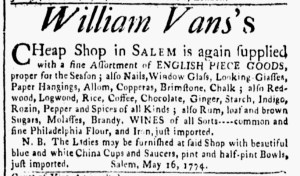
Readers encountered several invitations to purchase cheap goods when they perused the May 17, 1774, edition of the Essex Gazette.  Stephen Higginson’s advertisement listing dozens of items available “At his Store opposite the King’s Arms in SALEM” featured a headline that proclaimed, “Very Cheap.”  That framed how he wished prospective customers to think about his merchandise before they engaged with the rest of his notice.  Nathaniel Sparhawk stocked a “large and beautiful Assortment of English, India and European GOODS … at his CHEAP STORE in King-Street, SALEM.”  He pledged to sell “at the lowest Advance” or lowest markup “for Cash.”  Similarly, William Vans described his establishment as a “CHeap Shop,” though he did not offer further commentary on his prices.

These merchants and shopkeepers deployed the word “cheap” in a different manner than retailers and consumers use it today.  For colonizers, “cheap” did not have connotations of inferior quality. Vans certainly did not want prospective customers to think of the “beautiful blue and white China Cups and Saucers” he stocked at his “CHeap Shop” as deficient in any way, nor did Higginson intend for the public to have the impression that he prioritized price over quality for his “Very Cheap” textiles, “Men’s, Women’s and Children’s colour’d and white lamb and kid Gloves,” “Looking-Glasses,” and other wares.  Instead, “cheap” merely meant inexpensive.  Shoppers could expect to find bargain prices when they went to Vans’s “CHeap Shop” or Sparkawk’s “CHEAP STORE.”  The Oxford English Dictionary makes a distinction between “cheap” (meaning “bought at small cost; bearing a relatively low price; inexpensive”) and “cheap and nasty” (meaning “of low price and bad quality; inexpensive but with the disadvantage of being unsuitable to one’s purposes”).  The earliest examples for “cheap and nasty” given by the Oxford English Dictionary” come from the 1820s, a half century after Higginson, Sparhawk, Vans, and other advertisers used “cheap” to promote their goods.  At the time that colonial entrepreneurs used the word, neither they nor their prospective customers associated “cheap” with poor quality.  That sense of the word evolved over time, making it less positive and less powerful in modern marketing campaigns.  Today, consumers are wary of cheap goods, but that was not the case in eighteenth-century America.

Slavery Advertisements Published May 17, 1774

GUEST CURATOR:  Yaire Hernandez

The Slavery Adverts 250 Project chronicles the role of newspaper advertising in perpetuating slavery in the era of the American Revolution. The project seeks to reveal the ubiquity of slavery in eighteenth-century life from New England to Georgia by republishing advertisements about enslaved people – for sale as individuals or in groups, wanted to purchase or for hire for short periods, runaways who liberated themselves, and those who were subsequently captured and confined in jails and workhouses – in daily digests on this site as well as in real time via the @SlaveAdverts250 Twitter feed, utilizing twenty-first-century media to stand in for the print media of the eighteenth century.

The project aims to provide modern audiences with a sense of just how often colonizers encountered these advertisements in their daily lives. Enslaved men, women, and children appeared in print somewhere in the colonies almost every single day. Those advertisements served as a constant backdrop for social, cultural, economic, and political life in colonial and revolutionary America. Colonizers who did not purport to own enslaved people were still confronted with slavery as well as invited to maintain the system by purchasing enslaved men, women, and children or assisting in the capture of so-called “runaways” who sought to free themselves from bondage. The frequency of these newspaper advertisements suggests just how embedded slavery was in colonial and revolutionary American culture in everyday interactions beyond the printed page.

These advertisements also testify to the experiences of enslaved men, women, and children, though readers must consider that those experiences have been remediated through descriptions offered by enslavers rather than enslaved people themselves. Often unnamed in the advertisements, enslaved men, women, and children were not invisible or unimportant in early America.

These advertisements appeared in colonial American newspapers 250 years ago today.

Connecticut Courant (May 17, 1774).

**********

Connecticut Journal Extraordinary (May 17, 1774).

**********

Connecticut Journal Extraordinary (May 17, 1774).

**********

South-Carolina Gazette and Country Journal (May 17, 1774).

**********

South-Carolina Gazette and Country Journal (May 17, 1774).

**********

South-Carolina Gazette and Country Journal (May 17, 1774).

**********

South-Carolina Gazette and Country Journal (May 17, 1774).

**********

South-Carolina Gazette and Country Journal (May 17, 1774).

**********

South-Carolina Gazette and Country Journal (May 17, 1774).

**********

South-Carolina Gazette and Country Journal (May 17, 1774).

**********

South-Carolina Gazette and Country Journal (May 17, 1774).

**********

South-Carolina Gazette and Country Journal (May 17, 1774).

**********

South-Carolina Gazette and Country Journal (May 17, 1774).

**********

South-Carolina Gazette and Country Journal (May 17, 1774).

**********

South-Carolina Gazette and Country Journal (May 17, 1774).

**********

South-Carolina Gazette and Country Journal (May 17, 1774).

**********

South-Carolina Gazette and Country Journal (May 17, 1774).

**********

South-Carolina Gazette and Country Journal (May 17, 1774).

**********

South-Carolina Gazette and Country Journal (May 17, 1774).

**********

South-Carolina Gazette and Country Journal (May 17, 1774).

May 16

What was advertised in a colonial American newspaper 250 years ago today?

Newport Mercury (May 16, 1774).

“Fresh Imported … direct from LONDON … English & India GOODS.”

The crisis over tea hit the boiling point as Christopher Champlin inserted a new advertisement in the May 16, 1774, edition of the Newport Mercury.  Relying on standard language that appeared in notices placed by merchants and shopkeepers, he informed readers in Rhode Island that he stocked a “general assortment of English & India GOODS, Suitable for the Season, Which he continues to sell, by WHOLESALE and RETAIL.”  His merchandise was “Fresh Imported” on two ships “direct from LONDON.”  In a final appeal, Champlin asserted that he sold his wares “As low, for cash, as at any store or shop in the colony.”  Considering the news that ran immediately to the left of his advertisement, Champlin’s marketing strategy may not have been resonated differently than he originally intended.

Word of the Boston Port Act had arrived in Newport.  A news update with a headline that proclaimed, “JOIN or DIE!!” described the “act of parliament for blockading the harbour of Boston, in order to reduce its spirited inhabitants to the most servile and mean compliance ever attempted to be imposed on a free people” as leading to a fate “worse than death—SLAVERY.”  The editor had the news from “a gentleman” who recently arrived in Newport from Boston.”  That source stated that “a number of the first merchants in London had wrote the manufacturers in inland towns of England, not to send them any more goods, and had wrote to the merchants in Boston, that the surest way to settle the present difference, between the two countries, is to stop all trade immediately, and advised a strict union between all the colonies in this measure.”  Whether merchants in London had actually done any of that or it was wishful thinking on the part of patriots who sought allies on the other side of the Atlantic, colonizers had experience with nonimportant agreements (or boycotts) as political leverage in response to the Stamp Act and the Townshend Acts.  The update reminded readers “that hydra the Stamp Act … was destroyed by our firmness and union.”

By the end of October, the First Continental Congress adopted the Continental Association, a trade boycott intended to pressure Parliament into repealing the Boston Port Act and the rest of the Coercive Acts passed in retaliation for the Boston Tea Party as well as address other grievances.  For the moment, however, no boycott was in place when Champlin published his advertisement promoting his “Fresh Imported” goods.  The news that accompanied that notice perhaps caused some consumers to reconsider what they might purchase, but it might also have served to encourage sales among colonizers who suspected that it was only a matter of time before another boycott went into effect.  They could buy what they wished with a clear conscience and without others censuring them for doing so.  Whatever they chose to do in May 1774, consumers in Rhode Island made decisions in the context of news arriving from Boston, London, and other places.

Slavery Advertisements Published May 16, 1774

GUEST CURATOR:  Yaire Hernandez

The Slavery Adverts 250 Project chronicles the role of newspaper advertising in perpetuating slavery in the era of the American Revolution. The project seeks to reveal the ubiquity of slavery in eighteenth-century life from New England to Georgia by republishing advertisements about enslaved people – for sale as individuals or in groups, wanted to purchase or for hire for short periods, runaways who liberated themselves, and those who were subsequently captured and confined in jails and workhouses – in daily digests on this site as well as in real time via the @SlaveAdverts250 Twitter feed, utilizing twenty-first-century media to stand in for the print media of the eighteenth century.

The project aims to provide modern audiences with a sense of just how often colonizers encountered these advertisements in their daily lives. Enslaved men, women, and children appeared in print somewhere in the colonies almost every single day. Those advertisements served as a constant backdrop for social, cultural, economic, and political life in colonial and revolutionary America. Colonizers who did not purport to own enslaved people were still confronted with slavery as well as invited to maintain the system by purchasing enslaved men, women, and children or assisting in the capture of so-called “runaways” who sought to free themselves from bondage. The frequency of these newspaper advertisements suggests just how embedded slavery was in colonial and revolutionary American culture in everyday interactions beyond the printed page.

These advertisements also testify to the experiences of enslaved men, women, and children, though readers must consider that those experiences have been remediated through descriptions offered by enslavers rather than enslaved people themselves. Often unnamed in the advertisements, enslaved men, women, and children were not invisible or unimportant in early America.

These advertisements appeared in colonial American newspapers 250 years ago today.

Supplement to the Boston-Gazette (May 16, 1774).

**********

Supplement to the Boston-Gazette (May 16, 1774).

**********

Massachusetts Gazette (May 16, 1774).

**********

New-York Gazette and Weekly Mercury (May 16, 1774).

**********

New-York Gazette and Weekly Mercury (May 16, 1774).

**********

Supplement to the New-York Gazette and Weekly Mercury (May 16, 1774).

**********

Supplement to the New-York Gazette and Weekly Mercury (May 16, 1774).

**********

South-Carolina Gazette (May 16, 1774).

**********

South-Carolina Gazette (May 16, 1774).

**********

Supplement to the South-Carolina Gazette (May 16, 1774).

**********

Supplement to the South-Carolina Gazette (May 16, 1774).

**********

Supplement to the South-Carolina Gazette (May 16, 1774).

**********

Supplement to the South-Carolina Gazette (May 16, 1774).

**********

Supplement to the South-Carolina Gazette (May 16, 1774).

**********

Supplement to the South-Carolina Gazette (May 16, 1774).

**********

Supplement to the South-Carolina Gazette (May 16, 1774).

**********

Supplement to the South-Carolina Gazette (May 16, 1774).

**********

Supplement to the South-Carolina Gazette (May 16, 1774).

**********

Supplement to the South-Carolina Gazette (May 16, 1774).

**********

Supplement to the South-Carolina Gazette (May 16, 1774).

**********

Supplement to the South-Carolina Gazette (May 16, 1774).

**********

Supplement to the South-Carolina Gazette (May 16, 1774).

**********

Supplement to the South-Carolina Gazette (May 16, 1774).

May 15

What was advertised in a colonial American newspaper 250 years ago this week?

Massachusetts Spy (May 12, 1774).

“All sorts of Groceries as usual – except TEA.”

By the time that Thomas Walley’s advertisement ran in the May 12, 1774, edition of the Massachusetts Spy, it would have been a familiar sight to regular readers of that newspaper.  It previously appeared on six occasions in March, April, and May, advising the public that Walley stocked a variety of items that he sold wholesale or retail at his “Store on Dock-Square” in Boston.  He had “Dutch looking-glasses of various sizes,” “quart and pint Mugs and Chamber Pots,” and “choice junk” (or old rope) “to make into cordage of any size.”

Walley also sold “Oatmeal per bushel,” “all sorts of Spices,” “choice Rice,” “new Raisins,” and “all sorts of Groceries as usual – except TEA.”  That last entry, listing what he did not sell rather than what he wanted to put into the hands of consumers, may have the primary reason that Walley inserted his advertisement in the Massachusetts Spy so many times.  As one of the owners of the Fortune, the vessel that transported the tea involved in the second Boston Tea Party, Walley had been under suspicion, though he and his partners asserted that they did not have “any share, interest or property, directly or indirectly in any part of the Tea that came from London in said vessel.”  They made that declaration, affirmed by a justice of the peace, in an advertisement that ran in the March 10 edition of the Massachusetts Spy, just days after colonizers disguised as Indians once again dumped tea into Boston Harbor.

A week later, Walley’s advertisement listing a variety of goods “except TEA” appeared in the Massachusetts Spy for the first time.  Given the political orientation of that publication, printed by ardent patriot Isaiah Thomas, it made sense for Walley to take to the pages of that newspaper in his effort to convince the public that he was not trucking in tea.  His advertisement ran again the following week and then on April 7, 15, and 22 and May 5 and 12, missing from only the March 31 and April 28 editions.  Merchants and shopkeepers often ran notices for several months, but in this instance a desire to sell his inventory probably was not Walley’s sole consideration.  He continuously reminded the public that he wanted nothing to do with peddling tea, probably even more so on May 12 when Thomas published a two-page Postscript to the Massachusetts Spy that featured the text of the Boston Port Act that closed the harbor until the colonizers made restitution of the tea they destroyed.  As the crisis intensified, Walley sought to distance himself from tea.