June 30

What was advertised in a colonial American newspaper 250 years ago today?
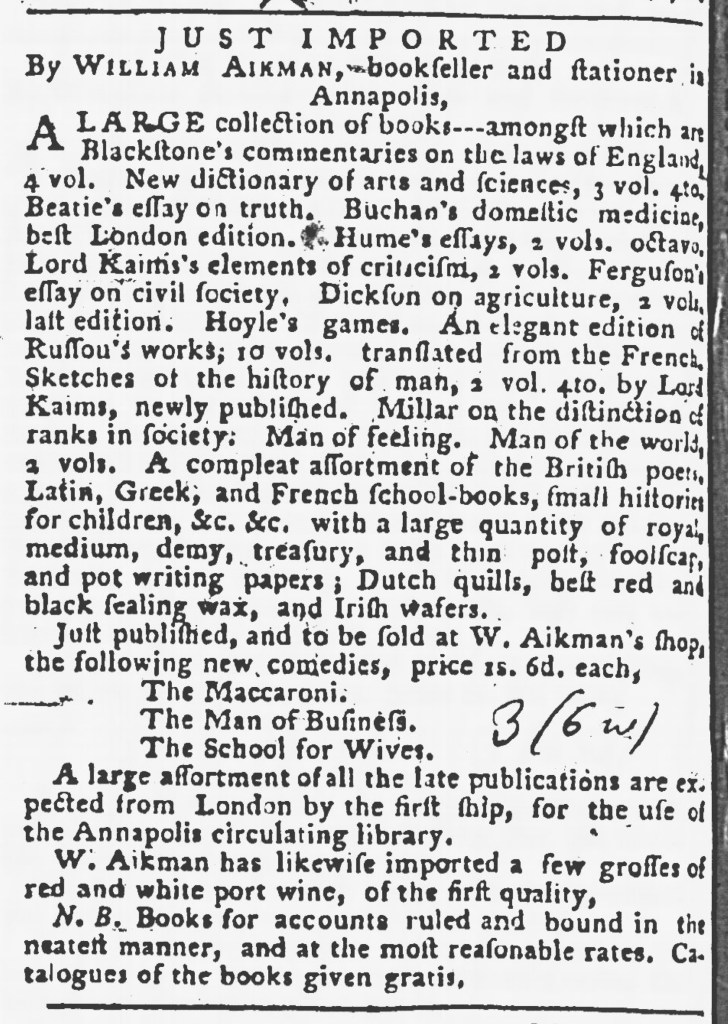
Maryland Gazette (June 30, 1774).

“Just published … the following new comedies.”

In the spring and summer of 1774, William Aikman, “bookseller and stationer in Annapolis,” advertised a “LARGE collection of books” in the Maryland Gazette.  He listed all sorts of titles, including “Blackstone’s commentaries on the laws of England” in four volumes, “Buchan’s domestic medicine, best London edition,” and “Russou’s works, … translated from the French.”  In addition, he stocked a variety of books from several genres, ranging from a “compleat assortment of the British poets” to “Latin, Greek, and French school-books” to “small histories for children.”  Aikman had something for every reader.

The bookseller also devoted a portion of his advertisement to three “new comedies” that sold for one shilling and six pence each.  These works, “Just published,” most likely were reprints that he acquired from John Dunlap in Philadelphia.  In 1774, Dunlap printed American editions of Robert Hitchcock’s The Macaroni: A Comedy, as It Is Performed at the Theatre Royal, George Coleman’s The Man of Business: A Comedy: As It is Acted at the Theatre-Royal in Covent-Garden, and Hugh Kelly’s The School for Wives: A Comedy: As It Is Performed at the Theatre-Royal in Drury Lane.  Perusing those works gave readers in the colonies, in Philadelphia or Annapolis or anywhere else that Dunlap distributed his reprinted editions, a taste of the theater scene in the cosmopolitan center of the empire.

In addition, Aikman announced that a “large assortment of all the late publications are expected from London by the first ship, for the use of the Annapolis circulating library.”  That was another venture that the enterprising bookseller and stationer oversaw.  A year earlier, he opened that library and advertised the subscription fees for joining for a month, a quarter, six months, or a year.  In the fall of 1773, he advertised that his Annapolis Circulating Library provided delivery service to Baltimore, both a convenience for members there and an attempt to undercut a competing library proposed by a competitor who did not manage to establish a library there.

Overall, Aikman’s advertisement revealed multiple trajectories for producing, distributing, and acquiring books on the eve of the American Revolution.  Booksellers received most of their inventory from English printers, though printers in the colonies published both American editions and original works.  Those printers worked with printers and booksellers in other towns to exchange, market, and sell books and pamphlets printed in the colonies.  For their part, readers could purchase books or join circulating libraries to increase their access to larger libraries than they could afford on their own.


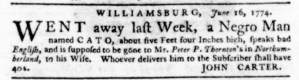
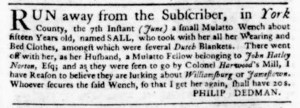
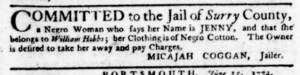
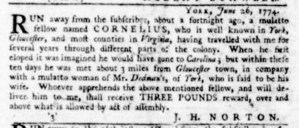
Slavery Advertisements Published June 30, 1774

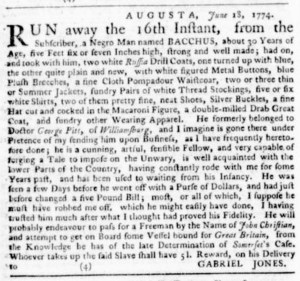
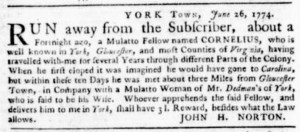
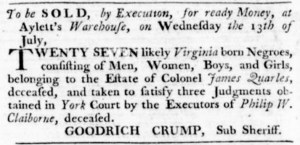
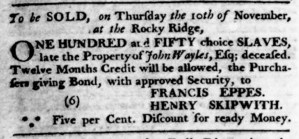
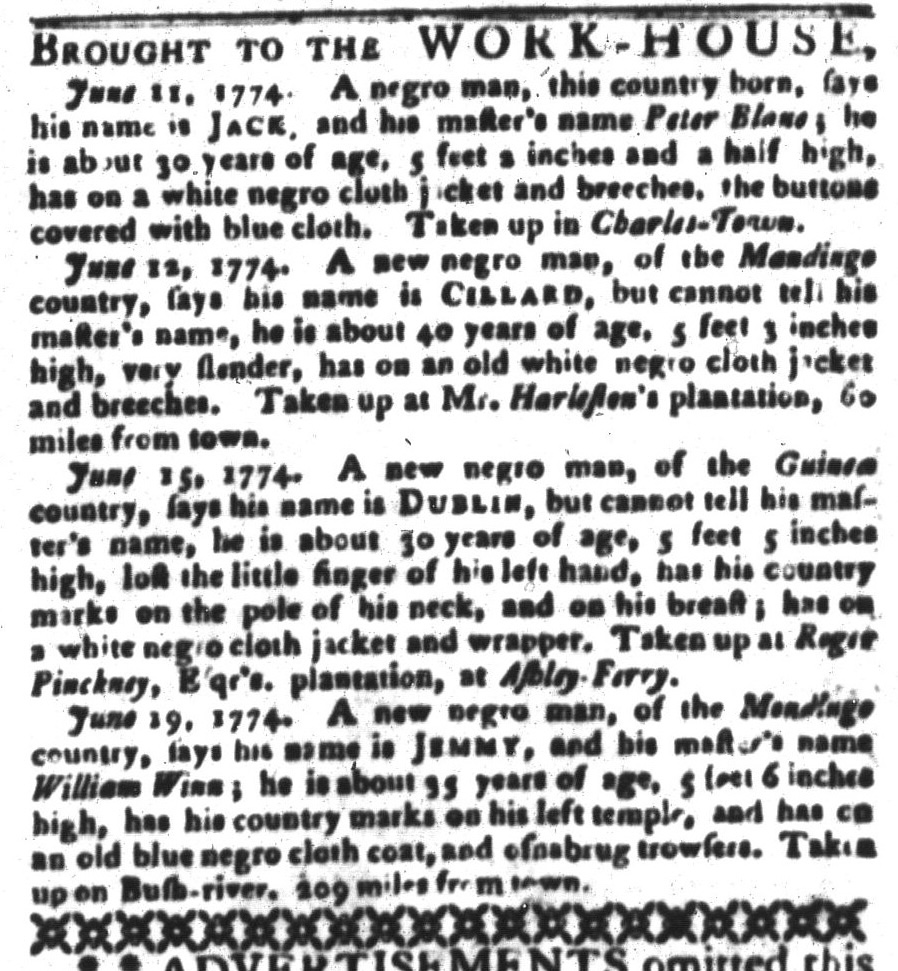
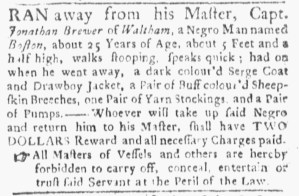
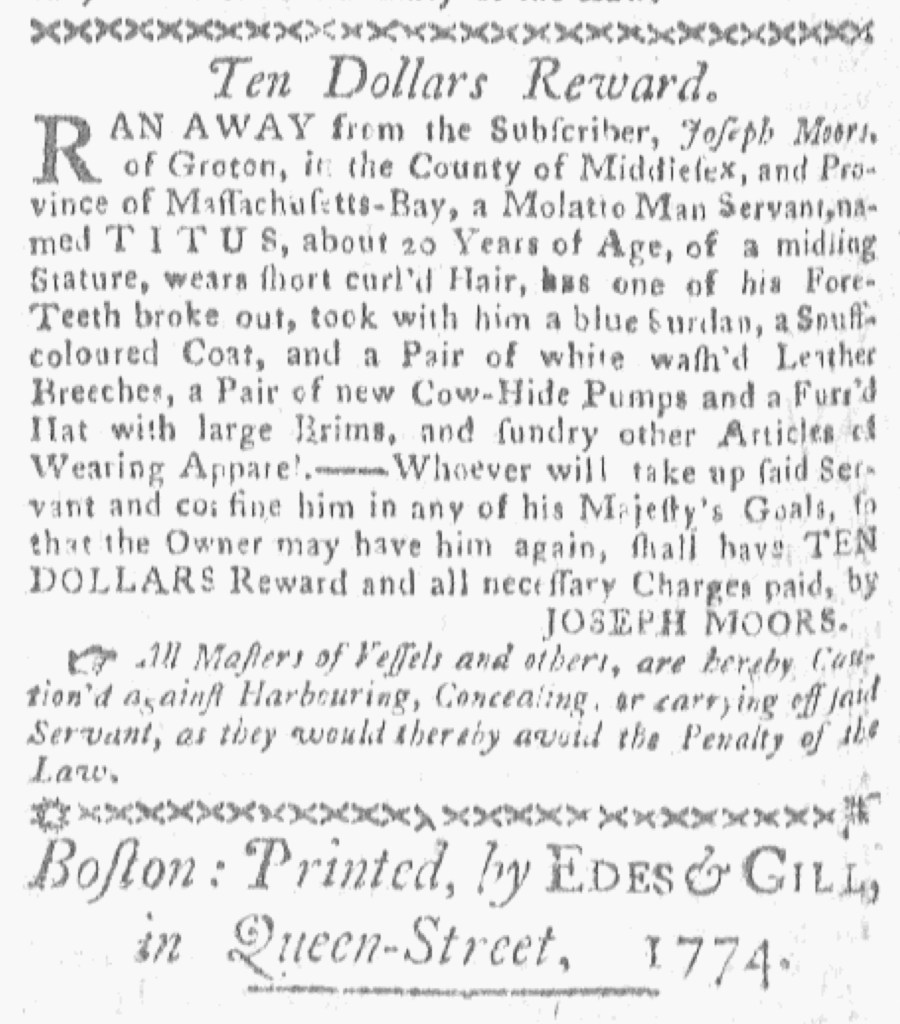
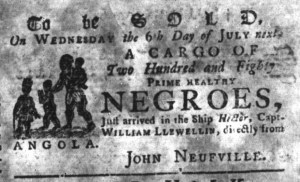
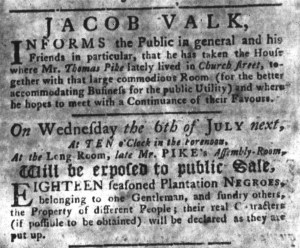
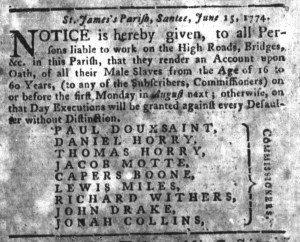
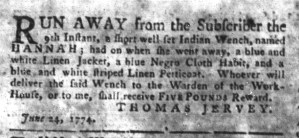
The Slavery Adverts 250 Project chronicles the role of newspaper advertising in perpetuating slavery in the era of the American Revolution. The project seeks to reveal the ubiquity of slavery in eighteenth-century life from New England to Georgia by republishing advertisements about enslaved people – for sale as individuals or in groups, wanted to purchase or for hire for short periods, runaways who liberated themselves, and those who were subsequently captured and confined in jails and workhouses – in daily digests on this site as well as in real time via the @SlaveAdverts250 Twitter feed, utilizing twenty-first-century media to stand in for the print media of the eighteenth century.
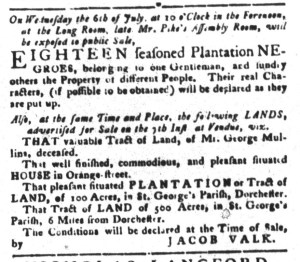
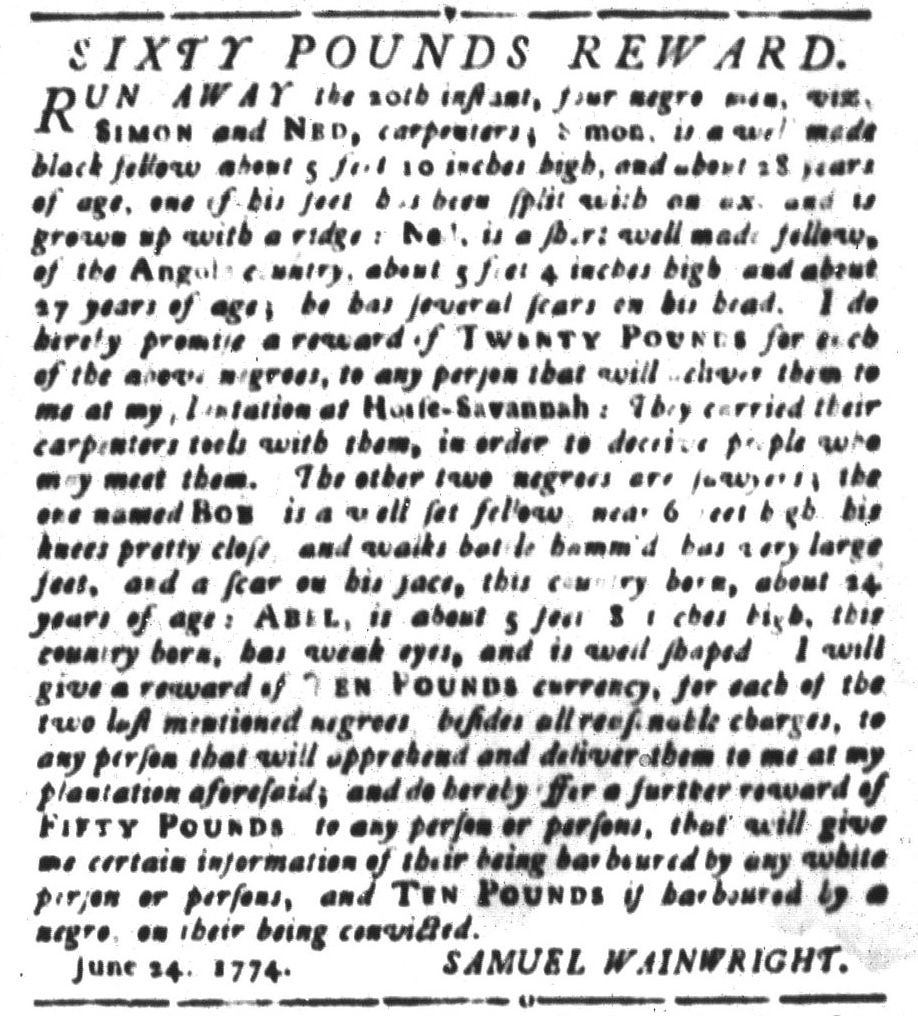
The project aims to provide modern audiences with a sense of just how often colonizers encountered these advertisements in their daily lives. Enslaved men, women, and children appeared in print somewhere in the colonies almost every single day. Those advertisements served as a constant backdrop for social, cultural, economic, and political life in colonial and revolutionary America. Colonizers who did not purport to own enslaved people were still confronted with slavery as well as invited to maintain the system by purchasing enslaved men, women, and children or assisting in the capture of so-called “runaways” who sought to free themselves from bondage. The frequency of these newspaper advertisements suggests just how embedded slavery was in colonial and revolutionary American culture in everyday interactions beyond the printed page.

These advertisements also testify to the experiences of enslaved men, women, and children, though readers must consider that those experiences have been remediated through descriptions offered by enslavers rather than enslaved people themselves. Often unnamed in the advertisements, enslaved men, women, and children were not invisible or unimportant in early America.

These advertisements appeared in colonial American newspapers 250 years ago today.

Massachusetts Gazette and Boston Weekly News-Letter (June 30, 1774).

**********

Massachusetts Spy (June 30, 1774).

**********

Massachusetts Spy (June 30, 1774).

**********

New-York Journal (June 30, 1774).

**********

Norwich Packet (June 30, 1774).

**********

Virginia Gazette [Purdie and Dixon] (June 30, 1774).

**********

Virginia Gazette [Purdie and Dixon] (June 30, 1774).

**********

Virginia Gazette [Purdie and Dixon] (June 30, 1774).

**********

Virginia Gazette [Purdie and Dixon] (June 30, 1774).

**********

Virginia Gazette [Purdie and Dixon] (June 30, 1774).

**********

Virginia Gazette [Purdie and Dixon] (June 30, 1774).

**********

Virginia Gazette [Purdie and Dixon] (June 30, 1774).

**********

Virginia Gazette [Purdie and Dixon] (June 30, 1774).

**********

Virginia Gazette [Purdie and Dixon] (June 30, 1774).

**********

Virginia Gazette [Purdie and Dixon] (June 30, 1774).

**********

Virginia Gazette [Purdie and Dixon] (June 30, 1774).

**********

Virginia Gazette [Purdie and Dixon] (June 30, 1774).

**********

Virginia Gazette [Purdie and Dixon] (June 30, 1774).

**********

Virginia Gazette [Purdie and Dixon] (June 30, 1774).

**********

Virginia Gazette [Purdie and Dixon] (June 30, 1774).

**********

Virginia Gazette [Rind] (June 30, 1774).

**********

Virginia Gazette [Rind] (June 30, 1774).

**********

Virginia Gazette [Rind] (June 30, 1774).

**********

Virginia Gazette [Rind] (June 30, 1774).

June 29

What was advertised in a colonial American newspaper 250 years ago today?

Essex Journal (June 29, 1774).

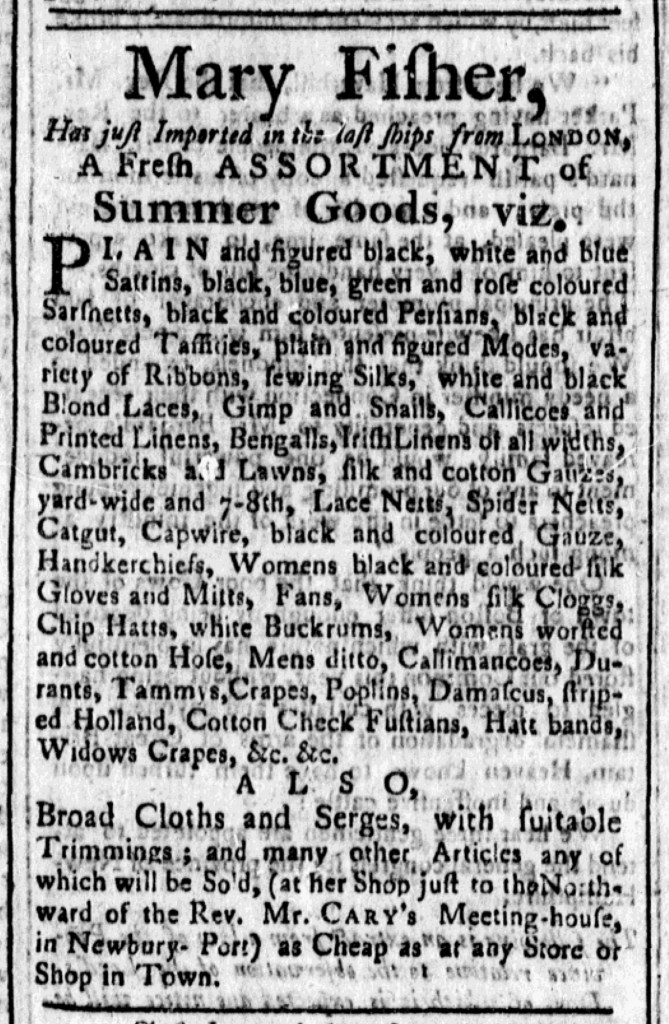
Imported in the last ships from LONDON, A Fresh ASSORTMENT of Summer Goods.”

As June 1774 came to a close, the final issue of the Essex Journal for that month carried news that arrived from Salem, Boston, New London, New York, Philadelphia, Williamsburg, and Charleston.  The editor also selected a short address “To the Farmers in America” from “FREEDOM” to reprint from the most recent edition of the Massachusetts Spy.  It advised, “INCREASE your SHEEP and raise WOOL as far as possible, that you from this time wear LIBERTY CLOTH.”  Although framed as advice to farmers, the suggestion to wear homespun cloth applied to all consumers who wished to protest various abuses by Parliament, especially the Boston Port Act that went into effect at the beginning of the month.  Colonizers discussed their prospects for using commercial means to achieve political ends, recognizing that any boycott of imported goods should be accompanied by encouraging “domestic manufactures” as alternative products.  That included clothing made of homespun fabrics to substitute for textiles imported from London.

Even as “FREEDOM” promoted “LIBERTY CLOTH” as a symbol of patriotism, merchants and shopkeepers hawked imported goods elsewhere in the newspaper.  No nonimportation or nonconsumption agreement had yet been adopted.  George Searle, for instance, “Just Imported from LONDON … an assortment of Painters Oils and Colours.”  Similarly, John Stickney and Son, announced that they “imported from London, a large assortment of English, India and hard ware GOODS.”  Those goods certainly included garments and fabrics.  Mary Fisher provided more detail, advertising that she “just Imported in the last ships from LONDON, A Fresh ASSORTMENT of Summer Goods.”  She then listed dozens of items, including an array of textiles that ranged from “PLAIN and figured black, white and blue Sattins” to “black, blue green and rose coloured Sarsnetts [sarcenets]” to “Callicoes and Printed Linens.”  Even as such items fell out of favor in some circles, Fisher offered an opportunity for consumers who desired imported textiles, even those who supported the patriot cause, and realized that they should buy what they could before discussions about boycotts became actual boycotts.  Fisher offered her wares “as Cheap as at any Store or Shop in Town,” making it possible for consumers to stockpile items they purchased from her.  Her imported textiles did not have the appearance of homespun “LIBERTY CLOTH,” but, for the moment, customers could at least equivocate that they had not bought those fabrics while a nonconsumption agreement was in effect.  Memories of boycotts in response to the Stamp Act and the duties on certain goods in the Townshend Acts guided consumers in preparing for a new round of protests.

Slavery Advertisements Published June 29, 1774

The Slavery Adverts 250 Project chronicles the role of newspaper advertising in perpetuating slavery in the era of the American Revolution. The project seeks to reveal the ubiquity of slavery in eighteenth-century life from New England to Georgia by republishing advertisements about enslaved people – for sale as individuals or in groups, wanted to purchase or for hire for short periods, runaways who liberated themselves, and those who were subsequently captured and confined in jails and workhouses – in daily digests on this site as well as in real time via the @SlaveAdverts250 Twitter feed, utilizing twenty-first-century media to stand in for the print media of the eighteenth century.

The project aims to provide modern audiences with a sense of just how often colonizers encountered these advertisements in their daily lives. Enslaved men, women, and children appeared in print somewhere in the colonies almost every single day. Those advertisements served as a constant backdrop for social, cultural, economic, and political life in colonial and revolutionary America. Colonizers who did not purport to own enslaved people were still confronted with slavery as well as invited to maintain the system by purchasing enslaved men, women, and children or assisting in the capture of so-called “runaways” who sought to free themselves from bondage. The frequency of these newspaper advertisements suggests just how embedded slavery was in colonial and revolutionary American culture in everyday interactions beyond the printed page.

These advertisements also testify to the experiences of enslaved men, women, and children, though readers must consider that those experiences have been remediated through descriptions offered by enslavers rather than enslaved people themselves. Often unnamed in the advertisements, enslaved men, women, and children were not invisible or unimportant in early America.

These advertisements appeared in colonial American newspapers 250 years ago today.

Pennsylvania Gazette (June 29, 1774).

**********

Pennsylvania Gazette (June 29, 1774).

**********

Pennsylvania Gazette (June 29, 1774).

**********

Pennsylvania Journal (June 29, 1774).

**********

Pennsylvania Journal (June 29, 1774).

**********

Postscript to the Pennsylvania Journal (June 29, 1774).

**********

Postscript to the Pennsylvania Journal (June 29, 1774).

June 28

What was advertised in a colonial American newspaper 250 years ago today?

Connecticut Courant (June 28, 1774).

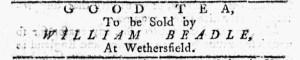
“GOOD TEA, To be Sold.”

William Beadle was at it again.  He advertised “GOOD TEA, To be Sold by WILLIAM BEADLE, At Wethersfield” in the June 28, 1774, edition of the Connecticut Courant and Hartford Weekly Intelligencer.  Unlike many other merchants and shopkeepers, Beadle had not refrained from advertising tea after colonizers disguised as Indians dumped tea into Boston Harbor on December 16, 1773.  In March 1774, he advertisedBest Bohea TEA, Such as Fishes never drink!!”  In April, he opened a new advertisement with a headline promoting “A New Supply of TEA, Extraordinary good.”  Perhaps Beadle sold smuggled tea that evaded the duties imposed by Parliament but could not state that was the case in the public prints … or his politics did not align with the patriots who objected to Parliament regulating trade in the colonies … or he realized that many consumers still wished to drink tea even with the controversy swirling around that commodity.

Still, his latest advertisement hawking tea and only tea seemed especially bold.  It was the first one he published after the Boston Port Act closed and blockaded the harbor until residents of that town paid for the tea that some of them destroyed.  Word of that punishment arrived in the colonies in May, before the legislation went into effect on June 1.  Newspapers throughout the colonies carried coverage of the Boston Port Act and reactions in Boston and other towns.  Many people called for a new round of boycotts on goods imported from England, including tea.  Further coverage focused on other measures meant to bring Boston in line, the series of Coercive Acts that included an Act for the Impartial Administration of Justice and a Quartering Act.  The issue of the Connecticut Courant that ran Beadle’s advertisement featured “AnAUTHENTIC ACCOUNT” from London “of Friday’s DEBATE on the second Reading of the Bill regulating the civil government of the Massachusetts-Bay.”  Known as the Massachusetts Government Act, that legislation abrogated the colony’s charter from 1691 and gave new powers to the royal governor.  That same issue included updates from Boston and, on the same page as Beadle’s advertisement for tea, a “Copy of a Letter from the Committee of Correspondence in New-York, to the Committee in Boston.”  Yet not everyone held what seemed to be the prevailing political sentiments captured in the public prints.  Even as John Holt swapped out the British coat of arms for the severed snake representing American unity in the masthead of the New-York Journal, some merchants and shopkeepers, such as William Beadle, continued advertising tea rather than making pronouncements about abstaining from the beverage due to political principles.

Slavery Advertisements Published June 28, 1774

The Slavery Adverts 250 Project chronicles the role of newspaper advertising in perpetuating slavery in the era of the American Revolution. The project seeks to reveal the ubiquity of slavery in eighteenth-century life from New England to Georgia by republishing advertisements about enslaved people – for sale as individuals or in groups, wanted to purchase or for hire for short periods, runaways who liberated themselves, and those who were subsequently captured and confined in jails and workhouses – in daily digests on this site as well as in real time via the @SlaveAdverts250 Twitter feed, utilizing twenty-first-century media to stand in for the print media of the eighteenth century.

The project aims to provide modern audiences with a sense of just how often colonizers encountered these advertisements in their daily lives. Enslaved men, women, and children appeared in print somewhere in the colonies almost every single day. Those advertisements served as a constant backdrop for social, cultural, economic, and political life in colonial and revolutionary America. Colonizers who did not purport to own enslaved people were still confronted with slavery as well as invited to maintain the system by purchasing enslaved men, women, and children or assisting in the capture of so-called “runaways” who sought to free themselves from bondage. The frequency of these newspaper advertisements suggests just how embedded slavery was in colonial and revolutionary American culture in everyday interactions beyond the printed page.

These advertisements also testify to the experiences of enslaved men, women, and children, though readers must consider that those experiences have been remediated through descriptions offered by enslavers rather than enslaved people themselves. Often unnamed in the advertisements, enslaved men, women, and children were not invisible or unimportant in early America.

These advertisements appeared in colonial American newspapers 250 years ago today.

South-Carolina Gazette and Country Journal (June 28, 1774).

**********

South-Carolina Gazette and Country Journal (June 28, 1774).

**********

South-Carolina Gazette and Country Journal (June 28, 1774).

**********

South-Carolina Gazette and Country Journal (June 28, 1774).

**********

South-Carolina Gazette and Country Journal (June 28, 1774).

**********

South-Carolina Gazette and Country Journal (June 28, 1774).

**********

South-Carolina Gazette and Country Journal (June 28, 1774).

**********

South-Carolina Gazette and Country Journal (June 28, 1774).

**********

South-Carolina Gazette and Country Journal (June 28, 1774).

June 27

What was advertised in a colonial American newspaper 250 years ago today?

Massachusetts Gazette and Boston Post-Boy (June 27, 1774).

“Purified Almond Soap, … Violet shaving Powder, … Lip-Salve of Tea Blossoms.”

An advertisement for “CARPENTER’s PERFUME SHOP” in the June 27 edition of the Massachusetts Gazette and Boston Post-Boy revealed that the establishment stocked a variety of cosmetics in addition to perfumes.  Carpenter divided the inventory into several categories – “WASH BALLS,” “New invented and improved SOAPS,” “POWDERS,” “PERFUMED WATERS,” “OILS,” and “ESSENCES” – to aid readers in navigating everything available at the shop.  In addition, the proprietor provided short descriptions about the use and purpose of some of the products, hoping to convince consumers to give them a try.  Those included “The True Italian Hair Water, which changes red or grey Hair to a fine black or brown,” “Royal Liquid to prevent the Hair from coming Grey, or falling off,” and “A Composition to take off superfluous Hair from the Forehead, Cheeks and Eye-brows, it takes it away instantly.”  In the most extensive product description, Carpenter marketed “Cream of Roses” for many purposes: “it prevents Tanning, it smooths, whitens and clears the Skin from Heat, Redness or Pimples, and will be of great Use to Children after the Measles or Small-Pox; Gentlemen that are tender or difficult to shave by using it afterwards, will take off the Smarting and prevent Choping for the future.”  In addition to that product, Carpenter stocked other items that catered to male shoppers, such as “Violet shaving Powder, adapted for the Army and Navy,” “Razor Straps of different sorts,” and “Shaving Boxes and Brushes, filled with sweet Soap.”  The “PERFUME SHOP” was not an establishment exclusively for women.

Neither was the shop where Carpenter and Winter “carry on Hair-dressing and Wig-making.”  In a continuation of the advertisement, they promised that “Gentlemen and Ladies will be waited on at the shortest Notice.”  Those availed themselves of Carpenter and Winter’s services could depend on having their hair done “with the greatest Taste and Elegance.”  The partners assured prospective clients that they had “laid in every Implement and Material necessary,” just as the “PERFUME SHOP” was fully stocked with everything from “Purified Almond Soap” and “Lavender Water” to “Lip-Salve of Tea Blossoms” and “Soft Pomatum of all Sorts.”  Carpenter and Winter acquired their supplies “from the best Hands in England.”  They made a point of highlighting “a very valuable Stock of the best Hairs” that one of the partners “culled out of a great Variety.”  The hairdressers aimed to demonstrate an attention to detail that began long before clients entered their shop and continued throughout their visit so they emerged with hair and wigs that testified to their own “Taste and Elegance.”  No doubt they also encouraged clients to purchase some of the items available at the “PERFUME SHOP,” just as modern hairdressers sell a variety of products to clients to maintain their styles and to tend to other aspects of hygiene and beauty.  Many eighteenth-century advertisements for consumer goods and services emphasized fashion, yet an emerging beauty industry was also on the scene to promote related products to both men and women as part of the total package.

Slavery Advertisements Published June 27, 1774

The Slavery Adverts 250 Project chronicles the role of newspaper advertising in perpetuating slavery in the era of the American Revolution. The project seeks to reveal the ubiquity of slavery in eighteenth-century life from New England to Georgia by republishing advertisements about enslaved people – for sale as individuals or in groups, wanted to purchase or for hire for short periods, runaways who liberated themselves, and those who were subsequently captured and confined in jails and workhouses – in daily digests on this site as well as in real time via the @SlaveAdverts250 Twitter feed, utilizing twenty-first-century media to stand in for the print media of the eighteenth century.

The project aims to provide modern audiences with a sense of just how often colonizers encountered these advertisements in their daily lives. Enslaved men, women, and children appeared in print somewhere in the colonies almost every single day. Those advertisements served as a constant backdrop for social, cultural, economic, and political life in colonial and revolutionary America. Colonizers who did not purport to own enslaved people were still confronted with slavery as well as invited to maintain the system by purchasing enslaved men, women, and children or assisting in the capture of so-called “runaways” who sought to free themselves from bondage. The frequency of these newspaper advertisements suggests just how embedded slavery was in colonial and revolutionary American culture in everyday interactions beyond the printed page.

These advertisements also testify to the experiences of enslaved men, women, and children, though readers must consider that those experiences have been remediated through descriptions offered by enslavers rather than enslaved people themselves. Often unnamed in the advertisements, enslaved men, women, and children were not invisible or unimportant in early America.

These advertisements appeared in colonial American newspapers 250 years ago today.

Boston Evening-Post (June 27, 1774).

**********

Boston Evening-Post (June 27, 1774).

**********

Boston-Gazette (June 27, 1774).

**********

Boston-Gazette (June 27, 1774).

**********

Boston-Gazette (June 27, 1774).

**********

Newport Mercury (June 27, 1774).

**********

Newport Mercury (June 27, 1774).

**********

New-York Gazette and Weekly Mercury (June 27, 1774).

**********

New-York Gazette and Weekly Mercury (June 27, 1774).

**********

New-York Gazette and Weekly Mercury (June 27, 1774).

**********

New-York Gazette and Weekly Mercury (June 27, 1774).

**********

South-Carolina Gazette (June 27, 1774).

**********

South-Carolina Gazette (June 27, 1774).

**********

South-Carolina Gazette (June 27, 1774).

**********

South-Carolina Gazette (June 27, 1774).

**********

South-Carolina Gazette (June 27, 1774).

**********

South-Carolina Gazette (June 27, 1774).

**********

South-Carolina Gazette (June 27, 1774).

**********

South-Carolina Gazette (June 27, 1774).

**********

South-Carolina Gazette (June 27, 1774).

**********

South-Carolina Gazette (June 27, 1774).

**********

South-Carolina Gazette (June 27, 1774).

**********

South-Carolina Gazette (June 27, 1774).

June 26

What was advertised in a colonial American newspaper 250 years ago this month?

Massachusetts Spy (June 23, 1774).

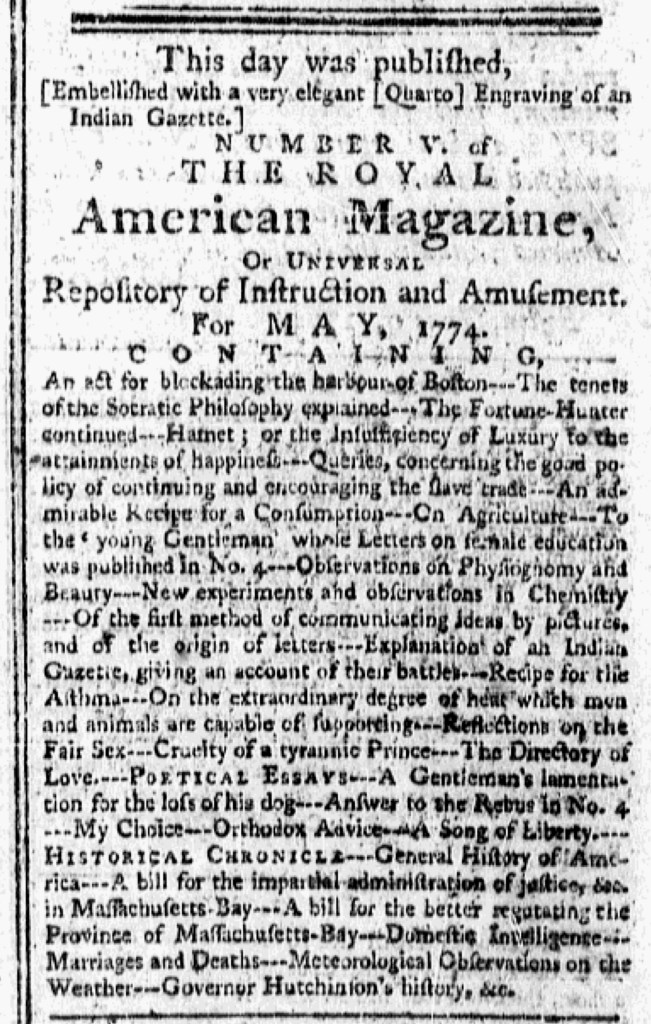
“NUMBER V. of THE ROYAL American Magazine.”

Isaiah Thomas significantly scaled down advertising for the Royal American Magazine in June 1774 compared to previous months.  The Adverts 250 Project has chronicled the printer’s marketing efforts from the first time he announced his intention to publish a magazine, the only one in America at the time, in May 1773 through the advertisements that appeared in newspapers from New England to Maryland in June, July, August, September, October, November, and December 1773 and January, February, March, April, and May 1774.

Thomas did not publish the May 1773 issue of the Royal American Magazine until well into June.  That accounts for some of the lack of advertising.  His first notice for the month ran in the June 16 edition of his own newspaper, the Massachusetts Spy.  In a brief update, he informed the public that “TO-MORROW will be published, No. V. of the ROYAL AMERICAN MAGAZINE,” but he did not mention any reason for the delay.  Six days later, the Essex Journal carried a notice that “Friday last was published in Boston, NUMBER V. of THE Royal AMERICAN MAGAZINE OR UNIVERSAL Repository of Instruction and Amusement.”  It was “Printed and sold by I. THOMAS, in Boston; sold also at the Printing-Office in Newbury-Port.”  Henry-Walter Tinges operated that printing office, where he published the Essex Journal in partnership with Thomas.  As Tinges had done in connection with the first issue of the magazine, he previewed some of the contents in the Essex Journal.  For the weekly selection in the “Poets Corner” on the final page, he reprinted “FEMALE ADVICE,” a poem “From the ROYAL AMERICAN MAGAZINE.”

The most extensive advertisement for the magazine first appeared in the June 23 edition of the Massachusetts Spy.  It resembled advertisements from previous months, announcing publication of the latest issue, promoting the copperplate engraving that “Embellished” the magazine, and listing the contents, starting with “An act for blockading the harbour of Boston” that had attracted so much attention in that city and throughout the colonies.  That advertisement ran a second time in the Massachusetts Spy a week later.  That Thomas did not publish and distribute the May 1774 issue of the Royal American Magazine until June 17 offers a cautionary tale about using dates on eighteenth-century magazines to assess when readers gained access to the information contained in them.  In contrast to modern magazines distributed in advance of the dates on their covers, early American magazines were typically published at the end of the month. The May issue, for instance, would come out during the final days of May … yet in this instance the May issue of the Royal American Magazine did not appear until the middle of June.

In total, only four newspaper advertisements promoted the Royal American Magazine in June 1774, all of them in newspapers published by Thomas.  Unlike previous months, he did not insert announcements in any of the other newspapers printed in Boston.  In addition, he did not publish other sorts of notices related to the magazine, such as calls for contributors to make submissions.  The unfolding political situation in combination with his efforts to continue publishing the Massachusetts Spy may have occupied more of his time than in previous months, making it less of a priority to advertise the magazine.

**********

“TO-MORROW will be published, No. V”

  • June 16 – Massachusetts Spy (first appearance)

Friday last was published in Boston, NUMBER V”

  • June 22 – Essex Journal (first appearance)

“This day was published … NUMBER V” (with contents)

  • June 23 – Massachusetts Spy (first appearance)
  • June 30 – Massachusetts Spy (second appearance)

June 25

What was advertised in a colonial American newspaper 250 years ago today?

Providence Gazette (June 25, 1774).

“There has been Cause of many Complaints on the Part of his Customers.”

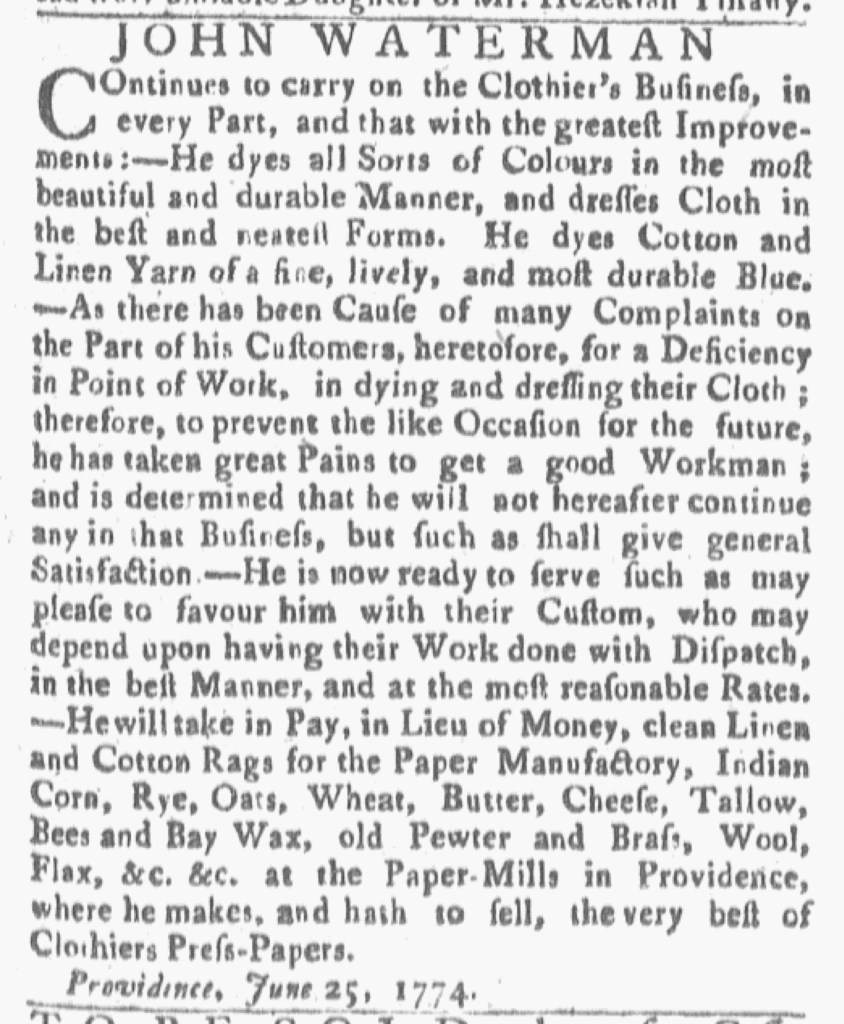
In the summer of 1774, John Waterman ran an advertisement in the Providence Gazette to inform the public that he “Continues to carry on the Clothier’s Business, in every Part, … with the greatest Improvements.”  Among the services he provided, he “dyes all Sorts of Colours in the most beautiful and durable Manner, and dresses Cloth in the best and neatest Forms.”  In particular, he “dyes Cotton and Linen Yarn of a fine, lively, and most durable Blue.”  Waterman did not go into detail about the “Improvements” he made to his business, but some of them likely involved hiring new employees.  At the start of the year, he had placed an advertisement seeking a clothier “well experienced in all Parts of the Business” to work at the “new and most compleat Works in the Colony.”

In this new advertisement, Waterman confessed that “there has been Cause of many Complaints on the Part of his Customers, heretofore, for a Deficiency … in dying and dressing their Cloth.”  Apparently, launching his new enterprise had not gone as smoothly as Waterman hoped.  To remedy the situation, he assured the public that he “has taken great Pains to get a good Workman.”  Furthermore, he asserted that he “is determined that he will not hereafter continue any in that Business, but such as shall give general Satisfaction.”  In other words, he would no longer employee workers who produced shoddy work, deferring to the judgment of his customers when it came to deciding what was unacceptable.  In an effort to redeem his reputation, Waterman acknowledged legitimate concerns voiced by previous customers and pledged that he had taken appropriate action to address them.

That being the case, the clothier proclaimed that he “is now ready to serve such as may please to favour him with their Custom.”  Waterman promised that they “may depend upon having their Work done with Dispatch, in the best Manner, and at the most reasonable Rates,” combining appeals to efficiency, quality, and price.  He asked former and prospective customers to forgive any misstarts that previously occurred and trust that his business now provided exemplary service.