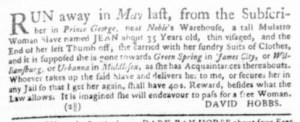
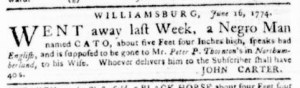
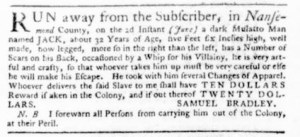
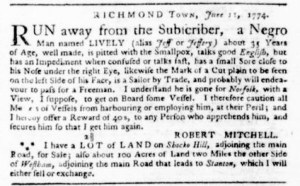
Slavery Advertisements Published June 25, 1774

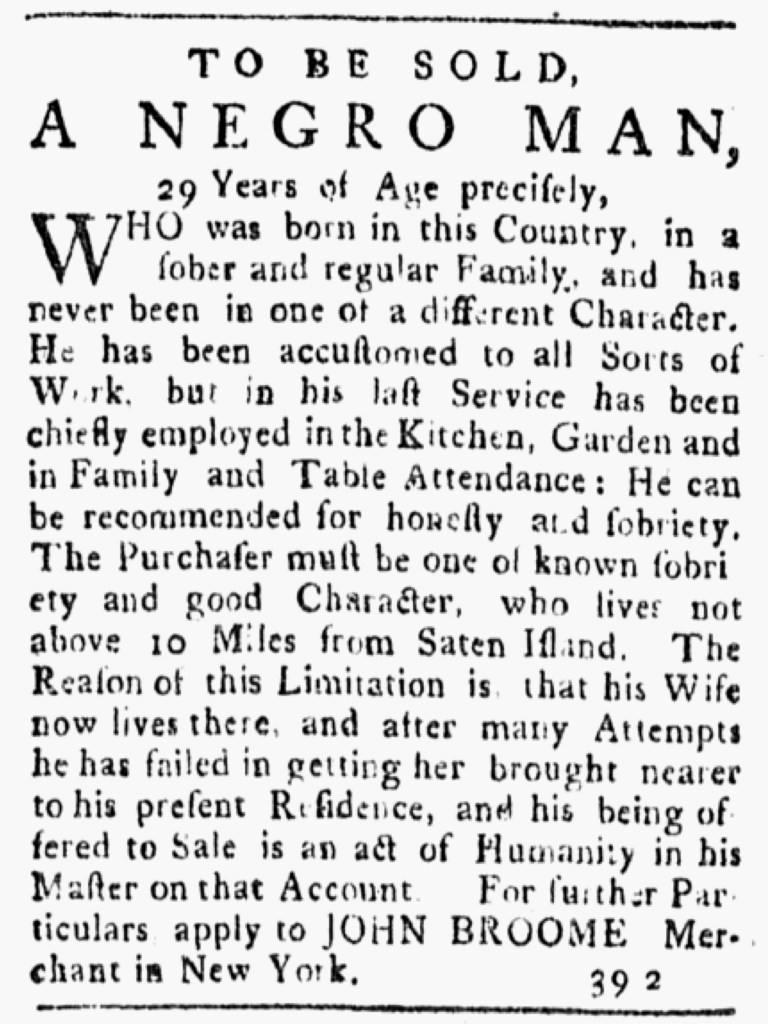
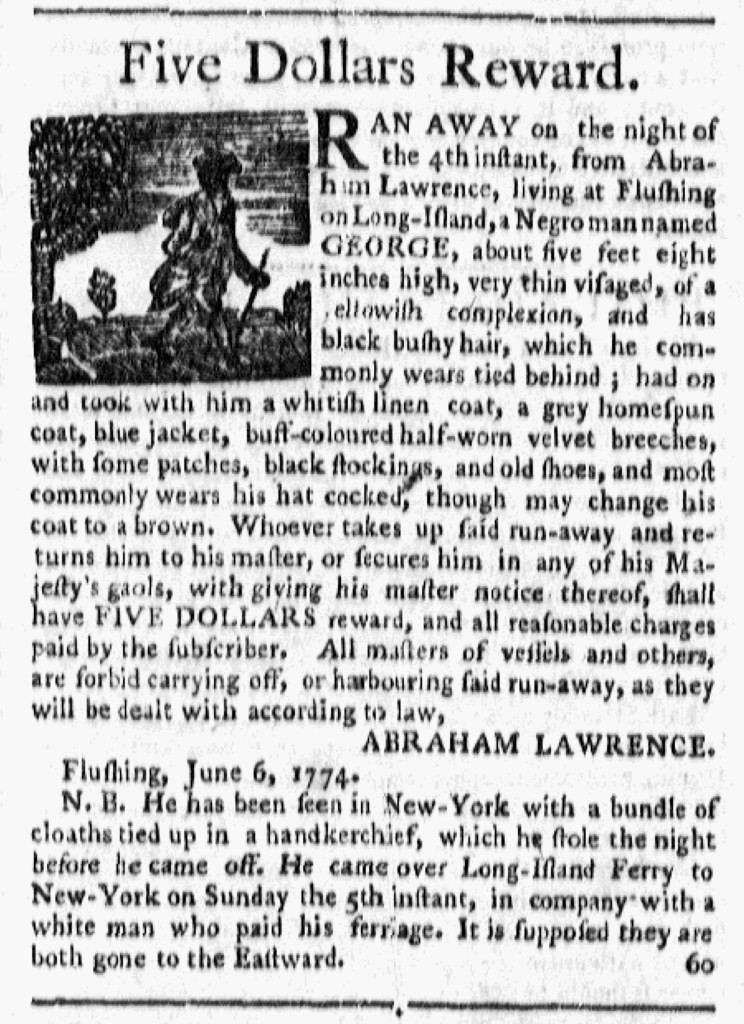
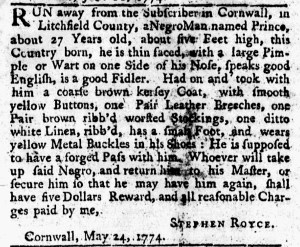
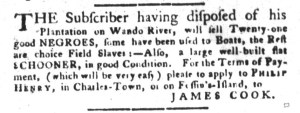
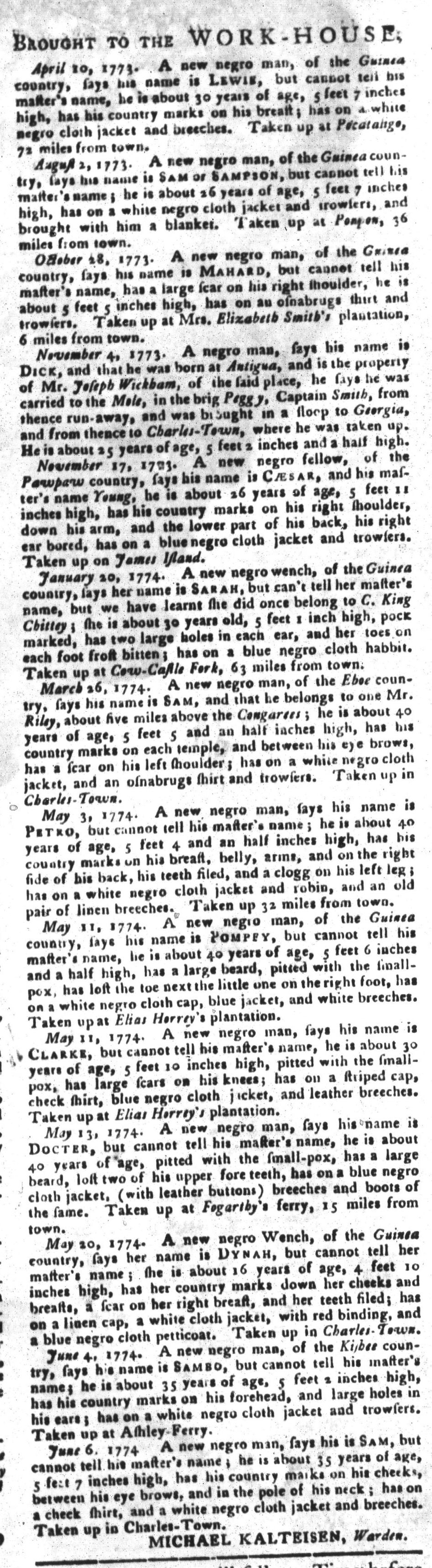
The Slavery Adverts 250 Project chronicles the role of newspaper advertising in perpetuating slavery in the era of the American Revolution. The project seeks to reveal the ubiquity of slavery in eighteenth-century life from New England to Georgia by republishing advertisements about enslaved people – for sale as individuals or in groups, wanted to purchase or for hire for short periods, runaways who liberated themselves, and those who were subsequently captured and confined in jails and workhouses – in daily digests on this site as well as in real time via the @SlaveAdverts250 Twitter feed, utilizing twenty-first-century media to stand in for the print media of the eighteenth century.

The project aims to provide modern audiences with a sense of just how often colonizers encountered these advertisements in their daily lives. Enslaved men, women, and children appeared in print somewhere in the colonies almost every single day. Those advertisements served as a constant backdrop for social, cultural, economic, and political life in colonial and revolutionary America. Colonizers who did not purport to own enslaved people were still confronted with slavery as well as invited to maintain the system by purchasing enslaved men, women, and children or assisting in the capture of so-called “runaways” who sought to free themselves from bondage. The frequency of these newspaper advertisements suggests just how embedded slavery was in colonial and revolutionary American culture in everyday interactions beyond the printed page.

These advertisements also testify to the experiences of enslaved men, women, and children, though readers must consider that those experiences have been remediated through descriptions offered by enslavers rather than enslaved people themselves. Often unnamed in the advertisements, enslaved men, women, and children were not invisible or unimportant in early America.

These advertisements appeared in colonial American newspapers 250 years ago today.
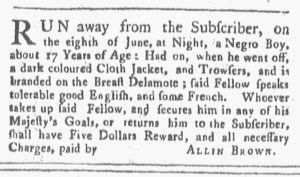
Providence Gazette (June 25, 1774).

June 24

What was advertised in a colonial American newspaper 250 years ago today?

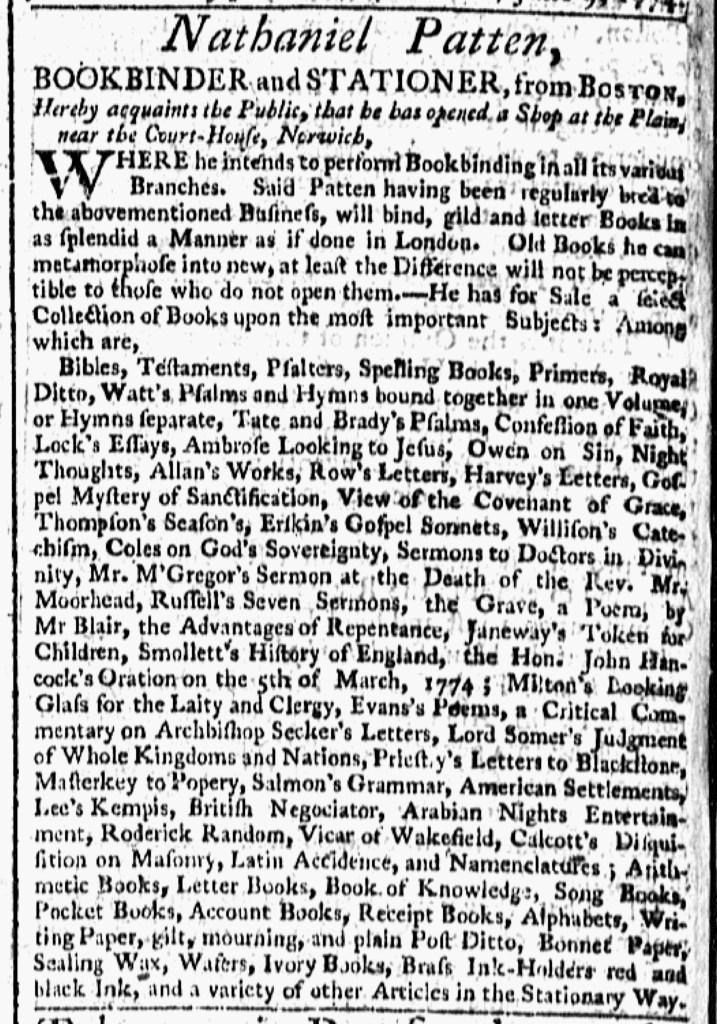
Connecticut Gazette (June 24, 1774).

“Old Books he can metamorphose into new.”

When Nathaniel Patten, “BOOKBINDER and STATIONER, from BOSTON,” set up shop in Norwich, he placed an advertisement in the Connecticut Gazette, published in New London, but curiously not in the Norwich Packet.  Perhaps he suspected that advertising in the Connecticut Gazette was the better investment since it had been in circulation for more than a decade while the Norwich Packet commenced publication only nine months earlier.  Until that time, the Connecticut Gazette had been the local newspaper for Norwich, though the Connecticut Courant (published in Hartford), the Providence Gazette, and newspapers from Boston and other cities in New England made their way to Norwich, some more consistently than others depending on arrangements that subscribers made with post riders.  In New England and beyond, newspapers served colonies and regions rather than just the towns where they were published.  The full title of the Norwich Packet and Connecticut, Massachusetts, New-Hampshire, and Rhode Island Weekly Advertiser revealed its aspirations to do so as it built up its circulation.  For the moment, however, Patten may have believed that advertising in the Connecticut Gazette would yield more customers.

The bookbinder and stationer made several appeals in hopes of drawing readers to his shop or convincing them to send orders.  Like many others in his trade, he also sold books, giving over more than half the space in his advertisement to a list of books and pamphlets he stocked.  Those “Books upon the most important Subjects” included “the Hon. John Hancock’s Oration on the 5th of March, 1774” in commemoration of the Boston Massacre.  He also listed many kinds of paper and writing equipment, such as “Sealing Wax” and “Brass Ink-Holders,” promising a “variety of other Articles in the Stationery Way.”  Patten declared that he had been “regularly bred to the [bookbinding] Business.”  In other words, he received formal training as a youth, preparing him to “bind, gild and letter Books in as splendid a Manner as if done in London.”  The newcomer from Boston did not merely compare his skills to what was available in that city but instead asserted that the quality of his work was equal to that produced in the metropolis at the center of the empire.  To that end, Patten boasted that “Old Books he can metamorphose into new,” pledging that “at least the Difference will not be perceptible to those who do not open them.”  He could not reverse wear from years of use or repair other damages to the pages themselves, but he could transform the bindings, the most visible part of any books displayed on shelves or elsewhere.  That claim challenged prospective customers to put Patten to the test so they could judge for themselves what the bookbinder was capable of accomplishing.  Even if they started with just one volume, satisfied customers likely meant more business over time.

Slavery Advertisements Published June 24, 1774

The Slavery Adverts 250 Project chronicles the role of newspaper advertising in perpetuating slavery in the era of the American Revolution. The project seeks to reveal the ubiquity of slavery in eighteenth-century life from New England to Georgia by republishing advertisements about enslaved people – for sale as individuals or in groups, wanted to purchase or for hire for short periods, runaways who liberated themselves, and those who were subsequently captured and confined in jails and workhouses – in daily digests on this site as well as in real time via the @SlaveAdverts250 Twitter feed, utilizing twenty-first-century media to stand in for the print media of the eighteenth century.

The project aims to provide modern audiences with a sense of just how often colonizers encountered these advertisements in their daily lives. Enslaved men, women, and children appeared in print somewhere in the colonies almost every single day. Those advertisements served as a constant backdrop for social, cultural, economic, and political life in colonial and revolutionary America. Colonizers who did not purport to own enslaved people were still confronted with slavery as well as invited to maintain the system by purchasing enslaved men, women, and children or assisting in the capture of so-called “runaways” who sought to free themselves from bondage. The frequency of these newspaper advertisements suggests just how embedded slavery was in colonial and revolutionary American culture in everyday interactions beyond the printed page.

These advertisements also testify to the experiences of enslaved men, women, and children, though readers must consider that those experiences have been remediated through descriptions offered by enslavers rather than enslaved people themselves. Often unnamed in the advertisements, enslaved men, women, and children were not invisible or unimportant in early America.

These advertisements appeared in colonial American newspapers 250 years ago today.
South-Carolina and American General Gazette (June 24, 1774).

**********

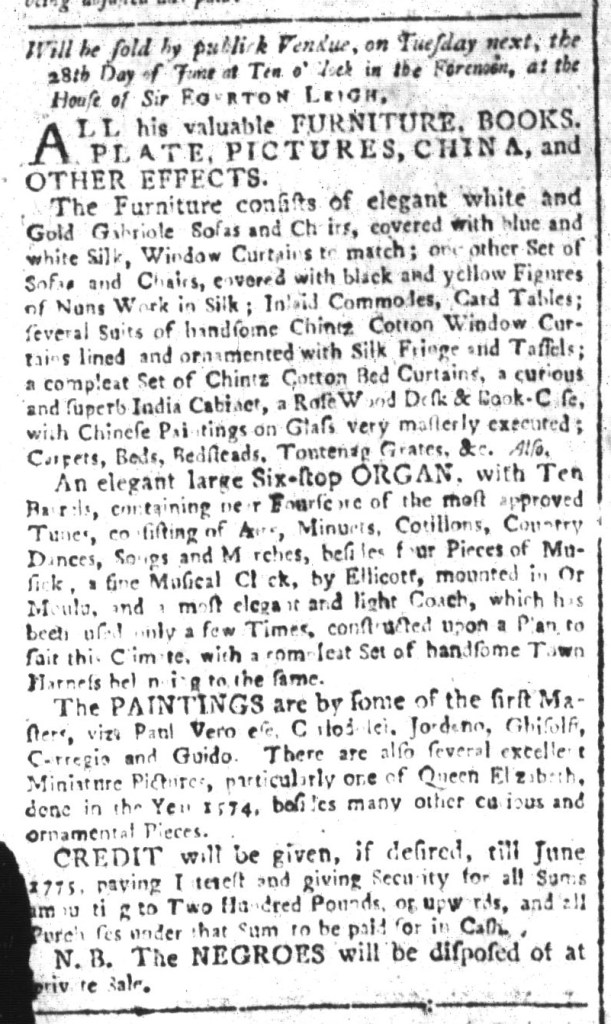
South-Carolina and American General Gazette (June 24, 1774).

**********

South-Carolina and American General Gazette (June 24, 1774).

**********

South-Carolina and American General Gazette (June 24, 1774).

**********

South-Carolina and American General Gazette (June 24, 1774).

**********

South-Carolina and American General Gazette (June 24, 1774).

**********

South-Carolina and American General Gazette (June 24, 1774).

**********

South-Carolina and American General Gazette (June 24, 1774).

**********

South-Carolina and American General Gazette (June 24, 1774).

**********

South-Carolina and American General Gazette (June 24, 1774).

**********

South-Carolina and American General Gazette (June 24, 1774).

**********

South-Carolina and American General Gazette (June 24, 1774).

**********

South-Carolina and American General Gazette (June 24, 1774).

**********

South-Carolina and American General Gazette (June 24, 1774).

**********

South-Carolina and American General Gazette (June 24, 1774).

**********

South-Carolina and American General Gazette (June 24, 1774).

**********

South-Carolina and American General Gazette (June 24, 1774).

**********

South-Carolina and American General Gazette (June 24, 1774).

**********

South-Carolina and American General Gazette (June 24, 1774).

**********

South-Carolina and American General Gazette (June 24, 1774).

**********

South-Carolina and American General Gazette (June 24, 1774).

**********

South-Carolina and American General Gazette (June 24, 1774).

**********

South-Carolina and American General Gazette (June 24, 1774).

**********

South-Carolina and American General Gazette (June 24, 1774).

June 23

What was advertised in a colonial American newspaper 250 years ago today?

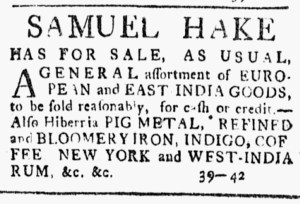
New-York Journal (June 23, 1774).

“AS USUAL, A GENERAL assortment of EUROPEAN and EAST INDIA GOODS.”

As readers perused the June 23, 1774, edition of the New-York Journal, they once again encountered Samuel Hake’s advertisements for a “GENERAL assortment of EUROPEAN and EAST INDIA GOODS, to be sold reasonably, for cash or credit.”  It was the fourth consecutive week that it appeared in that newspaper, having originated in the June 2 edition.  It was the first time, however, that the advertisement ran under a new image in the masthead.  The New-York Journal previously included the coat of arms of the United Kingdom, a lion and a unicorn flanking a shield with the words “DIEU ET MON DROIT” (“God and My Right”) on a banner beneath it.  After receiving word of the Boston Port Act that closed and blockaded the harbor until residents of that city paid for the tea destroyed during the Boston Tea Party, John Holt, the printer of the New-York Journal, selected a new image for the masthead, a snake severed into pieces with the words “UNITE OR DIE” beneath it.  Short abbreviations indicated each part of the snake represented New England or one of the other colonies.

Pennsylvania Gazette (May 9, 1754). Courtesy Library of Congress.

Holt drew inspiration from the “JOIN, or DIE” woodcut that appeared in Benjamin Franklin’s Pennsylvania Gazette twenty years earlier on May 9, 1754.  At that time, the American colonies faced a threat from the French and their Indigenous allies on the eve of the Seven Years War.  In an editorial, Franklin encouraged colonizers to support the Albany Plan of Union and recognize their shared identity as Americans.  The “JOIN, or DIE” political cartoon that accompanied that call to a common cause is the earliest known visual representation of such unity, a symbol repurposed during the imperial crisis.  According to public historians at the National Constitution Center, the “emblem appeared in colonial newspapers during the Stamp Act crisis” and again “during the American Revolutionary War, sometimes as part of a masthead.”  Holt was the first printer to deploy it in 1774, though in the coming months variations appeared in the mastheads of other newspapers.  Those newspapers carried editorials and coverage of the Boston Port Act and the rest of the Coercive Acts and the colonial response, including proposals to cease trade with Britain and stop purchasing imported goods.  Over the next several months, the “GENERAL assortment of EUROPEAN and EAST INDIA GOODS” advertised by Hake would take on new political meanings for colonial consumers.

New-York Journal (June 23, 1774).

Slavery Advertisements Published June 23, 1774

The Slavery Adverts 250 Project chronicles the role of newspaper advertising in perpetuating slavery in the era of the American Revolution. The project seeks to reveal the ubiquity of slavery in eighteenth-century life from New England to Georgia by republishing advertisements about enslaved people – for sale as individuals or in groups, wanted to purchase or for hire for short periods, runaways who liberated themselves, and those who were subsequently captured and confined in jails and workhouses – in daily digests on this site as well as in real time via the @SlaveAdverts250 Twitter feed, utilizing twenty-first-century media to stand in for the print media of the eighteenth century.

The project aims to provide modern audiences with a sense of just how often colonizers encountered these advertisements in their daily lives. Enslaved men, women, and children appeared in print somewhere in the colonies almost every single day. Those advertisements served as a constant backdrop for social, cultural, economic, and political life in colonial and revolutionary America. Colonizers who did not purport to own enslaved people were still confronted with slavery as well as invited to maintain the system by purchasing enslaved men, women, and children or assisting in the capture of so-called “runaways” who sought to free themselves from bondage. The frequency of these newspaper advertisements suggests just how embedded slavery was in colonial and revolutionary American culture in everyday interactions beyond the printed page.

These advertisements also testify to the experiences of enslaved men, women, and children, though readers must consider that those experiences have been remediated through descriptions offered by enslavers rather than enslaved people themselves. Often unnamed in the advertisements, enslaved men, women, and children were not invisible or unimportant in early America.

These advertisements appeared in colonial American newspapers 250 years ago today.
Maryland Gazette (June 23, 1774).

**********

Maryland Gazette (June 23, 1774).

**********

Maryland Gazette (June 23, 1774).

**********

Maryland Gazette (June 23, 1774).

**********

Massachusetts Gazette and Boston Weekly News-Letter (June 23, 1774).

**********

Massachusetts Gazette and Boston Weekly News-Letter (June 23, 1774).

**********

Massachusetts Gazette and Boston Weekly News-Letter (June 23, 1774).

**********

Massachusetts Spy (June 23, 1774).

**********

Massachusetts Spy (June 23, 1774).

**********

New-York Journal (June 23, 1774).

**********

New-York Journal (June 23, 1774).

**********

Rivington’s New-York Gazetteer (June 23, 1774).

**********

Rivington’s New-York Gazetteer (June 23, 1774).

**********

Virginia Gazette [Purdie and Dixon] (June 23, 1774).

**********

Virginia Gazette [Purdie and Dixon] (June 23, 1774).

**********

Virginia Gazette [Purdie and Dixon] (June 23, 1774).

**********

Virginia Gazette [Purdie and Dixon] (June 23, 1774).

**********

Virginia Gazette [Purdie and Dixon] (June 23, 1774).

**********

Virginia Gazette [Purdie and Dixon] (June 23, 1774).

**********

Virginia Gazette [Purdie and Dixon] (June 23, 1774).

**********

Virginia Gazette [Purdie and Dixon] (June 23, 1774).

**********

Virginia Gazette [Purdie and Dixon] (June 23, 1774).

**********

Virginia Gazette [Purdie and Dixon] (June 23, 1774).

**********

Virginia Gazette [Rind] (June 23, 1774).

**********

Virginia Gazette [Rind] (June 23, 1774).

June 22

What was advertised in a colonial American newspaper 250 years ago today?

Pennsylvania Gazette (June 22, 1774).

“ABINGTON MINERAL WATER, SO useful in Chronic Diseases.”

As the first day of summer arrived in 1774, a headline in the Pennsylvania Gazette promoted “ABINGTON MINERAL WATER,” inviting residents of Philadelphia and other towns to visit that “most healthy Part of the Province of Pennsylvania.”  There they could experience the waters “SO useful in Chronic Diseases” and recuperate from a variety of ailments.  William French placed that advertisement, offering “good Accommodations, at a modern Expence.”  Interested in encouraging health tourism in his town, he mentioned that “several other commodious Houses in the Neighbourhood of said Spring” also provided lodging for visitors.

In addition to marketing room and board in proximity to the mineral waters, Rush advised that that he had on hand “Dr. RUSH’S Experiments and Observations on the above Mineral Water, with particular Directions in what Diseases, and in what Manner, it should be used.”  He did not specify whether he sold copies or made them available for consultation by his guests, similar to modern hotels displaying fliers, brochures, and other promotional literature for points of interest in the area.  He also did not invoke the full title of the pamphlet, Experiments and Observations on the Minera Waters of Philadelphia, Abington, and Bristol, in the Province of Pennsylvania.  French conveniently left out other sites that competed for health tourism, though he was not the only advertiser who referred to Rush’s pamphlet, originally a paper delivered to the American Philosophical Society in June 1773, as a means of educating the public about the advantages of taking the waters.  The proprietors of the “BRISTOL BATHS and CHALYBEATE WELLS” did so as well in their own advertisement in the Pennsylvania Gazette a couple of months earlier.  In each instance, those seeking to generate revenue from mineral waters did not simply ask guests to take their word for the supposed benefits to their health; instead, they marshalled evidence from a medical expert as a testimonial on their behalf.  The “commodious Houses” in Abington amounted to pleasant amenities, but it was the healing power of the “MINERAL WATER” that most effectively marketed a stay in that town.

Slavery Advertisements Published June 22, 1774

The Slavery Adverts 250 Project chronicles the role of newspaper advertising in perpetuating slavery in the era of the American Revolution. The project seeks to reveal the ubiquity of slavery in eighteenth-century life from New England to Georgia by republishing advertisements about enslaved people – for sale as individuals or in groups, wanted to purchase or for hire for short periods, runaways who liberated themselves, and those who were subsequently captured and confined in jails and workhouses – in daily digests on this site as well as in real time via the @SlaveAdverts250 Twitter feed, utilizing twenty-first-century media to stand in for the print media of the eighteenth century.

The project aims to provide modern audiences with a sense of just how often colonizers encountered these advertisements in their daily lives. Enslaved men, women, and children appeared in print somewhere in the colonies almost every single day. Those advertisements served as a constant backdrop for social, cultural, economic, and political life in colonial and revolutionary America. Colonizers who did not purport to own enslaved people were still confronted with slavery as well as invited to maintain the system by purchasing enslaved men, women, and children or assisting in the capture of so-called “runaways” who sought to free themselves from bondage. The frequency of these newspaper advertisements suggests just how embedded slavery was in colonial and revolutionary American culture in everyday interactions beyond the printed page.

These advertisements also testify to the experiences of enslaved men, women, and children, though readers must consider that those experiences have been remediated through descriptions offered by enslavers rather than enslaved people themselves. Often unnamed in the advertisements, enslaved men, women, and children were not invisible or unimportant in early America.

These advertisements appeared in colonial American newspapers 250 years ago today.
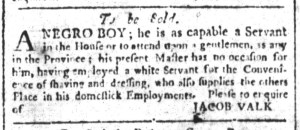
Pennsylvania Gazette (June 22, 1774).

**********

Pennsylvania Gazette (June 22, 1774).

**********

Supplement to the Pennsylvania Gazette (June 22, 1774).

**********

Supplement to the Pennsylvania Gazette (June 22, 1774).

**********

Postscript to the Pennsylvania Journal (June 22, 1774).

**********

Postscript to the Pennsylvania Journal (June 22, 1774).

June 21

What was advertised in a colonial American newspaper 250 years ago today?

Essex Gazette (June 21, 1774).

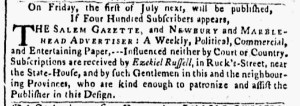
“Will be published … A Weekly, Political, Commercial, and Entertaining Paper.”

On June 21, 1774, the Essex Gazette carried an advertisement for a new newspaper that would become a competitor.  At that time, Samuel Hall and Ebenezer Hall printed the first and only newspaper in Salem.  Ezekiel Russell, however, wished to test the market to see if it would support the “SALEM GAZETTE, AND NEWBURY and MARKBLEHEAD ADVERTISER: A Weekly, Political, Commercial, and Entertaining Paper.”  He proposed that the Salem Gazette would commence publication on “the first of July next … If Four Hundred Subscribers appears.”  The enterprising printer hoped that a notice in the Essex Gazette would help generate subscribers, though that was not his only means of inciting interest.  He distributed an unnumbered prospectus issue on June 24, hoping that the content and appearance would convince the public to subscribe (and advertisers to place to notices).  Similarly, Isaiah Thomas and Henry-Walter Tynges gave out free copies of the first issue of the Essex Journal, the first newspaper printed in Newburyport, seven months earlier.

Whether or not Russell managed to attract four hundred subscribers by the appointed date, he did indeed publish the Salem Gazette on July 1.  Isaiah Thomas provided a brief overview in his History of Printing in America (1810), describing it as “the second paper published in the town, … published weekly on Friday.”  The Halls distributed the Essex Gazette on Tuesdays, so newspapers now circulated twice a week in Salem (in addition to those printed in other towns that made their way there).  As Thomas further explained, “This Gazette was of short continuance; its circulation was confined to a few customers in Salem and the neighboring towns, which were inadequate to its support.”[1]  The last known issue bears the date April 21, 1775, just two days after the skirmishes at Lexington and Concord.  It was not the only newspaper printed in Massachusetts that experienced disruptions or folded when the Revolutionary War began.  The Boston Evening-Post ceased publication on April 24, 1775, whole the last known issue of the Massachusetts Gazette and Boston Post-Boy appeared on April 17, 1775.  In his advertisement, Russell stated that the Salem Gazette would be “Influenced neither by Court or Country,” indicating that it would not take a political stance in favor of patriots or loyalists as the imperial crisis intensified.  Some prospective subscribers may have remembered that Russell previously published The Censor in Boston from November 1771 through May 1772.  As Thomas recounted, that “paper was supported, during the short period of its existence by those who were in the interest of the British government.”[2]  Perhaps Russell intended for the prospectus issue to demonstrate that this newspaper would not privilege one perspective over another.

Unfortunately, advertisements from the Salem Gazette will not be featured in the Adverts 250 Project.  According to Clarence Brigham’s History and Bibliography of American Newspapers, 1690-1820, the British Museum has a complete run (with the exception of the prospectus) and various research libraries in Massachusetts have scattered issues, but the Salem Gazette has not yet been digitized for greater access.  Although colonizers in Salem had access to yet another source of news and advertising for several months in 1774 and 1775, the availability of digitized primary sources largely determines the scope of the Adverts 250 Project.

**********

[1] Isaiah Thomas, The History of Printing in America: With a Biography of Printers and an Account of Newspapers (1810; New York: Weathervane Books, 1970), 275.

[2] Thomas, History of Printing, 153.

Slavery Advertisements Published June 21, 1774

The Slavery Adverts 250 Project chronicles the role of newspaper advertising in perpetuating slavery in the era of the American Revolution. The project seeks to reveal the ubiquity of slavery in eighteenth-century life from New England to Georgia by republishing advertisements about enslaved people – for sale as individuals or in groups, wanted to purchase or for hire for short periods, runaways who liberated themselves, and those who were subsequently captured and confined in jails and workhouses – in daily digests on this site as well as in real time via the @SlaveAdverts250 Twitter feed, utilizing twenty-first-century media to stand in for the print media of the eighteenth century.

The project aims to provide modern audiences with a sense of just how often colonizers encountered these advertisements in their daily lives. Enslaved men, women, and children appeared in print somewhere in the colonies almost every single day. Those advertisements served as a constant backdrop for social, cultural, economic, and political life in colonial and revolutionary America. Colonizers who did not purport to own enslaved people were still confronted with slavery as well as invited to maintain the system by purchasing enslaved men, women, and children or assisting in the capture of so-called “runaways” who sought to free themselves from bondage. The frequency of these newspaper advertisements suggests just how embedded slavery was in colonial and revolutionary American culture in everyday interactions beyond the printed page.

These advertisements also testify to the experiences of enslaved men, women, and children, though readers must consider that those experiences have been remediated through descriptions offered by enslavers rather than enslaved people themselves. Often unnamed in the advertisements, enslaved men, women, and children were not invisible or unimportant in early America.

These advertisements appeared in colonial American newspapers 250 years ago today.
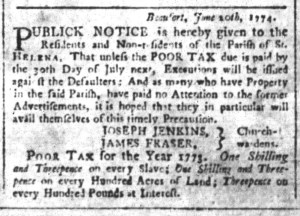
Connecticut Courant (June 21, 1774).

**********

Connecticut Courant (June 21, 1774).

**********

Essex Gazette (June 21, 1774).

**********

South-Carolina Gazette and Country Journal (June 21, 1774).

**********

South-Carolina Gazette and Country Journal (June 21, 1774).

**********

South-Carolina Gazette and Country Journal (June 21, 1774).

**********

South-Carolina Gazette and Country Journal (June 21, 1774).

**********

South-Carolina Gazette and Country Journal (June 21, 1774).

**********

South-Carolina Gazette and Country Journal (June 21, 1774).

**********

South-Carolina Gazette and Country Journal (June 21, 1774).

June 20

What was advertised in a colonial American newspaper 250 years ago today?

Massachusetts Gazette and Boston Post-Boy (June 20, 1774).

“The polite and useful ART of FENCING.”

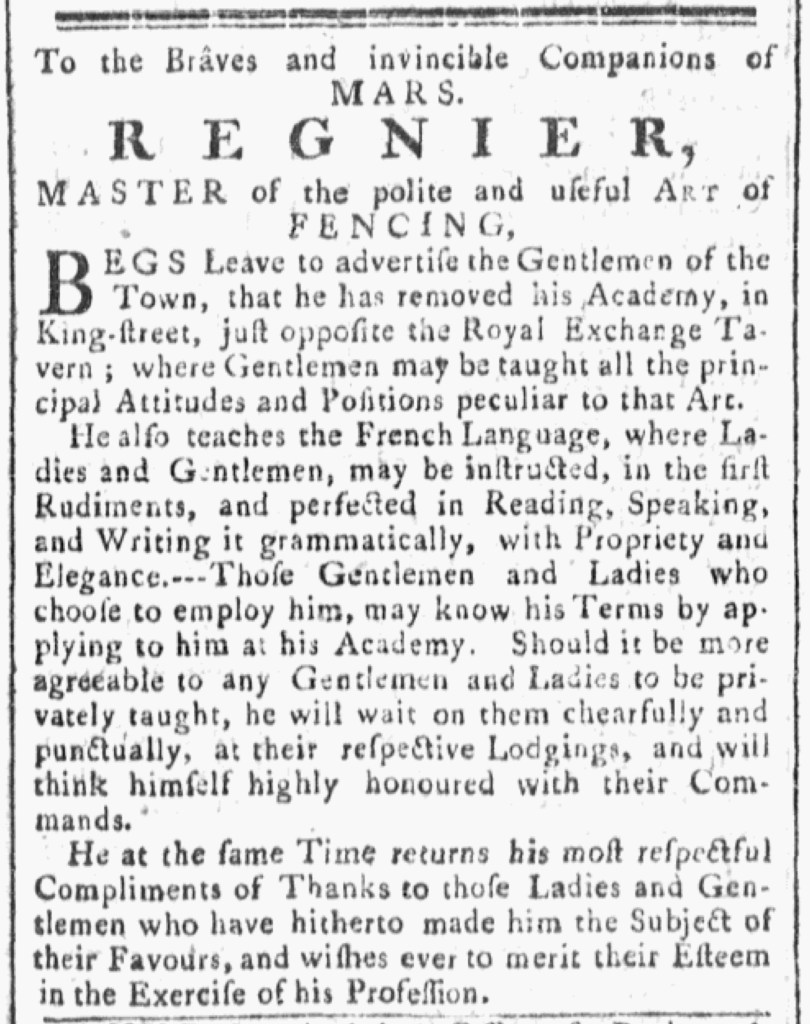
Two fencing masters dueled for pupils in the pages of the Massachusetts Gazette and Boston Post-Boy in June 1774. Each of them addressed prospective students with a flourish.  Donald McAlpine called on “all Lovers of the noble Science of DEFENCE,” while Monsieur Regnier, “MASTER of the polite and useful ART of FENCING,” was even more elaborate in addressing “the Braves and invincible Companions of MARS.”  Those headlines set their advertisements apart from others that read “TO BE SOLD” or “SPRING GOODS” or “THOMAS YOUNG.”

McAlpine specialized in teaching “the Art commonly called the BACKSWORD,” a “Science” that he would impart to the “entire Satisfaction” of “GENTLEMEN who choose to be instructed” by him.  He offered lessons on King Street from the early morning, commencing at sunrise, through the early evening, concluding with sunset, with a few hours set aside for meals and conducting other business.  He also visited gentlemen at their lodgings to give private lessons.  McAlpine indicated that he previously instructed “Gentlemen who have encouraged him” in his endeavor, while suggesting that he might not remain in Boston if other pupils did not engage his services.  He claimed that he “is strongly urged to go to another place” to teach the gentlemen there, yet it “would be most agreeable to him” to remain in Boston.  That would only happen, however, if he “Meets with such further Encouragement and Approbation” to convince him to stay.  If any gentlemen who considered themselves “Lovers of the noble Science of DEFENCE” had hesitated in seeking out McAlpine’s services, they needed to remedy that soon or risk him moving to another city.

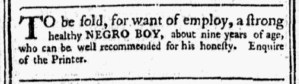
Massachusetts Gazette and Boston Post-Boy (June 20, 1774).
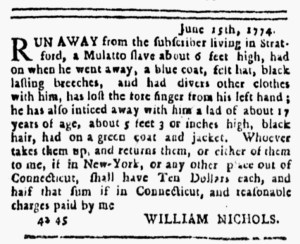
That appeal might have been more effective if Regnier had not simultaneously advertised that he taught fencing at “his Academy, in King-street, just opposite the Royal Exchange Tavern.”  He bestowed on his pupils “all the principal Attitudes and Positions peculiar to that Art.”  He made clear that learning to fence was not solely about using a sword but also entailed attaining graceful comportment that distinguished pupils as they pursued their everyday activities beyond his school.  To that end, he also taught French to both ladies and gentlemen, asserting that his pupils learned to read, speak, and write “with Propriety and Elegance.”  Regnier’s students became more genteel thanks to his lessons.  In addition, they could feel more confident in putting these markers of sophistication on display thanks to the careful instruction they received.  Like McAlpine, Regnier extended “his most respectful Compliments of Thanks” to those “who have hitherto made him the Subject of their Favours.”  Such remarks did more than reveal his success in cultivating a clientele in Boston; they also suggested to anyone who had not previously taken lessons or thought that they might benefit from brushing up that they needed to engage Regnier’s services to keep up with friends and acquaintances who already had the good sense to hire him.

As they competed with each other for pupils, McAlpine and Regnier also subtly encouraged the ladies and, especially, gentlemen they addressed to think of themselves in competition with each other.  Those “Lovers of the noble Science of DEFENCE” and those “invincible Companions of MARS” could enhance their social standing through displays of fencing, but they needed instruction from masters of the art to develop and to refine their skills.  More than mere lessons, McAlpine and Regnier marketed a means for achieving and demonstrating status.