June 14

What was advertised in a colonial American newspaper 250 years ago today?
South-Carolina Gazette and Country Journal (June 14, 1774).

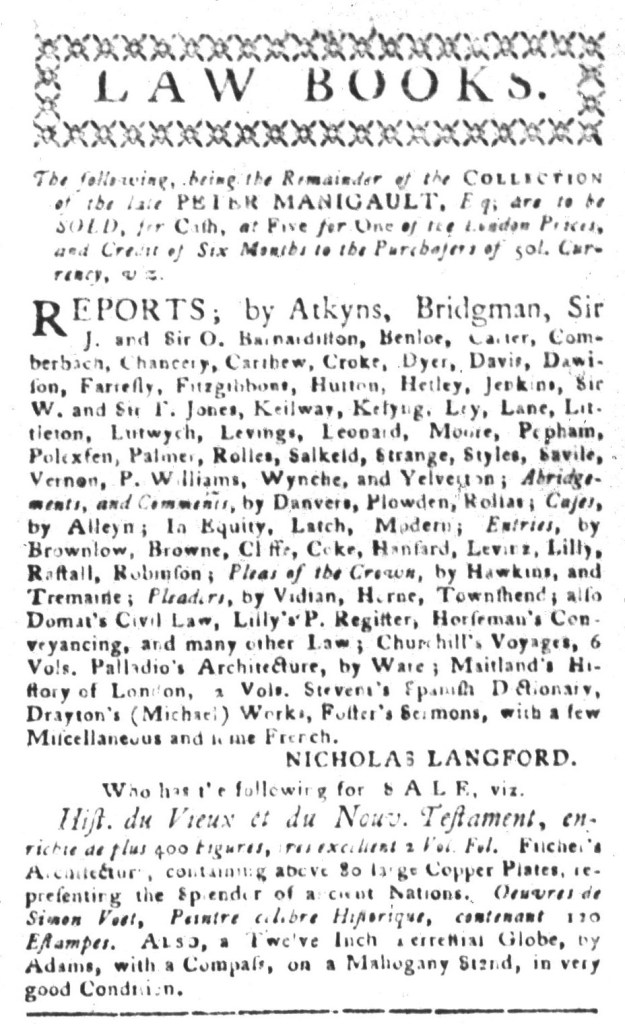
“LAW BOOKS … being the Remainder of the COLLECTION of the late PETER MANIGAULT, Esq.”

Nicholas Langford advertised dozens of law books for sale in the June 14, 1774, edition of the South-Carolina Gazette and Country Journal.  In addition to listing the authors and titles, his advertisement featured a headline, “LAW BOOKS,” enclosed within a border composed of decorative type.  It was the only notice in that issue that received such treatment.  Langford also advertised in the June 10 edition of the South-Carolina and American General Gazette, deploying the same headline with the list of books.  In that instance, the headline did not receive special treatment, suggesting that the printing office was responsible for the enhancement to the version in the South-Carolina Gazette and Country Journal instead of Langford issuing instructions or making a request.

Why might Charles Crouch, the printer of that newspaper, have decided that this advertisement merited such a headline?  Perhaps it was an act of deference.  Langford advertised “the Remainder of the COLLECTION of the late PETER MANIGAULT, Esq.”  Crouch and readers would have been familiar with the prominent lawyer, legislator, and plantation owner.  “Because of his large land and slave holdings,” Michelle Brown notes, Manigault “became one of the wealthiest men in eighteenth-century British North America.”  He owned thousands of acres and enslaved hundreds of men, women, and children.  Manigault served in the Commons House of Assembly from 1755 to 1772, elected as Speaker during the time that South Carolina and other colonies protested the Stamp Act and reelected seven times.  His political career began shortly after he returned from London, where he studied law at the Inner Temple from 1750 to 1754.  He resigned in 1772 due to ill health, returning to England in hopes of recuperating, but died there on November 12, 1773.  Brown reports that “his body was returned to Charleston for burial in the family vault of the Huguenot Church.”  His estate entrusted Langford, a bookseller, with selling his library of law books.  Given Manigault’s influence in the colony, Crouch may have decided that this advertisement deserved a more elaborate headline than others published in his newspaper.

Slavery Advertisements Published June 14, 1774

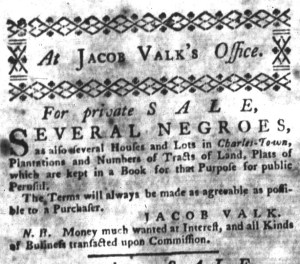
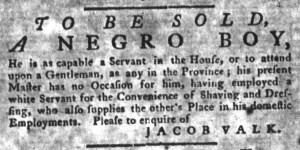
The Slavery Adverts 250 Project chronicles the role of newspaper advertising in perpetuating slavery in the era of the American Revolution. The project seeks to reveal the ubiquity of slavery in eighteenth-century life from New England to Georgia by republishing advertisements about enslaved people – for sale as individuals or in groups, wanted to purchase or for hire for short periods, runaways who liberated themselves, and those who were subsequently captured and confined in jails and workhouses – in daily digests on this site as well as in real time via the @SlaveAdverts250 Twitter feed, utilizing twenty-first-century media to stand in for the print media of the eighteenth century.

The project aims to provide modern audiences with a sense of just how often colonizers encountered these advertisements in their daily lives. Enslaved men, women, and children appeared in print somewhere in the colonies almost every single day. Those advertisements served as a constant backdrop for social, cultural, economic, and political life in colonial and revolutionary America. Colonizers who did not purport to own enslaved people were still confronted with slavery as well as invited to maintain the system by purchasing enslaved men, women, and children or assisting in the capture of so-called “runaways” who sought to free themselves from bondage. The frequency of these newspaper advertisements suggests just how embedded slavery was in colonial and revolutionary American culture in everyday interactions beyond the printed page.

These advertisements also testify to the experiences of enslaved men, women, and children, though readers must consider that those experiences have been remediated through descriptions offered by enslavers rather than enslaved people themselves. Often unnamed in the advertisements, enslaved men, women, and children were not invisible or unimportant in early America.

These advertisements appeared in colonial American newspapers 250 years ago today.

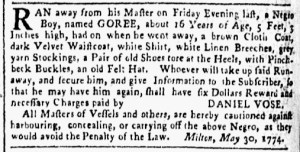
Connecticut Courant (June 14, 1774).

**********

Connecticut Courant (June 14, 1774).

**********

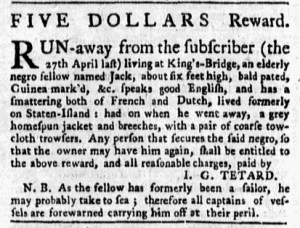
Essex Gazette (June 14, 1774).

**********

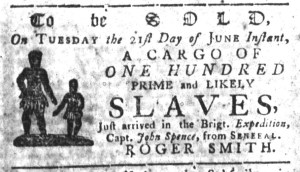
Essex Gazette (June 14, 1774).

**********

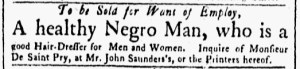
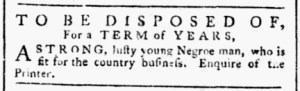
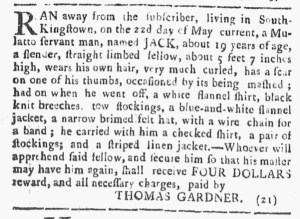
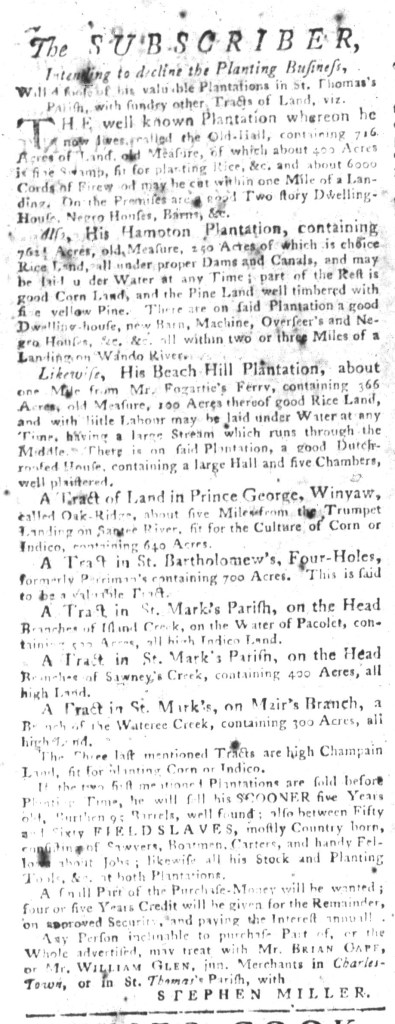
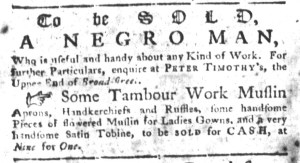
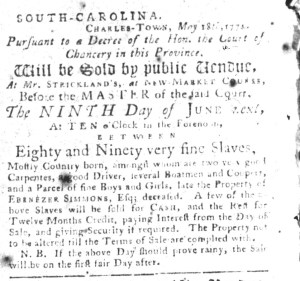
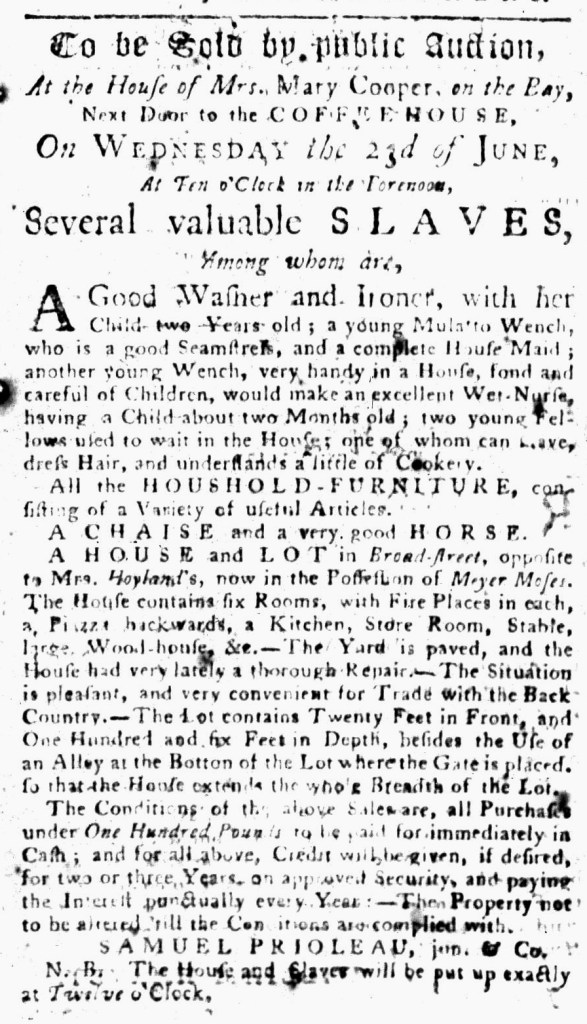
South-Carolina Gazette and Country Journal (June 14, 1774).

**********

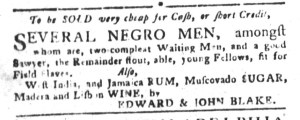
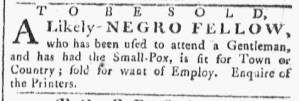
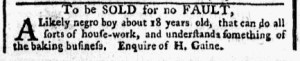
South-Carolina Gazette and Country Journal (June 14, 1774).

**********

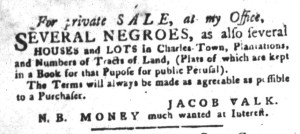
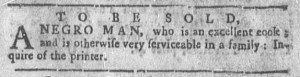
South-Carolina Gazette and Country Journal (June 14, 1774).

**********

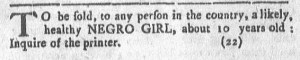
South-Carolina Gazette and Country Journal (June 14, 1774).

**********

South-Carolina Gazette and Country Journal (June 14, 1774).

**********

South-Carolina Gazette and Country Journal (June 14, 1774).

**********

South-Carolina Gazette and Country Journal (June 14, 1774).

**********

South-Carolina Gazette and Country Journal (June 14, 1774).

June 13

What was advertised in a colonial American newspaper 250 years ago today?

Supplement to the Newport Mercury (June 13, 1774).

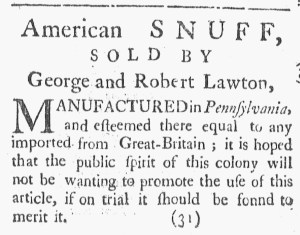
“American SNUFF … MANUFACTURED in Pennsylvania.”

George Lawton and Robert Lawton advertised “American SNUFF” in the Newport Mercury as colonizers from New England to Georgia discussed how to respond to the Boston Port Act, legislation that closed the harbor as punishment for the destruction of tea in December 1773.  Simultaneously, newspapers covered other abuses perpetrated by Parliament.  The June 13, 1774, edition of the Newport Mercury, for instance, featured “A BILL for better regulating the Government of the Province of the Massachusetts-Bay, in North-America” and “A BILL for the impartial Administration of Justice in the Cases of Persons questioned for any Acts, done by them in the Execution of the law, or for the Suppression of Riots & Tumults in the Province of the Massachusetts-Bay, in New-England.”  Although neither had yet been passed when the ship that carried them departed from Bristol more than five weeks earlier, the printer, Solomon Southwick, noted “there is no doubt of their having passed before this time.”  In colorful commentary, he added that “the — [devil] himself can suggest nothing too horrid to be expected from the present administration.”  Another note followed the second bill: “God save the PEOPLE from such Laws!

It was in that context that the Lawtons marketed “American SNUFF … MANUFACTURED in Pennsylvania” as an alternative to snuff imported from Great Britain.  They asserted that consumers in Pennsylvania “esteemed” this snuff “equal to any imported,” so customers did not have to sacrifice quality in their support of “domestic manufacturers,” goods produced in the colonies.  The Lawtons presented trying this snuff as the patriotic duty of consumers who had concerns about current events.  “[I]t is hoped,” they implored, “that the public spirit of this colony will not be wanting to promote the use of this article, if on trial it should be fo[u]nd to merit it.”  In other words, the Lawtons encouraged prospective customers to try the snuff, taking into account the endorsements from colonizers in Pennsylvania, and see for themselves if they liked it as much as imported snuff.  If they did, their subsequent purchases could serve two purposes: acquiring a product they enjoyed while putting political principles into practice.  In many places, colonizers already discussed another round of nonimportation agreements, drawing on a strategy deployed in response to the Stamp Act and the Townshend Acts.  Immediately above the Lawtons’ advertisement, the resolutions from “a town meeting held at Providence” called for “an universal stoppage of all trade with Great-Britain, Ireland, Africa, and the West-Indies” until Parliament opened Boston Harbor once again.  Colonizers sought to use commerce for political leverage.  Similarly, decisions about which products to consume had political implications.  Even with no boycott currently in place, the Lawtons encouraged consumers to think about how they could support the colonies in their contest against Parliament.

Slavery Advertisements Published June 13, 1774

The Slavery Adverts 250 Project chronicles the role of newspaper advertising in perpetuating slavery in the era of the American Revolution. The project seeks to reveal the ubiquity of slavery in eighteenth-century life from New England to Georgia by republishing advertisements about enslaved people – for sale as individuals or in groups, wanted to purchase or for hire for short periods, runaways who liberated themselves, and those who were subsequently captured and confined in jails and workhouses – in daily digests on this site as well as in real time via the @SlaveAdverts250 Twitter feed, utilizing twenty-first-century media to stand in for the print media of the eighteenth century.

The project aims to provide modern audiences with a sense of just how often colonizers encountered these advertisements in their daily lives. Enslaved men, women, and children appeared in print somewhere in the colonies almost every single day. Those advertisements served as a constant backdrop for social, cultural, economic, and political life in colonial and revolutionary America. Colonizers who did not purport to own enslaved people were still confronted with slavery as well as invited to maintain the system by purchasing enslaved men, women, and children or assisting in the capture of so-called “runaways” who sought to free themselves from bondage. The frequency of these newspaper advertisements suggests just how embedded slavery was in colonial and revolutionary American culture in everyday interactions beyond the printed page.

These advertisements also testify to the experiences of enslaved men, women, and children, though readers must consider that those experiences have been remediated through descriptions offered by enslavers rather than enslaved people themselves. Often unnamed in the advertisements, enslaved men, women, and children were not invisible or unimportant in early America.

These advertisements appeared in colonial American newspapers 250 years ago today.

Boston Evening-Post (June 13, 1774).

**********

Boston-Gazette (June 13, 1774).

**********

Boston-Gazette (June 13, 1774).

**********

Boston-Gazette (June 13, 1774).

**********

Boston-Gazette (June 13, 1774).

**********

Dunlap’s Pennsylvania Packet (June 13, 1774).

**********

Dunlap’s Pennsylvania Packet (June 13, 1774).

**********

Massachusetts Gazette and Boston Post-Boy (June 13, 1774).

**********

Newport Mercury (June 13, 1774).

**********

Newport Mercury (June 13, 1774).

**********

Supplement to the Newport Mercury (June 13, 1774).

**********

New-York Gazette and Weekly Mercury (June 13, 1774).

**********

New-York Gazette and Weekly Mercury (June 13, 1774).

**********

New-York Gazette and Weekly Mercury (June 13, 1774).

**********

New-York Gazette and Weekly Mercury (June 13, 1774).

**********

Supplement to the New-York Gazette and Weekly Mercury (June 13, 1774).

**********

South-Carolina Gazette (June 13, 1774).

**********

South-Carolina Gazette (June 13, 1774).

**********

South-Carolina Gazette (June 13, 1774).

**********

South-Carolina Gazette (June 13, 1774).

**********

South-Carolina Gazette (June 13, 1774).

**********

South-Carolina Gazette (June 13, 1774).

**********

South-Carolina Gazette (June 13, 1774).

**********

South-Carolina Gazette (June 13, 1774).

**********

South-Carolina Gazette (June 13, 1774).

**********

South-Carolina Gazette (June 13, 1774).

**********

South-Carolina Gazette (June 13, 1774).

**********

South-Carolina Gazette (June 13, 1774).

**********

South-Carolina Gazette (June 13, 1774).

**********

South-Carolina Gazette (June 13, 1774).

**********

South-Carolina Gazette (June 13, 1774).

**********

South-Carolina Gazette (June 13, 1774).

**********

Supplement to the South-Carolina Gazette (June 13, 1774).

**********

Supplement to the South-Carolina Gazette (June 13, 1774).

**********

Supplement to the South-Carolina Gazette (June 13, 1774).

**********

Supplement to the South-Carolina Gazette (June 13, 1774).

June 12

What was advertised in a colonial American newspaper 250 years ago this week?

Rivington’s New-York Gazetteer (June 9, 1774).

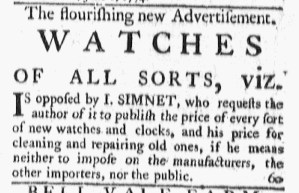
“The flourishing new Advertisement … IS opposed by I. SIMNET.”

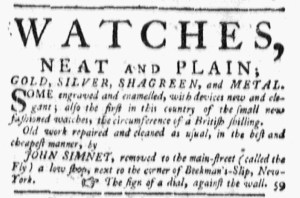
The cantankerous John Simnet once again picked a fight in the public prints in the summer of 1774, having previously engaged in similar behavior targeting competitors in Portsmouth in the late 1760s and New York in the early 1770s.  The watchmaker did not seem content simply promoting his own skill and merchandise, as he did in an advertisement for “WATCHES, NEAT AND PLAIN; GOLD, SILVER, SHAGREEN, and METAL” that first ran in the June 2, 1774, edition of Rivington’s New-York Gazetteer and appeared again a week later.  In that notice, Simnet emphasized a novelty available at his shop, “the first in this country of the small new fashioned watches, the circumference of a British shilling.”

Rivington’s New-York Gazetteer (May 26, 1774).

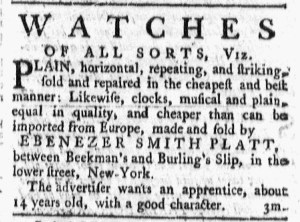
Yet Simnet did not believe that was not enough to distinguish him from his competitors. Instead, he placed a second advertisement in Rivington’s New-York Gazetteer on June 9, that one deriding “The flourishing new Advertisement” with a headline for “WATCHES OF ALL SORTS, viz.” that went on to list “PLAIN, horizontal, repeating, and striking.”  Ebenezer Smith Platt had been running that advertisement in Rivington’s New-York Gazetteer, though Sinmet’s comment about “The flourishing new Advertisement” suggests that his competitor may have distributed handbills or broadsides as well.  The part that really upset Simnet seems to have been Platt’s assertion that he made and sold watches and clocks “equal in quality, and cheaper than can be imported from Europe.”  Even though artisans throughout the colonies, including clock- and watchmakers, often made such appeals, Simnet acted as though they applied solely to him and his business.

Rivington’s New-York Gazetteer (June 9, 1774).

To that end, he quoted the headline of Platt’s advertisement and then trumpeted that he “IS opposed” to the claims made in it.  Simnet went on to demand, though he framed it as a request, that “the author of it” (he did not mention Platt by name) “publish the price of every sort of new watches and clocks, and his price for cleaning and repairing old ones, if he means neither to impose on the manufacturers, the other importers, nor the public.”  On occasion, Simnet had published the prices he charged for cleaning and repairs, though in his current advertisement he merely stated, “Old work repaired and cleaned as usual, in the best and cheapest manner.”  He sought to hold Platt to a higher standard than he met, suggesting that he did so in service to “the public” that might have otherwise been duped by Platt.  In an era when most advertisers promoted their own goods and services without engaging directly with their competitors, Simnet regularly took to the newspapers to demean others who followed his trade, especially those who ran their own advertisements.  He apparently considered such means effective … or at least derived some form of satisfaction from such conduct.

June 11

What was advertised in a colonial American newspaper 250 years ago today?

Maryland Journal (June 11, 1774).

“No money be expected until the test of proof shall confirm their intrinsic value.”

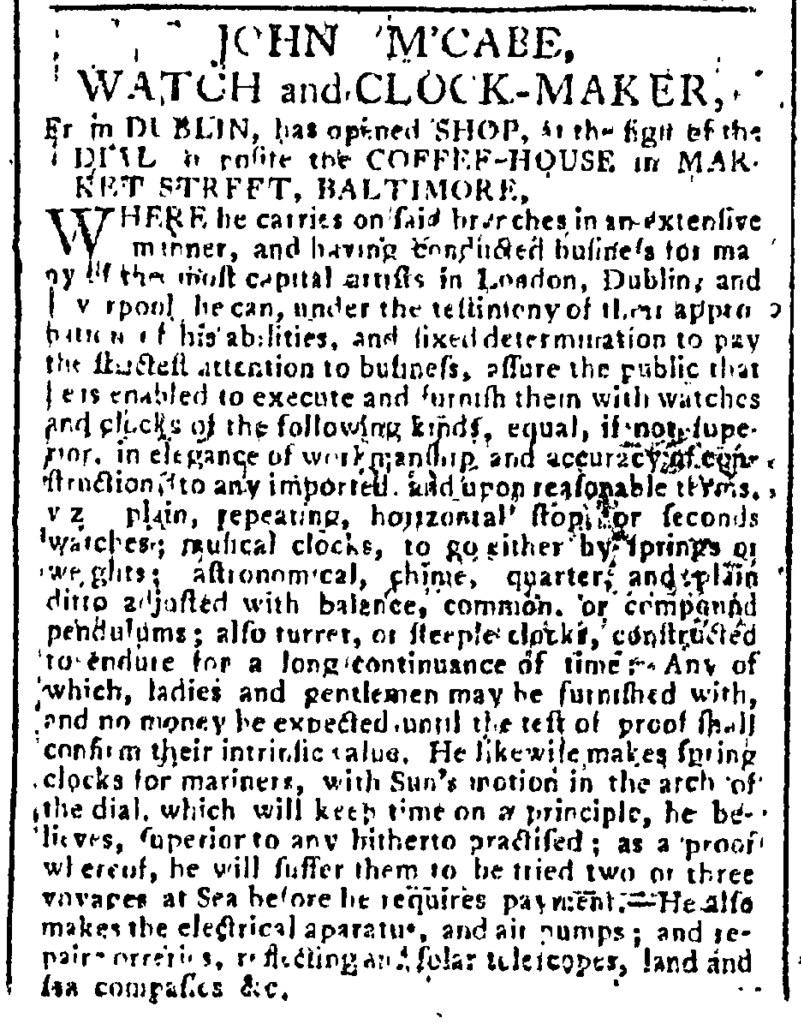
When he set up shop “at the sign of the DIAL” in Baltimore, John McCabe, a “WATCH and CLOCK-MAKER, From DUBLIN,” deployed a marketing strategy commonly undertaken by artisans who migrated across the Atlantic to the colonies.  In an advertisement in the June 11, 1774, edition of the Maryland Journal, he sought to establish his reputation in a town that did not have firsthand knowledge of his skill.  Instead, he relied on an overview of his experience, asserting that he had “conducted business for many of the most capital artists in London, Dublin, and Liverpool.”  Having worked in the most exclusive shops in urban centers, especially the cosmopolitan center of the empire, gave the newcomer a certain cachet, enhanced even more by the “testimony of their approbation of his abilities” that he claimed he could produce.

Yet McCabe did not rest on such laurels that were not immediately apparent to readers.  Instead, he simultaneously declared that his “fixed determination to pay the strictest attention to business.”  Underscoring his industriousness also came from the playbook developed by other artisans, a familiar refrain in their advertisements.  Prospective customers who might have been skeptical of McCabe’s credentials could judge for themselves whether he made clocks and watches “equal, if not superior, in elegance of workmanship and accuracy of construction to any imported.”  They could acquire such timepieces “upon reasonable terms,” getting the same style and quality as watches and clocks from London without paying exorbitant prices.

Even though the initial portions of his advertisement resembled notices placed by other artisans, McCabe, he did include an offer not made nearly as often: allowing a trial period for customers to decide if they wished to purchase or return watches and clocks from his shop.  The enterprising artisan declared that “ladies and gentlemen may be furnished” with any of the variety of clocks and watches listed in his advertisement and “no money be expected until the test of proof shall confirm their intrinsic value.”  McCabe did not explicitly state that customers could return items they found lacking, so confident was he that they would indeed be satisfied with his wares during the trial.  He extended a similar offer for “spring clocks for mariners … which keep time on a principle, he believes, superior to any hitherto practised.”  Customers could make that determination for themselves: “he will suffer them to be tried two or three voyages at Sea before he requires payment.”  Such arrangements would have required some negotiation about the amount of time and the length of those voyages, but allowing for such trials before collecting money from customers did not put McCabe at a disadvantage in the eighteenth-century commercial culture of extending extensive credit to consumers.  Prospective customers likely expected credit, so McCabe gained by transforming the time that would elapse between purchase and payment into a trial, giving those customers the impression that they received an additional benefit from doing business with him.  For some, that may have been the more effective marketing strategy than any claims about his experience working in the best shops in London, Dublin, and Liverpool.

Slavery Advertisements Published June 11, 1774

The Slavery Adverts 250 Project chronicles the role of newspaper advertising in perpetuating slavery in the era of the American Revolution. The project seeks to reveal the ubiquity of slavery in eighteenth-century life from New England to Georgia by republishing advertisements about enslaved people – for sale as individuals or in groups, wanted to purchase or for hire for short periods, runaways who liberated themselves, and those who were subsequently captured and confined in jails and workhouses – in daily digests on this site as well as in real time via the @SlaveAdverts250 Twitter feed, utilizing twenty-first-century media to stand in for the print media of the eighteenth century.

The project aims to provide modern audiences with a sense of just how often colonizers encountered these advertisements in their daily lives. Enslaved men, women, and children appeared in print somewhere in the colonies almost every single day. Those advertisements served as a constant backdrop for social, cultural, economic, and political life in colonial and revolutionary America. Colonizers who did not purport to own enslaved people were still confronted with slavery as well as invited to maintain the system by purchasing enslaved men, women, and children or assisting in the capture of so-called “runaways” who sought to free themselves from bondage. The frequency of these newspaper advertisements suggests just how embedded slavery was in colonial and revolutionary American culture in everyday interactions beyond the printed page.

These advertisements also testify to the experiences of enslaved men, women, and children, though readers must consider that those experiences have been remediated through descriptions offered by enslavers rather than enslaved people themselves. Often unnamed in the advertisements, enslaved men, women, and children were not invisible or unimportant in early America.

These advertisements appeared in colonial American newspapers 250 years ago today.

Providence Gazette (June 11, 1774).

June 10

What was advertised in a colonial American newspaper 250 years ago today?

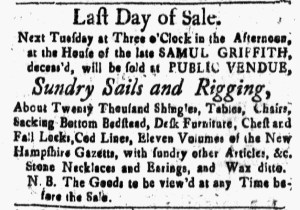
New-Hampshire Gazette (June 10, 1774).

“Last Day of Sale.”

The executors for Samuel Griffith’s estate held a sale in Portsmouth on June 14, 1774, advertising a “PUBLIC VENDUE” in the June 10, 1774, edition of the New-Hampshire Gazette.  The sale included “Sundry Sails and Rigging” as well as “About Twenty Thousand Shingles, Tables, Chairs, [a] Sacking Bottom Bedstead, Desk Furniture, …with sundry other Articles” that prospective buyers could view prior to the sale.

Griffith had apparently kept abreast of the news.  His estate included “Eleven Volumes of the New Hampshire Gazette,” a “HISTORICAL CHRONICLE” (according to the masthead) of events in the colony and throughout the Atlantic world.  The executors considered Griffith’s collection of newspapers of significant enough interest to merit mention in the sale notice.  Griffith had not treated his copies of the New-Hampshire Gazette as ephemeral.  If those “Eleven Volumes” corresponded with the past eleven years, then buyers could acquire an account of the imperial crisis as it had unfolded with the Royal Proclamation of 1763, the passage and repeal of the Stamp Act in 1765 and 1766, the Townshend Acts and nonimportation agreements in the late 1760s, the Boston Massacre in 1770, and the Boston Tea Party in 1773.  Some colonizers, like Harbottle Dorr, revisited news and editorials to inform their understanding of current events.

To incite interest and increase the number of people in attendance, the executors included a headline that proclaimed, “Last Day of Sale.”  That alerted readers that they had limited opportunity to acquire any of the items from the estate, likely at bargain prices for secondhand wares compared to what they would pay retail for new items.  Those interested in the sails, rigging, and shingles for their own businesses also had the potential for lower prices than purchasing them elsewhere on the market, but not if they hesitated.  They needed to be present the following Tuesday when the sale commenced.  Many advertisements in the New-Hampshire Gazette did not feature headlines at all, so one announcing “Last Day of Sale” likely helped draw attention to an event soon to take place.

Slavery Advertisements Published June 10, 1774

The Slavery Adverts 250 Project chronicles the role of newspaper advertising in perpetuating slavery in the era of the American Revolution. The project seeks to reveal the ubiquity of slavery in eighteenth-century life from New England to Georgia by republishing advertisements about enslaved people – for sale as individuals or in groups, wanted to purchase or for hire for short periods, runaways who liberated themselves, and those who were subsequently captured and confined in jails and workhouses – in daily digests on this site as well as in real time via the @SlaveAdverts250 Twitter feed, utilizing twenty-first-century media to stand in for the print media of the eighteenth century.

The project aims to provide modern audiences with a sense of just how often colonizers encountered these advertisements in their daily lives. Enslaved men, women, and children appeared in print somewhere in the colonies almost every single day. Those advertisements served as a constant backdrop for social, cultural, economic, and political life in colonial and revolutionary America. Colonizers who did not purport to own enslaved people were still confronted with slavery as well as invited to maintain the system by purchasing enslaved men, women, and children or assisting in the capture of so-called “runaways” who sought to free themselves from bondage. The frequency of these newspaper advertisements suggests just how embedded slavery was in colonial and revolutionary American culture in everyday interactions beyond the printed page.

These advertisements also testify to the experiences of enslaved men, women, and children, though readers must consider that those experiences have been remediated through descriptions offered by enslavers rather than enslaved people themselves. Often unnamed in the advertisements, enslaved men, women, and children were not invisible or unimportant in early America.

These advertisements appeared in colonial American newspapers 250 years ago today.

New-Hampshire Gazette (June 10, 1774).

**********

South-Carolina and American General Gazette (June 10, 1774).

**********

South-Carolina and American General Gazette (June 10, 1774).

**********

South-Carolina and American General Gazette (June 10, 1774).

**********

South-Carolina and American General Gazette (June 10, 1774).

**********

South-Carolina and American General Gazette (June 10, 1774).

**********

South-Carolina and American General Gazette (June 10, 1774).

**********

South-Carolina and American General Gazette (June 10, 1774).

**********

South-Carolina and American General Gazette (June 10, 1774).

**********

South-Carolina and American General Gazette (June 10, 1774).

**********

South-Carolina and American General Gazette (June 10, 1774).

**********

South-Carolina and American General Gazette (June 10, 1774).

**********

South-Carolina and American General Gazette (June 10, 1774).

**********

South-Carolina and American General Gazette (June 10, 1774).

**********

South-Carolina and American General Gazette (June 10, 1774).

**********

South-Carolina and American General Gazette (June 10, 1774).

**********

South-Carolina and American General Gazette (June 10, 1774).

**********

South-Carolina and American General Gazette (June 10, 1774).

**********

South-Carolina and American General Gazette (June 10, 1774).

**********

South-Carolina and American General Gazette (June 10, 1774).

**********

South-Carolina and American General Gazette (June 10, 1774).

**********

South-Carolina and American General Gazette (June 10, 1774).

**********

South-Carolina and American General Gazette (June 10, 1774).

**********

South-Carolina and American General Gazette (June 10, 1774).

**********

South-Carolina and American General Gazette (June 10, 1774).

June 9

What was advertised in a colonial American newspaper 250 years ago today?

Massachusetts Spy (June 9, 1774).

Contains as much news, as many Political Essays, as any in America.”

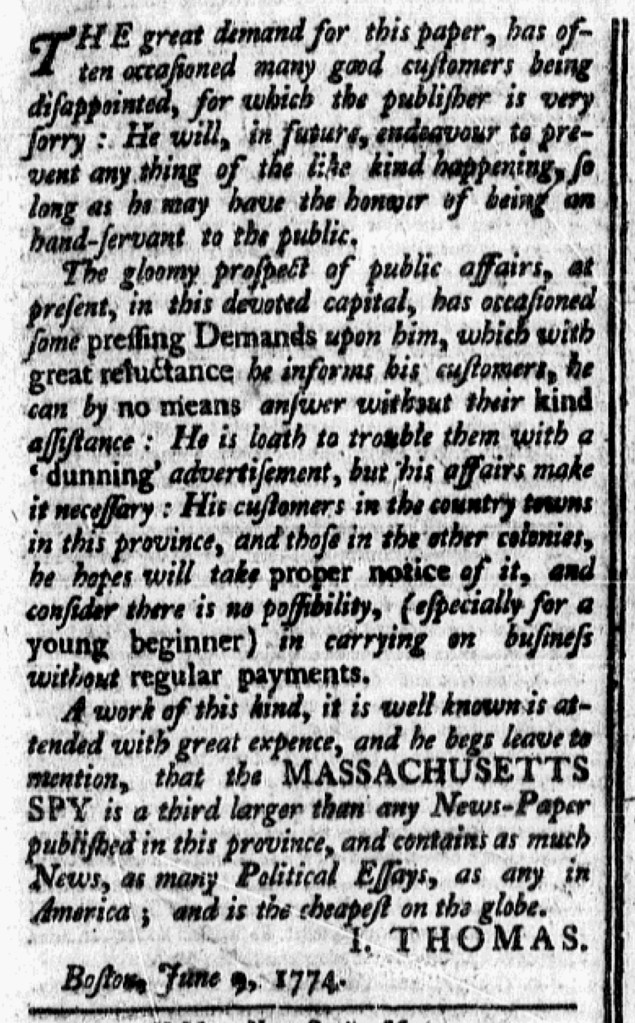
Printers and other entrepreneurs often published notices calling on customers and associates to settle accounts.  Isaiah Thomas, the printer of the Massachusetts Spy, did so in June 1774, though he confessed that he “is loath to trouble them with a dunning advertisement.”  Still, “his affairs make it necessary.”  Many printers threatened legal action against those who did not submit payment, but Thomas opted for a different strategy.  His “‘dunningadvertisement” focused primarily on the service to the public he provided in publishing the Massachusetts Spy, especially considering the “gloomy prospect of public affairs, at present.”  Readers knew, of course, that he referred to the Boston Port Act that initiated a blockade of the harbor and halted trade at the beginning of the month as well as a series of troubling events over the past decade.

Zechariah Fowle and Thomas commended publishing the Massachusetts Spy in July 1770, four months after the Boston Massacre.  At the age of twenty-one, Thomas became the sole proprietor just a few months later.  In the four years that the newspaper had been published, the young printer sought to establish its reputation in Boston and beyond.  When he asked subscribers to pay what they owed, he underscored that “the MASSACHUSETTS SPY is a third larger than any News-Paper published in this province.”  That distinguished it from the Boston Evening-Post, the Boston-Gazette, the Massachusetts Gazette and Boston Post-Boy, and the Massachusetts Gazette and Boston Weekly News-Letter as well as the Essex Gazette, published in Salem, and the Essex Journal, published in Newburyport.  At the time, no other city or colony had as many newspapers, which meant that Thomas faced significant competition for subscribers and advertisers. Furthermore, Thomas’s newspaper “contains as much News, [and] as many Political Essays, as any in America,” making it a valuable resource for readers far and wide.  Thomas also asserted that the Massachusetts Spyis the cheapest on the globe,” making it a good value that merited support (and payment) from readers.
In return for “the honour of being an hand-servant to the public,” Thomas requested the “kind assistance” of his customers.  He asked that they “take proper notice” of his appeal, warning that “there is no possibility … in carrying on business without regular payments.”  The June 9 edition of his newspaper featured extensive coverage of the “PROCEEDINGS in the HOUSE of COMMONS” from April, including an “Authentic account of Tuesday’s Debate on the Motion for repealing the Tea-Duty in America,” and editorials “To the FREE and BRAVE AMERICANS” from “AN AMERICAN” and “To the ADRESSERS of the late Governor HUTCHINSON” from “A MODERATE MAN.”  Thomas compiled and circulated such news and opinion as a service, but could not afford to continue that endeavor without receiving subscription fees from his customers.  Rather than an explicit threat to take them to court to force them to pay what they owed, Thomas made a much more subtle insinuation about what they would lose if they did not settle accounts.  By his accounting, no other newspaper compared to the Massachusetts Spy.