Slavery Advertisements Published July 15, 1775

GUEST CURATORS:  Ina Bechle, Stella Cullity, and Eva LaPorte

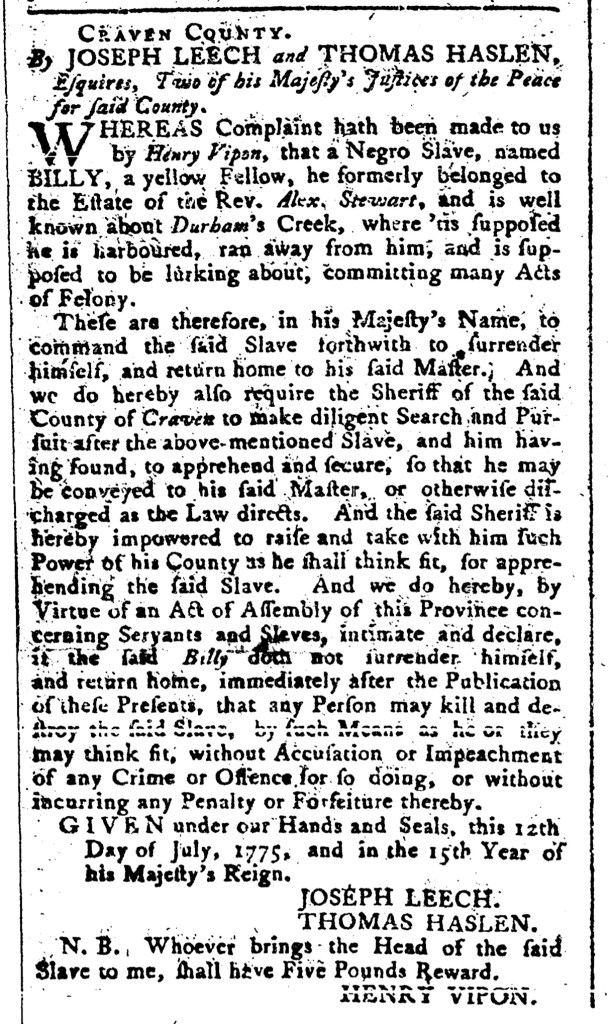
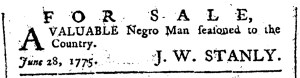
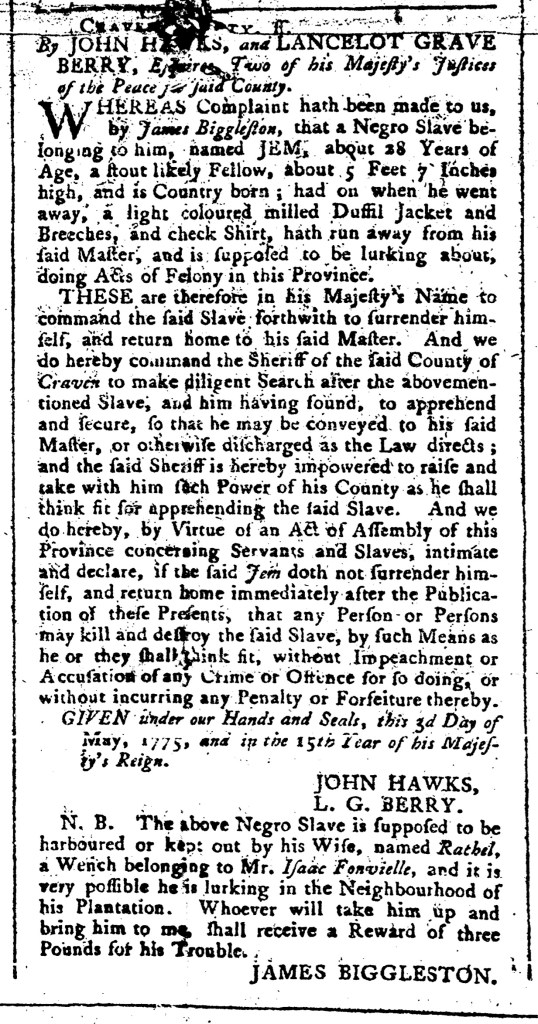
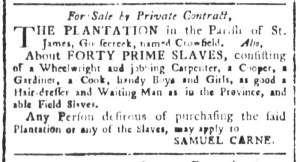
The Slavery Adverts 250 Project chronicles the role of newspaper advertising in perpetuating slavery in the era of the American Revolution. The project seeks to reveal the ubiquity of slavery in eighteenth-century life from New England to Georgia by republishing advertisements about enslaved people – for sale as individuals or in groups, wanted to purchase or for hire for short periods, runaways who liberated themselves, and those who were subsequently captured and confined in jails and workhouses – in daily digests on this site as well as in real time via the @SlaveAdverts250 Twitter feed, utilizing twenty-first-century media to stand in for the print media of the eighteenth century.

The project aims to provide modern audiences with a sense of just how often colonizers encountered these advertisements in their daily lives. Enslaved men, women, and children appeared in print somewhere in the colonies almost every single day. Those advertisements served as a constant backdrop for social, cultural, economic, and political life in colonial and revolutionary America. Colonizers who did not purport to own enslaved people were still confronted with slavery as well as invited to maintain the system by purchasing enslaved men, women, and children or assisting in the capture of so-called “runaways” who sought to free themselves from bondage. The frequency of these newspaper advertisements suggests just how embedded slavery was in colonial and revolutionary American culture in everyday interactions beyond the printed page.

These advertisements also testify to the experiences of enslaved men, women, and children, though readers must consider that those experiences have been remediated through descriptions offered by enslavers rather than enslaved people themselves. Often unnamed in the advertisements, enslaved men, women, and children were not invisible or unimportant in early America.

These advertisements appeared in colonial American newspapers 250 years ago today.
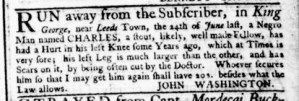
Supplement to the Pennsylvania Ledger (July 15, 1775).

**********
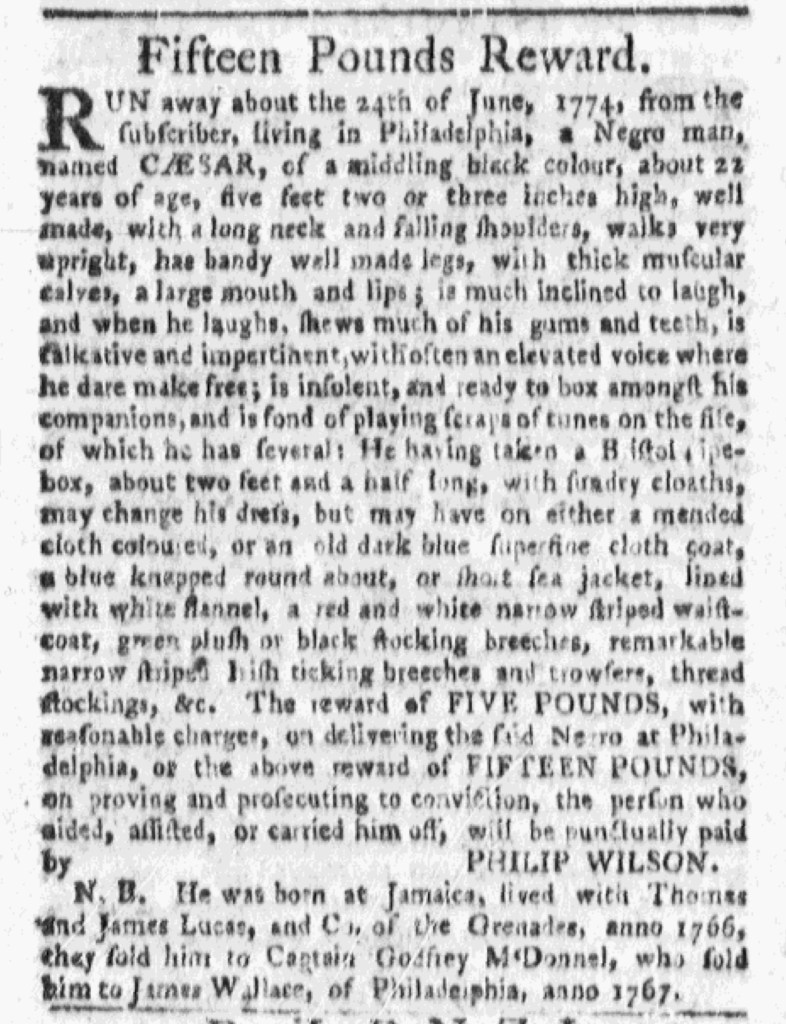
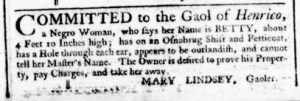
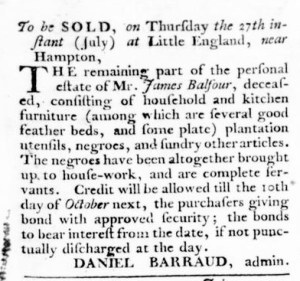
Virginia Gazette [Dixon and Hunter] (July 15, 1775).

**********
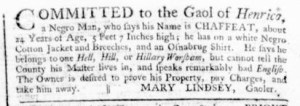
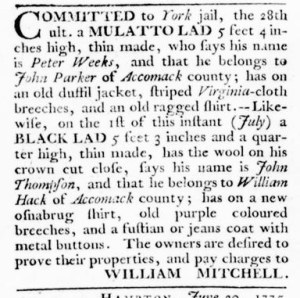
Virginia Gazette [Dixon and Hunter] (July 15, 1775).

**********
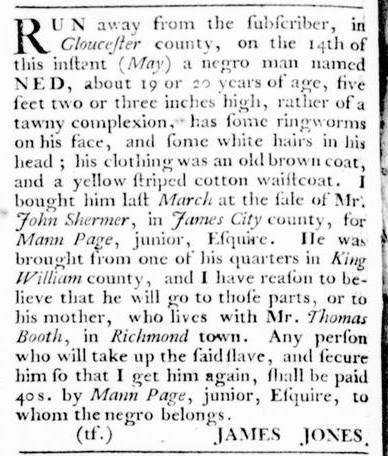
Virginia Gazette [Dixon and Hunter] (July 15, 1775).

**********
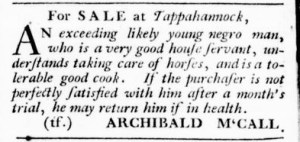
Virginia Gazette [Dixon and Hunter] (July 15, 1775).

July 14

What was advertised in a revolutionary American newspaper 250 years ago today?

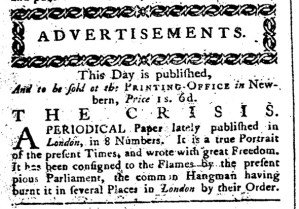
North-Carolina Gazette (July 14, 1775).

“THE CRISIS. A PERIODICAL Paper lately published in London, in 8 Numbers.”

Along with continued coverage of the Battle of Bunker Hill, the July 14, 1775, edition of the North-Carolina Gazettecarried an advertisement for The Crisis, a “PERIODICAL Paper lately published in London, in 8 Numbers.”  According to Neil L. York, The Crisis, published between January 1775 and October 1776, “was the longest-running weekly pamphlet series printed in the British Atlantic World during those years.”  (That London publication should not be confused with Thomas Paine’s “American Crisis,” a series of essays published in the United States between 1776 and 1783.)  The Crisis eventually included ninety-two editions, but James Davis, printer of the North-Carolina Gazette, had access to only the first eight.  According to his advertisement, he collected them together into a single volume.

Davis used the pamphlet’s colorful history in marketing it to readers in North Carolina.  “It is a true Portrait of the present Times,” he declared, “and wrote with great Freedom.  It has been consigned to the Flames by the present pious Parliament, the common Hangman having burnt it in several Places in London by their Order.”  York provides this overview: “The Crisis was condemned informally by leaders in the British government, and then formally in court, as a dangerous example of seditious libel [due to the depictions of George III].  Copies of it were publicly burned, and yet publication continued uninterrupted.”  American Patriots had their supporters among the British public, including authors and printers who “played on shared beliefs and shared fears: beliefs in the existence of fundamental rights … and the fear that loss of those rights in Britain’s American colonies could lead to their loss in Britain itself.”  York posits that the “men behind The Crisis were determined to interest the British public in American affairs and were no doubt pleased when various issues were reprinted in the colonies.”  Indeed, newspapers reprinted some of the essays in their entirety.  Printers also recognized opportunities to generate revenue while disseminating The Crisis to colonizers.  Advertisements for individual numbers of the pamphlet peppered the pages of American newspapers in the spring and summer of 1775 as printers in several colonies distributed new issues as they came to hand.  The day before Davis ran his advertisement in the North-Carolina Gazette, John Anderson announced in a notice in the New-York Journal that “on Monday will be published No. 9 of the CRISIS.”  Instead of printing one issue at a time, Davis packaged the first eight issues together for readers, hoping that providing such convenient access would entice them to buy the volume.

**********
This entry marks the final appearance of the North-Carolina Gazette in the Adverts 250 Project.  Few issues of that newspaper survive.  Only seven, all of them from 1775, have been digitized for greater access via databases of early American newspapers.  I have selected advertisements from the North-Carolina Gazette as often as possible to present a more complete representation of newspapers from throughout the colonies.

Slavery Advertisements Published July 14, 1775

GUEST CURATORS:  Ina Bechle, Stella Cullity, and Eva LaPorte

The Slavery Adverts 250 Project chronicles the role of newspaper advertising in perpetuating slavery in the era of the American Revolution. The project seeks to reveal the ubiquity of slavery in eighteenth-century life from New England to Georgia by republishing advertisements about enslaved people – for sale as individuals or in groups, wanted to purchase or for hire for short periods, runaways who liberated themselves, and those who were subsequently captured and confined in jails and workhouses – in daily digests on this site as well as in real time via the @SlaveAdverts250 Twitter feed, utilizing twenty-first-century media to stand in for the print media of the eighteenth century.

The project aims to provide modern audiences with a sense of just how often colonizers encountered these advertisements in their daily lives. Enslaved men, women, and children appeared in print somewhere in the colonies almost every single day. Those advertisements served as a constant backdrop for social, cultural, economic, and political life in colonial and revolutionary America. Colonizers who did not purport to own enslaved people were still confronted with slavery as well as invited to maintain the system by purchasing enslaved men, women, and children or assisting in the capture of so-called “runaways” who sought to free themselves from bondage. The frequency of these newspaper advertisements suggests just how embedded slavery was in colonial and revolutionary American culture in everyday interactions beyond the printed page.

These advertisements also testify to the experiences of enslaved men, women, and children, though readers must consider that those experiences have been remediated through descriptions offered by enslavers rather than enslaved people themselves. Often unnamed in the advertisements, enslaved men, women, and children were not invisible or unimportant in early America.

These advertisements appeared in colonial American newspapers 250 years ago today.

North-Carolina Gazette (July 14, 1775).

**********

North-Carolina Gazette (July 14, 1775).

**********
North-Carolina Gazette (July 14, 1775).

**********
South-Carolina and American General Gazette (July 14, 1775).

**********
South-Carolina and American General Gazette (July 14, 1775).

**********
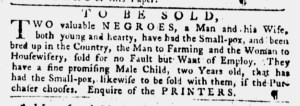
South-Carolina and American General Gazette (July 14, 1775).

**********
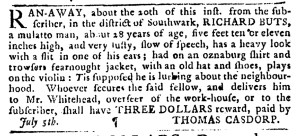
South-Carolina and American General Gazette (July 14, 1775).

**********

South-Carolina and American General Gazette (July 14, 1775).

**********

South-Carolina and American General Gazette (July 14, 1775).

**********

Virginia Gazette [Purdie] (July 14, 1775).

**********

Virginia Gazette [Purdie] (July 14, 1775).

**********

Virginia Gazette [Purdie] (July 14, 1775).

**********

Virginia Gazette [Purdie] (July 14, 1775).

**********

Virginia Gazette [Purdie] (July 14, 1775).

July 13

Who was the subject of an advertisement in a revolutionary American newspaper 250 years ago today?

Maryland Gazette (July 13, 1775).

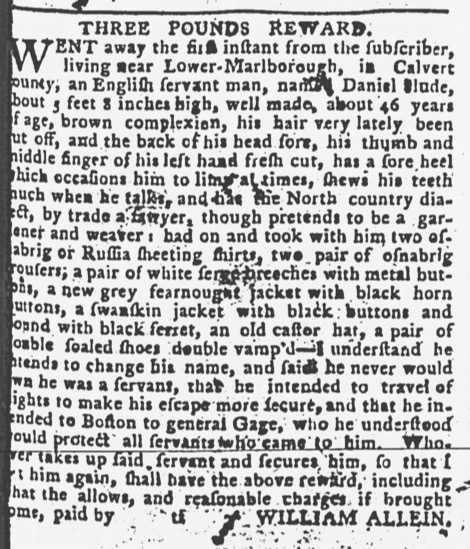
“An English servant man … intended to Boston to general Gage, who he understood would protect all servants who came to him.”

William Allein of Lower Marlborough in Calvert County turned to the Maryland Gazette to seek assistance in recovering an enslaved man and an indentured servant in the summer of 1775.  He ran two advertisements in the July 13 edition, one concerning Mial, an enslaved man who became a fugitive for freedom at the beginning of May, and Slude, an “English servant man” who “WENT away” in early July.  Allein expected newspaper readers to observe strangers to assess whether they matched the descriptions he published, offering rewards to those who participated in securing Mial and Slude and returning them to him.

Allein gave a physical description of Slude, including recent injuries (“his thumb and middle finger on his left hand fresh cut” and “a sore heel which occasions him to limp at times”) that could make him easier to recognize, and detailed the clothing that Slude wore or took with him.  His “North country dialect” also distinguished the indentured servant.  According to Allein, Slude was “by trade a sawyer, though he pretends to be a gardener and weaver.”  He would engage in other subterfuge as well, changing his name and traveling by night to avoid detection.

Compared to many of his counterparts who placed other advertisements for runaway indentured servants, apprentices, and convict servants and enslaved people who liberated themselves, Allein was well informed about where Mial and Slude were likely headed.  “I have heard that [Mial] proposed going towards Alexandria in Virginia,” Allein declared.  As for Slude, “I understand that … he intended to Boston to general Gage, who he understood would protect all servants who came to him.”  Current events influenced Slude when he planned the route for making his escape; he apparently relied on rumors, hoping for their veracity.  Word of the battles at Lexington and Concord and the ensuing siege of Boston quickly spread throughout the colonies, as did news of the Battle of Bunker Hill.

Yet not all the news was always accurate, not even the accounts printed in newspapers.  The confusion created openings for men like Slude to embrace the reports that they wanted to believe.  In the end, however, Mial may have been more successful in eluding Allein than Slude was.  The advertisement describing Mial ran for many weeks, but the notice about Slude appeared only once.  The indentured servant heading to Boston may have been recognized and captured shortly after it appeared, prompting Allein to discontinue the advertisement.  If Mial made it to Virginia and managed to avoid capture until November, he might have joined Lord Dunmore, the royal governor, when he issued a proclamation that offered freedom to enslaved people and indentured servants “appertaining to Rebels” if they joined “His MAJESTY’s Troops” in “reducing this Colony to a proper Sense of their Duty.”

Slavery Advertisements Published July 13, 1775

GUEST CURATORS:  Ina Bechle, Stella Cullity, and Eva LaPorte

The Slavery Adverts 250 Project chronicles the role of newspaper advertising in perpetuating slavery in the era of the American Revolution. The project seeks to reveal the ubiquity of slavery in eighteenth-century life from New England to Georgia by republishing advertisements about enslaved people – for sale as individuals or in groups, wanted to purchase or for hire for short periods, runaways who liberated themselves, and those who were subsequently captured and confined in jails and workhouses – in daily digests on this site as well as in real time via the @SlaveAdverts250 Twitter feed, utilizing twenty-first-century media to stand in for the print media of the eighteenth century.

The project aims to provide modern audiences with a sense of just how often colonizers encountered these advertisements in their daily lives. Enslaved men, women, and children appeared in print somewhere in the colonies almost every single day. Those advertisements served as a constant backdrop for social, cultural, economic, and political life in colonial and revolutionary America. Colonizers who did not purport to own enslaved people were still confronted with slavery as well as invited to maintain the system by purchasing enslaved men, women, and children or assisting in the capture of so-called “runaways” who sought to free themselves from bondage. The frequency of these newspaper advertisements suggests just how embedded slavery was in colonial and revolutionary American culture in everyday interactions beyond the printed page.

These advertisements also testify to the experiences of enslaved men, women, and children, though readers must consider that those experiences have been remediated through descriptions offered by enslavers rather than enslaved people themselves. Often unnamed in the advertisements, enslaved men, women, and children were not invisible or unimportant in early America.

These advertisements appeared in colonial American newspapers 250 years ago today.

Maryland Gazette (July 13, 1775).

**********

Maryland Gazette (July 13, 1775).

**********

Maryland Gazette (July 13, 1775).

**********

Maryland Gazette (July 13, 1775).

**********

Maryland Gazette (July 13, 1775).

**********

Maryland Gazette (July 13, 1775).

**********

Maryland Gazette (July 13, 1775).

**********

Maryland Gazette (July 13, 1775).

**********

New-England Chronicle (July 13, 1775).

**********

New-England Chronicle (July 13, 1775).

**********

Rivington’s New-York Gazetteer (July 13, 1775).

**********

Rivington’s New-York Gazetteer (July 13, 1775).

**********

Rivington’s New-York Gazetteer (July 13, 1775).

**********

Rivington’s New-York Gazetteer (July 13, 1775).

**********

Virginia Gazette [Pinkney] (July 13, 1775).

**********

Virginia Gazette [Pinkney] (July 13, 1775).

July 12

What was advertised in a revolutionary American newspaper 250 years ago today?

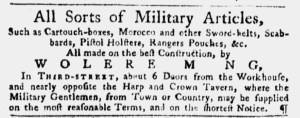
Pennsylvania Gazette (July 12, 1775).

“All Sorts of Military Articles.”

It was a sign of the times.  The headline for Wolere Ming’s advertisement in the July 12, 1775, edition of the Pennsylvania Gazette proclaimed, “All Sorts of Military Articles.”  The brief notice listed some of the items the merchant stocked, such as “Cartouch-boxes [for carrying cartridges], Morocco and other Sword-belts, Scabbards, Pistol Holsters, [and] Rangers Pouches.”  Hostilities had commenced with the battles of Lexington and Concord less than three months earlier, followed by the siege of Boston and the Battle of Bunker Hill.  The Second Continental Congress convened in Philadelphia, appointed George Washington of Virginia as commander of the Continent Army, and dispatched him to Massachusetts.  Colonizers in New England, New York, Pennsylvania, and elsewhere mobilized as they followed the news, some of them heading to Massachusetts to lend their support and others preparing to defend their communities.

Responding to current events meant new opportunities for colonial entrepreneurs.  For instance, Charles Oliver Bruff, a goldsmith and jeweler in New York, advised “gentlemen who are forming themselves into companies in defence of their liberties” that they could purchase swords of various sorts at this shop in May 1775.  In Philadelphia, those seeking to outfit themselves for military service could do so very well at Ming’s shop “nearly opposite the Harp and Crown Tavern” where they selected among items “made on the best Construction” available “on the shortest Notice.”  Ming addressed a particular kind of consumer, the “Military Gentlemen, from Town or Country,” as he sought to leverage current events to establish revenue streams.  The headline for his advertisement played an important role in attracting the attention of prospective customers, especially considering that most newspaper advertisements did not have headlines of any sort.  Only one other in the issue of the Pennsylvania Gazette that carried Ming’s advertisement featured a headline that mentioned goods offered for sale, Thomas McGlathry’s notice for “IRISH LINENS, of various Prices.”  Merchants and shopkeepers who had been restrained by the Continental Association, a nonimportation agreement, since December 1774 now faced new circumstances that they could make work to their benefit if they shifted their marketing strategies accordingly.

Slavery Advertisements Published July 12, 1775

GUEST CURATORS: Penelope Batsarisakis, Maxinne Cardenas, Heidi Landaverde Serrano, and Lia McDonald

The Slavery Adverts 250 Project chronicles the role of newspaper advertising in perpetuating slavery in the era of the American Revolution. The project seeks to reveal the ubiquity of slavery in eighteenth-century life from New England to Georgia by republishing advertisements about enslaved people – for sale as individuals or in groups, wanted to purchase or for hire for short periods, runaways who liberated themselves, and those who were subsequently captured and confined in jails and workhouses – in daily digests on this site as well as in real time via the @SlaveAdverts250 Twitter feed, utilizing twenty-first-century media to stand in for the print media of the eighteenth century.

The project aims to provide modern audiences with a sense of just how often colonizers encountered these advertisements in their daily lives. Enslaved men, women, and children appeared in print somewhere in the colonies almost every single day. Those advertisements served as a constant backdrop for social, cultural, economic, and political life in colonial and revolutionary America. Colonizers who did not purport to own enslaved people were still confronted with slavery as well as invited to maintain the system by purchasing enslaved men, women, and children or assisting in the capture of so-called “runaways” who sought to free themselves from bondage. The frequency of these newspaper advertisements suggests just how embedded slavery was in colonial and revolutionary American culture in everyday interactions beyond the printed page.

These advertisements also testify to the experiences of enslaved men, women, and children, though readers must consider that those experiences have been remediated through descriptions offered by enslavers rather than enslaved people themselves. Often unnamed in the advertisements, enslaved men, women, and children were not invisible or unimportant in early America.

These advertisements appeared in colonial American newspapers 250 years ago today.

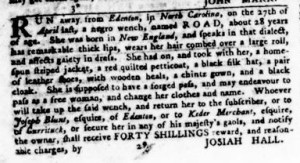
Pennsylvania Gazette (July 12, 1775).

**********

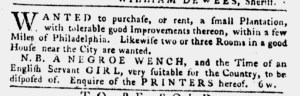
Pennsylvania Gazette (July 12, 1775).

**********

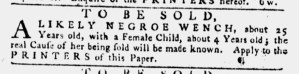
Pennsylvania Gazette (July 12, 1775).

**********

Pennsylvania Journal (July 12, 1775).

**********

Pennsylvania Journal (July 12, 1775).

July 11

What was advertised in a revolutionary American newspaper 250 years ago today?

Dunlap’s Maryland Gazette (July 11, 1774).

“It is hoped that all who wish to see the Manufactures of Great-Britain established in America will encourage this work.”

Robert Moore, a “Cabinet maker in Baltimore Town,” advertised paper hangings (or wallpaper) and “MOCK INDIA PICTURES” to decorate domestic interiors in a notice in Dunlap’s Maryland Gazette in July 1775.  He did not claim that he produced the paper hangings and pictures, only that he sold them.  The cabinetmaker likely aimed to diversity the revenue streams for his workshop.

Yet earning his livelihood was not Moore’s only purpose in hawking those items or promoting them in the public prints.  He also aimed to advance the American cause, doing his part in the commercial realm as readers in Maryland continued to receive news about military encounters, especially the battles at Lexington and Concord, the siege of Boston, and the Battle of Bunker Hill, and the Second Continental Congress and provincial congresses throughout the colonies coordinated responses as the imperial crisis became a war.  Both entrepreneurs and consumers had been using commerce as a means of resistance before the fighting commenced; Moore intended to continue following that strategy.  The Continental Association that the First Continental Congress devised in response to the Coercive Acts, called for boycotting imported goods and encouraging the production and consumption of alternatives made in the colonies.

Moore echoed that ideology in his advertisement.  He proclaimed that he paper hangings and pictures were “all entire the Manufacture of this Country.”  Perhaps he stocked paper hangings produced by Ryves and Fletcher at their “NEW AMERICAN MANUFACTORY” in Philadelphia and advertised in Dunlap’s Pennsylvania Packet.  Whatever the source, Moore emphasized that their quality (“great Perfection”) and price (“lower rates”) rivaled those imported from England.  Consumers did not have to make sacrifices to when they chose to put their political principles into action in the marketplace.  Furthermore, Moore asserted that consumers had a civic responsibility to purchase goods produced in the colonies: “It is hoped that all who wish to see the Manufactures of Great-Britain established in America will encourage this work.”  Even after the fighting commenced in New England, colonizers attempted to continue exerting pressure on Parliament through the choices they made as retailers and consumers.

Slavery Advertisements Published July 11, 1775

GUEST CURATORS: Penelope Batsarisakis, Maxinne Cardenas, Heidi Landaverde Serrano, and Lia McDonald

The Slavery Adverts 250 Project chronicles the role of newspaper advertising in perpetuating slavery in the era of the American Revolution. The project seeks to reveal the ubiquity of slavery in eighteenth-century life from New England to Georgia by republishing advertisements about enslaved people – for sale as individuals or in groups, wanted to purchase or for hire for short periods, runaways who liberated themselves, and those who were subsequently captured and confined in jails and workhouses – in daily digests on this site as well as in real time via the @SlaveAdverts250 Twitter feed, utilizing twenty-first-century media to stand in for the print media of the eighteenth century.

The project aims to provide modern audiences with a sense of just how often colonizers encountered these advertisements in their daily lives. Enslaved men, women, and children appeared in print somewhere in the colonies almost every single day. Those advertisements served as a constant backdrop for social, cultural, economic, and political life in colonial and revolutionary America. Colonizers who did not purport to own enslaved people were still confronted with slavery as well as invited to maintain the system by purchasing enslaved men, women, and children or assisting in the capture of so-called “runaways” who sought to free themselves from bondage. The frequency of these newspaper advertisements suggests just how embedded slavery was in colonial and revolutionary American culture in everyday interactions beyond the printed page.

These advertisements also testify to the experiences of enslaved men, women, and children, though readers must consider that those experiences have been remediated through descriptions offered by enslavers rather than enslaved people themselves. Often unnamed in the advertisements, enslaved men, women, and children were not invisible or unimportant in early America.

These advertisements appeared in colonial American newspapers 250 years ago today.

Dunlap’s Maryland Gazette (July 11, 1775).

**********

South-Carolina Gazette and Country Journal (July 11, 1775).

**********

South-Carolina Gazette and Country Journal (July 11, 1775).

**********

South-Carolina Gazette and Country Journal (July 11, 1775).

**********

South-Carolina Gazette and Country Journal (July 11, 1775).

**********

South-Carolina Gazette and Country Journal (July 11, 1775).

**********

South-Carolina Gazette and Country Journal (July 11, 1775).

**********

South-Carolina Gazette and Country Journal (July 11, 1775).

July 10

What was advertised in a revolutionary American newspaper 250 years ago today?

New-York Gazette and Weekly Mercury (July 10, 1775).

“Children educated … at a distance from probable, sudden danger and confusion.”

In July 1775, Andrew Wilson, a schoolmaster in Morristown, New Jersey, attempted to leverage current events to enroll students in his school “about twenty-seven miles from Powles-Hook, and eighteen miles from Elizabeth-Town.”  In the late spring and early summer, colonizers in New York followed the news about the battles at Lexington and Concord, the siege of Boston, and the Battle of Bunker Hill.  In addition to updates from Massachusetts, they read and discussed actions taken by the Second Continental Congress, meeting in Philadelphia, and provincial congresses throughout the colonies.  While the fighting had been confined to Massachusetts so far, colonizers anticipated that it would spread.

In such an environment, Wilson saw an opportunity to market his school to parents and guardians in New York City and other coastal towns.  “IN these dangerous and alarming times,” he declared, “the inhabitants of large cities, and other places on the sea coast, may wish to have their children educated in the interior parts of the country, at a distance from probably, sudden danger and confusion.”  He acknowledged that they likely weighed tuition and the quality of instruction against the prospects of danger, suggesting that they would send their children to such a school “if the expence was reasonable, and they could depend on the fitness of the teacher.”  Wilson confidently stated that he could alleviate both concerns.  He claimed that he “was recommended by Dr. Witherspoon, of New-Jersey College, and the Rev. Mr. Mason, in New-York.”  Furthermore, he had experience.  When he ran his advertisement in the July 10, 1775, edition of the New-York Gazette and Weekly Mercury, he had “taught [in Morristown] upwards of ten months, to the satisfaction of his employers.”  When it came to expenses, lodging and board amounted to “much less money than is generally given for the same in other places.”  His pupils did not reside at the school; instead, Wilson placed them in the homes of “good families.”  In addition, the schoolmaster described Morristown and a “healthy place” as well as an accessible one.  “[O]n three different days of the week,” he noted, “a stage goes from it to New-York.”

As resistance to imperial overreach became a revolution, the crafty schoolmaster portrayed Morristown, New Jersey, as a relatively safe place to send children to school.  Parents and guardians could remove their charges from danger while still attending to their education and development, alleviating at least some of the worry they experienced during uncertain times.