July 20

What was advertised in a revolutionary American newspaper 250 years ago today?
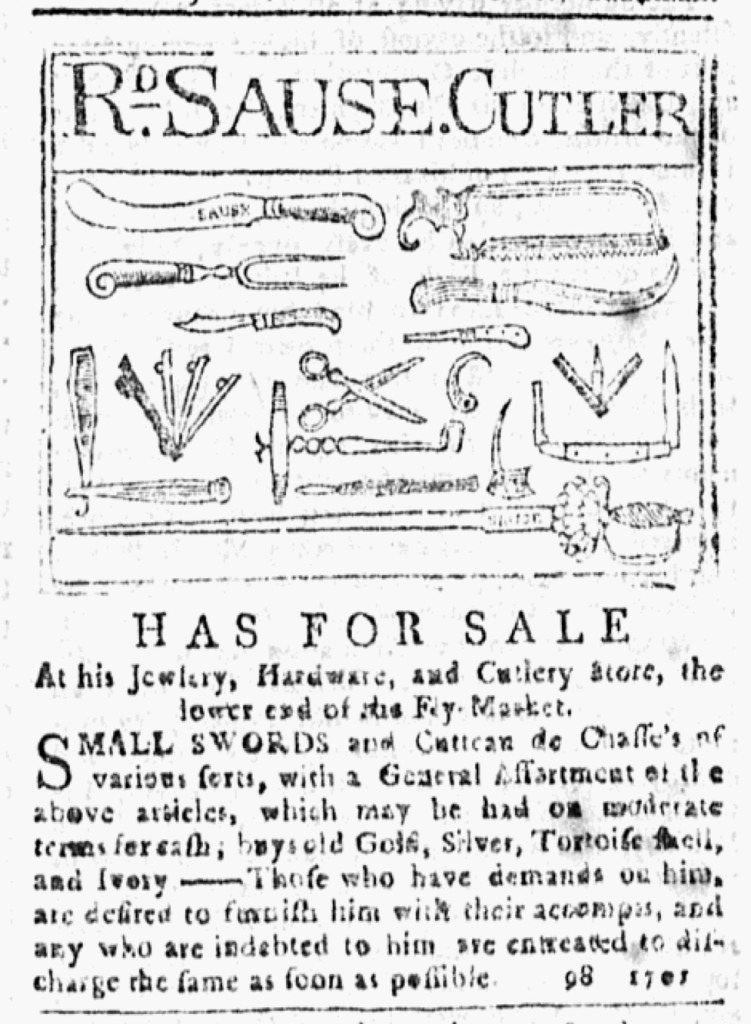
New-York Journal (July 20, 1775).

“SMALL SWORDS.”

Richard Sause resorted to a familiar image to adorn his advertisement in the July 20, 1775, edition of the New-York Journal.  It included his name and occupation, “RD. SAUSE. CUTLER,” and depictions of more than a dozen kinds of knives and other blades available at his “Jewlery, Hardware, and Cutlery Store.”  Some of the items, a table knife and a sword, even had his name on the blade, suggesting that Sause marked the items he made.  The image had periodically appeared in various newspapers published in New York since the early 1770s.  Personalized woodcuts, commissioned by advertisers, belonged to those advertisers to submit to printing offices as they saw fit.

In Sause’s previous advertisements, the woodcut accounted for a relatively small amount of space compared to the copy that Sause composed to promote his business.  This time, however, the image and the copy took up the same amount of space.  Sause noted that he sold “a General Assortment of the above articles,” perhaps referring to the “Jewelry, Hardware, and Cutlery” listed in the name of his store or perhaps referring to the many items in the woodcut.  In the copy, he highlighted only one sort of item: “SMALL SWORDS and Cutteau de Chasse’s of various sorts.”  (See Steve Rayner and Jim Mullins’s extensively researched “Cuttoe Knives: A Material Culture Study” for more on “a variety of short swords known as cutteau de Chasse.”  It includes an engraved trade card from 1739 for John Cargill, “Instrument Maker, at ye Saw & Crown in Lombard Street, London,” that featured an image of various blades and other instruments similar to Sause’s woodcut.)  It made sense that Sause emphasized swords in an advertisement placed in the summer of 1775.  Men in New York and other places prepared for the possibility that the fighting that began at Lexington and Concord in April and continued with the siege of Boston and the Battle of Bunkers Hill could occur in their own colonies.  They formed new companies to defend their liberties.  Merchants, shopkeepers, and artisans marketed military equipment while printers and booksellers published and sold military manuals.  Under those circumstances, Sause made a savvy decision to promote “SMALL SWORDS” in his advertisement.
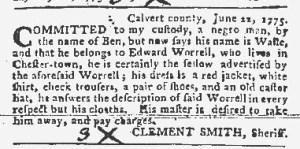
Slavery Advertisements Published July 20, 1775

GUEST CURATORS:  Jules Rizzitelli, Anna Shew, and Maddy Watt

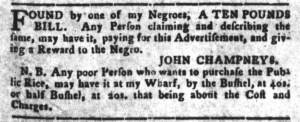
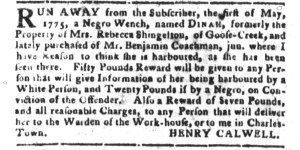
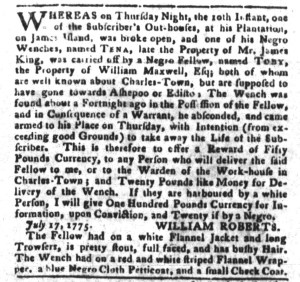
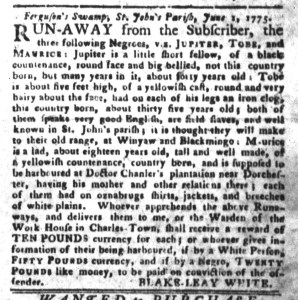
The Slavery Adverts 250 Project chronicles the role of newspaper advertising in perpetuating slavery in the era of the American Revolution. The project seeks to reveal the ubiquity of slavery in eighteenth-century life from New England to Georgia by republishing advertisements about enslaved people – for sale as individuals or in groups, wanted to purchase or for hire for short periods, runaways who liberated themselves, and those who were subsequently captured and confined in jails and workhouses – in daily digests on this site as well as in real time via the @SlaveAdverts250 Twitter feed, utilizing twenty-first-century media to stand in for the print media of the eighteenth century.

The project aims to provide modern audiences with a sense of just how often colonizers encountered these advertisements in their daily lives. Enslaved men, women, and children appeared in print somewhere in the colonies almost every single day. Those advertisements served as a constant backdrop for social, cultural, economic, and political life in colonial and revolutionary America. Colonizers who did not purport to own enslaved people were still confronted with slavery as well as invited to maintain the system by purchasing enslaved men, women, and children or assisting in the capture of so-called “runaways” who sought to free themselves from bondage. The frequency of these newspaper advertisements suggests just how embedded slavery was in colonial and revolutionary American culture in everyday interactions beyond the printed page.

These advertisements also testify to the experiences of enslaved men, women, and children, though readers must consider that those experiences have been remediated through descriptions offered by enslavers rather than enslaved people themselves. Often unnamed in the advertisements, enslaved men, women, and children were not invisible or unimportant in early America.

These advertisements appeared in colonial American newspapers 250 years ago today.

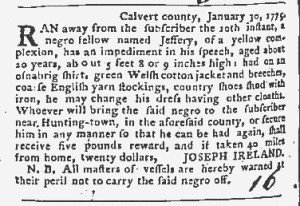
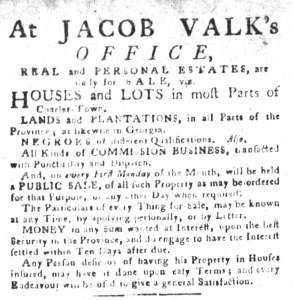
Maryland Gazette (July 20, 1775).

**********

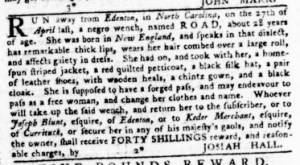
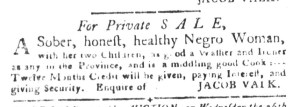
Maryland Gazette (July 20, 1775).

**********

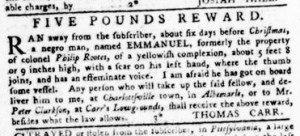
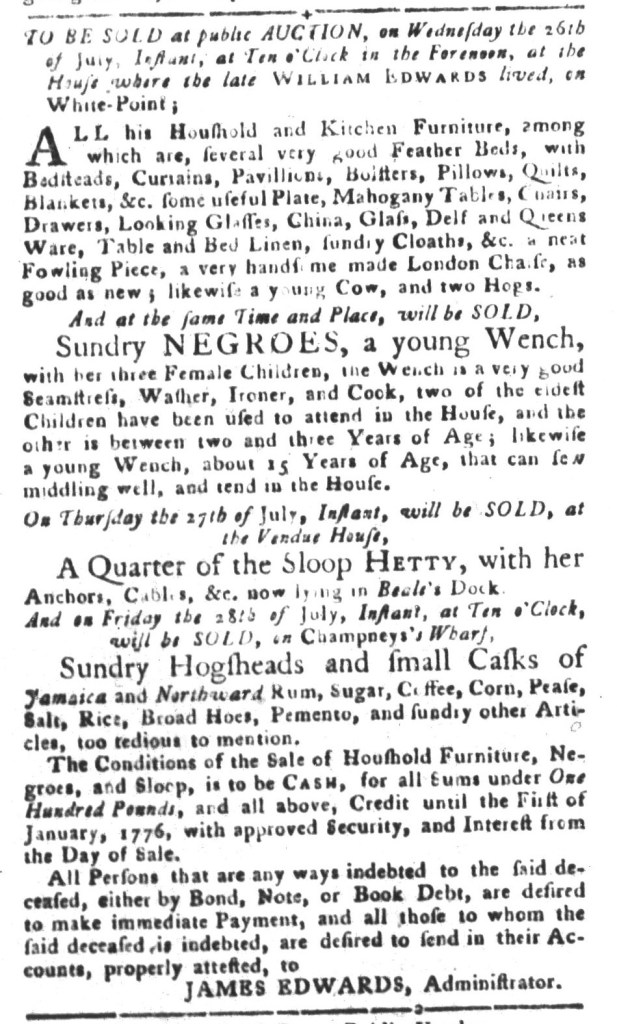
Maryland Gazette (July 20, 1775).

**********

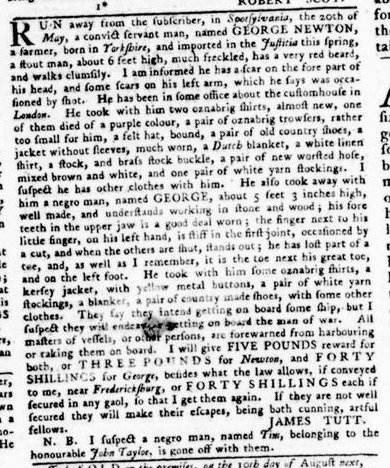
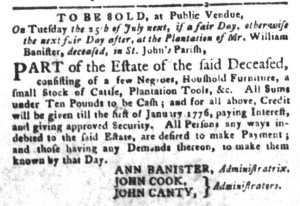
Virginia Gazette [Pinkney] (July 20, 1775).

**********

Virginia Gazette [Pinkney] (July 20, 1775).

**********

Virginia Gazette [Pinkney] (July 20, 1775).

**********

Virginia Gazette [Pinkney] (July 20, 1775).

July 19

What was advertised in a revolutionary American newspaper 250 years ago today?

Pennsylvania Journal (July 19, 1775).

“PROPOSALS, For printing … The PRUSSIAN EVOLUTIONS In actual Engagements.”

The July 19, 1775 editions of the Pennsylvania Gazette and the Pennsylvania Journal carried “PROPOSALS, For printing by SUBSCRIPTION, The PRUSSIAN EVOLUTIONS In actual Engagements” by Thomas Hanson.  A synopsis indicated that the book included “all the different Evolutions and Manoeuvres in firing standing, advancing and retreating, which were exhibited before his present Majesty, May 8, 1769, and before John Duke of Argyle … in 1771; with some additions since that time, explained with thirty folio copper-plates.”  Three bonus images accompanied by descriptions depicted surveying, fortifications, and a gun and mortar.

The advertisement noted that the proposals “were first published May 3, 1775, by THOMAS HANSON, Adjutant for the Second Battalion.”  That means that Hanson proposed and marketed the work very shortly after receiving news of the battles at Lexington and Concord.  Such projects, however, took time.  “It is expected,” Hanson stated, that the “said work will be completed in three or four weeks from this date” or sometime in the middle of August.  To entice readers to reserve copies in advance, Hanson also promised that the “Subscribers names will be inserted, and those that choose to subscribe must do it speedily, otherwise their names will not be in the book.”  Prospective subscribers had an opportunity to demonstrate their support for the American cause and appear in the company of fellow Patriots, just as genteel advocates for improvements in architecture had their names listed in a recently published American edition of Abraham Swan’s British Architect.

Several prominent residents of Philadelphia lent their support to the work by collecting subscriptions on behalf of Hanson, including “John Dickinson, Esq; Thomas Mifflin, Esq; Daniel Roberdeau, John Cox, jun.[,] Samuel Meredith, and John Wilcocks, Merchants,” Benjamin Towne, printer of the Pennsylvania Evening Post; William Hall, David Hall, and William Sellers, printers of the Pennsylvania Gazette; William Bradford and Thomas Bradford, printers of the Pennsylvania Journal; Robert Bell, printer and bookseller; and Thomas Nevell, “at the sign of the Carpenter’s-Hall” (who simultaneously collected subscriptions for The Gentleman and Cabinet-Maker’s Assistant and an American edition of Swan’s Collection of Designs in Architecture).

George Washington had already joined the ranks of the subscribers to Prussian Evolutions by the time Hanson’s proposals ran in the Pennsylvania Gazette and the Pennsylvania Journal on July 19.  According to historians at Mount Vernon, Washington purchased eight copies of Hanson’s manual, “one of the earliest for the instruction of American officers,” on May 20 and “likely distribute[d] the copies among militia officers and other key figures preparing for the growing conflict.  Indeed, “His Excellency George Washington” appeared among the “LIST OF SUBSCRIBERS NAMES” inserted immediately after the “DEDICATION, TO THE PRESERVERS of LIBERTY,” with a notation that he ordered eight copies.  Other subscribers included “The Honourable John Adams,” “The Honourable Benjamin Franklin,” “The Hon. John Hancock,” “His Excellency Richard Henry Lee,” “The Hon. Peyton Randolph,” and “His Excellency Philip Schuyler.”  Washington was not alone in subscribing for multiple copies.  Captain Moore Furman subscribed for five, Lieutenant Colonel Abraham Hunt for six, Captain Joseph Moulder for two, Lieutenant John Patton for two, and Colonel Daniel Roberdeau for four.  The “Merchants” who collected subscriptions also appeared on the list, identified by their military ranks: “Col. John Dickinson, Esq,” “Quarter Master General, Thomas Mifflin,” “Major, John Cox,” “Major, Samuel Meridith,” and “Capt. John Wilcocks.”  Subscribers certainly found themselves in good company!

Slavery Advertisements Published July 19, 1775

GUEST CURATORS:  Ina Bechle, Stella Cullity, and Eva LaPorte

The Slavery Adverts 250 Project chronicles the role of newspaper advertising in perpetuating slavery in the era of the American Revolution. The project seeks to reveal the ubiquity of slavery in eighteenth-century life from New England to Georgia by republishing advertisements about enslaved people – for sale as individuals or in groups, wanted to purchase or for hire for short periods, runaways who liberated themselves, and those who were subsequently captured and confined in jails and workhouses – in daily digests on this site as well as in real time via the @SlaveAdverts250 Twitter feed, utilizing twenty-first-century media to stand in for the print media of the eighteenth century.

The project aims to provide modern audiences with a sense of just how often colonizers encountered these advertisements in their daily lives. Enslaved men, women, and children appeared in print somewhere in the colonies almost every single day. Those advertisements served as a constant backdrop for social, cultural, economic, and political life in colonial and revolutionary America. Colonizers who did not purport to own enslaved people were still confronted with slavery as well as invited to maintain the system by purchasing enslaved men, women, and children or assisting in the capture of so-called “runaways” who sought to free themselves from bondage. The frequency of these newspaper advertisements suggests just how embedded slavery was in colonial and revolutionary American culture in everyday interactions beyond the printed page.

These advertisements also testify to the experiences of enslaved men, women, and children, though readers must consider that those experiences have been remediated through descriptions offered by enslavers rather than enslaved people themselves. Often unnamed in the advertisements, enslaved men, women, and children were not invisible or unimportant in early America.

These advertisements appeared in colonial American newspapers 250 years ago today.

Pennsylvania Gazette (July 19, 1775).

**********

Pennsylvania Gazette (July 19, 1775).

**********

Pennsylvania Gazette (July 19, 1775).

**********

Pennsylvania Gazette (July 19, 1775).

**********

Pennsylvania Gazette (July 19, 1775).

**********

Pennsylvania Journal (July 19, 1775).

**********

Pennsylvania Journal (July 19, 1775).

July 18

What was advertised in a revolutionary American newspaper 250 years ago today?

Pennsylvania Evening Post (July 18, 1775).

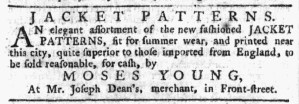
“JACKET PATTERNS … printed near this city, quite superior to those imported from England.”

Public discourse about the American Revolution resonated not only in the news and editorials that appeared in newspapers but also in the advertisements that ran in them.  In the July 18, 1775, edition of the Pennsylvania Journal, for instance, John Dean, a bookbinder, once again advertised the Philadelphia edition of A Self Defensive War Lawful, a sermon recently “preached at Lancaster, before Captain Ross’s company of militia” by John Carmichael.  The updated version of this advertisement indicated that four local printers and booksellers now stocked the sermon.  It also listed prices for single copies, a dozen, or a hundred, suggesting that Dean anticipated that retailers would purchase copies to sell or other customers would buy the sermon to distribute in their communities.

The advertisement immediately above the one for the sermon was also tied to the events of the American Revolution.  Moses Young announced that he sold “JACKET PATTERNS.”  He had an “elegant assortment of the new fashioned JACKET PATTERNS, fit for summer wear, and printed near this city.”  Young did not have to invoke the Continental Association, a nonimportation agreement devised by the First Continental Congress in response to the Coercive Acts, for readers to understand the implications of his assertion that the patterns were produced near Philadelphia.  In addition to prohibiting imported goods, the Continental Association called on colonizers to “encourage Frugality, Economy, and Industry; and promote Agriculture, Arts, and the Manufactures of this Country.”  Moses Young did just that … and he gave consumers a chance to do their part.  They could keep up with current trends and they could do so without sacrificing quality.  After all, Young described the patterns as both “new fashioned” and “quite superior to those imported from England.”  In addition, he sold them for a “reasonable” price.  As the siege of Boston continued in Massachusetts and the Second Continental Congress continued meeting in Philadelphia, Young’s marketing presented an opportunity for consumers to offer their support for the American cause through one of the decisions they made in the marketplace.

Slavery Advertisements Published July 18, 1775

GUEST CURATORS:  Ina Bechle, Stella Cullity, and Eva LaPorte

The Slavery Adverts 250 Project chronicles the role of newspaper advertising in perpetuating slavery in the era of the American Revolution. The project seeks to reveal the ubiquity of slavery in eighteenth-century life from New England to Georgia by republishing advertisements about enslaved people – for sale as individuals or in groups, wanted to purchase or for hire for short periods, runaways who liberated themselves, and those who were subsequently captured and confined in jails and workhouses – in daily digests on this site as well as in real time via the @SlaveAdverts250 Twitter feed, utilizing twenty-first-century media to stand in for the print media of the eighteenth century.

The project aims to provide modern audiences with a sense of just how often colonizers encountered these advertisements in their daily lives. Enslaved men, women, and children appeared in print somewhere in the colonies almost every single day. Those advertisements served as a constant backdrop for social, cultural, economic, and political life in colonial and revolutionary America. Colonizers who did not purport to own enslaved people were still confronted with slavery as well as invited to maintain the system by purchasing enslaved men, women, and children or assisting in the capture of so-called “runaways” who sought to free themselves from bondage. The frequency of these newspaper advertisements suggests just how embedded slavery was in colonial and revolutionary American culture in everyday interactions beyond the printed page.

These advertisements also testify to the experiences of enslaved men, women, and children, though readers must consider that those experiences have been remediated through descriptions offered by enslavers rather than enslaved people themselves. Often unnamed in the advertisements, enslaved men, women, and children were not invisible or unimportant in early America.

These advertisements appeared in colonial American newspapers 250 years ago today.

Dunlap’s Maryland Gazette (July 18, 1775).

**********

South-Carolina Gazette and Country Journal (July 18, 1775).

**********

South-Carolina Gazette and Country Journal (July 18, 1775).

**********

South-Carolina Gazette and Country Journal (July 18, 1775).

**********

South-Carolina Gazette and Country Journal (July 18, 1775).

**********

South-Carolina Gazette and Country Journal (July 18, 1775).

**********

South-Carolina Gazette and Country Journal (July 18, 1775).

**********

South-Carolina Gazette and Country Journal (July 18, 1775).

**********

South-Carolina Gazette and Country Journal (July 18, 1775).

**********

South-Carolina Gazette and Country Journal (July 18, 1775).

**********

South-Carolina Gazette and Country Journal (July 18, 1775).

**********

South-Carolina Gazette and Country Journal Extraordinary (July 18, 1775).

July 17

What was advertised in a revolutionary American newspaper 250 years ago today?

New-York Gazette and Weekly Mercury (July 17, 1775).

“I have not at any time, directly or indirectly, held any correspondence with General Gage.”

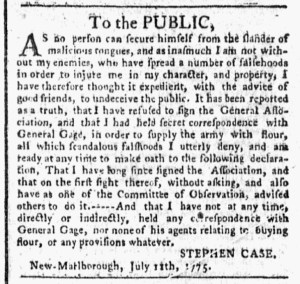
Stephen Case of New Marlborough, Massachusetts, needed to set the record straight.  To do so, he placed a notice “To the PUBLIC” in the July 17, 1775, edition of the New-York Gazette and Weekly Mercury.  The stakes were too high to let unsubstantiated rumors go unanswered.

“As no person can secure himself from the slander of malicious tongues, and as inasmuch I am not without my enemies, who have spread a number of falsehoods in order to injure me in my character, and property,” Case asserted, “I have therefore thought it expedient, with the advice of good friends, to undeceive the public.”  Even readers who had never heard of case likely found this introduction intriguing and wanted to learn more.  “It has been reported as a truth,” Case continued, “that I have refused to sign the General Association,” the nonimportation agreement devised by the First Continental Congress in response to the Coercive Acts.  Even worse, gossip spread that Case “held secret correspondence with General Gage, in order to supply the army with flour.”  Gage simultaneously served as governor of Massachusetts and commander of the British regulars involved in the battles at Lexington and Concord, the siege of Boston, and the Battle of Bunker Hill.  Such allegations against Case made him an enemy to the American cause and no doubt unpopular among many of his neighbors and associates.

Case strenuously objected.  He denied the “scandalous falshoods” and was “ready at any time to make oath” about them.  As far as the nonimportation agreement was concerned, he had “long since signed the Association, and [did so] on the first sight thereof, without asking” or prompting from others, “and also have as one of the Committee of Observation advised others to do it.”  When it came to the other accusations, Case proclaimed, “I have not at any time, directly or indirectly, held any correspondence with General Gage, nor none of his agents relating to buying flour, or any provisions whatever.”

To deliver this message “To the PUBLIC,” Case purchased advertising space in a newspaper that circulated in western Massachusetts.  The printer served as editor when it came to news items, letters, and other content, yet provided a forum for advertisers to publish their own news about current events.  Case attempted to take advantage of such access to the public prints to repair the damage to his reputation, but perhaps too much damage had been done.  Four months later he placed another advertisement in the New-York Gazette and Weekly Mercury (and the New-York Journal and Rivington’s New-York Gazetteer) that offered his farm in New Marlborough for sale or exchange “for a House in New-York.”  Case may have remained at odds with other residents of his town, despite the assertions he made in his first advertisement, and decided that he would be better off starting over somewhere else.  If so, it was the damage cause by rumors rather than the danger and destruction of battles that displaced him from his farm during the Revolutionary War.

Slavery Advertisements Published July 17, 1775

GUEST CURATORS:  Ina Bechle, Stella Cullity, and Eva LaPorte

The Slavery Adverts 250 Project chronicles the role of newspaper advertising in perpetuating slavery in the era of the American Revolution. The project seeks to reveal the ubiquity of slavery in eighteenth-century life from New England to Georgia by republishing advertisements about enslaved people – for sale as individuals or in groups, wanted to purchase or for hire for short periods, runaways who liberated themselves, and those who were subsequently captured and confined in jails and workhouses – in daily digests on this site as well as in real time via the @SlaveAdverts250 Twitter feed, utilizing twenty-first-century media to stand in for the print media of the eighteenth century.

The project aims to provide modern audiences with a sense of just how often colonizers encountered these advertisements in their daily lives. Enslaved men, women, and children appeared in print somewhere in the colonies almost every single day. Those advertisements served as a constant backdrop for social, cultural, economic, and political life in colonial and revolutionary America. Colonizers who did not purport to own enslaved people were still confronted with slavery as well as invited to maintain the system by purchasing enslaved men, women, and children or assisting in the capture of so-called “runaways” who sought to free themselves from bondage. The frequency of these newspaper advertisements suggests just how embedded slavery was in colonial and revolutionary American culture in everyday interactions beyond the printed page.

These advertisements also testify to the experiences of enslaved men, women, and children, though readers must consider that those experiences have been remediated through descriptions offered by enslavers rather than enslaved people themselves. Often unnamed in the advertisements, enslaved men, women, and children were not invisible or unimportant in early America.

These advertisements appeared in colonial American newspapers 250 years ago today.

Dunlap’s Pennsylvania Packet (July 17, 1775).

**********

Dunlap’s Pennsylvania Packet (July 17, 1775).

**********

Dunlap’s Pennsylvania Packet (July 17, 1775).

**********

New-York Gazette and Weekly Mercury (July 17, 1775).

**********

Norwich Packet (July 17, 1775).

July 16

What was advertised in a revolutionary American newspaper 250 years ago this week?

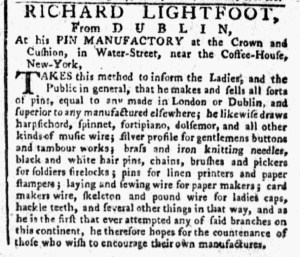
New-York Gazette and Weekly Mercury (July 10, 1775).

“He therefore hopes for the countenance of those who wish to encourage their own manufactures.”

In the summer of 1775, Richard Lightfoot placed a newspaper advertisement to promote his “PIN MANUFACTORY at the Crown and Cushion” in New York.  In addition to “all sorts of pins,” he also produced a variety of other wirework, including “harpsichord, spinnet, fortepiano, dolsemor, and all other kinds of music wire,” “brass and iron knitting needles,” “pins for linen printers and paper stampers,” and “laying and sewing wire for paper makers.”

Lightfoot addressed “the Ladies,” who presumably constituted a significant portion of his customers, yet also directed his advertisement to “the Public in general.”  After all, he had an interest in the entire community knowing about the work undertaken at his “PIN MANUFACTORY” and his contributions to the American cause through his participation in the marketplace.  Lightfoot proclaimed that “he is the first that ever attempted any of said branches,” the production of the various kinds of wirework, “on this continent.”  He did so at a time that colonizers observed the Continental Association, a nonimportation agreement devised by the First Continental Congress in response to the Coercive Acts.  That pact called for encouraging “Industry” and “the Manufactures of this Country” as alternatives to imported goods.  Under those circumstances, Lightfoot hoped “for the countenance of those who wish to encourage their own manufactures.”  That meant that “the Public in general” should support his enterprise by recommending it to “the Ladies” who purchased and used the pins and other items he made.

When they did so, they could depend on the quality of those products.  Lightfoot asserted that his pins were “equal to any made in London or Dublin, and superior to any manufactured elsewhere.”  He was qualified to make that claim, indicating that he was “From DUBLIN” and likely learned and practiced his trade there before migrating to New York.  Claiming that authority, Lightfoot assured prospective customers that they did not sacrifice quality when they applied their political principles to their decisions about which pins to purchase.  It did not matter that the Continental Association prohibited buying imported pins because Lightfoot made and sold pins that were just as good as (or even better than) pins produced elsewhere!

July 15

What was advertised in a revolutionary American newspaper 250 years ago today?

Pennsylvania Evening Post (July 15, 1775).

“I am not unfriendly to the present measures pursued by the friends to American liberty, but do heartily approve of them.”

Amos Wickersham had to do something to remedy the error he made.  He hoped that placing a newspaper advertisement to apologize and pledging to do better would help return him to the good graces of his community.  In a notice in the July 15, 1775, edition of the Pennsylvania Evening Post, he acknowledged that he had “frequently made use of rash and imprudent expressions, with respect to the conduct of my worthy fellow citizens, who are now engaged in a noble and patriotic struggle against the arbitrary measures of the British ministry.”  He did so three months after the battles at Lexington and Concord.  Since then, supporters of the American cause from Massachusetts and other colonies in New England had laid siege to Boston and Joseph Warren, one of their leaders, had been killed at the Battle of Bunker Hill.  The Second Continental Congress had convened in Philadelphia and appointed George Washington of Virginia as commander of the Continental Army.  As news of these events spread, provincial congresses met to determine how their colonies should respond to the outbreak of war.

Facing these new developments, Wickersham tried to distance himself from his previous comments, stating that he made them “some time since,” yet also admitted that the conduct “of the British ministry … has justly raised [the] resentments” of his “worthy fellow citizens” against him.  He may have had a sincere change of heart … or he may have found his circumstances untenable as emotions became more enflamed.  Either way, he wanted the public to know that he had “acted extremely wrong in so doing, for which I am exceedingly sorry, and humbly ask pardon and forgiveness.”  That was a good start, but perhaps not sufficient.  Wickersham continued, “I do solemnly promise that, for the future, I will conduct myself in such a manner as to avoid giving any offence; and, at the same time, in justice to myself, must declare that I am not unfriendly to the present measures pursued by the friends to American liberty, but do heartily approve of them; and, as far as is in my power, will endeavour to promote them.”
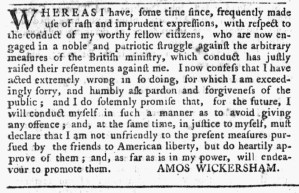
Wickersham’s advertisement resembled some that previously appeared in newspapers published in Massachusetts.  For the past year, men who signed an address to Governor Thomas Hutchinson when he departed the colony had been placing advertisements to recant, apologize, and assure others that they were friendly to the American cause.  More recently, others resorted to newspaper advertisements to acknowledge other kinds of words or deeds that raised suspicion about their political principles in their efforts to return to good standing in their communities.  Wickersham placed one of the first advertisements of this sort outside of New England.  Like his counterparts, he paid for space in the public prints to disseminate his confession and support for “the present measures pursued by the friends to American liberty.”  Wickersham apparently considered it a good investment if it restored his position and reputation among his neighbors and associates.