GUEST CURATORS: Penelope Batsarisakis, Maxinne Cardenas, Heidi Landaverde Serrano, and Lia McDonald
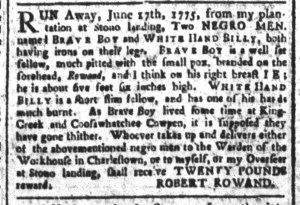
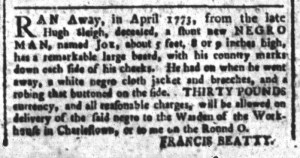
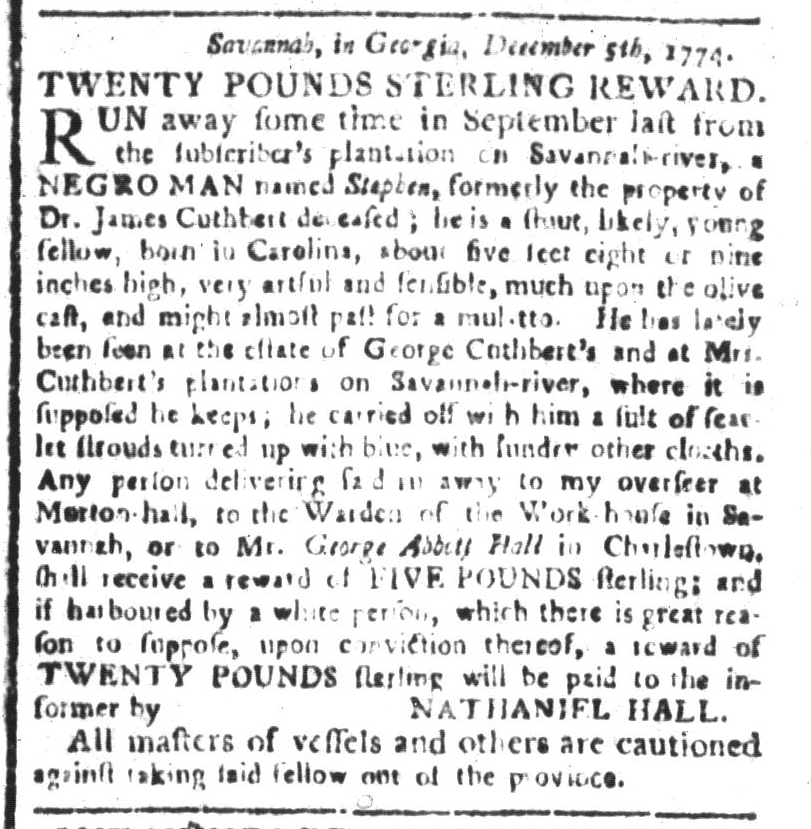
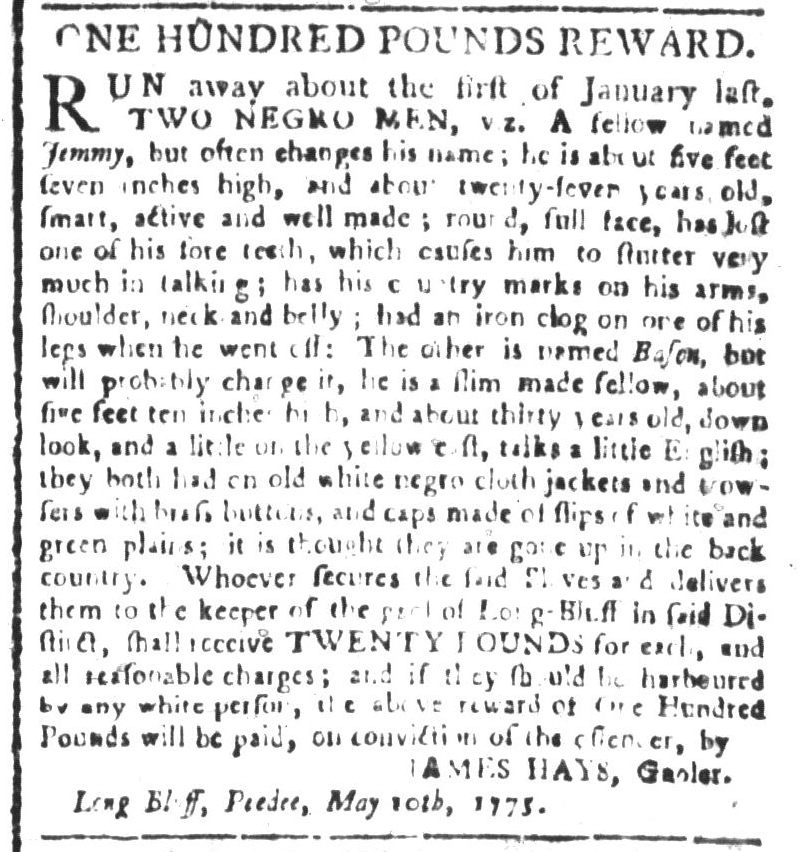
The Slavery Adverts 250 Project chronicles the role of newspaper advertising in perpetuating slavery in the era of the American Revolution. The project seeks to reveal the ubiquity of slavery in eighteenth-century life from New England to Georgia by republishing advertisements about enslaved people – for sale as individuals or in groups, wanted to purchase or for hire for short periods, runaways who liberated themselves, and those who were subsequently captured and confined in jails and workhouses – in daily digests on this site as well as in real time via the @SlaveAdverts250 Twitter feed, utilizing twenty-first-century media to stand in for the print media of the eighteenth century.
The project aims to provide modern audiences with a sense of just how often colonizers encountered these advertisements in their daily lives. Enslaved men, women, and children appeared in print somewhere in the colonies almost every single day. Those advertisements served as a constant backdrop for social, cultural, economic, and political life in colonial and revolutionary America. Colonizers who did not purport to own enslaved people were still confronted with slavery as well as invited to maintain the system by purchasing enslaved men, women, and children or assisting in the capture of so-called “runaways” who sought to free themselves from bondage. The frequency of these newspaper advertisements suggests just how embedded slavery was in colonial and revolutionary American culture in everyday interactions beyond the printed page.
These advertisements also testify to the experiences of enslaved men, women, and children, though readers must consider that those experiences have been remediated through descriptions offered by enslavers rather than enslaved people themselves. Often unnamed in the advertisements, enslaved men, women, and children were not invisible or unimportant in early America.
These advertisements appeared in colonial American newspapers 250 years ago today.
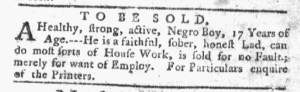
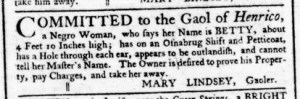
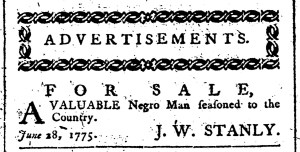
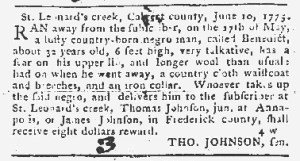
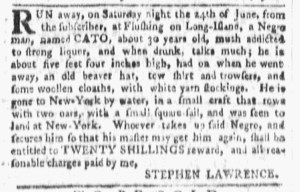
Dunlap’s Pennsylvania Packet (July 10, 1775).
**********
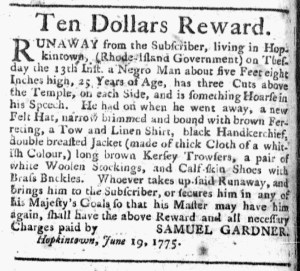
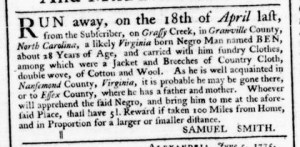
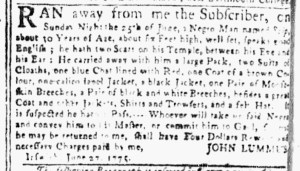
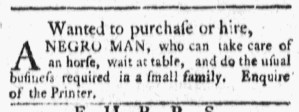
New-York Gazette and Weekly Mercury (July 10, 1775).
**********
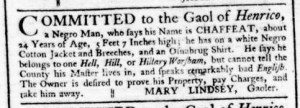
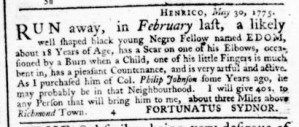
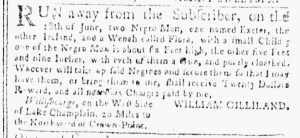
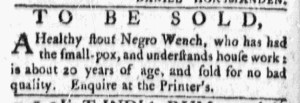
New-York Gazette and Weekly Mercury (July 10, 1775).
**********
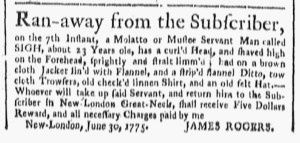
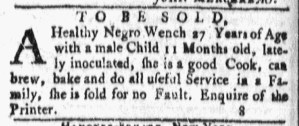
New-York Gazette and Weekly Mercury (July 10, 1775).
What was advertised in a revolutionary American newspaper 250 years ago today?
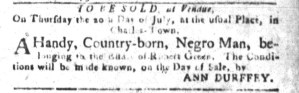
South-Carolina Gazette and Country Journal Extraordinary (July 9, 1775).
“SOAP and CANDLES as usual.”
It was an exceptionally rare Sunday edition that carried John Benfield’s advertisement for “RUM of all Sorts” and “SOAP and CANDLES as usual,” Ann Durffey’s advertisement offering an enslaved man for sale, and a handful of other advertisements. Charles Crouch usually published the South-Carolina Gazette and Country Journal on Tuesdays, but news of recent events merited a broadside extraordinary edition on Sunday, July 9.
Throughout the colonies, printers produced issues of their weekly newspapers on every day from Monday through Saturday, many of them choosing which day according to when postriders arrived with weekly newspapers from other towns. They allowed just enough time to select and reprint news updates, editorials, and letters about current events. None, however, published their weekly newspaper on Sundays. Some occasionally distributed supplements or postscripts at some point during the week, but not on Sundays. That made Crouch’s South-Carolina Gazette Extraordinary for “SUNDAY EVENING, June 9, 1775” truly extraordinary. The Adverts 250 Project has so far examined advertising from January 1, 1766, through July 9, 1775. I believe this is the first advertisement from a newspaper published on a Sunday included in the project in nearly a decade.
What prompted Crouch to rush to press with a broadside edition printed on only one side of the sheet? The Extraordinary included news of the Battle of Bunker Hill, including articles and letters that originated in Cambridge, Massachusetts; Newport, Rhode Island; and Philadelphia. The news filled two entire columns and spilled over into a second. A short update with borders composed of ornamental type to draw attention, ran just above the advertisements that accounted for half of the final column. Although the dateline, “CHARLES-TOWN, JULY 9,” suggested local news, it carried a grave update about recent events in Massachusetts. “LETTERS from Rhode-Island mention,” Crouch reported, “That there were only 1200 Provincials in the Engagement mentioned under the Cambridge Head, and near 5000 of the King’s Troops; and that the celebrated Dr. Jospeh Warren, was among the Slain of our Brethren” at the Battle of Bunker Hill. When Crouch decided to deliver that news as soon as he could after receiving it, he also disseminated advertisements that would not otherwise have circulated on a Sunday. Benfield advertised “SOAP and CANDLES as usual,” yet there was nothing usual about the Extraordinary that carried his advertisement.
South-Carolina Gazette and Country Journal Extraordinary (July 9, 1775).
GUEST CURATORS: Penelope Batsarisakis, Maxinne Cardenas, Heidi Landaverde Serrano, and Lia McDonald
The Slavery Adverts 250 Project chronicles the role of newspaper advertising in perpetuating slavery in the era of the American Revolution. The project seeks to reveal the ubiquity of slavery in eighteenth-century life from New England to Georgia by republishing advertisements about enslaved people – for sale as individuals or in groups, wanted to purchase or for hire for short periods, runaways who liberated themselves, and those who were subsequently captured and confined in jails and workhouses – in daily digests on this site as well as in real time via the @SlaveAdverts250 Twitter feed, utilizing twenty-first-century media to stand in for the print media of the eighteenth century.
The project aims to provide modern audiences with a sense of just how often colonizers encountered these advertisements in their daily lives. Enslaved men, women, and children appeared in print somewhere in the colonies almost every single day. Those advertisements served as a constant backdrop for social, cultural, economic, and political life in colonial and revolutionary America. Colonizers who did not purport to own enslaved people were still confronted with slavery as well as invited to maintain the system by purchasing enslaved men, women, and children or assisting in the capture of so-called “runaways” who sought to free themselves from bondage. The frequency of these newspaper advertisements suggests just how embedded slavery was in colonial and revolutionary American culture in everyday interactions beyond the printed page.
These advertisements also testify to the experiences of enslaved men, women, and children, though readers must consider that those experiences have been remediated through descriptions offered by enslavers rather than enslaved people themselves. Often unnamed in the advertisements, enslaved men, women, and children were not invisible or unimportant in early America.
These advertisements appeared in colonial American newspapers 250 years ago today.
South-Carolina and Country Journal Extraordinary (July 9, 1775).
What was advertised in a revolutionary American newspaper 250 years ago today?
Pennsylvania Evening Post (July 8, 1775).
“A SELF DEFENSIVE WAR lawful, Proved in a SERMON … before Captain Ross’s company of militia.”
An advertisement in the July 8, 1775, edition of the Pennsylvania Evening Post promoted a forthcoming pamphlet that would certainly be of interest to readers in Philadelphia and beyond. John Dean, a bookbinder who ran a shop in Laetitia Court, aimed to encourage anticipation for “A SELF DEFENSIVE WAR lawful, Proved in a SERMON … By the Rev. JOHN CARMICHAEL.” The pamphlet would soon be available for purchase since it was “in the press, and will be published in a few days.” The advertisement suggested that Dean collaborated with Carmichael on the project.
Dean gave more details about both the origins and the physical attributes of the pamphlet. Carmichael gave the sermon “at Lancaster, before Captain Ross’s company of militia, in the Presbyterian church on Sabbath morning, June 4th, 1775.” By then, word of the battles at Lexington and Concord and the siege of Boston had reached the town of Lancaster. One local militia company apparently appreciated the sermon so much that they wanted copies distributed more widely. Perhaps some thought that they would purchase their own copies to review at their leisure or even consult it as a means of better rehearsing Carmichael’s arguments and evidence when they needed to explain why they believed a “self defensive war” was indeed lawful. Francis Bailey, a printer in Lancaster, printed Carmichael’s sermon “for Captain Ross’s Company of Militia,” according to the imprint, and “at the request of said Company,” according to the subtitle. The new edition, printed in Philadelphia, was “published at the request of the Author, and corrected by himself from the copy printed at Lancaster.” In addition to being a more accurate rendering of the sermon, the Philadelphia edition would be “Printed on a good paper and type, octavo size.”
Dean and Carmichael envisioned a more extensive audience for the sermon than the Lancaster edition reached. The advertisement stated that it was “Humbly offered to the perusal of the MILITARY ASSOCIATORS of the city, liberties and county of Philadelphia.” The bookbinder-publisher and the author hoped to leverage patriotism and current events to sell more copies of the sermon, though they likely also wished to contribute to public discourse about whether military action was justified as the imperial crisis escalated and became a war. Carmichael’s dedication in the Lancaster edition highlighted another purpose: “TO all the brave SONS of LIBERTY in North-America, but in particular, to the Company of MILITIA in the Borough of Lancaster, known by the name of ROSS’S COMPANY.” The same dedication appeared in the Philadelphia edition, honoring all the “Officer and Soldiers” who defended American liberties throughout the colonies, especially the local men who did so.
GUEST CURATORS: Penelope Batsarisakis, Maxinne Cardenas, Heidi Landaverde Serrano, and Lia McDonald
The Slavery Adverts 250 Project chronicles the role of newspaper advertising in perpetuating slavery in the era of the American Revolution. The project seeks to reveal the ubiquity of slavery in eighteenth-century life from New England to Georgia by republishing advertisements about enslaved people – for sale as individuals or in groups, wanted to purchase or for hire for short periods, runaways who liberated themselves, and those who were subsequently captured and confined in jails and workhouses – in daily digests on this site as well as in real time via the @SlaveAdverts250 Twitter feed, utilizing twenty-first-century media to stand in for the print media of the eighteenth century.
The project aims to provide modern audiences with a sense of just how often colonizers encountered these advertisements in their daily lives. Enslaved men, women, and children appeared in print somewhere in the colonies almost every single day. Those advertisements served as a constant backdrop for social, cultural, economic, and political life in colonial and revolutionary America. Colonizers who did not purport to own enslaved people were still confronted with slavery as well as invited to maintain the system by purchasing enslaved men, women, and children or assisting in the capture of so-called “runaways” who sought to free themselves from bondage. The frequency of these newspaper advertisements suggests just how embedded slavery was in colonial and revolutionary American culture in everyday interactions beyond the printed page.
These advertisements also testify to the experiences of enslaved men, women, and children, though readers must consider that those experiences have been remediated through descriptions offered by enslavers rather than enslaved people themselves. Often unnamed in the advertisements, enslaved men, women, and children were not invisible or unimportant in early America.
These advertisements appeared in colonial American newspapers 250 years ago today.
What was advertised in a revolutionary American newspaper 250 years ago today?
North-Carolina Gazette (July 7, 1775).
“EXTRACTS from the Votes and Proceedings of the AMERICAN CONTINENTAL CONGRESS.”
When they perused the July 7, 1775, edition of the North-Carolina Gazette, readers encountered an advertisement that proclaimed, “JUST PUBLISHED, And to be sold at the Printing Office … EXTRACTS from the Votes and Proceedings of the AMERICAN CONTINENTAL CONGRESS, held at Philadelphia, on the Fifth Day of September, 1774.” The Extracts, however, were not “JUST PUBLISHED,” though James Davis certainly had them for sale at the printing office in New Bern. The Adverts 250 Project previously featured this advertisement’s appearance in the April 7, 1775, edition of the North-Carolina Gazette. Few issues of that newspaper survive, preventing a complete reconstruction of when the advertisement ran. Only seven issues, all from 1775, are available via America’s Historical Newspapers, the most comprehensive database of digitized eighteenth-century newspaper. Davis’s advertisement for the Extracts did not run on March 24, but appeared on April 7, May 5, and May 12. It was not in the June 30 issue, yet it returned for the July 7 and July 14 issues.
It is not clear how often the advertisement ran between May 12 and June 30, but Davis did not insert it in the issue immediately before the one that delivered several important updates that might have influenced him to believe that readers who had not yet purchased the Extracts would have increased interest in the “Bill of Rights, a List of Grievance, Occasional Resolves,” and “General Gage’s Answer to the Letter sent him by the General Congress.” The Extractsdocumented the meeting of the First Continental Congress in the fall of 1774. When the advertisement ran on July 7, 1775, the Second Continental Congress had been meeting for nearly two months. That issue included an update that “By Letters from the Congress of the 19th of June, we are informed, that Col. Washington, of Virginia, is appointed General and Commander in Chief of all the American Forces.” It also delivered news of the Battle of Bunker Hill, acknowledging that the account received in the printing office was “very imperfect, and must leave us in Suspence till a further Account of this most momentous Affair arrives.” Indeed, that “imperfect” account inaccurately claimed that “General Burgoyne fell … and was interred in Boston with great Funeral Pomp.” As he sorted through newspapers and letters arriving from the north, Davis apparently believed that the news he selected for publication would spark new interest in his remaining copies of the Extracts from the First Continental Congress.
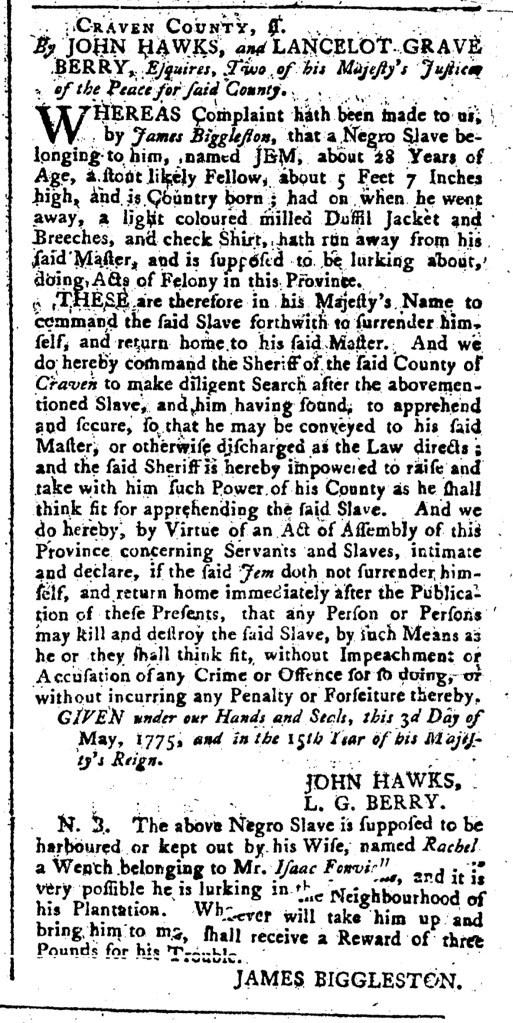
As had been the case in the April 7 edition, that advertisement ran alongside another that described an enslaved man who liberated himself by running away from his enslaver. In this instance, “a Negro Slave … named JEM,” was a fugitive from slavery who might have been “harboured or kept out by his Wife, named Rachel.” James Biggleston, Jem’s enslaver, suspected that Jem was “lurking in the Neighborhood” of the plantation where Rachel was enslaved. Biggleston offered a reward for the capture and return of Jem in a nota bene at the end of the advertisement, though the main body of the notice consisted of a warrant signed by “Two of his Majesty’s Justices of the Peace” that authorized that “if the said Jem doth not surrender himself, and return home immediately … that any Person or Persons may kill and destroy the said Slave … without Impeachment or Accusation of any Crime or Offence … or without incurring any Penalty.” Most readers of the North-Carolina Gazette and other newspapers compartmentalized the contents of those publications. They did so to such an extent that the juxtaposition of colonizers demanding freedom from oppression and enslaved people seeking liberty did not register as a contradiction.
GUEST CURATORS: Penelope Batsarisakis, Maxinne Cardenas, Heidi Landaverde Serrano, and Lia McDonald
The Slavery Adverts 250 Project chronicles the role of newspaper advertising in perpetuating slavery in the era of the American Revolution. The project seeks to reveal the ubiquity of slavery in eighteenth-century life from New England to Georgia by republishing advertisements about enslaved people – for sale as individuals or in groups, wanted to purchase or for hire for short periods, runaways who liberated themselves, and those who were subsequently captured and confined in jails and workhouses – in daily digests on this site as well as in real time via the @SlaveAdverts250 Twitter feed, utilizing twenty-first-century media to stand in for the print media of the eighteenth century.
The project aims to provide modern audiences with a sense of just how often colonizers encountered these advertisements in their daily lives. Enslaved men, women, and children appeared in print somewhere in the colonies almost every single day. Those advertisements served as a constant backdrop for social, cultural, economic, and political life in colonial and revolutionary America. Colonizers who did not purport to own enslaved people were still confronted with slavery as well as invited to maintain the system by purchasing enslaved men, women, and children or assisting in the capture of so-called “runaways” who sought to free themselves from bondage. The frequency of these newspaper advertisements suggests just how embedded slavery was in colonial and revolutionary American culture in everyday interactions beyond the printed page.
These advertisements also testify to the experiences of enslaved men, women, and children, though readers must consider that those experiences have been remediated through descriptions offered by enslavers rather than enslaved people themselves. Often unnamed in the advertisements, enslaved men, women, and children were not invisible or unimportant in early America.
These advertisements appeared in colonial American newspapers 250 years ago today.
Connecticut Gazette (July 7, 1775).
**********
North-Carolina Gazette (July 7, 1775).
**********
North-Carolina Gazette (July 7, 1775).
**********
South-Carolina and American General Gazette (July 7, 1775).
**********
South-Carolina and American General Gazette (July 7, 1775).
**********
South-Carolina and American General Gazette (July 7, 1775).
**********
South-Carolina and American General Gazette (July 7, 1775).
**********
South-Carolina and American General Gazette (July 7, 1775).
**********
South-Carolina and American General Gazette (July 7, 1775).
**********
South-Carolina and American General Gazette (July 7, 1775).
**********
South-Carolina and American General Gazette (July 7, 1775).
**********
South-Carolina and American General Gazette (July 7, 1775).
**********
South-Carolina and American General Gazette (July 7, 1775).
**********
South-Carolina and American General Gazette (July 7, 1775).
**********
South-Carolina and American General Gazette (July 7, 1775).
**********
South-Carolina and American General Gazette (July 7, 1775).
**********
South-Carolina and American General Gazette (July 7, 1775).
**********
South-Carolina and American General Gazette (July 7, 1775).
**********
Story and Humphreys’s Pennsylvania Mercury (July 7, 1775).
What was advertised in a revolutionary American newspaper 250 years ago today?
New-York Journal (July 6, 1775).
“Removed next door to the white corner house … a dial plate over the window.”
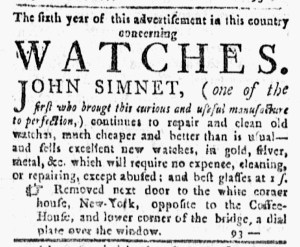
John Simnet, a cantankerous watchmaker who frequently advertised in New York’s newspapers in the early 1770s, once again took to the pages of the New-York Journal in the summer of 1775. In this notice, he announced that he “continues to repair and clean old watches … and sells new watches.” He took a neutral tone in that notice compared to the derogatory declarations he sometimes made about his competitors in other advertisements. Simnet did state that he cleaned and repaired watches “much cheaper and better than is usual,” comparing the price and quality of his services to those offered by other watchmakers, but he did not denounce any competitors by name or launch into a diatribe about the general incompetence of those who followed an occupation he often claimed as solely his own. He also described himself as “one of the first who brought this curious and useful manufacture to perfection,” but limited that comment to promoting his own work rather than denigrating other watchmakers.
Perhaps Simnet was more interested in drawing attention to his new location. He moved from a shop “at the Dial, next Beekman’s Slip, in Queen Street” to a shop “next door to the white corner house, New-York, opposite to the Coffee-House, and lower corner of the bridge.” Detailed directions were necessary. Neither New York nor any other town had standardized street numbers in the 1770s, though some of the largest port cities would begin assigning them by the end of the century. Sinnet resorted to landmarks to direct customers to his shop. Like many other entrepreneurs, he also marked his location with a device that represented his business, “a dial plate over the window.” It may have been the same “Dial” that had adorned his previous location. If Simnet did transfer the “dial plate” from one shop to another, he maintained a consistent visual image for customers and others to associate with his business. Other entrepreneurs who placed advertisements in the July 6, 1775, edition of the New-York Journal also used images to mark their locations, including James Wallace, a lacemaker and tailor “At the SIGN of the HOOD,” and William Pearson, a clock- and watchmaker “At the Dial, in HANOVER-SQUARE.” That a competitor displayed a dial made Simnet’s elaborate directions imperative. He did not want prospective customers stopping by another shop by mistake.
GUEST CURATORS: Penelope Batsarisakis, Maxinne Cardenas, Heidi Landaverde Serrano, and Lia McDonald
The Slavery Adverts 250 Project chronicles the role of newspaper advertising in perpetuating slavery in the era of the American Revolution. The project seeks to reveal the ubiquity of slavery in eighteenth-century life from New England to Georgia by republishing advertisements about enslaved people – for sale as individuals or in groups, wanted to purchase or for hire for short periods, runaways who liberated themselves, and those who were subsequently captured and confined in jails and workhouses – in daily digests on this site as well as in real time via the @SlaveAdverts250 Twitter feed, utilizing twenty-first-century media to stand in for the print media of the eighteenth century.
The project aims to provide modern audiences with a sense of just how often colonizers encountered these advertisements in their daily lives. Enslaved men, women, and children appeared in print somewhere in the colonies almost every single day. Those advertisements served as a constant backdrop for social, cultural, economic, and political life in colonial and revolutionary America. Colonizers who did not purport to own enslaved people were still confronted with slavery as well as invited to maintain the system by purchasing enslaved men, women, and children or assisting in the capture of so-called “runaways” who sought to free themselves from bondage. The frequency of these newspaper advertisements suggests just how embedded slavery was in colonial and revolutionary American culture in everyday interactions beyond the printed page.
These advertisements also testify to the experiences of enslaved men, women, and children, though readers must consider that those experiences have been remediated through descriptions offered by enslavers rather than enslaved people themselves. Often unnamed in the advertisements, enslaved men, women, and children were not invisible or unimportant in early America.
These advertisements appeared in colonial American newspapers 250 years ago today.
What was advertised in a revolutionary American newspaper 250 years ago today?
Massachusetts Spy (July 5, 1775).
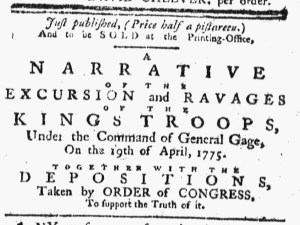
“A NARRATIVE OF THE EXCURSION and RAVAGES OF THE KINGS TROOPS, Under the Command of General Gage.”
I am fortunate to live just a few miles from the American Antiquarian Society in Worcester, Massachusetts. I pass the AAS on my way to campus, take students there to examine primary sources from the era of the American Revolution, and use its collections in my own research. Over the years that I have been in Worcester, I have become familiar with the stories that scholars and staff affiliated with the AAS most often tell about its founder, Isaiah Thomas. In recent months, I have used newspaper advertisements to retell some of those stories … and today I want to draw attention to an important detail that I have not heard highlighted nearly as often as the most treasured and repeated parts of the Thomas narrative.
This is a brief version of the story most often told: Thomas was an ardent Patriot whose editorial perspective in the Massachusetts Spy, the newspaper he printed in Boston so angered British officials that for his own safety he left Boston in April 1775, getting out just before the battles at Lexington and Concord and the siege of the city that followed. Thomas headed to Worcester, taking his press there and continuing to print the Massachusetts Spy in that town. It took a few weeks for him to acquire the paper necessary to print his newspaper, but when the first Worcester edition appeared on May 3, 1775, it included an account of the events at Lexington and Concord. Thomas famously signed the bottom of one copy: “This News-paper is the first Thing ever printed in Worcester – Isaiah Thomas.” (This story does not mention that Thomas previously announced plans to establish a printing office in Worcester and install a junior partner to print the town’s first newspaper or that when he left Boston he advertised that he would publish the next issue of the Massachusetts Spy in Worcester on May 3.) Thomas settled in Worcester. He collected as many books, pamphlets, newspapers, broadsides, and other items printed in America as he could to research and publish his History of Printing in America in 1810. Those items became the initial collections of the American Antiquarian Society, founded in Worcester in 1812. Thomas did not establish the library and learned society in Boston because he felt Worcester provided greater security as the new nation went to war with Great Britain for a second time.
That’s a great story, one that engages students, scholars, and visitors to the American Antiquarian Society … but there’s even more that, from my perspective, makes it an even better story about this Patriot printer and his contributions to the American cause. Two months after Thomas printed the first issue of the Massachusetts Spy in Worcester, the newspaper carried an advertisement for “A NARRATIVE OF THE EXCURSION and RAVAGES OF THE KINGS TROOPS, Under the Command of General Gage, On the 19th of April, 1775.” The book also included “DEPOSITIONS, Taken by ORDER of CONGRESS, To support the Truth of it.” Just as the first newspaper printed in the town featured an account of Lexington and Concord, so did the first book published there. Once again, Thomas made a notation on the product of his press: “First Book printed in Worcester.”[1] The imprint at the bottom of the title page stated, “WORCESTER, Printed by ISAIAH THOMAS, by order of the PROVINCIAL CONGRESS.” To underscore the point, Thomas printed the corresponding resolution on the verso of that page.[2] Thomas served as printer, even though other printers had offices closer to where the Massachusetts Provincial Congress met in Watertown. For instance, Samuel Hall and Ebenezer Hall relocated the Essex Gazette from Salem to Cambridge and renamed it the New-England Chronicle. Benjamin Edes, another prominent Patriot printer, moved to Watertown and printed the Boston-Gazette there.
When Thomas printed A Narrative of the Excursion and Ravages of the King’s Troops and marketed it in the Massachusetts Spy, Patriots fought a war on many fronts. In addition to the battles at Lexington, Concord, and Bunker Hill, they waged a war of information. Thomas worked to establish and expand a communications infrastructure to collect and disseminate news from Boston and its environs, the Continental Congress meeting in Philadelphia, and throughout the colonies and beyond. Yet he competed with misinformation and British officials and Tories who had different perspectives and relayed different versions of recent events and their causes. That made it even more important to supplement newspaper coverage of the outbreak of hostilities at Lexington and Concord, sometimes confused and contradictory, with “the Truth of it,” not just as presented by a Patriot printer but supported by “DEPOSITIONS, Taken by ORDER of CONGRESS.” Thomas played an important role in establishing the narrative of what occurred on April 19, 1775.