The Slavery Adverts 250 Project chronicles the role of newspaper advertising in perpetuating slavery in the era of the American Revolution. The project seeks to reveal the ubiquity of slavery in eighteenth-century life from New England to Georgia by republishing advertisements about enslaved people – for sale as individuals or in groups, wanted to purchase or for hire for short periods, runaways who liberated themselves, and those who were subsequently captured and confined in jails and workhouses – in daily digests on this site as well as in real time via the @SlaveAdverts250 Twitter feed, utilizing twenty-first-century media to stand in for the print media of the eighteenth century.
The project aims to provide modern audiences with a sense of just how often colonizers encountered these advertisements in their daily lives. Enslaved men, women, and children appeared in print somewhere in the colonies almost every single day. Those advertisements served as a constant backdrop for social, cultural, economic, and political life in colonial and revolutionary America. Colonizers who did not purport to own enslaved people were still confronted with slavery as well as invited to maintain the system by purchasing enslaved men, women, and children or assisting in the capture of so-called “runaways” who sought to free themselves from bondage. The frequency of these newspaper advertisements suggests just how embedded slavery was in colonial and revolutionary American culture in everyday interactions beyond the printed page.
These advertisements also testify to the experiences of enslaved men, women, and children, though readers must consider that those experiences have been remediated through descriptions offered by enslavers rather than enslaved people themselves. Often unnamed in the advertisements, enslaved men, women, and children were not invisible or unimportant in early America.
These advertisements appeared in colonial American newspapers 250 years ago today.
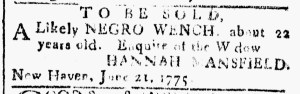
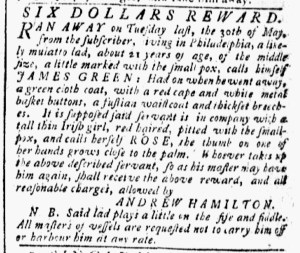
Connecticut Journal (July 5, 1775).
**********
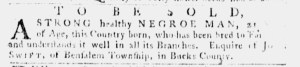
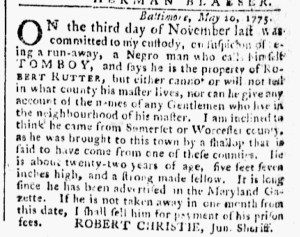
Pennsylvania Gazette (July 5, 1775).
**********
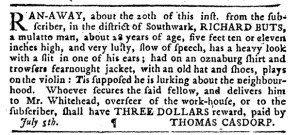
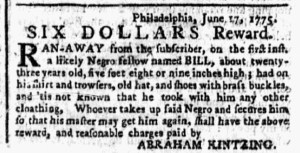
Pennsylvania Gazette (July 5, 1775).
**********
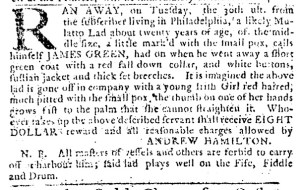
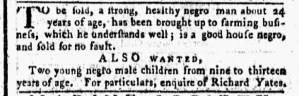
Pennsylvania Journal (July 5, 1775).
**********
Supplement to the Pennsylvania Journal (July 5, 1775).
**********
Supplement to the Pennsylvania Journal (July 5, 1775).
Who was the subject of an advertisement in a revolutionary American newspaper 250 years ago today?
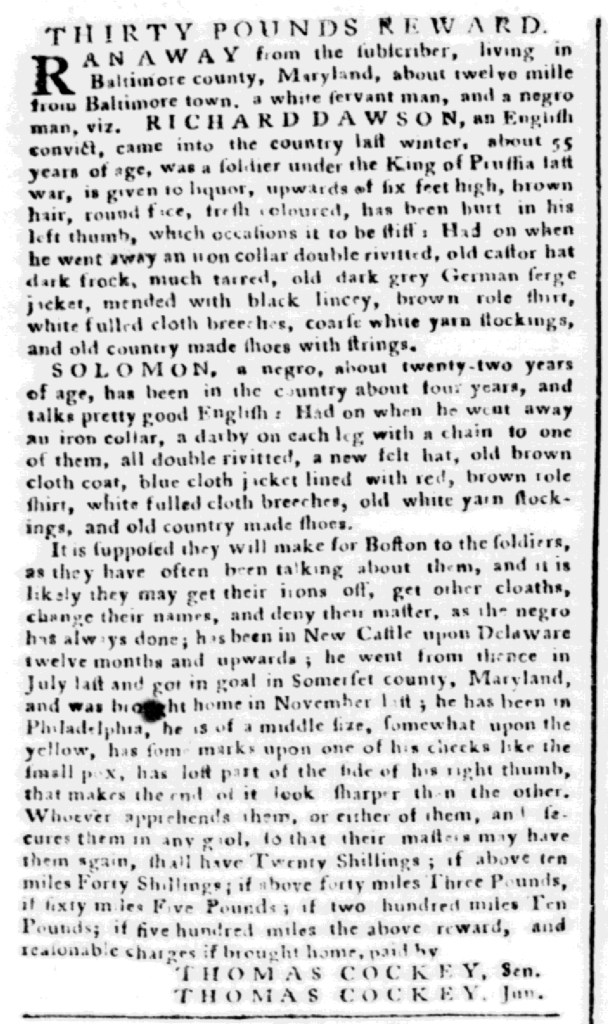
Dunlap’s Maryland Gazette (July 4, 1775). NB: The compositor mistakenly updated the masthead to “TUESDAY, JULY 3, 1775,” instead of “TUESDAY, JULY 4, 1775.”
“SOLOMON, a negro, … will make for Boston to the soldiers.”
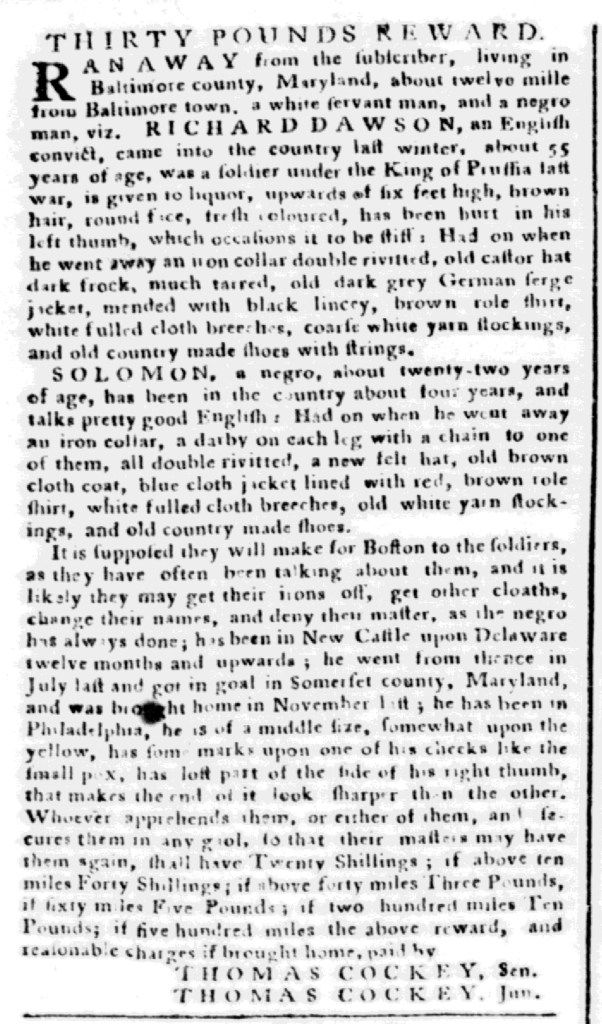
They made their escape together. Solomon, an enslaved man, and Richard Dawson, a “white servant man” and “an English convict,” ran away from Thomas Cockey, Sr., and Thomas Cockey, Jr., in Baltimore County in the spring of 1775. Their advertisement describing Solomon and Dawson first appeared in the May 16, 1775, edition of Dunlap’s Maryland Gazette. The two men apparently eluded capture because the notice ran regularly for the next several months, including in the July 4 edition.
When they departed, both Solomon and Dawson had an “iron collar double rivetted.” Solomon had also been outfitted with “a darby” or fetters “on each leg with a chain to one of them,” probably because the Cockeys correctly considered him likely to attempt to liberate himself. He did, after all, have a history of making a break for freedom. According to the Cockeys, Solomon previously made it to New Castle in Delaware, remaining there for “twelve months and upwards,” but then in July 1774 went to Somerset County, Maryland. There he was captured, jailed, and “brought home in November.” Within months, he became a fugitive seeking freedom once again. The Cockeys believed that Solomon “has been in Philadelphia.”
Solomon was a young man, “about twenty-two years of age,” who had been in the colonies “about four years.” Dawson, in contrast, was older, “about 55 years of age.” He had served as a soldier “under the King of Prussia [during the] last war.” The Cockeys did not indicate which crimes Dawson committed to merit punishment as a convict servant transported to America. They did speculate that Solomon and Dawson “will make for Boston to the soldiers, as they have often been talking about them,” though they did not reveal the particulars of what the enslaved man and the former soldier had to say about the British troops or when their conversations first occurred. Had they taken place after learning of the battles at Lexington and Concord? Did Dawson think that British soldiers might feel some sympathy for a former comrade? Did Solomon believe that regulars would shelter him from the colonizers who put him in bondage? Even if they did not hope for aid, Solomon and Dawson might have considered the upheaval in New England the best opportunity to avoid detection and capture. The Cockeys anticipated that both men would “get their irons off, get other cloaths [to disguise themselves], change their names, and deny their master.” Since Solomon “talks pretty good English” and evaded capture for so long during his previous attempt to liberate himself, he had likely learned to tell plausible stories.
Some advertisements about enslaved men and women who liberated themselves by running away from their enslavers during the era of the American Revolution suggested that they received assistance from enslaved relatives and friends. On occasion, other advertisements recorded enslaved people and unfree colonizers (indentured servants, convict servants, apprentices) working together. The role that the battles at Lexington and Concord and the siege of Boston played in Solomon’s decision to make common cause with Dawson cannot be determined from the narrative the Cockeys presented in their advertisement. What is clear, however, is that Solomon repeatedly made his own declarations of independence.
For other stories of enslaved people liberating themselves originally published on July 4 during the era of the American Revolution, see:
The Slavery Adverts 250 Project chronicles the role of newspaper advertising in perpetuating slavery in the era of the American Revolution. The project seeks to reveal the ubiquity of slavery in eighteenth-century life from New England to Georgia by republishing advertisements about enslaved people – for sale as individuals or in groups, wanted to purchase or for hire for short periods, runaways who liberated themselves, and those who were subsequently captured and confined in jails and workhouses – in daily digests on this site as well as in real time via the @SlaveAdverts250 Twitter feed, utilizing twenty-first-century media to stand in for the print media of the eighteenth century.
The project aims to provide modern audiences with a sense of just how often colonizers encountered these advertisements in their daily lives. Enslaved men, women, and children appeared in print somewhere in the colonies almost every single day. Those advertisements served as a constant backdrop for social, cultural, economic, and political life in colonial and revolutionary America. Colonizers who did not purport to own enslaved people were still confronted with slavery as well as invited to maintain the system by purchasing enslaved men, women, and children or assisting in the capture of so-called “runaways” who sought to free themselves from bondage. The frequency of these newspaper advertisements suggests just how embedded slavery was in colonial and revolutionary American culture in everyday interactions beyond the printed page.
These advertisements also testify to the experiences of enslaved men, women, and children, though readers must consider that those experiences have been remediated through descriptions offered by enslavers rather than enslaved people themselves. Often unnamed in the advertisements, enslaved men, women, and children were not invisible or unimportant in early America.
These advertisements appeared in colonial American newspapers 250 years ago today.
Dunlap’s Maryland Gazette (July 4, 1775).
**********
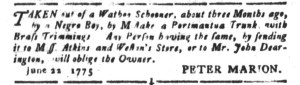
South-Carolina Gazette and Country Journal (July 4, 1775).
**********
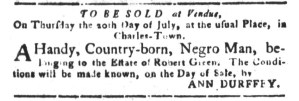
South-Carolina Gazette and Country Journal (July 4, 1775).
**********
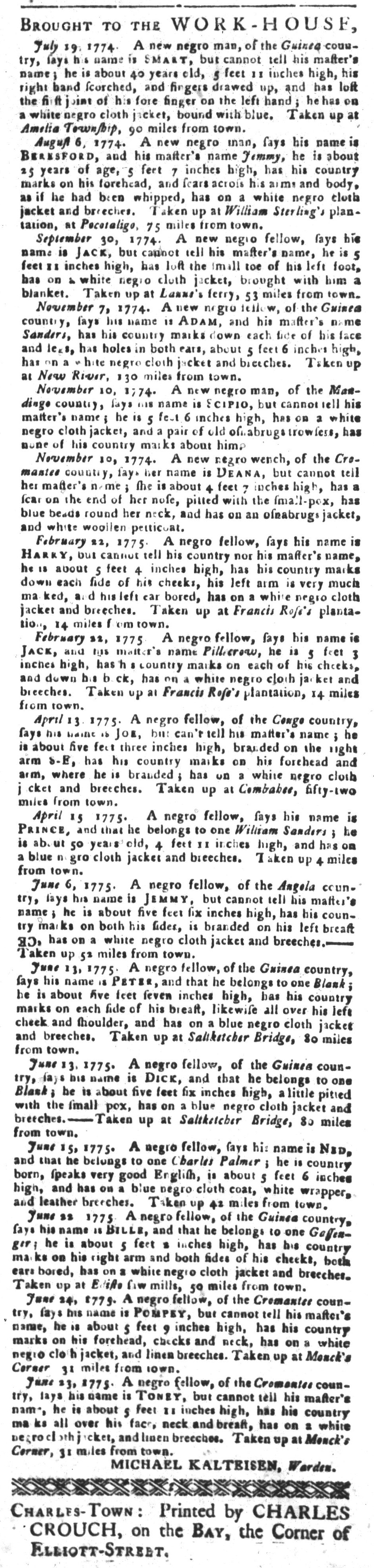
South-Carolina Gazette and Country Journal (July 4, 1775).
**********
South-Carolina Gazette and Country Journal (July 4, 1775).
**********
South-Carolina Gazette and Country Journal (July 4, 1775).
**********
South-Carolina Gazette and Country Journal (July 4, 1775).
**********
South-Carolina Gazette and Country Journal (July 4, 1775).
**********
South-Carolina Gazette and Country Journal (July 4, 1775).
**********
South-Carolina Gazette and Country Journal (July 4, 1775).
**********
South-Carolina Gazette and Country Journal (July 4, 1775).
**********
South-Carolina Gazette and Country Journal (July 4, 1775).
What was advertised in a revolutionary American newspaper 250 years ago today?
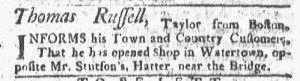
Boston-Gazette (July 3, 1775).
“Thomas Russell, Taylor from Boston … has opened Shop in Watertown.”
Benjamin Edes, a Patriot printer, moved the Boston-Gazette to Watertown following the battles at Lexington and Concord. He was not the only colonizer on the move during the siege of Boston at the beginning of the Revolutionary War. General Thomas Gage, the governor, and the Massachusetts Provincial Congress negotiated an agreement that allowed Loyalists to enter the city and Patriots and others to depart. Each could take whatever effects they could transport, except for firearms and ammunition. Many residents of Boston left the city for other towns and cities, some of them placing advertisements to introduce themselves to their new communities and announce their occupations to prospective clients and customers. In the late spring and summer of 1775, the description “from Boston” took on new meaning.
While some of those refugees headed to other colonies, Thomas Russell, a “Taylor from Boston,” moved only a short distance to Watertown. Upon arriving, he placed an advertisement in the Boston-Gazette to inform “his Town and Country Customers, That he has opened Shop in Watertown, opposite Mr. Stutson’s, Hatter, near the Bridge.” Although framed as an update for his current customers, Russell’s advertisement also signaled to all readers that he considered himself a “Steady Friend to America,” as Edes described a correspondent in the column to the left of the notice, rather than a Tory who embraced the protection of British regulars and supported the policies enacted by Parliament. Just above that piece, Edes relayed an account from New York about a colonizer taken into custody “who it is said had been privately inlisting men to serve under General Gage, against their country.” Russell, in contrast, had refused to remain in Boston and lend any kind of support to the general and his officers or the residents who approved of them. Instead, he hoped that his “Town” customers who had also departed the city would seek his services in Watertown. Similarly, he hoped that “Country Customers,” whether they previously hired him or not, would visit his shop.
The Slavery Adverts 250 Project chronicles the role of newspaper advertising in perpetuating slavery in the era of the American Revolution. The project seeks to reveal the ubiquity of slavery in eighteenth-century life from New England to Georgia by republishing advertisements about enslaved people – for sale as individuals or in groups, wanted to purchase or for hire for short periods, runaways who liberated themselves, and those who were subsequently captured and confined in jails and workhouses – in daily digests on this site as well as in real time via the @SlaveAdverts250 Twitter feed, utilizing twenty-first-century media to stand in for the print media of the eighteenth century.
The project aims to provide modern audiences with a sense of just how often colonizers encountered these advertisements in their daily lives. Enslaved men, women, and children appeared in print somewhere in the colonies almost every single day. Those advertisements served as a constant backdrop for social, cultural, economic, and political life in colonial and revolutionary America. Colonizers who did not purport to own enslaved people were still confronted with slavery as well as invited to maintain the system by purchasing enslaved men, women, and children or assisting in the capture of so-called “runaways” who sought to free themselves from bondage. The frequency of these newspaper advertisements suggests just how embedded slavery was in colonial and revolutionary American culture in everyday interactions beyond the printed page.
These advertisements also testify to the experiences of enslaved men, women, and children, though readers must consider that those experiences have been remediated through descriptions offered by enslavers rather than enslaved people themselves. Often unnamed in the advertisements, enslaved men, women, and children were not invisible or unimportant in early America.
These advertisements appeared in colonial American newspapers 250 years ago today.
Dunlap’s Pennsylvania Packet (July 3, 1775).
**********
Dunlap’s Pennsylvania Packet (July 3, 1775).
**********
Dunlap’s Pennsylvania Packet (July 3, 1775).
**********
Dunlap’s Pennsylvania Packet (July 3, 1775).
**********
New-York Gazette and Weekly Mercury (July 3, 1775).
**********
New-York Gazette and Weekly Mercury (July 3, 1775).
What was advertised in a revolutionary American newspaper 250 years ago this week?
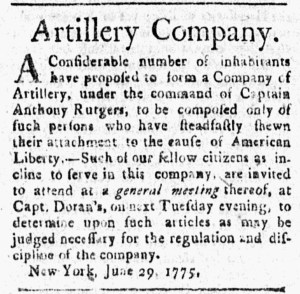
New-York Journal (June 29, 1775).
“Artillery Company.”
One advertisement in the June 29, 1775, edition of the New-York Journal seems to stand out from the others, at least to this reader perusing that issue 250 years later. The colonizers who placed the advertisement no doubt hoped that readers would take note and heed its call, intending that the headline, “Artillery Company,” would resonate differently with readers than the headlines for other notices that promoted goods and services, such as “FURRS,” “CLOCKS,” “WATCHES,” and “PUBLIC AUCTION.” This advertisement certainly served a different purpose once the imperial crisis boiled over into the battles at Lexington and Concord and the siege of Boston that followed. It may have seemed even more urgent and imperative appearing in the same issue as an “account of the engagement between the Provincials and Regulars on Saturday the 17th,” now known as the Battle of Bunker Hill.
That issue also featured an “Address of the Provincial Congress of the Colony of New-York. To his Excellency GEORGE WASHINGTON, Generalissimo of all the Forces raised, and to be raised, in the Confederated Colonies of America.” The advertisers sought to do their part in raising forces to defend against British troops. “[A]n atmosphere of patriotic fervor,” Alan C. Aimone and Eric I. Manders argue, “brought forth a spate of volunteer companies” in the spring and early summer of 1775, companies that “were to be the city’s independent militia.” Some volunteers had previous experience serving in the colonial militia. “A Considerable number of inhabitants have proposed to form a Company of Artillery, under the command of Captain Anthony Rutgers,” the advertisement reported. Aimone and Manders note, “Membership in the independent companies was restricted. All new volunteers were prosperous city men.”[1] The advertisement stated other qualifications. The ranks of this company would be limited to “only … such persons who have steadfastly shewn their attachment to the cause of American Liberty.” Accordingly, “Such of our fellow citizens as incline to serve in this company, are invited to attend at a general meeting … to determine upon such articles as may be judged necessary for the regulation and discipline of the company.” Several other independent companies had formed in the city by the time this advertisement appeared in the New-York Journal, yet updates about events unfolding in New England underscored the need to continue recruiting “fellow citizens” devoted “to the cause of American Liberty.”
**********
[1] Alan C. Aimone and Eric I. Manders, “A Note on New York City’s Independent Companies, 1775-1776,” New York History 63, no. 1 (January 1982): 59, 61.
What was advertised in a revolutionary American newspaper 250 years ago today?
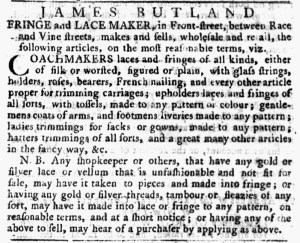
Pennsylvania Evening Post (July 1, 1775).
“Unfashionable [lace] … taken to pieces and made into fringe.”
In the summer of 1775, James Butland, a “FRINGE and LACE MAKER, in Front-street” in Philadelphia, placed a new advertisement in some of the city’s newspapers. A few months earlier, he assured “the public, that no advantage shall be taken on account of the troubles between Britain and America” and “he retails his goods cheaper than ever they were in this country before.” In other words, he did not raise his prices for the fringe and lace he made in Philadelphia once the Continental Association, a nonimportation agreement adopted in protest of the Coercive Acts, went into effect. In his new advertisement, he reminded readers that he “makes and sells … COACHMAKERS laces and fringes of all kinds … and every other article proper for trimming carriages; upholders [upholsterer’s] laces and fringes of all sorts, with tossels, made to any pattern or colour; … hatters trimmings of all sorts, and a great many other articles in the fancy way.”
In a nota bene that constituted a significant portion of this advertisement, Butland sought other business by proposing an eighteenth-century version of upcycling, the transformation of unwanted or undesirable items into fashionable new ones. “Any shopkeeper or others, that have any gold or silver lace or vellum that is unfashionable and not fit for sale,” he suggested,” may have it taken to pieces and made into fringe.” Furthermore, anyone “having gold or silver threads, tambour or sleazies of any sort, may have it made into lace or fringe to any pattern.” Tambour, according to the Oxford English Dictionary, could have referred to either a kind of fine gold or silver thread or a kind of embroidery that Butland deconstructed for the materials. Sleazies, a corruption of Silesia, referred to a kind of thin woven cloth originally from Silesia and used for making clothing in Britain and the colonies in the eighteenth century. Butland did this work “on reasonable terms, and at a short notice,” promoting both price and efficiency. Even if readers were not interested in incorporating upcycled fringe into their own wardrobes or décor, Butland still wanted any castoffs that they wished to sell to him. With the Continental Association still in place and the uncertainty about when trade with Britain might resume following the outbreak of hostilities in Massachusetts in April, Butland may have needed materials to continue his business.
The Slavery Adverts 250 Project chronicles the role of newspaper advertising in perpetuating slavery in the era of the American Revolution. The project seeks to reveal the ubiquity of slavery in eighteenth-century life from New England to Georgia by republishing advertisements about enslaved people – for sale as individuals or in groups, wanted to purchase or for hire for short periods, runaways who liberated themselves, and those who were subsequently captured and confined in jails and workhouses – in daily digests on this site as well as in real time via the @SlaveAdverts250 Twitter feed, utilizing twenty-first-century media to stand in for the print media of the eighteenth century.
The project aims to provide modern audiences with a sense of just how often colonizers encountered these advertisements in their daily lives. Enslaved men, women, and children appeared in print somewhere in the colonies almost every single day. Those advertisements served as a constant backdrop for social, cultural, economic, and political life in colonial and revolutionary America. Colonizers who did not purport to own enslaved people were still confronted with slavery as well as invited to maintain the system by purchasing enslaved men, women, and children or assisting in the capture of so-called “runaways” who sought to free themselves from bondage. The frequency of these newspaper advertisements suggests just how embedded slavery was in colonial and revolutionary American culture in everyday interactions beyond the printed page.
These advertisements also testify to the experiences of enslaved men, women, and children, though readers must consider that those experiences have been remediated through descriptions offered by enslavers rather than enslaved people themselves. Often unnamed in the advertisements, enslaved men, women, and children were not invisible or unimportant in early America.
These advertisements appeared in colonial American newspapers 250 years ago today.