October 20

What was advertised in a revolutionary American newspaper 250 years ago today?
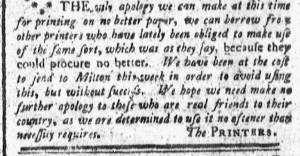
Essex Journal (October 20, 1775).

We hope we need make no further apology to those who are real friends to their country.”

John Mycall and Henry-Walter Tinges, the printers of the Essex Journal, found themselves in a situation similar to the one that Daniel Fowle, the printer of the New-Hampshire Gazette, experienced in the fall of 1775.  A disruption in Fowle’s supply of paper in Portsmouth had forced him to print his newspaper on smaller sheets on a few occasions, including the October 17 edition.  Three days later, Mycall and Tinges did the same in Newburyport.  Instead of four pages of three columns each, that issue had four pages of two columns each.  The masthead featured plain type for the title rather than presenting “Essex Journal” in the usual scrolling script.  The woodcuts that usually flanked the title, an Indigenous man with a bow and arrow on the left and a packet ship at sea on the right, did not appear at all.

Immediately above the advertisements, the printers inserted their own notice to explain what happened.  “THE only apology we can make at this time for printing on no better paper,” Mycall and Tinges stated, “we can borrow from other printers who have lately been obliged to make use of the same sort, which was as they say, because they could procure no better.”  They closely paraphrased portions of Fowle’s notice to his readers a couple of weeks earlier: “The only Apology the Publisher can make for this Day’s Paper, is that he could not procure any other.”  Mycall and Tinges printed their newspaper on different paper only as a last resort.  “We have been at the cost to send [an order for more paper] to Milton this week in order to avoid using this,” they informed readers, “but without success.”  With the disruptions and displacements that occurred in the six months since the battles at Lexington and Concord, securing paper became difficult.  The printers tried to get more from the paper mill on the Neponset River in Milton, but to no avail.  They expected their readers to understand, especially those who held the right sort of political principles.  “We hope we need make no further apology to those who are real friends to their country,” Mycall and Tinges proclaimed, “as we are determined to us [the substitute paper] no oftener than necessity requires.”  They hoped that readers would see the smaller newspaper as a minor inconvenience given the stakes of the contest between the colonies and Great Britain.  They did their best with the resources available to continue to disseminate news and advertising to their subscribers and other readers.
Slavery Advertisements Published October 20, 1775

GUEST CURATOR: Massimo Sgambati

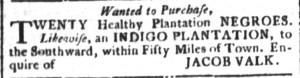
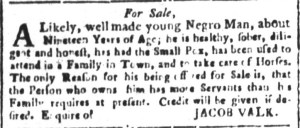
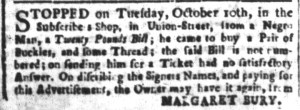
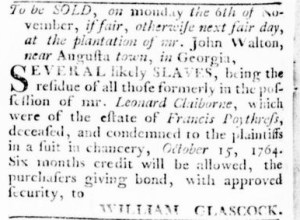
The Slavery Adverts 250 Project chronicles the role of newspaper advertising in perpetuating slavery in the era of the American Revolution. The project seeks to reveal the ubiquity of slavery in eighteenth-century life from New England to Georgia by republishing advertisements about enslaved people – for sale as individuals or in groups, wanted to purchase or for hire for short periods, runaways who liberated themselves, and those who were subsequently captured and confined in jails and workhouses – in daily digests on this site as well as in real time via the @SlaveAdverts250 Twitter feed, utilizing twenty-first-century media to stand in for the print media of the eighteenth century.

The project aims to provide modern audiences with a sense of just how often colonizers encountered these advertisements in their daily lives. Enslaved men, women, and children appeared in print somewhere in the colonies almost every single day. Those advertisements served as a constant backdrop for social, cultural, economic, and political life in colonial and revolutionary America. Colonizers who did not purport to own enslaved people were still confronted with slavery as well as invited to maintain the system by purchasing enslaved men, women, and children or assisting in the capture of so-called “runaways” who sought to free themselves from bondage. The frequency of these newspaper advertisements suggests just how embedded slavery was in colonial and revolutionary American culture in everyday interactions beyond the printed page.

These advertisements also testify to the experiences of enslaved men, women, and children, though readers must consider that those experiences have been remediated through descriptions offered by enslavers rather than enslaved people themselves. Often unnamed in the advertisements, enslaved men, women, and children were not invisible or unimportant in early America.

From compiling an archive of digitized eighteenth-century newspapers to identifying advertisements about enslaved men, women, and children in those newspapers to preparing images of each advertisement to posting this daily digest, Massimo Sgambati served as guest curator for this entry. He completed this work as part of the Summer Scholars Program, funded by a fellowship from the D’Amour College of Liberal Arts and Sciences at Assumption University in Worcester, Massachusetts, in Summer 2025.

These advertisements appeared in colonial American newspapers 250 years ago today.

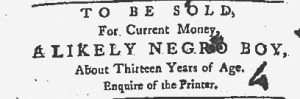
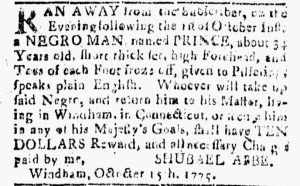
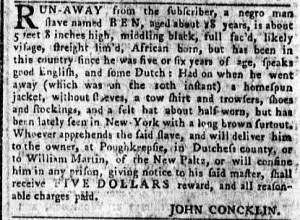
Connecticut Gazette (October 20, 1775)

**********

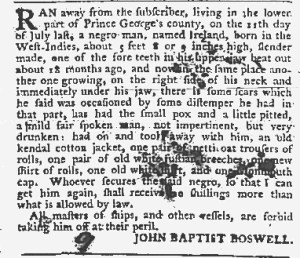
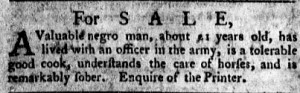
Essex Journal (October 20, 1775)

**********

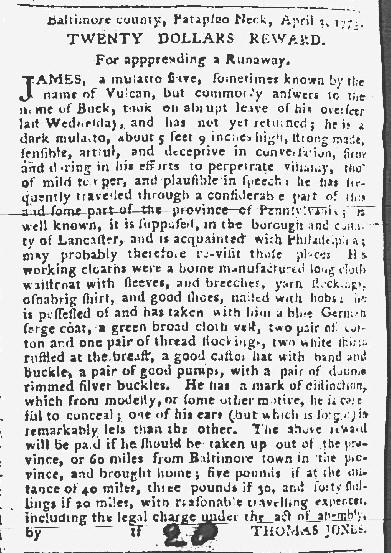
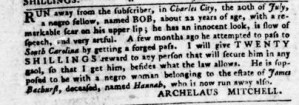
South-Carolina and American General Gazette (October 20, 1775)

**********

South-Carolina and American General Gazette (October 20, 1775)

**********

South-Carolina and American General Gazette (October 20, 1775)

**********

South-Carolina and American General Gazette (October 20, 1775)

**********

South-Carolina and American General Gazette (October 20, 1775)

**********

South-Carolina and American General Gazette (October 20, 1775)

**********

South-Carolina and American General Gazette (October 20, 1775)

**********

South-Carolina and American General Gazette (October 20, 1775)

**********

South-Carolina and American General Gazette (October 20, 1775)

**********

South-Carolina and American General Gazette (October 20, 1775)

**********

South-Carolina and American General Gazette (October 20, 1775)

**********

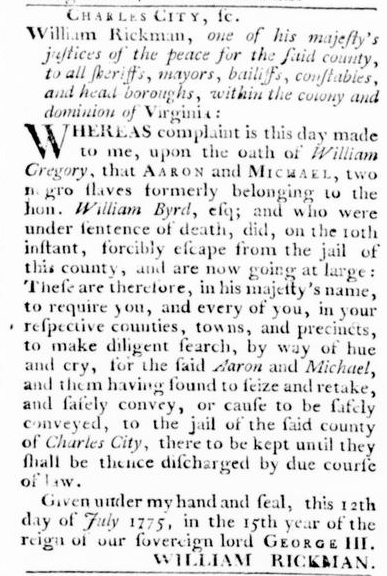
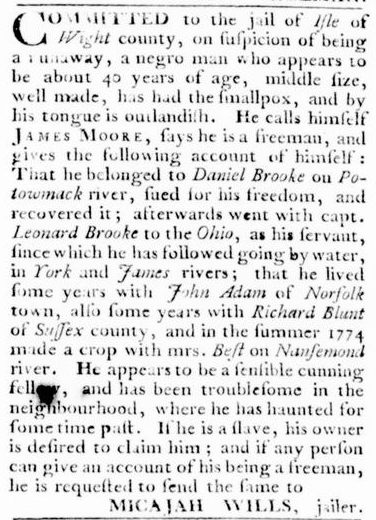
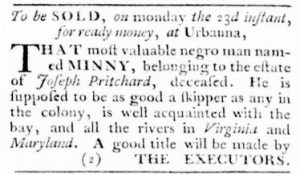
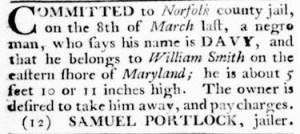
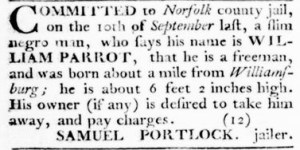
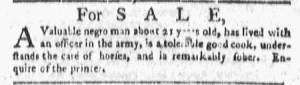
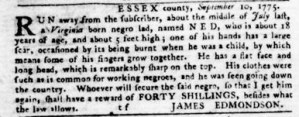
Virginia Gazette [Purdie] (October 20, 1775)

**********

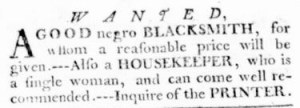
Virginia Gazette [Purdie] (October 20, 1775)

**********

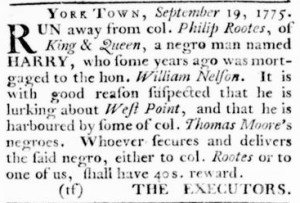
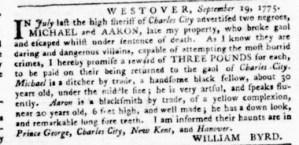
Virginia Gazette [Purdie] (October 20, 1775)

**********

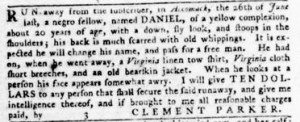
Virginia Gazette [Purdie] (October 20, 1775)

**********

Virginia Gazette [Purdie] (October 20, 1775)

**********

Virginia Gazette [Purdie] (October 20, 1775)

**********

Virginia Gazette [Purdie] (October 20, 1775)

**********

Virginia Gazette [Purdie] (October 20, 1775)

**********

Virginia Gazette [Purdie] (October 20, 1775)

**********

Virginia Gazette [Purdie] (October 20, 1775)

**********

Virginia Gazette [Purdie] (October 20, 1775)

**********

Virginia Gazette [Purdie] (October 20, 1775)

**********

Virginia Gazette [Purdie] (October 20, 1775)

October 19

What was advertised in a revolutionary American newspaper 250 years ago today?

Maryland Gazette (October 19, 1775).

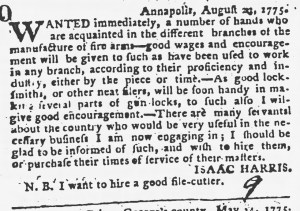
“WANTED immediately, a number of hands who are acquainted in the different branches of the manufacture of fire arms.”

In the late summer and early fall of 1775, Isaac Harris took to the pages of the Maryland Gazette with a call for “a number of hands who are acquainted in the different branches of the manufacture of fire arms.”  The timing of Harris’s advertisement, dated August 23, coincided with a new stage of the imperial crisis that started more than a decade earlier when Parliament attempted to regulate trade with the colonies following the conclusion of the Seven Years War.  The crisis had intensified at various moments, including passage of the Stamp Act in 1765 and imposition of duties on certain imported goods via the Townshend Acts in the late 1760s.  Events in Boston had often fueled the crisis, including the Boston Massacre in March 1770 and the destruction of tea by dumping it into the harbor in December 1773.  Parliament responded with the Coercive Acts, including the Boston Port Act and the Massachusetts Government Act, to punish the unruly Patriots, yet colonizers in other places believed that they could also be subject to similar treatment.

Yet only recently had hostilities commenced when Harris composed his advertisement and submitted it to the printing office in Annapolis.  News of the battles at Lexington and Concord in April 1775, the ensuing siege of Boston, the Battle of Bunker Hill in June 1775, and the appointment of George Washington as commander-in-chief of the Continental Army inspired colonizers to make preparations to defend their liberties.  Harris may have been among their ranks as he set about making firearms in Maryland.  He offered “good wages” to workers with experience in any aspect of producing firearms, paying them “according to their proficiency and industry, either by the piece or time.”  In addition, he thought that “good locksmiths, or other neat filers, will be soon handy in making several parts of gun locks.”  Colonizers with experience in other occupations could apply their skill to this endeavor.  Harris also sought indentured servants to join this enterprise, offering to hire them or “purchase their times of service [from] their masters.”  According to his advertisement, Harris planned to make a significant investment in acquiring the labor to support what he called “the necessary business” of making firearms.  Readers almost certainly made a connection between Harris’s plan to make firearms and the events that continued to unfold in Massachusetts.

Slavery Advertisements Published October 19, 1775

GUEST CURATOR: Massimo Sgambati

The Slavery Adverts 250 Project chronicles the role of newspaper advertising in perpetuating slavery in the era of the American Revolution. The project seeks to reveal the ubiquity of slavery in eighteenth-century life from New England to Georgia by republishing advertisements about enslaved people – for sale as individuals or in groups, wanted to purchase or for hire for short periods, runaways who liberated themselves, and those who were subsequently captured and confined in jails and workhouses – in daily digests on this site as well as in real time via the @SlaveAdverts250 Twitter feed, utilizing twenty-first-century media to stand in for the print media of the eighteenth century.

The project aims to provide modern audiences with a sense of just how often colonizers encountered these advertisements in their daily lives. Enslaved men, women, and children appeared in print somewhere in the colonies almost every single day. Those advertisements served as a constant backdrop for social, cultural, economic, and political life in colonial and revolutionary America. Colonizers who did not purport to own enslaved people were still confronted with slavery as well as invited to maintain the system by purchasing enslaved men, women, and children or assisting in the capture of so-called “runaways” who sought to free themselves from bondage. The frequency of these newspaper advertisements suggests just how embedded slavery was in colonial and revolutionary American culture in everyday interactions beyond the printed page.

These advertisements also testify to the experiences of enslaved men, women, and children, though readers must consider that those experiences have been remediated through descriptions offered by enslavers rather than enslaved people themselves. Often unnamed in the advertisements, enslaved men, women, and children were not invisible or unimportant in early America.

From compiling an archive of digitized eighteenth-century newspapers to identifying advertisements about enslaved men, women, and children in those newspapers to preparing images of each advertisement to posting this daily digest, Massimo Sgambati served as guest curator for this entry. He completed this work as part of the Summer Scholars Program, funded by a fellowship from the D’Amour College of Liberal Arts and Sciences at Assumption University in Worcester, Massachusetts, in Summer 2025.

These advertisements appeared in colonial American newspapers 250 years ago today.

Maryland Gazette (October 19, 1775)

**********

Maryland Gazette (October 19, 1775)

**********

Maryland Gazette (October 19, 1775)

**********

Maryland Gazette (October 19, 1775)

**********

Maryland Gazette (October 19, 1775)

**********

Maryland Gazette (October 19, 1775)

**********

Maryland Gazette (October 19, 1775)

**********

Maryland Gazette (October 19, 1775)

**********

New-England Chronicle (October 19, 1775)

**********

New-York Journal (October 19, 1775)

**********

New-York Journal (October 19, 1775)

**********

Rivington’s New-York Gazetteer (October 19, 1775)

**********

Rivington’s New-York Gazetteer (October 19, 1775)

**********

Rivington’s New-York Gazetteer (October 19, 1775)

**********

Rivington’s New-York Gazetteer (October 19, 1775)

**********

Virginia Gazette [Pinkney] (October 19, 1775)

**********

Virginia Gazette [Pinkney] (October 19, 1775)

**********

Virginia Gazette [Pinkney] (October 19, 1775)

**********

Virginia Gazette [Pinkney] (October 19, 1775)

**********

Virginia Gazette [Pinkney] (October 19, 1775)

**********

Virginia Gazette [Pinkney] (October 19, 1775)

October 18

What was advertised in a revolutionary American newspaper 250 years ago today?

Pennsylvania Journal (October 18, 1775).

“An Elegy to the memory of the American Volunteers who fell … April 19, 1775.”

During the era of the American Revolution, advertisements for almanacs frequently appeared in newspapers from New England to Georgia each fall.  Such was the case in the Pennsylvania Journal in 1775.  James Adams, a printer in Delaware, inserted a notice that announced that he “JUST PUBLISHED … The WILMINGTON and PENNSYLVANIA ALMANACKS, For the year of our LORD, 1776.”

Adams followed a familiar format for advertising almanacs.  He indicated that both editions included “the usual astronomical calculations” that readers would find in any almanac as well as a variety of other enticing contents.  The Pennsylvania edition included “Pithy Sayings” for entertainment and “Tables of Interest at six and seven per cent” for reference as well as the “Continuation of William Penn’s Advice to his Children” and the “Conclusion of Wisdom’s Call to the young of both sexes.”  Adams published a portion of those pieces in the almanac for the previous year, anticipating that readers would purchase the subsequent edition for access to the essays in their entirety.  The almanac for 1776 also suggested “Substitutes for Tea,” certainly timely considering that the Continental Association remained in effect. Colonizers sought alternatives while they boycotted imported tea.

Current events played an even more prominent role in the Wilmington Almanack.  It featured an “Elegy to the memory of the American Volunteers, who fell in the engagement between the Massachusetts-Bay Militia and the British Troops, April 19, 1775.”  Six months after the battles at Lexington and Concord, Adams memorialized the minutemen who had died for the American cause during the first battles of the Revolutionary War.  In addition, the almanac featured “The Irishman’s Epistle to the Officers and troops at Boston,” “Liberty-Tree,” and “A droll Dialogue between a fisherman of Poole, in England, and a countryman, relative to the trade of America, and proposed victory over the Americans.”  Adams did not elaborate on those items, perhaps intentionally.  Presenting the titles of the pieces without further elaboration was standard practice in advertisements for almanacs, but in this case the printer may have intended to stoke curiosity that would lead to more sales.  For both almanacs, a concern for current events and a burst of patriotism influenced the contents and their marketing.

Slavery Advertisements Published October 18, 1775

GUEST CURATOR: Massimo Sgambati

The Slavery Adverts 250 Project chronicles the role of newspaper advertising in perpetuating slavery in the era of the American Revolution. The project seeks to reveal the ubiquity of slavery in eighteenth-century life from New England to Georgia by republishing advertisements about enslaved people – for sale as individuals or in groups, wanted to purchase or for hire for short periods, runaways who liberated themselves, and those who were subsequently captured and confined in jails and workhouses – in daily digests on this site as well as in real time via the @SlaveAdverts250 Twitter feed, utilizing twenty-first-century media to stand in for the print media of the eighteenth century.

The project aims to provide modern audiences with a sense of just how often colonizers encountered these advertisements in their daily lives. Enslaved men, women, and children appeared in print somewhere in the colonies almost every single day. Those advertisements served as a constant backdrop for social, cultural, economic, and political life in colonial and revolutionary America. Colonizers who did not purport to own enslaved people were still confronted with slavery as well as invited to maintain the system by purchasing enslaved men, women, and children or assisting in the capture of so-called “runaways” who sought to free themselves from bondage. The frequency of these newspaper advertisements suggests just how embedded slavery was in colonial and revolutionary American culture in everyday interactions beyond the printed page.

These advertisements also testify to the experiences of enslaved men, women, and children, though readers must consider that those experiences have been remediated through descriptions offered by enslavers rather than enslaved people themselves. Often unnamed in the advertisements, enslaved men, women, and children were not invisible or unimportant in early America.

From compiling an archive of digitized eighteenth-century newspapers to identifying advertisements about enslaved men, women, and children in those newspapers to preparing images of each advertisement to posting this daily digest, Massimo Sgambati served as guest curator for this entry. He completed this work as part of the Summer Scholars Program, funded by a fellowship from the D’Amour College of Liberal Arts and Sciences at Assumption University in Worcester, Massachusetts, in Summer 2025.

These advertisements appeared in colonial American newspapers 250 years ago today.

Connecticut Gazette (October 18, 1775)

**********

Maryland Journal (October 18, 1775)

**********

Maryland Journal (October 18, 1775)

**********

Maryland Journal (October 18, 1775)

**********

Pennsylvania Gazette (October 18, 1775)

October 17

Who was the subject of an advertisement in a revolutionary American newspaper 250 years ago today?

New-Hampshire Gazette (October 17, 1775).

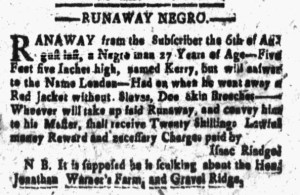
“RUNAWAY NEGRO … named Kerry, but will answer to the Name London.”

During the first year of the Revolutionary War, Daniel Fowle, the printer of the New-Hampshire Gazette, sometimes experienced disruptions to his paper supply that forced him to resort to broadsheets of alternate sizes.  His newspaper carried less content, both news and advertising, on such occasions.  That was the case on October 3, 1775, when he inserted an “Apology” that stated that “he could not procure any other” paper.  Compared to the usual three columns on each of four pages, that issue had only two columns on each of two pages.  Fowle did not include any advertisements.

The following week, Fowle managed to acquire broadsheets of the usual size, but apparently not enough of them for a four-page issue.  Instead, he published a half sheet edition that had three columns on each of two pages.  He found room for advertisements and even a poem, “On LIBERTY.”  On October 17, however, the New-Hampshire Gazette returned to the smaller sheet from two weeks earlier, but he had enough to publish four pages instead of two.  With twice as much space compared to the October 3 edition, he had room for five advertisements, including one by Mrs. Hooper, a milliner, and another for John Williams’s “House of Entertainment … at the Sign of the SALUTATION.”
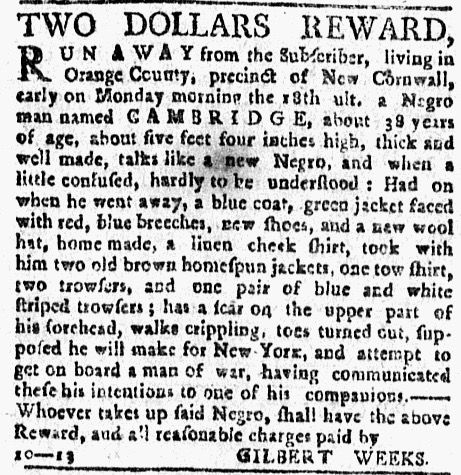
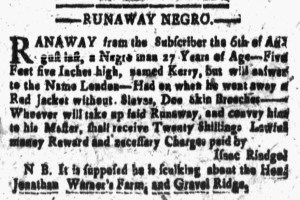
Another advertisement featured a headline that proclaimed, “RUNAWAY NEGRO.”  Isaac Rindgel described a “Negro man 27 Years of Age … named Kerry, [who] will answer to the Name London.”  Kerry liberated himself by escaping from his enslaver on August 6.  For two and a half months he managed to elude capture, though Rindgel suspected that Kerry “is sculking about Hon. Jonathan Warner’s Farm, and Gravel Ridge.”  He did not indicate why he thought Kerry might be in that area.  Perhaps Kerry had a wife, a parent, a sibling, or a friend at Warner’s farm.  The advertisement, composed by an enslaver seeking to recover his human property, did not include the details about Kerry’s life and experiences that mattered most to the fugitive seeking freedom.  In addition to not explaining why Kerry may have been in the proximity of Warner’s farm, Rindgel did not speculate on why the enslaved man departed when he did.  Kerry was likely aware of the disruptions caused by the battles at Lexington and Concord in April, the ensuing siege of Boston, and the Battle of Bunker Hill in June.  The same events that affected Fowle’s access to paper created an opportunity for Kerry to liberate himself by running away.  It is impossible to know for certain that was the case since the newspaper advertisement reflected his enslaver’s perspective and included only the details Rindgel chose.  Kerry certainly would have told a different and more complete story had he been given the opportunity.

Slavery Advertisements Published October 17, 1775

GUEST CURATOR: Massimo Sgambati

The Slavery Adverts 250 Project chronicles the role of newspaper advertising in perpetuating slavery in the era of the American Revolution. The project seeks to reveal the ubiquity of slavery in eighteenth-century life from New England to Georgia by republishing advertisements about enslaved people – for sale as individuals or in groups, wanted to purchase or for hire for short periods, runaways who liberated themselves, and those who were subsequently captured and confined in jails and workhouses – in daily digests on this site as well as in real time via the @SlaveAdverts250 Twitter feed, utilizing twenty-first-century media to stand in for the print media of the eighteenth century.

The project aims to provide modern audiences with a sense of just how often colonizers encountered these advertisements in their daily lives. Enslaved men, women, and children appeared in print somewhere in the colonies almost every single day. Those advertisements served as a constant backdrop for social, cultural, economic, and political life in colonial and revolutionary America. Colonizers who did not purport to own enslaved people were still confronted with slavery as well as invited to maintain the system by purchasing enslaved men, women, and children or assisting in the capture of so-called “runaways” who sought to free themselves from bondage. The frequency of these newspaper advertisements suggests just how embedded slavery was in colonial and revolutionary American culture in everyday interactions beyond the printed page.
These advertisements also testify to the experiences of enslaved men, women, and children, though readers must consider that those experiences have been remediated through descriptions offered by enslavers rather than enslaved people themselves. Often unnamed in the advertisements, enslaved men, women, and children were not invisible or unimportant in early America.

From compiling an archive of digitized eighteenth-century newspapers to identifying advertisements about enslaved men, women, and children in those newspapers to preparing images of each advertisement to posting this daily digest, Massimo Sgambati served as guest curator for this entry. He completed this work as part of the Summer Scholars Program, funded by a fellowship from the D’Amour College of Liberal Arts and Sciences at Assumption University in Worcester, Massachusetts, in Summer 2025.

These advertisements appeared in colonial American newspapers 250 years ago today.

Dunlap’s Maryland Gazette (October 17, 1775)

**********

New-Hampshire Gazette (October 17, 1775)

**********

South-Carolina Gazette (October 17, 1775)

**********

South-Carolina Gazette (October 17, 1775)

**********

South-Carolina Gazette (October 17, 1775)

**********

South-Carolina Gazette (October 17, 1775)

October 16

What was advertised in a revolutionary American newspaper 250 years ago today?

New-York Journal (October 16, 1775).

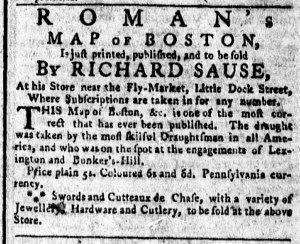
“THIS Map of Boston, &c. is one of the most correct that has ever been published.”

Richard Sause, a cutler in New York, became a local agent in that city when Nicholas Brooks and Bernard Romans collaborated on a map of Boston.  Brooks, a shopkeeper in Philadelphia, described himself as “the printer of said Maps” in newspaper advertisements, though he likely meant that he was the publisher who collaborated with Romans, a noted cartographer.  Sause had not been among the original list of local agents in an advertisement that appeared in Rivington’s New-York Gazetteer in August 1775, nor had he been on the list on a broadside subscription proposal that circulated in the summer and fall.  When Brooks and Romans launched a second project, “An Exact VIEW of the late BATTLE at CHARLESTOWN,” the subscription proposal in the Pennsylvania Ledger included “Mr. Richard Sause in New-York” among the local agents.  Brooks and Romans apparently supplied him with copies of the map as well as the print depicting what is now known as the Battle of Bunker Hill.

Sause, a frequent advertiser, was already familiar to consumers in New York.  A woodcut depicting various kinds of cutlery available at his “Jewlery, Hardware, and Cutlery Store” often adorned his advertisements in newspapers printed in that city.  In the summer and fall of 1775, he emphasized “SMALL SWORDS” in his advertisements.  Following the outbreak of hostilities at Lexington and Concord in April, residents of New York and other towns did not know what to expect.  Many prepared to defend their liberties should the British turn their attention to them.  Sause made sure that Patriots in New York knew that he could supply them with various kinds of small swords.  He even made a pitch for those items at the end of his advertisement for Romans’s map of Boston: “Swords and Cutteaux de Chase [a short sword], with a variety of Jewellery, Hardware and Cutlery, to be sold at the above Store.”

Yet the “MAP OF BOSTON” was the main attraction in that advertisement.  In addition to the headline in capital letters, Sause’s notice billed the map as “one of the most correct that has ever been published.”  To help make sales, he emphasized that the “draught [draft] was taken by the most skilful Draughtsman in all America.”  Buyers could depend on its accuracy because Romans “was on the spot at the engagements of Lexington and Bunker’s-Hill.”  Current events certainly played a role in Sause expanding his business to incorporate a new revenue stream, yet marketing and selling both Brooks and Romans’s map of Boston and prints depicting the Battle of Bunker Hill also gave him an opportunity to participate in politics via the marketplace.

Slavery Advertisements Published October 16, 1775

GUEST CURATOR: Massimo Sgambati

The Slavery Adverts 250 Project chronicles the role of newspaper advertising in perpetuating slavery in the era of the American Revolution. The project seeks to reveal the ubiquity of slavery in eighteenth-century life from New England to Georgia by republishing advertisements about enslaved people – for sale as individuals or in groups, wanted to purchase or for hire for short periods, runaways who liberated themselves, and those who were subsequently captured and confined in jails and workhouses – in daily digests on this site as well as in real time via the @SlaveAdverts250 Twitter feed, utilizing twenty-first-century media to stand in for the print media of the eighteenth century.

The project aims to provide modern audiences with a sense of just how often colonizers encountered these advertisements in their daily lives. Enslaved men, women, and children appeared in print somewhere in the colonies almost every single day. Those advertisements served as a constant backdrop for social, cultural, economic, and political life in colonial and revolutionary America. Colonizers who did not purport to own enslaved people were still confronted with slavery as well as invited to maintain the system by purchasing enslaved men, women, and children or assisting in the capture of so-called “runaways” who sought to free themselves from bondage. The frequency of these newspaper advertisements suggests just how embedded slavery was in colonial and revolutionary American culture in everyday interactions beyond the printed page.

These advertisements also testify to the experiences of enslaved men, women, and children, though readers must consider that those experiences have been remediated through descriptions offered by enslavers rather than enslaved people themselves. Often unnamed in the advertisements, enslaved men, women, and children were not invisible or unimportant in early America.

From compiling an archive of digitized eighteenth-century newspapers to identifying advertisements about enslaved men, women, and children in those newspapers to preparing images of each advertisement to posting this daily digest, Massimo Sgambati served as guest curator for this entry. He completed this work as part of the Summer Scholars Program, funded by a fellowship from the D’Amour College of Liberal Arts and Sciences at Assumption University in Worcester, Massachusetts, in Summer 2025.

These advertisements appeared in colonial American newspapers 250 years ago today.

Dunlap’s Pennsylvania Gazette (October 16, 1775)

**********

New-York Gazette and Weekly Mercury (October 16, 1775)

**********

New-York Gazette and Weekly Mercury (October 16, 1775)

**********

New-York Gazette and Weekly Mercury (October 16, 1775)

**********

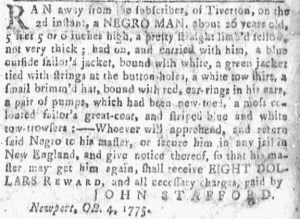
Newport Mercury (October 16, 1775)

**********

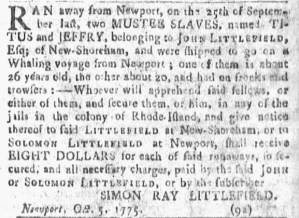
Newport Mercury (October 16, 1775)