November 13

What was advertised in a revolutionary American newspaper 250 years ago today?
Pennsylvania Gazette (November 13, 1776).

“The above Almanacks are to be had of Mr. GEORGE REYNHOLD, Bookseller, … in Market-street, Philadelphia.”

When James Adams advertised the almanacs for 1777 that he published “at his Printing-office in Wilmington,” Delaware, he promoted both the Wilmington Almanack and the Pennsylvania Almanack in a single notice in the November 12, 1776, edition of Dunlap’s Pennsylvania Packet.  For each almanac, he gave an extensive list of the contents to entice prospective customers.  The following day, he also placed advertisements in both the Pennsylvania Gazette and the Pennsylvania Journal, increasing the reach of his marketing campaign.

The advertisements published on November 13, however, did not feature the same copy as the one in Dunlap’s Pennsylvania Packet.  Instead of separate paragraphs giving the contents of each almanac, the new notice had a single paragraph that listed most, but not all, of the contents that appeared in the other advertisement.  That likely made it more difficult for readers to spot where the overview for one almanac ended and the other began.  Adams may have been attempted to reduce the cost of those advertisements by eliminating some of the copy.

The two versions also had a different note at the end.  In Dunlap’s Pennsylvania Packet, the printer announced, “From one penny to three pence a pound is given for clean Linen Rags by said Adams.”  Like many other printers, he collected rags to recycle into the paper he needed to continue operating his printing office.  In the Pennsylvania Gazette and the Pennsylvania Journal, on the other hand, he dropped the call for rags in favor of a nota bene that gave information about a local agent who also sold his almanacs: “N.B. The above Almanacks are to be had of Mr. GEORGE REYNHOLD, Bookseller, near the Sign of the Conestogoe-Wagon, in Market-street, Philadelphia.”  Perhaps it had been an oversight not to include Reynhold in the other advertisement.  Many prospective customers, especially readers who resided in the largest city in the new nation, no doubt found it more convenient to visit Reynhold’s shop in Philadelphia rather than make arrangements to acquire almanacs from Adams’s printing office in Wilmington.

Despite the minor differences in the advertisements, Adams strove to increase the number of prospective customers he reached by running his advertisements in multiple newspapers published in Philadelphia.  Each of them circulated far beyond that city.  He did not extend his advertising campaign to all the newspapers then published in the city.  He may have believed that the three newspapers he chose would yield the best return on his investment.  He certainly did not believe that placing a notice in a single newspaper would be as effective as running variations in multiple newspapers.
November 12

What was advertised in a revolutionary American newspaper 250 years ago today?

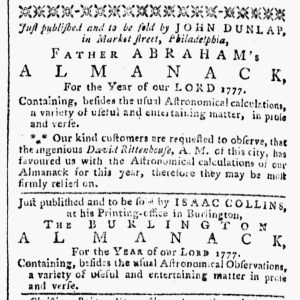
Dunlap’s Pennsylvania Packet (November 12, 1776).

“FATHER ABRAHAM’S ALMANACK.”

“THE BURLINGTON ALMANACK.”

“The WILMINGTON and PENNSYLVANIA ALMANACKS.”

It was the time of year for advertising and buying almanacs.  Although the advertisements for the popular pamphlets did not begin appearing in newspapers as early in 1776 as they had in previous years, they gained momentum by the middle of November.  The November 12 edition of Dunlap’s Pennsylvania Packet even carried advertisements for almanacs published in printing offices in three towns.

John Dunlap, the printer of that newspaper, promoted “FATHER ABRAHAM’s ALMANACK, For the Year of our LORD 1777,” an almanac that he “published and … sold” at his printing office in Philadelphia.  He trumpeted that “the ingenious David Rittenhouse, A.M. of this city, has favoured us with the Astronomical calculations …, therefore they may be most firmly relied on.”  The printer leveraged the reputation of the well-known astronomer and mathematician in marketing the almanac he published.  He also inserted standard language that appeared in advertisements for other almanacs: “Containing, besides the usual Astronomical calculations, a variety of useful and entertaining matter, in prose and verse.”

An advertisement for another almanac that ran immediately below Dunlap’s notice deployed almost identical copy, substituting “Astronomical Observations” for “Astronomical calculations.”  Isaac Collins announced that he “Just published … THE BURLINGTON ALMANACK, For the YEAR of our LORD 1777” and sold it “at his Printing-office in Burlington,” New Jersey.  With no local newspaper in that area, Collins resorted to advertising in Dunlap’s Pennsylvania Packet and other newspapers printed in Philadelphia each fall when he published the new edition of the Burlington Almanack.

James Adams found himself in a similar position when it came to marketing the “WILMINGTON and PENNSYLVANIA ALMANACKS, For the Year of our LORD 1777” that he “published and … sold … at his Printing-office in Wilmington, Delaware.”  That town also did not have its own newspaper, so Adams regularly advertised his almanacs in newspapers published in Philadelphia.  In addition to advertising in Dunlap’s Pennsylvania Packet in the fall of 1776, he increased the visibility of his almanacs by placing notices in the Pennsylvania Gazette and the Pennsylvania Journal.

Advertisements for almanacs were a sign of the season each fall.  Readers encountered them for weeks (and sometimes months) as they perused newspapers, often exposed to multiple advertisements in a single issue.  They were often given choices among several almanacs published in the same town as the newspaper, but sometimes, depending on the market served by a newspaper, it carried notices about almanacs published in other towns and even other states.

October 18

What was advertised in a revolutionary American newspaper 250 years ago today?

Pennsylvania Journal (October 18, 1775).

“An Elegy to the memory of the American Volunteers who fell … April 19, 1775.”

During the era of the American Revolution, advertisements for almanacs frequently appeared in newspapers from New England to Georgia each fall.  Such was the case in the Pennsylvania Journal in 1775.  James Adams, a printer in Delaware, inserted a notice that announced that he “JUST PUBLISHED … The WILMINGTON and PENNSYLVANIA ALMANACKS, For the year of our LORD, 1776.”

Adams followed a familiar format for advertising almanacs.  He indicated that both editions included “the usual astronomical calculations” that readers would find in any almanac as well as a variety of other enticing contents.  The Pennsylvania edition included “Pithy Sayings” for entertainment and “Tables of Interest at six and seven per cent” for reference as well as the “Continuation of William Penn’s Advice to his Children” and the “Conclusion of Wisdom’s Call to the young of both sexes.”  Adams published a portion of those pieces in the almanac for the previous year, anticipating that readers would purchase the subsequent edition for access to the essays in their entirety.  The almanac for 1776 also suggested “Substitutes for Tea,” certainly timely considering that the Continental Association remained in effect. Colonizers sought alternatives while they boycotted imported tea.

Current events played an even more prominent role in the Wilmington Almanack.  It featured an “Elegy to the memory of the American Volunteers, who fell in the engagement between the Massachusetts-Bay Militia and the British Troops, April 19, 1775.”  Six months after the battles at Lexington and Concord, Adams memorialized the minutemen who had died for the American cause during the first battles of the Revolutionary War.  In addition, the almanac featured “The Irishman’s Epistle to the Officers and troops at Boston,” “Liberty-Tree,” and “A droll Dialogue between a fisherman of Poole, in England, and a countryman, relative to the trade of America, and proposed victory over the Americans.”  Adams did not elaborate on those items, perhaps intentionally.  Presenting the titles of the pieces without further elaboration was standard practice in advertisements for almanacs, but in this case the printer may have intended to stoke curiosity that would lead to more sales.  For both almanacs, a concern for current events and a burst of patriotism influenced the contents and their marketing.

September 15

What was advertised in a colonial American newspaper 250 years ago today?

Pennsylvania Journal (September 15, 1773).

“JUST PUBLISHED … THE WILMINGTON ALMANACK, for 1774.”

It was a sign of the changing seasons, the arrival of fall, for readers of the Pennsylvania Gazette and the Pennsylvania Journal.  On September 15, 1773, James Adams published one of the first advertisements for almanacs for 1774.  Soon, many other printers and booksellers would advertise other almanacs in the Pennsylvania Gazette, the Pennsylvania Journal, and other newspapers throughout the colonies.  That would include Hall and Sellers, the printers of the Pennsylvania Gazette, and William Bradford and Thomas Bradford, the printers of the Pennsylvania Journal, inserting advertisers for almanacs they published.  The next day, Clementina Rind, printer of the Virginia Gazette, ran an advertisement for the Virginia Almanack for the Year of Our Lord 1774, drawing readers into the same annual ritual of marketing, selecting, and purchasing the popular pamphlets.

For readers in Philadelphia and its hinterlands, James Adams advertised two almanacs that came off the presses at his printing office in Wilmington, Delaware.  Both included the kinds of information that made almanacs both entertaining and useful.  The Wilmington Almanack, for instance, contained the usual astronomical observations as well as extracts from The Family Physician, “shewing people what is in their own power both with respect to the prevention and cure of diseases,” an “address to the Ladies, on the present fashions” (conveniently ignoring that men just as eagerly participated in consumer culture), and both “jests” and “wise sayings.”  The reference material included “tables of interest at 6 and 7 per cent,” schedules for courts, fairs, and “Friends yearly meetings,” and descriptions of roads in the region.  Adams also sought to compete with printers in Philadelphia by publishing his own Pennsylvania Town and Country-Man’s Almanack.  Like the Wilmington Almanack, its contents included astronomical observations, schedules for courts, fairs, and Quaker meetings, descriptions of roads, and tables of interest.  For the edification of readers, it also featured “two extraordinary letters, one of them from Sir Walter Rawleigh, to his wife, after his condemnation; the other from James Earl of Marlborough, a little before his death, to his friend” as well as “memoirs of several other great and worthy men” and an essay “concerning casualties and adversities.”  Adams listed Jonathan Zane and William Wilson, both on Second Street in Philadelphia, as local agents who sold the Pennsylvania Town and Country-Man’s Almanack.

Throughout the fall, the pages of the Pennsylvania Gazette, Pennsylvania Journal, and other colonial newspapers would become increasingly crowded with advertisements for almanacs.  As the new year approached, printers and booksellers would offer dozens of titles for consumers to select.  Some printers would also market discounts for purchasing in volume, hoping to enlist shopkeepers in town and country in selling and distributing almanacs.  As much as changes in the weather and fewer hours of daylight, the appearance of advertisements for almanacs signaled the arrival of fall for the reading public.