October 20

What was advertised in a revolutionary American newspaper 250 years ago today?
Essex Journal (October 20, 1775).

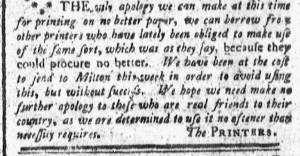
We hope we need make no further apology to those who are real friends to their country.”

John Mycall and Henry-Walter Tinges, the printers of the Essex Journal, found themselves in a situation similar to the one that Daniel Fowle, the printer of the New-Hampshire Gazette, experienced in the fall of 1775.  A disruption in Fowle’s supply of paper in Portsmouth had forced him to print his newspaper on smaller sheets on a few occasions, including the October 17 edition.  Three days later, Mycall and Tinges did the same in Newburyport.  Instead of four pages of three columns each, that issue had four pages of two columns each.  The masthead featured plain type for the title rather than presenting “Essex Journal” in the usual scrolling script.  The woodcuts that usually flanked the title, an Indigenous man with a bow and arrow on the left and a packet ship at sea on the right, did not appear at all.

Immediately above the advertisements, the printers inserted their own notice to explain what happened.  “THE only apology we can make at this time for printing on no better paper,” Mycall and Tinges stated, “we can borrow from other printers who have lately been obliged to make use of the same sort, which was as they say, because they could procure no better.”  They closely paraphrased portions of Fowle’s notice to his readers a couple of weeks earlier: “The only Apology the Publisher can make for this Day’s Paper, is that he could not procure any other.”  Mycall and Tinges printed their newspaper on different paper only as a last resort.  “We have been at the cost to send [an order for more paper] to Milton this week in order to avoid using this,” they informed readers, “but without success.”  With the disruptions and displacements that occurred in the six months since the battles at Lexington and Concord, securing paper became difficult.  The printers tried to get more from the paper mill on the Neponset River in Milton, but to no avail.  They expected their readers to understand, especially those who held the right sort of political principles.  “We hope we need make no further apology to those who are real friends to their country,” Mycall and Tinges proclaimed, “as we are determined to us [the substitute paper] no oftener than necessity requires.”  They hoped that readers would see the smaller newspaper as a minor inconvenience given the stakes of the contest between the colonies and Great Britain.  They did their best with the resources available to continue to disseminate news and advertising to their subscribers and other readers.
July 28

What was advertised in a revolutionary American newspaper 250 years ago today?

Essex Journal (July 28, 1775).

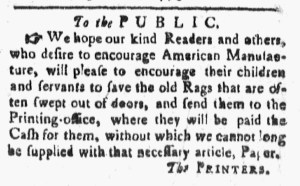
“Encourage their children and servants to save the old Rags … and send them to the Printing-office.”

John Mycall and Henry-Walter Tinges, the printers of the Essex Journal in Newburyport, Massachusetts, concluded the July 28, 1775, edition of their newspaper with an advertisement that presented colonizers an opportunity to aid the American cause.  “We hope our kind Readers and others, who desire to encourage American Manufacture,” Mycall and Tinges declared, “will please to encourage their children and servants to save the old Rags that are often swept out of doors, and send them to the Printing-office.”  The printers offered cash for the rags, explaining that without them “we cannot long be supplied with that necessary article, Paper.”  Mycall and Tinges oversaw a recycling venture imperative in producing an essential article for continuing to publish their newspaper and anything else.  They were not the only printers in the region who experienced a disruption in acquiring paper in the months after the battles at Lexington and Concord.  Daniel Fowle, the printer of the New-Hampshire Gazette, had a similar experience.

Throughout the imperial crisis, collecting rags to recycle into paper had been imbued with political significance.  Producing paper in the colonies meant that printers did not need to import as much paper from England.  As nonimportation agreements went into effect in 1768, Christopher Leffingwell of Norwich, Connecticut, described collecting rags as “an entire Saving to the COUNTRY” and encouraged “every Friend and lover thereof [to] save every Scrap” of discarded linen.  For years, John Keating regularly promoted his “Paper Manufactory” in New York’s newspapers, arguing that economic resistance during the “present alarming situation of the colonies” was the “safest and most efficacious method of convincing the Ministry of Great-Britain of their error.”  He suggested that each household designate a “certain place” for collecting rags and cultivate a habit that would “establish this valuable manufactory upon a permanent foundation.”  Who undertook such work?  John Dunlap, the printer of the Pennsylvania Packet, hoped “to prevail upon our LADIES to grant us a little of their industry and assistance,” believing that “the welfare of their country will influence them” to do their part in collecting rags to recycle into paper.  Mycall and Tinges extended the call to include “children and servants.”  As men mustered to defend their liberties, women, children, and servants had their own role to play.  They could contribute to the American cause by supporting “American Manufacture,” including collecting rags to transform into the newspapers and pamphlets that disseminated the rhetoric of the Revolution.