October 15

What was advertised in a revolutionary American newspaper 250 years ago this week?
Virginia Gazette [Dixon and Hunter] (October 14, 1775).

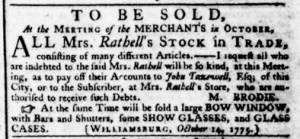
“Will be sold a large BOW WINDOW, with Bars and Shutters, some SHOW GLASSES, and GLASS CASES.”

In the spring of 1775, Catherine Rathell, a milliner in Williamsburg, advertised her intention to “dispose of my Goods” and go to England “till Liberty of Importation is allowed.”  The Continental Association, a nonimportation agreement devised by the First Continental Congress in protest of the Coercive Acts, disrupted trade for merchants, shopkeepers, and others who sold imported goods.  When she first placed her advertisement, Rathell and the rest of the residents of Williamsburg had not yet received word of the battles at Lexington and Concord.  The outbreak of hostilities may have prompted her to adjust her plans because she did not wait until she sold all her merchandise to depart.  Instead, she left her wares in the hands of Margaret Brodie, a mantuamaker who had worked with Rathell since 1771, to sell “At theMEETING of the MERCHANTS in OCTOBER.”  The milliner did not return to Williamsburg.  Unfortunately, she died when the ship taking her to England got caught in a hurricane and sank.

Brodie’s advertisement in the October 14, 1775, edition of John Dixon and William Hunter’s Virginia Gazette concerned more than just selling Rathell’s remaining merchandise.  It also called on those indebted to Rathell to settle accounts with Brodie.  A short note at the end of the notice, marked with a manicule to draw attention, noted that “a large BOW WINDOW, with Bars and Shutters, some SHOW GLASSES, and GLASS CASES” would be sold at the same time as “Mrs. Rathell’s STOCK in TRADE.”  That provides a glimpse of Rathell’s merchandising strategies.  By the early eighteenth century, bow windows became popular features of shops in London, so common that some critics complained about the way that they jutted into the street and made it more difficult for pedestrians to pass.  Yet that was one of the intended purposes, causing prospective customers to slow down and view the merchandise on display.  In addition, bow windows offered more space for displaying goods than windows flush with exterior walls.  Some American retailers, including Rathell, adopted this strategy for marketing their wares.  Rathell also invested in glass cases to showcase some of her merchandise for visitors to her shop.  She could protect valuable items from shoplifters while still making them visible to entice customers.  Similarly, the bars on shutters on the bow window protected goods from burglars when the shop was closed.  Without contemporary visual images of American shops, Rathell’s advertisement helps reconstruct their interiors and the experience of shopping in eighteenth-century America.
October 14

Who was the subject of an advertisement in a revolutionary American newspaper 250 years ago today?

Virginia Gazette [Dixon and Hunter] (October 14, 1775).

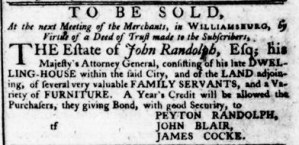
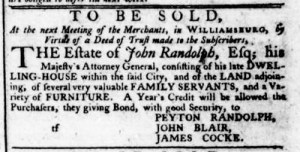
“Several very valuable FAMILY SERVANTS.”

A notice concerning the “Estate of John Randolph, Esq; his Majesty’s Attorney General,” first appeared in the October 14, 1775, edition of John Dixon and William Hunter’s Virginia Gazette.  It was not Randolph’s death that occasioned the notice.  Instead, the Loyalist and his family departed for England at the beginning of the Revolutionary War, leaving trustees in charge of selling “his late DWELLING-HOUSE” in Williamsburg, “several very valuable FAMILY SERVANTS, and a Variety of FURNITURE.”

At a glance, modern readers might assume that those “FAMILY SERVANTS” consisted of indentured servants like the ones that had “JUST ARRIVED” in Virginia on the Saltspring.  According to an advertisement on the next page, those servants included “many Tradesmen,” such as carpenters, blacksmiths, shoemakers, weavers, a cabinetmaker, and a wheelwright, as well as “FARMERS and other COUNTRY LABOURERS.”  Yet that almost certainly was not the case for the “FAMILY SERVANTS” in the notice about Randolph’s estate.  They did indeed possess a variety of skills like the indentured servants recently arrived in the colony, yet that phrase – “FAMILY SERVANTS” – referred to enslaved people who had been part of the Randolph household.

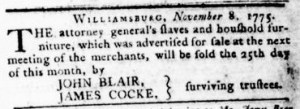
Virginia Gazette [Pinkney] (November 9, 1775).

A subsequent advertisement did not use the same turn of phrase.  After Peyton Randolph, one of the trustees, died suddenly on October 22, a new advertisement that first appeared in the November 9 edition of John Pinkney’s Virginia Gazette clarified that the “attorney general’s slaves and household furniture, which was advertised for sale at the next meeting of the merchants, will be sold the 25th day of this month, by JOHN BLAIR, [and] JAMES COCKE, surviving trustees.”  Of course, eighteenth-century readers understood the reference to “FAMILY SERVANTS” in the original advertisement.  They did not need a subsequent notice to clarify that it meant enslaved men and women.  They knew the lexicon of newspaper notices about enslaved people just as well as they knew the lexicon of consumer culture in advertisements that promoted all sorts of goods, especially textiles, with names that seem unfamiliar to today’s readers.

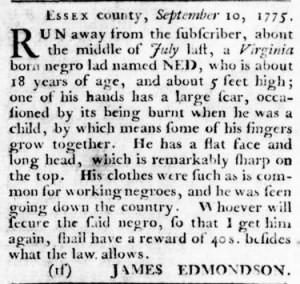
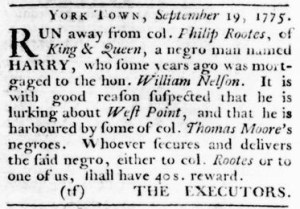
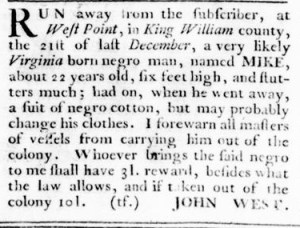
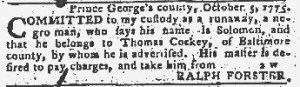
Slavery Advertisements Published October 14, 1775

GUEST CURATOR: Massimo Sgambati

The Slavery Adverts 250 Project chronicles the role of newspaper advertising in perpetuating slavery in the era of the American Revolution. The project seeks to reveal the ubiquity of slavery in eighteenth-century life from New England to Georgia by republishing advertisements about enslaved people – for sale as individuals or in groups, wanted to purchase or for hire for short periods, runaways who liberated themselves, and those who were subsequently captured and confined in jails and workhouses – in daily digests on this site as well as in real time via the @SlaveAdverts250 Twitter feed, utilizing twenty-first-century media to stand in for the print media of the eighteenth century.

The project aims to provide modern audiences with a sense of just how often colonizers encountered these advertisements in their daily lives. Enslaved men, women, and children appeared in print somewhere in the colonies almost every single day. Those advertisements served as a constant backdrop for social, cultural, economic, and political life in colonial and revolutionary America. Colonizers who did not purport to own enslaved people were still confronted with slavery as well as invited to maintain the system by purchasing enslaved men, women, and children or assisting in the capture of so-called “runaways” who sought to free themselves from bondage. The frequency of these newspaper advertisements suggests just how embedded slavery was in colonial and revolutionary American culture in everyday interactions beyond the printed page.
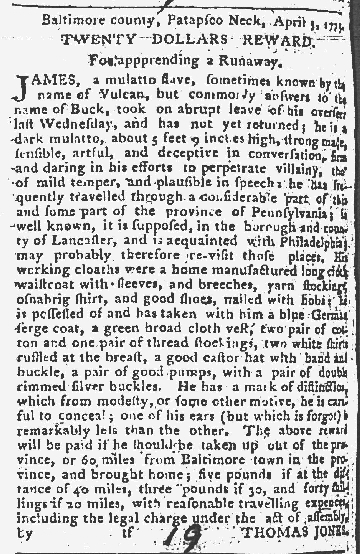
These advertisements also testify to the experiences of enslaved men, women, and children, though readers must consider that those experiences have been remediated through descriptions offered by enslavers rather than enslaved people themselves. Often unnamed in the advertisements, enslaved men, women, and children were not invisible or unimportant in early America.

From compiling an archive of digitized eighteenth-century newspapers to identifying advertisements about enslaved men, women, and children in those newspapers to preparing images of each advertisement to posting this daily digest, Massimo Sgambati served as guest curator for this entry. He completed this work as part of the Summer Scholars Program, funded by a fellowship from the D’Amour College of Liberal Arts and Sciences at Assumption University in Worcester, Massachusetts, in Summer 2025.

These advertisements appeared in colonial American newspapers 250 years ago today.

Providence Gazette (October 14, 1775)

**********

Virginia Gazette [Dixon and Hunter] (October 14, 1775)

**********

Virginia Gazette [Dixon and Hunter] (October 14, 1775)

**********

Virginia Gazette [Dixon and Hunter] (October 14, 1775)

October 13

What was advertised in a revolutionary American newspaper 250 years ago today?

Story and Humphreys’s Pennsylvania Mercury (October 13, 1775).

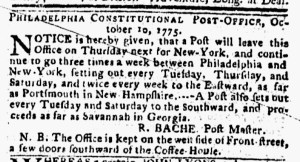
“PHILADELPHIA CONSTITUTIONAL POST-OFFICE.”

At the same time that Mary Katharine Goddard, postmaster and printer of the Maryland Journal, advertised the Baltimore branch of the Constitutional Post Office in the fall of 1775, Richard Bache ran a notice for the “PHILADELPHIA CONSTITUTONAL POST-OFFICE” in the October 13 edition of Story and Humphreys’s Pennsylvania Mercury. Although Bache was not the printer of that newspaper, his advertisement received a privileged place similar to the one that Goddard’s notice enjoyed in her newspaper.  It appeared first among the advertisements that readers encountered when they perused the newspaper from start to finish, immediately below the “SHIP NEWS” and list of “ARRIVALS” in Philadelphia.  A double line did separate news from advertising, yet this item delivered news relevant to the imperial crisis that had become a war with the battles at Lexington and Concord the previous spring.  Over the summer, the Second Continental Congress established the Constitutional Post Office as an alternative to the imperial post office.  Enoch Story and Daniel Humphreys, the printers of the newspaper that carried Bache’s advertisement, apparently considered it in their best interest to increase the likelihood readers would take note of the information about the Constitutional Post Office by placing the notice right after the news.

Compared to Goddard’s advertisement, Bache’s notice gave readers a much more expansive glimpse of the scope of the enterprise.  Rather than simply stating which days the post arrived and departed, Bache reported that the Constitutional Post carried letters and newspapers “as far as Portsmouth in New-Hampshire” to the north and “as far as Savannah in Georgia” to the south.  The system linked the thirteen colonies.  On Tuesdays, Thursdays, and Saturdays, a rider set out for New York from Philadelphia.  On Tuesdays and Saturdays, another rider headed “to the Southward” to Baltimore, arriving there, according to Goddard’s advertisement, on Mondays and Thursdays.  This new system did more than move mail.  “Establishing a new post office,” Joseph M. Adelman argues, “placed the levers of information circulation in the hands of Americans.  …  Forming a ‘continental’ post office that could properly embody an intercolonial union and its resistance to imperial tyranny was crucial to Patriot mobilization at the height of the imperial crisis.”  Furthermore, “Patriot printers and their radical friends” played an integral role in establishing the new postal system.[1]  No wonder that Story and Humphreys placed Bache’s advertisement about the “PHILADELPHIA CONTSITUTIONAL POST-OFFICE” right after the “SHIP NEWS.”

**********

[1] Joseph M. Adelman, “‘A Constitutional Conveyance of Intelligence, Public and Private’: The Post Office, the Business of Printing, and the American Revolution,” Enterprise and Society 11, no. 4 (December 2010): 747-748.

Slavery Advertisements Published October 13, 1775

GUEST CURATOR: Massimo Sgambati

The Slavery Adverts 250 Project chronicles the role of newspaper advertising in perpetuating slavery in the era of the American Revolution. The project seeks to reveal the ubiquity of slavery in eighteenth-century life from New England to Georgia by republishing advertisements about enslaved people – for sale as individuals or in groups, wanted to purchase or for hire for short periods, runaways who liberated themselves, and those who were subsequently captured and confined in jails and workhouses – in daily digests on this site as well as in real time via the @SlaveAdverts250 Twitter feed, utilizing twenty-first-century media to stand in for the print media of the eighteenth century.

The project aims to provide modern audiences with a sense of just how often colonizers encountered these advertisements in their daily lives. Enslaved men, women, and children appeared in print somewhere in the colonies almost every single day. Those advertisements served as a constant backdrop for social, cultural, economic, and political life in colonial and revolutionary America. Colonizers who did not purport to own enslaved people were still confronted with slavery as well as invited to maintain the system by purchasing enslaved men, women, and children or assisting in the capture of so-called “runaways” who sought to free themselves from bondage. The frequency of these newspaper advertisements suggests just how embedded slavery was in colonial and revolutionary American culture in everyday interactions beyond the printed page.

These advertisements also testify to the experiences of enslaved men, women, and children, though readers must consider that those experiences have been remediated through descriptions offered by enslavers rather than enslaved people themselves. Often unnamed in the advertisements, enslaved men, women, and children were not invisible or unimportant in early America.
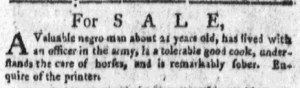
From compiling an archive of digitized eighteenth-century newspapers to identifying advertisements about enslaved men, women, and children in those newspapers to preparing images of each advertisement to posting this daily digest, Massimo Sgambati served as guest curator for this entry. He completed this work as part of the Summer Scholars Program, funded by a fellowship from the D’Amour College of Liberal Arts and Sciences at Assumption University in Worcester, Massachusetts, in Summer 2025.

These advertisements appeared in colonial American newspapers 250 years ago today.

Connecticut Gazette (October 13, 1775)

**********

South-Carolina and American General Gazette (October 13, 1775)

**********

South-Carolina and American General Gazette (October 13, 1775)

**********

South-Carolina and American General Gazette (October 13, 1775)

**********

South-Carolina and American General Gazette (October 13, 1775)

**********

South-Carolina and American General Gazette (October 13, 1775)

**********

South-Carolina and American General Gazette (October 13, 1775)

**********

South-Carolina and American General Gazette (October 13, 1775)

**********

Virginia Gazette [Purdie] (October 13, 1775)

**********

Virginia Gazette [Purdie] (October 13, 1775)

**********

Virginia Gazette [Purdie] (October 13, 1775)

**********

Virginia Gazette [Purdie] (October 13, 1775)

**********

Virginia Gazette [Purdie] (October 13, 1775)

**********

Virginia Gazette [Purdie] (October 13, 1775)

**********

Virginia Gazette [Purdie] (October 13, 1775)

**********

Virginia Gazette [Purdie] (October 13, 1775)

October 12

What was advertised in a revolutionary American newspaper 250 years ago today?

New-York Journal (October 12, 1775).

“I Acknowledge that I have at several times spoken in favour of the laws of Taxation.”

Lemuel Bower wanted to return to the good graces of his community in the fall of 1775.  Events that occurred since the previous April – the battles at Lexington and Concord, the siege of Boston, the Battle of Bunker Hill, the Second Continental Congress appointing George Washington as commander in chief of the Continental Army, an American invasion of Quebec – had intensified feelings about the imperial crisis and, apparently, made for a difficult situation for Bower since he had expressed Tory sentiments in the past.  In hopes of moving beyond that, he composed a statement that appeared in the October 12, 1775, edition of the New-York Journal.

“I Acknowledge,” Bower confessed, “I have at several times spoken in favour of the laws of Taxation, and against the measures pursued by America to procure Redress, and have thereby justly merited the displeasure of my country.”  To remedy that, “I beg forgiveness, and so solemnly promise to submit to the rules of the Continental and Provincial Congresses,” including abiding by the nonimportation and nonconsumption provisions in the Continental Association.  Furthermore, Bower pledged, “I never will speak or act in opposition to their order, but will conduct according to their directions, to the utmost of my power.”  He did not state that he had a change of heart, only that he would quietly act as supporters of the American cause were supposed to act rather than engage in vocal opposition.  As William Huntting Howell has argued, such compliance, especially when expressed in a public forum, may have been more important to most Patriots than whether Bower truly agreed with them.[1]  How he acted and what he said was more important than what he believed as long as he kept his thoughts to himself.

Bower did indeed express his regrets and his promise to behave better in a public forum.  He concluded his statement with a note that “this I desire should be published in the public prints.  When it appeared in the New-York Journal, it ran immediately below a notice from the Committee of Inspection and Observation in Stanford, New York, that labeled two Loyalists as “enemies to the liberties of their country” and instructed the public “to break off all commerce, dealings and connections with them.”  That was the treatment that Bower sought to avoid!  That notice appeared immediately below news from throughout the colony.  Bower’s statement ran immediately above paid advertisements.  The two statements concerning the political principles of colonizers thus served as a transition from news to advertising in that issue of the New-York Journal.  Did John Holt, the printer, treat them as paid notices?  Did he require Bower to pay to insert his statement?  Or did the Patriot printer publish one or both gratis?  Perhaps he printed the statement from the Committee of Inspection and Observation for free but made Bower pay to publish his penance.  Whatever the case, Bower’s statement was not clearly a news item nor an advertisement but could have been considered both simultaneously by eighteenth-century readers.

**********

[1] William Huntting Howell, “Entering the Lists: The Politics of Ephemera in Eastern Massachusetts, 1774,” Early American Studies 9, no. 1 (Winter 2011): 187-217.

Slavery Advertisements Published October 12, 1775

GUEST CURATOR: Massimo Sgambati

The Slavery Adverts 250 Project chronicles the role of newspaper advertising in perpetuating slavery in the era of the American Revolution. The project seeks to reveal the ubiquity of slavery in eighteenth-century life from New England to Georgia by republishing advertisements about enslaved people – for sale as individuals or in groups, wanted to purchase or for hire for short periods, runaways who liberated themselves, and those who were subsequently captured and confined in jails and workhouses – in daily digests on this site as well as in real time via the @SlaveAdverts250 Twitter feed, utilizing twenty-first-century media to stand in for the print media of the eighteenth century.

The project aims to provide modern audiences with a sense of just how often colonizers encountered these advertisements in their daily lives. Enslaved men, women, and children appeared in print somewhere in the colonies almost every single day. Those advertisements served as a constant backdrop for social, cultural, economic, and political life in colonial and revolutionary America. Colonizers who did not purport to own enslaved people were still confronted with slavery as well as invited to maintain the system by purchasing enslaved men, women, and children or assisting in the capture of so-called “runaways” who sought to free themselves from bondage. The frequency of these newspaper advertisements suggests just how embedded slavery was in colonial and revolutionary American culture in everyday interactions beyond the printed page.

These advertisements also testify to the experiences of enslaved men, women, and children, though readers must consider that those experiences have been remediated through descriptions offered by enslavers rather than enslaved people themselves. Often unnamed in the advertisements, enslaved men, women, and children were not invisible or unimportant in early America.
From compiling an archive of digitized eighteenth-century newspapers to identifying advertisements about enslaved men, women, and children in those newspapers to preparing images of each advertisement to posting this daily digest, Massimo Sgambati served as guest curator for this entry. He completed this work as part of the Summer Scholars Program, funded by a fellowship from the D’Amour College of Liberal Arts and Sciences at Assumption University in Worcester, Massachusetts, in Summer 2025.

These advertisements appeared in colonial American newspapers 250 years ago today.

Maryland Gazette (October 12, 1775)

**********

Maryland Gazette (October 12, 1775)

**********

Maryland Gazette (October 12, 1775)

**********

Maryland Gazette (October 12, 1775)

**********

Maryland Gazette (October 12, 1775)

**********

New-York Journal (October 12, 1775)

**********

New-York Journal (October 12, 1775)

**********

Rivington’s New-York Gazetteer (October 12, 1775)

**********

Rivington’s New-York Gazetteer (October 12, 1775)

**********

Rivington’s New-York Gazetteer (October 12, 1775)

**********

Rivington’s New-York Gazetteer (October 12, 1775)

**********

Virginia Gazette [Pinkney] (October 12, 1775)

October 11

What was advertised in a revolutionary American newspaper 250 years ago today?

Maryland Journal (October 11, 1775).

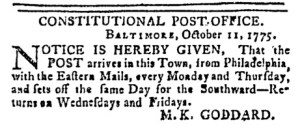
“CONSTITUTIONAL POST-OFFICE.  BALTIMORE.”

The contents of the October 11, 1775, edition of the Maryland Journal were organized such that the first advertisement that readers encountered promoted the Baltimore branch of the “CONSTITUTIONAL POST-OFFICE” established by the Second Continental Congress as an alternative to the imperial postal system operated by the British government.  It completed the middle column on the third page, a column otherwise filled with news from Cambridge, Hartford, New York, and Philadelphia.  Two lines separated it from other content, indicating a transition from news to advertising, yet the notice seemed a continuation of updates about current events, including an inaccurate report that General Richard Montgomery had captured Montreal as part of the American invasion of Quebec.  Advertisements inserted for other purposes, such as fencing lessons and descriptions of runaway indentured servants, appeared in the next column and on the next page.

“NOTICE IS HEREBY GIVEN,” the advertisement proclaimed, “That the POST arrives in this Town, from Philadelphia, with the Eastern Mailes, every Monday and Thursday, and sets off the same Day for the Southward.”  It returned from that direction on Wednesdays and Fridays.  The notice was signed, “M.K. GODDARD.”  The colophon at the bottom of the final page also listed “M.K. GODDARD, at the PRINTING-OFFICE in MARKET-STREET” as the printer of the Maryland Journal.  Mary Katharine Goddard operated the printing office in Baltimore.  Like many other printers, she simultaneously served as postmaster.  Many of them, as Joseph M. Adelman explains, had been “associated with the old imperial system” and “shifted [their] service from the British post office to the American one.”  They included Solomon Southwick, the printer of the Newport Mercury, John Carter, the printer of the Providence Gazette, and Alexander Purdie, the printer of the Virginia Gazette.  Appointed to the position in 1775, Goddard served as postmaster in Baltimore for fourteen years “until she lost her position in 1789 to a new postmaster more closely connected to the new Federal Postmaster General.”[1]

Women participated in the American Revolution in many ways.  They signed nonimportation agreements and made decisions in the marketplace that reflected their political principles, they spun wool and made homespun garments as alternatives to British imports, and they raised funds to support the Continental Army.  Some served in more formal roles, including Mary Katharine Goddard as both the printer of the Maryland Journal and the postmaster at the “CONSTITUTIONAL POST-OFFICE” in Baltimore.

**********

[1] Joseph M. Adelman, “‘A Constitutional Conveyance of Intelligence, Public and Private’: The Post Office, the Business of Printing, and the American Revolution,” Enterprise and Society 11, no. 4 (December 2010): 742.

Slavery Advertisements Published October 11, 1775

GUEST CURATOR: Massimo Sgambati

The Slavery Adverts 250 Project chronicles the role of newspaper advertising in perpetuating slavery in the era of the American Revolution. The project seeks to reveal the ubiquity of slavery in eighteenth-century life from New England to Georgia by republishing advertisements about enslaved people – for sale as individuals or in groups, wanted to purchase or for hire for short periods, runaways who liberated themselves, and those who were subsequently captured and confined in jails and workhouses – in daily digests on this site as well as in real time via the @SlaveAdverts250 Twitter feed, utilizing twenty-first-century media to stand in for the print media of the eighteenth century.

The project aims to provide modern audiences with a sense of just how often colonizers encountered these advertisements in their daily lives. Enslaved men, women, and children appeared in print somewhere in the colonies almost every single day. Those advertisements served as a constant backdrop for social, cultural, economic, and political life in colonial and revolutionary America. Colonizers who did not purport to own enslaved people were still confronted with slavery as well as invited to maintain the system by purchasing enslaved men, women, and children or assisting in the capture of so-called “runaways” who sought to free themselves from bondage. The frequency of these newspaper advertisements suggests just how embedded slavery was in colonial and revolutionary American culture in everyday interactions beyond the printed page.
These advertisements also testify to the experiences of enslaved men, women, and children, though readers must consider that those experiences have been remediated through descriptions offered by enslavers rather than enslaved people themselves. Often unnamed in the advertisements, enslaved men, women, and children were not invisible or unimportant in early America.

From compiling an archive of digitized eighteenth-century newspapers to identifying advertisements about enslaved men, women, and children in those newspapers to preparing images of each advertisement to posting this daily digest, Massimo Sgambati served as guest curator for this entry. He completed this work as part of the Summer Scholars Program, funded by a fellowship from the D’Amour College of Liberal Arts and Sciences at Assumption University in Worcester, Massachusetts, in Summer 2025.

These advertisements appeared in colonial American newspapers 250 years ago today.

Constitutional Gazette (October 11, 1775)

**********

Maryland Journal (October 11, 1775)

**********

Maryland Journal (October 11, 1775)

**********

Maryland Journal (October 11, 1775)

**********

Pennsylvania Gazette (October 11, 1775)

**********

Pennsylvania Gazette (October 11, 1775)

**********

Pennsylvania Gazette (October 11, 1775)

October 10

What was advertised in a revolutionary American newspaper 250 years ago today?

Dunlap’s Maryland Gazette (October 10, 1775).

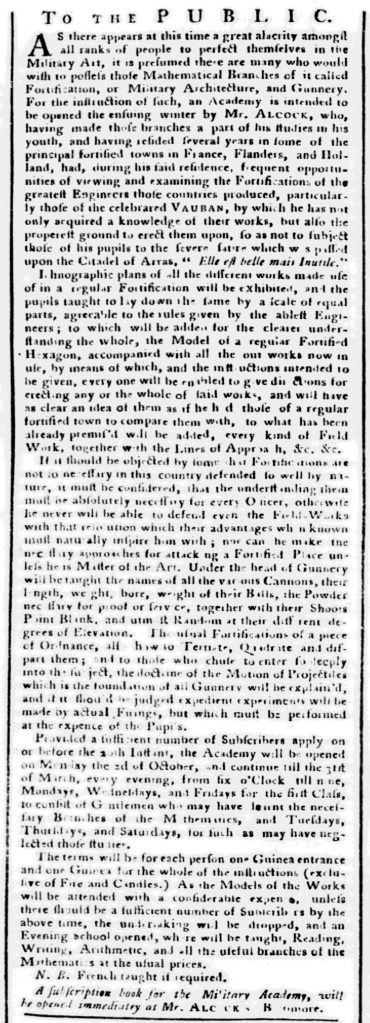
A subscription book for the Military Academy, will be opened immediately.”

In the fall of 1775, Mr. Alcock advertised an academy with a specialized curriculum.  “AS there appears at this time a great alacrity amongst all ranks of people to perfect themselves in the Military Art,” he declared to readers of the Dunlap’s Maryland Gazette and the Maryland Journal, “it is presumed there are so many who would wish to possess those Mathematical Branches of it called Fortification, or Military Architecture, and Gunnery.”  To that end, Alcock, announced his plans to open a school to teach those subjects.  For his qualifications, he noted that he “made those branches a part of his studies in his youth.”  In addition, he “resided several years in some of the principal fortified towns in France, Flanders, and Holland.”  While there, he took advantage of “frequent opportunities of viewing and examining the Fortifications of the greatest Engineers those countries produced.”  In the first year of the Revolutionary War, Alcock was not the only colonizer to advertise a school of this sort.  In the summer of 1775, John Vinal advertised that he taught “the Doctrine of Projectiles, or Art of GUNNERY,” at his school in Newburyport, Massachusetts.

In advance of opening his academy in Baltimore on October 2, Alcock began advertising in early September.  His lengthy notice appeared in the Maryland Journal on September 6, 13, and 20.  It may have run in Dunlap’s Maryland Gazette as early as September 5, but that issue, if it survives, has not been digitized for wider accessibility.  Alcock’s advertisement did appear in that newspaper for at least five weeks from September 12 through October 10.  With the last two insertions, he likely hoped to pick up stragglers who had not yet enrolled yet had not missed so many classes to join the academy.  From the start, Alcock advised that a “subscription book for the Military Academy, will be opened immediately,” allowing students to commit to enrolling by signing their names.  Prospective students could also peruse the list to see who else in their community planned to attend.  Alcock intended to divide his pupils into two classes, one cohort consisting of “Gentlemen who may have learnt the necessary Branches of the Mathematics” on Mondays, Wednesdays, and Fridays and another series of classes “for such as may have neglected those studies” on Tuesdays, Thursdays, and Saturdays.

Yet Alcock would offer the course on fortifications and gunnery only if “a sufficient number of Subscribers” enrolled.  Those interested in this enterprise needed to encourage their friends and neighbors to sign up or else risk having the classes canceled.  If Alcock did not have enough students, “the undertaking will be dropped and an Evening School opened, where will be taught, Reading, Writing, Arithmetic, and all the useful branches of the Mathematics at the usual prices.”  The schoolmaster did not want to resort to that.  Accordingly, he attempted to convince prospective students of the necessity of his lessons.  “If it should be objected by some that Fortifications are not so necessary in this country defended so well by nature,” he argued, “it must be considered, that the understanding them must be absolutely necessary for every Officer, otherwise he never will be able to defend even the Field-Works with that resolution which their which their advantages when known must naturally inspire him; nor can he make the necessary approaches for attacking a Fortified Place unless he is Master of the Art.”  Prospective students apparently did not find that convincing.  On November 7, Alcock returned to Dunlap’s Maryland Gazette to advertise an evening school “where will be taught Reading, Writing, and Arithmetic” as well as “French, and the most useful branches of the Mathematics, at the usual prices.”  Either he never attracted enough students to open his “Military Academy” or classes fizzled out shortly after they began.