
What was advertised in a revolutionary American newspaper 250 years ago today?
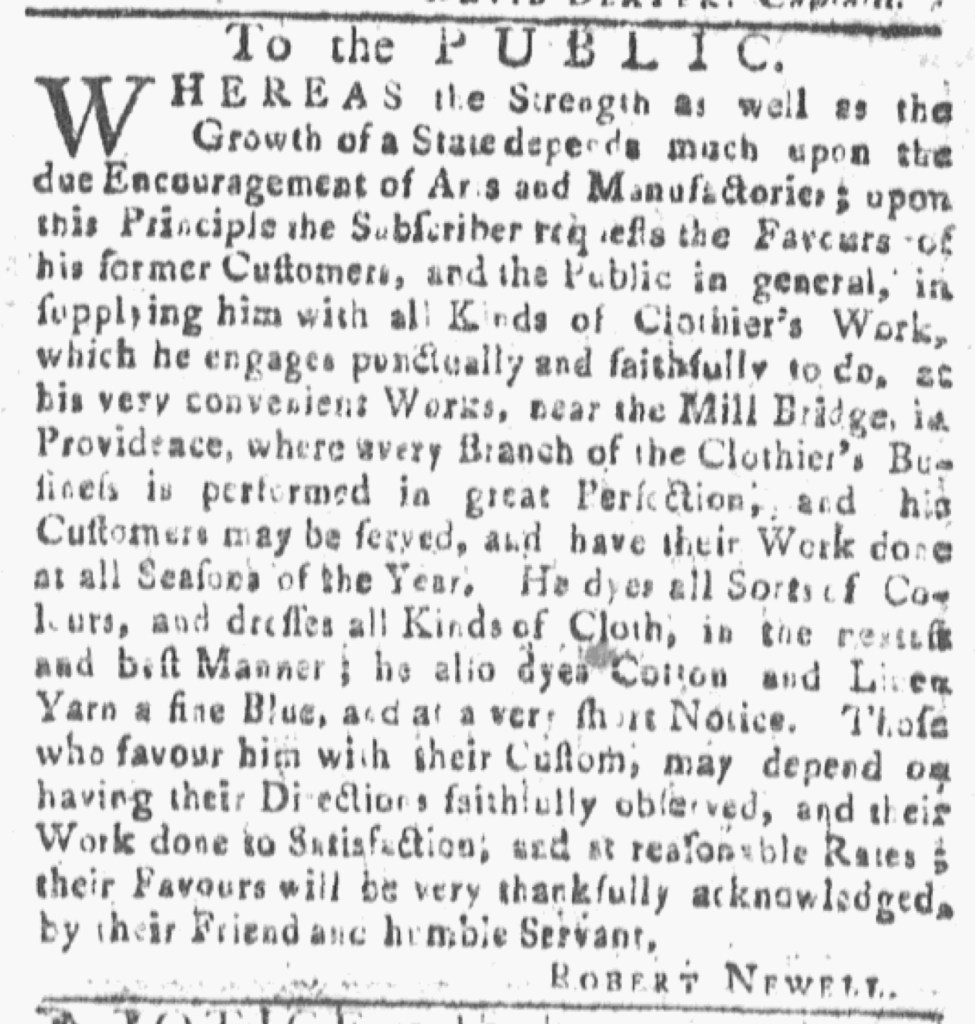
“The Strength as well as the Growth of a State depends much upon the due Encouragement of Arts and Manufactories.”
Robert Newell undertook “all Kinds of Clothier’s Work … at his very convenient Works, near the Mill Bridge, in Providence.” In an advertisement in the June 29, 1776, edition of the Providence Gazette, he informed the public that “every Branch of the Clothier’s Business is performed in great Perfection” when customers entrusted him their instructions for treating textiles. For instance, he “dyes all Sorts of Colours, and dresses all Kinds of Cloth, in the neatest and best Manner.” In addition, he “also dyes Cotton and Linen Yarn a fine Blue, and at a very short Notice.” Newell made skill and quality centerpieces of his appeals to the public, yet he also emphasized price and customer service. He declared that he “engaged punctually and faithfully to do” the work delivered to his “convenient Works,” pledging that “[t]hose who favour him with their Custom, may depend on having their Directions faithfully observed, and their Work done to Satisfaction, and at reasonable Rates.”
Artisans and others regularly made all those appeals in their newspaper advertisements. Newell added one more that he believed would resonate with the public as they contemplated current events, especially the war and calls for the colonies to declare independence rather than seek redress of grievances within the British imperial system. The clothier opened his notice with a pronouncement with wording that echoed the resolutions made by provincial congresses that appeared elsewhere in the public prints. “WHEREAS the Strength as well as the Growth of a State depends much upon the due Encouragement of Arts and Manufactories,” Newell asserted, “upon this Principle the Subscriber requests the Favours of his former Customers, and the Public in general, in supplying him with all Kinds of Clothier’s Work.” Beyond all his appeals concerning quality and customer service, Newell claimed that residents of Providence and other towns in the area had a civic duty to employ him if they wished for their country to prosper and thrive. He deployed language similar to the eighth article of the Continental Association devised by the Second Continental Congress and adopted throughout the colonies: “we will, in our Several Stations, encourage Frugality, Economy, and Industry; and promote Agriculture, Arts, and the Manufactures of this Country.” The decisions that colonizers made in the marketplace, as producers and as consumers, had political implications. The Second Continental Congress made that clear. Newell endorsed that position and sought to use it to his own advantage to attract customers for his “Clothier’s Business.”
[…] “domestic manufactures,” goods made locally rather than imported from Great Britain. Some entrepreneurs ran newspaper advertisements that promoted “domestic manufactures” that they made or sold, […]