Slavery Advertisements Published May 8, 1767

The Slavery Adverts 250 Project chronicles the role of newspaper advertising in perpetuating slavery in the era of the American Revolution. The project seeks to reveal the ubiquity of slavery in eighteenth-century life from New England to Georgia by republishing advertisements about enslaved people – for sale as individuals or in groups, wanted to purchase or for hire for short periods, runaways who liberated themselves, and those who were subsequently captured and confined in jails and workhouses – in daily digests on this site as well as in real time via the @SlaveAdverts250 Twitter feed, utilizing twenty-first-century media to stand in for the print media of the eighteenth century.

The project aims to provide modern audiences with a sense of just how often colonizers encountered these advertisements in their daily lives. Enslaved men, women, and children appeared in print somewhere in the colonies almost every single day. Those advertisements served as a constant backdrop for social, cultural, economic, and political life in colonial and revolutionary America. Colonizers who did not purport to own enslaved people were still confronted with slavery as well as invited to maintain the system by purchasing enslaved men, women, and children or assisting in the capture of so-called “runaways” who sought to free themselves from bondage. The frequency of these newspaper advertisements suggests just how embedded slavery was in colonial and revolutionary American culture in everyday interactions beyond the printed page.

These advertisements also testify to the experiences of enslaved men, women, and children, though readers must consider that those experiences have been remediated through descriptions offered by enslavers rather than enslaved people themselves. Often unnamed in the advertisements, enslaved men, women, and children were not invisible or unimportant in early America.

These advertisements appeared in colonial American newspapers 250 years ago today.
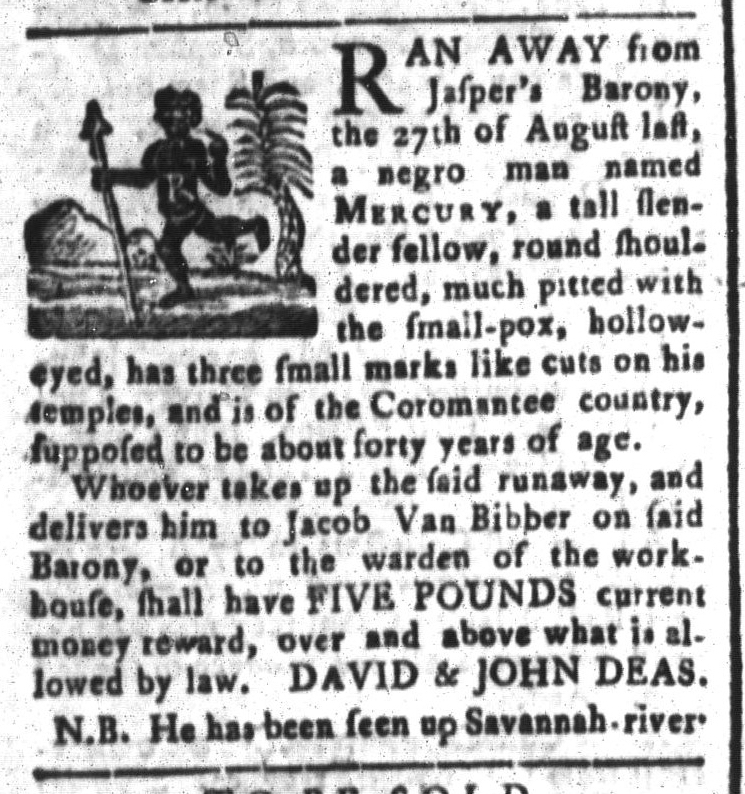
May 8 - South-Carolina and American General Gazette Slavery 1
South-Carolina and American General Gazette (May 8, 1767).

**********

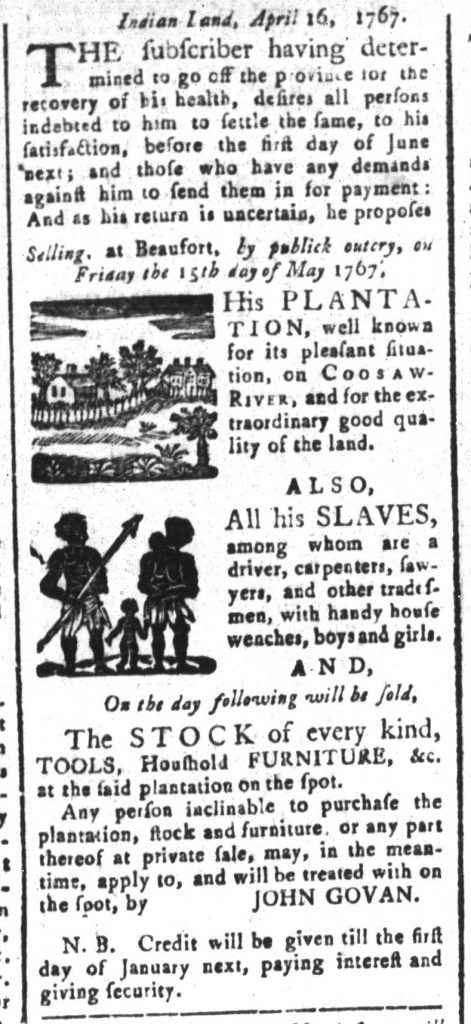
May 8 - South-Carolina and American General Gazette Slavery 2
South-Carolina and American General Gazette (May 8, 1767).

**********

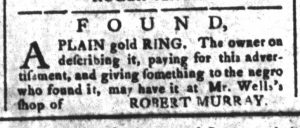
May 8 - South-Carolina and American General Gazette Slavery 3
South-Carolina and American General Gazette (May 8, 1767).

**********

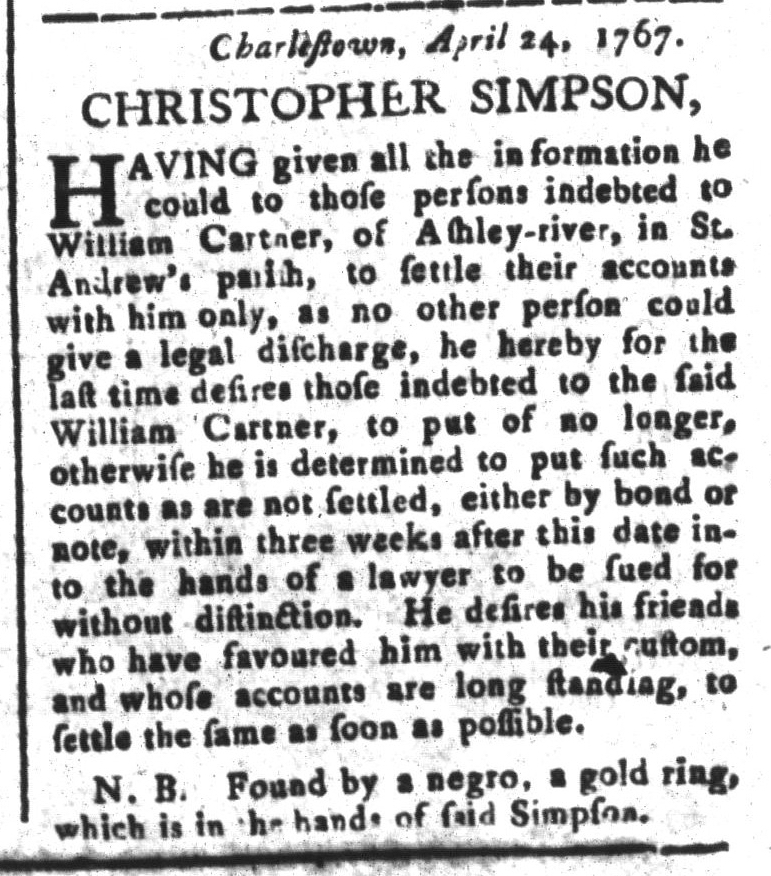
May 8 - South-Carolina and American General Gazette Slavery 4
South-Carolina and American General Gazette (May 8, 1767).

**********

May 8 - South-Carolina and American General Gazette Slavery 5
South-Carolina and American General Gazette (May 8, 1767).

**********

May 8 - South-Carolina and American General Gazette Slavery 6
South-Carolina and American General Gazette (May 8, 1767).

**********

May 8 - South-Carolina and American General Gazette Slavery 7
South-Carolina and American General Gazette (May 8, 1767).

**********

May 8 - South-Carolina and American General Gazette Slavery 8A
South- Carolina and American General Gazette (May 8, 1767).

**********

May 8 - South-Carolina and American General Gazette Slavery 8B
Continuation of previous advertisement from South-Carolina and American General Gazette (May 8, 1767).

**********

May 8 - South-Carolina and American General Gazette Slavery 9
South-Carolina and American General Gazette (May 8, 1767).

**********

May 8 - South-Carolina and American General Gazette Slavery 10
South-Carolina and American General Gazette (May 8, 1767).

**********

May 8 - South-Carolina and American General Gazette Slavery 11
South-Carolina and American General Gazette (May 8, 1767).

**********

May 8 - South-Carolina and American General Gazette Slavery 12
South-Carolina and American General Gazette (May 8, 1767).

March 25

GUEST CURATOR: Ceara Morse

What was advertised in a colonial American newspaper 250 years ago today?

Mar 25 - 3:25:1767 Georgia Gazette
Georgia Gazette (March 25, 1767).

“HENRY SNOW, Distiller from London, MAKES and SELLS … FINE Georgia Geneva.”

Henry Snow distilled many different spirits, including “Georgia Geneva,” “Orange Shrub,” and “Mulberry Brandy.” Many of the spirits he distilled could probably be found in local taverns.

Taverns were very important gathering places in colonial and Revolutionary America. An article about the Queen’s Head Tavern (now more commonly known as Fraunces Tavern) in New York City states, “Taverns were centers of community in the 18th century.” They were where people came to stay as well as just come in for a drink and learn of what was going on in the area. Imported spirits sometimes did not come fast enough to keep up with their popularity in taverns and households, thus American produced spirits were needed to help provide taverns and other consumers with the alcoholic beverages they desired. That’s where American products, like Henry Snow’s spirits, came into play. Because it was expensive to even import these goods, the domestic products were that much better.

 **********

ADDITIONAL COMMENTARY: Carl Robert Keyes

Henry Snow walked a fine line in his advertisement for a variety of spirits “Distilled and sold at his shop” in Savannah. As Ceara notes, he produced an array of cordials, brandies, and other liquor to compete with imports at affordable prices. Yet he wanted to assure potential customers of the quality of the spirits he distilled. To do so, he adopted a strategy deployed by many artisans who placed advertisements in eighteenth-century newspapers: he indicated his place of origin along with his occupation.

In this case, Snow was not merely a distiller but instead a “Distiller from London.” This imbued him and his products with greater cachet by suggesting connections to the cosmopolitan center of the empire and perhaps even specialized training compared to his local competitors. It also served as a recommendation for the dozen or so different types of spirits he distilled, suggesting that they were among the most popular among consumers in the metropole. Just as tailors implied their familiarity with the latest fashions by stating they were “from London,” Snow hinted that he distilled spirits currently in vogue rather than backwater alternatives to the beverages enjoyed by “gentlemen” on the other side of the Atlantic.

Doing so also meant making assurances about the quality of his locally produced liquors, describing some of them as “fine” or “superfine.” (The layout of the advertisement suggests that the distiller may have intended for “FINE” to describe all of the spirits in the first column and all or most in the second.) As far as Snow’s brandy was concerned, “Any gentlemen who may be pleased to favour him with their orders” could depend on it being “equal to French” brandy. His usquebaugh, however, was an exception. It was merely “little inferior to Irish.” It appears that Henry Snow knew better than to suggest that his whiskey was equal or superior to any produced and imported from Ireland. “Little inferior to Irish” was exceptionally high praise indeed!

October 15

GUEST CURATOR: Jordan Russo

What was advertised in a colonial American newspaper 250 years ago today?

oct-15-10151766-georgia-gazette
Georgia Gazette (October 15, 1766).

“Goods, suitable for the season.”

Cowper and Telfairs’ store had just received a large assortment of items imported from London. After the lengthy list of items that they sold, the partners added that “they shortly expect other articles from England and Scotland to make a complete assortment of goods for this country and season.” It was good to add that they would be receiving other items so customers would come back and purchase more from their store.

This advertisement was in the newspaper in October; colonists would soon need items for the winter that was coming, even if it would not be as cold as in New England or even Virginia. The advertisement states the supplies and clothing were “suitable for the season,” making potential buyers aware that this store had goods that would help them get through the winter. Throughout the colonies, settlers made preparations. According to David Robinson, “Mothers taught daughters how to card wool and coax soft fibers from the hard stems of flax; how to spin fibers into threads; how to stitch and mend the heavy coats and hooded cloaks that soon must ward off the biting winds.” Cowper and Telfairs’ store had “a variety of other ready-made cloaths” that colonists could purchase as well as an assortment of textiles they could use to make coats, cloaks, and warmer clothing that they would need for winter weather, even if winter in Georgia was not as extreme as in colonies further north.

**********

ADDITIONAL COMMENTARY: Carl Robert Keyes

Not long ago guest curator Nicholas Commesso examined an advertisement from the Massachusetts Gazette in which William Palfrey marketed “Articles suitable for the approaching Season.” He noted that colonists in Boston and its hinterland needed to take into account that fall had commenced and winter would arrive soon. Palfrey attempted to sell his goods by reminding colonists that it was time to start making preparations.

In my additional commentary I noted that “suitable to the season” was a stock phrase deployed in newspaper advertisements in Philadelphia and, more generally, in New England the Middle Atlantic colonies. I have not worked as extensively with advertisements from the Chesapeake or the Lower South, so I was uncertain if that was the case in those locales or if regional differences existed. I suggested that this merited further investigation.

Jordan turned her eye to that question today, identifying the same language in an advertisement from a newspaper printed in the Georgia Gazette. While one advertisement does not demonstrate a pattern or widespread usage of “suitable for the season,” it does indicate that the phrase was not unknown in the area. Cowper and Telfairs likely meant something a bit different – or had somewhat different merchandise in mind – than William Palfrey did when they described their wares as “suitable for the season.” Each advertiser would have taken into account local conditions.

As Jordan notes, the shopkeepers concluded by describing the items “from England and Scotland” they intended to have in stock soon as “goods for this country and season.” In addition to attempting to lure customers back to their store for subsequent visits, Cowper and Telfairs also signaled that they knew exactly what kind of merchandise would be arriving on ships expected in port soon. Most likely they had negotiated with their contacts on the other side of the Atlantic and placed orders for specific goods. London merchants sometimes tried to pawn off surplus inventory, expecting colonial retailers to accept and sell whatever was sent to them, but Cowper and Telfairs suggested that their customers would be pleased with the selection they offered because their wares had been chosen with Georgia and its climate in mind.

September 24

What was advertised in a colonial American newspaper 250 years ago today?

sep-24-9241766-georgia-gazette
Georgia Gazette (September 24, 1766).

“May be had at the Printing-Office … A SERMON.”

James Johnston, the printer of the Georgia Gazette, advertised the second edition of “A SERMON Preached in the Meeting at Savannah in Georgia, June 25th, 1766.” Although he did not specify the topic of this sermon, the four lines from Galatians that concluded the advertisement suggested that it addressed the uneasy relationship between the colonies and Great Britain that had been occasioned by Parliament’s attempts to regulate commerce within the empire, especially within its North American colonies. “Brethren, ye have been called unto liberty,” the biblical verses began, but concluded with a warning to “take heed that ye not be consumed one of another.” Johnston apparently presumed that potential customers/readers were so familiar recent political events, in general, and this sermon, in particular, that he did not need to state explicitly that it addressed the Stamp Act.

Johnston was certainly advertising John Joachim Zubly’s “The Stamp Act Repealed: A Sermon.” The title page of the second edition of that thirty-page duodecimo pamphlet included the same verses and other information that also appeared in the advertisement, including the assertion that it had been “First published at the Request and Expence of the Hearers.” The second edition was simultaneously published in Charleston by Peter Timothy and in Philadelphia by Heinrich Miller.

sep-24-pamphlet-cover
John Joachim Zubly, The Stamp-Act Repealed:  A Sermon (Savannah, GA:  James Johnston, 1766).  American Antiquarian Society.

In an introduction to the “Sermon,” Randall M. Miller notes that Zubly “captured the feelings of other prominent Georgians in 1766 who had recoiled from the strong words and threats of the Stamp Act crisis but also who had resented Parliament’s encroachment on American rights.” The sermon “stressed obedience to law and the reciprocal obligations of both Christian rulers and subjects to honor law and order.”[1]

By the time the second edition was published, colonists had known for several months that the Stamp Act had been repealed (which had led to Zubly preaching this sermon for a day of thanksgiving). One crisis had been averted, but colonists continued to grapple with their relationship to Britain, especially in the wake of the Declaratory Act. Still, few colonists were prepared at that time to sever ties with Britain. Johnston marketed a sermon that might assist readers in maintaining their identity as Britons while acknowledging that they had been slighted by Parliament. “We seemed like people that had been apprehensive of being shipwrecked and happily made a harbour,” Zubly proclaimed.[2] In publishing, marketing, and selling a second edition of the sermon, Johnston and his counterparts in Charleston and Philadelphia amplified that message to greater numbers of colonists.

**********

[1] Randall M. Miller, “A Warm & Zealous Spirit”: John J. Zubly and the American Revolution, A Selection of His Writings (Macon, GA: Mercer University Press, 1982), 31.

[2] John Joachim Zubly, The Stamp-Act Repealed: A Sermon (Savannah, GA: James Jonhnson, 1766), 28.

September 14

What was advertised in a colonial American newspaper 250 years ago this week?

sep-14-9131766-providence-gazette
Providence Gazette (September 13, 1744).

“Likewise to be sold at the same Place …”

Most readers of the Providence Gazette in 1766 probably would not have paused to question if this constituted one advertisement or two separate advertisements. For historians of printing and/or advertising interested in quantifying and analyzing the number of advertisements that appeared in colonial newspapers, on the other hand, it raises a conundrum.

At first glance, it appears to be a single advertisement, especially since the phrase “Likewise to be sold at the same place” functions as a transition from a list of books for sale to a more elaborate description of a particular book sold by the same advertiser. However, the two halves of this advertisement appeared separately, in different columns, in the previous issue. The list of books appeared at the bottom of a column and the advertisement for the pamphlet on making pearl ashes was at the top of the next column. This would have had the effect of presenting them sequentially to anybody who read the newspaper from first page to last, even through they were spatially separated. The printer likely intended them to be distinct, yet related advertisements. Still, the absence of a line separating them when they appeared one above the other (the same sort of line that defined the boundaries of other advertisements that appeared in the issue) serves as a visual cue indicating a single advertisement.

For the most part, it doesn’t much matter if this was one advertisement or two, though it does demonstrate that printers were able to leave some content (namely advertisements) in their forms and move them around to fit their needs from issue to issue.

Still, this presents a frustrating situation for certain research questions. For other projects I have attempted to count the number of advertisements placed by members of the book trade as a proportion of total advertisements. This example, if counted only once, downplays the influence of printers and booksellers on eighteenth-century advertising, especially considering its length relative to other advertisements in the same issue. This suggests that tabulating column inches would be a better method for making such assessments, but that method would be much more labor intensive (not necessarily a good justification for not doing it) as well as impossible to do with microfilmed and/or digitized sources that do not include measurements among the metadata (a better explanation for not measuring column inches). For researchers that do not have access to the original newspapers, tabulating column inches simply would not be possible. Counting how many advertisements appeared, while flawed, at least allows for some sort of metrics when working with surrogates rather than original sources.

August 28

What was advertised in a colonial American newspaper 250 years ago today?

Aug 28 - 8:28:1766 Maryland Gazette
Maryland Gazette (August 28, 1766).

“In your Paper of the 15th ult. I Advertised a Conditional SALE of my Houshold Furniture, &c.”

John Evitts packed so much into his open letter to Jonas Green, the printer of the Maryland Gazette, a letter reprinted in its entirety as an advertisement, that it is difficult to know where to start.

Let’s start by having a look at the genre of this advertisement. Although advertisements were not grouped together with other similar advertisements in the eighteenth century (legal notices with other legal notices; runaway slaves with other runaway slaves; consumer goods with other consumer goods), they did fall into several broad categories easily recognizable by readers. Advertisers occasionally played with form and genre by dividing the advertising space they purchased into two sections and submitting copy that pursued two different purposes, but within the distinct sections of such advertisements they usually relied on standard or formulaic wording.

To some extent, John Evitts departs from that practice, perhaps as the result of his advertisement originating as a letter (itself an interesting transformation of genre). His notice combines aspects of standard advertisements for vendue sales with aspects of standard advertisements for runaway wives (although it does not name his wife), but those elements comprised only the last two of four paragraphs. Either or both of the third and fourth paragraphs would not have appeared out of place as standalone advertisements.

Evitt’s letter-cum-advertisement, however, included much more. In the second paragraph he provided details about his ongoing dispute with his wife. While it might have seemed questionable to air private affairs in the public prints, Evitts may have felt that he had nothing to lose. After all, he was certain “that many of yours” were already aware of “the unhappy Difference subsisting between my Wife and me.” Annapolis was not a big town. Word got around. Perhaps Evitts felt he was better served to address gossip directly in the newspaper. It also gave him an opportunity to score some points. Despite the personal embarrassment he may have experienced from making a public acknowledgment about the disharmony in his household, his letter was calculated to diminish the reputation of his wife (at least from his rendition of events, which may or may not have matched what actually happened). Evitts stated that he had “endeavoured for a Reconciliation,” but that his wife “absolutely refused.” Furthermore, she responded with “insulting Language,” hardly becoming of a woman in the eighteenth century. In addition, he ahd been “insulted by her Friends.” Most advertisements for runaway wives were as formulaic as the third paragraph, but Evitts provided more details elsewhere in his advertisement.

It seems that Evitts was preparing to sell his house and his “Houshold Furniture, &c.” as a result of the discord with his wife. He had advertised this sale several weeks earlier, but, unfortunately for him, it “has not succeeded to my Wish and Expectation.” One of the most difficult parts of studying eighteenth-century advertising concerns the reception and effectiveness of commercial notices. Did they work? Very rarely did advertisers give any sort of indication about the results their marketing efforts generated. In this case, however, Evitts did report a rather disappointing result. It was possible that his advertisement was not especially effective, but, given the very public nature of the squabble with his wife, it was also possible that neighbors and other residents did not want to insert themselves into the Evittses’ domestic antagonisms. Whatever the explanation, Evitts retained hope that advertising could yield successful results. He sent the subsequent advertisement, the fourth paragraph of his open letter, desiring that it “may prove more effectual” than the first.

August 25

What was advertised in a colonial American newspaper 250 years ago today?

Aug 25 - 8:25:1766 Newport Mercury
Newport Mercury (August 25, 1766).

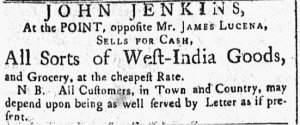
“All Customers … may depend upon being as well served by Letter as if present.”

In an age of online shopping, modern consumers are accustomed to the convenience of purchasing goods to be delivered directly to their homes without visiting stores to examine the products they are buying. In the evolution of shopping, this seems like a natural progression from catalog shopping, which has been a popular means of distributing merchandise to consumers for more than a century.

Both means of acquiring goods have been considered simultaneously disruptive and revolutionary, but such narratives obscure continuities with consumer culture in earlier eras. Consider, for instance, this brief advertisement for “All Sorts of West-India Goods, and Grocery” placed by John Jenkins. He informed “All Customers, in Town and Country” that they “may depend upon being as well served by Letter as if present.” In effect, Jenkins offered an early variation of mail order delivery. Customers wrote to inform him which items they wished to purchase. In turn, he had the items delivered to them. While such an arrangement was not a standard business practice mentioned in most advertisements, it was common enough in the 1760s that customers would have readily recognized this service.

Jenkins’s advertisement does differ in one significant way from others by merchants and shopkeepers who solicited orders through the post: its brevity. Most such advertisements included much more extensive lists of the goods that had been imported and were available for sale. Jenkins, on the other hand, did not specify any particulars. He did not name any specific merchandise. Why not? Could he not afford a lengthier advertisement? How effective was such a truncated advertisement? Did potential customers write to him in hopes he stocked the items they desired? Jenkins certainly offered a convenience to his customers, but it may have been negated by not providing enough information about his wares to guide customers in making their choices.

August 24

What was advertised in a colonial American newspaper 250 years ago this week?

Aug 24 - 8:23:1766 Providence Gazette
Providence Gazette (August 23, 1766).

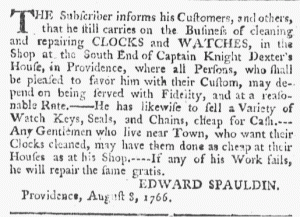
“THE Subscriber … still carries on the Business of cleaning and repairing CLOCKS and WATCHES.”

Publication of the Providence Gazette lapsed for more than a year from May 11, 1765, to August 9, 1765 (with the exception of two “extraordinary issues” on August 24, 1766, and March 12, 1766). The Stamp Act played a role in temporarily suspending the newspaper, but in the revival issue Sarah Goddard and Company indicated that an “inadequate Number of Subscribers” had delayed its return after the hated legislation had been repealed.

When the Providence Gazette once again commenced publication, it included an advertisement from clock- and watchmaker Edward Spauldin, an advertisement that appeared in all four issues published in August 1766. This advertisement had previously appeared in the most recent extraordinary on March 12, 1766. For the August iterations, a nota bene promoting compasses for mariners had been removed and the date listed below Spauldin’s name had been updated. Otherwise, the advertisement was the same, from the text to some rather curious line breaks. It’s possible that the type may not have been reset at all; it may have been sitting in the form for months.

Edward Spauldin made a decision to advertise in the extraordinary issue published nearly half a year earlier. Upon learning that the Providence Gazette would be revived, did he once again decide to place an advertisement in hopes of attracting customers? Or did the Providence Gazette publish his advertisements in order to fulfill a bargain that had been made months earlier? The reappearance of his advertisement can be interpreted in more than one way. It might indicate an enthusiastic advertiser who saw returns from his marketing efforts earlier in the year and hoped to make similar gains once again. Alternately, since the printer had been attempting to revive the newspaper for some time, it might have merely been the continuation of a set number of insertions that had been delayed.

August 23

What was advertised in a colonial American newspaper 250 years ago today?

Aug 23 - 8:23:1766 Providence Gazette
Providence Gazette (August 23, 1766).

“A most curious four wheeled Carriage, called the AETHERIAL VEHICLE.”

Thomas Sabin provided transportation between Providence and Boston “or elsewhere” for his clients, but he marketed an experience (not unlike modern car manufacturers and airlines). According to his advertisement, the important part of a trip was not necessarily arriving at the destination. Instead, enjoying the journey itself, including the amenities of his “AETHERIAL VEHICLE,” transformed getting from here to there into an event itself.

This was no ordinary “four wheeled Carriage,” Sabin proclaimed. A variety of factors, including its “wonderful and most elegant Construction,” merited an equally wonderful and most elegant name – the “AETHERIAL VEHICLE” – that distinguished it from any of the other carriages, coaches, chaises, phaetons, and, especially, stage wagons common in colonial America.

Sabin conjured up images of practically gliding from place to place, compared to the bumpy ride passengers experienced when using other wheeled vehicles. “It is airy, and more easy than any other Carriage,” he explained. “It would be almost impossible to describe it’s uncommon Machinery in Words, so as to give an adequate Idea of its Ease and Use.” Sabin implicitly challenged readers with doubts about the accuracy of this hyperbolic description to engage his services and judge for themselves, a crafty way to generate more business.

He also deployed another strategy to encourage the curious to become customers. “Those who are not inclined to ride in it, and desire to see it, shall be waited upon by the Owner to view it, when in his Coach House, gratis.” Once Sabin had potential customers in his “Coach House” and was able to speak to them directly, he could work on convincing them to hire his “AETHERIAL VEHICLE.” It’s difficult to know Sabin conducted himself in person, but it’s possible he could have given the same sort of hard sell that modern consumers encounter when they visit car dealerships.

At the very least, Sabin assured clients that they would receive special treatment when they rode the “AETHERIAL VEHICLE.” He promised that “besides the Satisfaction of being conveyed in so convenient a Machine,” customers “may depend upon the most ready Observance of their Desires, and punctual Compliance with their Commands.” For colonists, this would have been the equivalent of hiring a limousine or flying first class.

July 19

What was advertised in a colonial newspaper 250 years ago this week?

Jul 19 - 7:18:1766 Virginia Gazette
Virginia Gazette (July 18, 1766).

“If not sold, which the publick will have notice of in the Gazette of that date, it will be sold at publick sale.”

Many of the newspapers that modern researchers consult have been preserved not as individual issues but instead in bound volumes that have drawn together weeks, months, or years of a single publication, arranged chronologically. The original subscribers might have bound those or archivists may have bound them for preservation at a later time. Either way, each bound volume often represents a collection of newspapers that belonged to an individual or a family.

That certainly seems to be the case with the copies of the Virginia Gazette from 1766 made available for public consultation by the Colonial Williamsburg Digital Library. Each issue has a fair amount of marginalia among the advertisements, a variety of marks and manuscript notes added after the newspaper was printed. Who made these notes? As I continue to work with (the digital surrogates of) these newspapers, it seems increasingly clear that the printers made these notes for their own purposes of bookkeeping and, as today’s advertisement suggests, editing.

First, consider the “3” next to the advertisement. This most likely suggests that it was the third time the advertisement appeared. Indeed, two weeks earlier it ran for the first time (with an “x” in manuscript added next to it) and for a second time in the previous week’s issue (with a “2” in manuscript added later). The same advertisement, with modifications to be discussed in a moment, ran the following three weeks (with a “4,” “5,” and “x” in manuscript added later in the corresponding weeks). Its appearance in a sixth consecutively published issue on August 8, 1766, was the last time it was inserted in the Virginia Gazette. These markings likely aided the printer in determining when it was time to discontinue the notice based on the advertiser’s orders.

The first version of the advertisement included a nota bene stating that if the plantation offered for sale was not purchased before July 18 that it would go up for “publick sale” (auction) at a later date, which would be announced “in the Gazette.” Today’s iteration of the advertisement appeared on that deadline, July 18. Apparently John Hollowell did not manage to sell the plantation “at private sale” because the advertisement appeared three more times.

Jul 19 - 7:25:1766 Virginia Gazette
Virginia Gazette (July 25, 1766).

The marks on today’s iteration of Hollowell’s advertisement indicate the revisions made for its subsequent appearances. The nota bene was dropped completely. A new headline appeared (announcing that the auction would take place on August 5, three days before the advertisement made its final appearance). The last two lines were slightly revised to incorporate a portion of the original nota bene. Otherwise none of the other type was reset. The remainder of the advertisement appeared just as it had originally.

The advertisement certainly tells us about real estate transactions in early America, but today I focused on the marginalia in a particular collection of the Virginia Gazette as a means of exploring how certain colonists (in this case, printers) used newspapers and advertisements beyond announcing sales and inciting demand. This offered a glimpse of some of the business practices of the printers of the Virginia Gazette.