
What was advertised in a revolutionary American newspaper 250 years ago today?
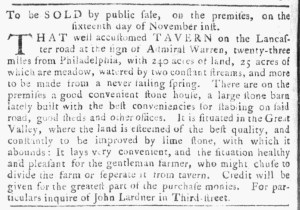
“THAT well accustomed TAVERN … at the sign of Admiral Warren.”
An advertisement for the upcoming sale of the “well accustomed TAVERN on the Lancaster road at the sign of Admiral Warren, twenty-three miles from Philadelphia,” appeared in the November 9, 1776, edition of the Pennsylvania Evening Post. The sale included “a good convenient house, a large stone barn lately built with the best conveniences for stabling on said road, good sheds and other offices.” The property came with “240 acres of land, 25 acres of which are meadow, watered by two constant streams.” It also had “a never failing spring” that would allow for the creation of additional streams for any “gentleman farmer” who chose to work the land.
The “TAVERN … at the sign of Admiral Warren” continues to operate today as General Warren Historic Hospitality. Their website explains that the “story of the General Warren can be followed through its name change.” George Aston founded the tavern in 1745, originally naming it in honor of Edward “Old Grog” Vernon (1648-1757), an admiral who served in the Royal Navy for forty-six years. A tavernkeeper in Boston also named his establishment for Vernon. More famously, George Washington’s estate and plantation, Mount Vernon, was named for the admiral. Just a year later, Aston renamed the tavern to the Sign of Admiral Warren to honor Admiral Peter Warren when news arrived about his command of the Royal Navy squadron that blockaded and aided in the capture of the French fortress at Louisbourg on Ile-Royale (Cape Breton Island) in 1745. Troops from New England contributed to the British victory over the French in that theater of the War of Austrian Succession, known as King George’s War in the colonies. In addition to a tavern in Pennsylvania, the towns of Warren, New Hampshire, and Warren, Rhode Island, were named for the admiral. Even after the Continental Congress declared independence, the tavern continued to be known as the Admiral Warren, a remnant of how the colonizers had previously embraced their British identity as members of the empire and participated in the celebration of its heroes. It was not until 1825, half a century after the battles at Lexington and Concord, that “it was renamed The General Warren Tavern … to honor Dr. Joseph Warren, who died at Bunker (Breed’s) Hill, Boston, in 1776, the first American general killed in the Revolution.” With just a slight alteration to its name, the tavern venerated an American hero and became part of a larger process of creating a distinctive American identity that took place throughout the nation during the eras of the American Revolution and the Early Republic.
Fittingly, the General Warren has its own “Washington slept here” story: “In 1777, New Jersey Continentals from Washington’s Army camped [there] the night before the ‘Battle of the Clouds’ on September 16.”