January 18

What was advertised in a colonial American newspaper 250 years ago today?

Pennsylvania Packet (January 18, 1773).

“AN ADDRESS TO THE INHABITANTS OF THE BRITISH SETTLEMENTS IN AMERICA, UPON SLAVE-KEEPING.”

In January 1773, John Dunlap, printer of the Pennsylvania Packet, announced that An Address to the Inhabitants of the British Settlements in America, upon Slave-Keeping, a work attributed to Benjamin Rush, was “Just published” and available for sale.  Dunlap leveraged his access to the press to give the announcement special prominence in his newspaper, treating it as an editorial rather than an advertisement.

Consider how Dunlap organized the contents of the January 18, 1773, edition of the Pennsylvania Packet and the supplement that accompanied it.  In the standard issue, news items and editorials appeared on the first two pages, followed by advertising on the last two pages.  Similarly, the two-page supplement began with two columns of news and the remainder of the content consisted of advertising.  Dunlap’s announcement masqueraded as an editorial that ran in the first column of the second page and overflowed into the next column, followed by news from London, Newport, New York, and Philadelphia.  The printer inserted an excerpt from the pamphlet, hoping to entice readers to want more and purchase their own copies.  In giving prospective customers an overview of the essay, Dunlap noted that the “Author of the above Address after having showed the inconsistency of Slave-keeping with the principles of humanity – justice – good policy and religion; concludes as follows.”  After reading that conclusion, prospective customers could acquire the pamphlet and examine the various arguments about humanity, justice, good policy, and religion for themselves.  In treating this announcement as an editorial or news item, Dunlap adopted a strategy sometimes deployed by other printers to promote books and pamphlets they published.

Whatever the conclusions reached in the Address … upon Slave-Keeping, Dunlap apparently did not find them sufficiently convincing to alter his policies concerning the kinds of advertising that he printed in the Pennsylvania Packet.  Two advertisements about enslaved people appeared on the facing page, one offering a “HEALTHY country bred NEGRO LAD” for sale and the other seeking to hire a “SMART, active WHITE or NEGRO BOY … to wait on table and go on errands.”  Candidates for that position included enslaved youths who did the work while their enslavers received the wages.  An advertisement in the supplement described a “Negro Fellow named LONDON” who liberated himself by running away from his enslaver in Baltimore and offered a reward for his capture and return.  Even as Dunlap treated the conclusion of the Address … upon Slave-Keeping as an editorial intended to arouse interest in a pamphlet he sold, he generated revenue by printing and disseminating advertisements that perpetuated slavery.

December 28

What was advertised in a colonial. American newspaper 250 years ago today?

Boston-Gazette (December 28, 1772).

“The only true and correct ALMANACKS from my Copy, are those printed by R. Draper, Edes & Gill, and T. & [J.] Fleet.”

As 1772 came to an end and the new year approached, Richard Draper, Benjamin Edes and John Gill, and Thomas Fleet and John Fleet continued their efforts to direct prospective customers to the edition of Nathaniel Ames’s almanac for 1773 that they collaboratively printed and sold.  The final issues of the Boston Evening-Post, the Boston-Gazette, and the Massachusetts Gazette and Boston Post-Boy for 1772 once again carried advertisements with a note from the almanac’s author that warned against counterfeit editions and proclaimed that the “only true and correct ALMANACKS from my Copy, are those printed by R. Draper, Edes & Gill, and T. & [J.] Fleet.”

None of those newspapers featured the extended version that ran in the Massachusetts Gazette and Boston Weekly News-Letter on December 24.  The Fleets even ran a streamlined version in the Boston Evening-Post, eliminated the introductory lines that declared “THIS DAY IS PUBLISHED, And TO BE SOLD by R. DRAPER, T. & J. FLEET, and EDES & GILL” as well as the final lines that advised “Purchasers, especially by the Quantity, are requested to be particular in enquiring whether they are printed by the above Printers, of whom ALMANACKS may be had at the cheapest Rate.”

The version of the advertisement in the Massachusetts Gazette and Boston Post-Boy remained unchanged, as did the version in the Boston-Gazette.  Edes and Gill did not include any fanfare about “JUST PUBLISHED” the first time they inserted the note from Ames in the Boston-Gazette.  They positioned that note just below local news, implying that it was just as much a piece of newsworthy information as an advertisement for an item they sold.  Those printers pursued a similar strategy the next time they ran the notice.  This time it did not serve as a transition from news to advertising.  Instead, it was the only advertisement that appeared on second page of the December 28 edition of the Boston-Gazette, running immediately below news from Warsaw.  That made it even more likely that anyone carefully perusing the news would encounter the notice from the printers.  Taking advantage of their access to the press to shape how information was disseminated to reader-consumers, Edes and Gill continued their practice of treating counterfeit almanacs that competed with their “true and correct” almanacs as news the community needed to know.  As part of their marketing efforts, they used the placement of the notice on the page to enhance their insinuation that consumers had a duty to choose the “true and correct” copies over any counterfeits.

October 24

What was advertised in a colonial American newspaper 250 years ago today?

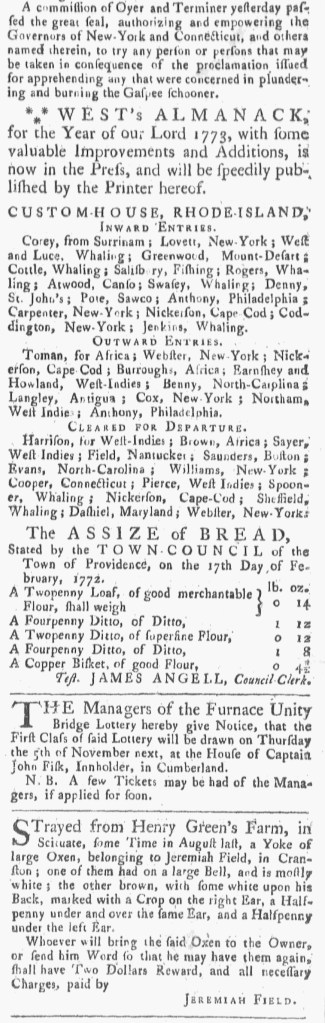
Providence Gazette (October 24, 1772).

“WEST’s ALMANACK … is now in the Press.”

Where advertisements appeared in colonial newspapers varied from publication.  Some printers reserved advertising for the final pages, placing news items on the front and interior pages.  Others placed advertisements on the first and last pages since those were the first pages printed when producing a standard four-page edition.  Advertisements, which often repeated for multiple weeks, could be set in type and printed first, saving the second and third pages for the latest news that arrived in the printing office.  In some instances, printers distributed advertising throughout the newspaper, placing paid notices in the rightmost column on each page.

John Carter, printer of the Providence Gazette, consistently placed advertising at the end of the newspaper.  Paid notices usually filled the final page, though sometimes news items ran in the upper left corner.  The third page often had advertising that appeared to the right of the news.  In general, Carter printed news and editorials in the first two pages.

That made the placement of an announcement about “WEST’s ALMANACK, for the Year of our Lord 1773, with some valuable Improvements and Additions” all the more noteworthy for its placement in the October 24, 1772, edition of the Providence Gazette.  Rather than appearing among the advertisements or even as the first of the advertisements, the notice ran on the third page, immediately below local news from Providence and above shipping news from the customs house, a regular news feature.  The first advertisements in the issue appeared lower in the column.  The notice about the almanac, authored by Benjamin West in an annual collaboration with the printer of the Providence Gazette, declared that it was “now in the Press, and will be speedily published by the Printer hereof.”  The notice appeared in larger type than the news above and below it, helping to draw attention to it.

Given his interest in the success of the almanac, Carter treated the notice about its publication as a news item.  In so doing, he exercised his prerogative as the printer of the newspaper to give the notice a privileged place, separate from other advertisements.  The following week, Carter inserted an advertisement to inform prospective customers that he “Just PUBLISHED” the almanac, placing it first among the advertisement in that issue.  In both his initial effort to incite interest and his subsequent attempt to market the almanac, Carter took advantage of his access to the press to increase the likelihood that consumers saw his notices.

September 5

Who was the subject of an advertisement in a colonial American newspaper 250 years ago today?

Providence Gazette (September 5, 1772).

“Lemuel Gustine, who was committed on Suspicion of counterfeiting New-York Money.”

Advertisements in colonial newspapers often delivered news to readers, supplementing the news that printers selected to appear elsewhere in their publications.  Colonizers who perused the September 5, 1772, edition of the Providence Gazette, for instance, learned of the death of Joshua Spooner, “late of Providence, Carpenter,” in an estate notice placed by John Smith.  They also found details about lotteries approved by the General Assembly for the purposes of raising funds “to build a Town Wharff in Warwick” and “for the repairing the Meeting House in the Town of Barrington; and also for the purchasing and opening some Highways in said Town.”  Another advertisement informed readers that Peter Heynes, “SCHOOLMASTER from DUBLIN,” planned to open an evening school with a term that ran from October 10 through April 10.

Advertisements also delivered news about crimes and their perpetrators.  Paul Tew, the sheriff, ran an advertisement about Lemuel Gustine, who had been committed to “his Majesty’s Goal in Providence … on Suspicion of counterfeiting New-York Money.”  That notice previously appeared in the August 22 and August 29 editions.  Disseminating news in the form of an advertisement had the advantage of keeping it in the public eye for longer durations.  It also reached readers who only occasionally perused newspapers and might have missed an article that ran only once in an issue they did not read.  Tew described Gustine, noting both the clothing he wore at the time he made his escape and a distinctive “cut on the Forehead in the Cherokee Mode.”  Gustine had been born in Saybrook, Connecticut.  The sheriff suspected that he was headed in that direction.  No matter where Gustine may have been at the time Tew’s advertisement spread the news of his escape from the jail in Providence jail for the third time, readers in Rhode Island, western Connecticut, and southern and central Massachusetts had access to information about his alleged crime, his appearance, and the reward for capturing and returning the fugitive to the sheriff.  Both Tew and the public had an interest in repeatedly disseminating news about criminals via advertisements in colonial newspapers.

July 8

Who was the subject of an advertisement in a colonial American newspaper 250 years ago today?

Newport Mercury (July 8, 1772).

“STOP a MURDERER!”

Yesterday I examined instances of advertisements in the Connecticut Courant delivering news to readers.  Notices about burglaries and prisoners who escaped from jails kept communities informed about recent events in their area.  On occasion, advertisements that doubled as news items merited regional coverage through publication in newspapers in several cities and towns.  Such was the case with the “STOP a MURDERER!” advertisements that ran in several newspapers published in New England in June and July 1772.

Elijah Williams, sheriff of Berkshire County in Massachusetts, reported that James Hervey, “a transient person” was suspected of robbing and murdering James Farrel in Stockbridge.  Williams listed the items that Hervey stole and might wear or attempt to sell, including “one pair of large silver shoe-buckles, marked I.F.”  The sheriff also provided a description of Hervey, “about six feet high, about 24 years old, very meanly clothed, of a fair complexion, very light coloured hair, supposed to be an Englishman.”  Williams enlisted the aid of the public in apprehending Hervey, offering a reward to whoever captured him and delivered him to the jail in Berkshire County.

This notice appeared among the advertisements, rather than integrated with news items, in several newspapers, including the July 3 edition of the New-London Gazette, the July 4 edition of the Providence Gazette, and the July 6 edition of the Newport Mercury.  Only Thomas Green and Samuel Green, printers of the Connecticut Journal and New-Haven Post-Boy, gave the notice a privileged place that suggested they considered it news as well as an advertisement.  They inserted the notice as the first item in the first column on the first page.  In combination with the headline, that increased the likelihood that readers would take note.  European news that arrived via ships from London and Bristol appeared immediately below.  In contrast, advertisements of various sorts surrounded the “STOP a MURDERER!” advertisement in other publications.  Still, the headline likely drew attention, especially considering that colonizers were accustomed to active reading as they navigated the dense text that filled eighteenth-century newspapers.

July 7

What was advertised in a colonial American newspaper 250 years ago today?

Connecticut Courant (July 7, 1772).

“The County Goal in this Place was broke up.”

Ebenezer Watson, printer of the Connecticut Courant, typically placed news items on the first pages of his newspaper and advertisements on the final pages.  Not every colonial printer did so.  Some dispersed paid notices throughout their newspapers, even placing advertisements on the first page.  Watson sometimes included advertisements in the final column of the second page, as he did in the July 7, 1772, edition of the Connecticut Courant, before continuing with additional news items on the third page and devoting the final page to advertisements.  As a general rule, only news items ran on the first page and only paid notice and the “POETS CORNER” appeared on the last page.

That did not mean, however, that readers did not encounter news when they perused the last page.  Among the advertisements for consumer goods and services in the July 7 issue, for instance, one advertisement featured a prominent headline that advised the public to “Take Notice!”  It described three men who recently escaped from the county jail.  Ely Warner, the jailer, offered rewards for the capture and return of Elisha Wadsworth of Hartford, “confined for Debt,” Abraham Curtiss of Suffield, “committed for Debt,” and John Grant, “a transient Person, committed for Burglary.”  Another advertisement had a dramatic headline that alerted readers to a “BURGLARY!”  Benjamin Sedgwick of Canaan reported that his shop “was broke open” and several items stolen on June 26.  He offered a reward for apprehending the thief and the stolen merchandise.  In another advertisement, Lynde Lord alerted the public that “noted Burglarian John Brown, who was under Sentence of Death for House breaking,” escaped from the jail in Litchfield sometime during the night of June 14.  Readers could easily recognize him since previous punishments included cropping his ears and branding.

Several of the advertisements in the Connecticut Courant delivered news, much of it more immediately relevant to residents of central Connecticut than stories reprinted from London, Philadelphia, and Boston.  When they paid to insert notices, advertisers acquired limited responsibilities as editors and journalists who aided in keeping their communities informed about local events.

May 28

Who was the subject of an advertisement in a colonial American newspaper 250 years ago today?

Pennsylvania Journal (May 28, 1772).

“CATHERINE DESSENER … came and stole away said boy.”

Beyond the articles and editorials that appeared elsewhere in eighteenth-century newspapers, advertisements often relayed news, gossip, or a combination of the two.  In a notice that ran in the May 28, 1772, edition of the Pennsylvania Journal, Thomas King relayed the story of a child that he had sheltered for more than five years and the child’s mother who “stole away said boy.”  Like advertisements about wives who “eloped” from their husbands, apprentices and indentured servants who ran away from their masters, and enslaved people who liberated themselves from their enslavers, King’s notice relayed the perspective of the advertisers and included only the details he chose to share with readers.  The mother, Catherine Dessener, might have given quite a different account had she placed her own advertisement.

According to King, Dessener left her son, Johannes, with him when the child was “only ten weeks old.”  Over the course of the next five and a half years, Dessener “made no satisfaction for [King’s] trouble of maintaining her child.”  King did not specify the details of any agreement he and Dessener reached when he agreed to shelter Johannes or how often he and the child had contact with Dessener while Johannes resided in his household.  He did warn others “not to take an indenture on said child, or entertain him at their peril.”  He might have been worried about Dessener earning the trust of another colonizer and then absconding with Johannes again … or he might have already had a claim on the child as an apprentice or servant when he reached an appropriate age.  King did not address issues that could have prompted Dessener to flee with her child, such as the quality of the food, clothing and shelter he provided or the treatment the child received in the King household.

King presented a straightforward story of a generous patriarch who welcomed a child of little means into his home, only to have the mother take advantage of the situation for years.  Whether or not that was accurate, King’s version framed the narrative for the public.  Dessener and her friends and relations may have circulated an alternative account via word of mouth, but they did not have the benefit of the power of the press that King purchased when he paid to place an advertisement in the Pennsylvania Journal.

January 14

What was advertised in a colonial American newspaper 250 years ago today?

Essex Gazette (January 14, 1772).

“Two LIGHT-HOUSES on Thatcher’s Island for the Safety of Navigation.”

Advertisements in colonial newspapers often carried important news that supplemented the contents that appeared elsewhere.  Consider, for example, an advertisement that first ran in the Essex Gazette on December 31, 1771, and then continued to appear in subsequent issues in 1772.  “WHeras the Government having at their own Charge erected Two LIGHT-HOUSES on Thatcher’s Island for the Safety of Navigation,” the advertisement informed readers, “This is to give Notice, that said LIGHT-HOUSES are finished.”  Furthermore, “the LAMPS in said HOUSES have been light ever since the 21st of this Month.”  According to the National Park Service, “The original towers [constructed in 1771] were replaced by the present 124-foot tall, twin granite towers in 1861.”  Now known as the Cape Ann Light Station, those towers are a distinctive site (and sight!) in the region.

The National Park Service also explains that Thacher Island, located about a mile offshore from Rockport, Massachusetts, gained its name “when the General Court granted it to Anthony Thacher in 1636-1637.”  Thacher and his wife were the sole survivors of a shipwreck near the island in 1635.  Over the next four decades, several other shipwrecks occurred in the area, prompting the Massachusetts colonial government to purchase the island with the intention of establishing a light station.  Only nine lighthouses operated in North America prior to the twin lights on Thacher Island.  The two towers made the site easy for mariners to identify.  The other lighthouses guided ships to entrances to harbors, making these lights the first to mark a hazardous location.  As the advertisement in the Essex Gazette noted, they contributed to “the Safety of Navigation.”  They were also the last lighthouses built before the colonies declared independence.

Readers of the Essex Gazette may very well have been aware of the construction of the lights on Thacher Island, but this advertisement confirmed for the entire community that the project had been completed and the lights now lit.  In addition, printers and merchants participated in extensive networks for exchanging newspapers and the information contained in them.  An advertisement in the Essex Gazette, the newspaper printed closest to the location of the new lighthouses, almost certainly helped in disseminating news that the lights on Thacher Island now warned vessels of treacherous waters.

October 5

What was advertised in a colonial American newspaper 250 years ago today?

Providence Gazette (October 5, 1771).

“Some evil-minded Person or Persons have attempted to destroy a new Store.”

John Carter, the printer of the Providence Gazette, did not include much local news in the October 5, 1771, edition of his newspaper.  Of the twelve columns spread over four pages in that issue, only two-thirds of a column featured news under the heading “PROVIDENCE.”  Such was the case in most colonial newspapers, most of them a weekly publication schedule.  Local news tended to spread by word of mouth before printers took their newspapers to press.

Even as printers like Carter made their own editorial decisions about which news to feature and which to exclude, advertisers paid to highlight certain events in the notices they placed.  As a result, advertisements often delivered news or elaborated on stories already in circulation.  Consider, for instance, an advertisement placed by the partnership of White, Allen, and Waterman.  According to that notice, “some evil-minded Person or Persons have attempted to destroy a new Store … by putting Fire through one of the Windows” and setting a barrel on fire.  Fortunately for the proprietors, that barrel contained “some Bayberry-Wax” and the fire “was happily extinguished by the running of the Wax.”  The partners offered a reward to “Whoever will give Information of the villainous Author or Authors of this wicked and diabolical Act, so that he or they may be legally convicted.”

Among the other advertisements in that issue of the Providence Gazette, readers encountered estate notices placed by executors, calls for creditors of colonists who presented petitions related to an Act for the Relief of Insolvent Debtors to appear in court, and an announcement that the proprietors of the Providence Library would meet the following week to conduct business vital to the continued operations of that institution.  Such local news that ran as advertisements, interspersed among notices for consumer goods and services, filled more space than the “PROVIDENCE” news selected by the printer.  Readers interested in all of the “freshest ADVICES, Foreign and Domestic” promised in the masthead needed to peruse the advertisements in addition to the other contents of the newspaper.

August 6

What was advertised in a colonial American newspaper 250 years ago today?

Connecticut Courant (August 6, 1771).

Many Gentlemen are enquiring concerning the situation, circumstances, &c of Dartmouth College.”

Colonial printers sometimes blurred the lines between news and advertising.  Such was the case with an item that appeared in the August 6, 1771, edition of the Connecticut Courant.  As the last item among the news in that issue or as the first item among the advertisements, Ebenezer Watson inserted a notice that functioned as both.  “Whereas many Gentlemen are enquiring concerning the situation, circumstances, &c of Dartmouth College,” Watson announced, “this may inform the public, That A Continuation of the Narrative of the Indian Charity-School in Lebanon in Connecticut; From the Year 1768 to the Incorporation of it with Dartmouth-College, and removal and settlement of it in Hanover, in the Province of New Hampshire, 1771 is lately published.”  The notice seemed to provide an overview of the recent history of Dartmouth College, but, like many advertisements for books, it simply listed the extensive title of the publication it promoted.

Eleazar Wheelock, president of Dartmouth College, penned the volume.  Watson, printer of the Connecticut Courant, printed the book and, in the notice that he placed in his own newspaper, informed readers that copies “may be had at the Printing Office in Hartford.”  He exercised his prerogative as printer to place his advertisement in a place that it looked like news, likely hoping to increase the number of readers who would take note of it even if they did not peruse other advertisements.  The items that appeared after it all had a format that readily identified them as advertisements, but Watson’s notice was more difficult to distinguish from the news items that filled most of the page.

In addition to using this advertisement as a transition between news and paid notices, Watson also made a request of other newspaper printers.  In a nota bene, he declared that “If the Printers in general would be so kind as to insert the above in their respective paper, the favor will be gratefully acknowledged, and possibly the public benefited.”  In asking his counterparts in other cities and towns to reprint his advertisement, Watson continued to treat it as a news item that delivered information for the purpose of better informing the public, not merely a commercial endeavor and means of generating revenue at his printing office in Hartford.  He apparently hoped that other printers would similarly present his advertisement as news of interest to their readers.