What was advertised in a colonial American newspaper 250 years ago this week?
New-York Journal (March 9, 1772).
“Her husband has absconded, to avoid the payment of his debts.”
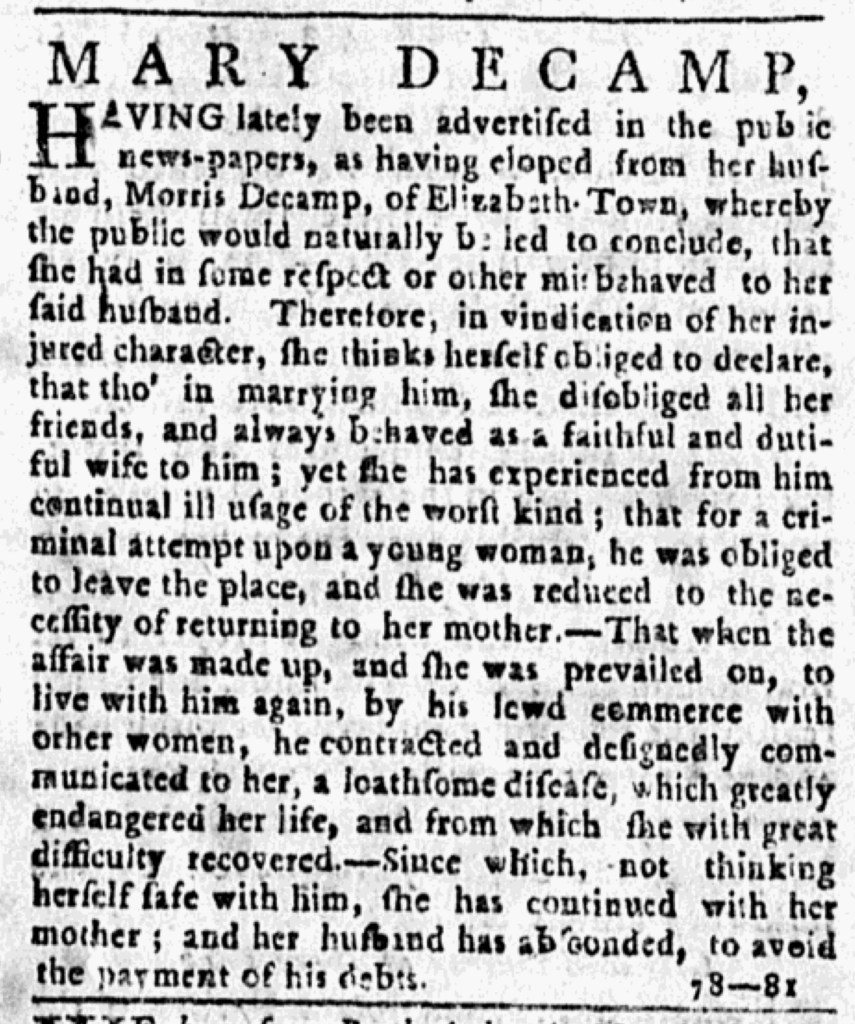
It began as a standard “runaway wife” advertisement in the January 19, 1775, edition of the New-York Journal. “WHEREAS my Wife Mary has lately eloped from me, and my perhaps endeavour to run me into Debt,” Morris Decamp proclaimed, “these are therefore to warn all Persons not to Trust or entertain her on my Account, as I will pay no Debts she may contract.” That advertisement ran for four weeks, but not without going unnoticed or unanswered by Mary.
Most women who appeared in the public prints as the subject of such advertisements did not have the means or opportunity to respond. Mary, however, did, perhaps with assistance from some of her relations. Her own advertisement began its run in the March 2 edition of the New-York Journal, placing it before the eyes of the same readers who saw her husband’s missive. She acknowledged that “the public would naturally be led to conclude, that she had in some respect or other misbehaved to her said husband” based on what they knew from his advertisement. On the contrary, she asserted, she “always behaved as a faithful and dutiful wife to him.” The misbehavior had been solely on his part. Mary “experienced from him continual ill usage of the worst kind,” yet his villainy extended beyond their household. The aggrieved wife alleged that Morris committed “a criminal attempt upon a young woman” that resulted in him having to leave town. Abandoned by her husband, Mary “was reduced to the necessity of returning to her mother.” Morris somehow managed to resolve that situation; Mary did not provide details but reported that “when the affair was made up, … she was prevailed on, to live with him again,” much to her regret. Her husband remained unreformed: “by his lewd commerce with other women, he contracted and designedly communicated to [Mary], a loathsome disease, which greatly endangered her life, and from which she with great difficulty recovered.”
The real story, Mary insisted, reflected poorly on her husband, not on her. She took to the pages of the New-York Journal“in vindication of her injured character.” Rather than “eloping” from Morris, she had returned to her mother because she did not consider herself safe with him. It was actually Morris who “has absconded, to avoid the payment of his debts.” Even as he tried to cut her off from his credit, her notice likely prompted others to think twice about doing business with him. Wives rarely placed rebuttals to the advertisements published by their husbands. In the rare instances that they did, women like Mary Decamp attempted to harness the power of the press to defend their reputations by setting the record straight.
What was advertised in a colonial American newspaper 250 years ago today?
Massachusetts Spy (February 16, 1775).
“I have no connection with said SUMNER.”
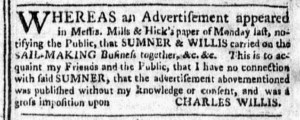
Charles Willis needed to correct an error. An advertisement in the February 13, 1775, edition of the Massachusetts Gazette and Boston Post-Boy proclaimed that “SUMNER and WILLIS … CARRY on the Sail-Making Business in all its Branches.” It gave their location and listed prices. Yet Willis had no knowledge of this partnership. Rather than wait for the next issue of the Massachusetts Gazette and Boston Post-Boy on February 20, he submitted his own advertisement to the Massachusetts Spy for inclusion in its February 16 edition.
“WHEREAS an Advertisement appeared in Messrs. Mills & Hick’s paper of Monday last, notifying the Public, that SUMNER & WILLIS carried on the SAIL-MAKING business together,” the aggrieved Willis asserted, “This is to acquaint my Friends and the Public, that I have no connection with said SUMNER, that the advertisement abovementioned was published without my knowledge or consent, and was a gross imposition upon CHARLES WILLIS.” The sailmaker was angry as he set the record straight. Readers of the Massachusetts Spy, on the other hand, may have been mildly amused by the drama that unfolded in the public prints. After all, a dispute between sailmakers could have been a welcome distraction from the hardships they encountered while the harbor remained closed to commerce because of the Boston Port Act.
Willis likely visited or contacted Mills and Hicks’s printing office about the offensive advertisement. It did not appear a second time, though the standard fee for advertisements provided for inserting them in three consecutive issues. Willis’s advertisement, for instance, ran in the Massachusetts Spy twice more before it was discontinued. Willis opted not to run a similar notice in the Massachusetts Gazette and Boston Post-Boy, the newspaper that carried the original “SUMNER and WILLIS” advertisement. That could have been because he did not wish to invest any more money on such notices in the public prints, yet it also suggests his confidence in the circulation of the Massachusetts Spy and ensuing conversations inspired by its contents, both news and advertisements. Advertising in just one newspaper sufficiently clarified that “SUMNER and WILLIS” were not indeed partners in the “Sail-Making Business.”
Who was the subject of an advertisement in a colonial American newspaper 250 years ago today?
Connecticut Courant (October 10, 1774).
“A Negro answering the above Discription has let himself to Mr. Jesse Leavensworth of New-Haven.”
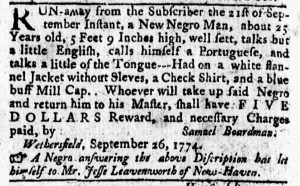
In the fall of 1774, Samuel Boardman of Wethersfield took to the pages of the Connecticut Courant and Hartford Weekly Intelligencer to offer a reward for the capture and return of a “New Negro Man” who liberated himself by running away. Boardman did not give a name for this man, but instead stated that he “talks but a little English, calls himself a Portuguese, and talks a little of the Tongue.” He offered a reward to “Whoever will take up said Negro and return him to his Master.” Dated September 26, the advertisement first appeared in the October 3 edition of the Connecticut Courant. It included a notation indicating that a “Negro answering the above Discription has let himself to Mr. Jesse Leavensworth of New-Haven.” Boardman most likely did not include that information in the copy he submitted to the printing office.
Instead, Ebenezer Watson, the printer, likely supplied it upon reading an advertisement that Leavenworth placed in the September 30 edition of the Connecticut Journal and New-Haven Post-Boy. After all, printers regularly exchanged newspapers in hopes of acquiring content for their own publications. Leavenworth devoted most of that notice to giving instructions for hiring his ferry, but added a note that recently a “lusty negro man, about 23 or 24 years old, speaks the Portuguese language, but little English” had “let himself to me.” Leavenworth hired the young man, but was suspicious that he was a fugitive seeking freedom and his enslaver was looking for him. Just in case, he supplemented his advertisement for the ferry with the description of the Black man who spoke Portuguese. Given the timing of the advertisements in the two newspapers, Boardman would not have seen Leavenworth’s notice when he drafted his own advertisement. If he had that information, he could have dispensed with advertising at all.
What role did Watson play in keeping Boardman informed about this development? He might have dispatched a message to the advertiser in Wethersfield, though he could have considered the note at the end of the advertisement sufficient to update Boardman, figuring that his customer would check the pages of the Connecticut Courant to confirm that his notice appeared. Watson could have also sent a message to Thomas Green and Samuel Green, the printers of the Connecticut Journal, along with his exchange copy of the Connecticut Courant, expecting they might pass along the information to Leavenworth. In addition, Leavenworth might have eventually encountered Boardman’s advertisement, depending on his reading habits, or otherwise heard about it. That alternative seems most likely. No matter what other action Watson took, inserting the note that connected the unnamed Black man in Boardman’s advertisement in the Connecticut Courant to the unnamed Black man in Leavenworth’s advertisement in the Connecticut Journal alerted readers that they could collect the reward if they decided to pursue the matter. The power of the press, including a printer whose assistance extended beyond merely setting type and disseminating the advertisement, worked to the advantage of Boardman, the enslaver, against the interests of the unnamed Black man who spoke Portuguese.
“YES, YOU SHALL BE PAID; BUT NOT BEFORE YOU HAVE LEARNED TO BE LESS INSOLENT.”
The saga continued. Elie Vallette, the clerk of the Prerogative Court in Annapolis and author of the Deputy Commissary’s Guide, did not bow to the public shaming that Charles Willson Peale, the painter, undertook in the pages of the Maryland Gazette in September 1774. Earlier in the year, Peale had painted a family portrait for Vallette and then attempted through private correspondence to get the clerk to pay what he owed. When Vallette did not settle accounts, Peale turned to the public prints. He started with a warning shot in the September 8 edition of the Maryland Gazette: “IF a certain E.V. does not immediately pay for his family picture, his name shall be published at full length in the next paper.” Peale meant it. He did not allow for any delay in Vallette taking note of the advertisement and acting on it. A week later, he followed through on his threat, resorting to all capitals to underscore his point, draw more attention to his advertisement, and embarrass the recalcitrant clerk. “MR. ELIE VALLETTE,” Peale proclaimed in his advertisement, “PAY ME FOR PAINTING YOUR FAMILY PICTURE.”
That still did not do the trick. Instead, it made Vallette double down on delaying payment. He responded to Peale’s advertisement, attempting to put the young painter in his place. In a notice also in all capitals, he lectured, “MR. CHARLES WILSON PEALE; ALIAS CHARLES PEALE – YES, YOU SHALL BE PAID; BUT NOT BEFORE YOU HAVE LEARNED TO BE LESS INSOLENT.” Vallette sought to shift attention away from his own debt by critiquing the decorum of an artist he considered of inferior status. That strategy may have worked, though only for a moment. Peale’s advertisement did not run in the next issue of the Maryland Gazette. That could have been because Peale instructed the printer, Anne Catharine Green, to remove his notice and returned to working with Vallette privately. Even if that was the case, it was only temporary. “MR. ELIE VALLETTE, PAY ME FOR PAINTING YOUR FAMILY PICTURE” appeared once again in the October 6 edition. Peale was not finished with his insolence. He placed the advertisement again on October 13 and 20. Vallette did not run his notice a second time, perhaps considering it beneath him to continue to engage Peale in the public prints. He had, after all, made his point, plus advertisements cost money. That being the case, the painter eventually discontinued his notice. Martha J. King notes that Vallette “eventually settled his account about a year later.”[1] For a time, advertisements in the only newspaper printed in Annapolis became the forum for a very public airing of Peale’s private grievances and Vallette’s haughty response.
**********
[1] Martha J. King, “The Printer and the Painter: Portraying Print Culture in an Age of Revolution,” Transactions of the American Philosophical Society 109, no. 5 (2021): 79.
Who was the subject of an advertisement in a colonial American newspaper 250 years ago today?
Pennsylvania Gazette (August 10, 1774).
“SAMUEL PENNOCK … has thought fit … to publish me in the Pennsylvania Gazette.”
Martha Pennock was not having it. Her husband, Samuel, a hatter, ran a newspaper advertisement that claimed she was not legally his wife because she had previously been married to John Morton of the Royal American Regiment. Her first husband was still alive for several years after Samuel married Martha, making her a bigamist and invalidating her marriage to the hatter. That being the case, Samuel advised the public “not to trust her on my account, for I will not pay any debts of her contracting.” It was quite a twist on the usual “runaway wife” advertisements that appeared so frequently in colonial newspapers.
In another twist, Martha responded in the public prints. Most women did not have the resources to counter the claims made by their husbands, especially after being cut off from their credit. That meant that the public had access to only one account, the one from the husband’s perspective, in newspapers, though conversations and gossip likely circulated alternate versions of what occurred. Martha not only published her rejoinder but did so very quickly. Samuel inserted his advertisement in the August 3, 1774, edition of the Pennsylvania Gazette. Martha’s notice ran in the next issue on August 10. If she became aware of what Samuel had done quickly enough, she could have responded in Dunlap’s Pennsylvania Packet on August 8, but waiting two more days meant that she presented her side of the story to readers in the same publication that carried her husband’s diatribe against her.
Martha’s narrative was quite different. She blamed the discord on “the instigation of his malicious friends,” asserting that Samuel and his friends “have used me extremely ill, at sundry times.” She denied “with a safe conscience” that she had another living husband, stating that she had been married to Samuel for eight years and “always behaved as a prudent wife to him. If necessary, she could provide “a sufficient testimonial of my lawful marriage to the said Pennock” as well as “an authentic power of attorney, under hand and seal, to collect his debts, and enjoy all that is or may be belonging to him hereafter.” Martha aimed to invalidate any claims that Samuel made, whether about having a first husband or about her rights as Samuel’s “lawful” wife. In doing so, she joined the ranks of relatively few women who responded in print to husbands who used advertisements to disavow their wives and blame them for discord within their households.
What was advertised in a colonial American newspaper 250 years ago today?
Connecticut Gazette (April 8, 1774).
“… that the Practice of Physick may be put under some better Regulation.”
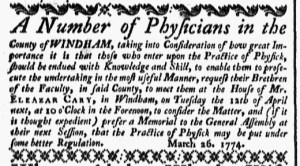
A “Number of Physicians in the County of WINDHAM” inserted an advertisement in the Connecticut Gazette in the spring of 1774. In it, they professed that they had been contemplating “how great Importance it is that those who enter upon the Practice of Physick, should be endued with Knowledge and Skill.” That was necessary, the physicians asserted, “to enable them to prosecute the undertaking in the most useful Manner,” achieving the best results for their patients. That being the case, they called a meeting of “their Brethren of the Faculty” in Windham County to discuss “the Matter, and (if it thought expedient) prefer a Memorial” or petition “to the General Assembly … that the Practice of Physick may be put under some better Regulation.” At a glance, their notice suggested that increased professionalization in their field would yield better care for patients.
The timing of their advertisement, however, suggests that this “Number of Physicians” may have had other motivations. A call for “some better Regulation” may have been an attempt to reduce or eliminate competition from others who provided various forms of medical treatment. Consider the testimonial about the hernia trusses “made and applied by Mr. STEPHEN JOHNSON, of Ashford, in Windham-County” that first ran in the March 25 edition of the Connecticut Gazette. Then note the date, March 26, on the announcement from the “Number of Physicians.” Did a “Number of Physicians” actually consult with each other before inserting that advertisement in the next issue of the Connecticut Gazette? Or did one of them see the testimonial about the trusses that proclaimed Johnson “hath the greatest Skill in that Business of any Man we ever heard of” and determine that such competition threatened the livelihoods and, just as significantly, the status of physicians in the area? Perhaps a single physician called the meeting, hoping to rally support among others. The advertisement also served as a counterpoint to the testimonial about Johnson’s trusses, especially when both appeared in the Connecticut Gazette on April 1 and on the same page on April 8.
Professionalization of the medical field accelerated in the late eighteenth century. Doctors displaced midwives, but women who provided care were not the only targets of physicians who received formal training. These two advertisements seem to tell a story of a “Number of Physicians” (or perhaps just one with a lot of initiative) to limit the medical treatment delivered by other men who did meet the standards of the “better Regulation” they envisioned.
What was advertised in a colonial American newspaper 250 years ago today?
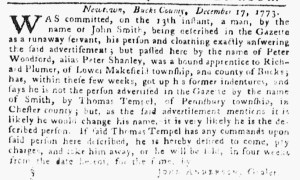
Pennsylvania Gazette (December 22, 1773).
“WAS committed … a man, by the name of John Smith, being described in the Gazette as a runaway servant.”
John Anderson, the jailer in Newtown in Bucks County, placed an advertisement in the December 22, 1773, edition of the Pennsylvania Gazette in hopes that it would come to the attention of Thomas Tempel of Pennsbury Township in Chester County, though he likely desired that other readers might supply additional information to help him sort out a situation at his jail. Anderson reported that on December 13 he detained a man named John Smith,” being described in the Gazette as a runaway servant, his person and cloathing exactly answering the said advertisement.” At least some colonizers closely read newspaper advertisements that described runaway indentured servants, convict servants, and apprentices or enslaved people who liberated themselves, making it worth the investment for masters and enslavers to place those notices.
Anderson stated that the man he believed was Smith “passed [in Newtown] by the name of Peter Woodford, alias Peter Shanley” and produced “former indentures” when he claimed he had been “a bound apprentice to Richard Plumer” in Lower Makefield Township in Bucks County. The jailer doubted this story and even the documents that Smith presented because the advertisement that previously ran in the Pennsylvania Gazette “mentions it is likely he would change his name.” Runaway servants and others often utilized that strategy to increase their chances of making good on their escapes. Accordingly, Anderson considered it “very likely he is the described person.” He did not mention any efforts to contact Plumer to determine whether the alleged Smith was actually his former apprentice. Instead, he advised that if Temple “has any commands upon the said person here described” that he should “come, pay charges, and take him away.” Otherwise, Anderson would sell Smith (or whoever he was) into a new indenture “in four weeks,” apparently unconvinced by his insistence that he was Peter Woodford or the documents he carried. A man of low status, unknown to the jailer in Newtown, did not seem to have much recourse to avoid this fate, though perhaps someone that Anderson considered trustworthy would see the advertisement and intervene on the detained man’s behalf. The prisoner also faced the possibility that Tempel would indeed go the Newtown and positively identify him. The power of the press had the potential to negate or, perhaps more likely in this instance, to strengthen the authority exercised by the jailer.
What was advertised in a colonial American newspaper 250 years ago this week?
Maryland Journal (November 6, 1773).
“PROPOSALS FOR ESTABLISHING A CIRCULATING LIBRARY IN BALTIMORE-TOWN.”
When he opened a circulating library in Annapolis in 1773, bookseller and stationer William Aikman faced competition in his efforts to recruit subscribers in Baltimore. Joseph Rathell announced his own intention for “ESTABLISHING A CIRCULATING LIBRARY IN BALTIMORE-TOWN” in the October 23 edition of the Maryland Journal. A week later, he published a longer advertisement, one that offered the same amenities, lower fees, and greater convenience for patrons than Aikman outlined in his notices.
In his updated address to prospective subscribers, Rathell emphasized the fees for “this much wish’d for Institution,” just “one Dollar a Quarter … (tho’ the Subscription to the Annapolis Library is One Guinea per Annum, besides the Expence of a Dollar a Year for Carriage of Books from thence to this Place by Water).” He expected readers to recognize the bargain for the quarterly fee, while simultaneously mocking Aikman’s most recent advertisement. Aikman apparently learned of Rathell’s “PROPOSALS” and, wary of the threat to his own efforts to expand his clientele beyond Annapolis, devised a plan to address the concerns that prospective subscribers had expressed about the “trouble and risk they run of procuring and returning the books.” In an advertisement in the October 30 edition of the Maryland Journal, the first issue after Rathell’s original advertisement, Aikman presented what he considered a reasonable solution, “any orders for books left with Mr. Christopher Johnston, merchant, in Baltimore, will be regularly forwarded by a packet that goes weekly between Baltimore and Annapolis.” Subscribers could request and return books for just a dollar a year, an additional fee that Rathell derided. Somehow, the bookseller in Baltimore became aware of Aikman’s proposal before it appeared in print in the Maryland Journal. In the same issue that Aikman first introduced delivery service Rathell published a rejoinder on another page. The advertisements ran next to each other in the November 6 edition, drawing even more attention to the bargain that Rathell offered. How did he know about Aikman’s newest proposal before reading the advertisement in the newspaper? The annual subscription fee previously appeared in notices in the Maryland Gazette, advertisements that Rathell could have seen, but the delivery service was a new aspect of Aikman’s library. Did someone in the printing office pass along that information?
Rathell sought to cater to “the Convenience of Gentlemen and Ladies of Literary Taste and Discernment” in Baltimore and surrounding towns, but he was not quite ready to launch his own circulating library. His advertisement undercutting Aikman also served as an invitation to prospective subscribers to submit their names within three weeks of his advertisement’s first appearance in the Maryland Journal. At that time, “if an adequate Number of Subscribers appear, the Library will be completed and opened without Delay.” Rathell encouraged subscribers “to be speedy in entering their Names … that he may be the sooner enable to provide a COLLECTION OF BOOKS … very considerable in Number.” He likely also intended that such haste would prompt prospective subscribers to choose between his library and Aikman’s library in Annapolis, boosting the prospects for his own by drawing subscribers away from a rival. This ploy did not work, in part because prospective subscribers considered Aikman’s proposal the more viable option. Rathell did not open a circulating library in Baltimore, despite the savvy appeals he made. Other factors defeated his plan. As Joseph Towne Wheeler explains, “the growing commercial town was still dependent upon the older community.”[1] After all, the Maryland Journal, Baltimore’s first newspaper, commenced publication just a couple of months earlier. “After the Revolution the situation was reversed,” Wheeler continues, noting that “when Parson Weems visited Annapolis in 1800, he could write, ‘There is not a book store in the whole town.’”[2] Baltimore was not quite ready for the circulating library that Rathell envisioned.
**********
[1] Joseph Towne Wheeler, “Booksellers and Circulating Libraries in Colonial Maryland,” Maryland Historical Magazine 34, no. 2 (June 1939): 118.
[2] Wheeler, “Booksellers and Circulating Libraries,” 119.
What was advertised in a colonial American newspaper 250 years ago today?
Massachusetts Gazette and Boston Post-Boy (September 13, 1773).
“After reading the above I leave the World to judge of my unhappy State.”
Most newspaper advertisements concerning runaway wives went unanswered, at least in the public prints. Friends, neighbors, and acquaintances almost certainly discussed the circumstances of the marital discord that prompted wives to depart from the households of their husbands, sharing what they knew or heard from others and checking for new developments when they engaged in the rituals of gossip. On occasion, however, some of those wives published their own advertisements in response. Such was the case with Judith Walker.
Her husband, Simeon, inserted an advertisement in the March 29, 1773, edition of the Massachusetts Gazette and Boston Post-Boy. It ran for three weeks. Simeon did not provide much detail, instead resorting to formulaic language that readers would have associated with any notice from the genre. “WHEREAS Judith, my Wife,” Simeon announced, “has Eloped from me, and refuses to Bed and Board with me:— I now forbid all Persons trusting her on my Account, as I will not pay any Debt of her contracting after this Date.” Curiously, Simeon dated the advertisement January 18, though it did not run until ten weeks later.
Judith’s response was anything but formulaic. She spilled a lot more ink than her estranged husband, first citing his advertisement and then offering her reasons for “absenting myself from him.” Judith asserted that Simeon did not provide “the common Necessaries of Life,” but instead perpetrated “abusive Treatment … for a Number of Years.” She contended that Simeon “oblig[ed] me to take the Care of Cattle thro’ several Winters, and many unreasonable Tasks he used to compel me to, which I, nor scarce any other Woman, could perform.” Rather than asking readers to take her word for it, Judith presented a note “from [Simeon’s] own Handwriting, and attested by two credible Persons,” Stephen Felton and Ruth Wheeler, in which he acknowledged that his wife “hath been a faithful, just Attorney in my Business … and she has just Occasion to harden her Heart against me.” Furthermore, this passage concluded with Simeon expressing his desire for “Church and State to have Charity for my Wife, for she has been obedient to me in Sickness and in Health.” That note bore the date “February 20th, 1773,” after the date on Simeon’s advertisement but before his advertisement appeared in the newspaper.
Their relationship apparently did not improve over the next several months. Nearly half a year after Simeon first placed his notice in the Massachusetts Gazette and Boston Post-Boy, Judith took to the pages of the same newspaper. Those relatively few women who did respond to “runaway wife” advertisements usually did so within weeks. Why did Judith wait months? Given the sentiments in Simeon’s handwritten note, had the couple perhaps reconciled temporarily and then found themselves at odds once again? Whatever had occurred, Judith presented her perspective to the public. “After reading the above,” she declared, “I leave the World to judge of my unhappy State.” Husbands usually controlled the narrative in the public prints, but in this instance Judith Walker managed to gain access to the power of the press to offer a competing account.
What was advertised in a colonial American newspaper 250 years ago this week?
Massachusetts Gazette and Boston Weekly News-Letter (April 8, 1773).
“He will open a Place for Sale of Goods to be known by the Name of The Silent Auction-Room.”
When he established the “Silent Auction-Room” in Boston in the spring of 1773, A. Bowman did not even pretend politeness toward his competitors in his advertisements. In a notice that he placed in the April 8 edition of the Massachusetts Gazette and Boston Weekly News-Letter, he mocked the advertisements placed by three of his competitors. All three advertisements appeared in that issue, making for easy reference for readers, though Bowman previously encountered them in other newspapers.
The auctioneer stated that he would “receive and sell all Sorts of Merchandise, House-Furniture,” and other goods. However, “‘Houses, Lands and Shipping,’ he does not pretend to sell,” he snidely comments, “because he is apprehensive it would be very difficult to get them up Stairs.” Bowman quoted directly from William Greenleaf’s advertisement. His rival stated, “In the Sale of Houses, Lands, Shipping, Merchandize, Household Furniture, &c. &c. my Employers may depend on my exerting myself for their Interest.”
The cantankerous auctioneer then declared that “Goods from ‘Servants and Minors’ will be received if they are properly authorized to deliver them.” In this instance, he taunted Martin Bicker, a broker who handled “all sorts of English and Scotch Goods [and] Household Furniture … to as good Advantage as can be done at any Auction whatever.” Bicker proclaimed that “the Public may rest assured, that no Goods will be received by him of any Servants or Minors.” Bowman established a different policy for his “Silent Auction-Room.” He took another jab at Bicker when he asserted that “His ‘Books’ shall be kept in good Order, so that it gives him no Concern whether they are ‘liable to Inspection,’ or not.” Before noting that he did not accept goods from servants or minors, presumably to avoid peddling stolen items, Bicker confided that “his Books are not liable to Inspection.” Bowman treated such lack of transparency with skepticism.
The final portion of Bowman’s advertisement, a short poem, most directly addressed the source of his anger and frustration. Joseph Russell, the proprietor of an auction room on Queen Street, previously published an advertisement that concluded with a poem that promoted his own business and mocked the demise of Bowman’s auction house. In addition to the poem, Russell announced that he “received a License from the Gentlemen Select-Men, to be an Auctioneer for the Town of Boston, conformable to the late Act for that Purpose.” Similarly, Greenleaf trumpeted that the “Gentlemen Select-Men … approbated me to officiate as one of the Vendue-Masters [or auctioneers] for this Town.” Bicker carefully described himself as a broker and made clear to prospective clients that his services rivaled those offered by auctioneers.
Boston Evening-Post (March 29, 1773).
Bowman apparently did not receive a license. In advertisements in the Boston Evening-Post and the Boston-Gazette on March 22 and in the Massachusetts Gazette and Boston Weekly News-Letter on March 25, he referred to his business as “BOWMAN’s Dying Auction-Room.” His advertisement in the March 29 edition of the Boston Evening-Post featured a thick black border, a symbol of death and mourning in early American print culture. Bowman lamented that his auction room “is soon to be sacrificed for the Good of the Province” and that he will be legally dead, (the taking away a Man’s Bread or his Life being synonymous) before another News-Paper comes out.” That advertisement appeared in the Boston-Gazette on the same day, though without the mourning border that clearly indicated how Bowman felt about the situation. That explains why Bowman described himself as the “late Auctioneer” at the “Dead Auction-Room” in his advertisement in the Massachusetts Gazette and Boston Weekly News-Letter on April 8. That he proposed opening a “Silent Auction-Room” suggests he identified some sort of loophole to defy the licensing act, perhaps as a broker rather than an auctioneer. In subsequent advertisements, he noted that he sold goods on commission.
Russell observed Bowman’s commentary in his advertisements, prompting him to allude to it in the poem he included in his own notice: “While some this Stage of Action quit, / And Dying advertise; / For Cash the Buyers here may meet / With constant fresh Supplies.” Not done with his own editorializing about his competitor, Russell added another stanza: “For Favors past, due Thanks return’d; / New Bargains, cheap and dear, / At the Old Place may still be found / J. RUSSELL, Auctioneer.” Russell pointedly declared that his business continued at a location familiar to residents of Boston.
In response, Bowman published his own poem at the end of his advertisement. “A License granted! pray for what? / To show their Parts in Rhyme; / But hear the Tale the Dead will rise, / And that in proper Time.” Bowman did not think much of Russell’s poetry nor his abilities as an auctioneer. At the same time, he pledged to revive his business, a footnote indicating that the public could anticipate that happening “When the expected Ships discharge their Cargoes.” Bowman critiqued the licensing act in a final stanza: “Fair LIBERTY thou Idol great, / How narrow is thy Sphere! / Ye Men of Sense say where she dwells, / For sure she reigns not here.” As colonizers in Boston debated the extent that Parliament infringed on their liberties, Bowman asserted that the new act, a local ordinance, curtailed liberty in the city.
By and large, auctioneers and other advertisers usually ignored their competitors. The angry and defiant Bowman, however, did not do so. Instead, he mocked several of the auctioneers and brokers who advertised in Boston’s newspapers, parroting their notices when he taunted them. He also continued to protest the new licensing act that caused him to close his auction room. In addition to promoting his next endeavor, the “Silent Auction-Room,” he used advertisements as a means of disseminating his commentary on the state of affairs in Boston.