January 12

What was advertised in a revolutionary American newspaper 250 years ago today?
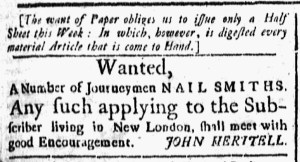
Connecticut Gazette (January 12, 1776).

(Advertisements omitted will be in our next.)

Instead of the usual four pages, the January 12, 1776, edition of the Connecticut Gazette consisted of only two pages.  Most issues of colonial newspapers had four pages, created by printing two pages on each side of a broadsheet and folding it in half.  Timothy Green, the printer of the Connecticut Gazette, had only enough paper that he was forced to condense the contents to a half sheet, one page printed on each side.  He certainly was not the only printer to experience a disruption in his paper supply during the first year of the Revolutionary War.

Green acknowledged the situation with a note that appeared at the top of the first column on the first page: “[The want of Paper obliges us to issue only a Half Sheet this Week: In which, however, is digested every material Article that is come to Hand.]”  In other words, subscribers and other readers did not need to worry that they missed important news because Green did not have enough space to print it.  Instead, he carefully undertook his duties as an editor to include everything of importance received in the printing office since the previous week’s issue of the Connecticut Gazette.  The small font for news items, smaller than the font used for advertisements, also allowed Green to squeeze a significant amount of content into just two pages.
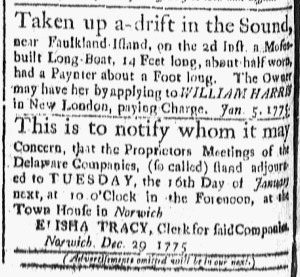
Connecticut Gazette (January 12, 1776).

What about the advertisements?  Only three paid notices appeared in that issue, one for “Journeyman NAIL SMITHS” immediately below the printer’s note on the first page and two more at the bottom of the final column on the second page.  The printer concluded the issue with a brief note: “(Advertisements omitted will be in our next.)”  Green assured advertisers, especially those who paid in advance of publication, that the Connecticut Gazette would indeed disseminate their notices.  In this instance, however, he prioritized the needs of subscribers (many of whom did not make timely payments) and other readers (who did not pay the printer at all) over advertisers (who comprised an important revenue stream).  It was a careful balancing act for all colonial printers as they served multiple constituencies simultaneously.  For this issue, Green considered keeping subscribers and the rest of the public informed about “The King’s SPEECH, to both Houses of Parliament, October 26, 1775,” and news from London, Philadelphia, New York, Newport, Worcester, and Watertown (where the Continental Army continued the siege of Boston) more important than publishing many of the advertisements submitted to his printing office.
April 12

What was advertised in a colonial American newspaper 250 years ago today?

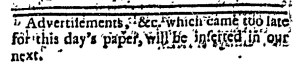
Maryland Journal (April 12, 1775).

“Advertisements, &c. which came too late for this day’s paper, will be inserted in our next.”

Some advertisers and correspondents may have been frustrated when the content they submitted to the printing office did not appear in the April 12, 1775, edition of the Maryland Journal.  To mollify them, the printer, William Goddard, inserted a brief note advising that “Advertisements, &c. which came too late for this day’s paper, will be inserted in our next.”  No printer wished to disappoint advertisers who paid to run their notices nor correspondents who contributed the “FRESHEST ADVICES, both FOREIGN and DOMESTIC” that subscribers expected to find when they perused colonial newspapers.  In this instance, some material just had not arrived in time to set the type and integrate it into the issue, but Goddard pledged that it would appear in print the following week.

The placement of the printer’s notice at the bottom of the final column on the third page suggests that he made the decision to include it shortly before taking the issue to press.  Each edition of the Maryland Journal, like other colonial newspapers, consisted of four pages, two printed on each side of a broadsheet folded in half.  Printers typically printed the side with the first and fourth pages and then the side with the second and third pages.  As a result, the newest content, whether articles, letters, editorials, or advertisements, appeared “inside” the newspaper rather than on the front page. Goddard had just enough space for his notice to advertisers and correspondents when the compositor finished setting type and laying out the rest of the third page (the last page prepared for the press).

Many of the advertisements that did appear in that issue featured datelines, sometimes including both the town and date and other times just the date.  Most on the fourth page (the first prepared for the press) were from March, along with a couple from February and the most recent from April 1, April 3 and April 4.  All of them ran in the previous issue on April 5, so the compositor merely used type already set.  The advertisements immediately above Goddard’s notice on the third page were dated April 6 and April 10, further demonstrating that where advertisements appeared in an issue depended in part on when they arrived in the printing office.  Goddard did not play favorites or decide that some advertisements were more important than others.  Instead, time constraints prevented him from immediately printing every advertisement submitted to him.  Those advertisers could depend on their notices running in the next issue.

February 11

What was advertised in a colonial American newspaper 250 years ago today?

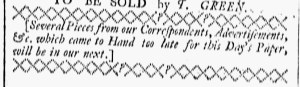
Connecticut Gazette (February 11, 1774).

Several Pieces from our Correspondents, Advertisements, &c. which came to Hand too late for this Day’s Paper, will be in out next.”

Timothy Green, the printer of the Connecticut Gazette, inserted a brief notice in the February 11, 1774, edition to advise that “Several Pieces from our Correspondents, Advertisements, &c. which came to Hand too late for this Day’s Paper, will be in out next.”  In a few short lines, the printer aimed to manage his relationships with subscribers, advertisers, and anyone who submitted news, editorials, essays, or any other content for the newspaper.  He suggested to readers that he worked until the last possible moment to include the latest news.  He assured advertisers that their notices would indeed appear in print in the next issue.  He let those who provided content know that practical matters, not a lack of appreciation for their efforts, played the deciding role in why their submissions did not appear alongside a proclamation from the governor, resolutions from a “Town-Meeting of the Town of Providence” concerning a “Duty upon Tea” enacted by Parliament, and an account of events that resulted in the tarring and feathering of John Malcom, a customs officer, in Boston.

Green’s notice appeared at the bottom of the final column on the third page.  While that may seem like a curious place to modern readers, it made absolute sense to eighteenth-century readers, especially anyone familiar with the process for printing newspapers.  The Connecticut Gazette, like other newspapers of the era, consisted of four pages, created by printing two pages on each side of a broadside and folding it in half.  Workers in a printing office set the type for the first and fourth pages, printed the side of the broadsheet that featured those pages, and let the ink dry before printing the second and third pages on the other side.  That meant that type for the interior pages was set last, so news received most recently, regardless of its magnitude, appeared there rather than on the front page.  Whatever appeared at the end of the last column on the third page was the final bit of content that printers managed to fit in that issue.  That Green’s notice appeared there testified to his efforts to publish everything received in his printing office in New London up to the moment he had to take that issue to press and distribute the February 11 edition on schedule.

September 4

What was advertised in a colonial American newspaper 250 years ago today?

Maryland Journal (September 4, 1773).

Advertisements omitted, will be inserted in our next.”

William Goddard quickly attracted advertisers when he commenced publication of the Maryland Journal, the first newspaper printed in Baltimore, in August 1773.  Paid notices filled four and a half columns, out of twelve total, in the third issue, but that was not all of them submitted to the printing office.  Goddard included a brief note alerting readers and, especially, advertisers who expected to see their notices in print that “Advertisements omitted, will be inserted in our next.”  Advertising represented an important revenue stream for printers, so Goddard must have been pleased with his initial success in attracting advertisers for the Maryland Journal.

For their part, advertisers from Baltimore and beyond welcomed the opportunity to disseminate information in the new publication.  Eleven of the advertisements in the September 4 edition described runaway indentured servants or runaway convict servants and offered rewards for their capture and return to their masters.  Previously, residents of Baltimore and surrounding towns resorted to the Maryland Gazette, published in Annapolis, the Virginia Gazette, published in Williamsburg, and the several newspapers published in Philadelphia to alert colonizers about runaways and encourage them to participate in surveillance of strangers to assess whether they matched the descriptions in the public prints.  The Maryland Journal buttressed the efforts of certain colonizers to use the early American press to uphold what they considered the appropriate order in their communities.

Other advertisers, including purveyors of consumer goods and services, now had a truly local alternative for promoting their businesses.  In the September 4 edition, Ewing and Hart marketed rum, wine, and spirits at their store on Gay Street, John Flanagan hawked tea, coffee, and sugar at his store on Market Street, and Nicholas Brooks promoted jewelry and prints “at the CROWN and CUSHION, in BALTIMORE.”  In addition, John Hamilton, “TAILOR and HABIT-MAKER, from GLASGOW,” introduced himself to prospective clients with an announcement that he “has opened shop in Gay-street, BALTIMORE-TOWN … where he makes mens and womens clothes in the very newest fashions.”  He highlighted his experience “having wrought for eight years past in the best shops in Britain,” hoping that readers would be impressed enough to give the newcomer a chance to build a reputation in Baltimore.  He promised to make it “his constant endeavour to give, to the utmost of his power, entire satisfaction” to his customers in return for “suitable encouragement from the generous public.”  The Maryland Journal provided an introduction to prospective customers beyond those Hamilton happened to meet in the course of his daily routine.

Other advertisers sought the advantages of placing notices in Baltimore’s first newspaper, some with advertisements that ran on September 4 and others with advertisements delayed until the next edition.  A newspaper, complete with shipping news, prices current, and advertisements, marked the port’s growing size and significance in the region.

June 8

What was advertised in a colonial American newspaper 250 years ago today?

South-Carolina Gazette and Country Journal (June 8, 1773).

“THE Printer of this Paper … will undertake any Kind of Printing-Work.”

Charles Crouch, the printer of the South-Carolina Gazette and Country Journal, included a brief note in the June 8, 1773, to alert readers and, especially, advertisers that “Advertisements omitted this Week, for want of Room, shall be in our next.”  Despite that “want of Room,” Crouch found space to run six of his own notices.  Some of them concerned the business of running the newspaper, while others advertised goods and services available at the printing office.

In tending to the operations of the newspaper, Crouch requested that “ALL Persons who may favour the Printer of this Gazette with their Advertisements … send the CASH with them, except where he owes Money, or has a running Account.”  Crouch suggested that “will prevent disagreeable Circumstances, as well as Trouble.”  He also prepared to address some of those “disagreeable Circumstances” with recalcitrant subscribers.  In another notice, he informed “ALL Persons in Charles-Town, who are in Arrears for this GAZETTE, to the first of January last, HAVE THIS PUBLIC NOTICE given them, that in the Course of this Month, they will be waited upon by my Apprentice, for Payment.”  Printers throughout the colonies often ran notices calling on delinquent subscribers to settle accounts, sometimes threatening legal action.  Few mentioned having their apprentices attempt to collect payment, but many likely tried that strategy as well.

In other advertisements, Crouch attempted to generate business at the printing office.  He advised that the “Printer of this Paper, being supplied with plenty of Hands, will undertake any Kind of Printing-Work, let it be ever so large.”  Prospective customers could depend on job printing orders “be[ing] correctly and expeditiously executed, and on reasonable terms.”  In another advertisement, the printer hawked “Shop and Waste PAPER, to be sold at Crouch’s Printing-Office, in Elliott-street.”  He also tried to generate interest in surplus copies of “THOMAS MORE’s ALMANACK, for the Year 1773.”  Though nearly half the year had passed, Crouch emphasized contents that readers could reference throughout the year, including “a List of Public Officers in this Province; a List of Justices for Charles-Town District; excellent Notes of Husbandry and Gardening, for each Month in the Year; [and] Descriptions of Roads throughout the Continent.”  At the end of that advertisement, Crouch appended a note that he also stocked copies of “BUCHAN’s Family Physician.”  In a final advertisement, the printer tended to the health of readers with products unrelated to the printing trade.  He announced that he just imported a variety of popular patent medicines, including a “Fresh Parcel of Dr. KEYSER’s genuine Pills,” “Dr. RYAN’s Incomparable Worm Destroying Sugar Plumbs,” and “Dr. JAMES’s Fever Powders.”  Like many other printers, Crouch sold patent medicines as an additional revenue stream.

An item that could be considered a seventh advertisement from the printer even found its way into the local news.  Immediately above the entries of vessels arriving and departing the busy port provided by the customs house, a short note stated, “Those GENTLEMEN who subscribed with the Printer hereof, for the AMERICAN EDITION of BLACKSTONE’s COMMENTARIES on the LAWS of ENGLAND, are requested to apply for the Fourth Volume, and the Appendix.”  Crouch served as a local agent on behalf of the publisher, Robert Bell in Philadelphia.

Crouch claimed that a “want of Room” prevented him from publishing all of the advertisements received in his printing office, yet he managed to include many of his own notices in the June 8, 1773, edition of the South-Carolina Gazette and Country Journal.  He exercised his prerogative as printer in shaping the contents of that issue, an act that potentially frustrated some advertisers who expected to see their notices in the public prints.  Given that just a few months earlier Crouch emphasized his “REAL Want of his Money,” he may have considered that a necessary gamble in his efforts to continue operations at his printing office on Elliott Street in Charleston.

May 16

What was advertised in a colonial American newspaper 250 years ago this week?

Massachusetts Gazette and Boston Weekly News-Letter (May 13, 1773).

“[The Avertisements that are omitted this Week, will have a good Place in out next.]”

Richard Draper, the printer of the Massachusetts Gazette and Boston Weekly News-Letter, inserted notes to readers and subscribers at the bottom of the third page of the May 13, 1773, edition.  In those notes, he provided information about the contents of the current issue and the next issue, acknowledging that he did not have sufficient space for all the materials received in his printing office that week.  Placing the notes on the third page made sense considering how eighteenth-century printers produced each standard issue of a four-page newspaper.  They printed two pages on each side of a broadsheet and then folded it in half, usually printing the first and fourth pages first and the second and third pages later.  That meant that they set the type of the third page last.

It was only when setting type for the third page that Draper or a compositor who worked in his printing office knew the layout of the entire issue.  In this instance, that meant that “A variety of domestic Articles are in the last Page, and London Articles in the SUPPLEMENT.”  That note ran across all three columns at the bottom of the third page, a thick line separating it from the rest of the content.  In another note, this one appearing at the bottom of the first column, Draper advised that “[The Avertisements that are omitted this Week, will have a good Place in out next.]”  Draper may not have yet realized that news from London would occupy only one page of the two-page supplement, leaving room for another entire page of advertisements … or he may have realized that even with the extra space he still would not have enough room for all the paid notices that customers expected to see in his newspaper.  After all, he resorted to a supplement again the following week in order to increase the content he disseminated from four pages to six pages.

Given that advertising represented such an important revenue stream for colonial printers, Draper erred on the side of caution in letting advertisers know that their notices might not appear in the current issue or its supplement and, as a consolation, promised “a good Place” in the next issue.  His advertisers had the option of giving their business to any of the four other newspapers printed in Boston at the time, prompting Draper to provide updates and reassurances about when they could expect to see their notices in the Massachusetts Gazette and Boston Weekly News-Letter.

February 6

What was advertised in a colonial American newspaper 250 years ago today?

Providence Gazette (February 6, 1773).

Advertisements omitted will be in our next.”

John Carter, the printer of the Providence Gazette, did not publish many advertisements in the February 6, 1773, edition of his newspaper, despite usually reserving a page or more for that kind of content.  The third page featured six brief advertisements that accounted for less than half a column and a longer notice about the benefits of “building a Bridge, across Seaconk River, between the Towns of Providence and Rehoboth.”  Having published many advertisements for his own projects, including the New-England Almanack for 1773 and subscription proposals for English Liberties, or, The Free-born Subject’s Inheritance, in recent issues, the printer did not include any of his own notices among the half dozen that made it into the February 6 edition.  He likely did not want to upset paying customers by giving space to his own advertisements over those they paid him to publish.  A short note appeared after those advertisements that did appear: “Advertisements omitted will be in our next.”  Carter alerted readers to additional content while also assuring advertisers that the newspaper would indeed disseminate their notices in the near future.

The note about the advertisements was one of several that gave directions and helped readers navigate that issue of the Providence Gazette.  Carter devoted most of the issue to a response to a speech that Thomas Hutchinson, governor of Massachusetts, recently delivered.  That response occupied the entire first page.  A note at the bottom of the third column instructed readers to “[See the Fourth Page.]”  The response filled most of that page.  Carter inserted another response, the one that spurred Isaiah Thomas to publish an extraordinary issue of the Massachusetts Spy on January 29, midway through the third column.  At the bottom, another note directed readers to “[See the Second Page.]”  That response filled the entire second page and continued onto the third page, but readers did not need additional directions to follow the flow.  That item did not conclude on the third page.  Instead, Carter inserted a note, “[The Remainder in our next.],” and provided brief news updates from New York, Newport, and Providence as well as the public service announcement about the proposed bridge and the six brief advertisements.  Carter provided a substantial amount of news from Massachusetts, but also created a cliffhanger to encourage readers to peruse the next issue.

What explained the strange format and all the jumping from page to page required to make sense of the content in that edition of the Providence Gazette?  Carter, like other printers, published a newspaper that consisted of four pages, created by printing two pages on each side of a broadsheet and then folding it in half.  Printers usually set the type and printed the first and fourth pages on one side, let the ink dry while they set the type for the second and third pages, and then printed those last two pages.  That process explains why the news began on the first page, continued on fourth page, moved back to the second page, and continued once again on the third page.  It also explains why so many notes giving directions to readers appeared in that issue of the Providence Gazette.

Although printers depended on advertising revenue to make newspapers viable, they sometimes opted to temporarily delay publication of some notices.  Such was the case when Carter received news that he considered important enough to displace most advertisements for a week.  Patriots in Massachusetts making their case in favor of the liberties of colonizers in opposition to the abuses of Parliament, Carter concluded, justified delaying publication of some advertisements by a week.

January 10

What was advertised in a colonial American newspaper 250 years ago this week?

South-Carolina Gazette (January 7, 1773).

A great Number of NEW ADVERTISEMENTS … shall be inserted in a Paper that will be published early on MONDAY next.”

The South-Carolina Gazette might better have been named the South-Carolina Gazette and Advertiser.  That was especially true for the January 7, 1773, edition of the newspaper since advertising constituted the vast majority of the content.  The printers, Thomas Powell and Company, distributed a standard four-page edition and a two-page supplement.  Advertising comprised fifteen of the eighteen columns.

Except for the masthead, the front page consisted entirely of advertising.  A banner that announced “New Advertisements” appeared at the top of the first column.  Similarly, the second page consisted entirely of advertising with a banner for “New Advertisements” once again running at the top of the first column.  Readers encountered the first news items on the third page.  The first column carried local news from Charleston.  Near the bottom, “Timothy’s Marine List,” a feature that retained the name of the former printer, provided news from the customs house about the arrival and departure of ships in the busy port.  It overflowed into the second column, filling most of it.  Another banner for “New Advertisements” described the rest of the page.  The final page did not feature any news items, only advertisements.

In the supplement, the first page column of the first page contained “NEWS from the Continent of Germany” and a short essay denigrating the “CHARACTERS of some of the crowned Heads od EUROPE.”  The second and third columns as well as all three columns on the second page featured advertisements exclusively.  That does not mean, however, that those portions of the newspaper did not deliver important information to readers.  Some of those advertisements included a proclamation from the governor concerning the “Boundary Line” with North Carolina and legal notices about court proceedings.

In addition to all that advertising, a note that ran at the end of news from Charleston and just above “Timothy’s Marine List” indicated that Powell and Company did not have sufficient space to publish all of the advertisements received in the printing office.  “A great Number of NEW ADVERTISEMENTS,” the note stated, “now left out for Want of Room, shall be inserted in a Paper that will be published early on MONDAY next.”  In addition, “Advertisements sent before that Time, shall (if desired) make their Appearance in it.”  Four days later, Powell and Company published a two-page Postscript to the South-Carolina Gazette on January 11.  It devoted more space to news than the previous issue and its supplement combined!  Advertising filled only two and a half of the six columns, though “New Advertisements” accounted for the first column on the first page.  The banner for “New Advertisements” once again appeared halfway down the second column on the second page.

The South-Carolina Gazette was certainly a delivery mechanism for advertising, sometimes more than a delivery mechanism for news.  That meant that readers gleaned information via a variety of formats, not just articles that reported on recent events.  It also meant significant revenues for the printers, underwriting the dissemination of news articles when Powell and Company made space for them.

October 15

What was advertised in a colonial American newspaper 250 years ago today?

Massachusetts Gazette and Boston Weekly News-Letter (October 15, 1772).

“WANTED immediately, a Wet-Nurse.”

Richard Draper had too much content to publish all of it in the October 15, 1772, edition of the Massachusetts Gazette and Boston Weekly News-Letter.  He remedied the situation, in part, by printing and distributing a supplement on a smaller sheet.  That supplement included additional news, but no advertising.  Even with the supplement, Draper did not have enough space for all the news and advertising received in the printing office.  A note at the bottom of the final column on the third page instructed readers to “See SUPPLEMENT” and advised that “Other Articles and Advertisements must be defer’d.”

Why insert such a note on the third page instead of placing it at the end of the final column on the last page?  The process of printing newspapers on a manually-operated press provides an explanation.  Like most other newspapers from the era of the American Revolution, a standard issue of the Massachusetts Gazette and Boston Weekly News-Letter consisted of four pages created by printing two pages on each side of a broadsheet and folding it in half.  Printers usually set the type and printed the first and fourth pages on one side of the sheet.  After it dried, they printed the second and third pages on the other side.  That resulted in the latest news often appearing inside the newspaper rather than on the front page.  That also meant that the last portion of the newspaper arranged by the compositor was the third page, not the final page.  That being the case, announcements about supplements and omitted materials usually appeared on the third page.

Draper did manage to include one additional advertisement in the standard issue for October 15 rather than deferring it for a week.  The urgency of the notice may have convinced him to make a special effort to include it.  “WANTED immediately,” the advertisement proclaimed, “a Wet-Nurse, with a young Breast of Milk, that can be well Recommended, to suckle a Child in a Family: Enquire of the Printer.”  That notice ran in the right margin of the third page, almost the entire length of an extensive advertisement that listed merchandise stocked by John Barrett and Sons at their store “near the MILL-BRIDGE” in Boston.  With some creative graphic design, Draper squeezed an advertisement seeking a wet nurse, a notice that likely arrived late to the printing office, into that issue.  In so doing, he adapted to the technology of the printing press while providing a special service to that advertiser.

October 6

What was advertised in a colonial American newspaper 250 years ago today?

South-Carolina Gazette and Country Journal (October 6, 1772).

“Advertisements omitted this Week, for want of Room, shall be in our next.”

Charles Crouch had more content than would fit in the September 29, 1772, edition of the South-Carolina Gazette and Country Journal.  To resolve the dilemma, he inserted a notice advising that “Sundry NEW ADVERTISEMENTS omitted this Week, in order to give Place to the LONDON NEWS, &c. shall have particular notice in our next.”  The following week, the October 6 edition consisted almost entirely of advertising.  A header for “NEW ADVERTISEMENTS” ran at the top of the first column on the first page.  Advertisements filled all three columns on that page.  Another header for “NEW ADVERTISEMENTS” appeared midway down the final column of the second page.  The first two and half columns featured news items, but the remainder of the second column as well as the entire third and fourth pages consisted entirely of advertising.  Crouch presumably made sure that “Sundry NEW ADVERTISEMENTS” that he omitted in the previous issue did indeed run in the October 6 edition.

Still, he found himself once again in the position of not having sufficient space to publish all of the advertisements received in the printing office.  He inserted a notice at the bottom of the final column on the third page: “Advertisements omitted this Week, for want of Room, shall be in our next.”  Why did the notice appear there instead of the bottom of the last page?  Understanding the process for producing newspapers on manually-operated presses reveals the answer.  A standard issue of the South-Carolina Gazette and Country Journal (and other colonial newspapers) consisted of four pages created by printing two pages on each side of a broadsheet and then folding it in half.  Printers often produced the first and last pages first.  After the ink dried, they then printed the second and third pages on the other side of the sheet.  In his effort to give the advertisements omitted the previous week “particular Notice” in the October 6 edition, Crouch printed them first, placing them on the first page.  Other new advertisements also ran on the fourth page, interspersed with notices that appeared in previous editions.  Crouch made publishing all of those advertisements a priority.  He also made advertisements a priority for the second and third pages, though he realized that subscribers who expected to receive news would not be satisfied with an issue that served solely as a mechanism for delivering advertisements.  He opted for a couple of columns of news on the second page before filling the rest of the newspaper with advertisements.  The notice at the bottom of the final column on the third page would have been the last of the type set and placed into position for the October 6 edition once Crouch determined that he did not have space for all the advertisements he intended to publish.

Crouch did have other options.  He could have produced an advertising supplement to accompany the September 29 edition or the October 6 edition or both.  He may have decided, however, that he did not have enough additional content to warrant doing so.  He may not have had the time to print a supplement.  He may not have considered doing so worth the resources required.  He apparently believed that advertisers would be patient with a short delay, though he made certain to acknowledge that he owed them space in his newspaper.