April 7

What was advertised in a colonial American newspaper 250 years ago today?

Pennsylvania Mercury (April 7, 1775).

“DR. HILL’S AMERICAN BALSAM.”

Enoch Story and Daniel Humphreys began distributing subscription proposals for a new newspaper, the Pennsylvania Mercury and Universal Advertiser, in the middle of January 1775.  They began promoting their newspaper at the same time that James Humphreys, Jr., commenced publication of the Pennsylvania Ledger and Benjamin Towne established Philadelphia’s first tri-weekly newspaper, the Pennsylvania Evening Post.  Those two newspapers brought the total in the city to six, joining Dunlap’s Pennsylvania Packet, the Pennsylvania Gazette, the Pennsylvania Journal, and the Wöchentliche Pennsylvanische Staatsbote.  As the imperial crisis intensified, the number of newspapers published in the largest city in the colonies increased … but did a market exist for yet another?  Could Story and Humphreys attract enough subscribers and advertisers to make a go of the Pennsylvania Mercury?

They decided that they could.  On Friday, April 7, they published the first issue.  In a note to “Subscribers and the Public” on the first page, they explained that they deviated from the conditions in their proposals only slightly, distributing it on Fridays instead of Saturdays, because “one of the eastern mails is now dispatched from Boston, in such time as to arrive here on Thursday (instead of Saturday as formerly).”  That meant that Story and Humphreys could distribute “the most early intelligence from that interesting quarter.”  That meant that the Pennsylvania Mercury scooped the Pennsylvania Evening Post and the Pennsylvania Ledger, both published on Saturday.  The printers also proclaimed that “the TYPE with which THIS Paper is printed are of AMERICAN manufacture,” signaling their support for the article in the Continental Association that called for supporting domestic manufactures, and asked for “every patriotic allowance” if the quality did not give “entire satisfaction to the judicious and accurate eye.”  It was, after all, a small sacrifice.  “[W]e flatter ourselves,” the printers declared, “that the rustic manufactures of America will prove more graceful to the patriotic eye, than the more finished productions of Europe.”

Story and Humphreys also managed to line up advertisers for the first issue of the Pennsylvania Mercury, an importance source of revenue for any newspaper.  In addition to their notice, two advertisements appeared on the first page, including one for “DR. HILL’S AMERICAN BALSAM.”  Advertising filled more than a column on the third page and nearly twice as much on the last page.  In total, paid notices accounted for one-quarter of the content of the inaugural issue.  The colophon encouraged readers to submit advertisements to the printing office in Norris’s Alley near Front Street.  The success of Philadelphia’s newest newspaper would depend in part on advertisers choosing to insert their notices in it.

February 3

What kinds of advertisements ran in the inaugural issue of Alexander Purdie’s Virginia Gazette 250 years ago today?

Virginia Gazette [Purdie] (February 3, 1775).

“BENJAMIN BUCKTROUT, Cabinet maker, … STILL carries on that business.”

To be sold … THIRTY Virginia born negroes, consisting of men, women, boys, and girls.”

Alexander Purdie launched his Virginia Gazette on Friday, February 3, 1775.  It was the third newspaper bearing that name printed in Williamsburg at the time.  John Pinkney published his Virginia Gazette on Thursdays and John Dixon and William Hunter distributed their Virginia Gazette on Saturdays.  As the imperial crisis intensified, a third Virginia Gazetteincreased access and dissemination of news and editorials (and advertisements) in the colony.

In early December 1774, Purdie and Dixon announced the dissolution of their partnership, with Dixon indicating that he would continue to publish that iteration of the Virginia Gazette with Hunter as his new partner and Purdie asserting that he would commence publication of another newspaper as soon as he attracted a sufficient number of subscribers.  He also solicited advertisers, realizing that paid notices accounted for an important source of revenue for any newspaper.

When he published the inaugural issue of his Virginia Gazette, it included seven advertisements that filled most of the last column on the final page.  Those numbers did not rival the amount of advertising in either of the other newspapers printed in Williamsburg that week, both of which had enough notices to fill an entire page, but it was a start.  Those initial advertisers signaled to others that they might consider advertising in Purdie’s newspaper a good investment.

Benjamin Bucktrout, a cabinetmaker, did not entrust his marketing efforts solely to Purdie’s Virginia Gazette.   He placed an identical advertisement in Dixon and Hunter’s newspaper the next day.  It likely enjoyed greater circulation in the more established Virginia Gazette, yet may have garnered greater notice by readers of Purdie’s Virginia Gazette as the first of only a few advertisements in that publication.

In addition to Bucktrout’s notice, one advertisement sought an apprentice to work in a store, two noted stray horses “TAKEN up” until their owners could be identified, and three concerned enslaved people.  Abraham Smith and Henry Lochhead presented “THIRTY Virginia born negroes, consisting of men, women, boys, and girls,” for sale.  Townshend Dade offered a reward for the capture and return of “a negro fellow named HARRY” who had liberated himself by running away from his enslaver the previous August.  Peter Pelham advised readers of “a runaway negro man named Goliah” who had been “COMMITTED to the publick jail” until his enslaver claimed him.  Advertisements about enslaved people represented a significant proportion of notices in each Virginia Gazette.  They amounted to nearly half of the advertisements in the first issue of Purdie’s Virginia Gazette.

January 28

What was advertised in a colonial American newspaper 250 years ago today?

Pennsylvania Ledger (January 28, 1775).

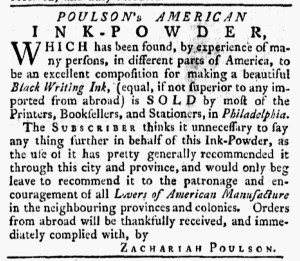
POULSON’s AMERICAN INK-POWDER.”

Just four days after Benjamin Towne launched the Pennsylvania Evening Post, James Humphreys, Jr., commenced publication of the Pennsylvania Ledger on January 28, 1775.  In less than a week, the number of English-language newspapers printed in Philadelphia increased from three to five, rivaling the number that came off the presses in Boston.  No other city in the colonies had as many newspapers.  Humphreys incorporated the colophon into the masthead, advising that he ran his printing office “in Front-street, at the Corner of Black-horse Alley:– Where Essays, Articles of News, Advertisements, &c. are gratefully received and impartially inserted.”

Unlike the first issue of the Pennsylvania Evening Post, the inaugural edition of the Pennsylvania Ledger carried advertisements.  Humphreys placed some of them, one hawking “POLITICAL PAMPHLETS … on Both Sides of the Question,” another promoting an assortment of books he sold, and a final one seeking “an APPRENTICE to the Printing Business.”  Nine other advertisers placed notices, all of them for consumer goods and services.  They took a chance that the new newspaper had sufficient circulation to merit their investment in advertising in its pages.

Among those advertisers, Zachariah Poulson marketed “POULSON’s AMERICAN INK-POWDER.”  He asserted that “most of the Printers, Bookseller, and Stationers, in Philadelphia” stocked that product.  Customers just needed to request it.  With the deteriorating political situation in mind, especially the boycott of imported goods outlined in the Continental Association, Poulson called on “all Lovers of American Manufacture” in Pennsylvania and “in the neighbouring provinces and colonies” to choose his ink powder over any other.

Detail from Edward Pole’s Advertisement in the Pennsylvania Ledger (January 28, 1775).

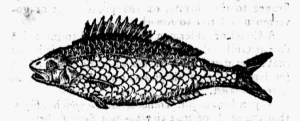
Edward Pole inserted the lengthiest advertisement (except for Humphreys’s notice cataloging the books he sold).  It filled half a column, the first portion devoted to the merchandise available “at his GROCERY STORE, in Market-street” and the rest to “FISHING TACKLE of all sorts,” “FISHING RODS of various sorts and sizes,” and other fishing equipment.  In advertisements in several newspapers published in Philadelphia (and, later, with ornate trade cards that he distributed), Pole regularly marketed himself as a sporting goods retailer.  For the first issue of the Pennsylvania Ledger, he adorned his advertisement with a woodcut depicting a fish that previously appeared in his notices in Dunlap’s Pennsylvania Packet in May and June 1774.

Humphreys provided residents of Philadelphia and other towns greater access to news and editorials with the Pennsylvania Ledger, but that was not all.  The publication of yet another newspaper in Philadelphia increased the circulation of advertising in the city and region, disseminating messages to consumers far and wide.  Not long after Humphreys published that first issue, advertisers took to the pages of the Pennsylvania Ledger to publish notices for a variety of purposes, supplementing the information the editor selected for inclusion.

January 7

What was advertised in a colonial American newspaper 250 years ago today?

Virginia Gazette [Dixon and Hunter] (January 7, 1775).

“We now present the Publick with our Paper, as a Sample of what they are to expect from us in Future.”

When John Dixon and William Hunter commenced their partnership as publishers of the Virginia Gazette, they inserted a notice “To the PUBLICK” as the first item in the first column of the first page of the January 7, 1775, edition.  A month earlier, Alexander Purdie and John Dixon announced the end of their partnership, alerting readers that Dixon and Hunter would continue publishing the Virginia Gazette and that Purdie would endeavor to launch his own Virginia Gazette once he attracted enough subscribers.  The numbering for Dixon and Hunter’s newspaper continued uninterrupted, though there were some changes.  They distributed it on Saturdays instead of Thursdays.  For several years, Purdie and Dixon had published their Virginia Gazette on the same day that William Rind, Clementina Rind, and John Pinkney, in succession, took a competing Virginia Gazette to press.  Readers in Williamsburg now had access to newspapers on both Thursdays and Saturdays.  The new partners published their Virginia Gazette “early every Saturday Morning” so it could be “despatched by the several Posts on the same day” for “speedy Conveyance to the Subscribers.”

Dixon and Hunter also updated the combination masthead and colophon beyond merely changing the names of the printers.  The woodcut depicting the arms of the colony that previously adorned the Virginia Gazette now appeared within an ornate baroque border.  The new partners also incorporated a note about the services they provided: “ALL Persons may be supplied with this Paper at 12s6 a Year, and have Advertisements (of a moderate Length) inserted for 3s. the first Week, and 2s. each Week after. – Printing Work done at this Office in the neatest Manner, with Care and Expedition.”  Those lines transformed the masthead and colophon into an advertisement.  In their notice, Dixon and Hunter reported that only a few readers “have withdrawn their Subscriptions,” leaving them feeling confident about the prospects for their newspaper because they received “many Orders … from the Subscribers to this Gazette for continuing them on our List.”  At twelve shillings and six pence for an annual subscription, the price remained the same.  The price for advertising did as well.  Dixon and Hunter charged a shilling for setting type and two shillings for the space the first time an advertisement appeared and then two shillings for each subsequent insertion.

The new partners also signaled their editorial stance in their message “To the PUBLICK.”  They declared that they would published “Whatever may be sent us in Favour of LIBERTY, or for the PUBLICK GOOD … with Cheerfulness.”  In the event of “Scarcity of News,” they planned to fill the pages with “such moral Pieces, from the best Writers, as may contribute to the Improvement of Mankind in general” and, occasionally, “Pieces of Wit and Humour, that tend both to amuse and instruct.”  It went without saying that advertisements would also fill the pages of the Virginia Gazette.  Indeed, paid notices accounted for nearly half the content in Number 1222, the first issue published by Dixon and Hunter.

August 20

Who were the subjects of advertisements in a colonial American newspaper 250 years ago today?

Maryland Journal (August 20, 1773).

“A NEGRO GIRL, about 12 years old.”

“RAN away … Negro PRINCE.”

After many months of disseminating subscription proposals and promoting the Maryland Journal, the first newspaper published in Baltimore, William Goddard printed and distributed the first issue on August 20, 1773.  In addition to subscribers, he sought advertisers to generate revenues that would make the enterprise viable.  In an update that appeared in the May 20 edition of the Maryland Gazette, for instance, Goddard pledged that “seasonable notice will be given in this gazette, to give gentlemen an opportunity to advertise in the first number.”  Just as John Dunlap managed to do when he launched the Pennsylvania Packet, Goddard attracted a significant number of advertisers for the first issue of the Maryland Journal.  Advertising accounted for a little more than four of the twelve columns in the inaugural issue.

Those advertisements included some that previously appeared in other newspapers, including Daniel Grant’s notice that he opened an inn and tavern “at the Sign of the Fountain” in Baltimore and a lengthy notice concerning land in the Ohio River valley placed by Virginia planter and land speculator George Washington.  Other advertisers included Christopher Hughes and Company, “GOLDSMITHS and JEWELLERS,” David Evans, “CLOCK and WATCH-MAKER,” Francis Sanderson, “COPPERSMITH,” Grant and Garrison, “TAYLORS,” and Mr. Rathell, “Teacher of the ENGLISH Language, Writing-master and Accomptant.”

Maryland Journal (August 20, 1773).

In addition, Thomas Brereton, “COMMISSION and INSURANCE BROKER,” placed a short notice in which he “GRATEFULLY acknowledges the favours of his friends, and hopes for a continuance of their correspondence.”  He also reported that he “has now for sale, a Pocket of good HOPS, a 10-inch new CABLE – and wants to buy a NEGRO GIRL about 12 years old.”  In another advertisement, Richard Bennet Hall described a Black man, Prince, who had liberated himself the previously December.  Prince was captured once “at Susquehanna Lower Ferry, but made his escape, and is often seen in the neighbourhood.”  The formerly enslaved man managed to elude capture, but Hall hoped his advertisement would help put an end to that. He offered five dollars who anyone who detained Prince in a local jail “so that that the owner may get him again” or ten pounds and “reasonable charges” to anyone who delivered Prince to Hall in Prince George’s County.  In its very first issue, the Maryland Journal became an instrument for perpetuating slavery with both a brokerage notice related to the slave trade and an advertisement encouraging readers to engage in surveillance of Black men in order to identify an enslaved man who liberated himself and assist in returning him to captivity.  Goddard had prior experience publishing such advertisements in the Providence Gazette and the Pennsylvania Chronicle.  From New England to Georgia, no newspaper printer in the colonies rejected advertisements about enslaved people.  Instead, they solicited and accepted them as an integral part of generating revenues that underwrote publishing news and editorials.

April 22

What was advertised in a colonial American newspaper 250 years ago today?

Rivington’s New-York Gazetteer (April 22, 1773).

“He will endeavour, to discharge himself in his Function, with Faithfulness to all Mankind.”

After several months of promoting the endeavor, including placing subscription proposals in newspapers in New England, New York, and Pennsylvania, James Rivington published the first issue of Rivington’s New-York Gazetteer; or the Connecticut, New-Jersey, Hudson’s River, and Quebec Weekly Advertiser on April 22, 1773.  In addition to subscribers, the printer sought advertisers for his newspaper … and promised “Gentlemen in Business” in neighboring Connecticut that they would have access to advertisements placed by the “Merchants and Traders of New-York” if they subscribed.

Rivington delivered on that promise, filling five of the twelve columns in the first issue with advertisements.  The revenue from those notices complemented what subscribers paid for their newspapers, an important alternate stream of revenue for the printer.  In the colophon at the bottom of the final page, he solicited more advertisements as well as job printing of blanks, broadsides, handbills, and other items.  Rivington’s roster of advertisers included many entrepreneurs who already placed notices in other newspapers.  They hoped to maintain or increase their share of the market by disseminating advertisements via New York’s newest newspaper.  Among those advertisers who supplemented their marketing efforts in other newspapers, Maxwell and Williams, tobacconists from Bristol, advertised a variety of snuff, John Simnet (in an uncharacteristically subdued notice) informed readers that he repaired watches “VERY cheap and VERY well,” John C. Knapp offered his services as an attorney, broker, and conveyancer at his “Scrivener’s Office,” and William Bayley hawked a “neat and general assortment” of merchandise he recently imported.  Bayley even pledged to insert a more extensive advertisement, encouraging prospective customers to look for it.  He planned to catalog his inventory of hardware, “a full Advertisement of which will be published in a future Paper.”   Nesbitt Deane, the hatmaker, retrieved the woodcut that depicted a tricorne hat with his name in a banner beneath it, from another printing office in order to include it in his advertisement in the first issue of Rivington’s New-York Gazetteer.

Rivington’s New-York Gazetteer (April 22, 1773).

Rivington also published notices from advertisers in other towns.  Rensselaer Williams inserted an advertisement for the Royal Oak Inn adjacent to the Trenton Ferry similar to the one he previously published in the Pennsylvania Gazette.  Given the anticipated circulation of Rivington’s New-York Gazetteer, that certainly made sense, a savvy investment by an innkeeper hoping to serve travelers from many colonies as they passed through New Jersey and Pennsylvania.  Edward Pole, who frequently advertised in newspapers printed in Philadelphia, placed a lengthy notice that listed “Fishing Tackle of all sorts.”  In a note at the end, he declared that “All Orders from Town and Country will be thankfully received, duly attended to, and carefully executed as though the Persons were themselves personally present.”  That signaled his eagerness to serve prospective customers in New York who wished to send orders, yet Pole likely believed that prospective customers in Philadelphia and nearby towns would encounter his advertisement in Rivington’s New-York Gazetteer.  After all, the printer ran subscription notices in the Pennsylvania Chronicle, the Pennsylvania Gazette, the Pennsylvania Journal, and the Pennsylvania Packet.  Pole apparently believed that the newspaper achieved sufficient circulation in his area to make it worth placing an advertisement to supplement those that ran in newspapers printed in his own city.

Advertising accounted for a significant portion of the content of the first issue of Rivington’s New-York Gazetteer … and likely accounted for a significant amount of revenue that helped to defray the costs of printing the newspaper. Although Rivington had presented the presence of advertisements as beneficial to some prospective subscribers, especially merchants in Connecticut, his marketing campaign much more extensively highlighted the news, essays, and speeches that he intended to print.  Still, when he published the first issue, advertising comprised nearly half of the content that subscribers received in Rivington’s New-York Gazetteer … and Weekly Advertiser.

October 28

What was advertised in a colonial American newspaper 250 years ago today?

Pennsylvania Packet (October 28, 1771).

“A GENERAL ASSORTMENT of EUROPEAN and EAST INDIA GOODS.”

In “PROPOSALS FOR PRINTING BY SUBSCRIPTION, A WEEKLY NEWS-PAPER, ENTITLED, THE PENNSYLVANIA PACKET, AND GENERAL ADVERTISER,” dated October 8, 1771, John Dunlap declared that the newspaper would commence publication on Monday, November 25 “or sooner, if sufficient encouragement should offer.”  That “encouragement” included acquiring both subscribers and advertisers whose fees would support the new enterprise.

Even though printers already published several newspapers – the Pennsylvania Chronicle, the Pennsylvania Gazette, the Pennsylvania Journal, and the Wochentliche Pennsylvanische Staatsbote – in Philadelphia, Dunlap garnered the attention he needed to launch the Pennsylvania Packet much earlier than expected, four weeks ahead of schedule.  On Monday, October 28, he distributed the first issue.  In a note “TO THE PUBLIC” on the front page, he extended “his most hearty thanks … for the generous encouragement … whereby he is enabled to issue this new publication in about half the time he proposed.”

The front page also included three advertisements, a brief notice in which Lennox and Turnbull promoted their “GENERAL ASSORTMENT of EUROPEAN and EAST INDIA GOODS,” a lengthy list cataloging the “large and neat Assortment of MERCHANDIZE” sold by John Biddle and Clement Biddle, and a testimonial about Enoch Story’s services as a broker and auctioneer signed by several prominent merchants.  The testimonial, dated May 16, 1771, previously ran in newspapers published in Philadelphia and Annapolis.

Those notices were just a few of many that appeared in the first issue of the Pennsylvania Packet.  Dunlap devoted half of a column on the third page to the shipping news from the customs house and then filled the rest of the page with advertisements.  The fourth page consisted entirely of advertisements and the colophon running across the bottom.  Dunlap even distributed a two-page supplement.  Essays appeared on the front and advertisements, mostly from Dunlap and other printers, on the back.  Dunlap even inserted a brief note to alert readers that “Some Advertisements which came too late, are deferred till next week, when they shall be carefully regarded.”

Many newspapers carried minimal advertising when they first launched.  Advertisers waited to see what kind of reception a publication received before investing in advertising.  They wanted to make sure newspapers had sufficient circulation to justify the expense.  How did Dunlap acquire so many advertisers so quickly?  Some may have responded to the pledge he made in the proposals when he stated that the “first Number shall be given gratis” to prospective subscribers.  Some advertisers may have believed that would yield sufficient circulation to merit placing their notices in the inaugural issue and then assessing whether they wished to continue.  If that was the case, Dunlap and his advertisers mutually benefitted.  The number of advertisements made the new Pennsylvania Packet look like a robust endeavor, one worthy of more subscribers.