February 21

What was advertised in a revolutionary American newspaper 250 years ago today?
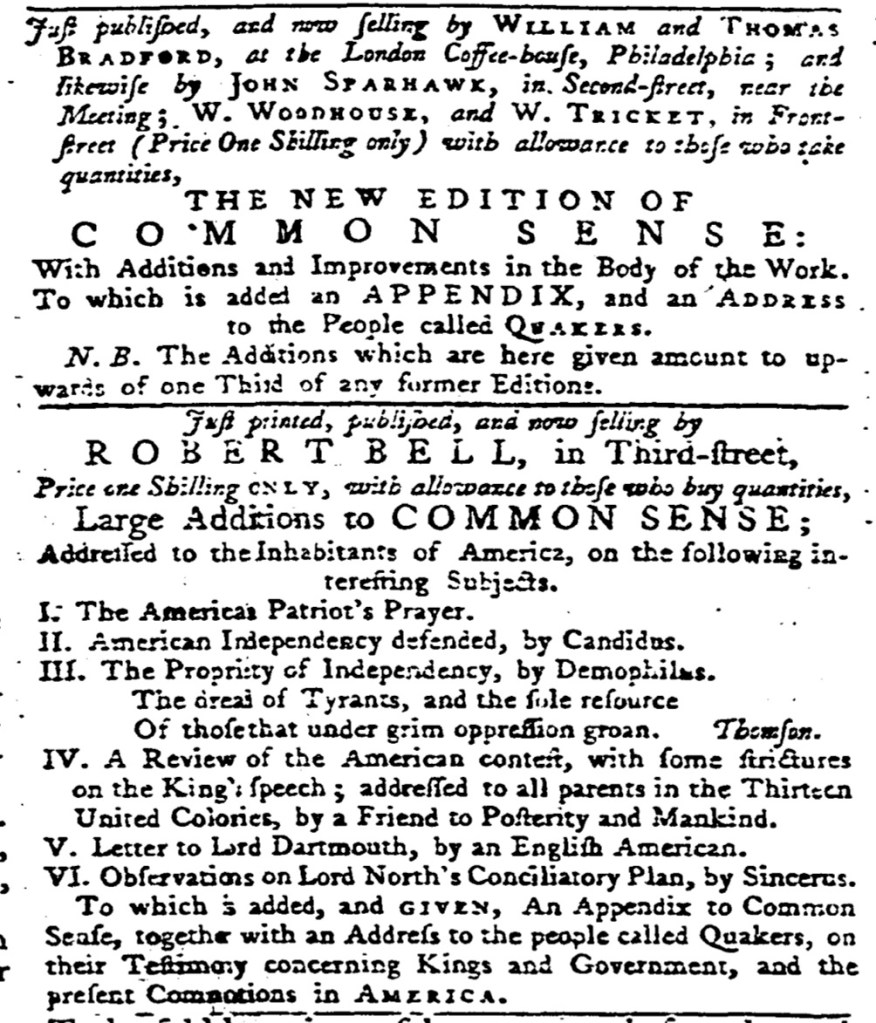
Pennsylvania Gazette (February 21, 1776).

“THE NEW EDITION OF COMMON SENSE.”

“Large Additions to COMMON SENSE.”

Although Benjamin Towne most frequently published advertisements for Thomas Paine’s Common Sense in his Pennsylvania Evening Post, he was not the only printer in Philadelphia to generate revenue from advertisements for competing editions of the pamphlet.  Other newspapers also carried advertisements for Common Sense.  After Paine and Robert Bell, the publisher of the first edition, had a falling out, Bell went forward with an unauthorized second edition and Paine worked with William Bradford and Thomas Bradford, the printers of the Pennsylvania Journal, on an expanded edition that featured new material.  Not to be outdone, Bell advertised, published, and sold other supplementary material that he billed as “Large Additions to COMMON SENSE,” though Paine was not the author of those pieces that Bell instead reprinted from newspapers.  Bell and Paine and then Bell and the Bradfords engaged in bitter exchanges in their advertisements in the Pennsylvania Evening Post.

They also placed more subdued notices in other newspapers.  In the February 21, 1776, edition of the Pennsylvania Gazette, for instance, their advertisements ran one after the other.  In the first, the Bradfords announced that they “Just published … THE NEW EDITION OF COMMON SENSE: With Additions and Improvements in the Body of the Work.”  To entice readers to select their pamphlet, they added a nota bene that stated that the “Additions … amount to upwards of one Third of any former Editions.”  Customers could acquire this new edition from the Bradfords “at the London Coffee-house” and from associates in the book trades, including John Sparhawk, William Trickett, and William Woodhouse.  Immediately below that advertisement, Bell hawked his “Large Additions.”  He listed the contents, just as he had done in his first advertisements for the first edition of Common Sense.  He also declared that he added Paine’s “Address to the people called Quakers,” pirated from the Bradfords’ new edition.  Like Towne, the printers of the Pennsylvania Gazette, William Hall, David Hall, and William Sellers, did not need to sell a single copy of the pamphlet to generate revenue from it.  They made their money on Common Sense from the competing advertisements placed by Bell and the Bradfords!

February 3

Who was the subject of an advertisement in a revolutionary American newspaper 250 years ago today?

Virginia Gazette [Pinkney] (February 3, 1776).

“RUN away … a mulatto man, named GABRIEL.”

After taking out an advertisement in a competing newspaper on January 27, 1776, an apology for not publishing his Virginia Gazette because he had difficulty acquiring paper, John Pinkney managed to print the next issue on schedule on February 3.  He may or may not have published subsequent issues, but today the February 3 edition is the last known one from his press.  In his apology, Pinkney lamented, “It gives me the greatest Uneasiness that I cannot publish such Advertisements as ought to have appeared this Week.”  The next (and perhaps final) issue included more than two dozen advertisements of various lengths on the last two pages.

Among those advertisements, Julia Wheatley offered her services as a midwife, Carter Braxton and John Ware described real estate for sale, and Pinkney hawked “A TREATISE on the MILITARY DUTY, By adjutant DAVIS,” a pamphlet that “has met with the approbation of colonel BULLITT, and many other officers.”  Six of those notices, accounting for one-quarter of the advertisements by number and far more than that by length, concerned enslaved people.  David Meade advertised “ABOUT one hundred Virginia born NEGROES” for sale, including “some female house servants, a carpenter, and shoemaker.”  Four described enslaved men who liberated themselves by running away from their enslavers, offering rewards for their capture and return.  The advertisers enlisted the public in engaging in surveillance of Black men to determine if they matched the descriptions in the newspapers.  John Hudson, for instance, pledged “FIVE POUNDS reward” to “Whoever takes up … and secures” a “mulatto man, named GABRIEL, aged 52 or 53 years,” who had “a free woman for his wife, who goes by the name of Betty Baines.”  The other advertisement described “a negro man named Frank,” dressed like a sailor, “COMMITTED to the jaol of Surry county” two months earlier.  Thomas Wall, the jailer, called on Frank’s enslaver, Walter Gwin of Portsmouth, to claim the enslaved man and pay the expenses of holding him and running the advertisement.

Such advertisements stood in stark contrast to news about the Revolutionary War and “EXTRACTS from a most excellent pamphlet, lately published, and addressed to the Americans, entitled COMMON SENSE” that appeared elsewhere in that edition of Pinkney’s Virginia Gazette.  William Rind founded that newspaper nearly a decade earlier, distributing the first issue shortly after the repeal of the Stamp Act.  Eventually, Clementina Rind, his widow, published the newspaper and, following her death, Pinkney did so on behalf of her estate and her children.  During that decade, each of those printers published hundreds of advertisements about enslaved men, women, and children even as they circulated news about the imperial crisis and the first months of the Revolutionary War.  Revenues generated from advertisements about enslaved people underwrote newspaper coverage of current events and editorials about freedom and liberty.

August 7

What was advertised in a colonial American newspaper 250 years ago this week?

Connecticut Gazette (August 5, 1774).

“All Persons indebted to T. GREEN, either for News-Papers, Advertisements, or otherwise are requested to make immediate Payment.”

Among the many advertisements that appeared on the final page of the August 5, 1774, edition of the Connecticut Gazette, Timothy Green, the printer, inserted a brief notice calling on readers to settle accounts in his printing office in New London.  “All Persons indebted to T. GREEN, either for News-Papers, Advertisements, or otherwise,” it read, “are requested to make immediate Payment.”  The “otherwise” included books and pamphlets.  Green simultaneously advertised several including “POEMS on various SUBJECTS, RELIGIOUS AND MORAL, By PHILLIS WHEATLEY,” “A PLEA, In Vindication of the Connecticut Title to the contested Lands, lying West of the Province of New-York … By BENJAMIN TRUMBULL,” and “The JUDGMENT of whole Kingdoms and Nations … By Lord Somers.”  Green likely stocked stationery and writing supplies as well.  Many printers even peddled patent medicines for supplementary revenue.

Printers also did job printing, such as blanks (printed forms), broadsides, and handbills.  When Green called on those indebted to him for advertisements to submit payment, he may have meant customers who ordered broadsides, handbills, and other advertising ephemera.  That was sometimes what printers meant when they solicited advertisements.  Such was the case when Joseph Crukshank announced that he opened a printing office in Philadelphia in 1769.  “Particular care will be taken,” he pledged, “to do Advertisements, Blanks, &c. on very short notice.”  Isaiah Thomas was more specific in the colophon that regularly ran at the bottom of the final page of the Massachusetts Spy in the early 1770s: “Small HAND-BILLS at an Hour’s Notice.”  That may have been the kind of work that Green meant, but he may have also intended to include paid notices that appeared in the Connecticut Gazette.  If so, extending credit to newspaper advertisers did not align with the business practice traditionally identified by historians of the early American press: printers supposedly allowed credit for subscriptions yet demanded payment in advance for newspaper advertisements.  The revenue from advertising underwrote whatever subscribers neglected to pay.  Yet printers sometimes inserted notices that indicated they had published newspaper advertisements on credit.  Ebenezer Watson, printer of the Connecticut Courant, reconsidered that policy when he announced that “No Advertisements will for the future be published in this paper, without the money is first paid.”  Green may have allowed credit for advertisements in the Connecticut Gazette.  The wording in his notice does not definitively eliminate that possibility.

January 17

What was advertised in a colonial American newspaper 250 years ago this week?

Virginia Gazette [Purdie and Dixon] (January 14, 1773).
“ADVERTISEMENTS coming to this Office from any other those with whom we have Accounts, unless the NEEDFUL accompanies them, will be paid no Regard to.”

In the second edition of the Virginia Gazette published in 1773, Alexander Purdie and John Dixon, the printers, inserted a notice addressed to “CUSTOMERS who have never paid a Farthing since the Commencement of our Partnership (very near Seven Years).”  They made the usual sorts of threats that printers throughout the colonies made when they found themselves in similar situations.  They vowed not to deliver any more newspapers to those recalcitrant subscribers.  In addition, those who did not settle accounts “before the ensuing April General Court” could expect that they “will be put in the Hands of an Attorney to bring Suit.”  Other customers had also neglected to pay their bills, including some who “have owed us a great Deal too long for BOOKS and STATIONARY.”  They would receive “the same Treatment, if they do not pay in a very short Time.”

The printers did not mention whether they previously extended credit to advertisers who also neglected to make payments.  Many printers required advertisers to pay in advance, but not all did so.  A note that Purdie and Dixon added at the end of their notice indicated that, no matter their policy in the past, certain advertisers had to submit payment along with any advertising copy directed to the printers.  “ADVERTISEMENTS coming to this Office from any other those with whom we have Accounts,” the printers advised, “unless the NEEDFUL accompanies them, will be paid no Regard to.”  In other words, prospective advertisers had to send payment or else Purdie and Dixon would not print their notices.  The colophon specified that advertisements “of a moderate Length” cost three shilling for the first week, covering the cost of setting type as well as the amount of space they occupied, and another two shillings for each additional insertion.  Given that subscriptions cost twelve shillings and six pence per year, Purdie and Dixon may have been able to wait seven years for some subscribers to pay their bills because they collected payment for most advertisements before publishing them.  In such an instance, advertising accounted for a more significant revenue stream than subscriptions.

July 18

What was advertised in a colonial American newspaper 250 years ago today?

Providence Gazette (July 18, 1772).

Thurber and Cahoon WANT to purchase … Red Oak Staves.”

In the early 1770s, Thurber and Cahoon regularly advertised imported goods for sale at “the Sign of the BUNCH of GRAPES” in Providence.  For instance, they hawked a “compleat Assortment of English and India GOODS, Of almost every Kind” in an advertisement in the July 18, 1772, edition of the Providence Gazette.  In addition, they promoted a “general Assortment of WEST-INDIA GOODS” in the same notice.  A notation at the end, “(3 M),” indicated that they planned to run the advertisement for three months.

Thurber and Cahoon did not turn to the public prints solely to market merchandise to consumers in Providence and nearby towns.  They also placed advertisements seeking resources they needed to participate in transatlantic trade, including wooden barrel staves.  Two such advertisements ran on the final page of the Providence Gazette on July 18, 1772.  In one, Thurber and Cahoon joined with Edward Thurber in calling on the public to supply them with a “Quantity of LONG STAVES.”  They needed the staves “immediately,” offering “good Pay” for them.  In another advertisement, they stated that they “WANT to purchase a Quantity of square edged Yellow Pine Boards, and Red Oak Stvaes.”  Again, they offered “good Pay” for those items.  The notation “(T. b. c.)” appeared on the final line, alerting the compositor that that Thurber and Cahoon intended for the advertisement “to be continued” until they alerted the printing office to discontinue it.

As Thurber and Cahoon utilized the Providence Gazette for both selling merchandise at their shop and acquiring supplies from other colonizers, John Carter, the printer, enjoyed a steady revenue stream.  Those advertisements helped in funding the distribution of news from London, Marseilles, Albany and Boston that appeared in the July 18 edition, including “the report of a Committee of the Honourable House of Representatives” in Massachusetts “to consider of a message from his Excellency the Governor.”  That report raised concerns about the governor, Thomas Hutchinson, “receiving his support, independent of the grants and acts of the General Assembly,” considering it a “dangerous innovation” because it made the governor less accountable to “the people” of Massachusetts.  Readers of the Providence Gazette learned about some of the most important issues that eventually resulted in the colonies declaring independence in part because Thurber and Cahoon ran advertisements seeking barrel staves “(T. b. c.)”

April 10

What was advertised in a colonial American newspaper 250 years ago today?

Connecticut Journal (April 10, 1772).

“The Printers hereof earnestly request all those who are indebted to them for Newspapers, Advertisements, Blanks, or in any other Way … to make speedy Payment.”

Colonial printers regularly called on customers to settle accounts, placing notices in their own newspapers for that purpose.  The appearance of those notices often coincided with an anniversary; as printers completed one year of publication and commenced another, they requested that customers make payments.  Thomas Green and Samuel Green, however, did so halfway through their fifth year of publishing the Connecticut Journal.  They inserted a notice in the April 10, 1772, edition to inform readers that “THIS Day’s Paper (No. 234) completes Four Years and an Half since the first Publication of the CONNECTICUT JOURNAL, and NEW-HAVEN POST-BOY.”  They then lamented that “many of the Subscribers for it, have not paid a single Farthing, and others are indebted for Two or Three Year’s Papers.”

The Greens focused most of their attention on subscribers who had fallen behind or never paid, but they did not limit their efforts to collecting from those customers.  Instead, they “earnestly request all those who are indebted to them for News Papers, Advertisements, Blanks, or in any other Way, (whose Accounts are of more than a Year’s standing) to make speedy Payment.”  They continued to allow credit for those whose accounts did not extend more than a year, but they wanted others to pay their bills because “Printing a Weekly News-Paper, and carrying on the other Branches of the Printing-Business is attended with great Expence.”  While some printers may have considered advertising the more significant source of revenue and required that advertisers pay for notices in advance while extending credit to subscribers, that was not always the case.  For a time in the early 1770s, the colophon for the Providence Gazette, printed by John Carter, stated that “ADVERTISEMENTS of a moderate Length (accompanied with the Pay) are inserted in this Paper three weeks.”  Ebenezer Watson, printer of the Connecticut Courant in Hartford, apparently updated his policy about paying for advertisements in advance of publication.  On February 25, 1772, he informed readers that “No Advertisements will for the future be published in this paper, without the money is first paid, unless it be for such persons as have open accounts with The Printer.”  Watson continued to accept advertisements without payment from existing customers in good standing, but no longer did so for new advertisers.  The Greens did not change their policy, but their notice did indicate that they extended credit for advertisements as well as subscriptions.  Payment in advance was not always required for publishing advertisements in early American newspapers.

April 5

What was advertised in a colonial American newspaper 250 years ago this week?

South-Carolina Gazette (April 2, 1772).

“Be very punctual in their Publications … and be particularly careful in circulating the Papers.”

The first page of the April 2, 1772, edition of the South-Carolina Gazette consisted almost entirely of the masthead and advertisements placed by colonizers.  At the top of the first column, however, Peter Timothy, the printer, inserted his own notice before the “New Advertisements” placed by his customers.  In it, he announced that “my present State of Health will not admit of my continuing the PRINTING BUSINESS any longer.”  Effective on May 1, “Thomas Powell, Edward Hughes, & Co.” would “conduct and continue the Publication of this GAZETTE.”  Wishing for the success of his successors, Timothy assured readers that they could expect the same quality from the publication under new management that he had delivered “during the Course of Thirty-three Years.”  Picking up where he left off, the partners “will have the Advantage of an extensive and well established Correspondence” with printers and others who provided news.  In addition, Timothy declared that they would “be very punctual in their Publications—regular and exact in inserting the Prices Current—continue my Marine List—and be particularly careful in circulating the Papers.”

Timothy addressed subscribers and other readers when he mentioned the “Charles-Town Price Current” and “Timothy’s Marine List,” as the printer called his version of the shipping news obtained from the customs house.  In making promises about the punctually publishing newspapers and attending to their circulation, however, he addressed both readers and advertisers.  Colonizers who paid to insert notices wanted their information disseminated as quickly and as widely as possible, whether they encouraged consumers to purchase goods and services, invited bidders to attend auctions and estate sales, or offered rewards for the capture and return of enslaved people who liberated themselves.  Certainly subscribers wanted their newspapers to arrive quickly and efficiently, but Timothy understood the importance of advertising when it came to generating revenues.  After all, he devoted only five of the twelve columns in the April 2 edition to news (including the “Charles-Town Price Current” and “Timothy’s Marine List”) and the other seven to advertising.  In addition, he distributed a half sheet supplement, another six columns, that consisted entirely of advertising.  Paid notices accounted for just over two-thirds of the content Timothy disseminated on April 2, even taking his “extensive and well established Correspondence” into consideration.

As he prepared to pass the torch to Powell and Hughes, Timothy did not address advertisers directly, but he certainly addressed concerns that would have been important to them.  The South-Carolina Gazette competed with two other newspapers published in Charleston at the time.  Timothy sought to keep both subscribers and advertisers loyal to the publication he would soon hand over to new partners.

March 28

What was advertised in a colonial American political magazine 250 years ago today?

The Censor (March 28, 1772).

The hurry of our other business prevents giving the Publick an additional half sheet.”

When Ezekiel Russell began publishing The Censor, a political magazine, in the fall of 1771, he did not include advertising as a means of generating revenue.  Each weekly issue of the publication consisted of four pages, two printed on each side of a broadsheet then folded in half.  In that regard, The Censor resembled newspapers of the period, but it did not carry short news articles reprinted from other newspapers, prices current, shipping news from the customs house, poetry, advertisements, and other content that appeared in other newspapers.  Instead, Russell used The Censor to disseminate political essays that expressed a Tory perspective on current events in Boston, often only one essay per issue.  Sometimes essays spanned more than one issue.  After a few months, Russell began distributing a half sheet Postscript to the Censor with content, including advertising, that more closely resembled what appeared in other newspapers published in Boston.

Russell devoted the entire March 28, 1772, edition of The Censor to a letter from a correspondent who defended Ebenezer Richardson, the customs official who killed eleven-year-old Christopher Seider.  On the night of February 22, 1770, Richardson fired into a crowd of protestors who objected to merchants bringing an end to their nonimportation agreement before Parliament repealed import duties on tea.  His shots killed Seider.  The boy’s funeral became an occasion for further anti-British demonstrations.  Less than two weeks later, heightened tensions overflowed into the Boston Massacre.  A jury convicted Richardson of killing Seider, but the authorities chose to imprison rather than execute him.  The king eventually pardoned Richardson and offered him a new post in Philadelphia in 1773, but he was still imprisoned in 1772 when a correspondent of The Censor examined his case.

That correspondent’s letter did not fit in a single issue of The Censor.  Russell concluded with a brief note that “The Remainder must be omitted until next Week.”  He further explained that “the hurry of our other business prevents giving the Publick an additional half sheet” with other news, advertising, and other content.  He did find space, however, to insert a short teaser about a forthcoming publication.  “It is with pleasure the Printer can promise his Customers,” Russell declared, “that in a few days will be published, a PAMPHLET, intimately connected with the present Times, and perhaps one of the most agreeable Entertainments ever offered the sensible Publick.”  He did not further elaborate on the topic of that pamphlet, but his announcement suggested that he could be savvy in his efforts to incite interest and anticipation among consumers.  In this instance, Russell emphasized his own marketing but did not tend to the paid notices that would have appeared in the “additional half sheet.”  Isaiah Thomas, the patriot printer of the Massachusetts Spy and author of The History of Printing in America (1810), claimed that The Censor quickly failed because Russell published unpopular political views.  While that may have been the primary reason, it also looks as though Russell did not sufficiently attend to the business aspects of publishing it.  Not distributing the “additional half sheet” meant delayed advertising revenues and dissatisfied advertisers.

March 7

Who was the subject of an advertisement in a colonial American newspaper 250 years ago today?

Providence Gazette (March 7, 1772).

“Several Negroes to be sold, belonging to said Estate.”

Estate notices regularly ran among the advertisements in the Providence Gazette and other colonial newspapers.  On March 7, 1772, for instance, Deborah Paget and Joseph Olney inserted a notice calling on “ALL Persons who have any Accounts against the Estate of HENRY PAGET, Esq; late of Providence, deceased, … to bring them to us … for Settlement.”  Similarly, they requested that “all those who are in any Manner indebted to said Estate … make immediate Payment” so Paget and Olney “may be enabled to discharge the Debts due from said Estate.”

The notice also included a nota bene that advised, “Several Negroes to be sold, belonging to the said Estate.”  That was not the only mention of enslaved people for sale in that edition of the Providence Gazette.  Another advertisement proclaimed, “TO BE SOLD, FOR no Fault, but for Want of Employ, a stout, likely NEGRO MAN, who understands Farming, and almost all other Kinds of Business.”  No colonizer signed that advertisement.  Instead, it instructed anyone interested in purchasing the enslaved man to “Enquire of the Printer.”  In this instance, John Carter, the printer of the Providence Gazette, not only generated revenue from disseminating the advertisement but also served as a broker in the slave trade.  Throughout the colonies, newspaper printers regularly assumed that dual role.

Elsewhere in the March 7 edition of the Providence Gazette, Carter reprinted an essay that ran in the Essex Gazette two weeks earlier.  It made a case for the colonies united in a “Grand American Commonwealth” to become “an independent state,” noting that “liberty has taken deep root in America, and cannot be eradicated by all the Tories in the universe.”  The author, who adopted the pseudonym “FORESIGHT,” challenged printers to fill the pages of newspapers “with essays against the present tyranny” perpetrated by Britain.  Carter may have believed that he joined that effort by reprinting the essay, but his decision to publish advertisements offering enslaved people for sale and to act as a broker in those transaction demonstrated the juxtaposition of liberty and enslavement in the era of the American Revolution.  Over and over, throughout the colonies, printers promoted the rights of colonizers against the tyranny of Britain while simultaneously perpetuating slavery and the slave trade.  Revenues generated from advertisements offering enslaved people for sale helped fund essays that advocated for the liberties of American colonizers.

February 25

What was advertised in a colonial American newspaper 250 years ago today?

Connecticut Courant (February 25, 1772).

No Advertisements will for the future be published in this paper, without the money is first paid.”

Colonial printers frequently inserted notices into their newspapers to advise subscribers to make payments or face legal action.  Usually those were empty threats.  After all, printers depended on subscribers, even those who did not actually pay, to bolster circulation and, in turn, make their newspapers attractive places to run advertisements.  Many historians assert that the most significant revenues associated with publishing newspapers in colonial America came from advertising rather than subscriptions.  That has prompted some to assume that printers required advertisers to pay upfront even though they extended credit to subscribers.  That may have often been the case, but in many of their notices printers did call on subscribers and others indebted to the printing office (perhaps including advertisers) to settle accounts.

Ebenezer Watson, printer of the Connecticut Courant, inserted a notice that directly addressed paying for advertising in the February 25, 1772, edition.  He advised the public that “No Advertisements will for the future be published in this paper, without the money is first paid, unless it be for such persons as have open accounts with The Printer.”  In so doing, he did not invoke a blanket policy.  New advertisers, perhaps colonizers unknown to Watson prior to placing advertisements in his newspaper, had to submit payment at the same time that they provided the printing office with the copy for the advertisements.  Existing customers, however, those advertisers who “have open accounts,” could apparently continue to publish advertisements with the intention of paying later.

Such business practices likely differed from newspaper to newspaper.  Notices published in newspapers reveal some of the particulars, but printers’ records still extant likely help to tell a more complete story.  Like Watson’s notice in the Connecticut Courant, however, account books require careful examination to reconstruct relationships to determine how printers actually put policies into practice.  Further investigate should incorporate working back and forth between ledgers and newspapers to compare dates advertisers made payments and dates their notices appeared in the public prints.