February 8

What was advertised in a colonial American newspaper 250 years ago today?

Feb 8 - 2:8:1768 Newport Mercury
Newport Mercury (February 8, 1768).

“ADVERTISEMENTS, not exceeding Sixteen Lines, are inserted Three Weeks for Three Shillings.”

In addition to the masthead on the first page, most eighteenth-century newspapers also included a colophon that listed publication information on the final page. At the very least the colophon usually indicated the name of the printer and the place of publication, but many printers inserted much more extensive information in their colophons, often transforming them into advertisements for the goods and services they provided. For instance, in the colophon for the February 8, 1768, edition of the New-York Gazette: Or, the Weekly Post-Boy James Parker announced that he accepted “Subscriptions, and Advertisements, &c. for this Paper” at his printing office on Beaver Street. On the same day, Peter Timothy similarly invited readers of the South Carolina Gazette to submit subscriptions and advertisements, but his colophon also stated that “all Kinds of useful Blanks sold, and all Sorts of Printing-Work is done with Accuracy and Dispatch” in his shop.

Like Parker and Timothy, many printers frequently solicited advertisements in their colophons. After all, advertising generated greater revenues than subscriptions. Far fewer printers, however, indicated how much they charged advertisers to have their notices inserted in the newspaper. In the colophon of the Newport Mercury Samuel Hall did publish such rates: “ADVERTISEMENTS, not exceeding Sixteen Lines, are inserted Three Weeks for Three Shillings, lawful Money, and Six Pence for each Week after.” This schedule indicates how much advertisers paid for both space in the newspaper and the time and labor involved in setting the type. Each advertisement required a minimum payment of three shillings (or thirty-six pence). Hall determined that the space taken up by an advertisement was worth six pence per week. Since the original order had to cover three weeks, that meant that eighteen pence went toward the space the advertisement occupied on the page. The remaining eighteen pence then covered the time and labor involved in setting the type. This sort of payment structure was common among printers who revealed advertising rates in their colophons. Once an advertiser made it worth their time to set the type (usually three weeks, but occasionally four), they continued to publish an advertisement for just the cost of the space. Running an advertisement for even a short time often exceeded the cost of a subscription to the newspaper, making paid notices lucrative for printers.

February 4

What was advertised in a colonial American newspaper 250 years ago today?

Feb 4 - 2:4:1768 New-York Gazette Weekly Post-Boy Extraordinary
New-York Gazette Extraordinary [New-York Gazette: Or, the Weekly Post-Boy] (February 4, 1768).

“HENDRICK OUDERNAARDE, BROKER, HAS to sell all Sorts of European and West-India Goods.”

Hendrick Oudenaaerde’s advertisement appeared in an Extraordinary issue that supplemented James Parker’s New-York Gazette: Or, the Weekly Post-Boy. Parker published his Gazette (not to be confused with Hugh Gaine’s New-York Gazette and the Weekly Mercury) on Mondays, but explained that circumstances warranted distributing an Extraordinary on Thursday, February 4, 1768. “Letter IX” from the series of “Letters from a FARMER in Pennsylvania, to the Inhabitants of the British Colonies” filled nearly four of the six columns in the Extraordinary; news and advertising filled the remainder. According to Parker, “As the Farmer’s Letters came too late for our Paper on Monday last, in order to oblige our Customers, we have given this additional Gazette, and thereby prevent the room being encroached on, in next Monday’s Paper.” This decision resulted in disseminating a greater amount of advertising – for consumer goods, for runaway slaves, for real estate – to readers of Parker’s Gazette alongside “Letter IX.”

Like many other printers throughout the colonies, Parker reprinted a series of essays, twelve in total, written by John Dickinson in 1767 and 1768. Dickinson, a lawyer and legislator rather than a farmer, argued that Parliament did not have the authority to raise revenues by imposing taxes on the American colonies. He conceded that Parliament could regulate trade, yet stressed that the colonies retained sovereignty over their internal affairs, including taxation. In “Letter IX,” Dickinson addressed the necessity for local representation in established assemblies. Published far and wide, the “Letters” helped to unify colonists in opposition to the Townshend Acts.

Readers of Parker’s Gazette could not consume “Letter IX” without being exposed to the advertisements that accompanied it. Public discourse concerning the political ramifications of Parliament’s policies concerning commerce and other matters contributed to an even wider and more frequent distribution of advertising in the late colonial period. In general, the revenues generated by advertisements made it possible for printers to publish and disseminate the news and editorial items that informed debates and shaped sentiments in the colonies. Broadly speaking, that was the case here: the revenues from the advertisements that regularly appeared in the New-York Gazette: Or, the Weekly Post-Boy allowed Parker to issue the extraordinary issue. However, the printer may not have generated additional revenues from the particular advertisements that appeared in the extraordinary. Advertisers usually paid to have their notices inserted for a certain numbers of weeks. The compositor may have chosen half a dozen advertisements that served as filler to complete the issue, but the printer may have run them gratis for the sake of filling the final page. Advertisers who paid to have their notices inserted for a specified number of weeks would have expected to see them in the regular issues of Parker’s Gazette for that many weeks.

In other words, the revenues from advertising generally supported the publication of news and editorials that shaped colonial discourse during the imperial crisis, yet the imperatives of distributing political content also bolstered an expanded dissemination of advertising.

May 31

What was advertised in a colonial newspaper 250 years ago this week?

May 31 - 5:30:1766 Rind's Virginia Gazette 3rd page
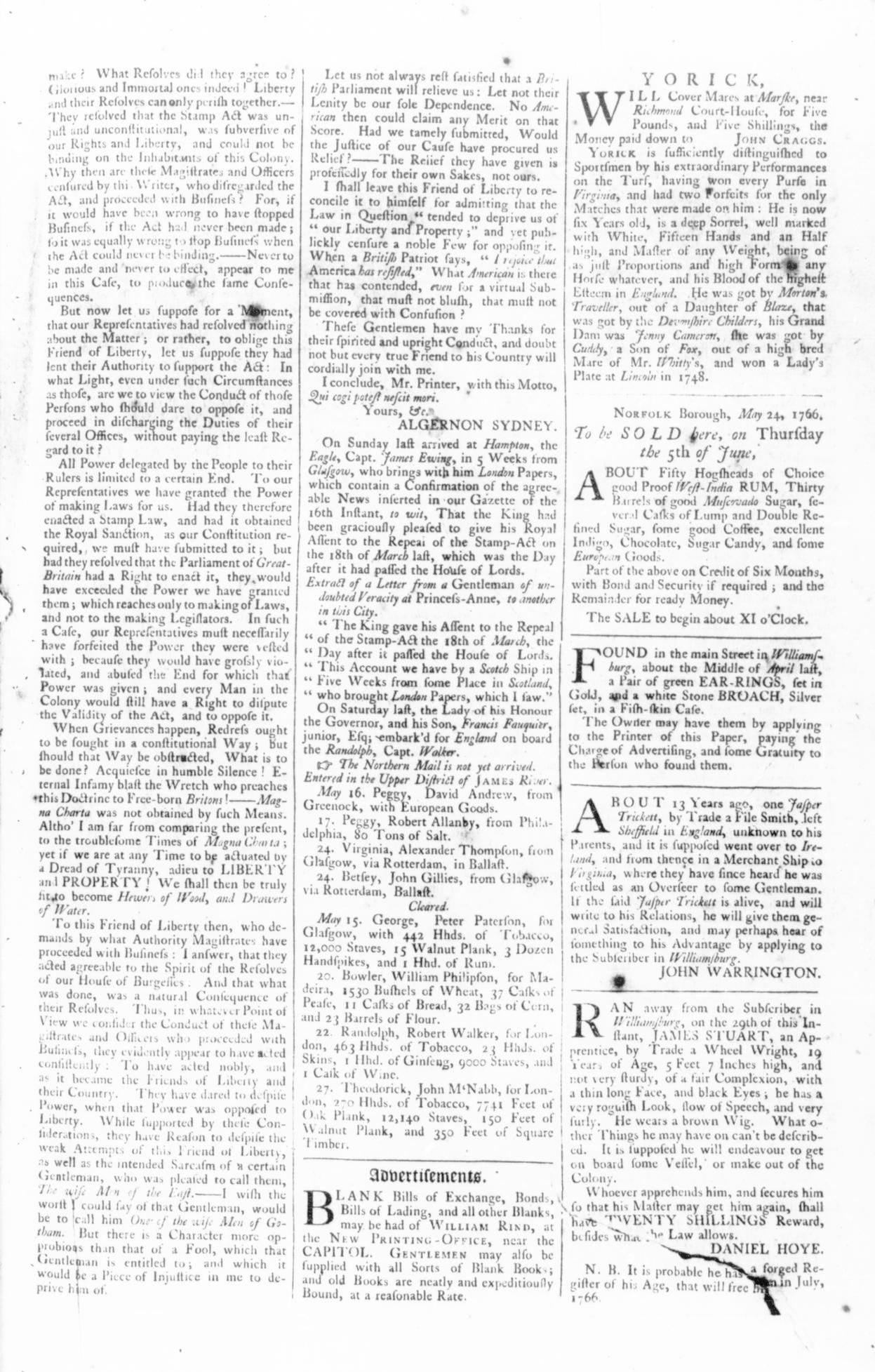
Third page of Rind’s Virginia Gazette (May 30, 1766).

Two weeks ago the Adverts 250 Project featured the entire first issue of Rind’s Virginia Gazette in order to examine the extent of advertising that appeared in that newspaper when it commenced publication. Although Rind included a limited number of advertisements in that initial issue, he issued a call for prospective advertisers to submit announcements and commercial notices.

How did William Rind fare when it came to generating advertisements, an important source of revenue for those who printed newspapers in the colonial period? Unfortunately, no copies of the second issue of Rind’s Virginia Gazette have survived, but the third issue (published two weeks after the first) suggests that advertising picked up relatively quickly. The entire final page was covered with advertising, as well as an entire column on the third page. While not as extensive as advertising in some long-established newspapers in urban ports, the amount of space devoted to advertising in the third issue of Rind’s Virginia Gazette was on par with other newspapers in smaller towns in the 1760s. In other words, Rind seems to have attracted a critical mass of advertisers fairly quickly.

May 31 - 5:30:1766 Rind's Virginia Gazette
Final Page of Rind’s Virginia Gazette (May 30, 1766)

This issue carried a variety of different kinds of advertisements: some for consumer goods and services, some legal announcements, some lost and found (including stray livestock), a horse “to cover,” a runaway apprentice (but not yet any runaway slaves, unlike the those that dominated the advertising section in the competing Virginia Gazette), and some placed by the printer himself to promote his own enterprises. A least one advertisement previously appeared in the pages of the local competitor. It appears that John Mercer wanted to cover all his bases when it came to the beer, porter, and ale from his Marlborough Brewery.

May 16

What was advertised in a colonial newspaper 250 years ago today?

May 16 - Subscription 5:16:1766 Rind's Virginia Gazette
Rind’s Virginia Gazette (May 16, 1766).

“THE Publisher of the GAZETTE, will esteem it as a Favour.”

Special circumstances prompt me to deviate from the usual “featured advertisement” format today. On this day 250 years ago William Rind published the first issue of Rind’s Virginia Gazette, as promised in an advertisement featured last week. This presents an opportunity to look at advertising as it appeared from the very start of a publication. Considering that colonial newspapers tended to make any profit from advertising, not from subscriptions, I was curious to examine to what extent advertising appeared in the first issue of Rind’s Virginia Gazette.

May 16 - Advert Extra 5:16:1766 Rind's Virginia Gazette
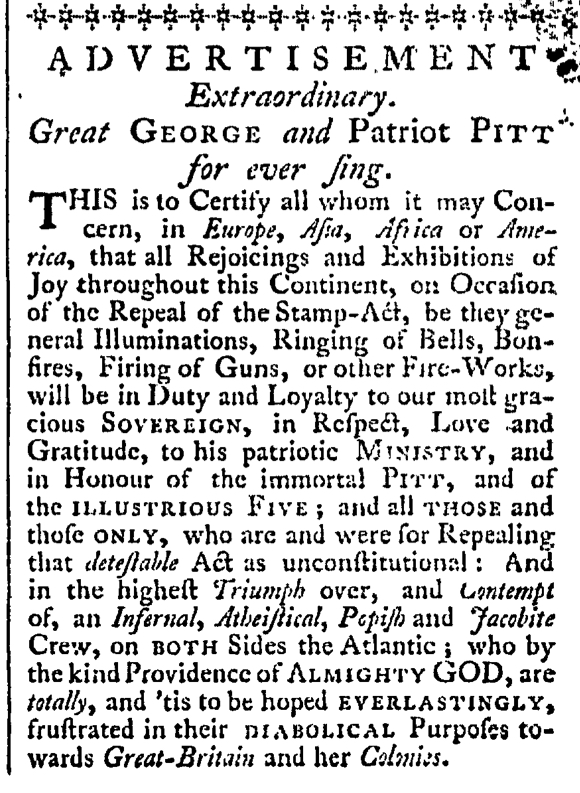
Rind’s Virginia Gazette (May 16, 1766).

Rind inserted an “ADVERTISEMENT Extraordinary” originally published in the Boston Gazette (April 21, 1766); the Adverts 250 Project previously featured this “ADVERTISEMENT Extraordinaryreprinted in the New-Hampshire Gazette (April 25, 1766) and noted when it also appeared in the Newport Mercury (April 28, 1766). It quite likely appeared in many other newspapers in April and May 1766. The original and the reprints in the New-Hampshire Gazette and the Newport Mercury all included this final line: “P.S. All Printers throughout this Continent are desired to publish this Advertisement.” Although this “ADVERTISEMENT Extraordinary” did not generate any revenue for Rind, it was valuable content that demonstrated to readers that they could depend on the printer’s connections to deliver news of interest from throughout the colonies.

May 16 - Lee 5:16:1766 Rind's Virginia Gazette
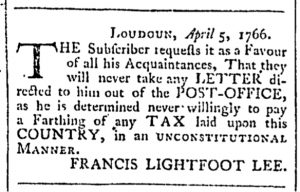
Rind’s Virginia Gazette (May 16, 1766).

The next two advertisements that appeared in the first issue of Rind’s Virginia Gazette took a distinctly partisan tone, making them appropriate complements to the “Advertisement Extraordinary.” In one, Francis Lightfoot Lee, member of the Virginia House of Burgesses and future signer of the Declaration of Independence, warned friends and acquaintances against picking up letters addressed to him at the post office because “he is determined never willingly to pay a Farthing of any TAX laid upon this COUNTRY, in an UNCONSTITUTIONAL MANNER.”

May 16 - 5:16:1766 Rind's Virginia Gazette
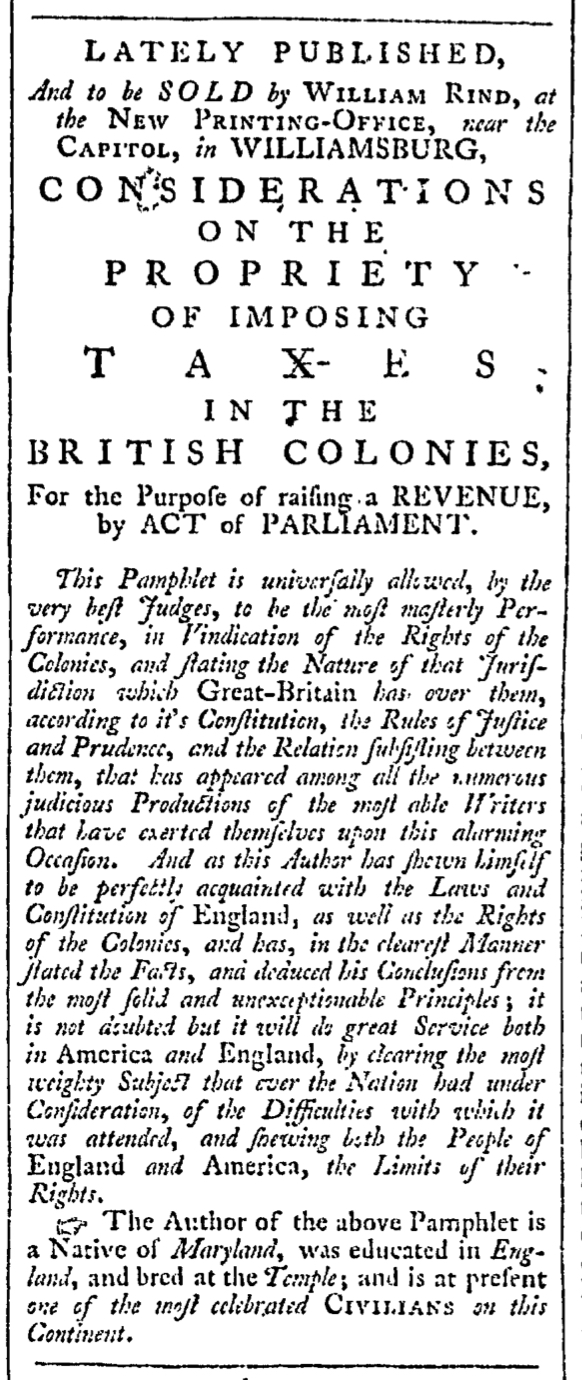
Rind’s Virginia Gazette (May 16, 1766).

The other advertisement with a partisan valence marketed a pamphlet that examined ‘THE PROPRIETY OF IMPOSING TAXES IN THE BRITISH COLONIES, For the Purpose of raising a REVENUE, by ACT of PARLIAMENT.” Although “LATELY PUBLISHED, And to be SOLD by WILLIAM RIND,” these two descriptions need to be separated from each other. Rind likely sold a pamphlet that had recently been published by another printer. This same advertisement, except for the information about where it was sold, previously appeared in a variety of newspapers in New England and the Middle Atlantic. Either the pamphlet’s printer provided printers and booksellers with copy to place their own advertisements or Rind borrowed the copy from other newspapers (just as he had done with the “ADVERTISEMENT Extraordinary.” Either way, the newspaper did not generate any revenue from this advertisement; Rind inserted it to advance his other branches of his printing and bookselling business. (This calls into question whether Lee paid to insert his advertisement, dated a month earlier, into Rind’s Virginia Gazette or if Rind reprinted it from another publication.)

May 16 - Stray Horse 5:16:1766 Rind's Virginia Gazette
Rind’s Virginia Gazette (May 16, 1766).

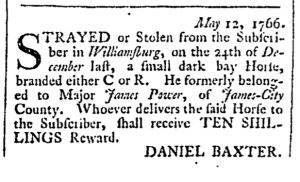
Daniel Baxter’s notice (dated May 12) about a stray or stolen horse was certainly a new advertisement. Similar advertisements appeared frequently in newspapers throughout the colonies. The misfortune of the advertisers financially benefited the printers who published their advertisements.

Rind inserted one more advertisement of his own, an abbreviated version of his request for “Gentlemen who have obliged him by taking in Subscriptions” to return the lists to him as soon as possible. A more extensive version appeared a week earlier in the competing Virginia Gazette.

May 16 - Subscription 5:16:1766 Rind's Virginia Gazette
Rind’s Virginia Gazette (May 16, 1766).

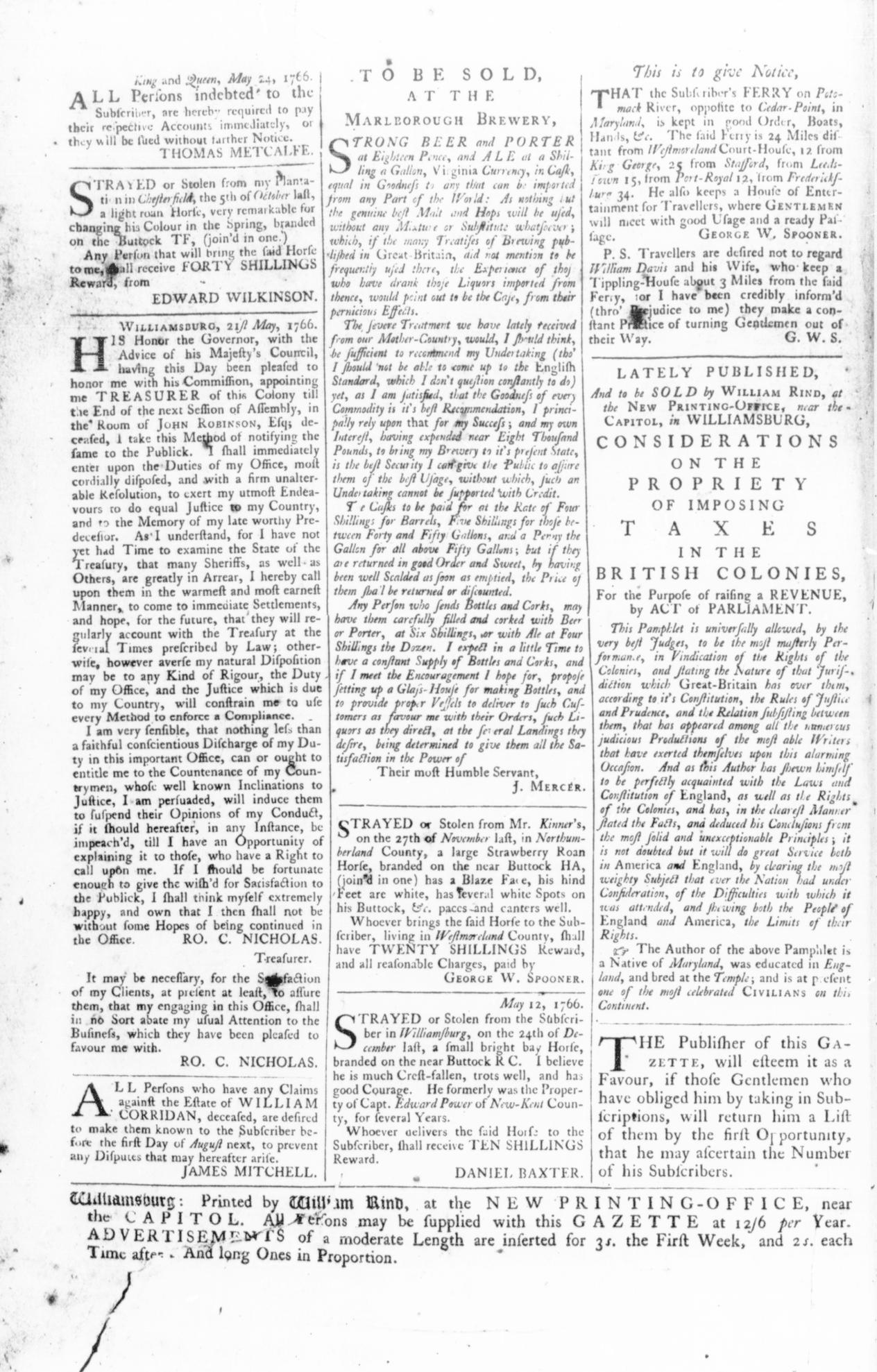
Finally, the colophon encouraged readers to become subscribers and presented the terms for advertising in Rind’s Virginia Gazette. “ADVERTISEMENTS of a moderate Length are inserted for 3 s. the First Week, and 2 s. each Time after: And long Ones in Proportion.” Rind adopted a price structure that exactly replicated that of the Virginia Gazette. He didn’t seek to undercut the competition (doing so might not have allowed for any profit), but he also attempted to make advertising in his newspaper as attractive as possible.

May 16 - Colophon 5:16:1766 Rind's Virginia Gazette
Rind’s Virginia Gazette (May 16, 1766).

Even though Rind had previously advertised in the Virginia Gazette that he intended to begin publishing his own newspaper, very little advertising appeared in the first issue. That makes sense since not even Rind seemed certain of how many people had signed up as subscribers. Potential advertisers likely waited to see how successful Rind’s Virginia Gazette would be, delaying decisions to purchase advertising space until they had a better sense that doing so would likely produce a satisfactory return on their investment. For his part, Rind inserted enough advertising to assure others that their marketing efforts would not stand alone in his newspaper.

January 10

What was advertised in a colonial newspaper 250 years ago today?

Jan 10 - 1:10:1766 New-Hampshire Gazette
New-Hampshire Gazette (January 10, 1766)

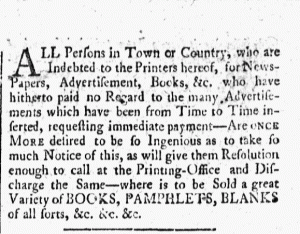
“ALL Persons … Indebted to the Printers hereof, for News-Papers, Advertisement, Books, &c. … Are ONCE MORE desired … to call at the Printing-Office.”

Historians of print culture have long contended that selling subscriptions did not make publishing newspapers profitable for colonial printers.  Instead, the real money was in charging for the advertisements!  I do not doubt the veracity of this claim, especially given how carefully so many other scholars have scrutinized the account books, ledgers, and other records of colonial printers.

However, I suspect that we sometimes overestimate the amount of revenue generated by newspaper advertising if we assume, when printers’ records are no longer extant to confirm that this was indeed the case, that each time an advertisement appeared in a new issue that the printer received payment.  In this instance, the printers of New-Hampshire Gazette placed their own advertisement to call on delinquent advertisers to pay for services rendered.  On many other occasions, some advertisements repeat for weeks or months, suggesting that printers sometimes used them for filler even without remuneration.