November 16

What was advertised in a revolutionary American newspaper 250 years ago today?
Pennsylvania Evening Post (November 16, 1775).

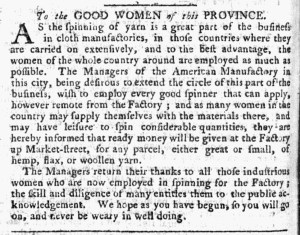
“The Managers of the American Manufactory … wish to employ every good spinner that can apply.”

The proprietors of the American Manufactory in Philadelphia periodically took to the public prints to encourage the public to support their enterprise.  In the March 1775, they called a general meeting at Carpenters’ Hall, the site where the First Continental Congress held its meetings the previous fall.  They invited prospective investors to attend as well as sign subscription papers already circulating.  A month later, the proprietors ran a brief advertisement, that one seeking both materials (“A Quantity of WOOL, COTTON, FLAX, and HEMP”) and workers “(a number of spinners and flax dressers”).  That notice happened to appear in the Pennsylvania Journal on April 19, 1775, the day of the battles at Lexington and Concord, though it would take a while for residents of Philadelphia to learn about the outbreak of hostilities near Boston.  The mission of the American Manufactory to produce an alternative to imported textiles became even more urgent.  In August, the proprietors once again sought workers, publishing an address “To the SPINNERS in thisCITY and the SUBURBS.”  They offered women an opportunity to participate in politics and “help to save the state from ruin.”

In November 1775, the proprietors or “Managers of the American Manufactory” made another appeal “To the GOOD WOMEN of this PROVINCE.”  They explained that “the spinning of year is a great part of the business in cloth manufactories” and “in those countries where they are carried on extensively, and to the best advantage, the women of the whole country are employed as much as possible.”  Having already engaged women “in this CITY and the SUBURBS” who responded to their previous advertisement and apparently needing even more yarn to make into textiles, the managers found themselves “desirous to extend the circle … to employ every good spinner than can apply, however remote from the Factory.”  They believed that women in the countryside “may supply themselves with the materials there” and had “leisure to spin considerable quantities.”  They may have been right on the first count, but perhaps overestimated how many other responsibilities wives, mothers, sisters, and daughters had in their households.  For those who made the time, the managers offered “ready money … for any parcel, either great or small, of hemp, flax, or woollen yarn.”

The managers also lauded the contributions of “those industrious women who are now employed in spinning for the Factory,” declaring that “the skill and diligence of many entitles them to the public acknowledgement.”  They served the American cause in their own way according to their own abilities, just as the delegates to the Second Continental Congress did and just as the soldiers and officers participating in the siege of Boston did.  “We hope as you have begun,” the managers encouraged, “so you will go on, and never be weary in well doing.”
August 7

What was advertised in a revolutionary American newspaper 250 years ago today?

Dunlap’s Pennsylvania Packet (August 7, 1775).

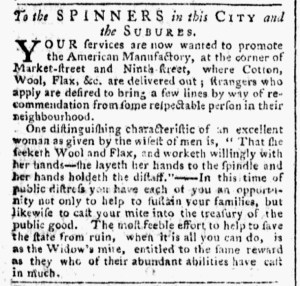
To the SPINNERS in this CITY and the SUBURBS, YOUR services are now wanted to promote the American Manufactory.”

The proprietors of the American Manufactory in Philadelphia published a recruiting notice that first appeared in Dunlap’s Pennsylvania Packet on August 7, 1775, and then in other newspapers printed in the city for several weeks.  They had previously advertised an organizing meeting to gain subscribers (or investors) in the enterprise in March.  A month later, the same day as the battles at Lexington and Concord, they ran a notice seeking a “Quantity of WOOL, COTTON, FLAX, and HEMP.”  That advertisement also advised that “a number of spinners and flax dressers may meet with employment.”  Their latest advertisement devoted significantly more effort to recruiting the “SPINNERS in this CITY and theSUBURBS” to work at the American Manufactory.

“YOUR services are now wanted to promote” the enterprise, the proprietors proclaimed, though they did not plan to hire everyone who presented themselves.  Instead, they followed the eighteenth-century version of letters of recommendation and checking references, instructing that “strangers who apply are desired to bring a few lines by way of recommendation from some respectable person in their neighborbood.”  Working at the American Manufactory offered women “an opportunity not only to help to sustain your families, but likewise to cast your mite into the treasure of the public good” during a “time of public distress.”  They expected that readers would recognize the reference to a story that Jesus told in Mark 12:41-44 and Luke 21:1-4 about a poor widow who donated two coins, called mites, to the temple.  Her small donation, being all she had, far overshadowed much larger donations by the wealthy who could have given much more.  “The most feeble effort to help to save the state from ruin, when it is all you can do,” the proprietors of the American Manufactory explained, “is as the Widow’s mite, entitled to the same reward as they who of their abundant abilities have cast in much.”  Working as a spinner at the American Manufactory, therefore, amounted to service to the American cause by “excellent wom[e]n,” service just as important as that undertaken by the men who participated in local meetings, provincial congresses, and the Second Continental Congress or mustered to defend their liberties.  Women’s work had political meaning during the era of the American Revolution.

June 19

What was advertised in a revolutionary American newspaper 250 years ago today?

Postscript to Dunlap’s Pennsylvania Packet (June 19, 1775).

“A NEW AMERICAN MANUFACTORY.”

As summer arrived in 1775, Ryves and Fletcher took to the pages of Dunlap’s Pennsylvania Packet to inform the public that they established a “NEW AMERICAN MANUFACTORY” where they made and sold “all kinds of PAPER HANGINGS” (better known as wallpaper today).  The eighth article of the Continental Association, the nonimportation pact devised by the First Continental Congress in the fall of 1774, called for “promot[ing] Agriculture, Arts, and the Manufactures of this Country” as alternatives to imported goods.  That charge had even greater urgency following once colonizers heard about the battles at Lexington and Concord and the ensuing siege of Boston.  When Ryves and Fletcher ran their advertisement two days after the Battle of Bunker Hill, word of that engagement had not yet arrived in Philadelphia.  When it appeared again in July, readers had even more information about momentous events in Massachusetts that likely shaped how they reacted to Ryes and Fletcher marketing paper hangings made in America.

The “PAPER STAINERS,” as Ryves and Fletcher described themselves, asserted that they “are the first who have attempted that manufacture on this continent.”  Perhaps they were not aware that Plunket Fleeson made, advertised, and sold “AMERICAN PAPER HANGINGS” in Philadelphia in 1769, though they may have conveniently overlooked that enterprise in their efforts to promote their own.  Ryves and Fletcher made significant investment in procuring both workers and materials, noting in particular that their undertaking “consumes a large quantity of the paper of this country.”  In return for their dedication to the patriot cause, they “are therefore induced to hope for the countenance and protection of all well wishers to the infant manufacturers of America.”  They did their duty as producers, but that was not enough; consumers now had an obligation to purchase the paper hangings that Ryves and Fletcher made.  The paper stainers launched a “Buy American” campaign at the beginning of the Revolutionary War.  As part of their marketing efforts, they emphasized quality, extolling the “neatness of patterns and elegance of colour,” and price, pledging that “they will sell on much more reasonable terms than any paper can be disposed of which is imported into America.”  Ryves and Fletcher were among the first to produce and market paper hangings made in America, helping establish a new industry during the era of the American Revolution.

**********

I provide a brief case study of patriotic advertisements for paper hangings in Carl Robert Keyes, “A Revolution in Advertising: ‘Buy American’ Campaigns in the Late Eighteenth Century,” in Creating Advertising Culture:  Beginnings to the 1930s, vol. 1, We Are What We Sell:  How Advertising Shapes American Life … And Always Has, eds. Danielle Coombs and Bob Batchelor (New York:  Praeger, 2013), 1-25.

April 19

What was advertised in a revolutionary American newspaper 250 years ago today?

Pennsylvania Journal (April 19, 1775).

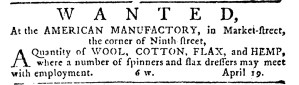
“WANTED, at the AMERICAN MANUFACTORY … A Quantity of WOOL, COTTON, FLAX, and HEMP.”

In the middle of March 1775, supporters of a “FUND for establishing and carrying on an AMERICAN MANUFACTORY, of LINEN, WOOLLEN,” and textiles made of other items met at Carpenters’ Hall in Philadelphia to learn more about the undertaking.  They pledged their support by signing their names to “Subscription Papers” or “general Proposals,” either at the meeting or at the London Coffee House in advance.  The organizers and the “Subscribers” sought to encourage “domestic manufactures” (products made in the colonies) as alternatives to imported goods.  Entrepreneurs had been pursuing that goal for more than a decade during the imperial crisis, though many devoted more effort during the times that colonizers adopted nonimportation agreements as political leverage.  In the spring of 1775, those involved with the “AMERICAN MANUFACTORY” did so as part of the Continental Association.  Its eighth article called for “encourage[ing] Frugality, Economy, and Industry; and promot[ing] Agriculture, Arts, and the Manufacturers of this Country.”

A month later, advertisements concerning the venture simultaneously appeared in the Pennsylvania Gazette and the Pennsylvania Journal on April 19.  “WANTED, At the AMERICAN MANUFACTORY,” the notices advised, “A Quantity of WOOL, COTTON, FLAX, and HEMP.”  Readers could demonstrate their commitment to the cause by supplying the resources necessary to produce textiles in the colony.  The advertisement also noted that “a number of spinners and flax dressers may meet with employment” at the manufactory, contributing to the success of the Continental Association while earning their livelihoods.

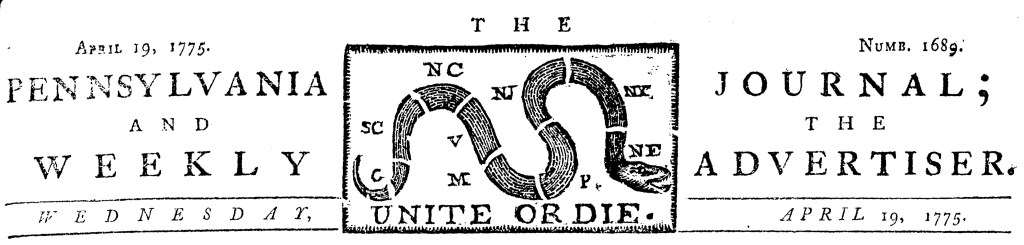
When the printers of the Pennsylvania Gazette and the Pennsylvania Journal distributed the weekly issue of their newspapers on April 19, they were not yet aware of the momentous events that happened at Lexington and Concord in Massachusetts that morning, though it would not take long for word to spread to Philadelphia and throughout the colonies.  Historians have long debated when the American Revolution began, echoing the question that John Adams posed to Thomas Jefferson in 1815: “What do We mean by the Revolution?  The War?  That was no part of the Revolution.  It was only an Effect and Consequence of it.  The Revolution was in the Minds of the People, and this was effected, from 1760 to 1775, in the course of fifteen Years before a drop of blood was drawn at Lexington.”  Establishing the “AMERICAN MANUFACTORY” in Philadelphia before the war, according to Adams, was part of the revolution.  Today, however, the 250th anniversary of the battles at Lexington and Concord offers a convenient moment for commemorating the American Revolution by aligning it with the Revolutionary War that secured independence for a new nation composed of thirteen former colonies.  For readers of the Pennsylvania Journal in 1775, the political cartoon depicting a severed snake with the motto “UNITE OR DIE” had already been spreading its message for many months.  The masthead, the articles and letters, and many of the advertisements had been part of a revolution that was already occurring “in the Minds of the People.”

Pennsylvania Journal (April 19, 1775).

March 14

What was advertised in a colonial American newspaper 250 years ago today?

Pennsylvania Evening Post (March 14, 1775).

“A FUND for establishing and carrying on an AMERICAN MANUFACTORY.”

The organizers of a “FUND for establishing and carrying on an AMERICAN MANUFACTORY, of LINEN, WOOLLEN,” and other textiles in Philadelphia and its hinterland called a meeting to rally support.  In an advertisement that first appeared in the March 11, 1775, edition of the Pennsylvania Evening Post, they announced that all “Subscribers” to that enterprise should meet “at the CARPENTERS HALL” on March 16 “to consider of a Plan for carrying the same into Execution.”  It was an especially appropriate place to meet considering that the organizers sought to put into effect one of the provisions of the Continental Association that the First Continental Congress had devised when the delegates held their meetings at Carpenters’ Hall in September and October 1774.  In addition to boycotting goods imported from Britain, the eighth article specified that colonizers should “encourage Frugality, Economy, and Industry; and promote Agriculture, Arts, and the Manufactures of this Country, especially that of Wool.”

Apparently, “general Proposals” had been printed and disseminated ahead of the meeting, perhaps by Benjamin Towne, the printer of the Pennsylvania Evening Post, or perhaps in the printing office operated by William Bradford and Thomas Bradford.  The notice stated that “one of the Subscription Papers [had been] left with WILLIAM BRADFORD, at the London Coffee-House.”  In addition, the Pennsylvania Journal, the newspaper printed by the Bradfords also carried the notice on the eve of the meeting.  No matter which printer produced the “Subscription Papers,” it was not too late for colonizers to sign their names and show their support for “this important and very interesting Undertaking” by becoming “Subscribers.”  They could visit the London Coffee House to add their names, but those who “may not have an Opportunity of Subscribing before the Day of meeting” could arrive early at Carpenters’ Hall to add their names.  For two hours before the meeting was scheduled to begin at three o’clock, some of the organizers would be present “for that Purpose.”  With subscription papers circulating, prospective supporters could examine who had already committed to the project.  That had the potential to inspire others to do so, provided colonizers actively engaged with printed materials that circulated in Philadelphia as the imperial crisis intensified.  Newspaper advertisements and subscription papers delivered news about the proposed “AMERICAN MANUFACTORY” that encouraged colonizers who encountered them to get involved by signing their names, attending meetings, and making donations.