September 26

What was advertised in a revolutionary American newspaper 250 years ago today?

New-Hampshire Gazette (September 26, 1775).

“Gentlemen Travellers inclining to have their Hair or Wigs dressed before they go to Town.”

As the siege of Boston continued to the south in the fall of 1775, John Williams took to the pages of the New-Hampshire Gazette to inform the public that he “has opened a House of Entertainment in Greenland,” just outside Portsmouth, “at the Sign of the SALUTATION.”  The image that marked the location of his tavern and inn may have depicted two or more colonizers greeting each other or perhaps a generous host welcoming patrons to his establishment.  Few signs for shops, taverns, and other businesses survive from the era of the American Revolution.  Instead, references to them in newspaper advertisements remain the only vestiges of most of them.

Whatever scene the “Sign of the SALUTATION” may have shown, Williams wanted prospective customers to know that he “will do his utmost to wait on such Gentlemen and Ladies as will oblige him with their Favours and Custom.”  To that end, he “Has provided himself with the best of Liquors and every other Necessary for the Accommodation of Travellers & their Horses.”  When it came to hospitality, Williams would not be outdone by tavernkeepers, coffeehouse proprietors, and innkeepers in other cities and towns.  He planned to see to his guests’ every need and “promises the best Attendance & Care of them.”

That included a service that most men and women who ran similar establishments did not offer.  In a nota bene, Williams noted that “Any Gentlemen Travellers inclining to have their Hair or Wigs dressed before they go to Town, may have it done by said WILLIAMS in the genteelest and most fashionable Manner.”  After enduring the trials of the road, his patrons did not have to worry about entering Portsmouth looking disheveled or out of sorts.  They certainly did not need to seek out the services of William Stanwood, a “PERUKE [or Wig] MAKER and HAIR DRESSER” in Portsmouth who advertised in the same issue of the New-Hampshire Gazette.  Their host at the “Sign of the SALUTATION” would help them look presentable for conducting business and making social calls.
December 12

What was advertised in a colonial American newspaper 250 years ago today?

New-York Gazette and Weekly Mercury (December 12, 1774).

“He will meet with due encouragement … by every real friend to American manufactures.”

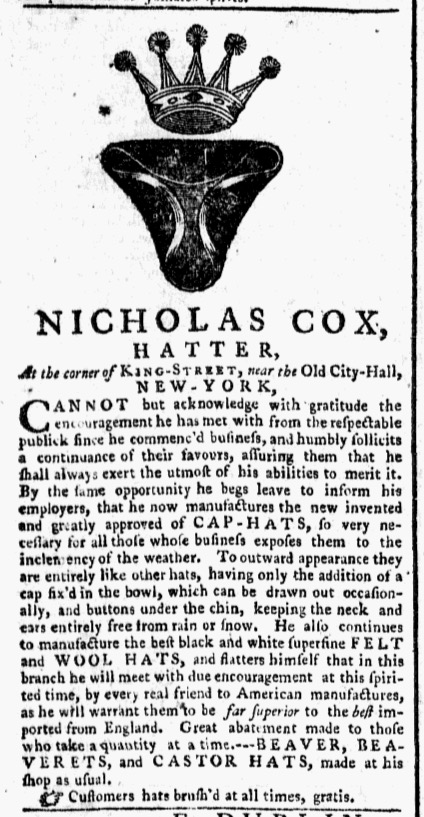
Nicholas Cox, a hatter, made several appeals to consumers in his advertisement in the December 12, 1774, edition of the New-York Gazette and Weekly Mercury.  He commenced with a standard expression of gratitude for “the encouragement he had met with from the respectable publick since he commenc’d business.”  Many purveyors of goods and services did so in their advertisements, signaling to readers that other consumers already considered them worthy of their business.  It was a familiar means of bolstering an advertiser’s reputation.

The hatter also incorporated commentary specific to his trade, proclaiming that he “manufactures the new invented and greatly approved of CAP-HATS.”  For those unaware of this innovation, eh explained that by “outward appearance they are entirely like other hats, having only the addition of a cap fix’d in the bowl, which can be drawn out occasionally.”  In such instances, it “buttons under the chin, keeping the neck and ears entirely free from rain or snow.”  Cox marketed this new style, a very practical element, as “so very necessary for all those whose business exposes them to the inclemency of the weather.”  According to Kate Haulman, colonizers debated whether they should carry umbrellas, “stylistic spoils of empire hailing from India,” in the 1760s and 1770s.  “Some regarded umbrellas as ridiculous and frivolous,” she notes, “serving no purpose that a good hat could not supply.”[1]  Cox produced and sold such hats for men of business who sought to eschew the effeminacy and luxury associated with umbrellas.

His next appeal made an even more explicitly political argument to prospective customers.  He made “the best black and white superfine FELT and WOOL HATS,” like the tricorne hat depicted in the woodcut that adorned his advertisement.  Cox asserted that patriotic consumers had a duty to support his business when they made choices about where to acquire their hats.  He expressed confidence that he “will meet with due encouragement at this spirited time, by every real friend to American manufactures.”  The Continental Association, a boycott of British goods adopted in response to the Coercive Acts, had recently gone into effect.  Cox offered an alternative to colonizers who desired to acquire hats yet wished to remain patriotically correct, either according to their own principles or at least to avoid the ire of others who observed the purchases they made.  Furthermore, his customers did not have sacrifice quality for principles.  The hatter pledged that “he will warrant [his hats] to be far superior to the best imported from England.” That being the case, the crown that appeared above the tricorne hat at the top of his advertisement may have testified to the superior quality of his hats, a general sense of pride in being part of the British Empire, or reverence for the monarch whom many colonizers still hoped would intervene on their behalf in their altercation with Parliament.

In addition to those appeals, Cox included two more common marketing strategies.  He promised a “[g]reat abatement … to those who take a quantity at a time.”  In other words, he gave discounts for buying multiple hats, both for consumers and for retailers who intended to sell them in their own shops.  He also provided a free ancillary service: “Customers hats brush’d at all times, gratis.”  Cox saw to the care and maintenance of the hats he made and sold long after the time of purchase.  He cultivated relationships with customers by encouraging them to return to his shop for assistance in keeping their hats in good order.  Overall, Cox resorted to a variety of familiar and specific appeals when advertising his hats, distinguishing him from competitors who did not put as much effort into marketing their wares.

**********

[1] Kate Haulman, “Fashion and the Culture Wars of Revolutionary Philadelphia,” William and Mary Quarterly, 3rd ser., 62, no 4 (October 2005): 632.

September 28

What was advertised in a colonial American newspaper 250 years ago today?

Pennsylvania Gazette (September 28, 1774).

“Goods purchased, delivered to any part of the city.”

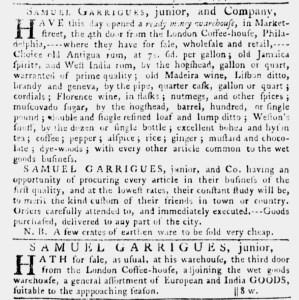
As fall arrived in 1774, Samuel Garrigues, Jr., placed a brief advertisement in the Pennsylvania Gazette to remind readers that he sold a variety of imported goods “as usual at his warehouses, the third door from the London Coffee-house” in Philadelphia.  He supplemented that notice with a longer advertisement informing the public that he and his partners, doing business as Samuel Garrigues, Jr., and Company, just opened a “wet goods warehouse” right next door at “the 4th door from the London Coffee-house.”  There they stocked “Choice old Antigua rum,” “old Jamaica spirits, and West India rum,” “old Madeira wine,” “brandy and geneva,” as well as sugar, spices, snuff, coffee, chocolate, and “every other article common to the wet goods business.”  The inventory curiously included “excellent bohea and hyson tea” despite the controversy associated with that commodity.

In addition to listing the merchandise, Garrigues and Company sought to entice prospective customers by explaining that they had “an opportunity of procuring every article in their business of the first quality, and at the lowest prices,” suggesting that they would pass along the savings while also assuring consumers that they did not need to be wary of such bargains meaning inferior goods.  They pledged to make it their “constant study … to merit the kind custom of their friends in town or country” by “carefully attend[ing] to orders” and “immediately execut[ing]” them.  The partnership promised superior customer service.  They also offered a valuable service, delivering purchases “to any part of the city,” whether just a gallon or quart or an entire hogshead or pipe.  They hoped that ancillary service, provided gratis, would sway customers to shop with them to take advantage of both the convenience and the cost.  Eighteenth-century entrepreneurs sometimes experimented with free services as marketing strategies to convince consumers to choose them over their competitors.  For Garrigues and Company, doing so was one aspect of their “constant study” in serving their customers.

March 27

What was advertised in a colonial American newspaper 250 years ago this week?

New-York Journal (March 24, 1774).

“WATCHES … no Expence for cleaning them.”

John Simnet, a watchmaker, was a prolific advertiser in New York’s newspapers in the early 1770s.  In late March 1774, he placed a new advertisement in the New-York Journal, with a headline that proclaimed, “The Sixth Year of this Advertisement in this Country.”  Simnet referred to the fact that he migrated to the colonies from London, though he first set up shop in New Hampshire.  He advertised there for about a year and a half, frequently engaging in feuds with a competitor, before relocating to New York.  Perhaps prospective customers in and near Portsmouth had not appreciated his abrasive style, though the curmudgeon did not seem to learn his lesson if that was the case.  After settling in New York, he frequently picked fights with local watchmakers, their arguments witnessed by newspaper readers as they perused the advertisements.  Over the years, the colorful Simnet has become a favorite for the Adverts 250 Project, one of the colonial advertisers most often featured thanks to his lively notices.  In March 1774, Simnet had indeed commenced his “Sixth Year” of running advertisements in the colonies.

When he did so, he advanced a marketing strategy he frequently deployed.  Simnet offered an ancillary service for free to his clients who paid for other services: “those Gentlemen, &c. who have employed the Advertiser to Repair their WATCHES, ARE now at no Expence for cleaning them.”  In other words, he did not charge customers for routine cleaning of watches that he previously repaired.  That kept the watches in good running order, which further testified to Simnet’s skills and justified hiring him for other work.  The watchmaker declared that “it will be his endeavour to prove, Watches which are tolerably good, will perform 20 Years without Expence.”  Prospective clients could take their watches to his competitors who did not invest the same care in their work, causing them to have to pay for additional repairs over time, or they could entrust their watches to Simnet with confidence that he would assist them in averting further expense.  His clients could avoid paying for “mending Work” on their watches (and simultaneously safeguard Simnet’s reputation) if they presented their watches for cleaning “at least once a Year.”  Putting a little effort into such routine maintenance, offered for free, made the clients and the watchmakers partners in the enterprise, encouraging customer loyalty.

December 3

What was advertised in a colonial American newspaper 250 years ago today?

New-York Journal (December 3, 1772).

“Every Particular in repairing at HALF the PRICE charged by any other.”

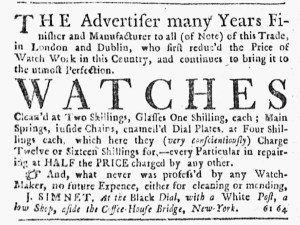
In early December 1772, watchmaker John Simnet inserted a new advertisement in the New-York Journal.  Simnet had a long history of advertising, first in New Hampshire and then in New York.  He sometimes promoted the services he provided, but other times denigrated the skill and character of one competitor or another.  This time he opted to compare his prices and ancillary services to those offered by other watchmakers, but he did not launch any attacks against particular rivals.

Simnet incorporated superlatives into his advertisement.  He mentioned his origins, declaring that he had been “many Years [a] Finisher and Manufacturer to all (of Note) of this Trade, in London and Dublin.”  In other words, he previously worked in only the best workshops in those cities before migrating to the colonies.  Upon his arrival he became the “first [who] reduc’d the Price of Watch Work in this Country,” suggesting that others charged far too much for the mending and cleaning services they provided.  Simnet also proclaimed that he “continues to bring it to the utmost Perfection,” leaving it to readers to determine if “it” meant prices alone or the entire watchmaking trade.

To entice prospective clients to avail themselves of his services, Siment listed his prices.  He charged two shillings to clean watches and one to clean watch glasses.  He replaced “Main Springs, inside Chains, [and] enamell’d Dial Plates, at Four Shillings each,” compared to others in the colonies who “(very conscientiously) Charge Twelve or Sixteen Shillings.”  He accused the industry of purposely charging three or four times what the prices should have been for replacing certain parts.  As for other fixing other parts of watches, Simnet asserted that he asked “HALF the Price charged by any other.”

If those prices were not enough to get clients into his shop, the watchmaker offered ancillary services for free.  He promised “no future Expence, wither for cleaning or mending” for any watches purchased from him.  Deploying one more superlative, Simnet proclaimed that such a deal “never was profess’d by any Watch-Maker” in the colonies.  Simnet had a high opinion of himself and the work undertaken in his shop.  He hoped that his confidence would convince prospective clients to choose him over his competitors, though he also compared prices and provided supplementary services as part of his sales pitch.

November 13

What was advertised in a colonial American newspaper 250 years ago today?

Connecticut Journal (November 13, 1772).

“Will alter any Fault (if observed within Twelve Months) gratis.”

Like many other artisans who migrated across the Atlantic, Edward Hart, a “WIG-MAKER,” described himself as “Lately from London” when he introduced himself to prospective customers in a newspaper advertisement.  Realizing that readers were unfamiliar with him and his work, he sought to use his origins to suggest a certain level of skill and, especially, knowledge of current fashions in the cosmopolitan center of the empire to convince clients in Wallingford and nearby towns to give him a chance.  In an advertisement in the November 13, 1772, edition of the Connecticut Journal, he declared that he made “Lady’s Hair Rolls … in the best Manner.”  He also boasted that his customers would “be served with all Sorts of Wigs, made in the present Taste.”

Hart did not confine his marketing efforts to those appeals.  He also offered free repair services for a year, pledging that he would “alter any Fault (if observed within Twelve Months) gratis.”  Knowing that he could not yet depend on his reputation to sell his wigs, Hart likely hoped that providing that warranty would persuade prospective customers that they had nothing to lose when they purchased his wares.  If they discovered any defects, the wigmaker pledged to correct them without charge.  Customer service extended beyond the initial purchase, aiding Hart in cultivating a clientele in a new location.

At a glance, Hart’s advertisement may look like little more than a dense block of text to modern readers, but it was not a mere announcement that he made and sold wigs.  Instead, he advanced several appeals intended to entice consumers to acquire their wigs from him rather than other sources.  He promoted his origins in London, the quality of his work, and his knowledge of the latest trends.  In case that was not enough, he also provided a warranty to reassure customers still hesitant after his other marketing appeals.  Rather than inserting an announcement in the newspaper, Hart devised a strategy for attracting customers to his new shop.

October 2

What was advertised in a colonial American newspaper 250 years ago today?

New-Hampshire Gazette (October 2, 1772).

“His customers may depend on having their ware packed in the best manner.”

Ebenezer Bridgham sold “Crockery Ware” and other goods at his “Staffordshire and Liverpool Ware House” on King Street in Boston in the early 1770s.  In an advertisement in the October 2, 1772, edition of the New-Hampshire Gazette, he declared that he imported his merchandise “directly from the Pot-Houses in Staffordshire and Liverpool” rather than purchasing from English merchants.  Fewer links in the supply chain meant fewer markups for his inventory.  Bridgham passed along the savings to his customers, making bold claims about his prices.  He trumpeted that he sold his wares “as low as they can be bought in London,” adding that he was “determined not to be UNDERSOLD by any person in America.”

Bridgham made that assertion in the midst of his attempts to create a regional market for the “Staffordshire and Liverpool Ware House.”  In a sense, every newspaper advertiser engaged a regional market since newspapers circulated far beyond the cities where they were published, usually serving entire colonies before the American Revolution.  Bridgham, however, intentionally placed advertisements in newspapers throughout New England.  In addition to Portsmouth’s New-Hampshire Gazette, he also advertised in Salem’s Essex Gazette, the Providence Gazette, Hartford’s Connecticut Courant, and the New-London Gazette.  Bridgham aimed to provide shopkeepers throughout the region with an assortment of merchandise for their own shops.  He expected that his “resolution” not to be “UNDERSOLD by any person in America” resonated with “his former good customers” who he hoped would “continue to favour him with their custom.”  In turn, invoking former customers signaled to new customers that Bridgham merited their orders since he already established and successfully served a clientele.

As evidence of his attention to the needs of his customers, he emphasized more than low prices for an incredible array of choiuces among the “full & complete assortment of Delph, Flint and Glass Ware” at the “Staffordshire and Liverpool Ware House.”  In a nota bene, Bridgham announced that he “lately procur’d packers from England” so “his customers may depend on having their ware packed in the best manner.”  They did not need to worry about receiving broken goods shipped to their towns throughout New England.  Bridgham believed that this ancillary service aided his efforts to serve a regional market, one that extended beyond Boston and beyond Massachusetts.

August 27

What was advertised in a colonial American newspaper 250 years ago today?

New-York Journal (August 27, 1772).

“May have them clean’d again immediately without expence.”

As fall approached in 1772, watchmaker John Simnet marked the second anniversary of his arrival in New York by distributing a new advertisement in the newspapers published in that city.  Readers should have been familiar with Simnet and his feud with rival watchmaker John Yeoman.  The two exchanged barbs in their newspaper notices over the course of several months.  Before moving to New York, Simnet had similarly participated in a war of words with a competitor, Nathaniel Sheaff Griffith, in the pages of the New-Hampshire Gazette.  In both Portsmouth and New York, Simnet acquired a reputation for acerbic commentary about his competitors.

He took a different approach, however, when marking two years in New York.  His most recent advertisement opened with an imitation of Yeoman’s advertisement intended to denigrate the other watchmaker.  The new advertisement simply declared, “WATCHES COMPLETELY repair’d, in every particular article, at HALF the price charg’d by any other.”  While he made reference to the prices of his competitors in general, Simnet did not deploy any insults aimed directly at Yeoman.  Instead, he focused on his credentials, his prices, and ancillary services intended to cultivate relationships with clients.  As usual, he trumpeted his experience and origins as a “WATCH-FINISHER, and Manufacturer, of London.”  He gave a list of prices for cleaning, replacing parts, and mending watches so prospective customers could assess for themselves whether he offered bargains compared to his competitors.  He also noted that since two years passed “since the author advertised here, some of the watches he has repair’d may become dirty.”  Simnet presented a special deal to his first customers who helped him get established in the city, inviting them to have their watches “clean’d again immediately without expence.”  He likely believed that this free service would generate more business.

Despite taking a different tone in this new advertisement, Simnet did not suspend his attacks on Yeoman.  His “ingenious Artificer” advertisement and his new notice both appeared in the August 27 edition of the New-York Journal.  That may have been an oversight, either on the part of Simnet or the compositor, since only the new advertisement found its way into the newspapers the following week.  Even without both advertisements running simultaneously, readers likely remembered Simnet’s cantankerous personality and feud with Yeoman when they encountered the new advertisement that focused solely on promoting Simnet’s positive attributes.

February 23

What was advertised in a colonial American newspaper 250 years ago today?

New-York Journal (February 20, 1772).

“Watches regulated, and such alterations which don’t require much time; gratis.”

For the past three years, the Adverts 250 Project has tracked newspaper advertisements placed by John Simnet, a “WATCH-FINISHER, and Manufacturer, of London,” first in the New-Hampshire Gazette during the period that he lived and worked in Portsmouth in 1769 and 1770 and then in newspapers published in New York after he migrated to that city.  Simnet often promoted his years of experience working in London in his advertisements in the New-Hampshire Gazette, but he also pursued a nasty public feud with one of his competitors.  That may have contributed to his decision to leave Portsmouth in favor of New York.

In a new city, Simnet adopted a much less aggressive approach in his advertising.  He deployed a variety of marketing strategies that did not focus on denigrating other watchmakers, though he did suggest that he possessed greater skill than any of his rivals.  In an advertisement that ran for the first time in the February 20, 1772, edition of the New-York Journal, for instance, he trumpeted that he “had more practice, and general knowledge on new work [the mechanisms in watches] than any yet in this country could have.”  Drawing on his long experience and superior expertise, he provided a service to anyone considering buying, selling, or repairing watches.  Simnet offered to examine watches and inform the owners or prospective buyers of “the first cost, or value of any new, or old watch.”  Once they knew the value of watches “with certainty,” they could make informed decisions about buying, selling, or repairing watches.

To generate business and enhance his reputation, Simnet also declared that he made “such alterations which don’t require much time; gratis.”  For those jobs that did involve more time and attention, he stated that he “will clean them, fit glasses, springs, inside chains; and perform every particular article in repairing, at half the price, charg’d by any other.”  Perhaps Simnet discovered that bargain prices brought more customers to his shop “At the Dial … beside the Coffee-House Bridge” than cantankerous diatribes that insulted his competitors.  In this advertisement, he focused on his own skill, asserting that customers could depend on his work keeping their watches in good order for quite some time instead of having them become “an annual or continual expence.”  Simnet attempted to leverage his skill and experience “To the Advantage of those who wear WATCHES” as well as his own benefit in earning a livelihood through providing various services.

September 26

What was advertised in a colonial American newspaper 250 years ago today?

Pennsylvania Journal (September 26, 1771).

“The newest fashionable muffs.”

In the fall of 1771, the partnership of Fromberger and Siemon took to the pages of the Pennsylvania Journal to promote a “Very large assortment of Russia and Siberia fur skins” which they intended to make into muffs, tippets, and linings for cloaks.  They deployed a variety of marketing strategies to capture the attention of consumers in Philadelphia and its environs.

For instance, the partners informed readers that they sold “the newest fashionable muffs, tippets, and ermine, now worn by the ladies at the courts of Great Britain and France.”  Fromeberger and Siemon attempted to incite demand by educating their prospective clients.  Ladies who feared they were unfamiliar with the latest trends on the other side of the Atlantic as well as those who merely wanted to confirm that they had indeed kept up with the latest styles could visit Fromberger and Siemon’s shop to outfit themselves.

Even as the partners emphasized European tastes, they also promoted “American manufacture.”  In the process, they suggested to “the ladies” that they could play an important role in supporting the commercial and politic interests of the colonies in the wake of recent meddling by Parliament that had resulted in nonimportation agreements in response to the Stamp Act and the duties imposed on certain goods in the Townshend Acts.  All but the duty on tea had been repealed and merchants returned to importing vast arrays of goods, but some American entrepreneurs continued to advocate for “American manufacture.”  Consumers did not have to sacrifice quality when supporting those entrepreneurs, at least according to advertisers like Fromberger and Siemon who promised they made muffs and tippets “superior to that which is manufactured in England.”

In addition to those appeals, the partners also offered a free ancillary service to their customers.  “Ladies who purchase any manufactured furs of great value” could wear them in the fall, winter, and spring and then “send them to our manufactory” where they would “be taken care of gratis for the summer season.”  Fromberger and Siemon cultivated relationships with customers that did not end when making a sale but could instead continue for years as they assisted in the care and maintenance of expensive garments.

A woodcut depicting a muff and tippet may have drawn the attention to Fromberger and Siemon’s advertisement, but they did not rely on the visual image alone to market their wares.  Instead, they incorporated several appeals to “the ladies” they hoped would visit their shop, order garments, and make purchases.  They invoked current fashions in England and France, the importance of supporting “American manufacture,” and free services to convince readers to become customers.