October 12

What was advertised in a revolutionary American newspaper 250 years ago today?

New-York Journal (October 12, 1775).

“I Acknowledge that I have at several times spoken in favour of the laws of Taxation.”

Lemuel Bower wanted to return to the good graces of his community in the fall of 1775.  Events that occurred since the previous April – the battles at Lexington and Concord, the siege of Boston, the Battle of Bunker Hill, the Second Continental Congress appointing George Washington as commander in chief of the Continental Army, an American invasion of Quebec – had intensified feelings about the imperial crisis and, apparently, made for a difficult situation for Bower since he had expressed Tory sentiments in the past.  In hopes of moving beyond that, he composed a statement that appeared in the October 12, 1775, edition of the New-York Journal.

“I Acknowledge,” Bower confessed, “I have at several times spoken in favour of the laws of Taxation, and against the measures pursued by America to procure Redress, and have thereby justly merited the displeasure of my country.”  To remedy that, “I beg forgiveness, and so solemnly promise to submit to the rules of the Continental and Provincial Congresses,” including abiding by the nonimportation and nonconsumption provisions in the Continental Association.  Furthermore, Bower pledged, “I never will speak or act in opposition to their order, but will conduct according to their directions, to the utmost of my power.”  He did not state that he had a change of heart, only that he would quietly act as supporters of the American cause were supposed to act rather than engage in vocal opposition.  As William Huntting Howell has argued, such compliance, especially when expressed in a public forum, may have been more important to most Patriots than whether Bower truly agreed with them.[1]  How he acted and what he said was more important than what he believed as long as he kept his thoughts to himself.

Bower did indeed express his regrets and his promise to behave better in a public forum.  He concluded his statement with a note that “this I desire should be published in the public prints.  When it appeared in the New-York Journal, it ran immediately below a notice from the Committee of Inspection and Observation in Stanford, New York, that labeled two Loyalists as “enemies to the liberties of their country” and instructed the public “to break off all commerce, dealings and connections with them.”  That was the treatment that Bower sought to avoid!  That notice appeared immediately below news from throughout the colony.  Bower’s statement ran immediately above paid advertisements.  The two statements concerning the political principles of colonizers thus served as a transition from news to advertising in that issue of the New-York Journal.  Did John Holt, the printer, treat them as paid notices?  Did he require Bower to pay to insert his statement?  Or did the Patriot printer publish one or both gratis?  Perhaps he printed the statement from the Committee of Inspection and Observation for free but made Bower pay to publish his penance.  Whatever the case, Bower’s statement was not clearly a news item nor an advertisement but could have been considered both simultaneously by eighteenth-century readers.

**********

[1] William Huntting Howell, “Entering the Lists: The Politics of Ephemera in Eastern Massachusetts, 1774,” Early American Studies 9, no. 1 (Winter 2011): 187-217.

September 21

What was advertised in a revolutionary American newspaper 250 years ago today?

New-England Chronicle (September 21, 1775).

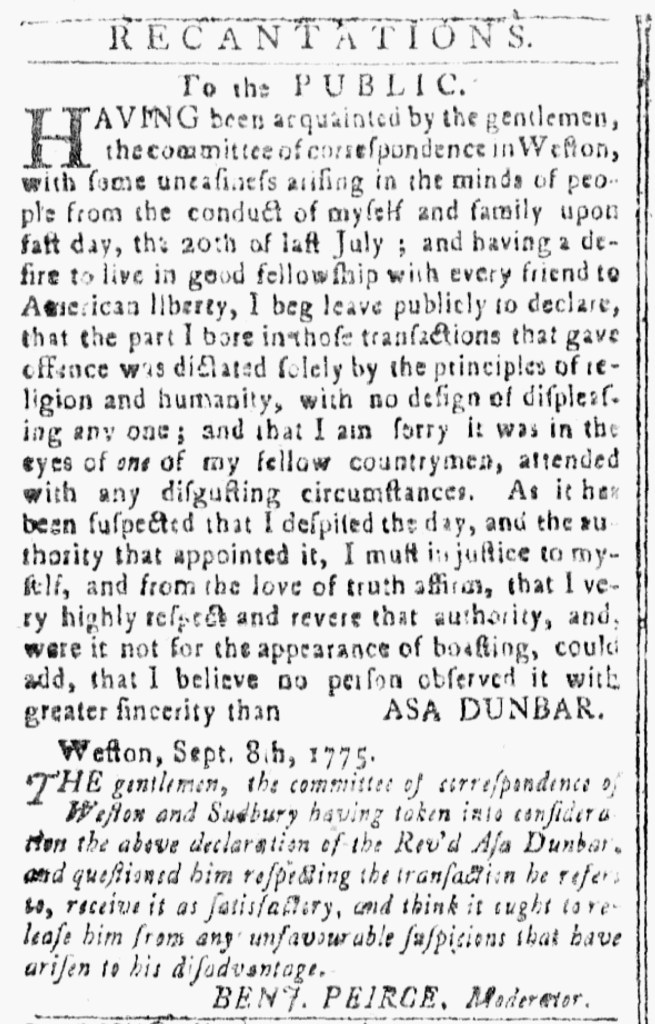
“Uneasiness arising in the minds of people from the conduct of myself and family upon the fast day.”

The final page of the September 21, 1775, edition of the New-England Chronicle had an entire column of “RECANTATIONS.”  Five notices appeared under that header, four of them colonizers who expressed regret for signing an address to Thomas Hutchinson, the former governor of the colony, in February 1774.  Such advertisements had become a regular feature in newspapers published in New England over the past year.  In the first of the “RECANTATIONS,” however, Asa Dunbar, a minister in Salem, apologized for something else that had caused concern in his community.

He had been “acquainted by the gentlemen, the committee of correspondence in Weston” about “some uneasiness arising in the minds of people from the conduct of myself and family upon the fast day, the 20th of last July.”  Katherine Carté, author of Religion and the American Revolution: An Imperial History, explains that on June 12 the Second Continental Congress passed a resolution to declare the fast on July 20, allowing for enough time for the news to reach distant colonies from Philadelphia.  The fast day became, Carté asserts, “in effect our first national holiday.”  Furthermore, it “was probably one of the only moments of the Revolutionary War that Americans experienced simultaneously, though not everyone celebrated it.  In a short essay, “Why We Should Remember July 20, 1775,” she chronicles commemorations of the fast day throughout the colonies, noting that many embraced the occasion and a few “marked it in protest.”

Something happened that day that cast suspicion on Dunbar and his support for the American cause: “I beg leave publicly to declare, that the part I bore in those transactions that gave offence was dictated solely by the principles of religion and humanity, with no design of displeasing any one.”  Whatever had occurred, the minister had not intended to make a statement, unlike Samuel Seabury who had “closed the doors of his church in protest” on the day of the fast.  “As it has been suspected that I despised the day, and the authority that appointed it,” Dunbar proclaimed, “I must in justice to myself, and from the love of truth affirm, that I very highly respect and revere that authority.”  Furthermore, “were it not for the appearance of boasting, [I] could add, that I believe no person observed it with greater sincerity.”

A short note from Benjamin Peirce, the moderator of Weston and Sudbury’s Committee of Correspondence, accompanied Dunbar’s recantation.  He reported that the committee took into account Dunbar’s “declaration” and “questioned him respecting the transaction he refers to,” but he did not elaborate on that transgression.  Whatever had occurred, the committee considered Dunbar’s explanation “satisfactory, and think it ought to release him from any unfavourable suspicions that have arisen to his disadvantage.”  That must have been a relief to Dunbar.  Like so many others, he resorted to an advertisement in the public prints to confess, to apologize, and to assure his community that he was not an enemy to American liberties.

August 28

What was advertised in a revolutionary American newspaper 250 years ago today?

Boston-Gazette (August 28, 1775).

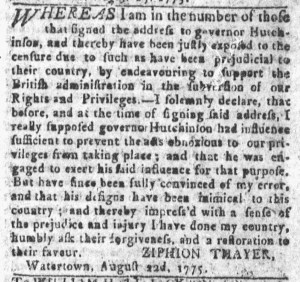
“Impress’d with a sense of the prejudice and injury I have done my country, humbly ask their forgiveness.”

It was yet another apology for signing an address to Thomas Hutchison when General Thomas Gage replaced him as governor of Massachusetts and he departed for England.  This time Ziphion Thayer lamented his error in an advertisement in the August 28, 1775, edition of the Boston-Gazette, published in Watertown as the siege of Boston continued.  Thayer acknowledged that he signed the address and “thereby have been justly exposed to the censure due to such as have been prejudicial to their country, by endeavouring to support the British administration in the subversion of our Rights and Privileges.”  As others indicated in their own apology-advertisements, signing the address came with consequences.  The “censure” that Thayer experienced likely included other colonizers refusing to engage with him socially or in business.

For a time, many signatories who published apology-advertisements claimed that they had affixed their names in haste without reading carefully or fully considering the full implications of the address.  More recently, however, others explained that they signed because they thought at the time that Hutchinson had the power to protect them from the “Vengeance of the British Ministry” and an inclination to advocate for American liberties.  “I solemnly declare, that before, and at the time of signing said address,” Thayer claimed, “I really supposed governor Hutchinson had influence sufficient to prevent the acts obnoxious to our privileges from taking place; and that he was engaged to exert his said influence for that purpose.”

Things certainly did not work out that way, leading Thayer to declare that he had “since been fully convinced of my error” and now realized that Hutchinson’s designs “have been inimical to this country.”  Did Thayer have an authentic conversion?  Or did he merely say what others wanted to hear so he could return to his former standing in his community?  William Huntting Howell contends that the authenticity of such apology-advertisements mattered much less to Patriots than the “rote expression of allegiance” in the public prints.[1]  Thayer asserted that he became “impress’d with a sense of the prejudice and injury I have done my country” and, accordingly, he “humbly ask[ed] their forgiveness, and a restoration to their favour.”  Whether or not Thayer truly believed the former, he wanted the latter and likely believed that his apology-advertisement would help convince others to overlook what he had done.

**********

[1] William Huntting Howell, “Entering the Lists: The Politics of Ephemera in Eastern Massachusetts, 1774,” Early American Studies 9, no. 1 (Winter 2011): 215-6.

August 15

What was advertised in a revolutionary American newspaper 250 years ago today?

Pennsylvania Evening Post (August 15, 1775).

“I will, for the future, conduct myself as a true friend to America.”

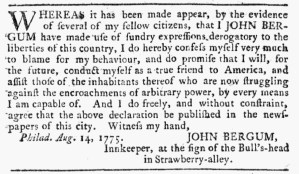
It was another confession accompanied with an apology.  John Bergum, an “Innkeeper, at the sign of the Bull’s-head in Strawberry-alley” in Philadelphia, acknowledged his infraction and promised that he had reformed.  Such items had been appearing among the advertisements in newspapers in Massachusetts for some time.  For the past year, colonizers who signed an address to the former governor, Thomas Hutchinson, when he departed for England had reconsidered their position … or been pressured into recanting by Patriots who did not care for their Tory stance.  More recently, similar advertisements appeared in newspapers outside of New England, especially after hostilities commenced at Lexington and Concord in April 1775.

Bergum inserted his advertisement in the August 15, 1775, edition of the Pennsylvania Evening Post.  “WHEREAS it has been made appear, by the evidence of several of my fellow citizens,” he declared, “that I JOHN BERGUM have made use of sundry expressions derogatory to the liberties of this country, I do hereby confess myself very much to blame for my behaviour.”  Bergum did not reveal any of those “sundry expressions” but instead focused on assuring the public that he would not utter anything like them again.  He promised, “I will, for the future, conduct myself as a true friend to America, and assist those of the inhabitants thereof who are now struggling against the encroachments of arbitrary power, by every means I am capable of.”  Bergum claimed would comport himself as a Patriot in both word and deed as the crisis continued to consume the colonies.

“I do freely, and without constraint,” the innkeeper added, “agree that the above declaration be published in the newspapers of this city.”  That made it sound like someone else had a hand in convincing Bergum of his error and running the advertisement.  William Huntting Howell posits that local Committees of Safety in Massachusetts pressured signatories of the address to Hutchinson into public confessions that concluded with an endorsement of the Patriot position.  The wording in Bergum’s advertisement – “I do freely … agree that the above declaration be published in the newspapers” – suggests that maybe he had an encounter with a local committee that convinced him that it was in his best interests to recant his previous statements and pledge his support in defending “the liberties of this country.”

August 14

What was advertised in a revolutionary American newspaper 250 years ago today?

Boston-Gazette (August 14, 1775).

“I feared the Vengeance of the British Ministry; and verily believed that Governor Hutchinson had Influence to avert it.”

Benjamin Clarke, “late of Boston” and now from Nantucket, joined the chorus of colonizers who recanted after signing an address to Governor Thomas Hutchinson when he departed Massachusetts.  Like others who did so, Clarke ran a newspaper advertisement to make it widely known that he did not support the governor.  His explanation, however, differed from what others had written in their notices.  Many had claimed that they signed their names without carefully reading the address first or that they only thought through the larger implications after they signed.

Clarke, on the other hand, gave a very different account of the circumstances around his signing of the “obnoxious Address to Governor Hutchinson.”  He asserted that he lived in fear of “the Vengeance of the British Ministry; and verily believed that Governor Hutchinson had Influence to avert it.”  According to scholars at the Winterthur Library, the repository that holds Clarke’s account book spanning 1769 to 1812, Clarke was a merchant who “specialized in brasses.”  He joined other merchants in signing a nonimportation agreement in 1768 and “the next year he signed the petition protesting the sending of the Regulars to Boston.”  Historian J.L. Bell notes that Clarke appeared on lists of colonizers involved in the Boston Tea Party compiled in the early nineteenth century.  Whether or not he participated, his history likely made him a suspect and, as he claimed in his advertisement, prompted him to sign the address to Hutchinson in hopes of finding favor and avoiding consequences under the governor’s protection.

In hindsight, Clarke claimed, he understood that was not the strategy he should have adopted.  Hutchinson, it turned out, supported Parliament more than Clarke realized when he signed the address, though some readers may have found that a convenient justification rather than an accurate account of the reputation the governor had earned.  “I have now the fullest Conviction of [Hutchinson’s] Enmity to this Country,” Clarke declared, “and am sensible of the Wrong and Injury which I have done my Countrymen.”  The same issue of the Boston-Gazette that carried his advertisement included a “Further Account of Tom. Hutchinson’s Assiduity in rooting up our ONCE happy Constitution, and of his Endeavours to disunite the AMERICAN COLONIES.”  With that as a backdrop, Clarke requested the “Forgiveness” of “my Countrymen” and “a Restoration to their Favour.”  Rehabilitating his own reputation may not have happened immediately, but Clarke became a justice of the peace when he returned to Boston after the Revolutionary War.

July 15

What was advertised in a revolutionary American newspaper 250 years ago today?

Pennsylvania Evening Post (July 15, 1775).

“I am not unfriendly to the present measures pursued by the friends to American liberty, but do heartily approve of them.”

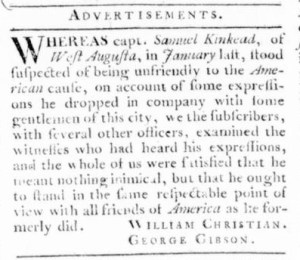
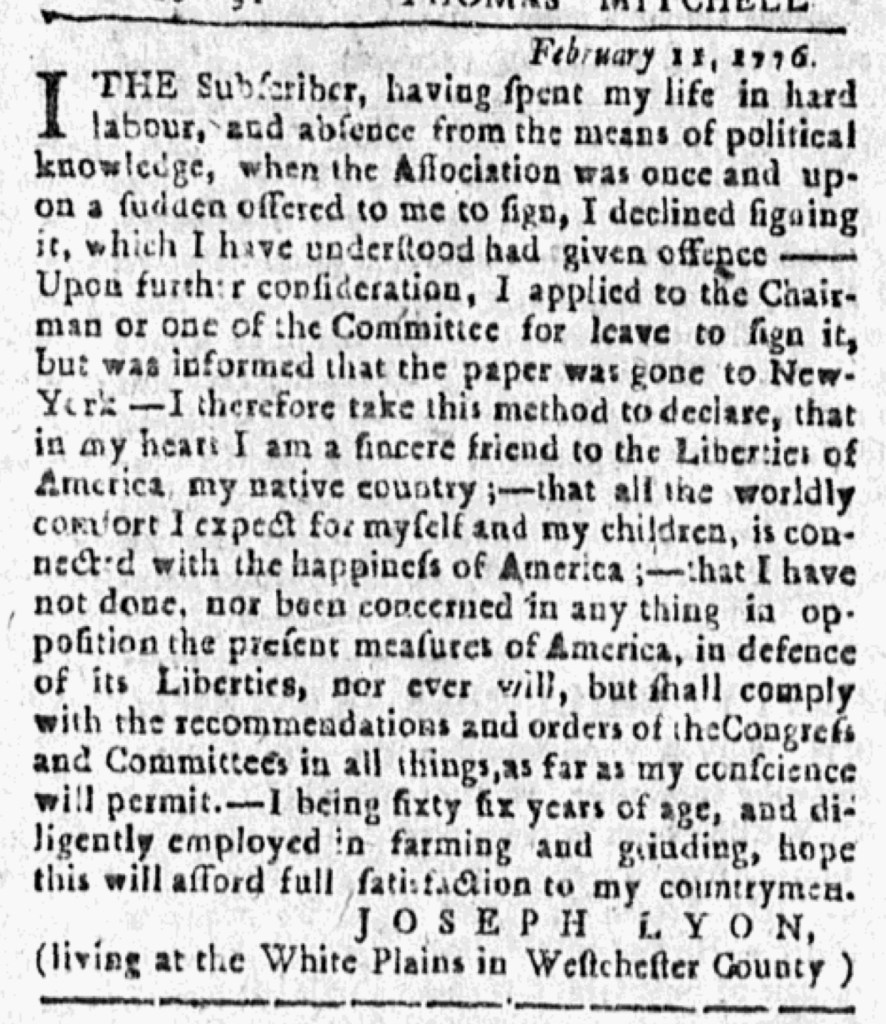
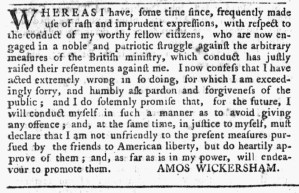
Amos Wickersham had to do something to remedy the error he made.  He hoped that placing a newspaper advertisement to apologize and pledging to do better would help return him to the good graces of his community.  In a notice in the July 15, 1775, edition of the Pennsylvania Evening Post, he acknowledged that he had “frequently made use of rash and imprudent expressions, with respect to the conduct of my worthy fellow citizens, who are now engaged in a noble and patriotic struggle against the arbitrary measures of the British ministry.”  He did so three months after the battles at Lexington and Concord.  Since then, supporters of the American cause from Massachusetts and other colonies in New England had laid siege to Boston and Joseph Warren, one of their leaders, had been killed at the Battle of Bunker Hill.  The Second Continental Congress had convened in Philadelphia and appointed George Washington of Virginia as commander of the Continental Army.  As news of these events spread, provincial congresses met to determine how their colonies should respond to the outbreak of war.

Facing these new developments, Wickersham tried to distance himself from his previous comments, stating that he made them “some time since,” yet also admitted that the conduct “of the British ministry … has justly raised [the] resentments” of his “worthy fellow citizens” against him.  He may have had a sincere change of heart … or he may have found his circumstances untenable as emotions became more enflamed.  Either way, he wanted the public to know that he had “acted extremely wrong in so doing, for which I am exceedingly sorry, and humbly ask pardon and forgiveness.”  That was a good start, but perhaps not sufficient.  Wickersham continued, “I do solemnly promise that, for the future, I will conduct myself in such a manner as to avoid giving any offence; and, at the same time, in justice to myself, must declare that I am not unfriendly to the present measures pursued by the friends to American liberty, but do heartily approve of them; and, as far as is in my power, will endeavour to promote them.”

Wickersham’s advertisement resembled some that previously appeared in newspapers published in Massachusetts.  For the past year, men who signed an address to Governor Thomas Hutchinson when he departed the colony had been placing advertisements to recant, apologize, and assure others that they were friendly to the American cause.  More recently, others resorted to newspaper advertisements to acknowledge other kinds of words or deeds that raised suspicion about their political principles in their efforts to return to good standing in their communities.  Wickersham placed one of the first advertisements of this sort outside of New England.  Like his counterparts, he paid for space in the public prints to disseminate his confession and support for “the present measures pursued by the friends to American liberty.”  Wickersham apparently considered it a good investment if it restored his position and reputation among his neighbors and associates.

June 8

What was advertised in a revolutionary American newspaper 250 years ago today?

New-England Chronicle (June 8, 1775).

“I am ready to assist them in their Struggles for Liberty and Freedom.”

A year later, John Prentice of Londonderry, New Hampshire, had second thoughts about having signed an address lauding Governor Thomas Hutchinson when he left office and departed Massachusetts for England.  On June 6, 1775, Prentice wrote about the mistake he made, acknowledged that he misjudged the governor’s motives, vowed his support for the American cause, and submitted his missive for publication in the New-England Chronicle.  “I the Subscriber was so unfortunate (some Time since),” he explained, “as to sign an Address to the late Governor Hutchinson, so universally and so justly deemed an Enemy to American Liberty and Freedom.”  Prentice claimed he had not understood that in the spring of 1774 – “at the Time I signed the said Address, I intended the Good of my Country” – but now understood his error.  He lamented that to his “Sorrow” signing the address had “a quite contrary Effect.”

Some of the “contrary Effect” that Prentice regretted, however, may have been the reception that he received from his neighbors and others in his community who refused to associate with him socially or to conduct business with him.  Such treatment had previously prompted others who signed the address to the governor to recant and to beg for forgiveness.  Yet Prentice did not mention how others treated him, nor did he apologize, though he did “hope that my injured and affronted Fellow Countrymen will overlook my past Misconduct.”  Perhaps the battles at Lexington and Concord and the ensuing siege of Boston inspired a sincere change of heart, inspiring Prentice to “renounce the same Address in every Part” and proclaim that he was “ready to assist [his countrymen] in their Struggles for Liberty and Freedom, in whatever Way I shall be called upon by them.”

How did Prentice really feel about the address?  Did it matter to readers of the New-England Chronicle?  William Huntting Howell argues that the authenticity of such a conversion was not nearly as important as the ability of a local Committee of Safety or similar panel of Patriots to induce those who signed the address to make public declarations – in print – that they renounced their past actions and now supported the American cause.[1]  The June 8, 1775, edition of the New-England Chronicle carried other letters similar to the one submitted by Prentice, though an adjudication accompanied each of those.  The Committee of Safety in Salem, for instance, absolved thirteen signers of the address who “now to our Sorrow find ourselves mistaken” and “Wish to live in Harmony with our Neighbours” and “to promote to the utmost of our Power the Liberty, the Welfare and Happiness of our country, which is inseparably connected with our own.”  The same committee accepted a more succinct petition from Alexander Walker, while the Committee of Correspondence for Groton accepted Samuel Dana’s apology for “adopt[ing] Principles in Politics different from the Generality of my Countrymen” that contributed to “the Injury of my Country.”

No such endorsement appeared with Prentice’s letter.  In addition, the layout of the issue that carried it suggests that it could have been a letter to the editor that the printers, Samuel Hall and Ebenezer Hall, chose to publish because it matched their political principles or an advertisement that Prentice paid to insert because he considered it so important to place before the public.  Either way, it buttressed the narrative that more and more colonizers recognized the tyranny perpetrated against them once fighting commenced in Massachusetts in the spring of 1775.

**********

[1] William Huntting Howell, “Entering the Lists: The Politics of Ephemera in Eastern Massachusetts, 1774,” Early American Studies 9, no. 1 (Winter 2011): 208-215.

May 24

What was advertised in a revolutionary American newspaper 250 years ago today?

Pennsylvania Journal (May 24, 1775).

“I … have inadvertently and imprudently sold India Bohea TEA, to sundry persons and at sundry times.”

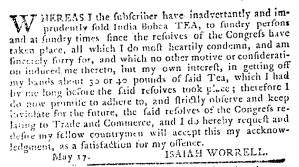
Isaac Worrell needed to do some damage control when others discovered that he had been selling tea in violation of the third article of the Continental Association in the spring of 1775.  That nonimportation agreement, devised by the First Continental Congress the previous fall, stated “we will not purchase or use any Tea imported on Account of the East India Company, or any on which a Duty hath been or shall be paid; and, from and after the first Dat of March next, we will not purchase or use any East India Tea whatever.”  Yet Worrell had not abided by those terms.

In an advertisement that first appeared in the May 17, 1775, edition of the Pennsylvania Journal and ran again the following week, Worrell confessed that he “imprudently sold India Bohea TEA, to sundry persons and at sundry times since the resolves of the Congress have taken place,” though he claimed that he had done so “inadvertently.”  Readers may have been skeptical that a prohibited act that occurred repeatedly happened “inadvertently.”  All the same, Worrell hoped that they would take note of his explanation for the infractions and accept his apology.  He asserted that he had “no other motive or consideration … but my own interest, in getting off my hands about 30 or 40 pounds of said Tea.”  He also contended that he acquired the tea “long before the said resolves took place,” hoping that would make his offense seem less serious.  At least he had not actively ordered or received new shipments.

Worrell assured his community that he had reformed.  “I do now promise to adhere to, and strictly observe and keep inviolate for the future,” he proclaimed, “the said resolves of the Congress relating to Trade and Commerce.”  He hoped that would be sufficient that “my fellow countrymen will accept this my accknowledgment, as a satisfaction for my offence.”  The Continental Association called for breaking off all ties, commercial and social, with those who violated it, yet Worrell hoped that his apology would outweigh his flimsy excuses to restore him to the good graces of the public. That he managed to sell “30 or 40 pounds of said Tea,” however, suggests that many others did not obey the terms of the Continental Association.  Loyalists accused Patriots of cheating, especially when it came to tea.  Worrell’s notice seems to support such allegations.

May 11

What was advertised in a revolutionary American newspaper 250 years ago today?

Rivington’s New-York Gazetteer (May 11, 1775).

“Many Publications have appeared from my Press which have given great Offence to the Colonies.”

James Rivington seemed to change his tune about what he printed and sold at his printing office on Hanover Square in New York.  On April 20, the day after the battles at Lexington and Concord, the printer of Rivington’s New-York Gazetteer once again advertised “several pamphlets on the Whig and Tory side” of “THE AMERICAN CONTEST.”  Word of what had occurred in Massachusetts the previous day had not yet arrived in New York, but Rivington had other news concerning the imperial crisis to report.  That included residents of New Brunswick, New Jersey, hanging “an effigy, representing the person of Mr. Rivington … merely for acting consistent with his profession as a free printer.”  A rare woodcut depicting the scene accompanied the combination article and editorial about his “OPEN and UNINFLUENCED PRESS.”

A week later, Rivington’s New-York Gazetteer carried news of Lexington and Concord.  The printer chose not to insert his advertisement hawking pamphlets representing both Whig and Tory perspectives in that issue.  In the next issue, two weeks after the battles in Massachusetts, Rivington ran a new advertisement, one that took a different tone than his coverage of the effigy.  “AS many Publications have appeared from Press which have given great Offence to the Colonies, and particularly to many of my Fellow Citizens,” the printer declared, “I am therefore led, be a most sincere Regard for their favourable Opinion, to declare to the Public, that Nothing which I have ever done, has proceeded from any Sentiments in the least unfriendly to the Liberties of this Continent, but altogether from the Ideas I entertained of the Liberty of the Press, and of my duty as a Printer.”  That being the case, “I am led to make this free and public Declaration to my Fellow Citizens, which I hope they will consider as a sufficient Pledge of my Resolution, for the future, to conduct my Press upon such Principles as shall not give Offence to the Inhabitants of the Colonies in general, and of this City in particular, to which I am connected by the tenderest of all human Ties, and in the Welfare of which I shall consider my own as inseparably involved.”  Rivington stopped short of offering an apology or stating that he regretted printing and selling newspapers and pamphlets that advanced Tory views, but he did take a less defiant tone in his effort to explain his editorial decisions.  He suggested that he would adopt a new approach, though he did not go into detail about that.  Perhaps he hoped that critics would notice that he did not advertise the problematic pamphlets.  Even if they did not, Rivington refrained from publishing an advertisement that ran counter to the message he delivered in his notice clarifying his prior actions.

That notice appeared in three consecutive issues of Rivington’s New-York Gazetteer, none of which carried advertisements for political pamphlets.  The events unfolding in Massachusetts may have encouraged the printer to take greater caution, though the masthead of his newspaper continued to proclaim that he operated an “OPEN and UNINFLUENCED PRESS.”  As far as the Sons of Liberty were concerned, however, the printer could not redeem himself.  On May 10, a week after Rivington first published his notice assuring the public that he would “conduct [his] Press upon such Principles as shall not give Offence to the Inhabitants of the Colonies,” the Sons of Liberty attacked his home and printing office.  Rivington fled to a British ship in the harbor.  Assistants maintained uninterrupted publication of the newspaper, continuing to run Rivington’s notice, while the printer petitioned the Second Continental Congress for pardon.  As Todd Andrlik documents, Rivington explained that “however wrong and mistaken he may have been in his opinions, he has always meant honestly and openly to do his duty.”  The Continental Congress forwarded the petition to the New York Provincial Congress.  Rivington received his pardon, but his reformation was not so complete as to avoid further notice from the Sons of Liberty.  In November 1775, Sons of Liberty from New Haven destroyed his press and reportedly melted down his types to make shot, bringing an end to Rivington’s New-York Gazetteer.

April 27

What was advertised in a revolutionary American newspaper 250 years ago today?

Norwich Packet (April 27, 1775).

I am sorry that I have drank any Tea.”

Ebenezer Punderson had the misfortune of appearing in an advertisement placed in the Norwich Packet by the local Committee of Inspection in the issue that carried the first newspaper coverage of the battles of Lexington and Concord.  The committee accused him of drinking tea in violation of the Continental Association, disparaging the First Continental Congress, and refusing to meet with the committee to discuss his conduct.  In turn, the committee advised the public not to carry on any “Trade, Commerce, Dealings or Intercourse” with Punderson.

Perhaps Punderson would have weathered that sort of public shaming under other circumstances, but news of events at Lexington and Concord made his politics even more unpalatable and his situation more dire.  From what ran in the newspaper, it did not take him long to change his tune, meet with the committee, and publish an apology for his behavior.  In a missive dated four days after the committee’s advertisement, Punderson reiterated the charges against him and “seriously and heartily” declared the he was “sorry I have drank any Tea since the first of March” and “will drink no more until the Use thereof shall generally be approved in North-America.”  In addition, he apologized for “all and every Expression that I have at any Time uttered against the Association of the Continental Congress.”  Furthermore, Punderson pledged that he “will not at any Time do any Thing that shall be inimical to the Freedom, Liberties, and Privileges of America, and that I will ever be friendly thereto.”  He requested that his “Neighbours and fellow-Men to overlook” his transgression and “sincerely ask[ed] the Forgiveness of the Committee for the Disrespect I have treated them with.”

Norwich Packet (April 27, 1775).

Punderson apparently convinced the committee to give him another chance.  Dudley Woodbridge, the clerk, reported that Punderson “appeared before them, and of his own Accord made the above Confession” and seemed “heartily sorry for his … conduct.”  In turn, the committee voted to find Punderson’s confession “satisfactory” and recommended that he “be again restored to Favour” in the community.  The committee also determined that “the above Confession, with this Vote, be inserted in the Public Papers,” perhaps less concerned with restoring Punderson’s good name than the example his recantation set for other Tories.  When the notice appeared in the Norwich Packet, Punderson inserted an additional note that extended an offer to meet with anyone “dissatisfied with the above Confession” and asserted that he would “cheerfully submit” to any further decisions the Committee of Inspection made in response.

Yet what appeared in the Norwich Packet did not tell the whole story.  According to Steve Fithian, Punderson “attempted to flee to New York but was captured and returned to Norwich where he spent eight days in jail and only released after signing a confession admitting to his loyalist sympathies.”  He did not stay in Norwich long after that.  “Several weeks later he fled to Newport, Rhode Island and boarded a ship which took him to England where he remained for the entire Revolutionary War.”  Apparently, he convincly feigned the sincerity he expressed, well enough that the committee accepted it.  While imprisoned, Punderson wrote a letter to his wife about his ordeal.  After arriving in England, he published an account with a subtitle that summarized what he had endured: The Narrative of Mr. Ebenezer Punderson, Merchant; Who Was Drove Away by the Rebels in America from His Family and a Very Considerable Fortune in Norwich, in Connecticut.  Just as the Committee of Inspection used print to advance a version of events that privileged the patriot cause, Punderson disseminated his own rendering once he arrived in a place where he could safely do so.

**********

The Committee of Inspection’s notice appeared with the advertisements in the April 20, 1775, edition of the Norwich Packet.  Punderson’s confession, however, ran interspersed with news items in the April 27 edition.  It may or may not have been a paid notice, but it was certainly an “advertisement” in the eighteenth-century meaning of the word.  At the time, according to the Oxford English Dictionary, an advertisement was a “(written) statement calling attention to anything” and “an act of informing or notifying.”  Advertisements often delivered local news in early American newspapers.  Punderson definitely made news as the imperial crisis became a war.