September 20

What was advertised in a revolutionary American newspaper 250 years ago today?
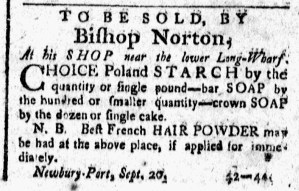
Essex Journal (September 20, 1776).

“Best French HAIR POWDER may be had … if applied for immediately.”

The first page of the September 20, 1776, edition of the Essex Journal featured the text of a resolution passed by the Continental Congress near the end of August, extracts of letters “from the West Indies,” “from a Planter in Grenada,” and “from a Merchant in Bermuda,” and news from Newport, Rhode Island.  Bishop Norton’s advertisement for starch and soap for sale at his shop “near the lower Long-Wharf” in Newburyport, Massachusetts, ran at the bottom of the final column.  He sold “CHOICE Poland STARCH by the quantity or single pound” as well as “bar SOAP by the hundred or smaller quantity” and “crown SOAP by the dozen or single cake.”

In a nota bene, Norton also promoted “Best French HAIR POWDER.”  The war did not deter readers from wanting to look their best.  Norton proclaimed that the hair powder “may be had … of applied for immediately,” creating a sense of urgency to acquire the product.  He likely hoped that scarcity would prompt prospective customers to make purchases.  The final line included the town and date, “Newbury-Port, Sept. 20.”  Readers could determine for themselves how recently Norton had placed the advertisement and imagine whether he any of the hair powder might still be available.  The final line also included a notation for the printer, “42-44,” that indicated the advertisement would run in three issues (No. 142 on September 20, No. 143 on September 27, and No. 144 on October 4) before being discontinued.  Norton’s admonition to place orders for his limited supply of hair powder “immediately” gained greater urgency in each subsequent insertion of his advertisement in the Essex Journal, especially when readers took note of the date at the end of the notice.  Not every advertisement included a date, but in this instance the date played an important part in making Norton’s appeal to prospective customers to act “immediately” or risk missing out on his “Best French HAIR POWDER.”

July 25

What was advertised in a colonial American newspaper 250 years ago today?

Pennsylvania Chronicle (July 25, 1772).

“The BEST of AMERICAN HAIR-POWDER.”

In the summer of 1772, William Trautwine, a barber who ran a shop “at the sign of the Bleeding Lady and Barber’s Pole” in Philadelphia, took to the pages of the Pennsylvania Chronicle to advertise the “BEST of AMERICAN HAIR-POWDER.”  In an age when many entrepreneurs promoted domestic manufactures, goods produced in the colonies, as alternatives to imported items, hairdressers and barbers frequently joined the chorus.  For his part, Trautwine encouraged “those gentlemen and ladies who are wellwishers to their country” to “favour him with their custom.”  Such “wellwishers” might have had the commercial and economic interests of the colonies in mind, yet such appeals usually had a political valence as well.  Especially when colonizers enacted nonimportation agreements in protest of new regulations and taxes passed by Parliament, advertisers editorialists, and others encouraged colonizers to participate in both the production and consumption of domestic manufactures.  Such appeals continued during periods of relative calm.  Trautwine’s reference to “wellwishers to their country” would not have seemed out of place to readers in July 1772.

Like others who promoted goods produced in the colonies, the barber believed that he needed to convince prospective customers that his product was as good as any they might acquire from merchants and shopkeepers who imported their goods.  Consumers did not need to sacrifice quality when they supported domestic manufactures.  The barber made his hair powder from “the very best of materials.”  Trautwine also proclaimed that his customers “may depend on being supplied with Hair-Powder in quality not inferior to the best which is imported from Europe.”  Indeed, it was Trautwine himself who made sacrifices to supply consumers with the “BEST of AMERICAN HAIR-POWDER,” assuming “considerable expence, in providing himself with a mill for that purpose.”  He suggested that his investment in support of the political and economic interests of the colonies merited the patronage of consumers in Philadelphia and other readers of the Pennsylvania Chronicle.  Trautwine acted on his civic duty when he produced an American alternative to an imported item.  In turn, he suggested, consumers had an obligation to do the same by purchasing his product.