November 18

What was advertised in a revolutionary American newspaper 250 years ago today?
Pennsylvania Evening Post (November 18, 1775).

“The Provedore to the Sentimentalists will exhibit food for the mind.”

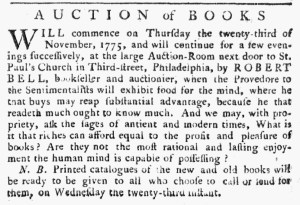
Readers of the November 18, 1775, edition of the Pennsylvania Evening Post encountered two advertisements promoting an “AUCTION of BOOKS,” one placed by Charles Mouse, “auctionier,” and the other by Robert Bell, “bookseller and auctionier.”  Mouse operated a “vendue store,” a combination of an auction house and a flea market, where he had a “large and choice collection of the most useful and entertaining [books].”  He invited those who had books to sell and “will[ing] to take their chance by auction” to deliver them to his vendue store on Second Street in Philadelphia.  The auctions would begin “precisely at six each evening” and “continue till the whole are sold.”  Mouse provided a straightforward account of this endeavor.

Robert Bell, on the other hand, crafted a more elaborate advertisement.  One of the most prominent American booksellers in the second half of the eighteenth century, Bell already established a reputation throughout the colonies by the time he advertised an auction “at the large Auction-Room next door to St. Paul’s Church in Third-street, Philadelphia,” scheduled for November 23.  He colorfully referred to himself in the third person as “the Provedore to the Sentimentalists” who would “exhibit food for the mind” to bidders and curious observers.  Those who made purchases, Bell declared, “may reap substantial advantage, because he that readeth much ought to know much.”  He further mused that “we may, with propriety, ask the sages of antient and modern times, What is it that riches can afford equal to the profit and pleasure of books?  Are they not the most rational and lasting enjoyment the human mind is capable of possessing?”  Mouse’s description of his “large and choice collection of the most useful and entertaining [books]” paled in comparison to the appeals that Bell made to readers.

Bell deployed another strategy to entice prospective bidders.  In a nota bene, he informed them that “[p]rinted catalogues of the new and old books will be ready to be given to all who choose to call or send for them.”  Those catalogues gave a preview of the sale and allowed Bell to disseminate information about the books up for bids more widely.  Those who visited his “Auction-Room” to collect a catalogue likely had an opportunity to browse the books, yet they could take their time going through the entries in the catalogue in the comfort of their own homes or offices or even at a coffeehouse with friends.  Those who sent for catalogues enjoyed the same benefit.  By distributing catalogs, Bell encouraged interest and prompted readers to imagine themselves bidding on the books they selected in advance.  He may have believed that prospective bidders were more likely to bid higher prices if they had spent time with the catalogue in advance and, as a result, became more committed to acquiring the books that interested them.
February 27

GUEST CURATOR:  Kamryn Vasselin

What was advertised in a colonial American newspaper 250 years ago today?

Boston Evening-Post (February 27, 1775).

“Will be Sold … Brass and other Andirons, Feather Beds.”

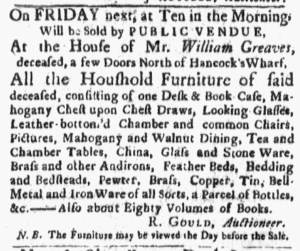
This advertisement features a variety of household goods sold at an auction held by R. Gould after the death of William Greaves. What caught my eye about this advertisement was some of the items being sold, like andirons and feather beds. I was not familiar with these items before reading this advertisement.

Andirons are a pair of brass or iron bracket supports used to hold up logs in an open fireplace. Andirons allow for better burning and less smoke due to the air circulation underneath the wood. In 1775, most homes used wood-burning fireplaces to keep warm, especially during cold winters. The use of andirons was widespread during this time.

The other item that caught my eye was featherbeds. According to art historians interviewed by Sunny Sea Gold, many people slept on beds of several different layers during this time. She reports, “At the bottom was a simple, firm mattress pad or cushion filled with corn husks or horsehair. Next came a big featherbed for comfort.” We would equate these to mattresses today, just instead filled with feathers. These featherbeds often sagged and caused problems when people laid flat on them. Wealthier colonists could buy professionally made featherbeds, while those less fortunate usually made their own out of goose or duck feathers.

Goods being sold at an auction as part of an estate sale generally cost less than when bought new. For those who may have needed a pair of andirons but were unwilling or unable to spend much, seeing this advertisement would have likely drawn them to the auction to get a good deal. The same goes for the featherbed, even a used one. An opportunity to increase the comfort of their bed at a cheap price would have provoked the interest of many people.

**********

ADDITIONAL COMMENTARY:  Carl Robert Keyes

When I invite students to serve as guest curators for the Adverts 250 Project, I do so in hopes that they will immerse themselves in eighteenth-century life and culture in new ways.  I assign both primary sources and secondary sources for our classes, yet I want my students to examine some aspect of life in early America even more intensively.  That begins with compiling a digital archive of newspapers published during a particular week during the era of the American Revolution and continues with searching through those newspapers to select advertisements that interest them.

Seeing why different advertisements spark interest for different students is always an interesting and illustrative part of working on this project together.  I learn from my students, especially when they explain what they see in their advertisements as they work with early American newspapers for the first time compared to the assumptions that I make after reading those newspapers for years.  I appreciate how Kamryn took an advertisement that would have appeared plain and ordinary to eighteenth-century readers familiar with the material culture of the period and demonstrated that some of the everyday items that colonizers purchased and used are no longer everyday items in the twenty-first century.  As a result, they require some explanation to understand their purpose and significance in the eighteenth century.

I also appreciate that Kamryn commented on auctions as the way that consumers sometimes acquired those objects of everyday life.  R. Gould, one of several auctioneers in Boston, oversaw an estate sale at the home of William Greaves.  The advertisement for that auction appeared between notices for upcoming sales at “RUSSELL’s Auction Room in Queen street” and William Hunter’s “New Auction-Room, Dock-Square.”  Some of the items for sale at “Hunter’sAuction-Room” were certainly secondhand goods, like at the estate sale, being the “Property of a Gentleman leaving the Province,” yet others, as far as the advertisements revealed, were new.  As Kamryn notes, auctions offered bargains to consumers, whether they purchased new or used goods.

January 26

GUEST CURATOR: James “Jack” Driscoll

Who was the subject of an advertisement in a colonial American newspaper 250 years ago today?

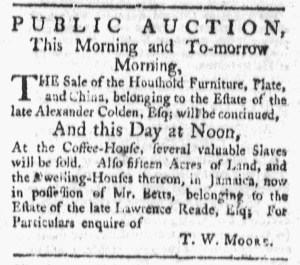
Rivington’s New-York Gazetteer (January 26, 1775).

“PUBLIC AUCTION … several valuable Slaves will be sold.”

In this advertisement in Rivington’s New-York Gazetteer from January 26, 1775, T.W. Moore advertised a public auction being held “This Morning and To-Morrow Morning” to sell off the possessions of the late Alexander Colden to the highest bidder. In addition to these household items up for sale, Moore held another auction “this Day at Noon” for several enslaved people. This especially stood out to me because this shows public auctions, a competitive method, was a primary method of buying and selling goods, land, and even enslaved people in Revolutionary America. While people who were involved in the open market used auctions to sell off belongings and estates, enslavers used them as a way to reach a wider range of buyers in their efforts to make a profit off of enslaved people.

This advertisement shows that slave auctions happened even in New York.  In “The Forgotten History of Slavery in New York,” Andrea C. Mosterman declares, “New York’s slavery past is still relatively unknown.”  However, we can see by this advertisement, that these slaves for sale were an important part of Moore’s auctions. There was a high demand for enslaved people in New York before, during, and after the American Revolution. In 1788, Mosterman states, “Close to 75% of the free, white Kings County families enslaved people within their home.”  The American Revolution did not result in freedom for everyone.  Instead, some people would stand and look at other human beings being sold against their will along with everyday items like furniture and China dishes.  By participating in these auctions, they treated enslaved people as property instead of as human beings.

**********

ADDITIONAL COMMENTARY: Carl Robert Keyes

In addition to selecting an advertisement to examine for the Adverts 250 Project, Jack is serving as guest curator for the Slavery Adverts 250 Project this week.  Beyond this advertisement for “several valuable Slaves” up for bids at Moore’s auction on January 26, 1775, he identified eight other advertisements about enslaved people that appeared in the New-York Journal and Rivington’s New-York Gazetteer on the same day.  As Jack makes clear, that auction was not an isolated incident.  Instead, slavery was widely practiced in New York on the eve of the American Revolution and continued after thirteen colonies secured independence as a new nation.

Auctioneers like Moore represented part of the infrastructure for perpetuating slavery and the slave trade in New York.  The printers who generated revenue by publishing these advertisements made significant contributions as well.  Brokers, like William Tongue, played an important role as well.  Tongue placed a lengthy advertisement enumerating “SLAVES,” “LANDS,” “HOUSES,” and “GOODS” for sale at his office “near the Exchange” in both the New-York Journal and Rivington’s New-York Gazetteer as well as the New-York Gazette and Weekly Mercury four days later.  He listed and gave prices for ten enslaved men, women, and children, ranging in age from five to forty.  They included a young woman who was “an useful domestic,” a man who was “a good farmer,” and a woman “with or without her son, 5 years old.”  Tongue also noted that he “has likewise orders to purchase slaves of both sexes.”

Yet auctioneers and brokers were not alone in enlisting the services of printers in publishing advertisements for the purpose of buying and selling enslaved people.  An anonymous advertiser offered a “LIKELY and handy Mulatto Boy” for sale in the New-York Journal.  That youth had experience “waiting at Table” and could “attend a Gentleman on traveling.”  The advertisement instructed reader to “Inquire of the Printer” for more details.  Another advertisement featured an enslaved woman, “twenty-six Years of Age,” and an enslaved boy, “of twelve Years of Age,” for sale, again with directions to “Enquire of the Printer.”  Still another described a “HEALTHY young Negro Girl … that can do all Kinds of House Work.”  While auctioneers and brokers earned their livelihoods through buying and selling enslaved people, other colonizers made purchases and sales of one or two enslaved people at a time.  Collectively, they made slavery a prevalent aspect of life in New York during the era of the American Revolution.

September 2

What was advertised in a colonial American newspaper 250 years ago today?

South-Carolina and American General Gazette (September 2, 1774).

“A Non-importation Agreement will undoubtedly soon take Place here.”

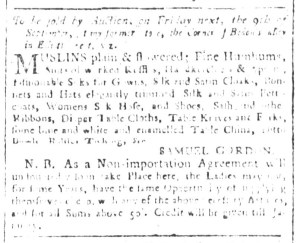
A week in advance of an auction to be held on September 9, 1774, Samuel Gordon took to the pages of the South-Carolina and American General Gazette to promote the various items up for bids.  The sale would include “MUSLINS plain & flowered; Fine Humhums, … fashionable Silks for Gowns, Silk and Satin Cloaks, Bonnets and Hats elegantly trimmed, Silk and Satin Petticoats, Womens Silk Hose, and Shoes, [and] Sash and other Ribbons.”  In addition, Gordon listed “Table Cloths, Table Knives and Fork, [and] some blue and white and enamelled Table China.”  He concluded with “&c.” (an abbreviation for et cetera) to indicate that consumers could acquire a variety of other wares at the auction.

Gordon appended a nota bene to his notice: “As a Non-importation Agreement will undoubtedly soon take Place here, the Ladies may not, for some Years, have the same Opportunity of supplying themselves cheap, with any of the above necessary Articles.”  The auctioneer referred to measures under consideration in response to the Boston Port Act, the Massachusetts Government Act, and the other Coercive Acts passed by Parliament in retaliation for the Boston Tea Party.  Throughout the colonies, patriots came to the defense of Massachusetts, rallying to determine common measures to address infringements on their liberty and rights as English subjects.  At the moment that Gordon published his advertisement, delegates were already arriving in Philadelphia for what would become known as the First Continental Congress.  Their deliberations would result indeed result in the Continental Association, a trade boycott intended as political leverage.  Colonizers had previously adopted similar nonimportation agreements in response to the Stamp Act and the duties on certain goods levied in the Townshend Acts.

Gordon encouraged readers to draw on their memories of the conditions during those boycotts or imagine what would likely happen when another nonimportation agreement went into effect.  He stoked fear and anxiety that goods would become scarce and, as a result, much more expensive.  Colonizers needed to acquire textiles and housewares while they were available and while they were affordable.  To facilitate that, he offered credit until January for purchases that exceeded fifty pounds.  That suggests that even though he addressed “Ladies,” the colonizers so often accused of the vice of luxuriating in consumption in newspaper editorials of the era, that he actually anticipated that it would be merchants and retailers, most of them men, who would make bids and purchase this merchandise with the intention of selling it once again.  Still, readers considered Gordon’s warning as they perused the many other advertisements for imported goods in the newspaper.  The auctioneer committed to print what many colonizers were likely thinking about their prospects for purchasing goods in the coming months and years.

March 17

GUEST CURATOR:  Adam Ide

What was advertised in a colonial American newspaper 250 years ago today?

Massachusetts Gazette and Boston Weekly News-Letter (March 17, 1774).

“Will be Sold by PUBLIC VENDUE, at the Auction-Room in Queen-Street.”

In this advertisement, the auctioneer Joseph Russell was advertising an auction that he was running in which the property of “a Gentleman lately deceased” would be sold off. The practice of auctioning made its way into the colonies through its popularity in England in the seventeenth and eighteenth centuries.

This advertisement originally caught my eye because they were selling off the property of a dead man. I wondered it that could be seen as disrespectful to the family and the memory of whoever’s items were being auctioned off. However, upon further research, I learned that “for most residents [of the British colonies], it was at local auctions—estate auctions, sheriffs’ sales, and discount vendues—that bidders, sellers, and observers created a body of knowledge that established a link between price and value.”[1]

Ellen Hartigan-O’Connor writes about the ways in which colonists interacted with each other and took part in consumer culture by participating in public auctions. Hartigan-O’Connor claims that “[w]ith each exchange, people reflected on what goods were worth” since there was no easy-to-come-by comparative price information.[2] Many were left “to wonder how much they should pay for tools, teapots, or thread if the prices fluctuated with market availability.”[3]

Thankfully for colonists, auctions or “vendues” or “public sales” offered a solution. Unlike regular retail, which relied on the fluctuation of the markets and the importation of new goods, auctions allowed the price that someone was willing to pay to determine the value. Through this method, “it was only at the end, when the hammer strike closed the bidding at a final price, that the assembled community learned what they really considered to be the value of an object.”[4] So despite my initial hesitance toward an estate sale, having one’s items sold at “PUBLIC VENDUE” after one died not only gave people an opportunity to purchase goods outside of the fluctuating markets of the time, but it also allowed the community to determine for themselves the value of the items being sold.

**********

ADDITIONAL COMMENTARY:  Carl Robert Keyes

Adam chose one of many auction notices that appeared in Boston’s newspapers during the week in March 1774 that he examined for his duties as guest curator of the Adverts 250 Project and the Slavery Adverts 250 Project.  As he notes in his examination of Joseph Russell’s advertisement for an upcoming “PUBLIC VENDUE,” auctions were a popular means of buying and selling goods in eighteenth-century America.  Russell’s notice in the Massachusetts Gazette and Boston Weekly News-Letter appeared immediately below another one about a sale the following day “At GOULD’S Auction-Office.”

The compositor for that newspaper often placed auction notices, with sales that took place at a particular time on a particular date, first among advertisements, following the shipping news from the custom house.  Sales in shops, stores, and warehouses did not operate on such regimented schedules, so the printing office, readers, and, especially, auctioneers likely considered it less important to have a dedicated place to find other advertisements.  In contrast, Gould’s auction would happen “TO-MORROW” and at no other time and Russell’s auction was scheduled for “Wednesday next.”

Not every compositor in every printing office took that approach, demonstrating that early American printers did not devise universal methods of classifying and organizing the contents of their newspapers.  When Russell’s advertisement ran in the Boston-Gazette later in the week, it appeared among notices placed for a variety of purposes.  It did not have a privileged place on the page, nor did Benjamin Church’s advertisement, one column over, for a “PUBLICK AUCTION … On THURSDAY NEXT.”  M. Deshon, “AUCTIONEER,” placed his own notice that appeared further down the column.

The Boston Evening-Post and the Massachusetts Gazette and Boston Post-Boy each carried advertisements about auctions that week.  Among the newspapers published in Boston, only the Massachusetts Spy did not disseminate notices about public vendues, though several appeared in its pages the following week.  Merchants and shopkeepers certainly competed with auctioneers when it came to finding buyers in Boston on the eve of the American Revolution.

**********

[1] Ellen Hartigan-O’Connor, “Public Sales and Public Values in Eighteenth-Century North America,” Early American Studies 13, no. 4 (Fall 2015): 749.

[2] Hartigan-O’Connor, “Public Sales and Public Values,” 751.

[3] Hartigan-O’Connor, “Public Sales and Public Values,” 751.

[4] Hartigan-O’Connor, “Public Sales and Public Values,” 752.

August 16

What was advertised in a colonial American newspaper 250 years ago today?

New-York Gazette and Weekly Mercury (August 16, 1773).

“IRISH / LINENS, / Sheetings, cotton and / Linen checks; calicoes.”

The format of an advertisement for upcoming sales at Templeton and Stewart’s Auction Room in the August 16, 1773, edition of the New-York Gazette and Weekly Mercury almost certainly caught the eye of readers.  Rather than appear in a blocky paragraph of text or side-by-side columns with one or two items per line, as was the case in other advertisements for consumer goods in that issue, the list of items for sale formed a diamond.  The entries at the top and bottom of the diamond, “IRISH LINENS” and “PLAYING CARDS,” had one word per line, all in capital letters spaced appropriately to create a pleasing and attractive form.  The compositor realized that lowercase letters at the top and bottom of the diamond would have had a jarring and unpleasant visual effect.  Likewise, too many uppercase letters would have crowded the rest of the diamond, so other items appeared in lowercase letters as the list progressively widened and then progressively narrowed.

Using type to form geometric shapes, especially diamonds, was rare but not unknown in newspaper advertisements of the period.    On September 30, 1771, all of the copy in Gilbert Deblois’s advertisement in the Supplement to the Boston-Gazette appeared within a diamond, though the compositor did not manage to create lines nearly as straight as those in Templeton and Stewart’s advertisement.  Such was also the case for Deblois’s advertisement in the Massachusetts Gazette and Boston Weekly News-Letter later that week.  The compositor for the Essex Gazette achieved better results in an advertisement placed by John Cabot and Andrew Cabot in the December 3, 1771, edition of the Essex Gazette.  All of the copy ran at a forty-five-degree angle, filling an entire square.  Two weeks later, the compositor and the Cabots experimented with the same copy, devising a shape that resembled a bulb as much as a diamond.  Still, the unique format set it apart from other advertisements.  With a shorter list of goods, Duncan Ingraham, Jr., concluded his advertisement in the April 20, 1772, edition of the Massachusetts Gazette and Boston Post-Boy with a diamond that featured straight edges.

Each of these advertisements demonstrates one manner for experimenting with graphic design elements of newspaper notices.  The advertisers likely made special requests or sent instructions.  They may have even submitted copy arranged the way they wished for it to appear in print, though compositors exercised final discretion in making innovative designs work.  While some of these advertisements evidenced greater skill than others, each presented a novelty to readers and prospective customers.  Such innovative graphic design demanded attention on pages largely devoid of visual images, the format encouraging readers to peruse the content.

January 13

What was advertised in a colonial American newspaper 250 years ago today?

Massachusetts Gazette and Boston Post-Boy (January 13, 1772).

A Mahogony Desk and Book-Case.

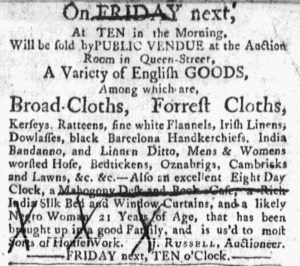
This advertisement presents a conundrum.  It attracted my attention because someone made manuscript notations on the copy of the Massachusetts Gazette and Boston Post-Boy that has been preserved in an archive and digitized for greater accessibility.  They crossed out “FRIDAY” in the portion of the headline that gave the date of an auction, crossed out “a Mahagony Desk and Book-Case” midway through the advertisement, and placed three large “X” over most of the rest of the content.  I suspected that either Joseph Russell or John Green, the partners who published the Massachusetts Gazette and Boston Post-Boy, made those notations to guide the compositor in setting type for a revised version of the advertisement to appear in a subsequent issue.  Russell, the auctioneer who placed the advertisement, focused primarily on operating the “Auction Room in Queen-Street” while Green oversaw the newspaper and the printing office.

A revised version did not appear in a subsequent edition of the Massachusetts Gazette and Boston Post-Boy.  The same advertisement did run in the Boston Evening-Post and the Boston Gazette on Monday, January 13, 1772, the same day it appeared in the Massachusetts Gazette and Boston Post-Boy.  Those newspapers ran the same copy, but with variations in line breaks because the compositors made their own decisions about format.  I also looked for revised versions of the advertisement in other newspapers published in Boston between January 13 and the day of the sale.  The Massachusetts Spy published on Thursday, January 16, the day before the say, did not carry the advertisement, but the Massachusetts Gazette and Boston Weekly News-Letter distributed on the same day did feature a slightly revised version.  Only the first line differed from the original version, stating that the auction would take place “TO-MORROW” rather than “On FRIDAY next.”

Massachusetts Gazette and Boston Weekly News-Letter (January 16, 1772).

The rest of the advertisement was identical to the one that ran in the Massachusetts Gazette and Boston Post-Boy earlier in the week.  The copy was identical and the format (including line breaks, spelling, and capitals) was identical.  Even the lines on either side of “FRIDAY next, TEN o’Clock” on the final line were identical.  Both advertisements lacked a space between “by” and “PUBLIC VENDUE” on the third line.  The manuscript notations on the original advertisement may have directed someone in revising the first line, but not the remainder of the notice.  Even more puzzling, it looks as though Green and Russell shared type already set at their printing office with Richard Draper, the printer of the Massachusetts Gazette and Boston Weekly News-Letter.  This is not the first time that I have detected such an instance in newspapers published by these printers in the late 1760s and early 1770s.  It raises questions about both the logistics and the business practices of those involved, questions that merit greater attention and closer examination of the contents, both news and advertising, in the two newspapers.

January 7

What was advertised in a colonial American newspaper 250 years ago today?

South-Carolina Gazette and Country Journal (January 7, 1772).

“They will be put up in small Lots for the better Conveniency of private Families.”

Samuel Gordon planned to leave South Carolina in February 1772.  In advance of his departure, he advertised that he would sell a variety of goods at auction on January 10.  To entice bidders, he listed many of those items, including “a great Variety of blue and white enameled Dishes and Plates,” “a great Number of Tea, Coffee, and Chocolate Cups and Saucers,” “Decanters and Wine Glasses,” and “an Assortment of Table Knives and Forks.”  He concluded the list with “&c.” (the abbreviation for et cetera commonly used in the eighteenth century) to indicate far more choices awaited those who attended the auction.

Gordon did not want prospective bidders to assume that he was attempting to get rid of merchandise that had lingered on the shelves at his “IRISH LINEN WARE-HOUSE” in Charleston.  He asserted that he had recently imported the goods “in the HEART-OF-OAK, who arrived here the Twentieth of December Instant, from LONDON.”  In other words, he acquired his inventory three weeks before the auction.  Colonizers had an opportunity to purchase new goods shipped from the cosmopolitan center of the empire for bargain prices at auction.

Yet they did not need to wait until the day of the auction if any of the textiles, housewares, and other items interested them.  In a nota bene, Gordon stated that he “continues to sell any of the above Goods at a very low Advance, till the Day of the Sale.”  He invited customers to visit his warehouse to examine the merchandise and select what they wished to purchase rather than take chances bidding against others at auction.  He offered low prices to make this option as attractive as the prospects of a good deal at auction.  Gordon also explained that any remaining inventory that went to auction “will be put up in small Lots for the better Conveniency of private Families.”  That meant that items would be bundled together.  Consumers who wished to purchase only specific items needed to buy them before the auction.

In his efforts to liquidate his merchandise before leaving the colony, Gordon sought to incite interest in new goods recently received from London.  He scheduled an auction for colonizers hoping for deep discounts via low bids, but also continued sales at his warehouse for others who wanted the security of making purchases without bidding against competitors.  Offering colonizers both means of acquiring his goods had the advantage of maximizing his revenue while also clearing out his inventory.

September 4

What was advertised in a colonial American newspaper 250 years ago this week?

Boston Evening-Post (September 2, 1771).

“Public Vendue, At the Auction-Room in Queen street.”

Colonial consumers encountered advertisements for all sorts of goods when they perused the pages of the Boston Evening-Post and other newspapers.  In the September 2, 1771, edition, for instance, Samuel Austin advertised “A large and compleat Assortment of English, India and Scotch Goods” recently imported from London.  Similarly, Joshua Gardner hawked “A fine Assortment of Fall and Winter Goods” received in vessels from London and Bristol.  Several other merchants and shopkeepers placed advertisements for new merchandise available at their stores and warehouses.

Consumers, however, had other options for acquiring goods.  Some preferred to purchase at vendue or auction where they might get better bargains than buying retail.  Joseph Russell, proprietor of “the Auction-Room in Queen street,” regularly placed advertisements in the Boston Evening-Post and other local newspapers to advise consumers of items soon up for bids.  In a notice that ran next to Austin’s advertisement, Russell promoted “A great Variety of English GOODS.”  He listed several different kinds of textiles as well as “Silk & linen Handkerchiefs” and “Mens & Womens worsted Hose,” many of the same items that Austin, Gardner, and others enumerated in their advertisements.  He concluded that litany with a promise of “a variety of other Goods,” encouraging prospective bidders to check out his auction before shopping elsewhere.

Russell also facilitated the market for secondhand goods, advertising an upcoming auction “At the House of Mr. Benjamin White.”  In particular, that auction featured “A Variety of HOUSE FURNITURE belonging to a Gentleman moved into the Country,” including a clock, a mahogany bureau, and looking glasses.  The inventory also included housewares, such as “a compleat Set of Burnt China for Tea-Table” and brass kettles.  Purchasing secondhand goods at auction or estate sales provided consumers an alternate means of participating in the consumer revolution.  Collectively, advertisements placed by merchants, shopkeepers, and auctioneers alerted colonists to the many options available to them and the multiple trajectories for shopping and obtaining goods of all sorts.

March 7

What was advertised in a colonial American newspaper 250 years ago today?

Mar 7 - 3:7:1770 Georgia Gazette
Georgia Gazette (March 7, 1770).

“SUNDRY HOUSEHOLD GOODS.”

A short advertisement in the March 7, 1770, edition of the Georgia Gazette informed readers of an auction that would take place nearly a month later.  “To be sold, on Monday the 2d of April,” it announced, “SUNDRY HOUSEHOLD GOODS, the property of Barbara Wilson, deceased.”  Several other notices provided details for upcoming auctions and vendue sales, as they were often called in the eighteenth century.  Stephen Mellen and Ursala Peters placed an advertisement that read: “To be sold by publick vendue … HOUSEHOLD FURNITURE, some CARPENTERS TOOLS, and a few NEGROES, belonging to the Estate of Christopher Peters, deceased.”  In the process of selling an array of goods the deceased Peters acquired during his lifetime, the administrators of his estate reduced enslaved people to commodities to be sold alongside “HOUSEHOLD FURNITURE” and “CARPENTERS TOOLS.”  Another notice mentioned “A PARCEL OF HOUSEHOLD FURNITURE” to be sold on the same day as Mrs. Simpson’s “DWELLING-HOUSE” and two lots of land.  Throughout these advertisements, “HOUSEHOLD FURNITURE” referred to a variety of personal belongings, not just chairs and tables and the like.

In contrast, the March 7 issue of the Georgia Gazette, like many others, had few advertisements placed by merchants, shopkeepers, artisans, and others promoting new goods for sale at their storehouses and shops.  This testifies to different means of participating in the consumer revolution of the eighteenth century.  Though eager to acquire new goods, especially the latest fashions, colonists also did brisk trade in secondhand goods at auctions and estate sales.  At such venues, buyers found bargains that they likely could not have achieved when purchasing new items, no matter how experienced or skillful they happened to be when it came to haggling with retailers.  While nonimportation agreements were in effect and colonists were suspicious of the origins of new merchandise, buying secondhand goods may have also provided a means of exercising their political principles.