What was advertised in a colonial newspaper 250 years ago today?
New-Hampshire Gazette (June 6, 1766).
“Gentlemen may have any sorts of Books Bound.”
William Appleton described his occupation as bookbinder, but his advertisement makes clear that he offered a variety of services at “his Shop in Queen Street, near the School House.”
“Gentlemen may have any sorts of Books Bound,” Appleton announced. In the eighteenth century, readers frequently purchased books that took a very different material form than what modern consumers expect today. Customers often purchased just the printed pages of the books (and the same went for magazines when they gained popularity after the Revolution) and then arranged for binding on their own, if they wished to have their books bound at all. Printers chose not to raise the production costs of books by having them bound, thus minimizing the risk for books that did not sell. Sometimes they did not even separate the leaves to create pages but instead passed along folded sheets to customers, leaving it to them or a bookbinder to do so. Sometimes printers and booksellers did sell bound books – or offered a choice for bound or unbound – but they marketed this as a convenience that added value. In other instances, however, Appleton and other bookbinders offered a service that allowed readers to customize their books through the various choices that went into selecting materials and appearance for bindings. In turn, bookbinders inserted their own binder’s labels into books to further advertise their services.
Appleton also bound blank books that customers would fill themselves with manuscript rather than print. The “Account Books” may have been lined to aid organizing entries for debiting and crediting accounts.
In addition, Appleton’s advertisement indicated that he supplemented his business by selling books and writing paper. He listed several kinds of reading material, but he likely did not stock as many volumes as contemporary booksellers who distributed catalogues that included hundreds of titles. Still, he gave the impression that potential customers could discover a variety of books when he truncated his list with “&c. &c.” (etc. etc.).
As a member of the book trades, Appleton worked with printers, booksellers, and publishers. Sometimes he took on some of the responsibilities of a bookseller, but likely did not do any printing. Printers and bookbinders provided complementary services that modern consumers usually consider part of the standard production of a commodity, a book, but the bound volume as a finished product was not necessarily what customers purchased in bookstores in the eighteenth century.
Readers who visit regularly know that I usually post extended commentary about methodological issues on Fridays, but I would like to depart from that today. It has been a while since I featured any marketing materials other than the day’s featured advertisement. When I expanded this project from Twitter to a blog I intended to use the “extra” space available to incorporate posts exploring other aspects of advertising in eighteenth-century America more regularly. After all, my handle on Twitter is @TradeCardCarl, so let’s see some trade cards!
In addition, in the course of my research I have identified more than a dozen forms of printed ephemera that circulated as advertising in eighteenth-century America, including trade cards, magazine wrappers, billheads, furniture labels, catalogues, and broadsides. I would like the Adverts 250 Project to explore all of those, even as it remains faithful to its primary mission, a “new” newspaper advertisement featured every day.
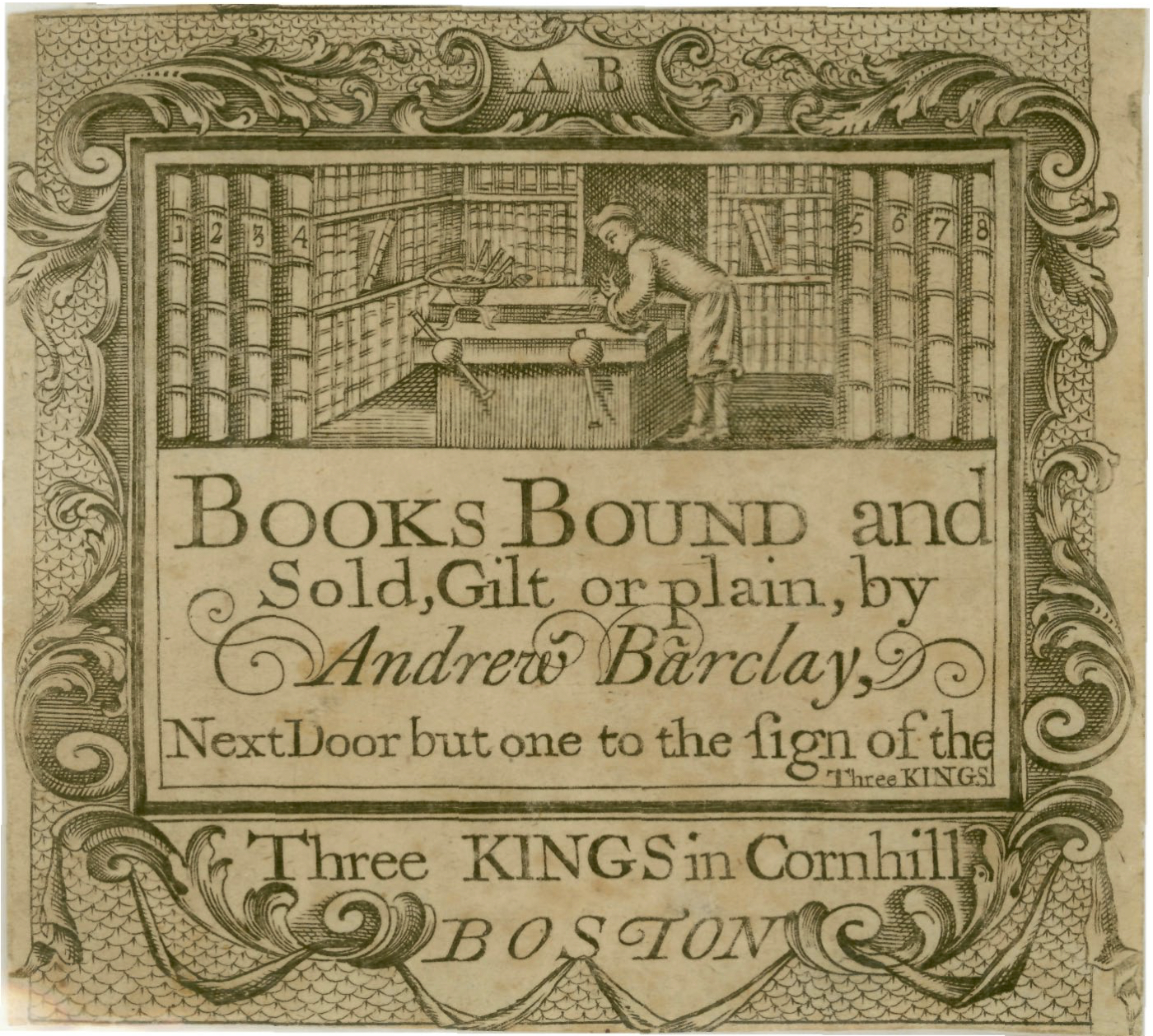
As I include diverse advertising media in the coming weeks and months, much of it will come from decades other than the 1760s. For today, however, I have chosen two items that would have been in circulation at the same time as the newspaper advertisements featured throughout the week: trade cards issued by bookbinder Andrew Barclay in the mid 1760s.
The first, according to the American Antiquarian Society’s catalog, dates to approximately 1764 through 1767. It measures 11 cm x 12 cm (or 4¼ in x 4¾ in).
Trade card distributed by bookbinder Andrew Bradford (ca. 1764-1767). American Antiquarian Society.
(Let’s take a little digital humanities detour here. As I have stated repeatedly, digital sources are wonderful and have revolutionized the work done by scholars and opened up new levels of access to historic sources for scholars and general audiences alike. But digital sources are not without their shortcomings. Viewing original sources on screens tends to standardize them. They appear to “be” whatever size the screen happens to be. As a result, all sources take on the same size. Others with much more digital humanities experience have commented on this at great length, but it bears repeating here, especially since I will be returning to the actual size, rather than the virtual size, of today’s featured trade cards later.)
The second, again according to the American Antiquarian Society’s catalog, dates to approximately 1765 through 1767. It measures 6 cm x 9 cm (or 2½ in x 3½ in).
Trade card distributed by bookbinder Andrew Bradford (ca. 1765-1767). American Antiquarian Society.
Both trade cards list the same address, but use slightly different language: “Next Door but one to the sign of the Three KINGS … in Cornhill Boston” and “next Door but one North of the three KINGS, in Cornhill Boston.” Thomas Johnston (1708-1767) engraved both. (Johnston’s death explains why both cards have been dated to 1767 at the latest.)
Unlike most of the newspaper advertisements for goods and services printed in the 1760s, these trade cards used both text and images to make appeals to potential customers. In addition to giving Barclay’s location, both announced that he bound and sold books, “Gilt or plain.” Consumers were accustomed to making choices and selecting goods that corresponded to their rank and stature. Offering “Gilt or plain” bindings allowed customers to choose features that corresponded to other decisions they made about how to present themselves to others.
Each trade card included an image of man leaning over a bookbinding press, hard at work. Shelves stocked with books are on display in the background. The books, bookbinding press, and assorted tools were testaments to Barclay’s trade. Both images also suggested an important quality that Barclay wanted past and potential customers to associate with him: industriousness. In both images, a bookbinder wearing an apron could be seen busily at work. Benjamin Franklin did not begin writing his famous Autobiography until 1771 (and it was not published until 1791, after his death), but other eighteenth-century artisans certainly knew the value of industry and the appearance of industriousness that Franklin extolled in his memoir.
Classifying and cataloging early American advertising media is as much art as science. Such items often defy strictly defined categories. I have described both of these items as “trade cards.” In the AAS catalog, however, both are described as “advertising cards” in the genre/form field. That seems like an appropriate description. Although I have heard curators and other staff at the AAS refer to such items as “trade cards,” there are a variety of reasons why catalogers would choose the alternate (and perhaps broader) “advertising cards” to classify these items.
One of these trade cards was featured in The Colonial Book in the Atlantic World, the first volume of the impressive History of the Book in America. There it is described as a “binder’s label.” That is a much narrower category than either “trade card” or “advertising card.” It is likely more accurate for its specificity (but I believe that fewer researchers would find it in the AAS catalog if it were classified only as “binder’s label” rather than “advertising card”).
This is where the size of these items becomes important. Most trade cards were larger, making them easier to pass from hand to hand, but also significant enough that they would not be misplaced easily. Many also tended to be large enough that vendors could record purchases and write receipts on the reverse (transforming them into billheads, of sorts).
These relatively small items, on the other hand, would have much more easily gotten lost in the shuffle or discarded … unless they were secured inside a book. Andrew Barclay likely pasted one of these labels inside some of the books he bound for his patrons. In the process, he transformed both the service he provided and the goods he sold into advertising media. When that happened, colonial consumers did not possess their books exclusively; instead, they shared ownership with an artisan who left his mark on a material object that happened to be in their possession. Some readers pasted their own bookplates in the volumes they owned, but Andrew Barclay’s binder’s label pre-empted that practice. Consumers could still place a bookplate in books bound by Barclay, but unless they pasted their own bookplate over his label, their act of taking possession competed with, rather than negated, Barclay’s label.
In the end, readers who took their books to Barclay to be bound ended up purchasing an advertisement that they would later encounter every time they used the item they had purchased from him. Every time they opened a book bound by Barclay consumers were once again exposed to his binder’s label advertisement.