
What was advertised in a revolutionary American newspaper 250 years ago this week?
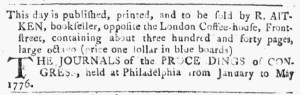
“THE JOURNALS of the PROCEEDINGS of CONGRESS, held at Philadelphia from January to May 1776.”
As the Revolutionary War continued in the fall of 1776, printers in Philadelphia printed, advertised, and sold “THE JOURNALS of the PROCEEDINGS of CONGRESS, held at Philadelphia.” William and Thomas Bradford, the printers of the Pennsylvania Journal, advertised the volume for “September to January last” in the October 23 edition of their newspaper. That issue also carried a notice from Robert Aitken, “Printer and Bookseller opposite the London Coffee-House,” that announced he published and sold “the JOURNALS of the PROCEEDINGS of CONGRESS … from January to May 1776.” In addition to coverage in newspapers, readers could keep well informed of the debates and decisions of the Continental Congress over the past year by purchasing the journals.
Three days later, Aitken ran the same advertisement in the Pennsylvania Evening Post, though that one described the new volume as “about three hundred and forty pages” while the other advertisement stated that it “contain[ed] nearly 240 pages.” (The new advertisement in the Pennsylvania Evening Post was correct.) For one dollar, buyers acquired the book “in blue boards.” That left it to each purchaser to make their own selections about a binding, if they wanted the journal bound at all, in consultation with a bookbinder. Aitken sold just the text, keeping production costs down. That made the journal even more accessible to readers who wanted more detail about the proceedings of the Continental Congress in those crucial months after the anonymous publication of an inflammatory political pamphlet called Common Sense in January 1776. Even though the title stated that the volume covered the proceedings “to May 1776,” it concluded with business conducted on April 29 (just as the previous volume for “September to January last” covered September through December). Still, it provided an important supplement to what appeared in newspapers and a record for both the public and political leaders to consult as citizens of the new nation simultaneously fought a war for independence and created a national identity.