April 8

What was advertised in a revolutionary American newspaper 250 years ago today?
Boston-Gazette (April 8, 1776).

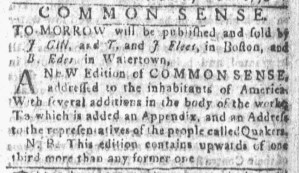
“TO-MORROW will be published … A NEW Edition of COMMON SENSE.”

The April 8, 1776, edition of the Boston-Gazette featured an update about the local edition of Thomas Paine’s Common Sense announced in the New-England Chronicle four days earlier.  On a Thursday, readers learned that “Next week will be PUBLISHED, and to be SOLD … in BOSTON, A New Edition of COMMON SENSE.”  The following Monday, an advertisement with a headline that proclaimed “COMMON SENSE” informed the public that “TO-MORROW will be published and sold … A NEW Edition of COMMON SENSE.”  In less than a week, the Boston edition went from in the press to in stock and for sale.

The new advertisement included a clarification about where readers could acquire copies: from “J. Gill, and T. and J. Fleet, in Boston, and B. Edes in Watertown.”  The previous version listed only Boston locations, though Benjamin Edes had relocated to Watertown to print the Boston-Gazette there throughout the siege of Boston.  Although the British departed on March 17, Edes and the Boston-Gazette remained in Watertown until the end of October.  Customers could purchase Common Sense from Edes in Watertown or from John Gill, his former partner in publishing the newspaper, in Boston.  In addition, Thomas Fleet and John Fleet, who had printed the Boston Evening-Post before it folded soon after the battles at Lexington and Concord, also sold Common Sense in Boston.

As the number of local editions of Common Sense proliferated in 1776, so did the number of advertisements promoting the popular political pamphlet and the number of newspapers disseminating advertisements about it.  The number of retailers who sold Common Sense also increased.  Although the printers in Boston and Watertown did not do so, others listed the price for a single copy and offered discounts for buying a dozen or more, encouraging booksellers, shopkeepers, and others to purchase copies to sell far and wide.  Counting the number of local editions of Common Sense demonstrates the popularity of the pamphlet compared to other political tracts published during the era of the American Revolution, yet that does not reveal the timing of their publication and sale to readers.  Advertisements for Common Sense, on the other hand, demonstrate when local editions became available to readers.
April 1

What was advertised in a revolutionary American newspaper 250 years ago today?

Boston-Gazette (April 1, 1776).

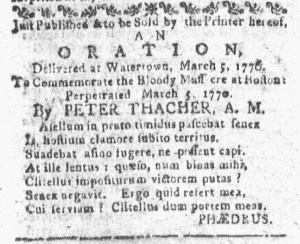
“AN ORATION … To Commemorate the Bloody Massacre at Boston: Perpetrated March 5, 1770.”

The annual tradition continued during the first year of the Revolutionary War.  Each year since the Boston Massacre, residents of the city gathered to mark the anniversary, honor the men who died when British regulars fired into a crowd of protestors, and hear an oration about the dangers of a standing army stationed in an urban port during times of peace.  James Lovell delivered the address in 1771, followed by Joseph Warren in 1772, Benjamin Church in 1773, and John Hancock in 1774.  In March 1775, Joseph Warren gave the last oration before the Revolutionary War commenced with the battles at Lexington and Concord on April 19.  Three months later, he was killed in action at the Battle of Bunker Hill.

Patriots made adjustments to the ritual in 1776.  The British occupation of Boston continued.  The Continental Army, commanded by George Washington, continued the siege of the city.  The Massachusetts Provincial Congress met at Watertown.  It was from there that William Cooper, the “Town Clerk of Boston” in exile, announced that according to a “vote in a town-meeting legally assembled” on March 5, 1775, “an ORATION will be delivered at the meeting-house, in Watertown, on the 5th of March next, … to commemorate the horrid Massacre perpetrated in Boston, on the evening of the 5th of March, 1770, by a party of Soldiers of the 29th Regiment, under the command of Capt. Thomas Preston.”  Refugees from Boston and the inhabitants of Watertown and other nearby towns gathered in Watertown for the annual oration about “the ruinous tendency of Standing armies being placed in large and populous cities, in time of peace.”  It was also a rally for asserting “the necessity of such exertions as the inhabitants of Boston then manifested, whereby the designs of the conspirators against the public safety, have been frustrated.”

Although circumstances forced those “who were inhabitants of Boston” to shift the location for the annual commemoration, other aspects remained constant, including the printing, marketing, and dissemination of the oration a few weeks after the gathering occurred.  This time, Peter Thacher delivered “AN ORATION … To Commemorate the Bloody Massacre at Boston: Perpetrated March 5, 1770.”  Benjamin Edes, who had relocated the Boston-Gazette from Boston to Watertown, printed the pamphlet and sold it at his printing office.  As had been the case with previous orations, this gave those who had been present an opportunity to experience Thacher’s address again and as many times as they wished to read it.  The pamphlet also gave those who had not attended a chance to read what Thacher said and imbibe the arguments made in support of the American cause.  Gathering for the oration was an important civic act, yet the circulation of the oration in print may have had an impact just as significant.

November 20

What was advertised in a revolutionary American newspaper 250 years ago today?

Boston-Gazette (November 20, 1775).

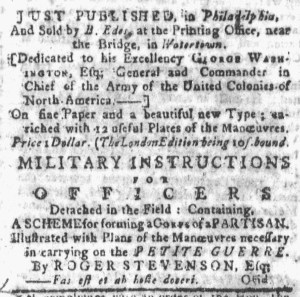
“MILITARY INSTRUCTIONS for officers Detached in the Field.”

On November 20, 1775, Benjamin Edes, the printer of the Boston-Gazette, ran an advertisement for a military manual “JUST PUBLISHED, in Philadelphia,” and available at his printing office in Watertown.  The printer had relocated there shortly after the battles at Lexington and Concord, though he did not update the name of his newspaper.  He advertised an edition of Roger Stevenson’s Military Instructions for Officers Detached in the Field published by Robert Aitken.  Although the advertisement proclaimed that the book had been “JUST PUBLISHED,” another edition had been available in Philadelphia since June.  At the time that Aitken advertised it, he noted that “A new Edition of this Book, with some Additions, is now in the Press and will soon be published.”  That likely referred to the edition that Edes stocked, especially considering that the appeals in his advertisement paralleled the advertisement that Aitken published in the Pennsylvania Ledger in August.

Both advertisements opened with an announcement that the book had been published and where to acquire copies, followed by a note that this edition was “Dedicated to his Excellency GEORGE WASHINGTON, Esq; General and Commander in Chief of the Army of the United Colonies of North-America.”  Next, both advertisements commented on the material aspects of the book, noting the “fine Paper and a beautiful new Type” as well as the “12 useful Plates [or illustrations] of the Manœuvres.”  The price in the local currency followed, along with a comparison to the price of a bound London edition.”  As was so often the case in advertisements for books, all that preamble appeared before the title of the book.  Aitken’s much longer advertisement then presented an address “TO THE PUBLIC” drawn from the preface.  Edes did not devote that much space to his advertisement in the Boston-Gazette.  Instead, he inserted a quotation from Ovid: “Fas est et ab roste doceri” (It is right to be taught from the pulpit).  That phrase invoked Stevenson’s experience as a British officer.  Edes did not devise it on his own.  Instead, he borrowed it from the title page.  Overall, Edes did not generate original copy for his advertisement for a military manual printed in Philadelphia.  Instead, he borrowed heavily from Aitken’s advertisement, revising the location where customers could purchase the book and the price in local currency.  He also substituted the quotation on the title page for an excerpt from the preface but did not compose anything new for his advertisement.  The marketing for the book in the Boston-Gazette thus replicated the strategies that Aitken introduced in the public prints in Philadelphia months earlier.  He may even have dispatched a clipping of the advertisement with the copies he sent to Edes.

November 6

What was advertised in a revolutionary American newspaper 250 years ago today?

Boston-Gazette (November 6, 1775).

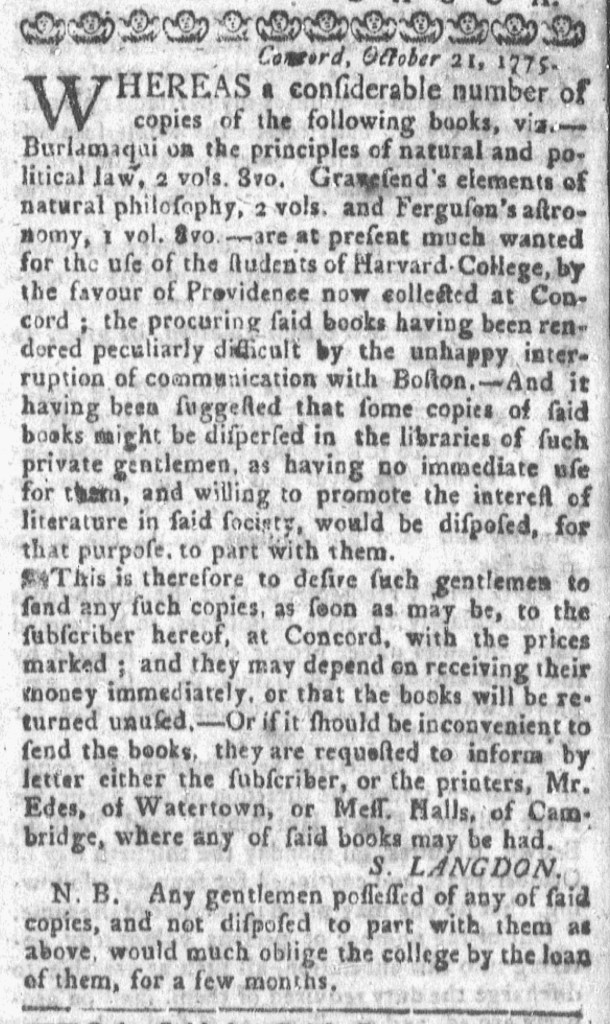
“The following books … are at present much wanted for the use of the students of Harvard College.”

Samuel Langdon, the president of Harvard College, issued a plea in the fall of 1775.  His students needed books!  As he explained in his advertisement in the November 6, 1775, edition of the Boston-Gazette, the college held classes in Concord while the siege of Boston continued … yet students could not acquire many of the texts that they needed because of “the unhappy interruption of communication” and trade with booksellers (and other purveyors of goods and services) in Boston.  Similarly, Benjamin Edes had moved the Boston-Gazette to Watertown following the battles at Lexington and Concord.

Langdon sought “a considerable number of copies” of “Burlamaqui on the principles of natural and political law, 2 vols. 8vo. Gravesend’s elements of natural philosophy, 2 vols. And Ferguson’s astronomy, 1 vol. 8vo.”  In specifying both the number of volumes and the size (“8vo” or octavo) of the books, Langdon made clear that the college preferred certain editions.  He reported that others “suggested” to him “that some copies of said books might be dispersed in the libraries of such private gentlemen” who did not have immediate use for them and thus might be willing to “part with them” to “promote the interest of literature” among the youth attending Harvard College.

Langdon requested that “such gentleman” who did have those books “send any such copies, as soon as may be … with the prices marked.”  They could “depend on receiving their money immediately, or that the books will be returned unused.”  Langdon understood that some readers might not wish to part with volumes from their personal libraries.  Alternately, he suggested that that it would “much oblige the college” if they would loan those volumes “for a few months.”  With classes continuing despite the disruptions caused by the outbreak of hostilities at Lexington and Concord the previous spring, Langdon engaged in an eighteenth-century version of crowdsourcing in his effort to procure books for his students.  The college survived a fire in its library a decade earlier, requesting donations of books to recover.  Now Harvard faced other obstacles and once again turned to the public to provide the books that the college needed.

October 30

What was advertised in a revolutionary American newspaper 250 years ago today?

Boston-Gazette (October 30, 1775).

“He pays cash for all kinds of homespun cloths.”

Enoch Brown, a shopkeeper, had a history of promoting domestic manufactures (or goods made in the colonies) as alternative to items imported from Britain.  In the spring of 1768, for instance, he ran an advertisement alerting “those Persons who are desirous of Promoting our Own Manufactures … That he takes in all Sorts of Country-made Cloths at his Store on Boston Neck.”  In the wake of learning about duties levied on certain imported goods in the Townshend Revenue Act, many colonizers set about organizing nonimportation agreements.  They simultaneously embraced goods produced locally as a means of supporting the colonial economy and correcting a trade imbalance with Britain.  Several years later, Brown ran another advertisement with similar themes in January 1775.  Bearing the headline “American Manufacture,” that notice emphasized that the variety of textiles Brown stocked “were manufactured in this Province, and are equal in quality to any, and superior to most imported from England, and much cheaper than can be produced from any part of Europe.”

Although Brown had been at the same location for years, he departed Boston for Watertown following the battles at Lexington and Concord.  That presented challenges for both Brown and his customers, so “for greater Conveniency” he once again moved, this time to “Little-Cambridge” in the fall of 1775.  When he opened his shop, he advertised a “Variety of Winter Goods” for the coming season as well as “sagathees, duroys, camblets,” and other textiles “of American manufacture, which he sells extreme cheap.”  Customers could acquire any of those for low prices, despite the disruptions taking place as the siege of Boston continued.  Committed to giving consumers choices that matched their political principles, Brown sought new merchandise made locally.  In a nota bene at the end of his advertisement, he declared that he “pays cash for all kinds of homespun cloths.”  In so doing, he filled the role of intermediary between producers and consumers, giving both the opportunity to support the American cause.  After all, the Continental Association devised by the First Continental Congress did not merely instruct consumers to cease purchasing imported goods but also called on colonizers to “encourage Frugality, Economy, and Industry; and promote Agriculture, Arts, and the Manufactures of this Country.”  As a shopkeeper who bought and sold homespun cloth, Brown did his part.

September 18

What was advertised in a revolutionary American newspaper 250 years ago today?

Boston-Gazette (September 18, 1775).

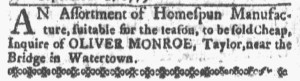
“AN Assortment of Homespun Manufacture.”

It was a short advertisement, just four lines in the September 18, 1775, edition of the Boston-Gazette, but it spoke volumes about the times in which the advertiser placed it and colonizers read it.  “AN Assortment of Homespun Manufacture, suitable for the season,” the notice announced, “to be sold Cheap.  Inquire of OLIVER MONROE, Taylor, near the Bridge in Watertown.”  Even before the battles at Lexington and Concord marked a new chapter in the imperial crisis, homespun cloth became a symbol of resistance to British abuses, especially duties on imported goods imposed by Parliament.  Over the past decade, colonizers had participated in a series of boycotts, first to protest the Stamp Act in 1765, then in response to the Townshend Acts in the late 1760s, and again when they learned of the Coercive Acts in 1774.  Each time, consumers opted for homespun cloth produced in the colonies as an alternative to textiles imported from England.

At the time that Monroe ran his advertisement, the Continental Association remained in place.  It had gone nine months earlier.  In addition to prohibiting merchants and shopkeepers from selling goods received after December 1, 1774, it called on colonizers to “promote Agriculture, Arts, and the Manufactures of this Country.”  That included purchasing homespun rather than the “Fine assortment” of imported textiles, ranging from corduroys to striped hollands to cambrics, listed in a longer advertisement that appeared in the same column as Monroe’s short notice.  Monroe did not need to invest much effort in marketing his “Homespun Manufacture” because the times spoke for themselves.  Prospective customers already recognized the political significance of the choices they made in the marketplace.  That they read his advertisement in the Boston-Gazette, now published in Watertown as the siege of Boston continued, only underscored the importance of practicing politics when they went shopping.

August 28

What was advertised in a revolutionary American newspaper 250 years ago today?

Boston-Gazette (August 28, 1775).

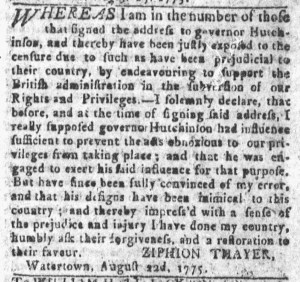
“Impress’d with a sense of the prejudice and injury I have done my country, humbly ask their forgiveness.”

It was yet another apology for signing an address to Thomas Hutchison when General Thomas Gage replaced him as governor of Massachusetts and he departed for England.  This time Ziphion Thayer lamented his error in an advertisement in the August 28, 1775, edition of the Boston-Gazette, published in Watertown as the siege of Boston continued.  Thayer acknowledged that he signed the address and “thereby have been justly exposed to the censure due to such as have been prejudicial to their country, by endeavouring to support the British administration in the subversion of our Rights and Privileges.”  As others indicated in their own apology-advertisements, signing the address came with consequences.  The “censure” that Thayer experienced likely included other colonizers refusing to engage with him socially or in business.

For a time, many signatories who published apology-advertisements claimed that they had affixed their names in haste without reading carefully or fully considering the full implications of the address.  More recently, however, others explained that they signed because they thought at the time that Hutchinson had the power to protect them from the “Vengeance of the British Ministry” and an inclination to advocate for American liberties.  “I solemnly declare, that before, and at the time of signing said address,” Thayer claimed, “I really supposed governor Hutchinson had influence sufficient to prevent the acts obnoxious to our privileges from taking place; and that he was engaged to exert his said influence for that purpose.”

Things certainly did not work out that way, leading Thayer to declare that he had “since been fully convinced of my error” and now realized that Hutchinson’s designs “have been inimical to this country.”  Did Thayer have an authentic conversion?  Or did he merely say what others wanted to hear so he could return to his former standing in his community?  William Huntting Howell contends that the authenticity of such apology-advertisements mattered much less to Patriots than the “rote expression of allegiance” in the public prints.[1]  Thayer asserted that he became “impress’d with a sense of the prejudice and injury I have done my country” and, accordingly, he “humbly ask[ed] their forgiveness, and a restoration to their favour.”  Whether or not Thayer truly believed the former, he wanted the latter and likely believed that his apology-advertisement would help convince others to overlook what he had done.

**********

[1] William Huntting Howell, “Entering the Lists: The Politics of Ephemera in Eastern Massachusetts, 1774,” Early American Studies 9, no. 1 (Winter 2011): 215-6.

August 14

What was advertised in a revolutionary American newspaper 250 years ago today?

Boston-Gazette (August 14, 1775).

“I feared the Vengeance of the British Ministry; and verily believed that Governor Hutchinson had Influence to avert it.”

Benjamin Clarke, “late of Boston” and now from Nantucket, joined the chorus of colonizers who recanted after signing an address to Governor Thomas Hutchinson when he departed Massachusetts.  Like others who did so, Clarke ran a newspaper advertisement to make it widely known that he did not support the governor.  His explanation, however, differed from what others had written in their notices.  Many had claimed that they signed their names without carefully reading the address first or that they only thought through the larger implications after they signed.

Clarke, on the other hand, gave a very different account of the circumstances around his signing of the “obnoxious Address to Governor Hutchinson.”  He asserted that he lived in fear of “the Vengeance of the British Ministry; and verily believed that Governor Hutchinson had Influence to avert it.”  According to scholars at the Winterthur Library, the repository that holds Clarke’s account book spanning 1769 to 1812, Clarke was a merchant who “specialized in brasses.”  He joined other merchants in signing a nonimportation agreement in 1768 and “the next year he signed the petition protesting the sending of the Regulars to Boston.”  Historian J.L. Bell notes that Clarke appeared on lists of colonizers involved in the Boston Tea Party compiled in the early nineteenth century.  Whether or not he participated, his history likely made him a suspect and, as he claimed in his advertisement, prompted him to sign the address to Hutchinson in hopes of finding favor and avoiding consequences under the governor’s protection.

In hindsight, Clarke claimed, he understood that was not the strategy he should have adopted.  Hutchinson, it turned out, supported Parliament more than Clarke realized when he signed the address, though some readers may have found that a convenient justification rather than an accurate account of the reputation the governor had earned.  “I have now the fullest Conviction of [Hutchinson’s] Enmity to this Country,” Clarke declared, “and am sensible of the Wrong and Injury which I have done my Countrymen.”  The same issue of the Boston-Gazette that carried his advertisement included a “Further Account of Tom. Hutchinson’s Assiduity in rooting up our ONCE happy Constitution, and of his Endeavours to disunite the AMERICAN COLONIES.”  With that as a backdrop, Clarke requested the “Forgiveness” of “my Countrymen” and “a Restoration to their Favour.”  Rehabilitating his own reputation may not have happened immediately, but Clarke became a justice of the peace when he returned to Boston after the Revolutionary War.

July 3

What was advertised in a revolutionary American newspaper 250 years ago today?

Boston-Gazette (July 3, 1775).

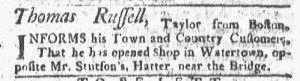
“Thomas Russell, Taylor from Boston … has opened Shop in Watertown.”

Benjamin Edes, a Patriot printer, moved the Boston-Gazette to Watertown following the battles at Lexington and Concord.  He was not the only colonizer on the move during the siege of Boston at the beginning of the Revolutionary War.  General Thomas Gage, the governor, and the Massachusetts Provincial Congress negotiated an agreement that allowed Loyalists to enter the city and Patriots and others to depart.  Each could take whatever effects they could transport, except for firearms and ammunition.  Many residents of Boston left the city for other towns and cities, some of them placing advertisements to introduce themselves to their new communities and announce their occupations to prospective clients and customers.  In the late spring and summer of 1775, the description “from Boston” took on new meaning.

While some of those refugees headed to other colonies, Thomas Russell, a “Taylor from Boston,” moved only a short distance to Watertown.  Upon arriving, he placed an advertisement in the Boston-Gazette to inform “his Town and Country Customers, That he has opened Shop in Watertown, opposite Mr. Stutson’s, Hatter, near the Bridge.”  Although framed as an update for his current customers, Russell’s advertisement also signaled to all readers that he considered himself a “Steady Friend to America,” as Edes described a correspondent in the column to the left of the notice, rather than a Tory who embraced the protection of British regulars and supported the policies enacted by Parliament.  Just above that piece, Edes relayed an account from New York about a colonizer taken into custody “who it is said had been privately inlisting men to serve under General Gage, against their country.”  Russell, in contrast, had refused to remain in Boston and lend any kind of support to the general and his officers or the residents who approved of them.  Instead, he hoped that his “Town” customers who had also departed the city would seek his services in Watertown.  Similarly, he hoped that “Country Customers,” whether they previously hired him or not, would visit his shop.

June 5

What was advertised in a revolutionary American newspaper 250 years ago today?

Boston-Gazette (June 5, 1775).

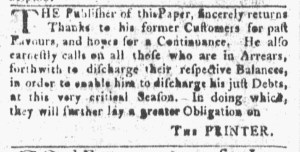
“THE Publisher of this Paper, sincerely returns Thanks to his former Customers for past Favours, and hopes for a Continuance.”

It was the first issue of the Boston-Gazette published in seven weeks.  It was also the first issue of the Boston-Gazette published in nearby Watertown rather than in Boston.  The newspaper underwent other changes following the battles at Lexington and Concord.  A notice placed by the printer (rather than by the printers) hinted at some of them.

Benjamin Edes and John Gill had been partners in publishing the Boston-Gazette since April 7, 1755.  Over the course of two decades, they developed a reputation as two of the printers who most ardently supported the Patriot cause.  In his diary entry for September 3, 1769, John Adams recorded that he joined Edes and Gill and other Sons of Liberty in spending the evening “preparing for the Next Days Newspaper – a curious Employment.  Cooking up Paragraphs, Articles, Occurences, &c. – working the political Engine!”  When the Revolutionary War began, all the newspapers in Boston either folded, relocated, or suspended publication.  Edes and Gill published their last issue on April 17, two days before the momentous events at Lexington and Concord.  They then dissolved their partnership.  Edes moved to Watertown and resumed publication with continuous numbering despite the change in location.  The Boston-Gazetteremained there more than a year with a new issue every Monday.  The last Watertown issue appeared on October 28, 1776.  On November 4, Edes once again published the Boston-Gazette in Boston.

The first issue in Watertown featured only four advertisements, two of them placed by the printer.  In one, Edes expressed his appreciation “to his former Customers for past Favours, and hope[d] for a Continuance” of their subscriptions.  He also needed “also those who are in Arrears, forthwith to discharge their respective Balances, in order to enable him to discharge his just Debts, at this very critical Season.”  In addition to cash, Edes needed other resources to continue publishing the Boston-Gazette.  Another advertisement announced, “CASH given for clean Cotton and Linnen RAGS, at the Printing Office in Watertown.”  Those rags would be made into paper.  Edes had limited access to that essential item; throughout most of the summer his newspaper consisted of only two pages (a half sheet) rather than the usual four pages (a full sheet).  The other two advertisements offered employment opportunities, one to “Journeymen Taylors” and the other to “Journeymen Saddlers.”  In addition, a notice at the top of the first column on the first page invited “THOSE Persons who are possessed of any of Governor Hutchinson’s Letters … to forward them to the Printer hereof, in order for Publication.”  Edes wished to embarrass the former governor and score political points, as he had done two years earlier.  The printer moved his press to Watertown, yet he continued the same political activism.