May 12

What was advertised in a colonial newspaper 250 years ago today?

May 12 - 5:12:1766 Boston Post-Boy
Boston Post-Boy (May 12, 1766).

“William Fisher, In CORNHILL, HAS imported a general Assortment of English Goods which he sells at the cheapest Rates.”

Today’s featured advertisement appears fairly short and relatively basic when compared to many of the more extensive advertisements that crowded the pages of eighteenth-century newspapers. William Fisher’s advertisement, however, was not unique. Many advertisers opted for this sort of short commercial notice. Some may not have been able to afford more space in the newspaper. Others may not have been as innovative in their thinking, compared to their competitors, about how to incite demand among potential customers. Some may have depended on networks of friends, neighbors, and acquaintances to sustain their shops, believing that an abbreviated advertisement served as sufficient reminder of the wares they offered for sale.

I’ve chosen this advertisement to feature today as a means of correcting an oversight. In the process of selecting advertisements to examine I have privileged some and disproportionately excluded others, especially the plethora of short commercial notices that were familiar to colonial readers.

I’ve also selected this advertisement because even though it is short enough to fit entirely in a modern tweet it still incorporated three common marketing appeals that tell us about eighteenth-century consumer culture. Fisher made an appeal to price when he noted that “he sells at the cheapest Rates.” He expected that low prices would help to attract customers. He also stressed that he offered choices to his customers, “a general Assortment.” Upon visiting his shop customers could expect to make purchases based on their own tastes rather than accept whatever happened to be in stock. Fisher may not have found it necessary to pay to print an exhaustive list of his merchandise. Other shopkeepers already did so, which meant that Fisher could depend on readers already being familiar with what was available in Boston. Finally, he stated that he had “imported … English Goods.” Consuming wares imported from England helped colonists feel connected to fellow Britons on the other side of the Atlantic. Though they resided thousands of miles away, they shared a British identity.

William Fisher’s advertisement seems deceptively short considering how much it tells us about early American consumer culture.

April 28

What was advertised in a colonial newspaper 250 years ago today?

Apr 28 - 4:28:1766 Boston Post-Boy
Boston Post-Boy (April 28, 1766).

“TAKEN out of the Shop … two Beaver Hatts supposed to be Stolen.”

Advertisements did not always serve a single purpose in the eighteenth century, as we saw last week in a notice that seemed to squeeze two separate advertisements – one for a sloop and the other for an enslaved woman – together into a single square. Neither seemed to be the primary purpose for the advertisement; instead, an auctioneer placed relatively equal emphasis on both sales.

Lazarus LeBaron, however, did have a purpose when he placed his notice. He proclaimed that a thief had stolen “two Beaver Hatts” from his shop and warned readers against “any suspicious Person” selling similar hats. LeBaron was agitated and he wanted justice, offering a reward to “any Person that can give Information so that the Person who took them may be convicted.” His indignation was apparent.

His demeanor in the notice made the nota bene that much more jarring: “Hatts of all Sorts made and Sold at the above Shop.” As long as he was paying for an advertisement in hopes of recovering his stolen goods, LeBaron likely figured that he might as well attempt to attract some business in the bargain. Even if the pilfered hats never turned up, perhaps the nota bene might have yielded new business to offset the loss and the price of the notice. Still, promoting his shop seemed to be an afterthought relative to his crusade to track down “any suspicious Person” who had absconded with his “Beaver Hatts.”

March 26

GUEST CURATOR:  Elizabeth Curley

What was advertised in a colonial newspaper 250 years ago this week?

Mar 26 - 3:24:1766 Boston Post-Boy
Boston Post-Boy (March 24, 1766).

“A General Assortment of the freshest and best of DRUGS and MEDICINES.”

In this advertisement, Philip Godfrid Kast sold something a little different. Imported from the last ships from London (which is a way to guarantee their freshness), he sold “a general assortment of the freshest and best of DRUGS and MEDICINES.” I have never seen a pharmaceutical advertisement when looking through colonial newspapers for the Adverts 250 Project, which is why I chose this advertisement for today.

Kast characterizes his drugs as “Chymical” (which is the historical spelling of “chemical”) and “Galenical” (which is a medicine made from natural ingredients – plant or animal components – rather than synthetic components). Most prescription medications made today are of the chemical sort, since over time they have been proven to help more, and can be developed further to help more people.

What else further interested me was that this was a “dual” advertisement almost. Philip Godfrid Kast advertised for himself in Salem as well as for Dr. Stephen Huse in Haverhill, Maassachusetts. This is interesting because those towns are around twenty miles apart. Is it possible that these were the only two shops on the North Shore of Massachusetts that sold pharmaceuticals other than the port of Boston? Also, I noticed that Huse had the label of “Dr.” whereas Kast did not. This makes me wonder if they could possibly have been business partners or maybe Kast was more like a pharmacist today and Huse was more like a doctor today. Or maybe colonial Americans did not care as much about getting their medicines from such an official.

**********

ADDITIONAL COMMENTARY:  Carl Robert Keyes

I intended to feature this advertisement (from a previous issue of the Boston Post-Boy) last week before my Public History students resumed their guest curator duties, but when Elizabeth submitted her list of proposed advertisements for this week I held off for a bit. I figured it would be much more interesting to see what each of us thought was interesting and important about this advertisement.

What originally drew me to this advertisement? In early January I included another advertisement from Kast in my analysis of the featured advertisement of the day. The Kast advertisement I used, however, was a trade card rather than a newspaper advertisement. I posted it because the trade card included an image of Kast’s “Sign of the Lyon & Mortar.” Most colonial shop signs have been lost to time, but trade cards provide an alternate form of preservation of the image if not the material object.

Philip Godfrid Kast Trade Card
Philip Godfrid Kast’s trade card engraved by Nathaniel Hurd in Boston in 1774 (American Antiquarian Society).

All of the advertisements that Elizabeth examined this week have told us something about consumer culture and life in eighteenth-century America, but in at least one aspect some of her advertisers themselves were extraordinary. Recall that Mary Symonds, the milliner from Philadelphia, also issued a trade card for her business. (Elizabeth also included a trade card from William Breck, whose shop “at the Golden Key” was located near the shop promoted in the featured advertisement on another day.) Very few retailers, merchants, producers, or suppliers distributed trade cards in colonial America. Only a small fraction of newspaper advertisers experimented with advertising campaigns that utilized multiple media. I’ve been hoping that some of my students would have an opportunity to examine some of those advertisers, but I never would have guessed at the outset of this project that any of them in any single week would encounter two or more advertisers who used trade cards to supplement their newspapers advertisements.

March 17

What was advertised in a colonial newspaper 250 years ago today?

Mar 17 - 3:17:1766 Boston Post-Boy
Boston Post-Boy (March 17, 1766).

“A Compleat Assortment of Druggs and Medicines; … a fine Assortment of Surgeon’s Instruments.”

Benjamin Church operated a shop that likely attracted many different kinds of customers.

Anderson’s Pills, Bateman’s Drops, Stoughton’s Bitters, and Turlington’s Balsam were all familiar patent medicines that colonists would have purchased both with or without consulting a physician. In some ways, they were the over the counter medications of their day. The first half of Church’s advertisement lists a “Compleat Assortment of Druggs and Medicines” and ingredients that customers from a variety of backgrounds would have purchased.

The second half, on the other hand, lists equipment, “a fine Assortment of Surgeon’s Instruments,” likely intended for specific occupational groups that practiced one form of medicine or another. Everyday consumers may have had some of these supplies in their homes, just as modern American households possess basic first aid materials, but “Midwifry Instruments” and “Surgeon’s Knives” were likely purchased almost exclusively by medical practitioners.

I’m curious to know which volumes were included among the “good Collection of modern Medical Authors.” Did they include any works of general reference? Who would have purchased them?

Overall, this advertisement offers an interesting glimpse of medicine in colonial America, but it also demonstrates how an eighteenth-century business operated. Once upon a time I worked for an independently owned retail pharmacy and home health care supply store. Although the two portions of the business shared a location, most employees were specifically affiliated with either one or the other. Pharmacy staff and home health care staff had distinct areas of expertise and experience and consulted with customers accordingly. In contrast, it is likely that Benjamin Church worked on both sides of the business at his shop in colonial Boston.

February 24

GUEST CURATOR:  Mary Aldrich

Who was the subject of an advertisement in a colonial newspaper 250 years ago today?

Feb 24 - 2:24:1766 Boston Post-Boy
Boston Post-Boy (February 24, 1766).

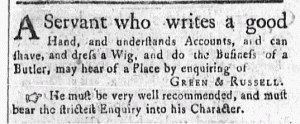
“A Servant who writes a good Hand … may hear of a Place.”

Having a servant “who writes a good Hand” would be most valuable to his master, along with the other duties that he would perform: shaving, dressing a wig, helping with the accounts, and “the Business of a Butler.” Having a servant doing these tasks would have freed up his master to pursue other activities and would have provided standing among his peers. The emphasis on writing implies that the person who placed the advertisement was keen to find a servant that would possibly assist in managing his household by doing his writing for him as well as keeping track of his accounts.

This person that the advertiser was going to hire could not be just anyone; he needed to be well recommended. Recommendations in some cases had more weight than experience, especially in a busy port city like Boston with people coming and going.

In this case, it seems like the man looking for a servant did not want to deal directly with those responding to the advertisement but instead went though the newspaper printers, Green and Russell.

**********

ADDITIONAL COMMENTARY:  Carl Robert Keyes

When I decided to combine my own research with my teaching duties by inviting students in my Public History course to take on responsibilities as guest curators for the Adverts 250 Project I hoped that their relative unfamiliarity with eighteenth-century print and consumer culture would uncover elements of various advertisements that I take for granted.

I have appreciated, for instance, how some of the guest curators have interrogated the language used in the advertisements they selected, demonstrating how usage has changed over time. Similarly, for today’s featured advertisement Mary suggested in her first draft that Green and Russell were an employment agency of some sort, not realizing that “enquiring of GREEN & RUSSELL” was a variant of “Enquire of the Printers.” Other guest curators have reached similar conclusions when working with advertisements that directed readers to printers when those men were identified by name rather than occupation. Given the modern process for matching applicants with jobs through agencies, this seems like a natural assumption.

In turn, it opens the door for productive conversations about the role of printers in eighteenth-century America. Their print shops were hubs of activity – commercial and political. Many printers also served as postmasters in addition to publishing their newspapers, which meant that people visited their offices to send and pick up letters. Information, including employment possibilities, circulated through printing offices. Local residents, unlike twenty-first-century readers, would have recognized the printers by name and would have been familiar with the practice of instructing interested parties to gain more information at the local print shop.

In this regard, today’s advertisement is a nice companion to the two advertisements concerning wet nurses featured yesterday. In each of them printers played a role as intermediaries after the advertisements were published.

“May hear of a Place by enquiring of GREEN & RUSSELL.”

“Enquire of the Printers.”

“Inquire of W. Weyman.”

February 10

GUEST CURATOR:  Kathryn J. Severance

Feb 10 - 2:10:1766 Boston Post-Boy
Boston Post-Boy (February 10, 1766).

What was advertised in a colonial newspaper 250 years ago today?

“Will be Sold by PUBLIC VENDUE … A variety of genteel House Furniture, belonging to a Gentleman going out of the Province, viz. Mohogony Desk and Book-Case.”

This advertisement features a series of household goods for sale, listing both the type of items and how many of the items are available.  This particular advertisement was placed by an individual who was leaving the ‘province,’ which, for all intents and purposes, meant the same thing as the colony.  Today, we might look at this ad as an eighteenth-century version of an advertisement for a yard sale of a homeowner who was leaving the state. It is always interesting to look at something from history and see it through a modern lens. When a person moves, they sometimes sell their possessions to make some funds for the move and get rid of possessions that will not be needed or wanted for their journey elsewhere.

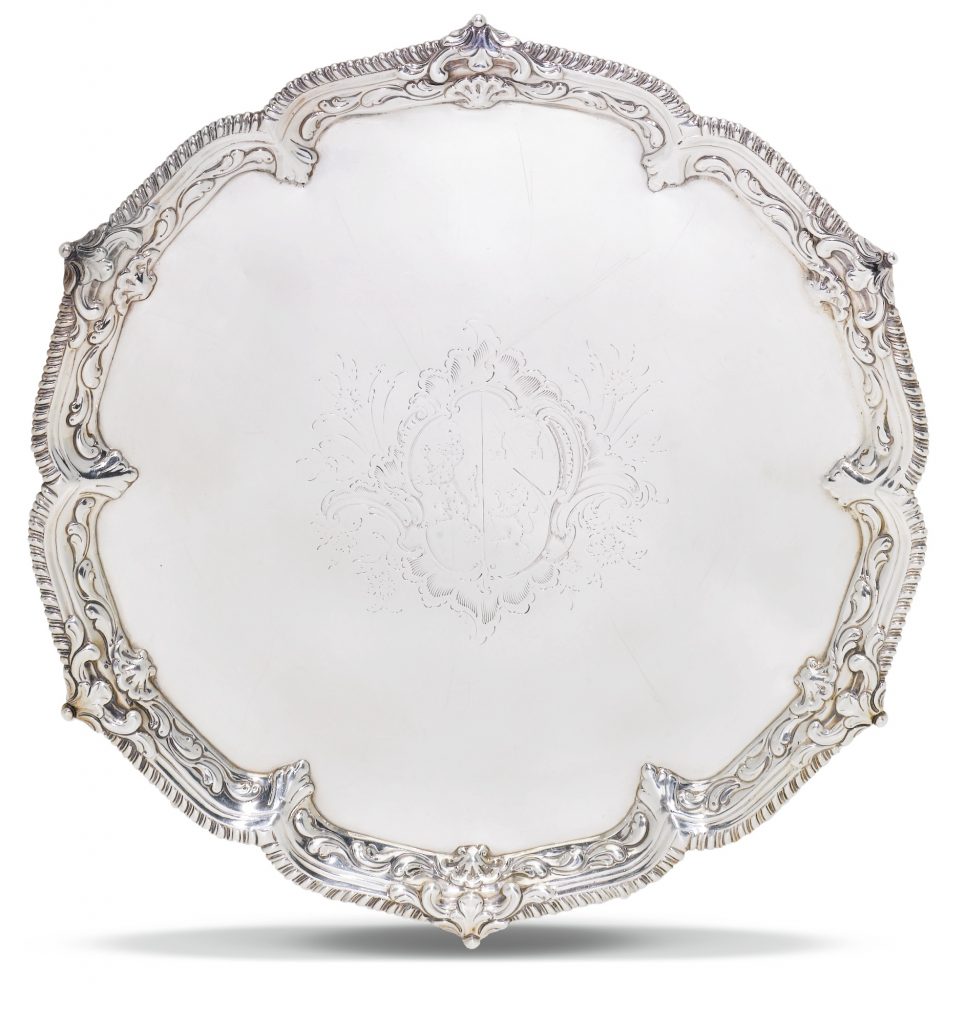
Feb 10 - Silver Salver
Silver Salver (Ebenezer Coker, London, 1766).

One item featured in the advertisement that I find intriguing is the mahogany desk.  Desks of the Colonial period were sometimes ornate, featuring far more details and far more lavish woods than what is utilized in today’s desks.  To a large extent, furniture helped to designate a family or individual’s social class.  Wealthier families would have the most ornate woods and intricately-carved pieces in their homes, while middling individuals would have pieces that were far more basic.

Other items also caught my attention: the “porringers” and “salver.”  A porringer was a special type of bowl that featured one or two decorated handles and were often made out of silver or pewter.  They were often used for serving soup or porridge. (Check out this modern recipe for perfect porridge from BBC Good Food magazine.) Once again, the more ornate the dishes were, the more wealth that a family had. Silver was a sign of elite status, while pewter was a sign of the middling and lower sorts.  A salver, on the other hand, was an eighteenth-century tray.  These also could be made of silver or pewter, with the same connotations for their worth. Check out this silver salver crafted by Ebenezer Coker of London.

**********

ADDITIONAL COMMENTARY:  Carl Robert Keyes

One of the reasons I founded the Adverts 250 Project was to use advertisements to open up the daily lives of colonists. I anticipated that some advertisements would be featured because they were simply mundane, what colonists expected to see, rather than exceptional or extraordinary in some way.

Kathryn has chosen an advertisement and offered commentary that illuminates the daily lives of colonists in several ways, some of them demonstrating a continuity with our modern lives and others demonstrating how much has changed. I confess that I never thought of this kind of “Public Vendue” notice as an eighteenth-century “garage sale” advertisement, but Kathryn makes a valid comparison that I will incorporate into my own classroom explanations in the future.

I also appreciate the way she worked through some of the language in the advertisement. Porringers? Salvers? Those would have been housewares encountered by many early Americans on a daily basis. The words they used to describe them would have been part of their everyday lexicon. Yet the words sound strange to most of us today. The uses, to some extent, seem archaic. Who needs a porringer to serve soup or porridge when there’s a bowl in the cupboard?!

The household goods this gentleman sought to sell included one more item much less common today. His “Case containing 12 Knives and Forks, [and] 12 Spoons” also included a spoon “for Marrow.” That’s not a standard piece of many silverware sets sold today, reflecting a change in dining habits since the colonial era.

February 6

GUEST CURATOR:  Maia Campbell

What was advertised in a colonial newspaper 250 years ago this week?

Feb 6 - 2:3:1766 Boston Post-Boy
Boston Post-Boy (February 3, 1766)

“Tickets in the Faneuil-Hall Lottery, Sold by Green & Russell.”

It seems that the interest modern Americans have in the lottery is not a new interest, as the lottery in America has its roots in colonial times. I have never seen a colonial lottery advertisement before, so it intrigued me. The advertisement itself is so simplistic and short that one could miss it by reading through the paper too quickly. The lottery advertisement also shocked me because of the religious devotion in the American colonies.

To compare the advertisement to those of the lottery in today’s day and age: this advertisement is not flashy and designed to entice you. It received the same printing treatment as other advertisements. Today, lottery commercials and billboards are covered in enticing colors and images, and of course the added temptation arrives with the amount of money at stake. This advertisement simply gives the location of the tickets to be sold and who the tickets are being sold by.

I question if an advertisement such as this one was effective, and yet I do not think it would be included in this paper if the lottery did not have a target audience in the colonial period.

**********

Feb 6 - Final Page of Boston Post Boy 2:3:1766
Final Page of Boston Post-Boy (February 3, 1766).

I have long argued that many marketing practices that we assume originated in the twentieth century actually had precursors in the eighteenth century. As modern Americans, we sometimes imagine the past as being too different from the present, not realizing some of the similarities. Perhaps we sometimes focus too much on change over time and make assumptions about the extent to which life in the twenty-first century must be significantly different than life in the colonial era.

The same sentiment applies to lotteries, as Maia discovered when she selected her final advertisement for this week as guest curator. I’d like to offer two recent examinations of lotteries in early America: Matthew Wittmann’s “Lottery Mania in Colonial America” and Diana Williams’ “Lottery Fever: A Brief History of American Lotteries.”

Maia notes that nothing in particular distinguishes this advertisement. In fact, it is at the bottom of the final column of the last page of the newspaper, suggesting that it may have been inserted simply to fill the space. I echo Maia’s question: was this advertisement effective?!

Feb 6 - Lottery Advert - Pennsylvania Gazette 1:9:1766
Pennsylvania Gazette (January 9, 1766).

Having examined a greater number of colonial American newspapers I can offer a bit more context about advertisements for lotteries (another category that I have previously chosen not to feature). While some are this short, others are much more extensive (see the example below, published less than a month earlier in the Pennsylvania Gazette). Many comment on the civic and public works projects that will be accomplished with the proceeds. Others include extensive charts that detail how many tickets will be sold, how many drawn, and the varying amounts of money to be awarded to winners. Just as advertisements for consumer goods and services could be as short as a couple of lines or extend over and entire column, advertisements for lotteries did not all loo the same.

February 3

GUEST CURATOR:  Maia Campbell

What was advertised in a colonial newspaper 250 years ago today?

Feb 3 - 2:3:1766 Boston Post-Boy
Boston Post-Boy (February 3, 1766)

“A Silver Sugar Chest and Quart Can, Gold and Silver Lace …”

A variety of the items to be sold in this new public auction room seem like the type of items that wealthier families during the eighteenth century would purchase. Goods such as horse whips and saddles would appeal more to wealthier classes because they were more likely to own many horses, as they were a symbol of wealth in the eighteenth century (and in some cases they remain a symbol of wealth to this day). Also, fancier fabrics like gold and silver lace would appeal to upper classes because they tended to dress in a more stylized manner than more common people.

Likewise, a variety of items appeal to the general public. Items such as buttons, blankets, hinges, and household furniture were things that that everybody needed to have. The advertisement demonstrates the flexibility of the vendor and his desire to reach a wide audience of customers. This colonial vendor had a vast number of clients and the knowledge of their necessities and desires.

**********

ADDITIONAL COMMENTARY:  Carl Robert Keyes

What an assortment of goods up for sale at “PUBLIC VENDUE” on Tuesday, Wednesday, and Friday evenings! I agree with Maia’s assessment that this advertisement includes merchandise intended to appeal to many different kinds of potential customers. A consumer revolution was taking place in the eighteenth-century British Atlantic world, a transformation in consumption habits experienced not only by the elite but, as the century progressed, increasingly by the middling sort and, to the alarm of some critics, the lower sorts as well, though some colonists were able to participate to greater extents than others.

Some of the goods on offer here would have permitted the better sort to demonstrate their affluence by engaging in conspicuous consumption that others would easily recognize as markers of their social and economic stature. Yet, as Maia suggests, many of the other items likely ended up in the possession of colonists from more humble backgrounds. Some may have even purchased unexpected items in hopes doing so might contribute to their social mobility.

This advertisement also hints at a much larger assortment of merchandise for consumers and retailers to purchase. Note that “&c.” (the eighteenth-century method of writing “etc.”) was included twice, suggesting too much inventory to include in the small space available.

January 20

What was advertised in a colonial newspaper 250 years ago today?

Jan 20 - 1:20:1766 Boston Post-Boy
Boston Post-Boy (January 20, 1766)

“At his STORE … Where LADIES may find as compleat an Assortment as at any Store in Town.”

Consumption is feminized in the twenty-first century.  After all, ladies love shopping, right?  At first glance, Samuel Fletcher’s advertisement might suggest that this is a natural conclusion, that consumption has always been a feminine pursuit because women more inherently possess a desire to shop than men do.

However, reaching such a conclusion based on Fletcher’s advertisement would be faulty.  This advertisement, listing so many of the different goods for sale in Boston and so many other colonial American port cities and villages, is rather unique among those published in the 1760s.  Very rarely did advertisers in this era identify potential customers by gender (though there were exceptions, such as seamstresses who made clothes for women and tailors who specialized in men’s garments).  In explicitly identifying “LADIES” with consumption, Fletcher engaged in a mode of marketing not yet widely practiced, but one that eventually became a largely unquestioned part of American consumer culture.

I choose many advertisements because they include common or standard aspects of eighteenth-century marketing, but this advertisement caught my attention precisely because the appeal to the “LADIES” was extraordinary, rather than ordinary, in the 1760s.