May 20

What was advertised in a colonial American newspaper 250 years ago today?

Maryland Gazette (May 20, 1773).

“Seasonable notice will be given in this gazette, to give gentlemen an opportunity to advertise in the first number.”

William Goddard, the printer of the Pennsylvania Chronicle in Philadelphia, continued his efforts to establish a new operation in Baltimore.  In the early 1770s, Maryland had only one newspaper, the Maryland Gazette, published by Anne Catherine Green and Son in Annapolis.  In late October 1772, Goddard placed an advertisement in that newspaper to announce his intention to publish the Maryland Journal and Baltimore Advertiser “as soon … as I shall obtain a sufficient Number of Subscribers barely to defray the Expence of the Work.”  He also solicited advertisements, stating that they “shall likewise be accurately published, in a conspicuous Manner, with great Punctuality, at the customary Prices.”

Nearly seven months later, Goddard inserted an update in the May 20, 1773, edition of the Maryland Gazette.   He had opened a printing office “in Baltimore-town,” where “PRINTING in all it’s various branches, [was] performed in a neat,correct, and expeditious manner, on the most reasonable terms.”  The printer also informed readers that he would begin publishing the Maryland Journal “As soon as proper posts or carriers are established.”  They could expect at least one more update in the Maryland Gazette before that happened because Goddard wished “to give gentlemen an opportunity to advertise in the first number.”  While advertising could aid merchants, shopkeepers, artisans, and others in capturing the markets served by Baltimore’s first newspaper, Goddard also knew from experience that advertisements accounted for an important revenue stream.

In his notice, Goddard attended to both advertisers and subscribers.  He requested that the “gentlemen” who served as local agents “who have been so obliging as to take in subscriptions … transmit the subscription lists (or the subscribers names and places of abode) as speedily as possible” so he “may be enable to ascertain the number necessary to be printed” as well as make arrangements for delivering the newspapers “to every subscriber.”  Goddard was still three months away from publishing “the first number” of the Maryland Journal and Baltimore Advertiser, but his notice in the Maryland Gazette kept the public, including prospective subscribers and advertisers, apprised of his progress.  In the coming months, the Adverts 250 Project will examine Goddard’s success in attracting advertisers for “the first number” and subsequent editions of Baltimore’s first newspaper.

May 16

What was advertised in a colonial American newspaper 250 years ago this week?

Massachusetts Gazette and Boston Weekly News-Letter (May 13, 1773).

“[The Avertisements that are omitted this Week, will have a good Place in out next.]”

Richard Draper, the printer of the Massachusetts Gazette and Boston Weekly News-Letter, inserted notes to readers and subscribers at the bottom of the third page of the May 13, 1773, edition.  In those notes, he provided information about the contents of the current issue and the next issue, acknowledging that he did not have sufficient space for all the materials received in his printing office that week.  Placing the notes on the third page made sense considering how eighteenth-century printers produced each standard issue of a four-page newspaper.  They printed two pages on each side of a broadsheet and then folded it in half, usually printing the first and fourth pages first and the second and third pages later.  That meant that they set the type of the third page last.

It was only when setting type for the third page that Draper or a compositor who worked in his printing office knew the layout of the entire issue.  In this instance, that meant that “A variety of domestic Articles are in the last Page, and London Articles in the SUPPLEMENT.”  That note ran across all three columns at the bottom of the third page, a thick line separating it from the rest of the content.  In another note, this one appearing at the bottom of the first column, Draper advised that “[The Avertisements that are omitted this Week, will have a good Place in out next.]”  Draper may not have yet realized that news from London would occupy only one page of the two-page supplement, leaving room for another entire page of advertisements … or he may have realized that even with the extra space he still would not have enough room for all the paid notices that customers expected to see in his newspaper.  After all, he resorted to a supplement again the following week in order to increase the content he disseminated from four pages to six pages.

Given that advertising represented such an important revenue stream for colonial printers, Draper erred on the side of caution in letting advertisers know that their notices might not appear in the current issue or its supplement and, as a consolation, promised “a good Place” in the next issue.  His advertisers had the option of giving their business to any of the four other newspapers printed in Boston at the time, prompting Draper to provide updates and reassurances about when they could expect to see their notices in the Massachusetts Gazette and Boston Weekly News-Letter.

May 13

What was advertised in a colonial American newspaper 250 years ago today?

Massachusetts Spy (May 13, 1773).

“Hand and Shop BILLS.”

At the bottom of the final page of each issue of the Massachusetts Spy, the colophon informed readers that they could purchase subscriptions from Isaiah Thomas at his printing office in Boston or from local agents in several other towns in the colony.  In addition, the colophon stated, “ADVERTISEMENTS taken in,” “PRINTING in its various Branches, performed in a neat Manner,” and “HAND BILLS at an Hour’s Notice.”  Thomas aimed to generate revenue from both notices in the newspaper and advertisements printed to distribute separately.

In the spring of 1773, the printer enhanced his efforts to encourage colonizers to purchase advertising.  He commenced with a newspaper notice that appeared as the first item at the top of the first column on the first page of the April 16 edition.  Thomas advised that “THE extensive circulation of the MASSACHUSETTS SPY, through town and country, renders it very beneficial for those who ADVERTISE therein.”  Furthermore, “Advertisements (sent in season) are inserted in a neat and conspicuous manner on the most reasonable terms.”  The remainder of the notice solicited subscriptions, though the printer’s comment that the newspaper “has met with very great encouragement from the public” also assured advertisers of its “extensive circulation” that made advertising a good investment.

Three weeks later, Thomas inserted another advertisement about advertising, this time for “Hand and Shop BILLS.”  Printers occasionally hawked handbills, as Thomas did in the colophon, but rarely did they advertiser shop bills.  Those billheads, the precursors to modern letterheads, included the name and location of the merchant, shopkeeper, or artisan.  They often featured a visual image or a brief advertisement describing the goods and services available at the shop or both.  Most of the sheet remained blank, leaving space to write in a list of purchases.  Billheads simultaneously served as both advertisements and receipts.

Thomas apparently sought to increase the amount of advertising produced at his shop.  He declared that he “furnished himself with an elegant assortment of LARGE, and other TYPES, for the purpose of printing in the best manner, SHOP and other BILLS.”  He acknowledged that the type he used for printing the newspapers was not always the best choice for freestanding advertisements like broadsides, handbills, and billheads.  Instead, Thomas acquired the necessary equipment for crafting the most effective advertisements.

He also gave his notice about “Hand and Shop BILLs” a privileged spot the first time it appeared, placing it after news from Boston dated May 5 and before news from Boston dated May 6.  Even readers who only skimmed or completely skipped over advertisements were likely to see it there.  His previous notice about advertising in the Massachusetts Spyran as the final item in the Postscript, the only advertisement in that supplement, reinforcing the printer’s efforts to market advertising.  As with other instances of advertising ephemera mentioned in newspaper notices, the “Hand and Shop BILLS” that Thomas promoted in the spring of 1773 testifies to a vibrant culture of advertising in early America, though most such items have not been collected and preserved in research libraries and historical societies.

April 26

What was advertised in a colonial American newspaper 250 years ago today?

Massachusetts Gazette and Boston Post-Boy (April 26, 1773).

“Hope the Customers to the Paper will continue to encourage it by advertising.”

The first advertisement in the April 26, 1773, edition of the Massachusetts Gazette and Boston Post-Boy concerned the operation of the newspaper.  For nearly sixteen years, since August 1757, John Green and Joseph Russell printed the newspaper, but starting on that day “the Printing and Publishing of this PAPER will, in future be carried on by NATHANIEL MILLS and JOHN HICKS.”  Neither the printers nor readers knew it at the time, but the newspaper would not continue for nearly as long under Mills and Hicks.  They published the last known issue on April 17, 1775, two days before the skirmishes at Lexington and Concord that marked the beginning of the Revolutionary War.

At the time that ownership of the newspaper changed hands, Green and Russell expressed “their respectful Thanks for the Favours they have received.”  Furthermore, they expressed their “hope the Customers to the Paper will continue to encourage it by advertising, &c.”  That “&c.” (an abbreviation for et cetera) included subscribing to the newspapers and providing content, such as editorials and “Letters of Intelligence.”  The printers realized that the continued viability and success of the newspapers depended most immediately on maintaining advertising revenue since readers but subscribed for a year while most advertisements ran for only three or four weeks.

Readers likely noticed a new feature in the first issue published by Mills and Hicks, a colophon that ran across the bottom of the final page.  Green and Russell did not always include a colophon, perhaps because they considered the newspaper so well established that they did not consider it necessary to devote space to it in each issue.  Their final issue, the April 19 edition, for instance, did not feature a colophon.  On April 12, the colophon at the bottom of the last column on the final page simply stated, “Printed by Green and Russell.”  Mills and Hicks, on the other hand, opted for a more elaborate colophon that served as a perpetual advertisement for the newspaper and other services available in their printing office, a practice adopted by some, but not all, colonial printers.  Distributed over three lines, it read, “BOSTON: Printed by MILLS and HICKS, at their PRINTING-OFFICE in School-street, next Door to CROMWELL’S HEAD TAVERN, where Subscriptions, Advertisements, and Letters of Intelligence for this Paper are taken in; and the Printing Business carried on, in its different Branches, with the greatest Care.”

Mills and Hicks could not depend on their reputations to market the Massachusetts Gazette and Boston Post-Boy in the same way that Green and Russell did after more than a decade of publishing the newspaper.  In their first issue, they placed greater emphasis on soliciting advertisements to help support their enterprise.  Subsequent issues included the colophon, a regular feature that encouraged colonizers to advertise as well as purchase subscriptions and submit orders for job printing.

Colophon from Massachusetts Gazette and Boston Post-Boy (April 26, 1773).

April 16

What was advertised in a colonial American newspaper 250 years ago today?

Massachusetts Spy (April 16, 1773).

THE extensive circulation of the MASSACHUSETTS SPY, through town and country, renders it very beneficial for those who ADVERTISE therein.”

Many colonial printers promoted their newspapers in the colophon that appeared on the final page.  Isaiah Thomas, the printer of the Massachusetts Spy, did so in one of the lengthier colophons that appeared in newspapers published in the 1770s.  In addition to providing his name and the place of publication, he gave extensive directions to his printing office “At the South Corner of MARSHAL’S LANE, leading from the MILL-BRIDGE into UNION-STREET.”  Thomas noted that “all Persons may be supplied with this Paper” and gave the price for an annual subscription.  He also listed local agents in four towns – Bridgewater, Charlestown, Newburyport, and Salem – who accepted subscriptions on his behalf.  In addition, Thomas solicited advertisements and job printing, including handbills and printed blanks.  He informed prospective customers of “PRINTING in its various Branches, performed in a neat Manner, with the greatest Care and Dispatch, on the most reasonable Terms.”

Massachusetts Spy (April 16, 1773).

Although printers regularly promoted various goods and services available in their printing offices, they did not often include their own newspapers among those advertisements (except to call on recalcitrant subscribers to make payments) nor did they insert notices to encourage the public to place advertisements.  That made Thomas’s notice at the top of the first column on the first page of the April 16, 1773, edition of the Massachusetts Spy rather unusual.  The printer proclaimed, “THE extensive circulation of the MASSACHUSETTS SPY, through town and country, renders it very beneficial for those who ADVERTISE therein.”  Established July 17, 1770, the Massachusetts Spy was the newest of the five newspapers published in Boston at the time, but Thomas suggested that its circulation rivaled its competitors.  Advertising in his newspaper, the printer asserted, drew the attention of readers and, in turn, that attention yielded results for the advertisers.  In making his pitch, Thomas also stated that “Advertisements … are inserted in a neat and conspicuous manner on the most reasonable terms,” offering assurances about the effectiveness, quality, and price of advertising in his newspaper.

Thomas also sought new subscribers.  After extolling advertisements, he addressed “Such gentlemen and ladies, in this Province as are desirous of taking in the SPY.”  The printer characterized its contents as “the earliest and most important Foreign and Domestic Intelligence, with a number of ORIGINAL papers, on a variety of subjects.”  To further entice prospective subscribers, he gave the price of an annual subscription and trumpeted that it “is cheaper than any public paper or other periodical publication whatever, of its bigness [or size], in the four quarters of the globe.”  Accordingly, the Massachusetts Spyhas met with very great encouragement from the public,” a pronouncement intended to resonate with prospective advertisers as well as prospective subscribers.  In a nota bene, Thomas offered to send the newspaper to “Gentlemen and ladies in any of the American colonies, who incline to subscribe,” another testament to the “extensive circulation” that he mentioned as a reason for placing advertisements.

At the bottom of the final page of each issue of the Massachusetts Spy, the colophon informed readers that Thomas accepted subscriptions at the printing office and briefly mentioned “ADVERTISEMENTS taken in.”  Although advertisements accounted for significant revenue for colonial printers, Thomas and others rarely promoted advertising except in the colophons of their newspapers.  In this instance, Thomas apparently recognized an opportunity to cultivate more advertising for his newspaper.  In making his pitch to prospective advertisers, he emphasized price (“reasonable terms”) and, especially, effectiveness (displaying notices in a “conspicuous manner” and the “extensive circulation” of the newspaper).  He coupled those appeals with his efforts to attract more subscribers, hoping to expand both means that the Massachusetts Spy generated revenue.

August 10

What was advertised in a colonial American newspaper 250 years ago today?

South-Carolina Gazette Extraordinary (August 10, 1772).

“ADVERTISEMENTS of some Consequence to the Parties, are brought in so late, that the immediate Insertion of them in the GAZETTE, would delay the Publication thereof.”

Thomas Powell and Company aimed to provide the best possible service for advertisers who chose the South-Carolina Gazette, such as disseminating their notices to the public as quickly as possible.  That included publishing supplements when necessary.  With a few exceptions, most American newspapers published before the Revolution consisted of a single weekly issue.  Powell, Hughes, and Company circulated a new edition of the South-Carolina Gazette on Thursdays in 1772.  Less than two weeks after the death of Edward Hughes, Powell and Company distributed a South-Carolina Gazette Extraordinary on Monday, August 10.

A notice at the top of the first column on the first page explained the purpose of the supplement.  “[I]t frequently happens,” Powell and Company declared, “that ADVERTISEMENTS of some Consequence to the Parties, are brought in so late, that the immediate Insertion of them in the GAZETTE would delay the Publication thereof beyond the stated Day.”  In addition, “others are omitted to make Room for fresh Intelligence” or news just arrived in the printing office. Powell and Company recognized that they had a duty to both subscribers and advertisers, prompting them to “NOW assure the Public, that in EITHER of the above Cases … they will issue a GAZETTE EXTRAORDINARY, as soon after their stated Day as possible.”  Publishing supplements minimized delays for both news and paid notices, allowing Powell and Company to fulfill “their Duty, to contribute … to the ENTERTAINMENT, as well as EMOLUMENT, of that Public which so generously supports them.”

The four-page supplement contained both advertising and news, divided nearly evenly between the two.  The advertisements included five that offered rewards for the capture and return of enslaved men and women who liberated themselves as well as several others promoting consumer goods and services.  Powell and Company inserted a heading for “New Advertisements” on all three pages that carried paid notices, though not all advertisements in the supplement appeared for the first time.  Despite these efforts, Powell and Company suggested that more advertising and news flooded into their printing office than would fit in the supplement.  That may have been a strategy to underscore the viability of the newspaper following the death of one of the partners.  A brief notice at the bottom of final column on the third page, the last item the compositor would have locked into place for the entire supplement, advised that “Several NEW ADVERTISEMENTS, &c. now omitted, shall be inserted in Thursday’s Gazette.”  According to their notice on the first page, Powell and Company hoped “to merit a CONTINUANCE” of the support they already received.  Hughes no longer participated in publishing the newspaper, yet, the notice suggested, subscribers, advertisers, and the general public could depend on the South-Carolina Gazette being in good hands with Powell.

August 8

Who was the subject of an advertisement in a colonial American newspaper 250 years ago today?

Pennsylvania Chronicle (August 8, 1772).

“My wife, HANNAH FREDERICK, did … elope from my bed and board.”

In the eighteenth century, aggrieved husbands often took to the pages of newspapers to warn others not to extend credit to misbehaving wives who “eloped” from them.  Readers regularly encountered “runaway wife” advertisements in newspapers published throughout the colonies.  Those notices continued to appear during the era of the American Revolution and, as Mary Beth Sievens demonstrates, well into the nineteenth century.[1]

Although most notices followed a pattern, each provided details specific to a particular household.  Wives usually “eloped” from their husbands on their own, but in an advertisement in the August 8, 1772, edition of the Pennsylvania Chronicle one husband reported that his wife, Hannah Frederick, “did … elope from my bed and board … with a certain Abraham Hudson.”  The husband believed that the two of them traveled “from Fish-Kills, in Duchess County, in New-York government … to Elizabeth-Town” in New Jersey “and from thence to Philadelphia.”  To aid readers in identifying his wife, the advertiser reported that her “maiden name was Hannah Coleman” and she “served her time,” likely as an indentured servant, “with John Taylor, at Tinicum-Island.”  He concluded with a formulaic statement cutting his wife off from his credit: “these are therefore to forewarn all persons from trusting her on my account, as I shall pay no debts of her contracting after the date hereof.”

Printers published such advertisements without offering commentary of their own, but, in this instance, William Goddard did insert a clarification.  “In the copy of the foregoing Advertisement, which was sent to the Printer,” he explained, “the Advertiser’s name was omitted.”  As a result, the husband’s name appeared as “———- FREDERICK.”  That being the case, how did Goddard handle payment for the advertisement?  Some printers required advertisers to pay in advance, even though they extended credit to subscribers.  After all, advertising comprised a lucrative revenue stream.  Occasional notices in eighteenth-century newspapers, however, make clear that some printers did allow credit for advertisements as well as subscriptions.  This husband may have submitted payment, but not his name, to the printing office … or Goddard may have taken a chance that he would settle up in a timely manner.  Even if that was the case, the printer’s trust only went so far.  The advertisement ran just twice (August 8 and 15), though most newspapers initially published advertisements for three or four weeks for a set fee before charging a lower fee for each insertion.  Goddard may have been carefully managing how much credit he extended to “———- FREDERICK” even as that husband attempted to exert control over his credit when it became clear his wife was beyond his influence.

**********

[1] Mary Beth Sievens, “Female Consumerism and Household Authority in Early National New England,” Early American Studies:  An Interdisciplinary Journal 4, no. 2 (Fall 2006):  353-371.

April 16

What was advertised in a colonial American newspaper 250 years ago today?

Massachusetts Gazette and Boston Weekly News-Letter (April 16, 1772).

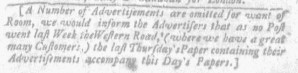
Last Thursday’s Paper containing their Advertisements accompany this Day’s Papers.”

Advertisements accounted for important revenue for colonial printers.  That was certainly the case for Richard Draper, printer of the Massachusetts Gazette and Boston Weekly News-Letter.  So many colonizers submitted advertisements for inclusion in the April 16, 1772, edition, that he resorted to distributing a half sheet supplement devoted almost exclusively to paid notices.  That helped, but still did not provide enough space for all of the advertisements that he should have published that week.  That prompted him to insert a brief note to address the situation.  “A Number of Advertisements,” Draper stated, “are omitted for want of Room.”  He then tried to convince advertisers that they did not need to be concerned because “no Post went last Week” along “the Western Road, (where we have a great many Customers)” so that meant that “last Thursday’s Paper containing their Advertisements accompany this Day’s Papers.”

Would that mollify advertisers who expected to see their notices in print?  Draper did the best he could to give a favorable impression of the situation, assuring advertisers that readers would indeed see their notices that week even if they did not happen to appear in the most recent edition or its supplement.  He did not, however, attempt to explain why they should not be concerned that delivery of the previous edition had been delayed by a week, perhaps because everyone understood he had less control over the post than his press.  He simply expected advertisers to accept that their notices had not been distributed as widely as they anticipated as soon as they intended.  What truly mattered, he sought to convince them, was that their advertisements were now before the eyes of readers.  Interestingly, Draper’s note explicitly addressed advertisers, not subscribers.  He made no apology to subscribers outside of Boston that they had to wait a week to receive either news or notices.  Through that omission, he once again positioned delivery as further beyond his control than the contents of his newspaper.  In this instance, maintaining good relationships with customers and safeguarding an important revenue stream meant focusing on the concerns of advertisers.

July 29

What was advertised in a colonial American newspaper 250 years ago today?

Boston-Gazette (July 29, 1771).

“The Particulars in our next.”

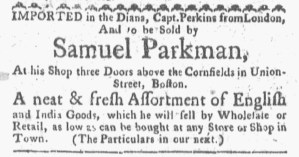
In late July 1771, Benjamin Edes and John Gill, printers of the Boston-Gazette, ran short on space for advertising.  In the July 22 edition, they included a note that “ADVERTISEMENTS omitted will be in our next.”  A week later they apparently had sufficient space to insert notices from all advertisers that submitted them to the printing office and even had room for a note of their own to remind “All Persons indebted for this Paper, whose Accounts have been above Twelve Months standing, are requested to make immediate Payment.”  Not every advertisement, however, appeared in its entirety.  Samuel Parkman’s advertisement for a “neat & fresh Assortment of English and India Goods” concluded with a note advising, “The Particulars in our next.”

Boston-Gazette (August 5, 1771).

Parkman’s complete advertisement did indeed appear in the next issue of the Boston-Gazette.  Perhaps to make amends for truncating its earlier appearance, the printers gave it a privileged place at the top of the third column on the first page.  The first two columns consisted of news, making Parkman’s advertisement the first commercial notice that readers encountered when perusing the August 5 edition.  The copy for the complete advertisement suggests that the printers consulted with Parkman about how to abbreviate his initial advertisement.  In most cases, the compositor would have set the type for the first portion of the advertisement and later added additional material, in this case a list of goods available at Parkman’s shop, without making revisions to the introductory section.  In this case, however, it appears that the compositor started afresh in setting type for the second iteration of the advertisement.  Notice, for instance, the spacing for “the Diana” in the first and “theDiana” in the second as well as the changing line breaks for “Union-Street” and “Assortment of English and India Goods.”  More significantly, the first advertisement stated that Parkman “will sell be Wholesale or Retail, as low as can be bought at any Store or Shop in Town.”  In the second advertisement, this shifted to “will sell on the best Terms by Wholesale or Retail.”  That version did not make explicit comparisons to other stores and shops.  In general, advertisers were responsible for copy and compositors responsible for design, so it seems likely that Parkman at least approved the revisions incorporated into the second advertisement.

As with many aspects of the business of advertising in eighteenth-century newspapers, this conclusion rests on reasonable conjecture based on close examination of advertising in the Boston-Gazette and many other newspapers.  The advertisements offer clues about what might have happened or what likely happened, but often no definitive answers about the relationship between advertisers and printers.

July 26

What was advertised in a colonial American newspaper 250 years ago today?

New-Hampshire Gazette (July 26, 1771).

“Hatts of all kinds.”

John Beck, a hatter, placed advertisements in the New-Hampshire Gazette on multiple occasions during the summer of 1771.  Although the copy remained consistent, the format varied, an unusual situation when it came to early American advertising.  Printers and compositors usually conserved time and effort by setting type for advertisements just once and then running them in that format for as long as advertisers wished for them to continue to appear.  For some reason, however, that was not the case with Beck’s advertisement.

When the advertisement appeared in the July 5 edition, it occupied only three lines.  In its entirety, it informed readers of “HATTS of all Kinds, made and Sold by JOHN BECK, as usual, at the Sign of the HATT and BEVER, in Queen Street, Portsmouth.”  The advertisement did not run again until July 26.  It did not appear in the same format.  The copy remained the same, including the variations in spelling, but the new version made use of larger fonts, distributed the copy across five lines that occupied twice as much space as the previous iteration, and discontinued the use of italics.  The revised version then ran several times in August.

New-Hampshire Gazette (July 5, 1771).

Who made decisions about changing the format of the advertisement, someone in the printing office or the advertiser?  Unfortunately, that question is impossible to answer from the sources available.  Certain aspects of the advertisements allow for reasonable conjectures about a portion of the process, but not all the details.  The identical copy, for instance, testifies to an attribute seen in other advertisements placed in multiple newspapers.  Advertisers usually exercised control over the copy.  Advertisements with identical copy placed in multiple newspapers also demonstrate that compositors usually made decisions about format, including font size and the use of capitals and italics.  This instance, however, concerns an advertisement placed multiple times in one newspaper, not an advertisement placed in multiple newspapers.  It presents the possibility that Beck, dissatisfied with the original advertisement, negotiated for a different format.  Yet that may not have been the case at all.  Alternately, the compositor may have inadvertently broken down the type after Beck’s advertisement ran the first time and then someone had to set it again, making new choices in the process.  Or something else altogether may have occurred.  Something unusual happened, deviating from the standard practices for producing newspaper advertisements in the eighteenth century.  This raises questions about the roles of the advertiser and the compositor, the influence of each, but no definitive answers that might better illuminate the evolution of business practices associated with advertising in early America.