December 13

What was advertised in a colonial American newspaper 250 years ago today?

South-Carolina Gazette and Country Journal (December 13, 1768).

“Be early in sending their Advertisements for Insertion, and not to exceed Monday Noon.”

Just as Mein and Fleeming marked the first anniversary of publishing the Boston Chronicle by placing a notice in their own newspaper, a day later Charles Crouch celebrated three years of publishing the South-Carolina Gazette and Country Journal with his own advertisement. Like his counterparts in Boston, Crouch addressed advertisers as well as subscribers, encouraging them to place notices in his publication. In the process, he provided details about the mechanism for publishing advertisements that did not often appear in the pages of eighteenth-century newspapers.

To entice advertisers, Crouch first underscored the popularity of the South-Carolina Gazette and Country, a necessary step considering that it competed with Peter Timothy’s South-Carolina Gazette and Robert Wells’s South-Carolina and American General Gazette. Crouch did not mention either by name, but when he addressed “the Friends to this Gazette” he did note that their “Number are as great as any other in the Place.” In other words, his newspaper had as many subscribers and advertisers as the others. Advertisers could not go wrong by placing notices in his South-Carolina Gazette and Country Journal “as the Circulation of his Papers are very numerous.”

Crouch distributed the South-Carolina Gazette and Country Journal on Tuesdays. To keep to that schedule, he requested that advertisers “be early in sending their Advertisements for Insertion, and not to exceed Monday Noon.” Despite the time required to set type and print the newspaper on a hand-operated press, advertisers could submit their notices as late as a day prior to publication, though Crouch probably limited the number of last-minute submissions out of practicality. He aimed to keep to his schedule for the benefit of his readers, but also to adhere to what seems to have been an informal agreement among Charleston’s printers to stagger publication throughout the week. Until recently, the South-Carolina Gazette appeared on Mondays, the South-Carolina Gazette and Country Journal on Tuesdays, and the South-Carolina and American General Gazette on Thursday. Crouch asserted that he was “fully determined to CONTINUE always punctual to his Day,” perhaps rebuking other printers in the city for recently deviating from the usual schedule and potentially infringing on his circulation and sales as a result.

Crouch did not offer much commentary on the other contents of his newspaper, other than noting that “Letters of Intelligence, Speculative Pieces, &c. are kindly received” and considered for publication. In promoting the South-Carolina Gazette and Country Journal as it “begins the fourth Year of its Publication,” he called on subscribers to pay their bills and assured prospective advertisers that he could place their notices before the eyes of numerous readers. He asserted that his circulation was as large as that of any other newspaper printed in South Carolina, making it the ideal venue for advertising.

April 7

GUEST CURATOR: Megan Watts

What was advertised in a colonial American newspaper 250 years ago today?

Apr 7 - 4:7:1767 South-Carolina Gazette and Country Journal
South-Carolina Gazette and Country Journal (April 7, 1767).

“A Large and neat assortment of GOODS.”

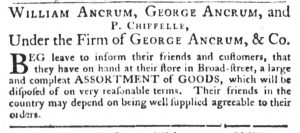
I chose this advertisement because it demonstrates something common in advertisements for consumer goods in eighteenth-century newspapers, a general store offering a wide array of products. Reeves, Wise and Poole stated that they possessed “A Large and neat assortment of GOODS” at their shop. Throughout my research I have encountered many advertisements placed by shopkeepers. They varied in length and detail, but almost always communicated that they offered a wide array of goods. An advertisement placed by Ancrum and Company is another example of such an advertisement below. These merchants either chose to keep their advertisements short or made them short out of necessity (perhaps because space was expensive). Some advertisements, on the other hand, went on for a quarter of a column. Regardless of the length, the content was the same: an effort to get consumers. Newspaper advertisements were an important way to keep a constant flow of customers and revenue in colonial stores.

Apr 7 - 4:7:1767 Ancrum South Carolina Gazette and Country Journal Page 4
South-Carolina Gazette and Country Journal (April 7, 1767).

However, newspapers also relied on advertisements for their profits and longevity. Virtually all newspapers in colonial America included advertisements as a way to make money. This practice was widespread. In fact, the first weekly newspaper, the Boston News-Letter (1704) had an advertisement for advertisements, stating that for the price of “Twelve Pence to Five Shilling and Not to exceed” interested parties could buy space to market goods and services or place other sorts of notices. Not only did advertisements provide printers with consistent sources of income for every advertisement, but a newspaper that contained a good variety of news and advertisements could attract new paying subscribers. Advertising was a key part of newspaper printing. As Jack Lynch states, “The newspaper business and the advertising business got under way together.”

**********

ADDITIONAL COMMENTARY:  Carl Robert Keyes

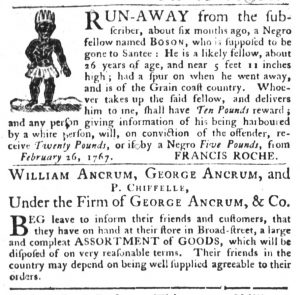
The same issue of the South-Carolina Gazette and Country Journal that carried advertisements by Reeves, Wise, and Poole and George Ancrum and Company also carried twelve advertisements concerning slaves. Six offered slaves for sale. Three cautioned against runaways. One described nine captured runaways “BROUGHT TO THE WORK-HOUSE.” Another listed a variety of consumer goods and a horse confiscated from two runaway slaves, seeking the rightful owner to claim their possessions. The final advertisement described a horse “TAKEN up by a Negro fellow belonging to Mr. Arthur Peronneau.” As far as the South-Carolina Gazette and Country Journal was concerned, this was a relatively small number of advertisements and total column space given over to slavery. That newspaper regularly issued a two-page advertising supplement in order to publish even greater numbers of notices concerning slaves, as well as other sort of advertisements, including those for “A Large and neat assortment of GOODS” that Megan examined today.

Apr 7 - 4:7:1767 Ancrum and Slave South-Carolina Gazette and Country Journal Page 4
George Ancrum and Company’s advertisement for consumer goods appeared immediately below an advertisement about a runaway slave in the South-Carolina Gazette and Country Journal (April 7, 1767).

Megan makes an important point about the role advertisements played in underwriting the publication of newspapers and, by extension, the dissemination of information in eighteenth-century America. Advertisements place by merchants, like those featured today, as well as similar notices from shopkeepers, artisans, and others who provided consumer goods and services comprised a significant portion of newspaper advertising, yet “subscribers” (in the eighteenth-century sense of “contributors”) submitted a variety of other kinds of announcements. David Waldstreicher has long argued that those other kinds of advertisements included a significant number of advertisements for runaways, both slaves and indentured servants, as well as other notices that facilitated the slave trade and maintained slavery as an institution in early America.

Megan asserts two industries, advertising and newspaper publishing, were inextricably linked almost as soon as the colonists began publishing their first weekly newspaper. In doing so, she acknowledges an important aspect of eighteenth-century print culture. As the Adverts 250 Project has evolved and the companion Slavery Adverts 250 Project developed, one of my aims has been to demonstrate to students the simultaneous significance of advertisements for consumer goods and services and advertisements for slaves. In an era before classifications organized their layout on the page, these two types of advertisements mixed together indiscriminately as they sustained and expanded newspaper publication in the eighteenth century.