May 8

What was advertised in a revolutionary American newspaper 250 years ago today?
Connecticut Courant (May 8, 1775).

“To prevent Trouble …”

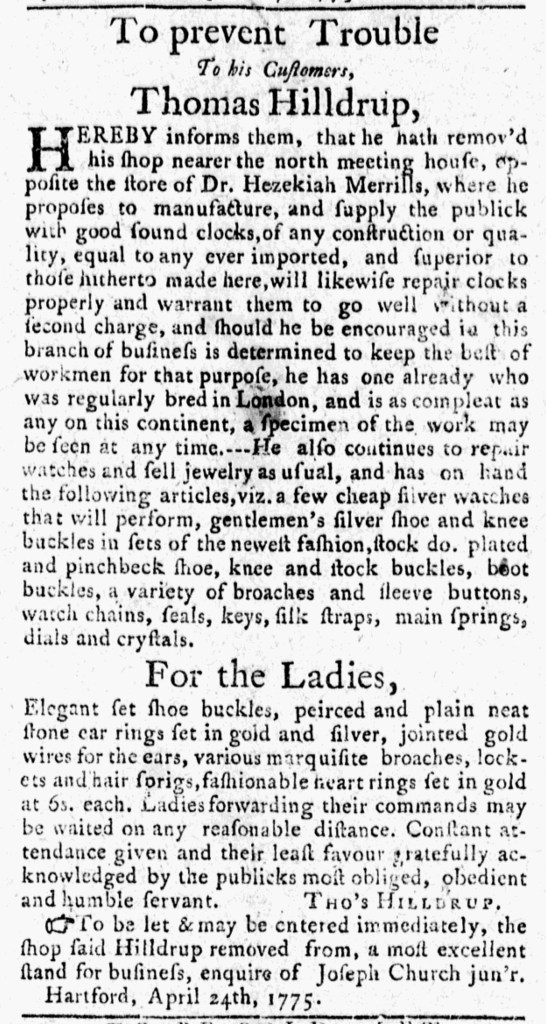
Thomas Hilldrup used a clever turn of phrase as a headline to draw attention to his advertisement in the May 8, 1775, edition of the Connecticut Courant and Hartford Weekly Intelligencer.  “To prevent Trouble,” it proclaimed, inviting readers to look more closely to see what kind of trouble might be afoot.  The headline stood out even more considering that most advertisements in that newspaper did not have headlines.  Among those that did, some used the names of the advertisers as the headlines, such as “PETER VERSTILE” and “CALEB BULL, jun.”  Hilldrup also used his name as a secondary headline on the third line of his advertisement.  A few headlines indicated the goods or services offered in the notices, including “LEATHER BREECHES” and “WILL COVER” (the phrase commonly applied to stud horses).

When they looked more closely, readers saw a second line, “To his Customers,” in a smaller font than the primary and secondary headlines on the first and third lines.  When they continued reading the body of Hilldrup’s advertisement they discovered his important message: “To prevent Trouble To his Customers, Thomas Hilldrup, HEREBY informs them, that he hath remov’d his shop nearer the north meeting house … where he proposes to manufacture, and supply the publick with good sound clocks.”  Hilldrup devised a dramatic means of announcing that he moved to a new location!  He ran the advertisement as a courtesy for those who might go looking for his former shop.  It turned out that it was nothing as dire as threatening to sue customers and associates who did not settle accounts, nor did it have any connection to current events.  Hilldrup first ran the advertisement on April 24, just days after the battles at Lexington and Concord.  He may or may not have been aware of those skirmishes when he composed the advertisement, though he almost certainly realized that the imperial crisis could boil over at any moment.  When his advertisement appeared in subsequent issues of the Connecticut Courant, readers no doubt searched the pages for new information about what was occurring in and near Boston and the responses in other places.  That meant that a notice placed “To prevent Trouble” likely garnered more attention than other advertisements as readers perused the newspaper.
June 11

What was advertised in a colonial American newspaper 250 years ago today?

Maryland Journal (June 11, 1774).

“No money be expected until the test of proof shall confirm their intrinsic value.”

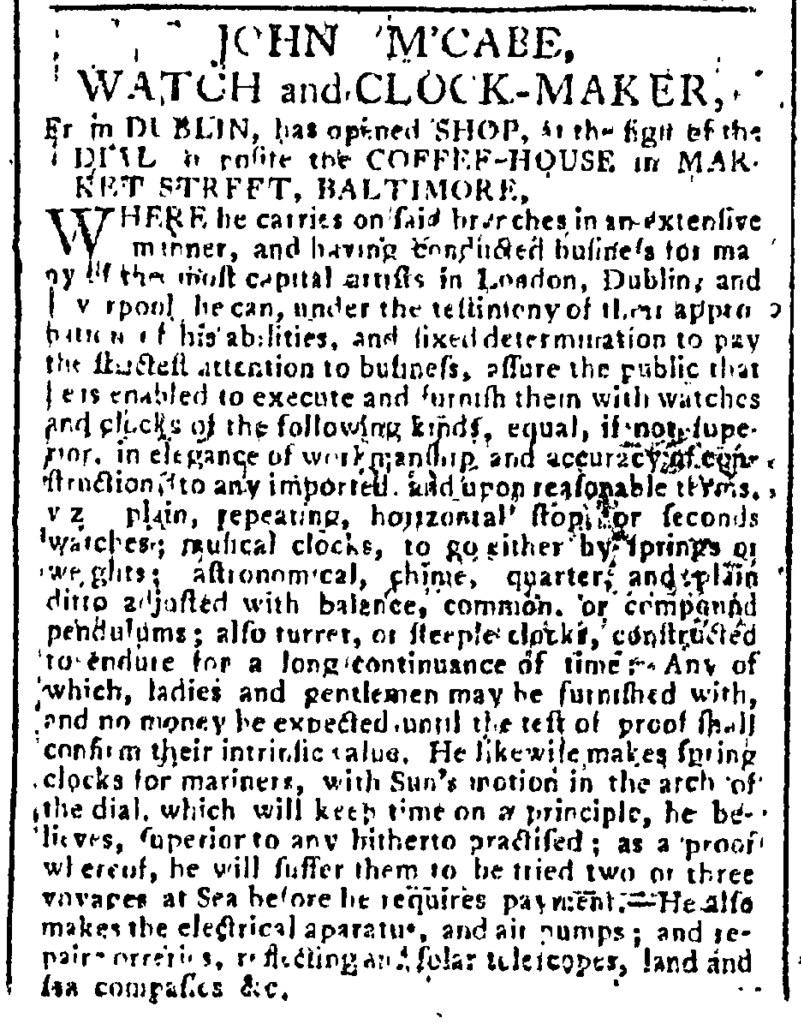
When he set up shop “at the sign of the DIAL” in Baltimore, John McCabe, a “WATCH and CLOCK-MAKER, From DUBLIN,” deployed a marketing strategy commonly undertaken by artisans who migrated across the Atlantic to the colonies.  In an advertisement in the June 11, 1774, edition of the Maryland Journal, he sought to establish his reputation in a town that did not have firsthand knowledge of his skill.  Instead, he relied on an overview of his experience, asserting that he had “conducted business for many of the most capital artists in London, Dublin, and Liverpool.”  Having worked in the most exclusive shops in urban centers, especially the cosmopolitan center of the empire, gave the newcomer a certain cachet, enhanced even more by the “testimony of their approbation of his abilities” that he claimed he could produce.

Yet McCabe did not rest on such laurels that were not immediately apparent to readers.  Instead, he simultaneously declared that his “fixed determination to pay the strictest attention to business.”  Underscoring his industriousness also came from the playbook developed by other artisans, a familiar refrain in their advertisements.  Prospective customers who might have been skeptical of McCabe’s credentials could judge for themselves whether he made clocks and watches “equal, if not superior, in elegance of workmanship and accuracy of construction to any imported.”  They could acquire such timepieces “upon reasonable terms,” getting the same style and quality as watches and clocks from London without paying exorbitant prices.

Even though the initial portions of his advertisement resembled notices placed by other artisans, McCabe, he did include an offer not made nearly as often: allowing a trial period for customers to decide if they wished to purchase or return watches and clocks from his shop.  The enterprising artisan declared that “ladies and gentlemen may be furnished” with any of the variety of clocks and watches listed in his advertisement and “no money be expected until the test of proof shall confirm their intrinsic value.”  McCabe did not explicitly state that customers could return items they found lacking, so confident was he that they would indeed be satisfied with his wares during the trial.  He extended a similar offer for “spring clocks for mariners … which keep time on a principle, he believes, superior to any hitherto practised.”  Customers could make that determination for themselves: “he will suffer them to be tried two or three voyages at Sea before he requires payment.”  Such arrangements would have required some negotiation about the amount of time and the length of those voyages, but allowing for such trials before collecting money from customers did not put McCabe at a disadvantage in the eighteenth-century commercial culture of extending extensive credit to consumers.  Prospective customers likely expected credit, so McCabe gained by transforming the time that would elapse between purchase and payment into a trial, giving those customers the impression that they received an additional benefit from doing business with him.  For some, that may have been the more effective marketing strategy than any claims about his experience working in the best shops in London, Dublin, and Liverpool.

April 29

What was advertised in a colonial American newspaper 250 years ago today?

New-Hampshire Gazette (April 29, 1774).

WATCHES sent … by Post Riders, will be mended, cleaned and sent back with great Care.”

In the spring of 1774, Nathaniel Sheaff Griffith once again advertised that he “Cleaned and Repaired” clocks and watches “in the cheapest and best Manner,” making appeals to both price and skill.  He regularly ran notices in the New-Hampshire Gazette, but this one included an update about an employee who worked in his shop in Portsmouth.  Griffith advised prospective customers that he “has a Workman from London, which Work shall be done with Fidelity and Dispatch.”  In other words, Griffith vouched for his employee.  Other artisans in New England sometimes promoted the work undertaken by their employees.  For instance, Charles Stevens, a goldsmith and silversmith in Providence, informed the public that he “employs an excellent Workman from London” who did “all Kinds of Jewellers Work.”  Similarly, Enos Doolittle advised readers of the Connecticut Courant that he “employed a journeyman who has serv’d a regular Apprenticeship to the Watchmaking business in London.”  Griffith, Stevens, and Doolittle all signaled that they could effectively serve an even more extensive clientele thanks to the workmen from London who labored in their shops.

That may have been a factor in another marketing strategy that Griffith deployed for the first time.  He concluded his advertisement with a note that “WATCHES sent from East, West, North or South by Post Riders, will be mended, cleaned and sent back with great Care.”  While he may have done business that way in the past, he had not previously mentioned this option in his newspaper advertisements.  Perhaps now that he had an assistant Griffith felt more secure in advertising this service widely.  Once again, other artisans in New England also marketed similar arrangements.  Thomas Hilldrup, a watchmaker from London who settled in New London, declared that clients could “forward their Watches to me … by applying to Mr. JOSEPH KNIGHT, Post-Rider.”  He promised the same sort of “Dispatch” or quick service that Griffith did, stating that any watches he received would be “returned regularly the next Week.”  Post riders provided an infrastructure for watchmakers like Griffith and Hilldrup to serve clients who lived at a distance, expanding their business to rural towns rather than working solely for local customers in port cities.

February 25

What was advertised in a colonial American newspaper 250 years ago today?

Norwich Packet (February 24, 1774).

“CLOCKS and WATCHES, if left with Mr. JOHN CHAMPLIN, in New-London, will be carefully forwarded to the said HARLAND, and returned with all Expedition.”

In February 1774, Thomas Harland, “WATCH & CLOCK MAKER, From LONDON,” ran an advertisement in the Norwich Packet “to acquaint the public, that he has opened a Shop … in Norwich.”  In it, he incorporated some of the appeals commonly advanced by artisans who migrated across the Atlantic.  In particular, Harland emphasized the quality of his work, declaring that he “makes, in the neatest manner, and on the most improved principles, horizontal, repeating, and plain watches.”  Like others in his trade, he also “cleans and repairs watches and clocks with the greatest care and dispatch.”  Harland devoted a nota bene to engraving and finishing clock faces and cutting and finishing parts, such as watch wheels and fusees, as “neat as in LONDON and at the same price.”  Harland suggested that he offered the sort of superior workmanship available in the largest and most cosmopolitan city in the empire.

Connecticut Gazette (February 25, 1774).

Residents of Norwich and surrounding towns were not the only prospective customers that Harland sought to attract.  He simultaneously ran the same advertisement, with a few modifications, in the Connecticut Gazette, published in New London.  His notice appeared on the front page of the February 25, 1774, edition, supplemented with a short paragraph that informed readers, “CLOCKS and WATCHES, if left with Mr. JOHN CHAMPLIN, in New-London, will be carefully forwarded to the said HARLAND, and returned with all Expedition.”  In his own advertisement on the fourth page of that issue, Champlin, a “GOLDSMITH and JEWELLER,” promoted the work he undertook in his shop and “likewise informs his Customers and others that they may have Clocks and Watches repaired at his Shop as usual.”  Harland’s advertisement suggests that those repairs did not take place in Champlin’s shop, that he instead sent them to Norwich.  Champlin had a history of partnering with associates to provide ancillary services to attract customers to his shop.  The previous fall, Champlin and Daniel Jennings jointly advertised in the New-London Gazette.  In April 1772, Champlin placed a notice in which he stated that he “employed a Person well acquainted” with “Clock and Watch making, mending, cleaning and repairing.”  In December 1769, James Watson advertised that he moved from one silversmith’s shop to Champlin’s shop “where he makes, mends and repairs all kinds of clocks and watches.”  Harland and Champlin mutually benefited from their partnership.  Harland, a newcomer, had an established artisan generating business for him, while Champlin continued providing the same array of services to current and prospective customers.

Champlin may have also played a role in Harland’s marketing efforts.  The watch- and clockmaker in Norwich may have sent his advertising copy to Champlin as part of their regular correspondence rather than directly to the printing office in New London.  An advertisement that had a rather plain appearance in the Norwich Packet featured a variety of embellishments in the Connecticut Gazette.  That version had greater variation in fonts as well as a decorative border.  Champlin’s advertisement also had a decorative border, while most paid notices in the Connecticut Gazette did not.  The compositor could have been responsible for sprucing up Harland’s advertisement, but the connection between Champlin and Harland suggests that the changes may have resulted from specific instructions from one of the advertisers.

July 3

What was advertised in a colonial American newspaper 250 years ago today?

Providence Gazette (July 3, 1773).

“Watch and Clockmaker, from Paris, but late from New-Orleans.”

Advertisements in colonial newspapers testified to the migration of artisans from place to place in the Atlantic World in the eighteenth century.  As they sought to earn their livelihoods in new locations, some artisans introduced themselves to prospective customers with newspaper notices.  These newcomers had not yet established their reputations in the cities and towns where they settled, so they used advertising as a means of assuring consumers of the quality of their work if given a chance.  As part of those efforts, they listed their origins in hopes that prospective customers would associate some sort of cachet with London, Paris, and other European cities.  Some even continued to make reference to their origins long after they set up shop in the colonies.

Consider two advertisements that appeared in the July 3, 1773, edition of the Providence Gazette.  In the first, Lambert Lescoiet pledged that he made and repaired watches and clocks “in the best Manner, and doubts not of giving entire Satisfaction to such as may please to employ him.”  Having recently arrived in Providence, he had not yet established a reputation or cultivated a clientele.  In the absence of the community’s familiarity with him and his work, he hoped that introducing himself as a “Watch and Clockmaker, from Paris, but late from New-Orleans,” would suggest to readers that he did indeed possess the skills to “giv[e] entire Satisfaction” to his customers.  He also attempted to excite some curiosity and even bragging rights among colonizers who availed themselves of the services of the clockmaker “from Paris, but late from New-Orleans.”

In the other advertisement, John Sebring continued promoting himself as a “Saddler, Chaise and Harness-Maker, from London” who made saddles and accessories “in the newest Fashion, and in the neatest Manner.”  He likely hoped that prominently displaying his origins suggested that he maintained connections to London and possessed special insight into the latest fashions in the most cosmopolitan city in the empire, even though he had been working in Providence for eight months.  In that time, his previous advertisement in which he declared that he “has had the Advantage of several Years Experience in some of the principal Shops in London” may have helped in attracting clients.  In his latest advertisement, he expressed “his Thanks to all those who have obliged him with their Custom, and hopes for a Continuance of their Favours.”  In so doing, he signaled to prospective clients that their peers already trusted him to supply their saddles and accessories.

Like many other artisans who advertised in colonial newspapers, both Lescoiet and Sebring hoped that invoking their origins from metropolitan places, like Paris and London, would serve as recommendations to prospective customers.  As newcomers who had not yet established their reputations in Providence, they made reference to their origins as one means of inciting interest among local consumers.

March 2

What was advertised in a colonial American newspaper 250 years ago today?

South-Carolina Gazette and Country Journal (March 2, 1773).

“She carries on the MILLINARY BUSINESS in all its branches, and will be much obliged to her FRIENDS for a continuance of their favours.”

The Bowers continued their advertising efforts in the South-Carolina Gazette and Country Journal in March 1773. William gave directions to the new location for his shop and advised readers that he “continues to carry on the CLOCK and WATCH-MAKING BUSINESS in all its branches.”  Katharine, a milliner and shopkeeper, promoted the “very neat ASSORTMENT of MILLINARY GOODS” she recently imported and sold at the same location that William made and repaired clocks and watches.

The two previously placed a joint advertisement with the primary purpose of informing current customers and the general public of their new location.  William’s portion of the original notice was a little longer than Katharine’s portion, mostly as a result of providing more extensive directions to the new shop at “the fourth corner of Tradd-street and the Bay, lately possessed by Messrs. Mackenzie & Tunno, and next door to The Great Stationary and Book Store.”  In terms of describing the goods and services they provided, William and Katharine occupied similar amounts of space in that earlier notice.

Such was not the case with the new notice.  William’s portion of the advertisement repeated, the type still set from the previous iteration, but Katharine submitted entirely new copy that required twice as much space as William’s portion.  That made her business the focal point of the shared advertisement, especially since her headline for “MILLINARY GOODS,” in a larger font than anything else in the notice (including their names), appeared in the center of the advertisement.  In addition, Katharine adopted a strategy deployed by many merchants and shopkeepers.  She listed a “Neat assortment of fashionable CAPS, … a great variety of sash and other RIBBONS, fashionable FANS, women and girls white and coloured GLOVES,” and various other items.  In a nota bene, Katharine declared that she “carries on the MILLINARY BUSINESS in all its branches, and will be much obliged to her FRIENDS for a continuance of their favours.”  In other words, she hoped the clientele she cultivated would follow her to her new location.

Although William and his endeavors had a privileged place at the beginning of the shared advertisement, the length and format of their respective sections made Katharine’s business more prominent in this variation.  That may have been an indication that she contributed as much to the household income through her entrepreneurial activities as he did. William’s name appeared first, but not in a way that overshadowed Mary’s business.

January 19

What was advertised in a colonial American newspaper 250 years ago today?

South-Carolina Gazette and Country Journal (January 19, 1773).

“WILLIAM BOWER … continues to carry on the CLOCK and WATCH-MAKING BUSINESS.”

“KATHARINE BOWER … carries on the MILLINARY BUSINESS.”

When clock- and watch-maker William Bower moved to a new location, he placed an advertisement in the January 19, 1773, edition of the South-Carolina Gazette and Country Journal to inform current and prospective customers.  Now located “next door to The Great Stationary and Book Store,” he continued to offer the same services “as cheap and expeditiously done, as by any [other clock- and watchmaker] in the province.”  Katharine Bower, a milliner, also advised the public that she moved to a new location “where she carries on the MILLINARY BUSINESS in all its branches, and will be much obliged to her friends for a continuance of their favours.”  William and Katharine, presumably husband and wife, but possibly otherwise related, now ran businesses from the same location at “the store the fourth corner of Tradd-street and the Bay, lately possessed by Messrs. Mackenzie & Tunno.”  Previously, William had a workshop on Broad Street, while Katharine kept shop on Church Street.

In addition to sharing a store at the corner of Tradd Street and the Bay, William and Katharine also advertised together, purchasing a “square” of space in one of the local newspapers.  Husbands and wives (and other male and female relatives) who pursued separate occupations sometimes did so, especially in newspapers published in Charleston.  Those advertisements tended to adhere to certain patterns.  The husband or other male relative usually appeared first, followed by his wife or other female relative.  In some instances, the female entrepreneur appeared only in a brief note at the end of the advertisement.  In this case, however, both William and Katharine had headlines in larger fonts that made their names visible to readers.  William had a secondary headline that gave his occupation, “CLOCK and WATCH MAKER,” while Katharine did not.  Even when female entrepreneurs were not relegated to a short note, the amount of space devoted to promoting the husband’s business usually exceeded that amount of space for the wife’s business.  At a glance, that looked like the case in the Bowers’ advertisement.  However, much of the additional space in William’s portion of the notice gave extensive directions to the new shop, directions that Katharine did not need to repeat.  Katharine did not make as elaborate appeals about price and customer service as William, but she did encourage existing customers to visit her at her new location.

The Bowers pooled their resources to insert an advertisement in the South-Carolina Gazette and Country Journal.  Their notice gave preference to William by listing his business first and including a secondary headline that listed his occupation, but this did not overshadow Katharine’s enterprise as much as some other advertisements placed jointly by men and women.  Katharine’s name appeared as a headline in the same size font as William’s name and, aside from the directions to the new location, the details about her business occupied a similar amount of space.  In general, the notice communicated that both William and Katharine were competent entrepreneurs responsible for their own participation in the marketplace.

June 6

What was advertised in a colonial American newspaper 250 years ago today?

Providence Gazette (June 6, 1772).

“HE doubts not of giving Satisfaction to such persons as may please him with their Custom.”

Among the various marketing appeals in their newspaper advertisements, merchants and shopkeepers often vowed to provide exemplary customer service.  Several who placed notices in the June 6, 1772, edition of the Providence Gazettedid so.  Edward Thurber, for instance, declared that “Whoever pleases to favour him with their Custom may depend upon the utmost Fidelity, and on having their Business executed with Dispatch.”  An extensive catalog of the “fine Assortment of Grocery, Hard-Ware, and Piece GOODS” for sale at his store “at the Sign of the BRAZEN LION” in the “North End of Providence” comprised most of his advertisement, but he did not intend for that testimonial to consumer choice to eclipse his commitment to customer service.  Gabriel Allen and William Allen also stocked a “compleat Assortment of English, India, and Hard-Ware GOODS” at their shop “on the West Side of the GREAT BRIDGE.”  They enhanced their allusion to so many choices with a promise that “Ladies and Gentlemen that are pleased to favour them with their Custom, may depend on the best Treatment.”

Artisans and others who provided services also incorporated customer service into their marketing efforts.  Benjamin Bagnall, Jr., informed the public that he “Carefully CLEANED and MENDED” clocks and watches at his shop, confidently stating that he “doubts not of giving Satisfaction to such Persons as may please to favour him with their Custom.”  In this case, “giving Satisfaction” had more than one meaning.  It implied that Bagnall extended good customer service to his clients, but it also signaled quality and skill, two appeals that artisans often included in their advertisements.  In addition, convenience was an element of the customer service that Bagnall provided.  He claimed that “Watches have been frequently sent to adjacent Places to repair,” presumably because colonizers believed that artisans in Providence did not possess the same skills as their counterparts in Boston and New York.  Such inconvenience was not necessary, Bagnall contended, since he “will endeavour to convince his Employers that there is no Occasion to send [watches] out of the Town.”  In making that pledge, Bagnall brought together customer service, skill, and quality in a single appeal to prospective customers.

May 4

GUEST CURATOR: Tyler Reid

What was advertised in a colonial American newspaper 250 years ago today?

Supplement to the New-York Gazette and Weekly Mercury (May 4, 1772).

“Be cautious, there are many … counterfeit watches … so bad they cannot be rendered useful.”

John Simnet, a clock- and watchmaker, created this advertisement.  It displays a competitive market in 1772. Simnet emphasizes his “Term of Apprenticeship to Mr. Webster, Exchange Alley, London.”  He thought that his qualifications mattered.  He also mentioned his expertise in cleaning watches and fitting glasses. These skills mattered.  In an article about clocks and clockmakers in eighteenth-century Philadelphia, Michelle Smiley states that clockmaking “was considered an intellectual profession requiring great artisanal skill and scientific knowledge.”  In addition, “the mathematical precision and mechanical intricacy of the profession put it at a superior rank to the crafts of blacksmithing and carpentry.”  In his advertisement, Simnet had a big ego about his skill and knowledge, especially being trained in England and voyaging to the colonies.  He also complained about “counterfeit Watches … so bad they cannot be rendered useful.”  He believed that colonists should be careful when buying watches from others because they might end up receiving broken merchandise.  He wanted customers to think of him as reliable, as someone who sold only good watches that worked well.  According to his advertisements, they could trust him because of his training in England.

**********

ADDITIONAL COMMENTARY:  Carl Robert Keyes

When students in my classes submit their proposed advertisements for approval before moving to the research and writing phases of contributing the Adverts 250 Project, I often recognize the advertisers because I have already perused the newspapers to identify which notices belong in the Slavery Adverts 250 Project.  I did not simply recognize the advertiser that Tyler selected for his entry.  Instead, John Simnet has become very familiar to me over the past three years as I have traced his advertisements in the New-Hampshire Gazette in 1769 and 1770 and then in newspapers published in New York in the early 1770s.  I consider Simnet the most notorious of the advertisers featured on the Adverts 250 Project because he regularly disseminated negative advertisements that demeaned his competitors as much as they promoted his own skill, expertise, training, and experience.  In both Portsmouth and New York, he participated in bitter feuds with competitors in the public prints, sometimes demeaning character as well as their abilities.

Tyler was not yet familiar with Simnet when he selected this advertisement, one of several variations that Simnet published in the New-York Gazette and Weekly Mercury and the New-York Journal in the spring of 1772.  He chose it because the headline for “WATCHES” caught his interest.  He wanted to learn more about clock- and watchmakers in early America.  This presented an opportunity for me to once again dovetail my teaching and my research, a pedagogical moment that could not be planned in advance when inviting students to select any advertisements they wished to feature.  They usually focus on a single advertisement, an appropriate approach for students working this intensively with primary sources for the first time.  They make all sorts of connections between their advertisements and commerce, politics, and daily life in eighteenth-century America.  Yet we have fewer opportunities to examine the advertisers and their marketing campaigns.  When Tyler chose Simnet’s advertisement from among the hundreds that he might have selected from the first week of May 1772, that gave all the students in my Revolutionary America class a chance to hear more about the clock- and watchmaker’s long history of placing cantankerous advertisements that deviated from the norms of the period.  This context better humanized Simnet, even if it did not make him particularly likeable.  Each advertisement represents a snapshot of a particular moment in the past, but I also underscored the value of examining multiple advertisements, placed over weeks or even years, as a means of constructing an even more robust understanding of the experiences of the advertisers and their world.

May 1

What was advertised in a colonial American newspaper 250 years ago today?

New-Hampshire Gazette (May 1, 1772).

“Clocks & Watches Clean’d in the Cheapest and best Manner.”

Nathaniel Sheaff Griffith made brief appeals to price and quality in an advertisement that ran in the May 1, 1772, edition of the New-Hampshire Gazette.  He succinctly informed prospective customers that he “Clean’d” clocks and watches “in the Cheapest and best Manner” at his shop in Portsmouth.  In addition, he sold “Silver plated Shoe and Knee-Buckles” and other goods.

While this advertisement may not seem noteworthy when considered alone or alongside other notices that ran in the same issue, regular readers of the New-Hampshire Gazette likely remembered other advertisements placed by Griffith or that mentioned Griffith.  For a period of eighteen months, Griffith participated in a feud with another clock- and watch-maker, John Simnet, an exceptionally public disagreement undertaken in advertisements in the colony’s only newspaper.  Simnet had relocated to New Hampshire after several decades working in London.  Like many artisans who crossed the Atlantic, he attempted to leverage his training and experience in the cosmopolitan center of the empire to woo customers unfamiliar with his work.  His competitors, including Griffith, benefited from having established a reputation among local consumers.  Simnet adopted more aggressive tactics than most artisans, not only promoting his own credentials but also proclaiming that his rivals did inferior work that actually damaged the clocks and watches they pretended to repair.  He singled out Griffith in particular, eventually denigrating his character and intellect as well as his skill.  For his part, Griffith accused the newly-arrived Simnet of being an itinerant likely to abscond with the watches that colonizers entrusted to him.  In general, however, Griffith was much less abusive toward Simnet than Simnet was toward him, at least in the public prints.

After a year and a half in Portsmouth, Simnet relocated once again, this time to New York.  He placed fairly neutral advertisements in the newspapers published in the bustling port, at least at first, but eventually found himself embroiled in another argument with a competitor.  His advertisements became increasingly colorful as he devised new ways to denigrate clock- and watchmaker James Yeoman.

Back in Portsmouth and its environs, many readers of the New-Hampshire Gazette likely remembered the altercation between Griffith and Simnet when they encountered new advertisements from Simnet, no matter how brief or neutral.  Did those memories influence whether they hired Griffith?  Did they think about some of the insults that Griffith leveled at Simnet?  Did they put any stock in Simnet’s accusations against Griffith or dismiss the cantankerous rantings of the interloper?  Did they credit Griffith for the restraint he showed when he eventually decided that the best response to Simnet was to ignore him?  Did they recall being entertained by the vitriolic exchanges, even if they had no need to hire artisans to clean or repair their clocks and watches?  Griffith’s brief announcement published in the spring of 1772 was just one notice among a series of advertisements that likely shaped public perceptions of his business.