
What was advertised in a revolutionary American newspaper 250 years ago this week?
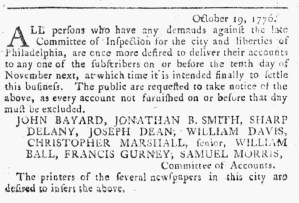
“The printers of the several newspapers in this city are desired to insert the above.”
On October 19, 1776, the Pennsylvania Evening Post carried an advertisement from the Committee of Accounts associated with the “late Committee of Inspection for the city and liberties of Philadelphia” that had been organized according to the Continental Association, the nonimportation agreement devised by the First Continental Congress in the fall of 1774. The Committee of Accounts requested that “ALL persons who have any demands … deliver their accounts to any one of [its members] on or before the tenth day of November.” This was the last call for any outstanding accounts since the committee “intended finally to settle this business.” The advertisement warned the public “to take notice … as every account not furnished on or before that day must be excluded.”
Hoping to get the word out as widely was possible, the committee included a request to the “printers of the several newspapers in this city … to insert” the advertisement. Those printers, however, did not immediately comply with that request. The Pennsylvania Ledger, also published on October 19, did not carry the notice. If the committee had delivered copy only to the Pennsylvania Evening Post and simply expected other printers to see the advertisement in that newspaper and then reprint it then the Pennsylvania Ledger would not have had an opportunity to run the advertisement on the same day. It could have appeared, however, in Dunlap’s Pennsylvania Packet on October 22, but it did not. The printer did include a note that “Advertisements omitted this week for want of room shall be inserted in our next.” The next day, neither the Pennsylvania Gazette nor the Pennsylvania Journal carried the advertisement. In addition, the Pennsylvania Evening Post did not run the advertisement a second time in its October 22 and October 24 editions. So far, the “printers of the several newspapers in this city” did not take heed of the request to publish the committee’s notice.
In the end, none of those printers opted to insert the advertisement. The committee had allowed for three weeks between its initial appearance and the November 10 deadline for submitting accounts. In that time, the notice did appear in the Pennsylvania Evening Post two more times, once on October 29 and again on November 7. That it ran three times suggests that the committee may have paid the standard rate for an advertisement, a fee that included setting the type and three insertions. They may have hoped that other printers would publish the notice gratis as a public service, but they ended up disappointed if that was the case. It does not appear that the committee delivered copy to each printing office but instead depended on local printers monitoring the content in other newspapers. It was possible, but unlikely, that no other printer in Philadelphia happened to see the advertisement and the request to print it. Instead, those printers seemingly made other choices about what to publish with limited space and a shortage of paper.