December 7

What was advertised in a revolutionary American newspaper 250 years ago today?
Maryland Gazette (December 7, 1775).

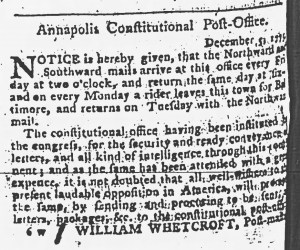
“Annapolis Constitutional Post-Office.”

In early December 1775, William Whetcroft became the latest postmaster to run a newspaper advertisement promoting a local branch of the Constitutional Post Office established by the Second Continental Congress.  In October, Mary Katharine Goddard placed a notice about the Baltimore office in the Maryland Journal.  Otherwise, advertisements for local branches appeared in newspapers published in New England, New York, and Pennsylvania, but not yet in newspapers from colonies south of Maryland.  The headline for this newest advertisement proclaimed, “Annapolis Constitutional Post-Office,” alerting readers of the Maryland Gazette that they had an alternative to the British imperial system.  Whetcroft commenced with an overview of his office’s schedule: “the Northward and Southward mail arrive at this office every Friday at two o’clock, and return the same day at six.”  In addition, “on Monday a rider leaves this town for Baltimore, and returns on Tuesday with the Northward mail.”

Yet Whetcroft used his advertisement to relay more than just the logistical details.  He gave an overview of the purpose that the Constitutional Post Office served as the imperial crisis intensified, hostilities commenced, and some colonizers considered whether they should declare independence rather than continue seeking redress of their grievances against Parliament.  “The constitutional office having been instituted by the congress,” the postmaster explained, “for the security and ready conveyance of letters, and all kinds of intelligence through this continent; and as the same has been attended with a great expence, it is not doubted that all well-wishers to the present laudable opposition in America, will promote the same, by sending and procuring to be sent all letters, packages, &c. to the constitutional post-office.”  Supporters of the American cause had a civic duty, Whetcroft asserted, to make use of this service.

Frederick Green, the printer of the Maryland Gazette, gave Whetcroft’s notice a privileged place the first time it appeared in that newspaper.  It appeared as the second advertisement following the news, preceded only by Green’s own advertisement for the almanac he just published and sold at the printing office.  As much as Green may have been a supporter of the Constitutional Post Office, he still had to earn his livelihood with his own endeavors!  Still, the printer had room for only two advertisements at the bottom of the final column on the second page.  He could have chosen from among several of a similar length to Whetcroft’s advertisement, yet he selected the notice about the Constitutional Post Office to appear alongside news of the revolutionary events taking place in Maryland and beyond.  In subsequent editions, that advertisement ran intermingled among others, but that was common practice for notices that printers initially gave privileged places the first time they ran in their newspapers.

November 29

What was advertised in a revolutionary American newspaper 250 years ago today?

Pennsylvania Gazette (November 29, 1775).

“We, the subscribers, do recommend the above named John Spering as a Rider.”

In the fall of 1775, John Spering, a resident of Easton, took to the pages of the Pennsylvania Gazette to announce that he “proposes to ride POST” between Philadelphia and Northampton.  Along the way he would make stops in “Germantown, Bussel-town [now Bustleton], Four-lane-end [now Langhorne], Newtown, Durham, Easton, Bethlehem, and Northampton.”  Until January 1, he would depart Philadelphia each Wednesday evening.  In January, February, and March, he planned to scale back service to “once every fortnight,” presumably due to the weather, and then resume weekly service on April 1.  He assured “All Gentlemen and ladies who are pleased to encourage this undertaking” that they “may depend upon being punctually served, and that the greatest care will be taken of such letters, or other things,” such as small parcels, entrusted to him.  Given that the Pennsylvania Gazette circulated widely beyond Philadelphia, Spering hoped that his advertisement would attract patrons in the many towns along his route.

He also realized that most prospective customers did not know him and thus might be cautious about handing over letters and packages.  To address such concerns, he included a character reference signed by nine residents of Easton.  “We, the subscribers,” they declared, “do recommend the above named John Spering as a Rider, as we believe he will perform his duty therein faithfully and honestly.”  They noted that Spering had been “a resident in Easton for upwards of thirteen years, where he has, during that time, behaved himself very well.”  Prospective clients could have confidence that he would faithfully deliver their letters without tampering with them.  The signatories would have been as unknown to most readers as Spering, but the titles that accompanied some of their names testified to their trustworthiness and standing in their community: “Lewis Gordon, Esq; Henry Fullert, Esq; Dr. Andrew Ledlie, [and] Jacob Orndt, Esq.”  That so many of his neighbors endorsed Spering at the risk of their own reputations may have helped to convince the “Gentlemen and Ladies” that Spering addressed to avail themselves of his services when they had letters to post.

November 17

What was advertised in a revolutionary American newspaper 250 years ago today?

Thomas’s Massachusetts Spy (November 17, 1775).

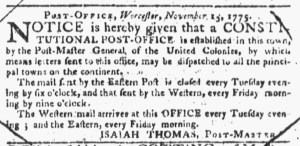
“A CONSTITUTIONAL POST-OFFICE is established in this town.”

Isaiah Thomas, the printer of Thomas’s Massachusetts Spy, gained a new title in the fall of 1775.  He became the postmaster for the “CONSTITUTIONAL POST-OFFICE” in Worcester.  In an advertisement in the November 17 edition of his newspaper, he informed the public that “the Post-Mater General of the United Colonies” established the post office in Worcester.  That meant that “letters sent to this office, may be dispatched to all the principal towns on the continent” via a network of post offices and riders authorized by the Second Continental Congress as an alternative to the imperial postal system.  Thomas provided a schedule.  Outgoing mail “sent by the Eastern Post is closed every Tuesday evening by six o’clock.”  For outgoing mail, the post office dispatched letter received “Friday morning by nine o’clock.”  That corresponded with the arrival of new mail: “The Western mail arrives at this OFFICE every Tuesday evening; and the Eastern, every Friday morning.”  Patrons who planned accordingly could use the new postal system to correspond with friends, relatives, and associates throughout the colonies.

Thomas gave this advertisement a prominent place when he published it, placing it immediately below a notice that the Second Continental Congress created a committee to compile a “just and well authenticated account of the hostilities committed by the ministerial troops and navy in America since March last,” including “proper evidence of the truth of the facts related.”  In documenting buildings destroyed, vessels seized, and stock taken, they justified their resistance and engaged in public relations to demonstrate that colonizers had legitimate grievances.  Thomas could have placed any number of other advertisements below that notice, yet he opted for one that promoted another effort undertaken by the Second Continental Congress to protect American liberties.  It was a fitting editorial decision for a newspaper with American Oracle of Liberty as its secondary title.  In this instance, Thomas deployed an advertisement as a continuation of news about current events, keeping readers updated not only about what occurred but also about how they could support the American cause.

October 29

What was advertised in a revolutionary American newspaper 250 years ago this week?

Rivington’s New-York Gazetteer (October 26, 1775).

“A CONSTITUTIONAL POST-OFFICE is established in this city.”

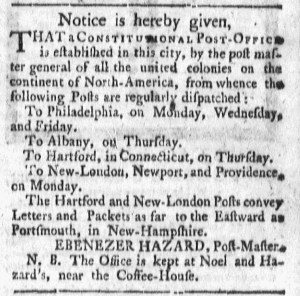
Yet another advertisement for a “CONSTITUTIONAL POST-OFFICE,” an alternative to the British postal system, appeared in the public prints at the end of October 1775.  It ran in Rivington’s New-York Gazetteer, despite the reputation of that newspaper and its printer, James Rivington, for expressing Loyalist sentiments.  William Goddard originally envisioned the Constitutional Post and set about establishing local offices before the battles at Lexington and Concord, but after hostilities commenced the Second Continental Congress assumed responsibility for maintaining and expanding its services.  That included appointing Benjamin Franklin as the postmaster general, much to the chagrin of Goddard.  Ebenezer Hazard, a bookseller, became the postmaster in New York, though John Holt, the printer of the New-York Journal, lobbied for the position.  According to the nota bene in the advertisement, “The Office is kept at Noel and Hazard’s, near the Coffee-House,” the same location where the new postmaster and his partner, Garrat Noel, stocked the “JOURNAL OF THE PROCEEDINGS” of the First Continental Congress.

The notice in Rivington’s New-York Gazetteer, signed by Hazard as the “Post-master,” informed the public that a “CONSTITUTIONAL POST-OFFICE” is established in this city, by the post master general of all the united colonies on the continent of North-America.”  Hazard offered the most complete schedule of any that yet appeared in newspaper advertisements, stating that the “Posts are regularly dispatched” to Philadelphia on Mondays, Wednesdays, and Fridays, to Albany on Thursdays, to Hartford on Thursdays, and to New London, Newport, and Providence on Mondays.  The routes to both Hartford and New London extended “as far to the Eastward” as Portsmouth, New Hampshire.  Unlike some other postmasters, Hazard did not mention that service continued as far south as Georgia.  He focused primarily on the network that connected New York to New England and Pennsylvania.  As new advertisements for the Constitutional Post appeared in newspapers in multiple towns and cities, the public became more aware of an enterprise that competed with the imperial postal system to carry “Letters and Packets,” delivering news and information without interference from British authorities.

August 30

What was advertised in a revolutionary American newspaper 250 years ago today?

Pennsylvania Journal (August 30, 1775).

“The first Publication of all New Pamphlets may be had of the Rider.”

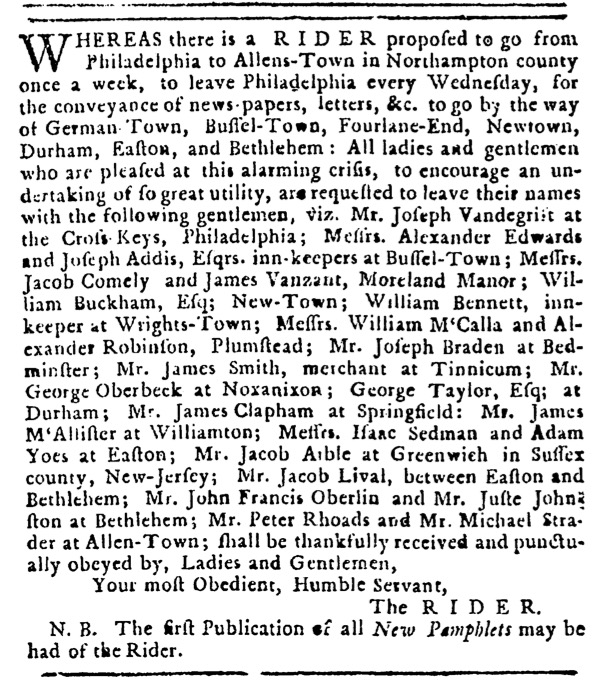
An anonymous post rider advertised his services in the August 30, 1775, edition of the Pennsylvania Journal, stating that the “Proposed to go from Philadelphia to Allens-Town in Northampton county once a week.”  He intended to depart from Philadelphia each Wednesday, the same day that a new issue of the Pennsylvania Journal, a weekly publication, hit the streets.  Subscribers to that newspaper along his route would benefit from the quickest possible access to the news in the latest edition.  Although “The RIDER” did not give details about collecting fees, he likely envisioned providing his services via subscription, similar to the plan that Thomas Sculley outlined in an advertisement for his route between Philadelphia and Lewes, Delaware, in the Pennsylvania Ledger a month earlier.  Both post riders contributed to an expanding communication infrastructure.  The same issue of the Pennsylvania Journal that carried the anonymous rider’s advertisement also featured a notice that gave the days the new Constitutional Post departed Philadelphia to carry letters to “New-York, Connecticut, Rhode-Island, Massachusetts-Bay, [and] New-Hampshire.”

The rider framed carrying “news-papers, letters, &c.” as a public service at an important moment, instructing “ladies and gentlemen who are pleased at this alarming crisis, to encourage an undertaking of so great utility … to leave their names with the following gentlemen.”  He then listed twenty-three associates in sixteen towns, demonstrating that he had already devoted significant effort to establishing a network for transmitting information.  The outbreak of hostilities in Massachusetts, the “alarming crisis,” made it more important than ever that colonizers residing in smaller towns gained regular access to newspapers and correspondence.  Some were so eager to read the latest news that they may have been stealing copies of Dunlap’s Maryland Gazette.  The rider aimed to keep colonizers along his route well informed.  “The first Publication of all New Pamphlets,” he stated in a nota bene, “may be had of the Rider.”  The “&c.” (or etc.) in “news-papers, letters, &c.” included the political pamphlets and sermons about current events so often advertised in the Pennsylvania Journal and other newspapers printed in Philadelphia.  Post riders in New England had sometimes acted as local agents for disseminating political pamphlets earlier during the imperial crisis.  The anonymous rider joined their ranks, delivering “news-papers, letters, &c.” with a purpose beyond merely earning his own livelihood.

August 29

What was advertised in a revolutionary American newspaper 250 years ago today?

Dunlap’s Maryland Gazette (August 29, 1775).

“The Papers taken out by evil minded persons, who had no manner of right to them.”

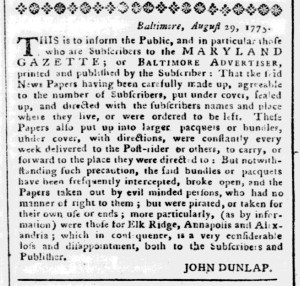
Something went wrong.  John Dunlap, the printer of Dunlap’s Maryland Gazette, had a system for delivering his newspaper to subscribers who lived outside of Baltimore, but “evil minded persons” interfered with it.  In particular, disruptions occurred in Annapolis and Elk Ridge, both in Maryland, and Alexandria, Virginia.  That prompted Dunlap to run a notice in the August 29, 1775, edition, placing it immediately after local news and first among the advertisements to increase the likelihood that readers would see it.

The exasperated printer went into great detail about his delivery infrastructure, hoping to convince “the Public, and in particular those who are Subscribers” that he made every effort to follow through on his obligation to deliver the newspaper.  The correct number of copies had been “carefully made up, agreeable to the number of Subscribers, put under covers, sealed up, and directed with the subscribers names and place where they live, or were ordered to be left.”  Then, those newspapers were “also put up into larger pacquets or bundles, under cover, with directions” and “constantly every week delivered to the Post-rider or other, to carry, or forward to the place they were directed to.”  Despite such careful attention and “notwithstanding such precaution, the said bundles or pacquets have been frequently intercepted, broke open, and the Papers taken out by evil minded persons, who had no manner of right to them.”  Dunlap called this “a very considerable loss and disappointment, both to the Subscribers and Publisher.”  Advertisers may have also been frustrated upon learning that the notices they paid to insert in Dunlap’s Maryland Gazette did not circulate as widely as they expected.  The printer likely realized that could have an impact on revenue as well.

Dunlap declared that the missing newspapers “were pirated, or taken for their own use or ends” by the thieves.  Despite the consequences for subscribers, advertisers, and the printer, the motivation for taking the newspapers may not have been completely nefarious.  In the wake of recent events – the battles at Lexington and Concord, the Battle of Bunker Hill, the Second Continental Congress meeting in Philadelphia, colonial assemblies holding their own meetings, George Washington assuming command of the Continental Army as it besieged Boston – colonizers were eager for news.  Some may have resorted to unsavory means of getting the latest updates, taking newspapers that did not belong to them.  That did not justify what they did, but it does testify to the role of the early American press in disseminating information about the imperial crisis and the Revolutionary War.  Some colonizers became better informed because of the theft, while subscribers to Dunlap’s Maryland Gazette had to seek out other newspapers or rely on conversations and correspondence to learn the latest updates.

July 29

What was advertised in a revolutionary American newspaper 250 years ago today?

Pennsylvania Ledger (July 29, 1775).

“All Letters Post free, and small bundles not exceeding eight ounces, carried gratis for any Subscriber.”

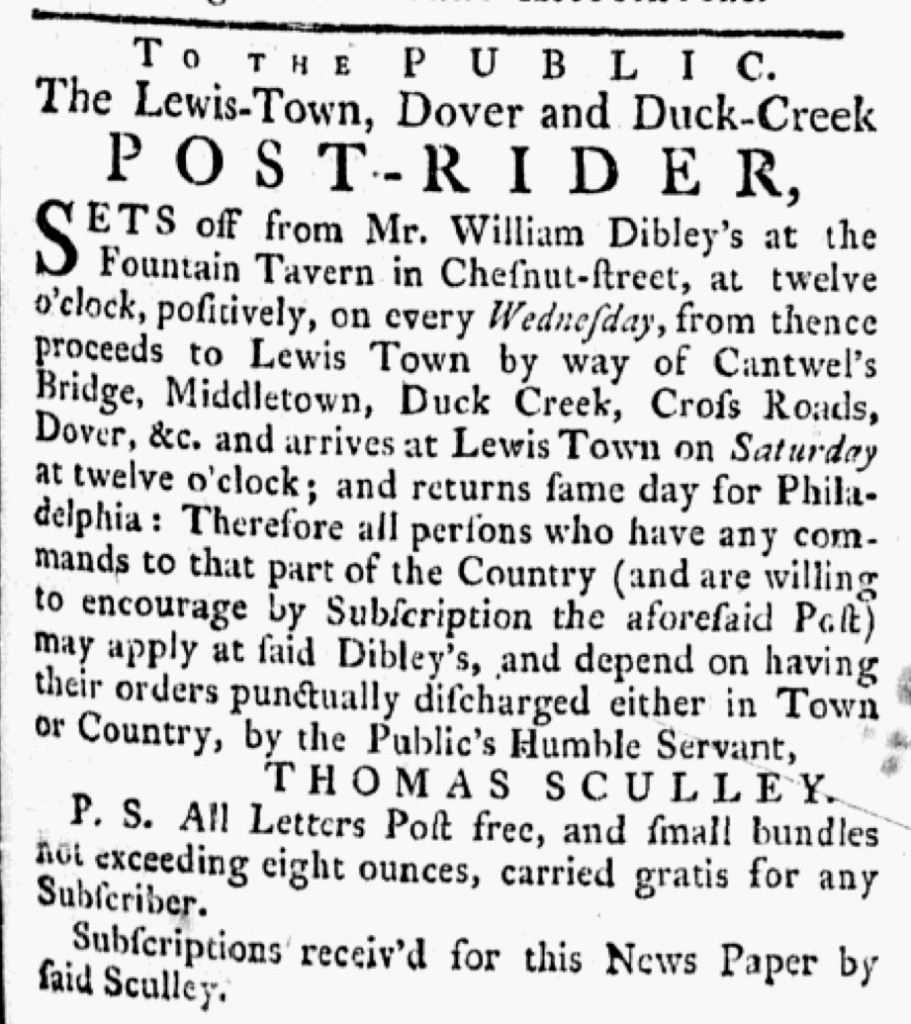
As the Revolutionary War commenced, Thomas Sculley, a post rider, followed a route that connected several towns in Delaware to Philadelphia.  At noon on every Wednesday, he departed from William Dibley’s Fountain Tavern on Chestnut Street and made for Lewis Town (now Lewes).  He stopped at Middletown, Dover, and other towns along the way, delivering letters, newspapers, and packages.  That took three days.  Sculley arrived at Lewis Town by noon on Saturday and started the return trip later the same day.  Presumably he made it to Philadelphia on Tuesday, giving customers an opportunity to consult with him at the Fountain Tavern.

Sculley placed an advertisement for his services in the July 29, 1775, edition of the Pennsylvania Ledger.  Like some other post riders, he did not charge solely by the letter, package, or newspaper subscription but instead marketed a subscription service.  Subscribers paid a set fee on a regular basis whether they made use of the service or not.  In return, they could post as many letters as they wished as well as send “small bundles not exceeding eight ounces.”  Anything else incurred additional charges.  Even if customers did not use Sculley’s service every time he rode between Philadelphia and Lewes, the subscription fee could have been a bargain compared to paying for each letter or package each time.  In addition, Sculley intended for subscriptions, if paid on time, to yield steady income that made serving his route possible. Prospective customers who wanted to make sure that a post rider was available when they desired needed to support the enterprise with their subscriptions, not just when they had letters and packages to send.

Sculley also accepted subscriptions for the Pennsylvania Ledger.  He may have also delivered other newspapers printed in Philadelphia at the time, including Dunlap’s Pennsylvania Packet, the Pennsylvania Evening Post, the Pennsylvania Gazette, and the Pennsylvania Journal.  Subscriptions to his service also supported dissemination of news about the imperial crisis, the hostilities that had recently commenced in Massachusetts, the meeting of the Second Continental Congress in Philadelphia, and reactions from throughout the colonies.  Post riders like Thomas Sculley played an important role in the communications infrastructure that disseminated news during the era of the American Revolution.

June 18

What was advertised in a revolutionary American newspaper 250 years ago this week?

Massachusetts Spy (June 14, 1775).

This Paper now has the greatest advantage for News, from ALL quarters, of any in this Province.”

Isaiah Thomas, the printer of the Massachusetts Spy, took his press and left Boston just before the battles at Lexington and Concord in April 1775.  He announced his intention to continue publishing the newspapers at a new printing office he established in Worcester, safely away from the British officials he angered with his advocacy for the patriot cause.  Printing his newspaper in another town at the beginning of the Revolutionary War meant building up a new customer base, something that Thomas diligently endeavored to do.  During the first months that he published the Massachusetts Spy in Worcester, he regularly placed advertisements promoting the newspapers and encouraging colonizers in central Massachusetts and beyond to become subscribers.

Interspersed with news on the third page of the June 14, 1775, edition of the Massachusetts Spy, Thomas placed a notice that proclaimed, “This Paper has now the greatest advantage for News, from ALL quarters, of any in this Province.  Those who incline to become customers may know the Conditions, by turning to the last Page, column 3d.”  Readers who followed those instructions encountered the “PROPOSALS For continuing the Publication of The MASSACHUSETTS SPY, OR American ORACLE of LIBERTY,” including the extensive list of local agents who received subscriptions in nearly three dozen towns in Worcester County.  Those proposals had appeared in every issue of the Massachusetts Spy since Thomas began printing it in Worcester on May 3, initially on the front page and then migrating to the last one.

In addition to the proposals, readers found another notice from Thomas, one that furthered his argument that his newspapers “has now the greatest advantage from News, from ALL quarters, of any in this Province.”  He announced that he “has engaged Two RIDERS, one to go from hence to CAMBRIDGE and SALEM, the other to PROVIDENCEand NEWPORT.”  The printer then explained that the “great advantage that will arise to the Public, from their going to, and coming from, the places abovementioned, is well known, especially with regard to fresh and authentic intelligence.”  The rider that went east gathered the latest news from the siege of Boston, while the rider who headed south acquired newspapers from other colonies that made their way by land and sea to the printing offices in Rhode Island.  Thomas did not exaggerate in describing his network for receiving news to reprint in the Massachusetts Spy as superior to any other newspaper then published in the colony.

That was not the only notice in which Thomas discussed the communications infrastructure he developed in the spring of 1775.  Two weeks earlier, he announced a plan to establish riders to both Cambridge and Providence.  A week later, he ran an advertisement about a new “Post-Rider to Cambridge and Salem” who covered one of the proposed routes and another advertisement abut a “Post-Rider to Providence and Newport” who followed the other one.  Both appeared again in the June 14 issue, supplementing the proposals and Thomas’s other notices promoting the Massachusetts Spy.  He devoted more space to his own advertisements than paid notices from customers!  The success of the enterprise, however, depended on the public.  Thomas “begs the assistance of the public to support this undertaking, by promoting the circulation of News-Papers, and helping the Riders to such business as they may be thought capable of transacting.”  The printer did not focus solely on distributing the Massachusetts Spy but instead the “circulation of News-Papers” in general.  That contributed to his livelihood, but that was not the printer’s only purpose.  Having already witnessed the power of the press, he aimed to keep the public informed about current events, charging them with taking some responsibility in that endeavor.

June 12

What was advertised in a revolutionary American newspaper 250 years ago today?

Connecticut Courant (June 12, 1775).

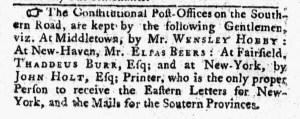
“The Constitutional Post-Offices on the Southern Road, are kept by the following Gentlemen.”

Although William Goddard established the Constitutional Post as an alternative to the British Post Office in 1773, advertisements for the service appeared in colonial newspapers only sporadically until after the battles at Lexington and Concord in April 1775.  After the Revolutionary War began, however, the number and frequency of newspaper notices promoting the Constitutional Post increased, especially in New England, New York, and Pennsylvania.  In May 1775, for instance, Nathan Bushnell, Jr., a postrider in Connecticut, stated that he was affiliated with the Constitutional Post in advertisements that ran in both the New-England Chronicle, published in Cambridge, Massachusetts, and the Connecticut Gazette, published in New-London.  John Holt, the printer of the New-York Journal, inserted a lengthy advertisement to advise readers that a “Constitutional POST-OFFICE, Is now kept” at his printing office in early June.

An unsigned advertisement in the June 12, 1775, edition of the Connecticut Courant, published by Ebenezer Watson in Hartford, listed four branches: “The Constitutional Post-Offices on the Southern Road, are kept by the following Gentlemen, viz. At Middletown, by the Mr. WENSLEY HOBBY: At New-Haven, Mr. ELIAS BEERS: At Fairfield, THADDEUS BURR, Esq; and at New-York, by JOHN HOLT, Esq; Printer.”  Holt may have been responsible for the notice, considering that it described him as “the only proper Person to receive the Eastern Letters for New-York, and the Mails for the Sout[h]ern Provinces.”  One of the other postmasters could have placed the notice, though Watson may have done it of his own volition as a public service.  Joseph M. Adelman persuasively argues that “printers had a direct financial and business interest in promoting a post office to their liking both because it distributed their newspapers and other print goods and because they were the chief beneficiaries of a patronage system centering on the post office.”[1]  He also acknowledges that printers “enlisted merchants and members of the revolutionary elite … to provide financial and political support.”[2]  The notice in the Connecticut Courant included only one printer, John Holt, among the four postmasters.  Fairfield and Middletown did not have newspapers, but they did have need of reliable post offices and trustworthy postmasters.  In New Haven, Thomas Green and Samuel Green printed the Connecticut Journal, yet the notice did not indicate that they had an affiliation with the Constitutional Post Office.  While printers played an important role in establishing the service, they worked alongside postmasters from other occupations in creating an infrastructure for disseminating news and information.

**********

[1] Joseph M. Adelman, “‘A Constitutional Conveyance of Intelligence, Public and Private,’: The Post Office, the Business of Printing, and the American Revolution,” Enterprise and Society 11, no. 4 (December 2010): 713.

[2] Adelman, “Constitutional Conveyance,” 709.

June 10

What was advertised in a revolutionary American newspaper 250 years ago today?

Providence Gazette (May 10, 1775).

“A regular Intercourse between the Colonies, at this critical Juncture, is of the utmost Importance.”

As the imperial crisis intensified in the spring of 1775, Isaiah Thomas, the printer of the Massachusetts Spy, left Boston just before the battles at Lexington and Concord.  He had previously planned to establish a printing office in Worcester, setting up a junior partner to publish the town’s first newspaper.  When he left Boston because his political principles and advocacy put him in jeopardy with royal officials, however, he also decided to transfer his newspaper to Worcester and become the local printer.  After revising his plans, he set about expanding the infrastructure for collecting and distributing news in central Massachusetts.

Worcester, previously lacking a printer and a newspaper, became a much more important hub for disseminating information.  Tarent Putnam aimed to be part of that transformation, announcing in the Providence Gazette that he “has began to ride Post from Providence to Worcester, and proposes, on receiving proper Encouragement, to continue his Ride weekly.”  He departed Providence on Saturdays, “immediately after the Publication of the Providence Gazette,” and returned on the following Thursday.  Thomas published the Massachusetts Spy (now branded the Massachusetts Spy, Or, American Oracle of Liberty) on Wednesdays, which meant that Putnam carried newspapers hot off the presses in both directions.  In addition to carrying letters, the postrider accepted subscriptions “for the Providence or Worcester Papers” and promised that he would “faithfully execute any other Business that may be entrusted to him.”

Yet he did not offer these services merely to earn his own livelihood.  Instead, he asked colonizers to consider the impact they could have on current events if they supported his undertaking.  Putnam asserted that “a regular Intercourse between the Colonies, at this critical Juncture, is of the utmost Importance.”  Accordingly, he “flatters himself that the Friends of Liberty and the Rights of Mankind will afford him every Encouragement.”  Putnam did more than move letters and newspapers from one town to another; he made important contributions to the flow of information that kept citizens informed as the siege of Boston continued and the imperial crisis became a war for independence.  The stakes were high … and readers had an opportunity to play their part by supporting Putnam’s “POST from Providence to Worcester.”  In hiring his services, they simultaneously became better informed themselves and aided the American cause by keeping communities in New England and beyond better connected and aware of the latest information regarding current events.