January 20

What was advertised in a colonial American newspaper 250 years ago today?

Connecticut Gazette (January 20, 1775).

“To be sold … agreeable to the tenth Article of the Association … Apothecaries Drugs.”

On January 12, 1775, the Committee of Inspection for Norwich, Connecticut, placed an advertisement for an upcoming sale of “three Chests and six Casks of Apothecary’s Drugs” that would be held on January 20 in the Norwich Packet.  They ran the notice again a week later, this time stating that the sale would take place on January 24.  That allowed four more days for word of the sale to circulate and attract prospective customers.  It also made possible advertising in the January 20 edition of the Connecticut Gazette, published in New London.

The advertisement specified that the local Committee of Inspection would oversee that sale “at the Town-House in Norwich … agreeable to the tenth Article of the Association of the American Continental Congress.”  That nonimportation, nonconsumption, and nonexportation agreement had been disseminated far wide in the months since the meetings of the First Continental Congress in Philadelphia concluded at the end of October 1774.  The tenth article made provisions for imported goods that arrived in the colonies between December 1, 1774, and February 1, 1775.  The importers had three options.  They could either return the goods, surrender them to the local Committee of Inspection to store until the boycott ended, or entrust them to the committee to sell.  After the sale, the committee reimbursed the importer what they paid for the goods, but applied any profits to relief of Boston where the harbor had been closed to commerce since the Boston Port Act went into effect on June 1, 1774.

The tenth article of the Continental Association also called for “a particular Account [to be] inserted in the publick Papers.”  When the Committee of Inspection for Norwich advertised the sale of “Apothecaries Drugs, Imported in the ship Lady Gage, from London, via New-York, since the first of December last” in both the Norwich Packet and the Connecticut Gazette, they did more than address prospective customers.  They also kept the public throughout the region that the two newspapers circulated updated on compliance with the Continental Association, encouraging others to abide by it as well.
January 14

What was advertised in a colonial American newspaper 250 years ago today?

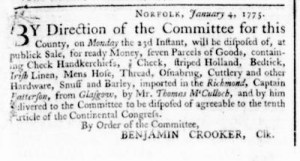
Virginia Gazette [Dixon and Hunter] (January 14, 1775).

“Seven Parcels of Goods … delivered to the Committee to be disposed of agreeable to the tenth Article of the Continental Congress.”

As an advertisement in the January 14, 1775, edition of Dixon and Hunter’s Virginia Gazette made clear, Thomas McCulloch of Norfolk abided by the Continental Association.  The First Continental Congress adopted that nonimportation, nonconsumption, and nonexportation agreement when it met in Philadelphia in September and October 1774, intending to use economic leverage to convince Parliament to repeal the Coercive Acts passed in retaliation for the destruction of tea during the Boston Tea Party.

“BY Direction of the Committee for this County,” the advertisement informed readers, “on Monday the 23d Instant, will be disposed of, at publick Sale, for ready Money, seven Parcels of Goods … imported in the Richmond, Captain Patterson, from Glasgow, by Mr. Thomas McCulloch.”  The “Committee for this County” referred to the local Committee of Inspection, empowered to oversee the sale of imported goods that arrived between December 1, 1774, and February 1, 1775.  According to the tenth article of the Continental Association, importers had several options for dealing with such items.  They could return the goods, surrender them to the committee to store until the nonimportation agreement concluded, or entrust them to the committee to sell.  McCulloch “delivered [his goods” to the Committee to be disposed of agreeable to the tenth Article of the Continental Congress.”  In that case, the committee would reimburse him what he paid but apply any profit to the relief of Boston where the harbor had been closed since the Boston Port Act went into effect on June 1, 1774.

Another advertisement in the same issue of Dixon and Hunter’s Virginia Gazette advised the public of the sale of “SUNDRY Parcels of Goods lately imported from Great Britain” for sale “Under the Direction of the Committee for the County of CHARLES CITY.”  In this instance, the committee divided the merchandise into “Lots not over ten Pounds Value” to encourage sales.  These local Committees of Inspection joined their counterparts in Massachusetts, New York, and other colonies in advertising imported goods sold according to the tenth article of the Continental Association and, in the process, demonstrating compliance with that measure.

January 8

What was advertised in a colonial American newspaper 250 years ago this week?

Rivington’s New-York Gazetteer (January 5, 1775).

“We being heartily disposed to comply with the association entered into by the late continental congress …”

After it went into effect on December 1, 1774, the Continental Association had an impact on some advertisements that appeared in colonial newspapers.  The tenth article of this nonimportation, nonexportation, and nonconsumption agreement enacted by the First Continental Congress allowed for the sale of goods that arrived between December 1, 1774, and February 1, 1775, but specified that local Committees of Inspection would oversee such transactions, not the importers.  In turn, the importers would be reimbursed for the cost of the goods, but any profits would be earmarked for the relief of Boston while its harbor remained closed because of the Boston Port Act.  The tenth article asserted that “a particular Account” of those goods would be “inserted in the publick Papers.”

That was the case for sales in Plymouth, Massachusetts, near the end of December.  In early January, Thomas Ellison, Jr., Henry Remsen, and several other importers in New York published their own account of goods they ordered the previous spring and summer and the upcoming sale overseen by Joseph Haller, Nicholas Hoffman, and other members of the Committee of Inspection.  Ellison, Remsen, and the others provided an inventory of the imported items.  They also carefully documented when they placed the orders for each item to demonstrate that they had submitted them before the First Continental Congress commenced its meetings in Philadelphia in September and certainly before delegates issued the Continental Association near the end of October.  Still, even though the ship that carried their orders left New York in July, it had returned on January 2, 1775.

The importers recognized their obligation: “we being heartily disposed to comply with the association entered into by the late continental congress, give this public notice, that the said goods will be sold at the Merchants Coffee-house.”  They listed the time and date of the sale and named the members of the Committee of Inspection.  They also provided a succinct inventory, such as “1 case checks, buttons, &c.” and “6 cases Manchester goods,” but did not compose the elaborate descriptions that appeared in many other advertisements before the Continental Association went into effect.  In that regard, their advertisement resembled those for the sales in Plymouth.  Importers who surrendered their goods to Committees of Inspection did not incorporate the marketing strategies commonly used under other circumstances.

January 2

What was advertised in a colonial American newspaper 250 years ago today?

Boston-Gazette (January 2, 1775).

The GRAND AMERICAN CONTINENTAL ASSOCIATION … to be pasted up in every Family.”

In the first issue of the Boston-Gazette published in 1775, Benjamin Edes and John Gill, the printers, opened with a notice concerning the Continental Association as the first item in the first column on the first page.  The First Continental Congress had devised that nonimportation, nonconsumption, and nonexportation pact when it met in Philadelphia in September and October 1774, intending for it to go into effect on December 1.  The Continental Association answered the Boston Port Act, the Massachusetts Government Act, and the other Coercive Acts that Parliament had passed in retaliation for the Boston Tea Party, perhaps not expecting a unified response from the colonies.  The First Continental Congress, however, devised a plan that allowed consumers from New England to Georgia to express their political principles through the decisions they made in the marketplace., drawing inspiration from the nonimportation agreements that went into effect to protest the Stamp Act and the duties on imported goods in the Townshend Acts.

Edes and Gill helped to raise awareness of the Continental Association not only through newspaper coverage but also by disseminating copies far and wide.  “ANY Town or District within this Province,” their notice advised, “may be supplied by Edes and Gill, on the shortest Notice, with the GRAND AMERICAN CONTINENTAL ASSOCIATION, printed on one Side of a Sheet of Paper.”  They offered the pact as a broadside “on purpose to be pasted up in every Family.”  The printers wished for local governments to purchase their edition of the Continental Association and distribute them to households for constant reference.  Putting the pact on display demonstrated support for the American cause against Parliament or at least signaled an intention to comply.  Posting it in homes as well as public spaces made it easy to consult, reminding everyone that they had a part to play in the protest.  The Continental Association made decisions about participating in the marketplace inherently political, making it impossible for any individual or household to take a neutral stance.  Edes and Gill recognized that was the case.  Although they stood to generate revenue from selling broadside copies of the Continental Association by the dozen or gross, the political stance they consistently advanced throughout the imperial crisis suggested that increasing awareness of the pact and encouraging compliance with it motivated them as much or even more.