May 10

What was advertised in a revolutionary American newspaper 250 years ago today?
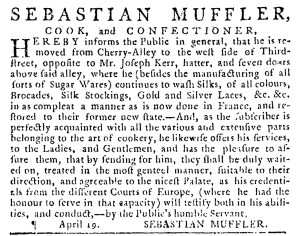
Pennsylvania Journal (May 10, 1775).

“The manufacturing of all sorts of Sugar Wares.”

In the spring of 1775, Sebastion Muffler, “COOK, and CONFECTIONER,” ran a newspaper notice to promote his “manufacturing of all sorts of Sugar Wares” at a new location on Third Street in Philadelphia.  Customers would no longer find him in Cherry Alley.  Muffler joined the ranks of confectioners who advertised their services in American port cities, including Peter Lorent in Boston, Frederick Kreitner in Charleston, and P. Lenzi in New York.  Like most of his counterparts, he touted his prior experience on the other side of the Atlantic.  To that end, Muffler proclaimed that he earned “his credentials from the different Courts of Europe, (where he had the honour to serve …)”  That experience, he asserted, “will testify both in his abilities, and conduct.”  The cook and confectioner hoped that would entice “Ladies, and Gentlemen” to hire him.  Upon doing so, they could depend on being “duly waited on, [and] treated in the most genteel manner, suitable to their direction.”  Furthermore, Muffler declared himself “perfectly acquainted with all the various and extensive parts belonging to the art of cookery.”  Accordingly, his clients should anticipate dining “agreeable to the nicest Palate.”

Despite this depiction of his mastery of “the art of cookery” and “manufacturing of all sorts of Sugar Wares,” Muffler apparently depended on a side hustle to earn his livelihood.  He advised readers of the Pennsylvania Journal that he “continues to wash Silks, of all colours,” and other items “in as compleat a manner as is now done in France, and restored to their former new state.”  That was an impressive feat, but not a service directly related to his primary occupation.  In the largest and most cosmopolitan city in the colonies, Muffler needed to supplement the income he earned as a cook and confectioner by providing unrelated services.  Perhaps he hoped that he could eventually establish himself well enough to cultivate a market for his culinary services that made cleaning fabrics unnecessary.  Until then, he included his other occupation in his advertisements.  He hoped that his secondary headline, “COOK and CONFECTIONER,” would attract attention, using it to direct prospective customers to both related and unrelated services.
July 3

What was advertised in a colonial American newspaper 250 years ago this week?

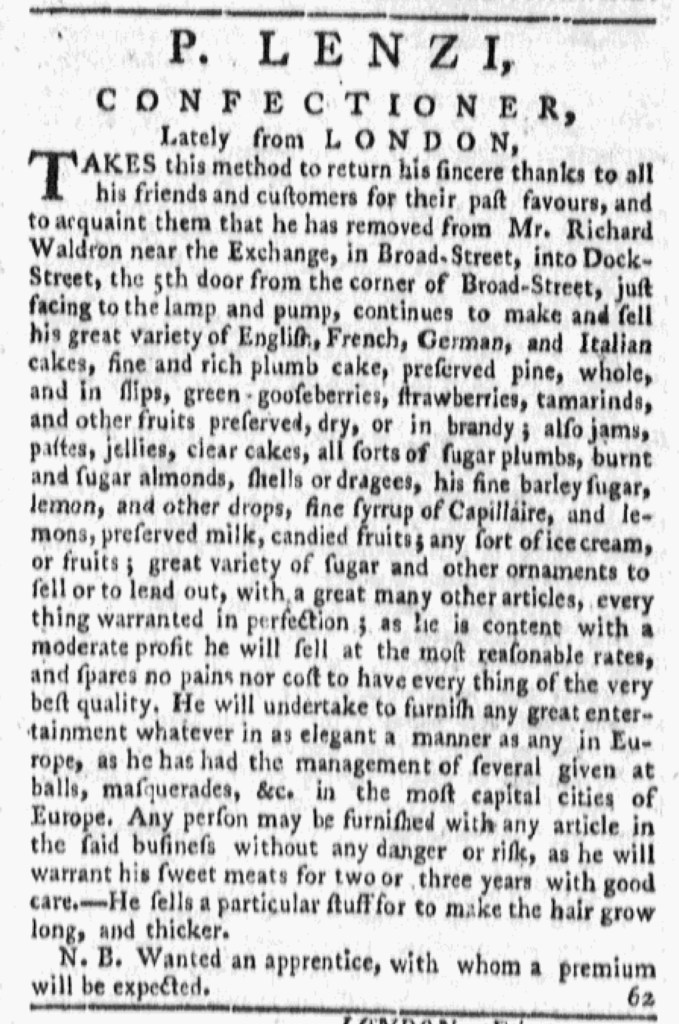
Rivington’s New-York Gazetteer (June 30, 1774).

“Great variety of English, French, German, and Italian cakes.”

In the summer of 1774, P. Lenzi, a “CONFECTIONER, Lately from LONDON,” took to the pages of Rivington’s New-York Gazetteer to thank “his friends and customers for their past favours,” inform them that he had moved to a new location, and entice the public with descriptions of the sweet treats that he made and sold.  In addition to a “great variety of English, French, German, and Italian cakes,” he offered “fine and rich plumb cake,” a variety of preserved fruits either “dry, or in brandy,” “all sorts of sugar plumbs,” candied fruits,” and “any sort of ice cream” at his shop.  He encouraged prospective customers to imagine the “perfection” of these items or, better yet, take advantage of his low prices to sample these confections for themselves.

Lenzi also promoted his catering services, declaring that he “will undertake to furnish any great entertainment whatever in as elegant a manner as any in Europe.”  That made his London origins even more significant, testifying to his familiarity with parties and events held in the most cosmopolitan city in the empire.  He confided that he had experience supplying cakes and sweets at balls and masquerades “in the most capital cities of Europe.”  Customers looking to impress their guests could depend on his management of their soirees, especially since Lenzi “spares no pain nor cost to have every thing of the very best quality.”  Beyond the confections he supplied, Lenzi encouraged readers to imagine the parties they could host with his assistance.  He had a “great variety of sugar and other ornaments to sell or to lend out, with a great many other articles” to decorate the venues where his clients held their gatherings.

The confectioner sought different kinds of customers.  He recognized the opportunity to generate revenues by providing candies and desserts to clients hosting fêtes while also welcoming patrons who occasionally wished to enjoy a treat, a small indulgence purchased “at the most reasonable rates.”  Recognizing that everyone had their own favorite, Lenzi listed dozens of confections for customers to choose and enjoy.

November 23

What was advertised in a colonial American newspaper 250 years ago today?

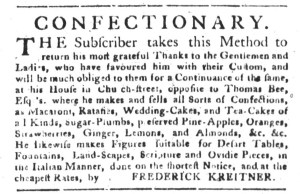
South-Carolina Gazette and Country Journal (November 23, 1773).

“Wedding-Cakes.”

Frederick Kreitner made and sold sweet treats at his “CONFECTIONARY” in Charleston in the early 1770s.  In an advertisement in the November 23, 1773, edition of the South-Carolina Gazette and Country Journal, he expressed “his most grateful Thanks to the Gentlemen and Ladies, who have favoured him with their Custom” and solicited the patronage of new and returning customers.  The confectioner listed several of the items he made and sold, including macaroons, “Tea-Cakes of all Kinds, Sugar-Plumbs, [and] preserved Pine-Apples, Oranges, Strawberries, Ginger, Lemons, and Almonds.”  Kreitner also advertised that he sold “Wedding-Cakes.”

What distinguished a wedding cake from other cakes in colonial Charleston?  In “Wedding Cake: A Slice of History,” Carol Wilson examines a variety of traditions, including English traditions that colonizers brought with them to North America.  According to Wilson, “bride cake, the predecessor of the modern wedding cake,” replaced bride pie in the seventeenth century.  “Fruited cakes, as symbols of fertility and prosperity, gradually became the centerpieces for weddings.”  However, a “much less costly bride cake took the simpler form of two large rounds of shortcrust pastry sandwiched together with currants and sprinkled with sugar on the top.”  This simple type of cake “could easily be cooked on a bakestone on the hearth.”  Wilson also reports, “Bride cake covered with white icing first appeared sometime in the seventeenth century.”  In 1769, Elizabeth Raffald, known for the recipes and other household hints she published in England, “was the first to offer the combination of bride cake, almond cake, and royal icing.”  In 1773, Raffald published the third edition of The Experienced English Housekeeper, for the Use and Ease of Ladies, Housekeepers, Cooks.  It contained nearly nine-hundred recipes, including instructions “To make a BRIDE CAKE,” “To make ALMOND-ICEING for the BRIDE CAKE,” and “To make SUGAR ICEING for the BRIDE CAKE.”  Raffald considered these recipes so important that she placed them first in chapter 11, following and introduction that offered “Observations upon CAKES.”

Prospective customers in Charleston had expectations about what distinguished wedding cakes from “Tea-Cakes” and other cakes that Kreitner made and sold.  By including wedding cakes among the confections in his advertisement, Kreitner aided in further diffusing traditions associated with new marriages and presented himself as an authority who could assist customers who wished to adhere to contemporary fashions and rituals.

July 16

What was advertised in a colonial American newspaper 250 years ago this week?

Jul 16 - 7:13:1769 Massachusetts Gazette Draper
Massachusetts Gazette [Draper] (July 13, 1769).
Confectioner and Distiller from London.”

In the summer of 1769 Peter Lorent, a confectioner and distiller, provided a variety of sweet treats to the residents of Boston. In addition to “Cakes of all kind,” he made and sold macaroons, sugar plums, candied fruits, syrups, and cordials.

As part of his marketing efforts, Lorent underscored the quality of his confections. He introduced himself to prospective customers as a “Confectioner and Distiller from London,” hoping readers would associate him with his counterparts in the most cosmopolitan city in the empire. Advertisers from many occupations, especially artisans and doctors, frequently deployed this strategy, implying that their origins testified to skills and expertise gained from training or employment on the other side of the Atlantic. They also prompted consumers to imbue their goods or services with the cachet of having been acquired from a purveyor “from London.” Advertisers like Lorent invoked their origins as a means of asserting status; they suggested that customers could demonstrate and enhance their own status by making purchases from the right providers of goods and services.

Lorent helped consumers reach the intended conclusions about the cakes, candies, and cordials they could acquire from a confectioner “from London.” He trumpeted that he made all of his treats “in as great Perfection as in Europe” and underscored that he had the requisite exposure to make that claim since he previously “worked in England, France, and Italy.” Lorent aimed to impress prospective customers with his experience that ranged beyond England to other countries often associated with taste and fashion. He also attempted to ease their anxieties about residing far from the center of the empire. Residents of Boston did not need to worry that they lived in a provincial backwater, not when they could consumer confections as fine as those enjoyed by the genteel ladies and gentlemen of London.