February 5

What was advertised in a revolutionary American newspaper 250 years ago today?
Connecticut Courant (February 5, 1775).

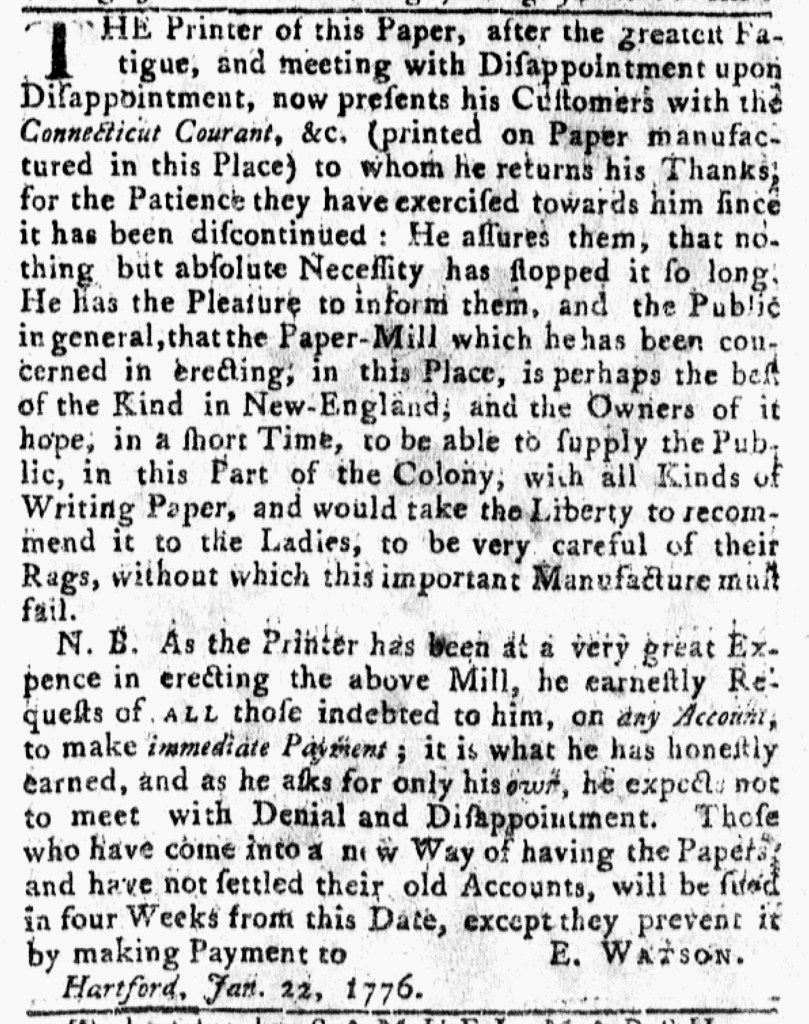
“The Paper-Mill which he has been concerned in erecting … is perhaps the best of the Kind in New-England.”

Ebenezer Watson, the printer of the Connecticut Courant and Hartford Weekly Intelligencer, briefly suspended publication of that newspaper due to a lack of paper in late December 1775 and early January 1776.  The issue for December 11, “NUMBER 572,” was the last for over a month.  The next known issue had neither a date nor a number in the masthead, but the news from Hartford on the final page bore the date January 15.  The issue for January 22, “NUMB. 574,” had both a date and number in the masthead.  A handwritten note at the bottom of the first page of the December 11 edition digitized for the America’s Historical Newspapers database states, “There appears to be an interruption of four weeks,” consistent with the issue numbering.

Watson inserted a notice about the suspension in the January 22 edition and the next two issues.  “THE Printer of this Paper, after the greatest Fatigue, and meeting with Disappointment upon Disappointment,” he explained, “now presented his Customers with the Connecticut Courant, &c. (printed on Paper manufactured in this Place).”  That made the Connecticut Courant yet another newspaper that experienced difficulties due to lack of paper during the first year of the Revolutionary War.  Watson expressed appreciation “for the Patience [his subscribers] have exercised toward him since it has been discontinued” while simultaneously “assur[ing] them, that nothing but absolute Necessity has stopped is so long.”  During the newspaper’s hiatus, Watson had been “concerned in erecting” a paper mill.  Perhaps it produced the paper that allowed him to resume publishing the Connecticut Courant.  He anticipated that “in a short Time” the mill, “perhaps the best of the Kind in New-England, would “be able to supply the Public, in this Part of the Colony, with all Kinds of Writing Paper.”  For that to happen, he recruited the assistance of “the Ladies, to be very careful of their Rags without which this important Manufacture must fail.”  In other words, the paper mill needed clean linen rags to recycle into paper to use in writing letters and publishing newspapers.  In addition to rags, Watson needed to cover “the very great Expence in erecting the above Mill,” so he called on “ALL those indebted to him, on any Account, to make immediate Payment.”  Watson aimed to continue disseminating news about the momentous events occurring in the colonies, but he needed the cooperation of both women saving rags and customers paying off accounts to make that possible.
December 18

What was advertised in a revolutionary American newspaper 250 years ago today?

Connecticut Courant (December 18, 1775).

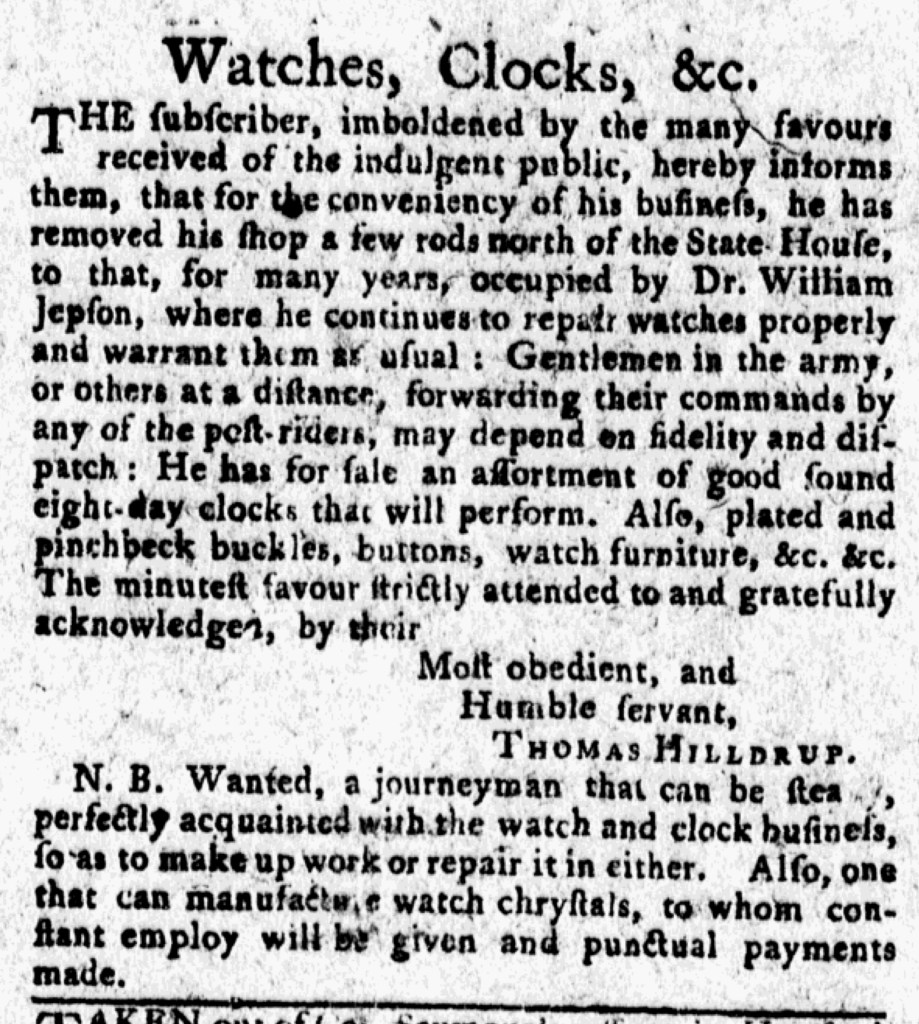
“Gentlemen in the army … forwarding their commands by any of the post-riders, may depend on fidelity and dispatch.”

Thomas Hilldrup, a watch- and clockmaker, had a history of running engaging advertisements in newspapers printed in Connecticut in the 1770s.  He once again took to the pages of the Connecticut Courant and Hartford Weekly Intelligenceron December 18, 1775, this time informing existing and prospective clients that he had moved to a new location.  In framing this announcement, he asserted that he had already built a reputation and earned the trust of many customers.  Having been “imboldened by the many favours received of the indulgent public,” Hilldrup declared, he “hereby informs them that for the conveniency of his business, he has removed his shop a few rods north of the State-House, to that, for many years, occupied by Dr. William Jepson.”  He supplemented this announcement with assurances about his skill and the quality of his work, stating that he “continues to repair watches properly and warrant them as usual.”

Realizing that the Connecticut Courant circulated far beyond Hartford, Hilldrup took the opportunity to address “Gentlemen in the army, or others at a distance.”  Like other watchmakers, he provided mail order services for cleaning and repairs.  He promised those clients that by “forwarding their commands by any of the post-riders” they “may depend on fidelity and dispatch.”  As the Continental Army continued the siege of Boston, Hilldrup may have known that some of the clients he served in recent years too part in that endeavor.  In an unfamiliar place that experienced some of the most significant disruptions during the first year of the Revolutionary War, they may have been at a loss to identify local artisans that they trusted to do repairs and perform routine maintenance.  That might have made Hilldrup’s mail order service look especially attractive.  The watchmaker likely also hoped that others enlisted in the army (as well as “others at a distance”) who had not previously availed themselves of his services would be influenced by his claim that he already established a robust clientele, those “many favours received of the indulgent public” that he invoked at the beginning of his advertisement.  Whether or not this strategy proved effective, Hilldrup envisioned “Gentlemen in the army” as a new category of customers to target in his marketing.  The Revolutionary War presented opportunities to savvy entrepreneurs as well as challenges and disruptions.

December 4

What was advertised in a revolutionary American newspaper 250 years ago today?

Connecticut Courant (December 4, 1775).

“Newest fashioned Bonnets … at the same reasonable prices that they have been accustomed to in times past.”

When they relocated to Hartford, milliners Mary Salmon and Jane Salmon placed an advertisement in the December 4, 1775, edition of the Connecticut Courant to introduce themselves to their new neighbors and, especially, to prospective customers.  They informed “the Ladies in this and the neighbouring towns, That they make the newest fashioned Bonnets in the neatest manner, and any sort of Caps.”  They also noted that they “make Cloaks” and other garments.  The milliners hoped to establish a clientele and earn their livelihood in a town new to them.  In the headline for their advertisement, they described themselves as “from Boston.”  The Salmons were not the only newcomers from Boston who ran an advertisement in that issue of the Connecticut Courant.  James Lamb and Son, tailors “From Boston” who had previously inserted a notice in that newspaper in September, ran a new advertisement that appeared in the same column as the Salmons’ notice.  Like the Lambs, the Salmons may have been refugees who left Boston following the outbreak of hostilities at Lexington and Concord in the spring.

In marketing their wares, the Salmons did not allow the difficulties of the war to overshadow prospective customers’ desire for hats that followed the latest styles.  They intentionally declared that they made “the newest fashioned Bonnets” and did so “in the neatest manner.”  They combined appeals to taste with a pledge about the quality of their hats and their skill as milliners.  The Salmons also incorporated promises regarding price into their brief advertisement, asserting that they charged “the same reasonable prices that [prospective customers] have been accustomed to in times past.”  The disruptions caused by the war did not cause them to raise prices.  In addition, they made a nod to the ninth article of the Continental Association: “That such as are Venders of Goods or Merchandise will not take Advantage of the Scarcity of Goods that may be occasioned by this Association, but will sell the same at the Rates we have been respectively accustomed to do so for twelve Months last past.”  The Salmons could not rely on their reputation among an existing clientele to generate business as they had done in Boston.  Instead, they devised an advertisement that said a lot in just a few lines, deploying appeals to fashion, quality, skill, and price.  They may have also expected that current events would resonate with their notice, anticipating that prospective customers would realize why they moved from Boston and their commitment to abiding by the Continental Association.

September 4

What was advertised in a revolutionary American newspaper 250 years ago today?

Connecticut Courant (September 4, 1775).

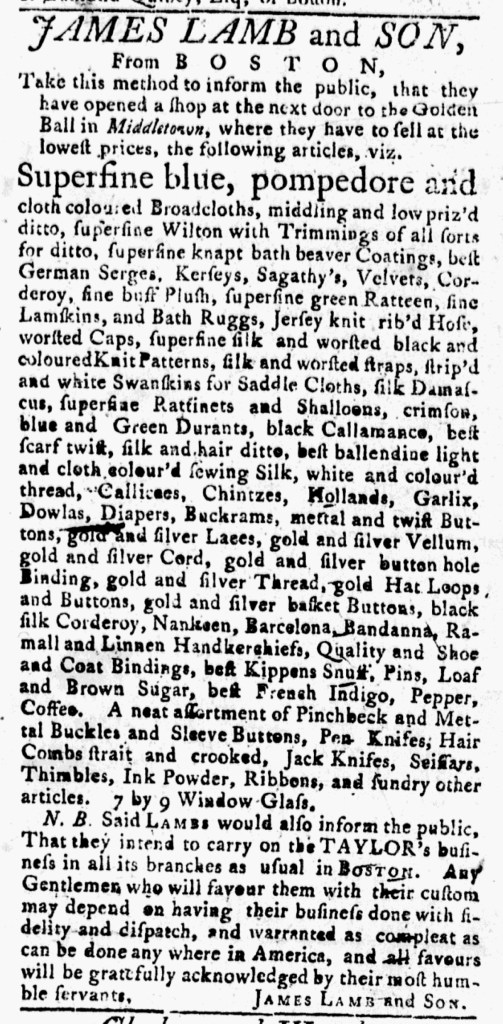
“JAMES LAMB and SON, From BOSTON, … intend to carry on the TAYLOR’s business.”

James Lamb and Son used an advertisement in the September 4, 1775, edition of the Connecticut Courant, published in Hartford, to inform the public “that they have opened a shop at the next door to the Golden Ball in Middletown.”  They listed dozens of items they stocked, mostly an assortment of textiles but also ribbons, buttons, buckles, thread, pins, sugar, indigo, and coffee.  Their inventory rivaled those that ran in newspapers prior to the Continental Association going into effect.  The Lambs did not mention when or how they acquired their wares.  Instead, the header for their advertisement focused on their origins, “From BOSTON.”  Like others “From BOSTON” who advertised that they opened shops in other cities and towns in New England in the summer and fall of 1775, the Lambs might have been refugees displaced by the siege of Boston after the battles at Lexington and Concord in April.  They could have left the city when they had an opportunity, taking merchandise with them in hopes of establishing themselves in a new place.

A nota bene indicated that they offered residents of central Connecticut the same quality and range of service that they previously provided to customers in Boston.  They were not, after all, shopkeepers but also skilled tailors who “intend to carry on the TAYLOR’s business in all its branches as usual in BOSTON.”  That last phrase meant “as they had in BOSTON,” signaling to prospective customers that the Lambs had experience as tailors.  As newcomers, they needed to start building their reputation; for the moment, their own account of their experience substituted for local clients familiar with their work.  Yet that did not prevent them from making bold claims.  “Any Gentlemen who will favour them with their custom,” the Lambs proclaimed, “may depend on having their business done with fidelity and dispatch.”  In addition to exemplary customer service, the Lambs promised the highest quality.  They “warranted” their work “as complear as can be done any where in America.”  The tailors “From BOSTON” asserted that their garments rivaled any from Charleston, New York, Philadelphia, or any other city or town in the colonies.  They hoped such claims would attract customers as they began building their business in Middletown in the first year of the Revolutionary War.

June 12

What was advertised in a revolutionary American newspaper 250 years ago today?

Connecticut Courant (June 12, 1775).

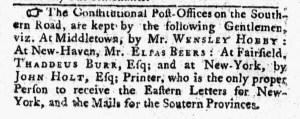
“The Constitutional Post-Offices on the Southern Road, are kept by the following Gentlemen.”

Although William Goddard established the Constitutional Post as an alternative to the British Post Office in 1773, advertisements for the service appeared in colonial newspapers only sporadically until after the battles at Lexington and Concord in April 1775.  After the Revolutionary War began, however, the number and frequency of newspaper notices promoting the Constitutional Post increased, especially in New England, New York, and Pennsylvania.  In May 1775, for instance, Nathan Bushnell, Jr., a postrider in Connecticut, stated that he was affiliated with the Constitutional Post in advertisements that ran in both the New-England Chronicle, published in Cambridge, Massachusetts, and the Connecticut Gazette, published in New-London.  John Holt, the printer of the New-York Journal, inserted a lengthy advertisement to advise readers that a “Constitutional POST-OFFICE, Is now kept” at his printing office in early June.

An unsigned advertisement in the June 12, 1775, edition of the Connecticut Courant, published by Ebenezer Watson in Hartford, listed four branches: “The Constitutional Post-Offices on the Southern Road, are kept by the following Gentlemen, viz. At Middletown, by the Mr. WENSLEY HOBBY: At New-Haven, Mr. ELIAS BEERS: At Fairfield, THADDEUS BURR, Esq; and at New-York, by JOHN HOLT, Esq; Printer.”  Holt may have been responsible for the notice, considering that it described him as “the only proper Person to receive the Eastern Letters for New-York, and the Mails for the Sout[h]ern Provinces.”  One of the other postmasters could have placed the notice, though Watson may have done it of his own volition as a public service.  Joseph M. Adelman persuasively argues that “printers had a direct financial and business interest in promoting a post office to their liking both because it distributed their newspapers and other print goods and because they were the chief beneficiaries of a patronage system centering on the post office.”[1]  He also acknowledges that printers “enlisted merchants and members of the revolutionary elite … to provide financial and political support.”[2]  The notice in the Connecticut Courant included only one printer, John Holt, among the four postmasters.  Fairfield and Middletown did not have newspapers, but they did have need of reliable post offices and trustworthy postmasters.  In New Haven, Thomas Green and Samuel Green printed the Connecticut Journal, yet the notice did not indicate that they had an affiliation with the Constitutional Post Office.  While printers played an important role in establishing the service, they worked alongside postmasters from other occupations in creating an infrastructure for disseminating news and information.

**********

[1] Joseph M. Adelman, “‘A Constitutional Conveyance of Intelligence, Public and Private,’: The Post Office, the Business of Printing, and the American Revolution,” Enterprise and Society 11, no. 4 (December 2010): 713.

[2] Adelman, “Constitutional Conveyance,” 709.

May 15

What was advertised in a revolutionary American newspaper 250 years ago today?

Connecticut Courant (May 15, 1775).

“TEA! (I ask pardon) [&] COFFEE kettles.”

In the spring of 1775, Frederick Bull advertised a variety of items available at his store in Hartford.  In addition to “earthen and delph WARE” and an assortment of liquors and groceries, he emphasized that he stocked the “most universal assortment of iron HOLLOW WARE perhaps ever brought into any one store in this town, such as large kettles and coolers, large, middle sized and small pots, spiders, bake pans, basons, [and] skillets.”  The list concluded with two items that likely drew attention because they appeared in capital letters: “TEA! [&] COFFEE kettles.”

The tea kettles may have caused some concern among readers.  After all, the third article of the Continental Association specified that “after the first Day of March [1775], we will not purchase or use any East India Tea whatever.”  If colonizers were abiding by the nonimportation and nonconsumption agreement devised by the First Continental Congress and not drinking tea then they should not have needed to purchase new tea kettles, yet Bull marketed them in the Connecticut Courant.  The first time his advertisement appeared, it ran one column over from an update about Samuel Adams and John Hancock from Massachusetts and Silas Deane and Roger Sherman from Connecticut making their way to Philadelphia to attend the Second Continental Congress following the battles at Lexington and Concord.  Their arrival in New York “was announced by the ringing of bells, and other demonstrations of joy.”

All the same, Bull advertised tea kettles for sale in Hartford.  He had the good graces to insert a brief note of apology.  The entire phrase read: “TEA! (I ask pardon) [&] COFFEE kettles.”  Most likely the tea kettles had been part of a larger shipment; perhaps he presented them to consumers as an option, leaving it to them to decide whether they could purchase them in good conscience.  That he included them in his advertisement at all indicated that there were limits to the amount of shame that Bull felt in hawking them.  Although he proclaimed, “I ask pardon,” that may have been an eighteenth-century version of “Sorry (not sorry),” a wink and a nod to prospective customers who continued to drink tea on the sly.  Bull acknowledged that he engaged in suspect behavior by selling tea kettles, yet he hoped that his apology combined with demand for those kettles would absolve him of any consequences.

May 8

What was advertised in a revolutionary American newspaper 250 years ago today?

Connecticut Courant (May 8, 1775).

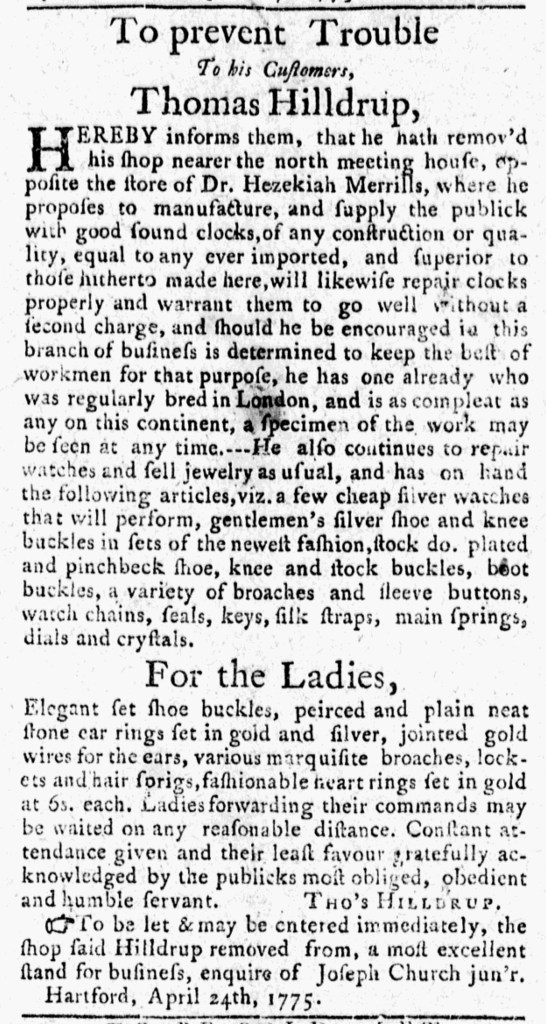
“To prevent Trouble …”

Thomas Hilldrup used a clever turn of phrase as a headline to draw attention to his advertisement in the May 8, 1775, edition of the Connecticut Courant and Hartford Weekly Intelligencer.  “To prevent Trouble,” it proclaimed, inviting readers to look more closely to see what kind of trouble might be afoot.  The headline stood out even more considering that most advertisements in that newspaper did not have headlines.  Among those that did, some used the names of the advertisers as the headlines, such as “PETER VERSTILE” and “CALEB BULL, jun.”  Hilldrup also used his name as a secondary headline on the third line of his advertisement.  A few headlines indicated the goods or services offered in the notices, including “LEATHER BREECHES” and “WILL COVER” (the phrase commonly applied to stud horses).

When they looked more closely, readers saw a second line, “To his Customers,” in a smaller font than the primary and secondary headlines on the first and third lines.  When they continued reading the body of Hilldrup’s advertisement they discovered his important message: “To prevent Trouble To his Customers, Thomas Hilldrup, HEREBY informs them, that he hath remov’d his shop nearer the north meeting house … where he proposes to manufacture, and supply the publick with good sound clocks.”  Hilldrup devised a dramatic means of announcing that he moved to a new location!  He ran the advertisement as a courtesy for those who might go looking for his former shop.  It turned out that it was nothing as dire as threatening to sue customers and associates who did not settle accounts, nor did it have any connection to current events.  Hilldrup first ran the advertisement on April 24, just days after the battles at Lexington and Concord.  He may or may not have been aware of those skirmishes when he composed the advertisement, though he almost certainly realized that the imperial crisis could boil over at any moment.  When his advertisement appeared in subsequent issues of the Connecticut Courant, readers no doubt searched the pages for new information about what was occurring in and near Boston and the responses in other places.  That meant that a notice placed “To prevent Trouble” likely garnered more attention than other advertisements as readers perused the newspaper.

October 10

Who was the subject of an advertisement in a colonial American newspaper 250 years ago today?

Connecticut Courant (October 10, 1774).

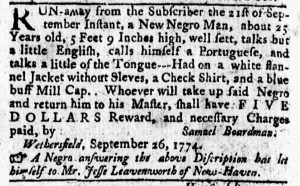
A Negro answering the above Discription has let himself to Mr. Jesse Leavensworth of New-Haven.”

In the fall of 1774, Samuel Boardman of Wethersfield took to the pages of the Connecticut Courant and Hartford Weekly Intelligencer to offer a reward for the capture and return of a “New Negro Man” who liberated himself by running away.  Boardman did not give a name for this man, but instead stated that he “talks but a little English, calls himself a Portuguese, and talks a little of the Tongue.”  He offered a reward to “Whoever will take up said Negro and return him to his Master.”  Dated September 26, the advertisement first appeared in the October 3 edition of the Connecticut Courant.  It included a notation indicating that a “Negro answering the above Discription has let himself to Mr. Jesse Leavensworth of New-Haven.”  Boardman most likely did not include that information in the copy he submitted to the printing office.

Instead, Ebenezer Watson, the printer, likely supplied it upon reading an advertisement that Leavenworth placed in the September 30 edition of the Connecticut Journal and New-Haven Post-Boy.  After all, printers regularly exchanged newspapers in hopes of acquiring content for their own publications.  Leavenworth devoted most of that notice to giving instructions for hiring his ferry, but added a note that recently a “lusty negro man, about 23 or 24 years old, speaks the Portuguese language, but little English” had “let himself to me.”  Leavenworth hired the young man, but was suspicious that he was a fugitive seeking freedom and his enslaver was looking for him.  Just in case, he supplemented his advertisement for the ferry with the description of the Black man who spoke Portuguese.  Given the timing of the advertisements in the two newspapers, Boardman would not have seen Leavenworth’s notice when he drafted his own advertisement.  If he had that information, he could have dispensed with advertising at all.

What role did Watson play in keeping Boardman informed about this development?  He might have dispatched a message to the advertiser in Wethersfield, though he could have considered the note at the end of the advertisement sufficient to update Boardman, figuring that his customer would check the pages of the Connecticut Courant to confirm that his notice appeared.  Watson could have also sent a message to Thomas Green and Samuel Green, the printers of the Connecticut Journal, along with his exchange copy of the Connecticut Courant, expecting they might pass along the information to Leavenworth.  In addition, Leavenworth might have eventually encountered Boardman’s advertisement, depending on his reading habits, or otherwise heard about it.  That alternative seems most likely.  No matter what other action Watson took, inserting the note that connected the unnamed Black man in Boardman’s advertisement in the Connecticut Courant to the unnamed Black man in Leavenworth’s advertisement in the Connecticut Journal alerted readers that they could collect the reward if they decided to pursue the matter.  The power of the press, including a printer whose assistance extended beyond merely setting type and disseminating the advertisement, worked to the advantage of Boardman, the enslaver, against the interests of the unnamed Black man who spoke Portuguese.

September 12

What was advertised in a colonial American newspaper 250 years ago today?

Connecticut Courant (September 12, 1774).

“A SERMON preached … after the Report arrived that People at Boston had destroyed a large Quantity of TEA.”

The September 12, 1774, edition of the Connecticut Courant carried relatively few advertisements.  News and editorials, especially concerning the imperial crisis that increasingly consumed public discourse, crowded out most of the notices that appeared the previous week.  Ebenezer Watson, the printer, however, did find space to include an advertisement for “A SERMON preached” by Israel Holly “at Suffield, Dec. 27, 1773, the next Sabbath after the Report arrived that the People at Boston had destroyed a large Quantity of TEA belonging to the East-India Company, rather than submit to Parliament Acts which they looked upon unconstitutional, tyrannical, and tending to enslave America.”  Watson proclaimed that he had “Just Published” the sermon and offered it for sale.

Even though Holly delivered the sermon eight months earlier, it was especially timely in September 1774 as colonizers received word of the Quebec Act.  Watson initially advertised the sermon in the September 6 edition, immediately below the notice for Considerations on the Measures Carrying On with Respect to the British Colonies in North-America.  He devoted most of the second and a portion of the third page to “an authentic Copy OF the ACT OF PARLIAMENT, For making more effectual Provision for the Government of the Province of QUEBEC, in NORTH-AMERICA.”  Colonizers found several aspects of that legislation troubling, including the free practice of Catholicism by the residents of the territory won from the French in the Seven Years War.  As relayed in the Connecticut Courant, the Quebec Act provided that “His Majesty’s Subject’s professing the Religion of the Church of Rome, of an in the said Province of Quebec, may have, hold and enjoy the free Exercise of the Religion of the Church of Rome … and that the Clergy of the said Church may hold, receive, and enjoy their accustomed Dues and Rights,” such as collecting tithes, “with respect to such Persons only as shall, profess the said Religion.”  Protestants in New England and elsewhere in the colonies did not appreciate those provisions.

How was the Quebec Act connected to a minister preaching in support of the Boston Tea Party?  In a review of James P. Byrd’s Sacred Scripture, Sacred War: The Bible and the American Revolution, Mark A. Noll explains that Holly’s “word of warning to New England reflected the deeply engrained anti-Catholic biblicism that had become standard in the British Empire over the course of previous decades.”  According to the minister’s line of reasoning, “[i]f New England did not repent of its own tyrannies … the expansion of British despotism could soon lead to more ‘arbitrary government’ and even ‘popery.’”[1]  The Quebec Act seemed to fulfill the prediction that Holly made in December 1773, helping to explain why the minister and the printer took the sermon to press when they did.

**********

[1] Mark A. Noll, “The Holy Book in a Holy War,” Reviews in American History 42, no. 2 (December 2014): 612.

September 6

What was advertised in a colonial American newspaper 250 years ago today?

Connecticut Courant (September 6, 1774).

This celebrated Performance … had a wonderful Operation on the Minds of that People.”

A popular political pamphlet originally printed in London and reprinted in four towns in the colonies made another appearance among the advertisements in the September 6, 1774, edition of the Connecticut Courant.  In this instance, Ebenezer Watson, the printer of that newspaper, promoted his own edition of Considerations on the Measures Carrying On with Respect to the British Colonies in North-America produced at his printing office in Hartford.  By that time, John Holt, printer of the New-York Journal, and Benjamin Edes and John Gill, printers of the Boston-Gazette, had already advertised their own editions of the tract.  In New Haven, David Atwater advertised and sold Holt’s New York edition.

Those advertisers replicated the copy from one notice to another.  For his part, however Watson devised his own copy, though he had likely seen at least some of the other advertisements as he scoured other newspapers for content to reprint in the Connecticut Courant.  Watson even offered a variant title in his advertisement, “CONSIDERATIONS On the Measures carrying on by GREAT-BRITAIN, Against the Colonies in NORTH-AMERICA,” though the title on the title page of the pamphlet itself was consistent with the original London edition and the others reprinted in the colonies.  Although Watson did not directly borrow copy from the other advertisements circulating at the time, he seems to have been inspired by them enough to paraphrase from them.  “This celebrated performance” (rather than a “most masterly performance”), he proclaimed, “was first published in England, and had a wonderful Operation on the Minds of that People, in eradicating their Prejudices against the Inhabitants of America.”  In comparison, the other advertisements declared that the tract “had a wonderful effect in removing the prejudices and convincing the people of England.”  Other advertisers commented on the price of American editions compared to the London edition.  Watson did so more elaborately, stating that a “Book so highly admired, and so wonderfully calculated to open blind Eyes, ought to be in the hands” of colonizers throughout America.  That convinced him “to sell it as cheap as he can possibly afford it” without losing money on it.

To disseminate the pamphlet widely, Watson enlisted the aid of local agents in several towns, including Canaan, Farmington, Great Barrington, Litchfield, Middletown, Norfolk, Sheffield, Simsbury, and Torringford.  In addition, readers could acquire copies from two post riders, Joseph Knight and Amos Alden.  As printers in New England marketed a variety of books and pamphlets related to the imperial crisis in the mid 1770s, some of them integrated post riders into their distribution networks in new ways.  They made a point of naming post riders as agents who sold these publications, entrusting them with responsibilities beyond delivering items that buyers ordered from a local dignitary or directly from the printer.  This made post riders’ role in keeping colonizers informed about arguments critiquing Parliament even more visible as they became active proponents rather than mere messengers.